There are no items in your cart
Add More
Add More
| Item Details | Price | ||
|---|---|---|---|




The Hindu News Analysis – 2nd May, 2026
1. GST collections rise to a record of ₹2.43 lakh crore in April (GS-3)
2. Abu Dhabi exits OPEC for an ascent of ‘peak oil’ (GS-2, GS-3)
3. India to tap augmented solar capacity, coal to weather El Nino, summer power demand (GS-3)
4. Sixth Nilgiri-class frigate joins fleet, boosting naval power (GS-3)
5. Changes to Citizenship Rules notified by Centre (GS-2)
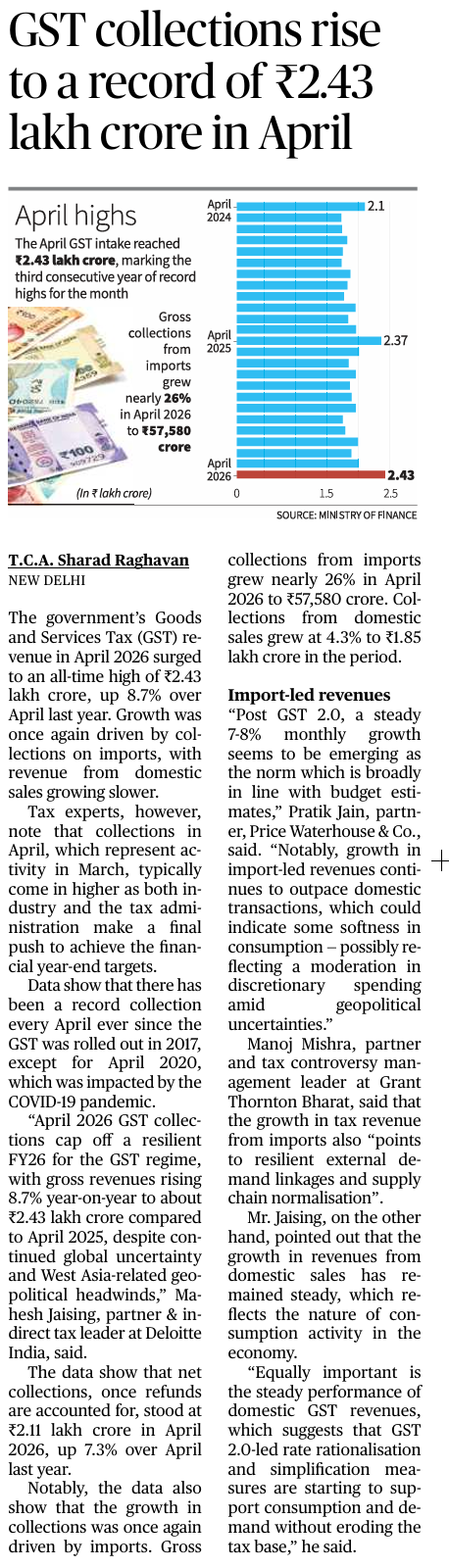
India recorded its highest-ever GST collection of ₹2.43 lakh crore in April 2026, marking sustained revenue buoyancy. The growth is largely import-driven, while domestic consumption shows moderate expansion.
Prelims concepts
Since its rollout in 2017, the Goods and Services Tax (GST) has evolved into a cornerstone of India’s fiscal architecture. In 2026, the regime has transitioned into GST 2.0, featuring a streamlined structure and enhanced digital compliance.
1. Core Structure and Types
GST is a destination-based, multi-stage indirect tax levied on every value addition. It is divided into four main types depending on the transaction's geography:
CGST (Central GST): Collected by the Central Government on intra-state sales.
SGST (State GST): Collected by State Governments on intra-state sales.
IGST (Integrated GST): Levied by the Centre on inter-state trade and imports; the revenue is shared between the Centre and the consuming State.
UTGST (Union Territory GST): Applied in Union Territories without a legislature (e.g., Lakshadweep, Andaman and Nicobar).
2. Current Tax Slabs (GST 2.0)
As of late 2025/early 2026, the tax structure has been rationalized into three primary tiers to simplify compliance and boost consumption:
0% (Exempt): Essential foods (fresh milk, paneer), 33 life-saving drugs, and educational materials (notebooks, pencils).
5% (Merit Rate): Common items like sugar, spices, edible oils, and budget footwear/apparel (up to ₹2,500).
18% (Standard Rate): Most goods and services, including electronics (ACs, fridges), small cars, and telecom services.
40% (Demerit/Sin Rate): Luxury cars, tobacco, aerated drinks, and online gaming.
3. Key Constitutional & Regulatory Bodies
GST Council (Article 279A): A joint forum of the Centre and States that serves as the supreme decision-making body for rates, exemptions, and laws.
Voting Power: The Centre holds 1/3 weightage, while States combined hold 2/3.
Decisions: Require a 3/4 majority of weighted votes.
GST Network (GSTN): The massive digital infrastructure that handles registration, return filing, and payment processing.
UPSC MCQ
Q. With reference to the recent trends in GST collections in India, consider the following statements:
The highest-ever GST collection was recorded in April 2026.
The growth in GST revenue in April 2026 was primarily driven by domestic consumption.
GST collections from imports showed significantly higher growth compared to domestic GST revenues.
Which of the statements given above is/are correct?
A. 1 and 2 only
B. 2 and 3 only
C. 1 and 3 only
D. 1, 2 and 3
Correct Answer: C. 1 and 3 only
Explanation:
Statement 1: Correct – ₹2.43 lakh crore is the record GST collection.
Statement 2: Incorrect – Growth was import-led, not domestic consumption.
Statement 3: Correct – Import GST grew ~26%, much higher than domestic (~4.3%).
Context
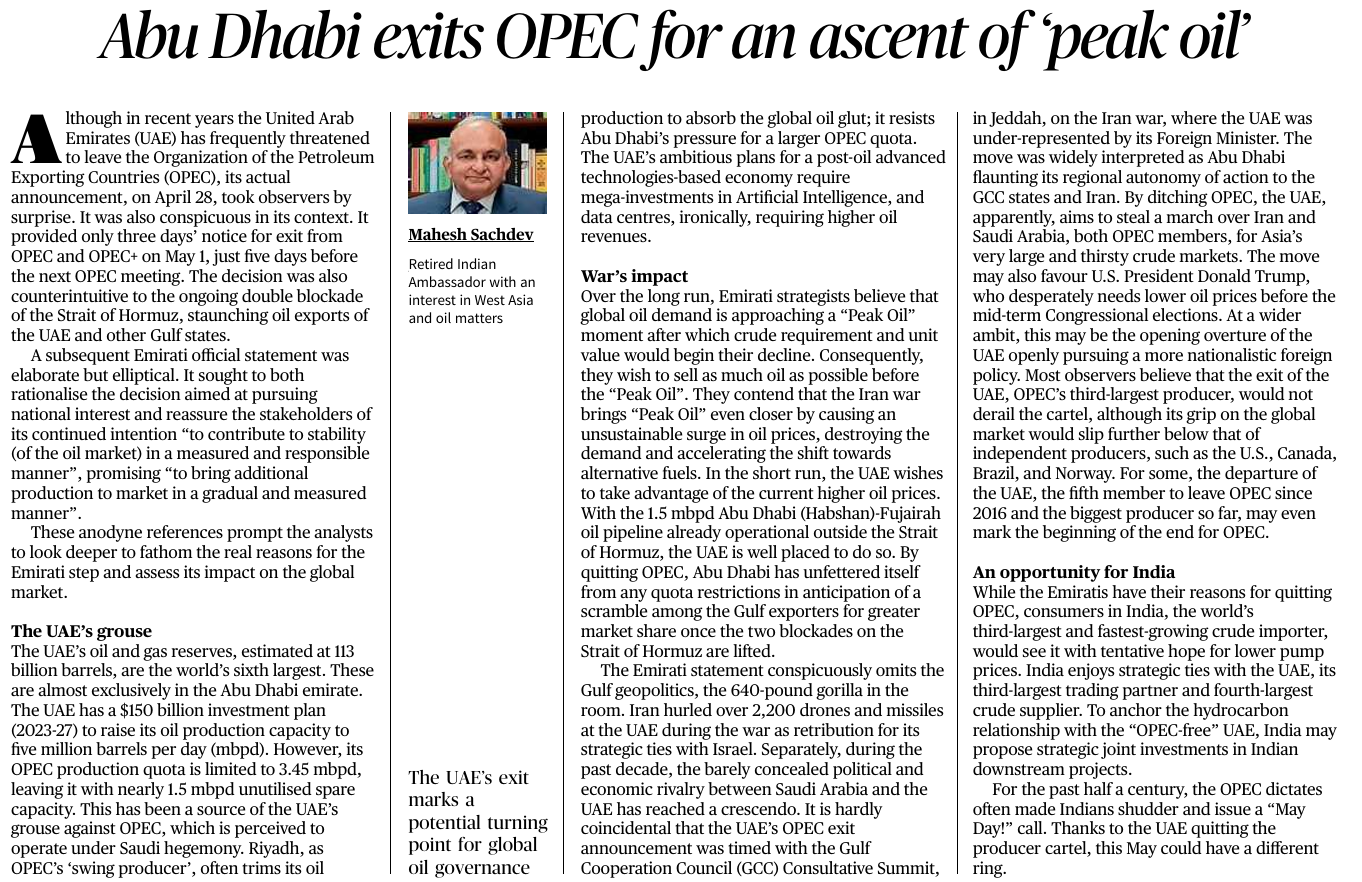
The UAE (Abu Dhabi) announced its exit from OPEC, signaling a strategic shift driven by production constraints, geopolitical calculations, and anticipation of peak oil demand.
Background: OPEC & UAE
OPEC: Cartel controlling oil supply to influence prices
UAE: One of the top oil producers, but constrained by quota limits
Abu Dhabi holds majority of UAE’s oil reserves
Detailed Analysis
1. Core Reason: Quota Constraints vs Capacity Expansion
UAE plans to increase production to ~5 million barrels/day
OPEC quota restricts output (~3.45 mbpd earlier)
Exit allows:
Unrestricted production
Maximizing revenue during high-price phases
👉 Conflict: National interest vs cartel discipline
2. ‘Peak Oil’ Strategy
UAE anticipates global oil demand nearing “Peak Oil”
Strategy:
Sell more oil before demand declines
Invest oil revenues into:
AI
Advanced technologies
Economic diversification
👉 “Produce more now before oil loses value”
3. Geopolitical Dimensions
Assertion of strategic autonomy in West Asia
Tensions:
With Saudi Arabia (OPEC leader)
Regional rivalries involving Iran
Timing linked to:
Gulf geopolitics
Strait of Hormuz tensions
👉 UAE moving toward independent foreign policy
4. Impact on Global Oil Market
Short term:
Possible increase in supply → lower prices
Long term:
OPEC influence may gradually weaken
However:
Major producers still in OPEC → no immediate collapse
5. Implications for India
India = 3rd largest oil importer
Opportunities:
Potential lower crude prices
Strengthening India–UAE energy ties
Investment in downstream projects
Strategic benefit:
Reduced vulnerability to OPEC pricing shocks
6. Risks & Concerns
Oil price volatility may increase
Weakening of coordinated supply management
Intensified competition among oil exporters
Geopolitical instability in Gulf
Significance
Marks a turning point in global oil governance
Reflects:
Shift from cartel control → market competition
Rise of nationalistic energy policies
Signals beginning of post-OPEC dominance era
Way Forward
Global Level
Diversification into renewables & clean energy
Strengthen energy market transparency
For India
Expand strategic petroleum reserves
Deepen ties with:
UAE; Other non-OPEC producers
Accelerate energy transition (solar, hydrogen)
Conclusion
The UAE’s exit from OPEC reflects a strategic recalibration in a changing energy landscape, where countries prioritize maximizing present gains before a potential decline in oil demand. While it may not immediately dismantle OPEC, it signals erosion of cartel cohesion and a shift toward competitive oil markets.
UPSC Mains question
“Recent changes in OPEC dynamics, including the UAE’s exit, have significant implications for India’s energy security.” Discuss.
 India to tap augmented solar capacity, coal to weather El Nino, summer power demand
Context
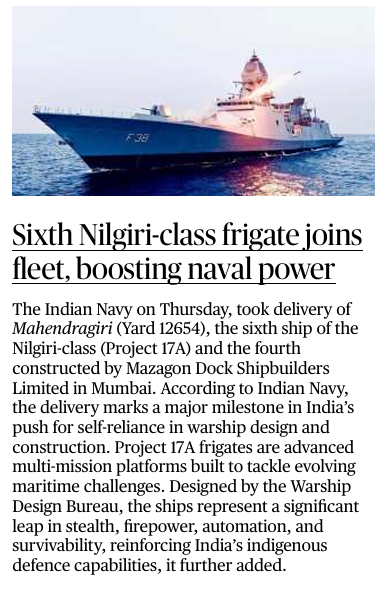
The Indian Navy inducted INS Mahendragiri, the sixth Nilgiri-class (Project 17A) stealth frigate, marking progress in indigenous warship building and strengthening maritime capabilities.
Prelims concepts
1. Defense and Security: Project 17A (Nilgiri-class)
Project 17A Overview: This is a follow-on program to the Project 17 Shivalik-class frigates for the Indian Navy.
Platform Nature: These are advanced, multi-mission stealth frigates designed to handle evolving maritime threats.
Key Technological Features:
Stealth: Improved radar cross-section (RCS) to reduce detectability.
Automation and Survivability: High degree of automation and reinforced design for better damage control.
Firepower: Equipped with advanced weapon systems for multi-role combat.
2. Indigenous Defense Ecosystem (Atmanirbhar Bharat)
Mahendragiri: The sixth ship of the Nilgiri-class (Yard 12654) recently delivered to the Indian Navy.
Design Authority: Designed by the Warship Design Bureau (WDB), which is the Indian Navy’s in-house organization for ship design.
Key Shipbuilders:
Mazagon Dock Shipbuilders Limited (MDL): Located in Mumbai; constructed four of the ships in this class, including Mahendragiri.
The project involves multiple Indian shipyards, promoting domestic manufacturing and self-reliance.
The Union Home Ministry has notified Citizenship (Amendment) Rules, 2026, introducing digital processes for OCI and citizenship applications and adding new conditions for minor applicants.
Prelims concepts
1. Statutory Framework & Authority
Notifying Authority: The Union Home Ministry is the nodal agency for notifying changes to citizenship rules.
Legislative Basis: The new changes, known as the Citizenship (Amendment) Rules, 2026, amend the existing Citizenship Rules, 2009.
Constitutional Context: While the article focuses on Rules (delegated legislation), citizenship in India is governed by Articles 5 to 11 of the Constitution and the Citizenship Act, 1955.
2. Key Changes for Minor Children
Dual Passport Restriction: A specific proviso has been added stating that a minor child cannot hold a passport from any other country while simultaneously holding an Indian passport.
Registration of Birth Abroad: Under the 2009 Rules, parents can register the birth of a minor child born outside India at the Indian consulate in that country.
Mandatory Declaration: Such applications must be accompanied by a formal declaration that the child does not hold a passport from another country.
3. Digital Transformation & OCI Services
Digital Shift: The 2026 Rules introduce a "digital shift" across various citizenship and Overseas Citizen of India (OCI) processes.
Online Initiatives: New online processes have been introduced for:
OCI Applications: Streamlined digital application procedures.
Renunciation: A digital process for the renunciation of OCI status.
 Launch your Graphy