There are no items in your cart
Add More
Add More
| Item Details | Price | ||
|---|---|---|---|

1. Iran vows to protect its nuclear programme (GS-2, GS-3)
2. On May Day, a workforce in India without a floor (GS-2, GS-3)
3. Kerala starts programme to restore sacred groves (GS-3)
4. India’s first green methanol plant to turn Kutch’s most invasive weed into marine fuel (GS-3)
5. DIPAM gives nod for NLC arm’s listing; ₹4,000 cr. IPO in FY27
(GS-3)
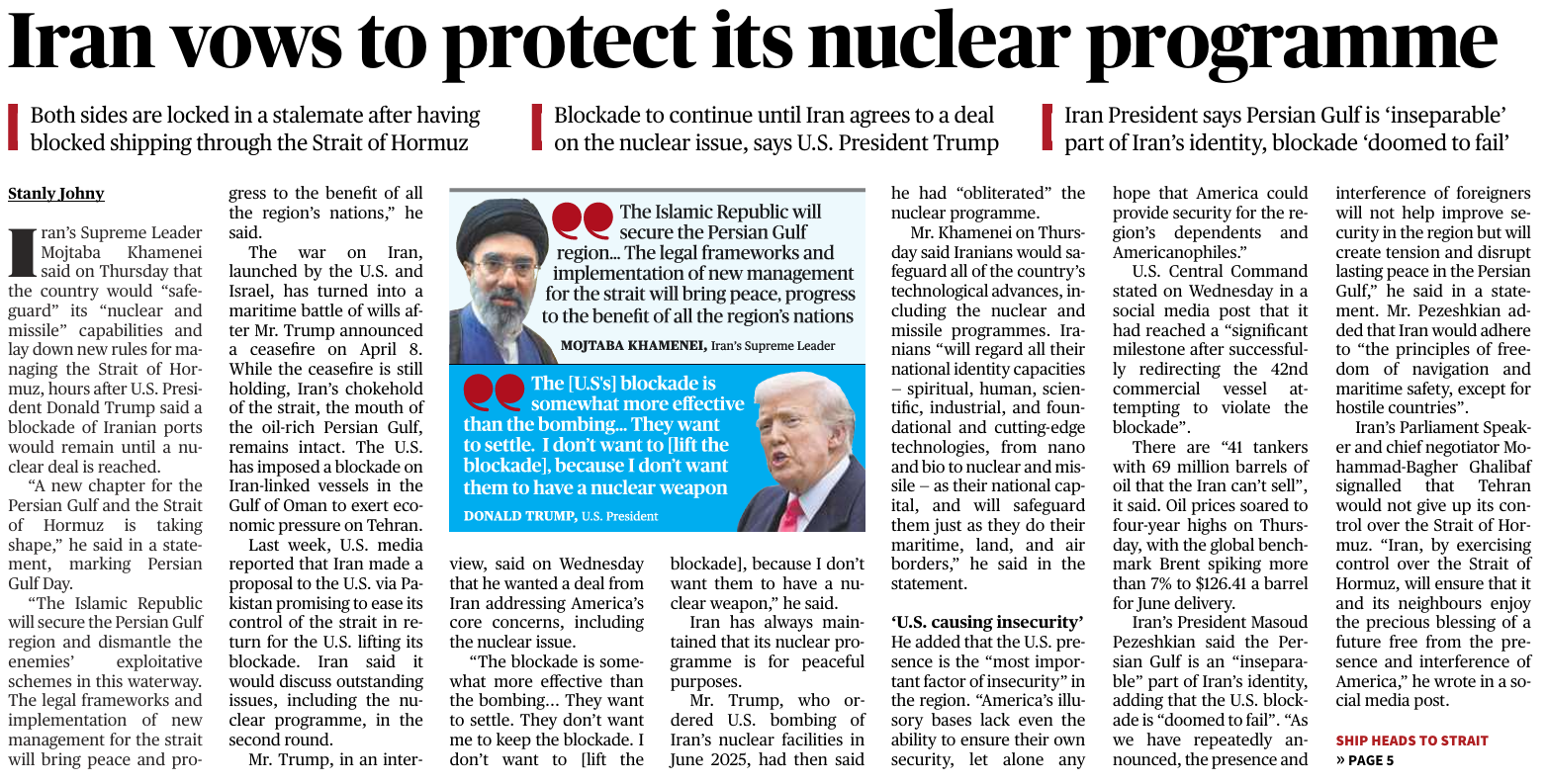 Iran vows to protect its nuclear programme
Rising tensions between Iran and the United States over Iran’s nuclear programme.
The U.S. has imposed a blockade on Iranian shipping, especially affecting the Strait of Hormuz.
Iran has responded by asserting control over the region and refusing to compromise on its nuclear capabilities.
The situation has evolved into a strategic and economic stalemate, with global energy implications.
Prelims concepts
1. International Relations & Security
Maritime Blockade: A tool of economic warfare used by the U.S. against Iranian ports to prevent the sale of oil and pressure Iran into a new nuclear deal.
Nuclear and Missile Programmes: Iran’s Supreme Leader emphasized safeguarding these as "national identity capacities" encompassing scientific, industrial, and cutting-edge technologies like nano and bio-tech.
Enrichment Levels: Before recent escalations, Iran had been enriching uranium at near-weapons-grade levels of 60%.
U.S. Central Command (CENTCOM): The military authority responsible for monitoring and reporting on the blockade and commercial vessel movements in the region.
2. Geographical Locations & Features
Strait of Hormuz: Identified as a critical "chokehold" and the "mouth of the oil-rich Persian Gulf". It is a strategic maritime waterway through which significant global oil supplies pass.
Persian Gulf: Described as central to Iran's national identity and a primary region of maritime conflict.
Gulf of Oman: Mentioned as the location where the U.S. has imposed blockades on Iran-linked vessels to exert economic pressure.
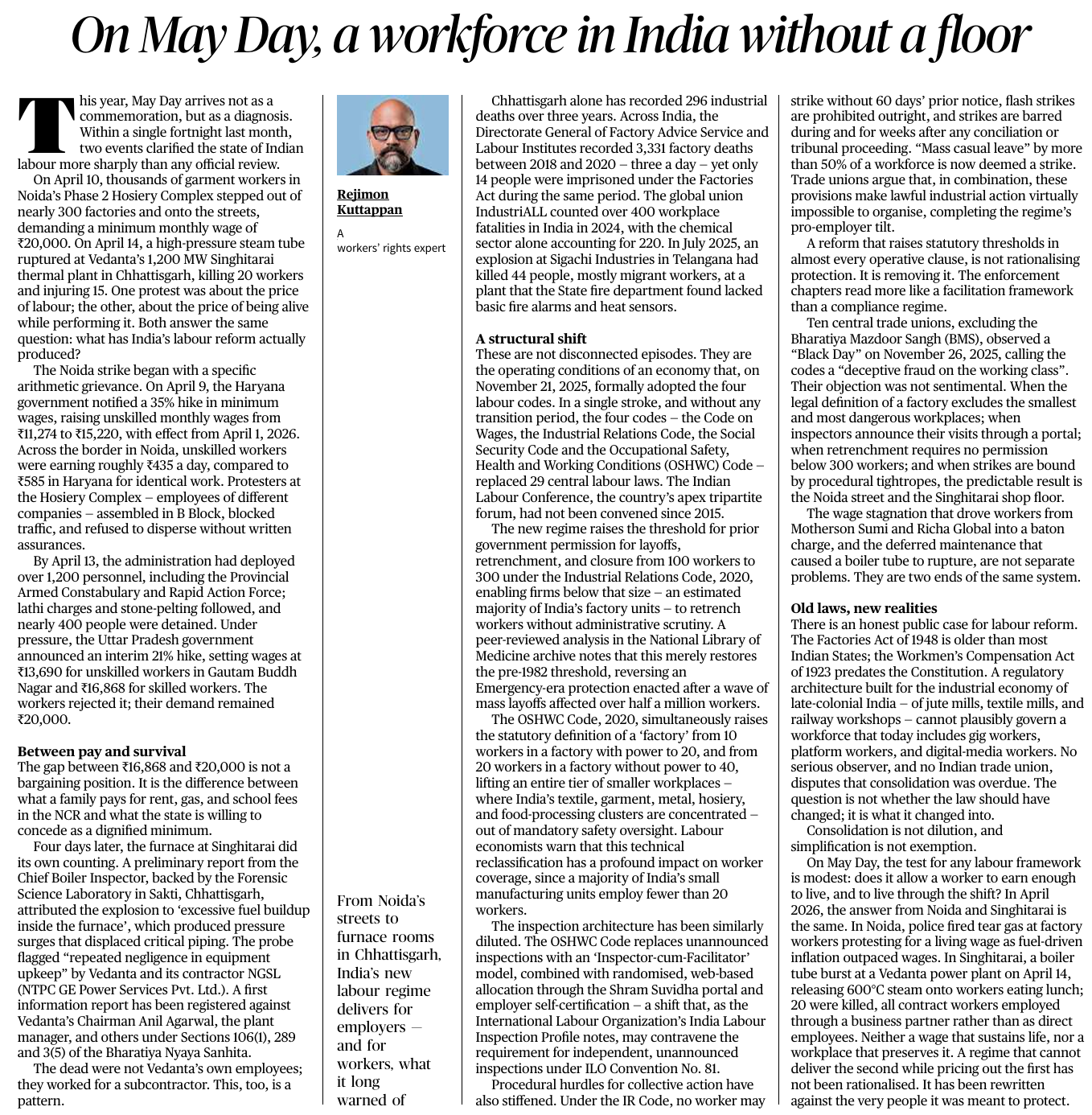
Context
The article uses recent labour incidents (Noida garment worker protests and Chhattisgarh thermal plant accident) to examine the real impact of India’s new labour codes (2020).
It argues that labour reforms have tilted the balance towards employers, weakening worker protections and safety mechanisms.
Detailed Analysis
1. Ground Reality: Labour Distress Signals
Noida protests: Workers demanded higher wages amid interstate wage disparity.
Chhattisgarh accident: Industrial disaster highlights poor safety enforcement.
These events show:
Wage stagnation
Unsafe working conditions
Weak enforcement of labour protections
2. Structural Shift in Labour Laws
India consolidated 29 labour laws into 4 Labour Codes (2020):
Code on Wages
Industrial Relations Code
Social Security Code
OSHWC Code
Key Changes
Threshold for layoffs increased 100 → 300 workers
Factory definition threshold increased → many small units excluded
Inspection system shifted to web-based, self-certification model
👉 Result: Reduced state oversight + increased employer flexibility
3. Weakening of Workers’ Collective Power
Stricter rules for strikes:
Mandatory 60-day notice
Ban on flash strikes
Restrictions during conciliation
“Mass casual leave” treated as strike → limits informal protest
👉 Makes collective bargaining difficult
4. Dilution of Safety and Compliance
Replacement of labour inspectors with “Inspector-cum-Facilitators”
Reduced surprise inspections
Smaller factories removed from strict compliance
👉 Leads to:
Increased industrial accidents
Lower accountability
5. Wage vs Survival Crisis
Gap between minimum wage and living wage remains high
Inflation (fuel, rent, schooling) outpacing wages
Contract labour system worsens insecurity
👉 Indicates absence of a “wage floor for dignified living”
6. Informalisation of Workforce
Large share of workforce:
Gig workers
Contract workers
Small factory workers
Labour codes fail to fully address:
Social security
Workplace safety
Job stability
7. “Old Laws vs New Economy” Debate
Old laws outdated for modern economy ✔️
But reforms resulted in:
Simplification = dilution
Compliance → facilitation model
👉 Core issue: Reforms changed nature, not just structure
Challenges
Weak enforcement capacity
Growing informal sector
Declining trade union power
Rising industrial accidents
Wage stagnation vs rising cost of living
Regulatory dilution in safety norms
Significance
Impacts millions of workers in manufacturing & informal sector
Direct link to:
Inclusive growth
Social justice
Human dignity at workplace
Affects India’s demographic dividend utilisation
Way Forward
1. Balance Flexibility with Protection
Ensure labour reforms are not pro-employer only
Introduce “flexicurity” model (flexibility + security)
2. Strengthen Safety Mechanisms
Restore independent inspections
Strict penalties for violations
3. Ensure Living Wage Framework
Move beyond minimum wage → living wage concept
4. Strengthen Social Security
Expand coverage for:
Gig workers
Contract workers
5. Empower Collective Bargaining
Simplify strike rules
Encourage tripartite dialogue (Govt–Employers–Workers)
6. Data-Driven Governance
Real-time labour monitoring systems
Transparency in compliance
Conclusion
The article highlights that India’s labour reforms, while aiming at ease of doing business, risk creating a “floorless workforce”—one without adequate wage security, safety, or bargaining power. Sustainable growth requires a balanced labour regime that protects workers while enabling industrial competitiveness.
UPSC Mains Question
Q. Recent labour reforms in India aim to enhance ease of doing business but have raised concerns regarding workers’ rights and safety. Critically examine the impact of the new labour codes on labour welfare and industrial relations in India. (250 words)
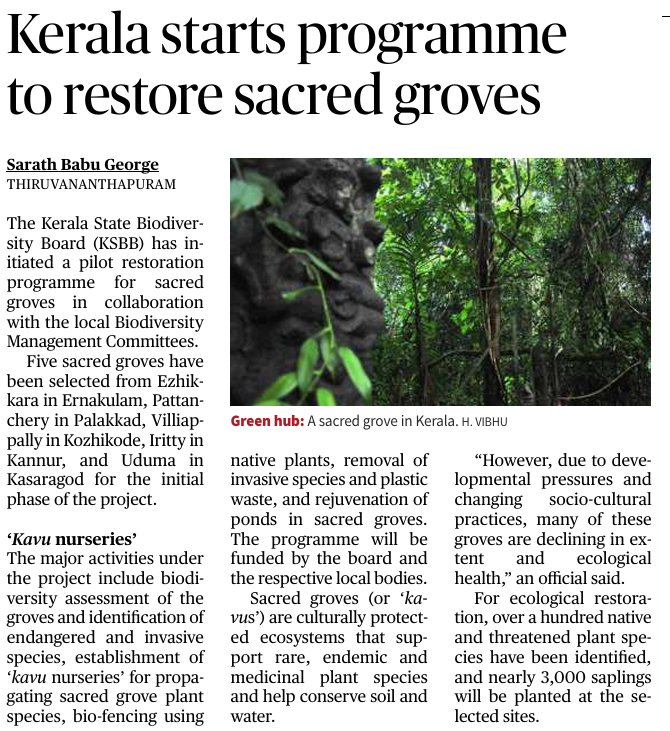
Context
The Kerala State Biodiversity Board (KSBB) has launched a pilot project to restore sacred groves (kavus) across selected districts.
The initiative involves local Biodiversity Management Committees (BMCs) and focuses on ecological restoration amid increasing degradation due to urbanisation and changing socio-cultural practices.
Prelims concepts
1. Sacred Groves
Sacred groves are patches of virgin or near-natural forests protected by local communities due to religious, cultural, and spiritual significance.
Significance: They serve as biodiversity refuges for rare, endemic, and medicinal species and provide essential ecosystem services like soil and water conservation.
Cultural Links: Often associated with deities, ancestral spirits, or water sources (e.g., Serpent idols or Naga Prathishta in Kerala).
Regional Names:
Kavu: Kerala.
Devarakadu: Karnataka.
Devrai: Maharashtra.
Sarna: Bihar.
Law Kyntang: Meghalaya.
Oran: Rajasthan.
2. Biodiversity Management Committees (BMCs)
The restoration project is a collaborative effort between the KSBB and local BMCs.
Legal Basis: Constituted by local bodies under Section 41 of the Biological Diversity Act, 2002.
Mandate: To promote conservation, sustainable use, and documentation of biological diversity.
Primary Function: Preparation of the People’s Biodiversity Register (PBR) in consultation with local residents to record biological resources and associated traditional knowledge.
3. Institutional Framework: Biological Diversity Act, 2002
The Act established a three-tier institutional structure for managing India’s biodiversity:
National Biodiversity Authority (NBA): A statutory body based in Chennai that regulates access to biological resources by foreign entities.
State Biodiversity Boards (SBBs): Boards like the KSBB that provide guidance and technical support to BMCs.
Biodiversity Management Committees (BMCs): Grassroots bodies responsible for local conservation and documentation.
4. Restoration Strategies Mentioned
Invasive Species Management: Removal of non-native species that threaten local ecosystem health.
Ex-situ and In-situ Conservation: Identification of endangered plant species and their propagation in 'kavu nurseries' for eventual replanting (nearly 3,000 saplings planned).
Bio-fencing: Utilizing native plant species to create natural barriers for protected areas.
UPSC MCQ
Q. With reference to sacred groves (kavus) in India, consider the following statements:
Sacred groves are forest patches protected by local communities due to religious and cultural beliefs, often conserving rare and endemic species.
Sacred groves are legally designated protected areas under the Wildlife (Protection) Act, 1972.
Which of the statements given above is/are correct?
(a) 1 only
(b) 2 only
(c) Both 1 and 2
(d) Neither 1 nor 2
Answer:
(a) 1 only
Explanation:
Statement 1: Correct – Sacred groves are traditionally protected ecosystems with high biodiversity value.
Statement 2: Incorrect – They are not formally classified as protected areas under the Wildlife Protection Act; protection is mostly community-driven, though they may be supported under biodiversity laws like the Biological Diversity Act, 2002.
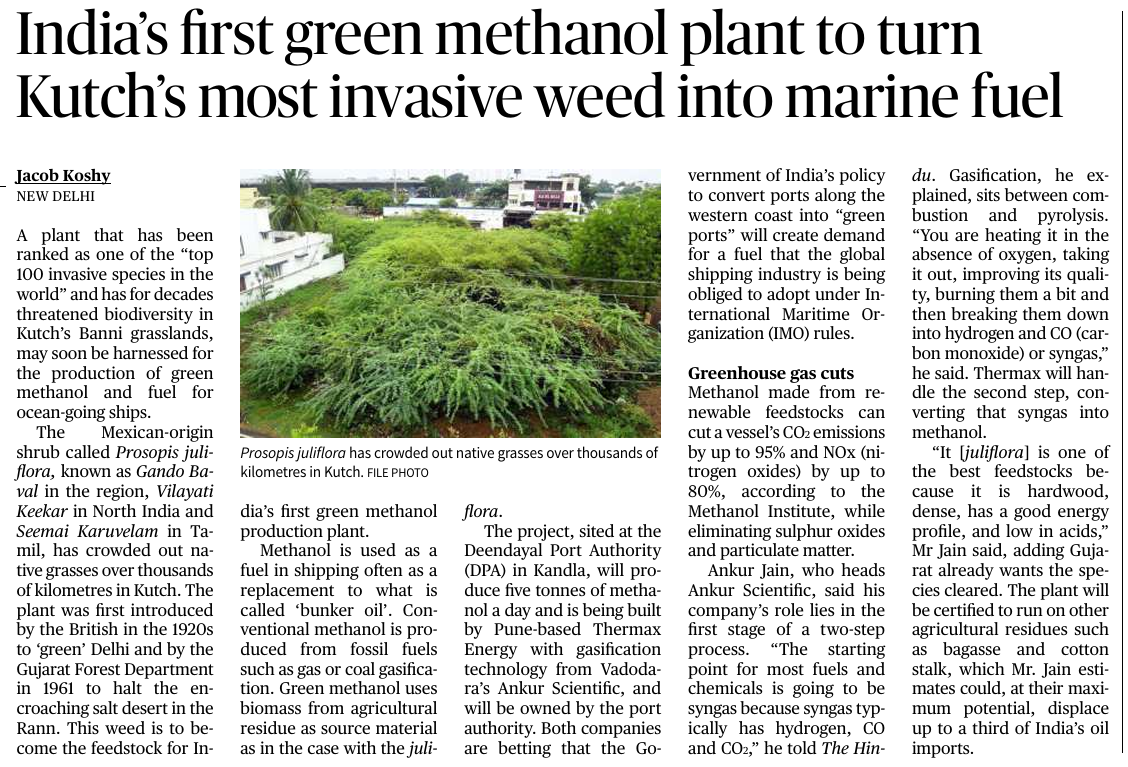 India’s first green methanol plant to turn Kutch’s most invasive weed into marine fuel
Context
India is setting up its first green methanol plant at Kandla (Deendayal Port Authority), Gujarat.
The plant will use Prosopis juliflora (invasive species) as feedstock to produce green methanol for marine fuel.
Aligns with India’s push for green ports and IMO emission norms.
Prelims concepts
Green Methanol Production
Definition: Unlike conventional methanol produced from fossil fuels (gas or coal gasification), green methanol uses biomass from agricultural residues or invasive species as source material.
The Process (Gasification):
It sits between combustion and pyrolysis.
Feedstock is heated in the absence of oxygen to break it down into syngas (a mixture of hydrogen and carbon monoxide ($CO$)).
The syngas is then chemically converted into methanol.
Emission Reductions
Methanol made from renewable feedstocks can cut a vessel's CO_2 emissions by up to 95%.
It can reduce Nitrogen Oxides (NOx) by up to 80%.
It eliminates Sulphur Oxides (SOx) and particulate matter.
India's First Green Methanol Plant
Location: Sited at the Deendayal Port Authority (DPA) in Kandla, Gujarat.
Capacity: Designed to produce five tonnes of methanol a day.
Strategic Importance: Part of the Government of India's policy to convert western coast ports into "green ports".
Prosopis juliflora (The Feedstock)
Origin and Status: A Mexican-origin shrub ranked among the "top 100 invasive species in the world".
Ecological Impact: It has crowded out native grasses over thousands of kilometres, specifically threatening the biodiversity of Kutch's Banni grasslands.
Characteristics: It is a hardwood, dense, has a good energy profile, and is low in acids, making it an ideal feedstock for fuel production.
UPSC MCQ
Q. With reference to green methanol, consider the following statements:
Green methanol is produced from renewable feedstocks such as biomass and agricultural residues.
It can be used as an alternative fuel in the shipping industry to replace conventional bunker fuel.
Green methanol production does not involve any intermediate gas formation such as synthesis gas (syngas).
Which of the statements given above is/are correct?
(a) 1 and 2 only
(b) 2 and 3 only
(c) 1 only
(d) 1, 2 and 3
Answer:
(a) 1 and 2 only
Explanation:
Statement 1: Correct – It is derived from renewable sources like biomass, waste, etc.
Statement 2: Correct – It is emerging as a clean marine fuel alternative.
Statement 3: Incorrect – Production involves gasification → syngas (CO + H₂) as an intermediate step.
Context
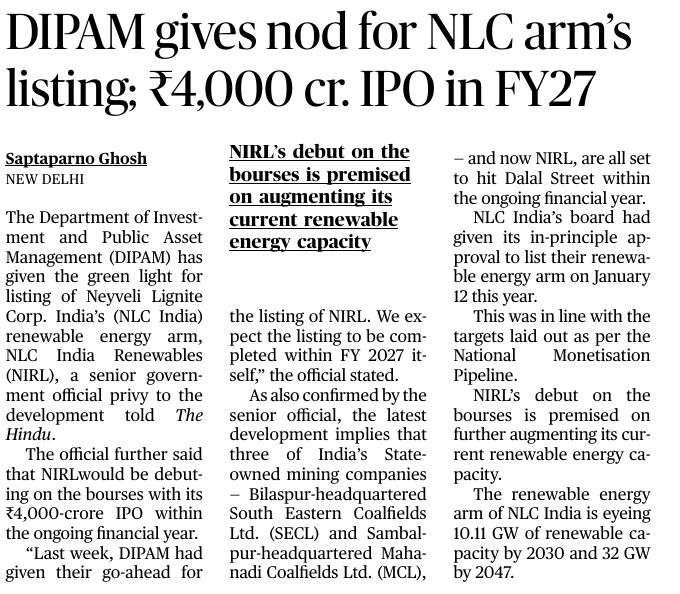
The Department of Investment and Public Asset Management (DIPAM) has approved the listing of NLC India Renewables Ltd (NIRL).
A ₹4,000 crore IPO is planned, aligned with the National Monetisation Pipeline (NMP).
Objective: raise funds to expand renewable energy capacity.
Prelims concepts
1. Department of Investment and Public Asset Management (DIPAM)
Mandate: It is the nodal department for all matters relating to the management of Central Government investments in equity, including disinvestment of equity in Central Public Sector Undertakings (CPSUs).
Ministry: It operates under the Ministry of Finance.
Role in IPOs: DIPAM oversees the listing of public sector subsidiaries on the stock exchanges (the "bourse") to raise capital and ensure public participation.
2. National Monetisation Pipeline (NMP)
Objective: Launched to unlock the value of investments in brownfield public sector assets by tapping into private sector capital and efficiencies.
Mechanism: The capital raised through NMP is typically reinvested in new infrastructure projects. The listing of NIRL is explicitly mentioned as being in line with targets laid out under this pipeline.
3. Initial Public Offering (IPO) and Listing
IPO: The process by which a private or government-owned company offers shares to the public for the first time to raise capital.
Listing: Once an IPO is completed, the company's shares are "listed" on a stock exchange (such as BSE or NSE), allowing them to be traded by the public.
Purpose for NIRL: The capital raised is intended for augmenting renewable energy capacity, with targets of 10.11 GW by 2030 and 32 GW by 2047.
UPSC MCQ
Q. With reference to the National Monetisation Pipeline (NMP), consider the following statements:
It aims to generate revenue by leasing out existing brownfield infrastructure assets.
It involves complete transfer of ownership of public sector assets to private entities.
The proceeds from monetisation are intended to be reinvested in new infrastructure creation.
Which of the statements given above is/are correct?
(a) 1 and 3 only
(b) 2 and 3 only
(c) 1 only
(d) 1, 2 and 3
Answer:
(a) 1 and 3 only
Explanation:
Statement 1: Correct – NMP focuses on leasing/monetising brownfield assets, not selling them outright.
Statement 2: Incorrect – Ownership typically remains with the government.
Statement 3: Correct – Funds are used for greenfield infrastructure development.
 Launch your Graphy