The Hindu Analysis March 31

The Hindu News Analysis – 31st March, 2026
1. Ensuring federalism within delimitation (GS-2)
2. The continued pursuit of the perfect election (GS-2)
3. Manufacturing, capital goods lift IIP growth to 5.2% in Feb. (GS-3)
4. Earliest Census data set to be available in 2027; India has fewer villages than during Census 2011 (GS-2, GS-1)
5. Rupee doing fine, FM tells LS as currency crosses 95 a dollar (GS-3)
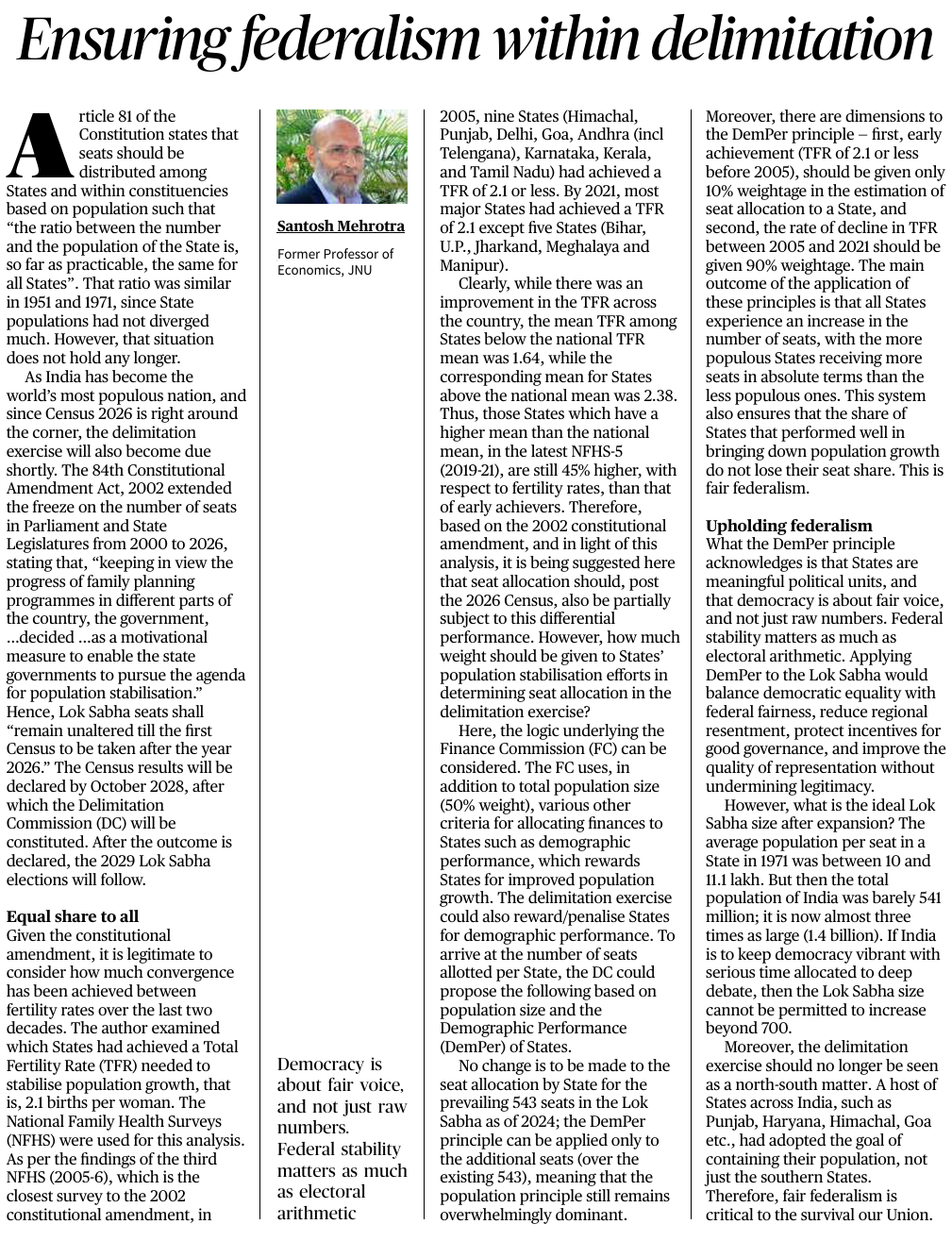
Ensuring federalism within delimitation
GS Paper II:
Parliament and State Legislatures – Structure, Functioning
Issues and challenges pertaining to Federal Structure
Representation of People Act & electoral reforms
Context
Delimitation exercise is due after the 2026 Census (results by ~2028).
Current freeze (via 84th Constitutional Amendment, 2002) kept seat distribution unchanged to incentivize population control.
Rising concern: North–South divide due to differential population growth and fertility decline.
Detailed Analysis
1. Constitutional Basis & Changing Demography
Article 81: Seats allocated based on population with equal representation principle.
Earlier (1951–1971): Population distribution relatively uniform → fair representation.
Present:
Significant divergence in Total Fertility Rate (TFR) across states.
Southern & western states → achieved replacement level (2.1) earlier.
Northern states → lagged behind, leading to higher population growth.
Implication: Pure population-based delimitation may penalize states that controlled population.
2. The Core Problem: Representation vs Incentives
If seats are redistributed purely by population:
High population states gain more seats.
States successful in population control lose relative political weight.
This creates:
Federal imbalance
Disincentive for population stabilization
Potential regional resentment (North vs South narrative)
3. Demographic Performance (DemPer) Principle
The article proposes a balanced formula:
Components:
Early achievement of replacement fertility (TFR ≤ 2.1 before 2005)
→ Weight: 10%
Rate of decline in fertility (2005–2021)
→ Weight: 90%
Outcome:
All states gain seats (due to population growth overall).
More populous states still gain more seats in absolute terms.
But states that performed well in population control retain fair share.
Insight:
Blends democratic equality (population) with federal fairness (performance).
4. Learning from Finance Commission
Finance Commission uses:
Population (50%)
Performance criteria (like demographic efforts)
Suggestion:
Apply similar incentive-based federalism in delimitation.
Reward states for responsible governance outcomes.
5. Upholding Federalism
The DemPer approach ensures:
Balance between:
Democratic principle (one person, one vote)
Federal principle (fair state representation)
Prevents:
Regional alienation
Political marginalisation of better-performing states
Strengthens:
Cooperative federalism
Legitimacy of representation
6. Issue of Lok Sabha Size
1971 average population per MP: ~10–11 lakh
Today: ~25 lakh+ per MP
Concern:
Representation quality declines with large constituencies.
Suggestion:
Increase Lok Sabha seats but cap around ~700 to maintain:
Debate quality
Legislative efficiency
7. Beyond North–South Divide
Population control is not just a “southern phenomenon”:
States like Punjab, Himachal, Goa also succeeded.
Significance
Ensures fair representation without penalising good governance
Protects federal balance
Maintains unity of India
Encourages population stabilisation policies
Challenges
Political consensus on formula (DemPer adoption)
Constitutional and legal changes may be required
Resistance from high-population states
Balancing mathematical fairness vs political practicality
Way Forward
Adopt hybrid formula (Population + Demographic Performance)
Increase Lok Sabha size moderately
Build political consensus through Inter-State Council
Ensure transparency in delimitation process
Avoid framing debate as North vs South conflict
Conclusion
Delimitation is not just a technical exercise—it is a test of India’s federal spirit. A balanced approach like DemPer can reconcile democratic equality with federal fairness, ensuring that states are neither penalized for progress nor rewarded for demographic inertia. This is essential for preserving both representation quality and national unity.
UPSC Mains question:
Q. “Delimitation is not merely a technical exercise but a political process with deep federal implications.” Discuss. (250 words)
Source: The Hindu
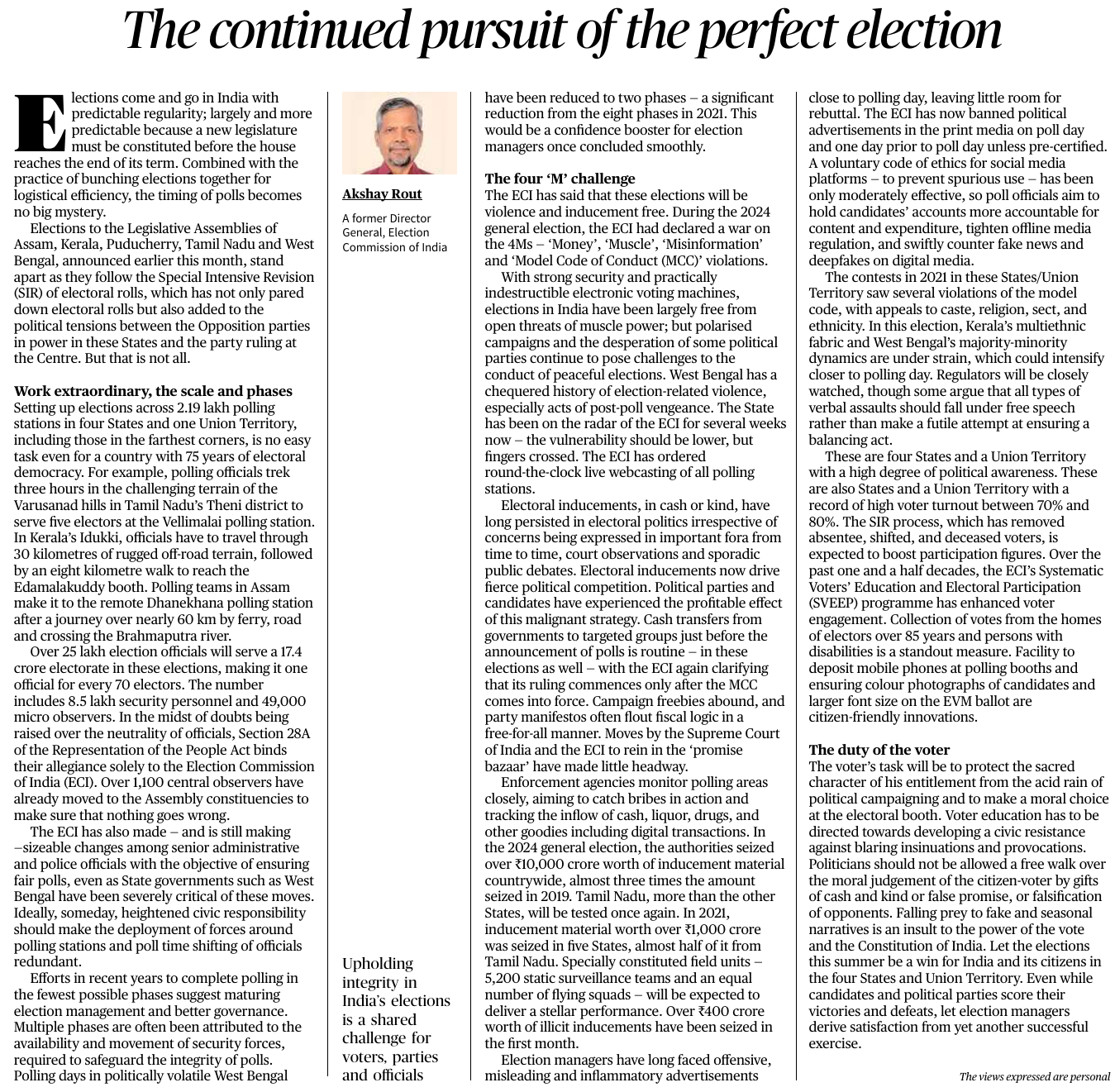
The continued pursuit of the perfect election
GS Paper II:
Election Commission of India – powers, functions, challenges
Electoral reforms
Representation of People Act
Context
Ongoing Assembly elections across multiple States highlight:
The scale, complexity, and maturity of Indian elections
Persistent issues affecting free and fair elections
The article evaluates ECI’s efforts vs emerging challenges in achieving “perfect elections.”
Detailed Analysis
1. Strength of India’s Electoral System
India conducts elections at an unparalleled scale:
~2.19 lakh polling stations
Remote accessibility (hills, forests, islands)
Strong institutional mechanisms:
EVMs ensuring credibility
Deployment of observers, security forces
Legal backing under Representation of People Act
Inference:
India has achieved procedural robustness in elections.
2. Reduction in Traditional Malpractices
Decline in:
Booth capturing
Direct violence (due to EVMs, security deployment)
Better monitoring:
Live webcasting of polling stations
Surveillance teams
However:
These gains are being offset by new-age challenges.
3. The Shift to the “4M” Challenge
The nature of electoral threats has evolved:
a) Money Power
Massive seizures (₹10,000+ crore in 2024)
Institutionalisation of inducements:
Cash transfers
Freebies
Distorts level playing field
b) Muscle Power
Reduced but persists in certain regions
Post-poll violence remains a concern
c) Misinformation
Digital platforms amplify:
Fake news
Deepfakes
Hate campaigns
Regulation lagging behind technology
d) MCC Violations
Appeals to caste, religion, language
Polarisation-based campaigns
Core Insight:
Elections are shifting from physical manipulation → psychological & financial manipulation.
4. Electoral Inducements & Fiscal Concerns
Competitive populism:
Freebies in manifestos
Targeted welfare before elections
Weak enforcement:
MCC applies only after poll announcement
Implication:
Undermines fiscal discipline
Converts elections into a “market of promises”
5. Digital Media & Regulatory Dilemma
Social media:
Hard to regulate due to free speech concerns
Existing measures:
Ban on print ads before polling
Voluntary code for platforms (ineffective)
Challenge:
Balancing:
Freedom of expression
Electoral integrity
6. Ethical Dimension: Role of Voters
Voters face:
Cash inducements
Emotional manipulation
Fake narratives
Ethical responsibility:
Reject bribery
Vote based on informed judgment
Key Idea:
Electoral integrity is not just institutional, but societal.
Significance
Highlights evolution of electoral challenges in India
Reinforces need for second-generation electoral reforms
Emphasises shared responsibility:
ECI + Political parties + Citizens
Challenges
Weak legal backing for regulating digital platforms
Increasing influence of money in politics
Political resistance to reforms (freebies, funding transparency)
Balancing rights vs regulation
Persistent regional sensitivities and polarisation
Way Forward
Legal reforms:
Regulate political advertising (especially digital)
Bring transparency in political funding
Institutional strengthening:
Empower ECI with greater enforcement powers
Real-time monitoring mechanisms
Curb inducements:
Debate on state funding of elections
Regulate freebies through fiscal responsibility norms
Combat misinformation:
AI-based detection systems
Platform accountability
Ethical reforms:
Strengthen voter awareness (SVEEP)
Promote civic responsibility
Conclusion
India has mastered the mechanics of elections, but the challenge now lies in preserving their spirit. The transition from visible malpractices to subtle manipulation through money, media, and misinformation demands adaptive reforms. Achieving the “perfect election” is not a destination but a continuous process, requiring vigilance from institutions and integrity from citizens alike.
UPSC Mains question:
Q. Examine the emerging challenges to free and fair elections in India and suggest measures to address them. (250 words)
Source: The Hindu
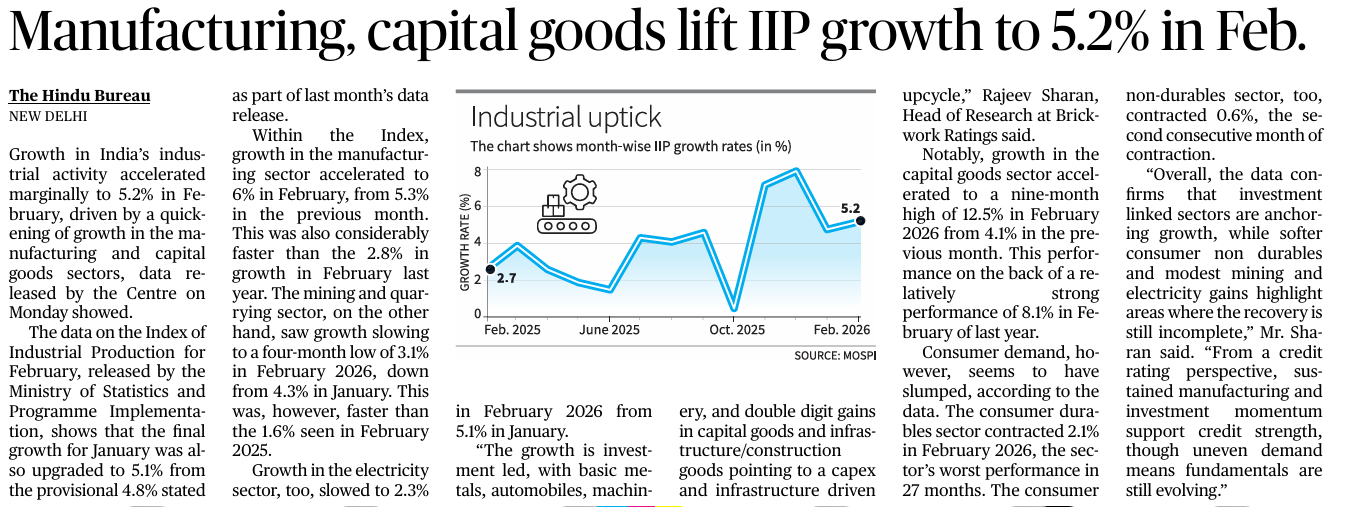
Manufacturing, capital goods lift IIP growth to 5.2% in Feb.
GS Paper III:
Indian Economy – Growth and development
Industrial growth (IIP)
Infrastructure and investment models
Context
India’s Index of Industrial Production (IIP) growth rose to 5.2% in February 2026.
Growth driven mainly by:
Manufacturing sector
Capital goods sector
Signals emerging investment-led recovery, but concerns persist about weak consumption demand.
Prelims concepts
1. Index of Industrial Production (IIP)
What it is: The IIP is an indicator that measures the changes in the volume of production of industrial products during a given period. It maps the growth of various sectors in the economy.
Publishing Agency: Compiled and published monthly by the National Statistical Office (NSO), which falls under the Ministry of Statistics and Programme Implementation (MoSPI).
Base Year: The current base year for the IIP is 2011-12.
Sectoral Classification (and weightage):
Manufacturing (highest weightage at ~77.6%)
Mining (~14.3%)
Electricity (~7.9%)
Use-Based Classification: Goods are also categorized by how they are used: Primary Goods, Capital Goods, Intermediate Goods, Infrastructure/Construction Goods, Consumer Durables, and Consumer Non-durables.
2. Index of Eight Core Industries (ICI) - Associated Concept
Relevance to IIP: While not explicitly detailed in the article, it is highly relevant for prelims. The Eight Core Industries comprise about 40.27% of the total weight of items included in the IIP.
The Eight Core Sectors (in decreasing order of weightage): Refinery Products, Electricity, Steel, Coal, Crude Oil, Natural Gas, Cement, and Fertilizers.
3. Types of Goods Mentioned
Capital Goods: Tangible assets such as machinery, equipment, vehicles, and tools that an organization uses to produce other goods or services. Growth here (as highlighted in the article) indicates rising investment and business expansion.
Consumer Durables: Products that do not wear out quickly and yield utility over a long period rather than being consumed in one use (e.g., refrigerators, cars, washing machines).
Consumer Non-Durables (FMCG): Goods that are consumed quickly or have a short lifespan (e.g., packaged food, cosmetics, beverages).
4. Key Economic Trends to Note (from the data)
K-Shaped/Uneven Recovery Indicator: The article notes that while investment-linked sectors (like capital goods and manufacturing) are seeing high growth, consumer sectors (durables and non-durables) are contracting or slumping. This indicates that while businesses and infrastructure are expanding, everyday consumer demand at the household level remains weak.
UPSC MCQ:
Q. Consider the following statements regarding the Index of Industrial Production (IIP):
The IIP measures the performance of the industrial sector including manufacturing, mining, and electricity.
Capital goods are considered an indicator of investment activity in the economy.
A sustained decline in consumer durables necessarily indicates a slowdown in investment demand.
Which of the statements given above is/are correct?
A) 1 and 2 only
B) 2 and 3 only
C) 1 and 3 only
D) 1, 2 and 3
Correct Answer:
A) 1 and 2 only
Explanation
Statement 1: Correct – IIP tracks industrial output across manufacturing, mining, electricity.
Statement 2: Correct – Capital goods reflect investment/capex activity.
Statement 3: Incorrect – Consumer durables indicate consumption demand, not investment.
Earliest Census data set to be available in 2027; India has fewer villages than during Census 2011
GS Paper II:
Governance – Census and data collection
Welfare schemes & targeting (use of census data)
GS Paper I:
Population and associated issues
Urbanisation
Context
Census 2027 will be India’s first digital Census with self-enumeration option.
Data release expected in 2027.
Key trend: Decline in number of villages and rise in urban settlements compared to Census 2011.
Prelims concepts:
1. Office of the Registrar General and Census Commissioner
Role: The authority responsible for conducting the decennial Census.
Ministry: It operates under the Ministry of Home Affairs (MHA), Government of India.
Significance: It oversees both the census operations and the implementation of the Registration of Births and Deaths Act.
2. The Census Act, 1948 & Data Confidentiality
Statutory Backing: The Indian Census is conducted under the provisions of the Census Act, 1948.
Strict Confidentiality: The data collected is entirely confidential. According to the article, individual data cannot be shared with State governments or even the judiciary.
RTI Exemption: Census data does not come under the purview of the Right to Information (RTI) Act.
No Individual Benefits: The data is released only in aggregate form and cannot be used to provide reservation or targeted welfare benefits to any specific individual.
3. Key "Firsts" of the Upcoming Census
Digital Census: This will be the first time the census is conducted digitally (officials will use mobile apps/tablets).
Self-Enumeration: For the first time, respondents living in India will have the option to fill in their data themselves via an online portal (available in 16 languages).
Caste Enumeration: The article highlights that it will be the first census to explicitly enumerate caste (methodology for this is currently being finalized).
4. Phases of the Census
The Census is typically conducted in two distinct phases:
Phase 1: House Listing Operations (HLO). This involves identifying and listing all houses and structures, and gathering data on amenities available to households. (Scheduled for April 1 - September 30).
Phase 2: Population Enumeration. This is the actual headcount where individual demographic data (religion, caste, occupation, migration status, etc.) is collected. (Scheduled for February 2027).
5. Administrative Classifications: Statutory vs. Census Towns
The article notes an increase in both Statutory and Census towns, and a decrease in villages. Understanding the distinction is a classic UPSC geography/economy concept:
Statutory Towns: Urban areas defined by administrative notification. They have a local body like a Municipal Corporation, Municipality, Cantonment Board, or Notified Town Area Committee.
Census Towns: Areas that are technically classified as rural by the administration (they have a Gram Panchayat) but are classified as "urban" by the Census because they exhibit urban characteristics. They must meet all three of the following criteria:
A minimum population of 5,000.
At least 75% of the male main working population engaged in non-agricultural pursuits.
A population density of at least 400 persons per square kilometer.
UPSC MCQ:
Q. Consider the following statements regarding the upcoming Census in India:
The upcoming Census will be India’s first fully digital Census with a provision for self-enumeration.
Census data can be accessed under the Right to Information (RTI) Act for individual-level details.
The Census is conducted under the provisions of the Census Act, 1948.
The Census data can be used as legal evidence in courts.
Which of the statements given above is/are correct?
A) 1 and 3 only
B) 1, 2 and 3 only
C) 2 and 4 only
D) 1, 3 and 4 only
Correct Answer:
A) 1 and 3 only
Explanation
Statement 1: Correct – Census 2027 will be digital with self-enumeration.
Statement 2: Incorrect – Individual data is confidential and not under RTI.
Statement 3: Correct – Governed by Census Act, 1948.
Statement 4: Incorrect – Census data cannot be used as legal evidence.
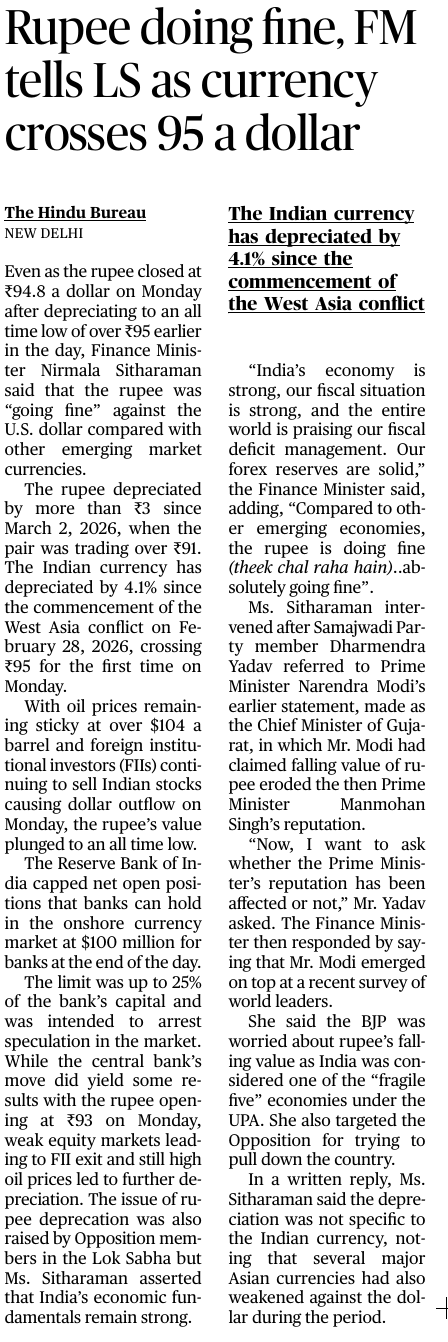
Rupee doing fine, FM tells LS as currency crosses 95 a dollar
GS Paper III:
Indian Economy – External sector
Exchange rate management
Balance of Payments (BoP)
Role of RBI
Context
Indian Rupee depreciated to ₹95 per dollar (all-time low) amid:
West Asia conflict
Rising crude oil prices (~$104/barrel)
FII outflows
Finance Minister maintains that economic fundamentals remain strong.
Extent of Depreciation
Rupee fell:
From ~₹91 (March 2026) → ~₹95
Overall depreciation:
~4.1% since West Asia conflict began
Implication:
Reflects external shocks rather than domestic weakness alone.
Prelims concepts
1. Currency Depreciation vs. Devaluation
Depreciation: A decrease in the value of a domestic currency relative to foreign currencies in a floating exchange rate system (like India's). It is driven entirely by market forces—specifically, the supply and demand for the currency in the foreign exchange market.
Devaluation: A deliberate downward adjustment of a currency's value by the government or central bank, which occurs in a fixed exchange rate system.
Impact: Depreciation generally makes imports more expensive (leading to "imported inflation") but can make a country's exports cheaper and more competitive in the global market.
2. Key Drivers of Rupee Depreciation
Rising Crude Oil Prices:
India imports most of its oil → higher global prices increase dollar demand → rupee weakens.
FII/FPI Outflows:
Foreign investors withdraw funds → sell rupees and buy dollars → rupee depreciates.
3. RBI's Intervention: Net Open Position (NOP)
What it is: The article mentions the RBI capping the Net Open Position for banks at USD 100 million (or 25% of the bank's capital). A Net Open Position is essentially the difference between a bank's assets and liabilities in a foreign currency.
Why cap it: Banks sometimes engage in proprietary trading, betting on currency movements. By capping the NOP, the central bank restricts banks from hoarding foreign exchange or taking massive speculative positions that assume the Rupee will keep falling. This helps curb artificial volatility and panic in the onshore currency market.
4. The "Fragile Five" Economies
Origin: A term coined by a financial analyst at Morgan Stanley in 2013 to describe emerging market economies that were highly vulnerable to global financial shocks and capital outflows.
The Countries: The original five were India, Brazil, Indonesia, South Africa, and Turkey.
Why they were "fragile": At that time, these nations shared common macroeconomic vulnerabilities: high inflation, slowing growth, large current account deficits, and a heavy reliance on short-term foreign investment to finance those deficits.
UPSC MCQ:
Q. Consider the following statements:
A rise in crude oil prices can lead to depreciation of the Indian Rupee.
Foreign Institutional Investor (FII) outflows can put downward pressure on the domestic currency.
Depreciation of the rupee always worsens India’s export competitiveness.
The Reserve Bank of India can intervene in the forex market to reduce excessive volatility in the exchange rate.
Which of the statements given above is/are correct?
A) 1, 2 and 4 only
B) 1 and 3 only
C) 2, 3 and 4 only
D) 1, 2, 3 and 4
Correct Answer:
A) 1, 2 and 4 only
Explanation
Statement 1: Correct – Higher oil imports increase dollar demand → rupee weakens.
Statement 2: Correct – FII outflows lead to capital outflow → depreciation pressure.
Statement 3: Incorrect – Depreciation generally improves export competitiveness.
Statement 4: Correct – RBI intervenes to stabilise forex markets




 Launch your Graphy