The Hindu Analysis March 27th & 28th




The Hindu News Analysis – 27th March, 2026
1. The key to India’s multi-domain deterrence, capabilities
(GS-2, GS-3)
2. Beyond the rhetoric of the north-south divide (GS-2)
3. Jaishankar, French counterpart discuss Iran, Hormuz at G7 meet (GGS-2)
4. S-400 deliveries expedited as India enhances air defence
(GS-3)
5. FPIs sell a record ₹1.1 lakh crore in Indian equities as markets stay fragile (GS-3)
6. Five killed as avalanche strikes Zojila Pass on Srinagar-Leh national highway (GS-3)
7. Petrol, diesel excise duty cut; prices won’t drop (GS-3)
8. Amid war, India sends out invites for BRICS meetings (GS-2)
 The key to India’s multi-domain deterrence, capabilities
GS Paper III:
• Defence Technology
• Internal Security – Challenges to India’s security
• Indigenisation of technology
GS Paper II:
• India and its neighbourhood (China)
• Governance & policy decision-making in national security
Context
India faces a widening capability gap with China, especially in advanced military technologies and industrial capacity. The article discusses how India should restructure its defence-industrial ecosystem and adopt a multi-domain deterrence strategy to effectively counter China.
Detailed Analysis
1. Nature of the Challenge
China’s military modernisation poses a systemic and long-term threat.
India must make urgent policy choices regarding:
What to buy vs what to build
Allocation of limited resources
Technology is evolving faster than doctrine → decision-making complexity increases
👉 Core issue:
India’s defence-industrial base is weak in scale, speed, and integration, not necessarily in technological competence.
2. Strategic Options Before India
(A) Bold/Disruptive Approach
Invest in next-generation warfare technologies
Attempt to leapfrog China
Risks:
Implementation failures → capability gaps widen
Weak industrial base → inability to scale production
(B) Conservative Approach
Integrate emerging tech into existing systems
Strengthen cyber, space, and electronic warfare
Limitations:
Incremental improvements
May not significantly shift the balance of power with China
(C) Middle Path (Preferred)
Combine legacy systems + enabling layers
Build multi-domain operational capability
Key enabling layers:
C2 (Command & Control)
ISR (Intelligence, Surveillance, Reconnaissance)
Deep-strike capabilities
Logistics & infrastructure
👉 This approach enhances deterrence without overdependence on disruptive tech
3. Structural Problems in India’s Defence Ecosystem
(i) Weak Defence-Industrial Base
Not structured for rapid production at scale
Delays in:
Missiles
Drones
Ammunition
(ii) Procurement Inefficiencies
Overly bureaucratic processes
Lack of long-term contracts & budget stability
(iii) Limited Private Sector Role
Defence production dominated by public sector
Private players underutilised
(iv) Doctrinal–Technological Gap
Lack of alignment between:
Military doctrine
Industrial output
Technological innovation
4. Importance of Multi-Domain Deterrence
Multi-domain operations integrate:
Land, air, sea
Cyber, space, electronic warfare
Why it matters:
No single capability can decisively win wars
Integrated systems increase operational resilience
Enhances ability to degrade enemy systems
5. Role of Enabling Layers (Critical Insight)
(i) C4ISR Dominance
C4ISR = Command, Control, Communications, Computers, Intelligence, Surveillance, Reconnaissance
Determines:
Situational awareness
Decision-making superiority
👉 “The side that can see can continue to fight”
(ii) ISR + Cyber + Space Integration
Cheap ISR platforms (e.g., drones) → scalable advantage
Cyber & electronic warfare → disrupt adversary networks
(iii) Integrated Strike Capability
Coordination of:
Missiles
Aircraft
Drones
→ Enables deep-strike operations
(iv) Logistics as a War-Winner
Sustained warfare depends on:
Supply chains
Infrastructure
Rear-area support
(v) Nuclear Deterrence
Remains a critical balancing factor against China
Compensates for gaps in conventional capability
6. Policy Priorities Suggested
Priority 1: Identify Vulnerabilities
Especially in C4ISR systems
Focus on areas where China has an advantage
Priority 2: Strengthen Defence Manufacturing
Incentivise production through:
One-time budgetary push
Large-scale inventory creation
👉 War readiness requires mass production capability
Priority 3: Promote Private Sector Participation
Shift mindset:
Private sector can deliver efficiency + innovation
Priority 4: Reform Procurement System
Reduce red tape
Focus on speed, adaptability, and scale
Priority 5: Doctrinal Convergence
Align:
Military strategy
Industrial policy
Technological development
7. Key Insight / Core Argument
India should focus less on:
Service-specific acquisitions
And more on:
System-wide enabling layers
Integrated multi-domain deterrence architecture
Way Forward
Develop a robust defence-industrial ecosystem with private sector participation
Prioritise C4ISR and enabling technologies
Ensure policy coherence between defence, industry, and technology sectors
Invest in scalable production capacity
Move toward theatre commands + doctrinal integration
Conclusion
India’s deterrence against China will not depend on any single advanced weapon system, but on its ability to build a coherent, integrated, and scalable multi-domain military capability supported by a strong defence-industrial base.
UPSC Mains question:
Q. Discuss the challenges in building a robust defence-industrial base in India. How can it support the goal of multi-domain deterrence against China? (250 word)
 Beyond the rhetoric of the north-south divide
GS Paper II:
Federalism – challenges & issues
Representation in Parliament (delimitation)
Centre–State relations
GS Paper I:
Regional disparities in India
GS Paper III:
Inclusive growth
Inequality and development
Context
The article discusses the growing socio-economic and political divide between North and South India, especially in light of the upcoming delimitation exercise and Census. It argues that this divide is no longer rhetorical but structural, posing risks to national unity.
Detailed Analysis
1. Structural North–South Divide
India is increasingly split into two development trajectories:
Southern States (Peninsular India):
Higher per capita income
Better human development indicators
Northern Heartland (Hindi belt):
Lower income levels
High population growth
Lagging social indicators
👉 This creates a mismatch between economic contribution and political power.
2. Political Economy Imbalance
In most federations:
Economic power and political representation are aligned.
In India:
Population-heavy but poorer states dominate political power
Wealth-generating states have less proportional representation
⚠️ Risk:
Productive minority subsidising a politically dominant but poorer majority
Can lead to conflict and instability (historical parallels: USSR, Yugoslavia)
3. Delimitation as a Flashpoint
Post-Census delimitation may:
Increase seats for northern states (due to higher population)
Reduce proportional voice of southern states
Suggested Solution:
Degressive proportionality:
Larger states → more seats but fewer per capita
Smaller states → fewer seats but better per capita representation
✔️ Balances:
Population principle
Federal equality
National unity
4. Crisis within the South
The article avoids a simplistic “North vs South” narrative and highlights internal issues in the South:
Middle-income trap
Persistent inequality despite higher income
Growth is:
Uneven
Extractive (benefits elite sections more)
Examples:
Wage stagnation despite income growth
Urban concentration of wealth
Social issues: caste, patriarchy
👉 Conclusion:
South’s model is not fully inclusive or sustainable.
5. Failure of Natural Convergence
Three expected balancing mechanisms are failing:
Mechanism
Why it is failing
Economic convergence
Huge income gaps persist
Migration
Creates “internal outsiders,” not integration
Southern growth pulling others
Limited due to institutional weaknesses
6. Weak Institutions & Governance Issues
Southern states also face:
Weak rule of law in some areas
Environmental violations
Governance gaps
👉 This reduces their ability to:
Sustain growth
Lead national convergence
7. Need for a New Social Contract
The article emphasizes:
Move beyond regional rhetoric
Focus on:
Inclusive growth
Human development
Social cohesion
✔️ Real progress indicators:
Agricultural wages
Literacy in poorest districts
Reduction in inequality
Significance
Highlights a silent fault line in Indian federalism
Links:
Economic geography
Political representation
Warns against:
Majoritarian political dominance
Regional alienation
Challenges
Balancing population vs equity in representation
Managing regional aspirations
Addressing intra-state inequality
Preventing political polarization along regional lines
Way Forward
1. Reform Delimitation Mechanism
Adopt degressive proportionality
Ensure fair voice without dominance
2. Promote Inclusive Growth
Focus on:
Rural wages
Social justice
Human capital
3. Strengthen Federal Dialogue
Institutional platforms for:
Centre–State negotiation
Fiscal federalism reforms
4. Address Governance Deficits
Improve:
Rule of law
Environmental compliance
Institutional capacity
5. Build Social Cohesion
Reduce:
Regionalism
Identity-based politics
Promote national integration through equity
Conclusion
The North–South divide is no longer a political narrative but a structural challenge rooted in economic and demographic asymmetry. Without a balanced representation system and inclusive development model, this divide could deepen into a serious threat to India’s unity. The solution lies not in confrontation but in cooperative federalism and a new social contract focused on shared prosperity.
UPSC Mains Question:
Q. India is witnessing the evolution of ‘two nations within one sovereign space’ in terms of development. Discuss the causes and implications of regional disparities between northern and southern States.
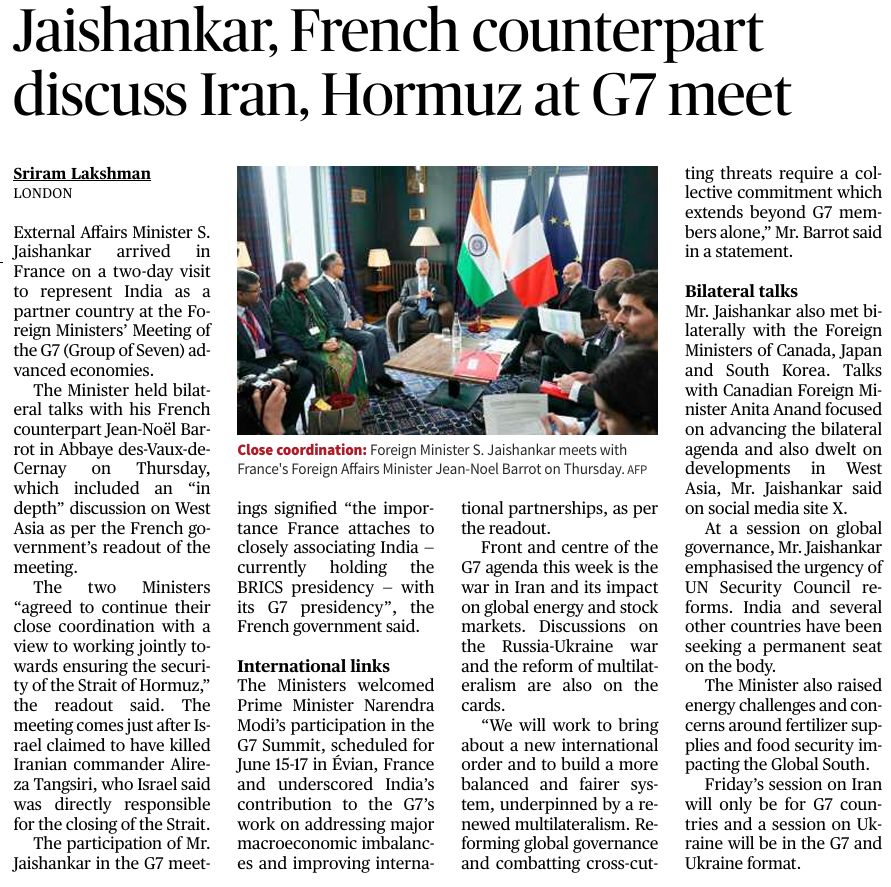 Jaishankar, French counterpart discuss Iran, Hormuz at G7 meet
GS Paper II:
• India and its neighbourhood & international relations
• Bilateral, regional and global groupings (G7, BRICS)
• Effect of policies of developed countries on India’s interests
• Important International institutions, agencies and fora
Context
India’s External Affairs Minister engaged in bilateral and multilateral diplomacy at the G7 Foreign Ministers’ Meeting, focusing on:
Rising tensions in West Asia (Iran–Israel context)
Security of the Strait of Hormuz
Reform of global governance institutions
Prelims Concepts
1. G7 (Group of Seven)
Informal grouping of advanced economies
Members: USA, UK, France, Germany, Italy, Canada, Japan
No permanent secretariat or treaty base
Focus: global economy, security, climate issues
👉 Exam Trap:
India is not a member, but is invited as a partner country
2. Strait of Hormuz
Narrow sea passage between Iran and Oman
Connects:
Persian Gulf → Gulf of Oman → Arabian Sea
👉 Key Facts:
~20% of global oil trade passes through it
One of the world’s most critical oil chokepoints
3. Chokepoint (Geography Concept)
Narrow maritime route critical for global trade
Vulnerable to disruption → affects global supply chains
Examples:
Strait of Hormuz
Strait of Malacca
Suez Canal
4. Multilateralism
Cooperation among multiple countries on global issues
👉 Examples:
UN, G7, BRICS
👉 Current trend:
Push for reformed multilateralism (more inclusive representation)
UPSC Prelims MCQ
Q. Consider the following statements:
The Strait of Hormuz connects the Persian Gulf with the Red Sea.
G7 is a treaty-based organisation with a permanent secretariat.
India is not a member of the G7 but participates as a partner country.
How many of the above statements are correct?
(a) Only one
(b) Only two
(c) All three
(d) None
Answer: (a) Only one
Explanation
Statement 1
Strait of Hormuz connects Persian Gulf → Gulf of Oman, not Red Sea
Statement 2
G7 is informal, no treaty, no secretariat
Statement 3
India is not a member, but attends as a partner country
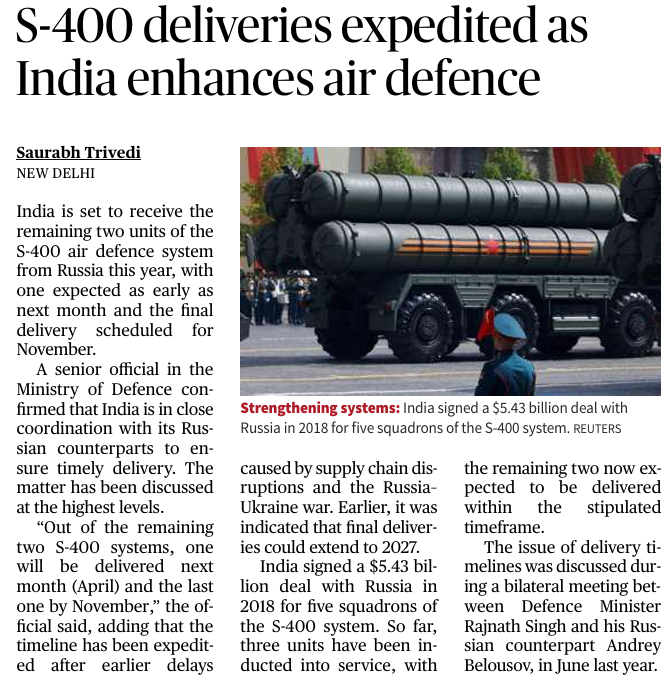
S-400 deliveries expedited as India enhances air defence
GS Paper III:
• Defence Technology
• Internal Security – Defence preparedness
• Indigenisation of defence production
Context
India is set to receive the remaining S-400 air defence systems from Russia, with delivery timelines expedited despite earlier delays due to the Russia-Ukraine war and supply chain disruptions.
1. What is the S-400 System?
A long-range surface-to-air missile (SAM) system developed by Russia
Designed to detect, track, and destroy:
Aircraft
Drones
Ballistic and cruise missiles
👉 India signed a $5.43 billion deal (2018) for 5 squadrons
2. Key Features
Range: up to 400 km
Can track multiple targets simultaneously
Equipped with advanced radar systems
Multi-layered defence capability
3. Current Status
3 squadrons already operational
Remaining 2 to be delivered (April & November timeline)
Delays earlier due to:
Russia-Ukraine conflict
Global supply chain issues
4. Strategic Significance for India
(i) Strengthening Air Defence
Enhances India’s ability to counter:
Enemy aircraft
Missile threats
(ii) Deterrence Against China & Pakistan
Covers sensitive regions:
Northern borders (China)
Western front (Pakistan)
(iii) Multi-layered Defence Shield
Works alongside systems like:
Akash missile system
Fighter aircraft
(iv) Strategic Autonomy
Despite Western pressure (e.g., CAATSA), India continued the deal
Reflects independent foreign policy
CAATSA
Countering America’s Adversaries Through Sanctions Act (USA)
Imposes sanctions on countries buying defence equipment from Russia
UPSC Prelims MCQ
Q. Consider the following statements regarding the S-400 system:
It is a surface-to-air missile system capable of intercepting ballistic missiles.
It is developed indigenously by India under DRDO.
It can track multiple targets simultaneously.
How many of the above statements are correct?
(a) Only one
(b) Only two
(c) All three
(d) None
Answer: (b) Only two
Explanation
Statement 1 – S-400 can intercept aircraft + ballistic missiles
Statement 2 – It is Russian, not developed by India
Statement 3 – Can track multiple targets simultaneously
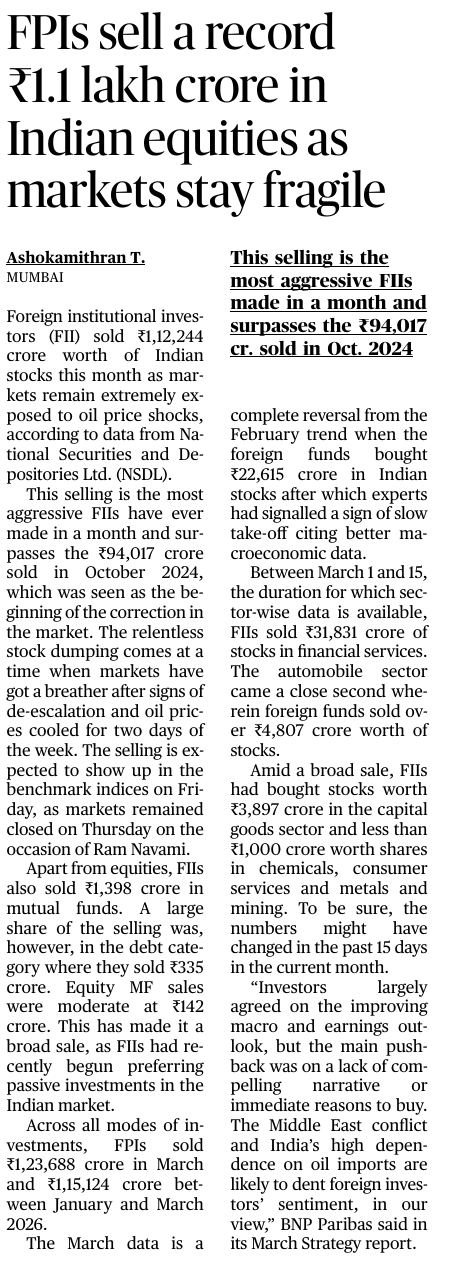
FPIs sell a record ₹1.1 lakh crore in Indian equities as markets stay fragile
GS Paper III:
• Indian Economy – Capital markets
• Investment models (FPI, FDI)
• External sector & economic stability
Context
Foreign Portfolio Investors (FPIs) have made a record sell-off of ₹1.1 lakh crore in Indian equities due to global uncertainties, oil price shocks, and weak market sentiment.
Reasons for FPI Sell-off
(i) Oil Price Uncertainty
India is a major oil importer
Rising prices → inflation + fiscal pressure
(ii) Global Geopolitical Tensions
Middle East conflict → market instability
Risk-off sentiment among investors
(iii) Lack of Strong Growth Triggers
No immediate positive macroeconomic signals
Weak investor confidence
(iv) Shift in Investment Strategy
FPIs preferring passive investments
Reduced active participation
Impact on Indian Economy
(i) Stock Market Volatility
Sharp fall in indices
Increased market fragility
(ii) Currency Pressure
Capital outflows → pressure on rupee depreciation
(iii) Sectoral Impact
Financial sector most affected
Broad-based correction
Differences between FDI vs FPI
Both are ways foreign capital enters a country, but their intent, nature, and impact on the economy are quite different.
The Core Difference
FDI is like starting a new business or buying a significant stake in an existing one in another country. It is an active, long-term commitment.
FPI is simply buying financial assets (like stocks or bonds) in another country's financial markets to get a quick return. It is a passive, short-term investment.
Detailed Comparison
Parameter
Foreign Direct Investment (FDI)
Foreign Portfolio Investment (FPI)
Meaning
Investment made by a foreign entity to acquire a lasting interest and control in an enterprise.
Investment in financial assets (shares, bonds, mutual funds) of a foreign country.
Role of Investor
Active. The investor often participates in the management and operations of the company.
Passive. The investor only cares about the financial return (dividends/capital gains).
Degree of Control
High. The investor gains significant voting rights and management control.
Low or None. The investor does not gain control over the company's management.
Investment Horizon
Long-term. It takes time to set up factories, hire people, and generate returns.
Short-term. Investors can easily sell their shares and exit if the market fluctuates.
Liquidity
Low. It is difficult and time-consuming to sell physical assets or entire businesses.
High. Financial assets can be bought and sold quickly on the stock exchange.
What it Brings
Capital, technology transfer, management expertise, and job creation.
Only capital. It does not bring technology or management skills.
Volatility
Stable. FDI is sticky and does not leave the country quickly during minor economic shocks.
Highly Volatile. Often called "Hot Money" because it can be withdrawn instantly at the first sign of economic trouble.
Target
Invests in physical assets, infrastructure, or a specific company.
Invests in the financial markets (equities, bonds).
The 10% Rule (Arvind Mayaram Committee)
To make it easier to classify investments, India broadly follows the recommendation of the Arvind Mayaram Committee:
If a foreign investor holds 10% or more of the post-issue paid-up equity capital on a fully diluted basis in a listed Indian company, it is treated as FDI.
If the stake is less than 10%, it is classified as FPI.
UPSC Prelims MCQ
Q. Consider the following statements:
Foreign Portfolio Investment involves long-term control over companies.
FPI flows are generally more volatile than FDI.
Large FPI outflows can lead to depreciation of the domestic currency.
How many of the above statements are correct?
(a) Only one
(b) Only two
(c) All three
(d) None
Answer: (b) Only two
Explanation
(1) That is FDI, not FPI
(2) FPI is volatile
(3) Outflows → rupee depreciation
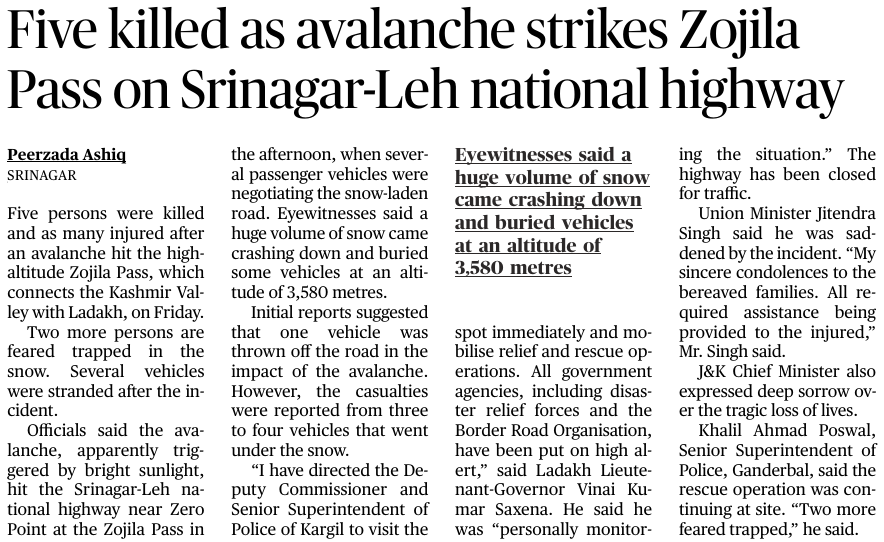 Five killed as avalanche strikes Zojila Pass on Srinagar-Leh national highway
GS Paper III:
Disaster and disaster management
Infrastructure challenges in hilly areas
Context
An avalanche at Zojila Pass (3,580 m altitude) on the Srinagar–Leh highway resulted in fatalities and injuries, disrupting connectivity between Kashmir Valley and Ladakh. The incident highlights the vulnerability of high-altitude infrastructure to natural hazards.
Key Concepts for Prelims
1. Avalanche
A rapid flow of snow, ice, and debris down a mountain slope
Triggered by:
Heavy snowfall
Sudden temperature rise
Vibrations (natural or human-induced)
Common in Himalayan high-altitude regions
Types of Avalanches
Loose Snow Avalanche – starts from a point, spreads outward
Slab Avalanche – large block of snow breaks and slides (more dangerous)
Avalanche Trigger Factors
Natural:
Fresh snowfall
Sunlight warming snow
Wind deposition
Human-induced:
Movement of vehicles
Construction activities
2. Zojila Pass
Located in Union Territory of Ladakh
Connects:
Srinagar (Kashmir Valley) with Leh (Ladakh)
Situated on National Highway-1 (NH-1)
Altitude: ~3,500+ metres
3. Border Roads Organisation (BRO)
A Government of India organization
Under Ministry of Defence
Responsible for:
Construction & maintenance of roads in border areas
Prelims MCQ
Consider the following statements regarding avalanches:
Avalanches occur only due to heavy snowfall.
Sudden warming due to sunlight can trigger avalanches.
Slab avalanches are generally more dangerous than loose snow avalanches.
Which of the statements given above are correct?
(a) 1 and 2 only
(b) 2 and 3 only
(c) 1 and 3 only
(d) 1, 2 and 3
Answer: (b) 2 and 3 only
Explanation
Statement 1 : Wrong → Avalanches are not only due to snowfall (also sunlight, vibrations).
Statement 2 : Correct → Sunlight weakens snow layers → triggers avalanche.
Statement 3 : Correct → Slab avalanches = more dangerous.
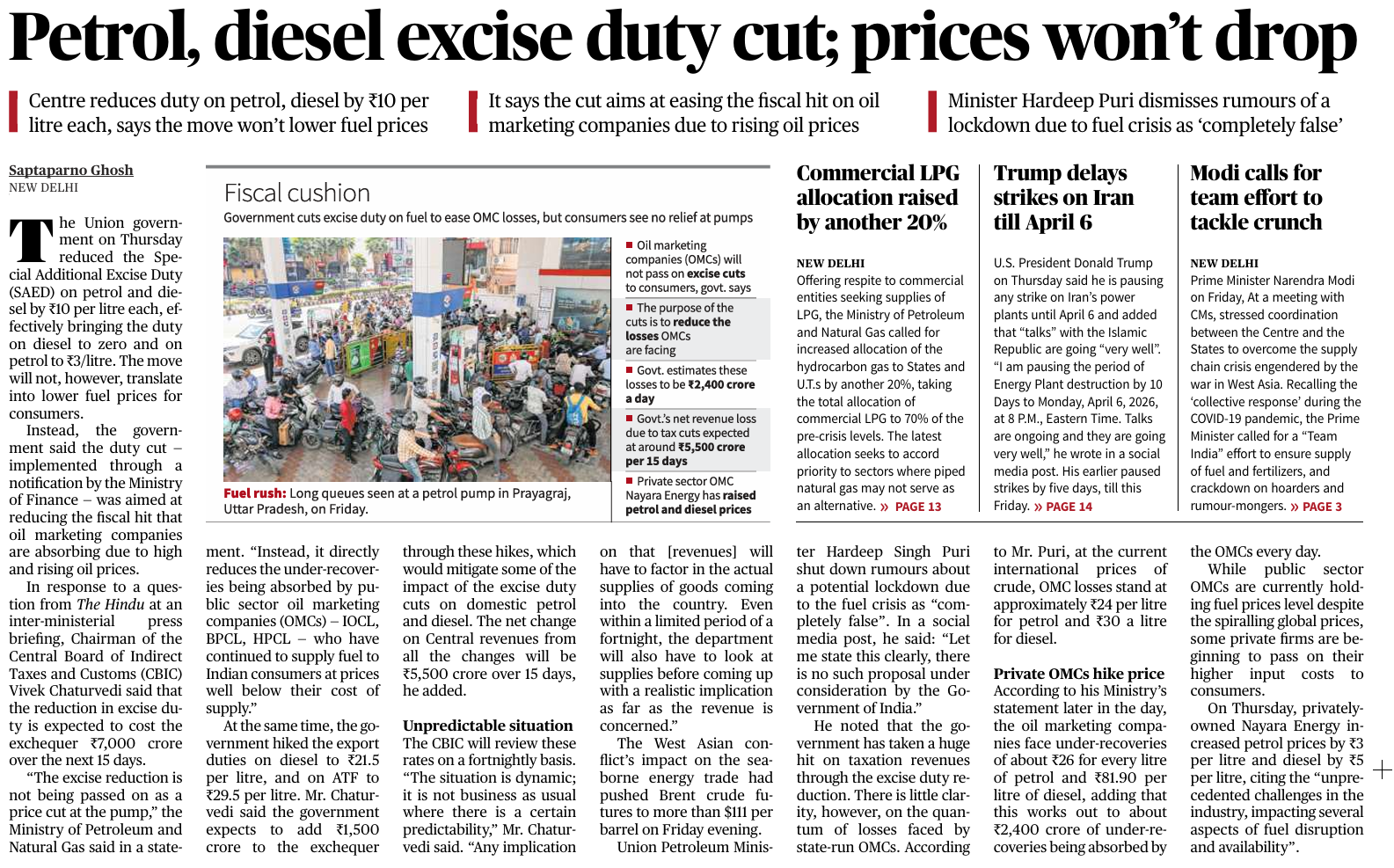 Petrol, diesel excise duty cut; prices won’t drop
GS Paper III:
Indian Economy – Fiscal policy
Energy sector
Inflation & fuel pricing
Context
The Union Government reduced excise duty on petrol and diesel by ₹10/litre, but clarified that retail fuel prices may not decrease as the benefit is aimed at easing the financial stress of Oil Marketing Companies (OMCs).
Why excise duty was cut
Rising global crude oil prices increased costs for OMCs
OMCs were:
Selling fuel below cost
Facing under-recoveries (losses)
👉 Duty cut aims to reduce fiscal pressure on OMCs, not consumers.
Why prices won’t fall for consumers
OMCs will absorb the benefit to offset losses
Hence:
No immediate reduction in pump prices
Private companies may even increase prices
Prelims Concepts
1. Excise Duty
Indirect tax levied by the Union Government on manufacture of goods (including petrol & diesel)
Major component of fuel price in India
2. Fuel Price Components
Base price (refinery)
Freight + dealer commission
Excise duty (Centre)
VAT (State Governments)
3. Under-recovery
When:
Selling price < cost price
Leads to:
Losses for Oil Marketing Companies (OMCs)
4. Oil Marketing Companies (OMCs)
Major public OMCs:
IOCL, BPCL, HPCL
Responsible for:
Fuel distribution
Retail pricing (in deregulated regime)
5. Fuel Price Deregulation
Petrol: Deregulated (2010)
Diesel: Deregulated (2014)
👉 Prices ideally linked to global crude oil prices
6. Windfall Tax
Definition: Tax on abnormally high profits earned due to external factors
Windfall: Unexpected profit (not due to business effort)
Causes: War, price surge, shortages, policy changes
Sectors: Oil, gas, mining
Purpose: Capture excess gains & raise govt revenue
UPSC MCQ:
Q. Consider the following statements regarding Windfall Tax:
It is imposed on profits arising due to unexpected external factors.
It is a permanent tax applied every year.
It is commonly imposed on sectors like oil and gas.
Which of the statements given above are correct?
(a) 1 and 3 only
(b) 2 and 3 only
(c) 1 and 2 only
(d) 1, 2 and 3
👉 Answer: (a) 1 and 3 only
Explanation
Statement 1: Correct → Windfall tax is imposed on unexpected profits due to external factors.
Statement 2: Incorrect → It is not permanent, only temporary/situation-based.
Statement 3: Correct → Commonly applied to oil, gas, and mining sectors.
Amid war, India sends out invites for BRICS meetings
GS Paper II:
International relations
Multilateral groupings (BRICS)
India’s foreign policy
Context
India, as the 2026 Chair of BRICS, has invited member countries for the Foreign Ministers’ Meeting (May) and BRICS Summit (September). This comes amid the West Asia conflict, where achieving a joint position within BRICS has become difficult.
1. India’s Diplomatic Role as BRICS Chair
India is attempting to:
Maintain group cohesion
Facilitate dialogue on global conflicts
Hosting:
Foreign Ministers’ Meeting
Leaders’ Summit
👉 Shows India’s role as a bridge-builder in global diplomacy
2. Challenge of Consensus in BRICS
BRICS follows consensus-based decision-making
Current issue:
Divergent positions among members
Example:
Iran directly involved in conflict
UAE and others have differing geopolitical interests
👉 Result: Difficulty in issuing a joint statement
BRICS
BRICS – Members
Original: Brazil, Russia, India, China, South Africa
Expanded (BRICS+): Includes Iran, UAE, Egypt, Ethiopia, Indonesia
Nature of BRICS
Informal grouping (not treaty-based)
No permanent secretariat
Chairmanship
Rotates annually among members
Host country conducts Summit
Decision-Making
Based on consensus (no voting)
Key Institutions
New Development Bank (NDB) → development financing
Contingent Reserve Arrangement (CRA) → financial stability
BRICS Summit
Annual meeting of:
Heads of State/Government
Importance
Represents Global South
Focus on:
Economic cooperation
Reform of global institutions
UPSC MCQ
Q. With reference to BRICS, consider the following statements:
BRICS has a permanent secretariat similar to the United Nations.
Decisions in BRICS are taken by consensus.
The New Development Bank is associated with BRICS.
Which of the statements given above are correct?
(a) 2 and 3 only
(b) 1 and 2 only
(c) 1 and 3 only
(d) 1, 2 and 3
Answer: (a) 2 and 3 only
Explanation
1 : No permanent secretariat
2 : Decisions by consensus
3 : NDB belongs to BRICS

 Launch your Graphy