The Hindu Analysis March 24th & 25th
The Hindu News Analysis – 24th & 25th March, 2026
1. A decade of building India’s TB Champion movement
(GS-2, GS-3)
2. Lok Sabha sends Corporate Law Amendment Bill 2026 to JPC (GS-3, GS-2)
3. Why transport must sit at the centre of India’s air quality strategy (GS-3)
4. Centre mulls delimitation based on 2011 Census to implement women’s quota (GS-2)
 A decade of building India’s TB Champion movement
GS Paper II:
Health – Issues relating to development and management of social sector (Health)
Government policies and interventions (NTEP)
GS Paper III:
Human resource & social development
Role of civil society in development
Context:
The article highlights the evolution of India’s TB Champion movement over the last decade, where TB survivors are actively engaged in awareness, treatment support, and stigma reduction as part of India’s TB elimination efforts under the National TB Elimination Programme (NTEP).
Detailed Analysis
1. Background: TB Burden & Social Challenges
India diagnoses over 25 lakh TB cases annually, making it one of the highest burden countries.
TB is not just a medical issue but a social disease:
Deep-rooted stigma and discrimination
Social exclusion affecting:
Women
Children
Transgender communities
Elderly and poor
Patients often face loneliness, delayed diagnosis, and treatment discontinuation.
👉 Thus, purely biomedical approaches were insufficient.
2. Shift from Biomedical to Community-Centric Approach
Earlier TB response focused only on:
Diagnosis
Clinical treatment
Criticism: Ignored lived experiences of patients.
Transformation (post-2016):
Recognition of TB survivors as:
Community leaders
Peer supporters
Emergence of the TB Champion model:
Survivors trained to:
Spread awareness
Support patients emotionally
Advocate for care
3. Role of National TB Elimination Programme (NTEP)
Provides:
Free diagnosis & treatment
Improved case detection
Better treatment outcomes
Recent innovations:
AI-enabled screening
Active case finding
Shorter, less toxic treatment regimens
Nutritional support
Differentiated care models
👉 However, community participation remains essential, which TB Champions fulfill.
4. TB Champions: Bridging System & Society
TB Champions are TB survivors turned advocates.
Key Contributions:
Last-mile connectivity:
Reach underserved communities
Awareness generation:
Symptoms, treatment availability
Myth-busting:
TB is curable and treatable
Peer counselling:
Emotional and psychological support
Improved treatment adherence
👉 Their lived experience makes them credible communicators.
5. Social Impact: Fighting Stigma
TB Champions:
Share personal stories
Normalize conversations around TB
Result:
Increased health-seeking behaviour
Reduced self-stigmatization
Greater community trust
👉 Seen as a powerful anti-stigma strategy.
6. Survivor-to-Champion Model
Formal training under NTEP:
“Survivor to Champion” curriculum
Focus areas:
Counselling skills
Treatment literacy
Community engagement
👉 Converts patients into agents of change.
7. Building Networks & Collective Strength
TB Champions now form:
Survivor-led networks
State-level collectives
Benefits:
Stronger advocacy
Mutual support systems
Platform for voicing concerns
8. Challenges in the Movement
Sustainability issues:
Dependence on external funding
Lack of institutional integration
Need for scaling up across all regions
Socio-economic vulnerabilities of survivors:
Even after cure, many face economic hardships
9. Significance of the Movement
Enhances effectiveness of public health programmes
Bridges trust deficit between system & citizens
Promotes:
Participatory governance in health
Community ownership
Supports India’s goal of TB elimination by 2025
10. Way Forward
Policy & Institutional Measures
Integrate TB Champions formally into public health workforce
Provide financial incentives & livelihood support
Strengthening Networks
Promote self-sustaining survivor collectives
Link with SHGs, NGOs, Panchayats
Holistic Support
Combine:
Medical care
Nutritional support
Mental health services
Awareness & Behavioural Change
Scale up community campaigns led by survivors
Conclusion
The TB Champion movement reflects a paradigm shift from a top-down biomedical model to a participatory, community-driven approach. By transforming survivors into leaders, India is not only addressing the clinical aspects of TB but also tackling its social determinants—stigma, exclusion, and lack of awareness. Sustaining and institutionalizing this model will be crucial for achieving the ambitious goal of a TB-free India.
UPSC Mains Question
“Biomedical interventions alone are insufficient to eliminate tuberculosis in India.” Examine the role of community-driven initiatives like the TB Champion movement in achieving TB elimination. (250 words)
Source: The Hindu
 When the Chief Justice steps away
GS Paper II:
• Judiciary – Structure, Organization & Functioning
• Separation of Powers
• Judicial Accountability & Transparency
Context
The article discusses the recusal of Chief Justice of India (CJI) Surya Kant from hearing petitions challenging the Chief Election Commissioner (CEC) appointment law, 2023. It raises key issues regarding:
Conflict of interest
Doctrine of necessity
Limits of judicial discretion
Absence of codified recusal norms in India
Detailed Analysis
1. What is Judicial Recusal?
Recusal refers to a judge withdrawing from a case due to potential bias or conflict of interest.
Rooted in the principle of natural justice: “Nemo judex in causa sua” (no one should be a judge in their own cause).
👉 In India:
No formal statute governs recusal.
It is largely based on individual judicial conscience and ethics.
2. Key Issue in the Present Case
The CJI stepped aside citing possible conflict of interest.
However, he also directed listing of the case before a bench excluding judges in line of succession.
⚠️ Problem:
This resembles a pre-emptive decision on recusal of future CJIs, raising concerns about:
Institutional propriety
Overreach in administrative authority
3. Doctrine of Necessity
Exception to recusal rule.
Applied when:
No alternative forum/judge is available
Ensures justice is not denied
📌 In this case:
Since Supreme Court is the only constitutional court, doctrine may justify hearing despite conflict.
Raises tension between:
Fairness (bias avoidance)
Continuity of justice delivery
4. NJAC Case Precedent (2015)
In Supreme Court Advocates-on-Record Association v. Union of India:
Justice J.S. Khehar did not recuse despite being affected by NJAC outcome.
📌 Key principles evolved:
Conflict must be real and substantial, not remote.
Doctrine of necessity can override recusal.
5. Problems with Current Recusal System
a) Lack of Codification
No statutory framework (unlike US Code – Section 455).
Leads to:
Inconsistency
Lack of transparency
b) Excessive Judicial Discretion
Judges decide:
Whether to recuse
Whether to disclose reasons
👉 No external review mechanism
c) Institutional Concerns
CJI’s administrative powers (Master of the Roster)
Possibility of:
Bench selection influencing outcomes
Perception of bias
d) Impact on Public Trust
Frequent or selective recusals may:
Undermine confidence
Raise doubts about impartiality
6. Pre-emptive Judicial Direction Issue
CJI’s direction to exclude successor judges:
Seen as binding future benches
Blurs line between:
Administrative power
Judicial overreach
⚠️ Criticism:
Recusal should remain case-specific and personal, not institutionalized prospectively
7. Need for Codification
Why Needed?
Ensure:
Consistency
Transparency
Accountability
Global Insight
US model shows:
Clear guidelines help
But enforcement still depends on judges
8. Larger Constitutional Questions
Who decides “who decides” in case of judicial conflict?
Can judiciary self-regulate effectively?
Should Parliament legislate without affecting judicial independence?
Way Forward
1. Enact a Judicial Recusal Law
Define:
Grounds of recusal
Disclosure requirements
Procedure
2. Mandatory Reasoned Orders
Judges should record reasons for recusal/non-recusal
Enhances transparency
3. Institutional Mechanism
Independent body or internal panel to:
Review recusal decisions (limited scope)
4. Limit CJI’s Discretion
Ensure bench allocation is rule-based
Reduce perception of arbitrariness
5. Balance Independence with Accountability
Avoid:
Excessive legislative interference
Ensure:
Judicial integrity + public trust
Conclusion
The episode highlights a systemic gap in India’s judicial framework—the absence of clear recusal norms. While judicial discretion is vital, unchecked discretion risks arbitrariness and erosion of trust. A balanced codification, preserving independence while ensuring transparency, is essential to uphold the legitimacy of the judiciary.
UPSC Mains Question
Q. Judicial recusal in India is guided more by convention than by codified law. In the light of recent developments, examine the challenges arising from this approach and suggest measures to ensure transparency and accountability while preserving judicial independence.
Lok Sabha sends Corporate Law Amendment Bill 2026 to JPC
GS Paper II:
Parliament and State Legislatures – Structure, functioning, conduct of business
Separation of powers & parliamentary committees
GS Paper III:
Indian Economy – Business environment & reforms
Corporate governance
Context:
The Lok Sabha has referred the Corporate Laws (Amendment) Bill, 2026 to a Joint Parliamentary Committee (JPC) for detailed scrutiny amid opposition concerns, especially regarding provisions related to Corporate Social Responsibility (CSR).
Prelims Concepts
1. Joint Parliamentary Committee (JPC)
Ad hoc committee constituted by Parliament for a specific purpose.
Includes members from:
Lok Sabha + Rajya Sabha
Set up through:
Motion passed in one House and agreed by the other.
Functions:
Detailed scrutiny of a Bill or issue
Submits report with recommendations
Not permanent (unlike Standing Committees)
👉 Example: JPC on 2G spectrum, JPC on Stock Market Scam
2. Parliamentary Standing Committees
Permanent committees of Parliament.
Divided into:
Department-related Standing Committees (DRSCs)
Functions:
Examine Bills
Scrutinize Demands for Grants
Oversight of ministries
👉 Key Difference from JPC:
Standing Committee = Permanent
JPC = Temporary (issue-specific)
3. Corporate Social Responsibility (CSR)
Mandated under Companies Act, 2013 (Section 135)
Applicability Criteria (any one):
Net worth ≥ ₹500 crore
Turnover ≥ ₹1000 crore
Net profit ≥ ₹5 crore
Provision:
Must spend at least 2% of average net profits (last 3 years) on CSR activities
CSR Areas (Schedule VII):
Education
Health
Environment
Poverty alleviation
4. Companies Act, 2013 vs LLP Act, 2008
Companies Act, 2013:
Governs incorporation, regulation of companies
Includes CSR provisions
Limited Liability Partnership (LLP) Act, 2008:
Hybrid structure:
Partnership + Company features
Partners have limited liability
UPSC MCQ:
Q. Consider the following statements regarding Joint Parliamentary Committee (JPC):
It is a permanent body of Parliament.
It includes members from both Lok Sabha and Rajya Sabha.
It is constituted to examine a specific issue or Bill.
How many of the above statements are correct?
A) Only one
B) Only two
C) All three
D) None
Answer: B) Only two
Explanation:
Statement 1 : JPC is not permanent, it is ad hoc.
Statement 2 : Includes members from both Houses.
Statement 3 : Formed for a specific purpose.
Source: The Hindu
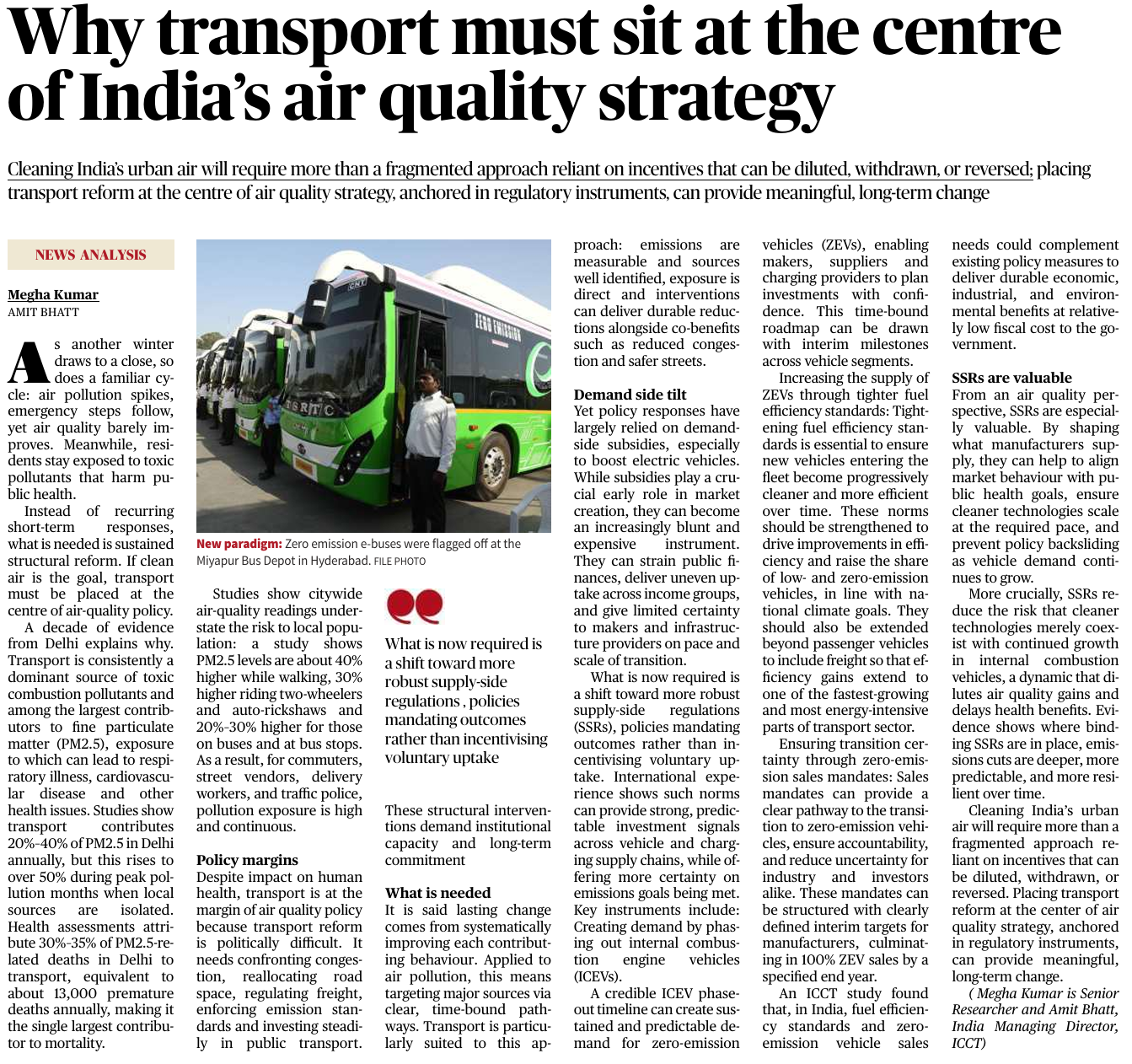 Why transport must sit at the centre of India’s air quality strategy
GS Paper III:
Environmental pollution and degradation
Climate change & mitigation strategies
Infrastructure (transport sector)
Context:
The article argues that India’s air pollution crisis, especially in urban areas, cannot be solved through short-term or fragmented measures. Instead, transport sector reforms must be central to a long-term, sustainable air quality strategy.
Transport as a Major Pollution Source
Contributes:
20–40% of PM2.5 in Delhi annually
Over 50% during peak pollution episodes
Key contributors:
Vehicles (especially ICE vehicles)
Congestion and inefficient mobility systems
Prelims Concepts
1. PM2.5 (Particulate Matter 2.5)
Refers to fine particulate matter ≤ 2.5 micrometres in diameter.
Sources:
Vehicle emissions
Industrial pollution
Construction dust
Why harmful?
Penetrates deep into lungs and bloodstream
Causes:
Respiratory diseases
Cardiovascular problems
2. Internal Combustion Engine Vehicles (ICEVs)
Vehicles powered by:
Petrol / Diesel engines
Working:
Fuel combustion → energy → motion
Issues:
Emit:
CO₂
NOx
PM2.5
3. Zero Emission Vehicles (ZEVs)
Vehicles that produce no tailpipe emissions
Examples:
Battery Electric Vehicles (BEVs)
Hydrogen Fuel Cell Vehicles
👉 Important:
Indirect emissions may still exist (electricity source).
4. Electric Vehicles (EVs)
Powered by:
Electric motors using batteries
Key difference:
EV ⊃ ZEV (all ZEVs are EVs, but not all EVs are strictly zero-emission depending on source)
5. Air quality index (AQI)
Categories: Good (0–50) → Severe (401–500)
Pollutants (8): PM₂.₅, PM₁₀, NO₂, SO₂, CO, O₃, NH₃, Pb
Measurement: 24-hour avg (except CO & O₃ → 8-hour)
Goal: One Number – One Colour – One Description
By: CPCB
Key Point: Based on worst pollutant (sub-index)
UPSC MCQ:
Q1. Consider the following statements regarding PM2.5:
It refers to particulate matter with a diameter less than or equal to 2.5 micrometres.
It can penetrate deep into the lungs and enter the bloodstream.
It is primarily produced only by natural sources like dust storms and forest fires.
Which of the statements given above are correct?
A) 1 and 2 only
B) 2 and 3 only
C) 1 and 3 only
D) 1, 2 and 3
Answer: A) 1 and 2 only
Explanation:
Statement 1- Correct definition.
Statement 2 - Causes severe health impacts.
Statement 3 - Also produced by anthropogenic sources (vehicles, industries).
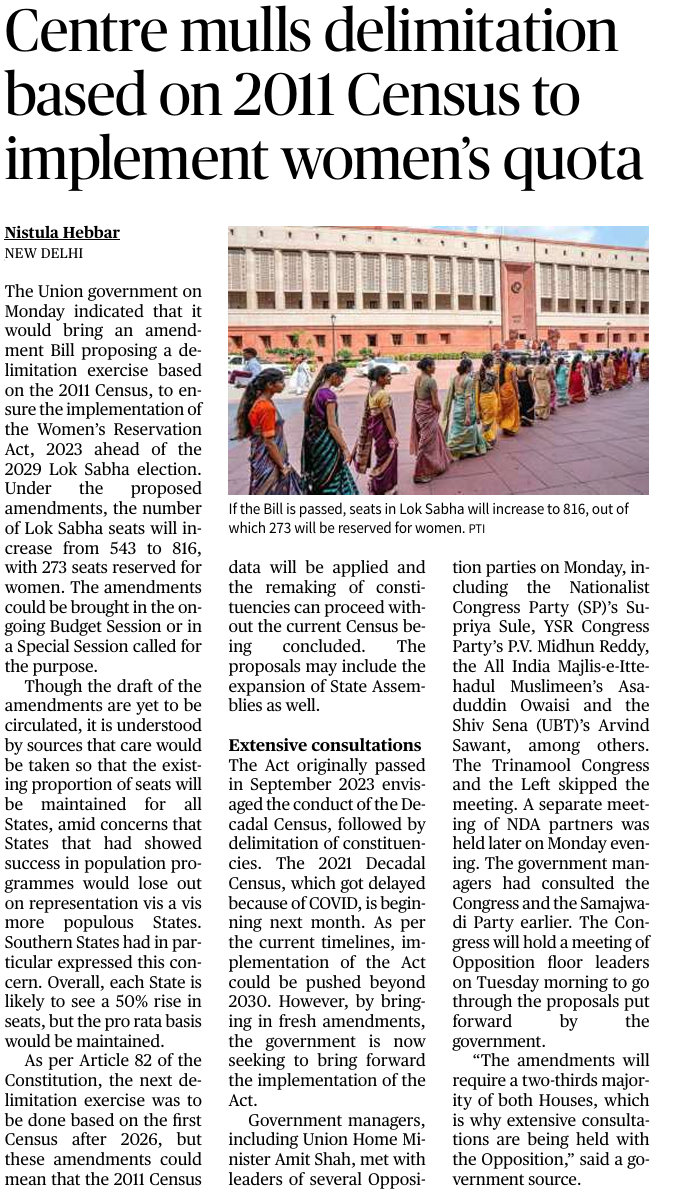 Centre mulls delimitation based on 2011 Census to implement women’s quota
GS Paper II:
Parliament and State Legislatures – Representation
Constitutional provisions (Delimitation, Reservation)
Issues related to federalism
Context:
The Union government is considering an amendment to enable delimitation based on the 2011 Census to implement the Women’s Reservation Act, 2023 before the 2029 Lok Sabha elections, instead of waiting for the next Census.
Prelims Concepts
1. Delimitation
Process of:
Redrawing boundaries of electoral constituencies
Done to ensure:
Equal representation based on population
2. Constitutional Provision – Article 82
Provides for:
Delimitation after every Census
Parliament enacts a Delimitation Act after Census
3. Delimitation Commission
Statutory body
Appointed by:
President of India
Composition:
Retired Supreme Court judge (Chairperson)
Chief Election Commissioner
State Election Commissioners
👉 Orders:
Have force of law
Cannot be challenged in court
4. Freeze on Delimitation
42nd Amendment (1976):
Freeze till 2001 Census
84th Amendment (2001):
Extended freeze till 2026
Purpose:
Encourage population control
5. Women’s Reservation Act, 2023
Provides:
33% reservation for women in:
Lok Sabha
State Assemblies
Comes into effect:
After Census + Delimitation
6. Census in India
Conducted by:
Registrar General & Census Commissioner (Ministry of Home Affairs)
Frequency:
Every 10 years
Last completed:
2011 Census
2021 Census:
Delayed
UPSC MCQ:
Q1. Consider the following statements regarding delimitation in India:
Delimitation is carried out after every Census under Article 82 of the Constitution.
The Delimitation Commission is a constitutional body.
The orders of the Delimitation Commission cannot be challenged in any court.
Which of the statements given above are correct?
A) 1 and 3 only
B) 2 and 3 only
C) 1 and 2 only
D) 1, 2 and 3
Answer: A) 1 and 3 only
Explanation:
Statement 1 - Correct (Article 82).
Statement 2 - Incorrect It is a statutory body, not constitutional.
Statement 3 – correct. Orders have force of law and are not subject to judicial review.
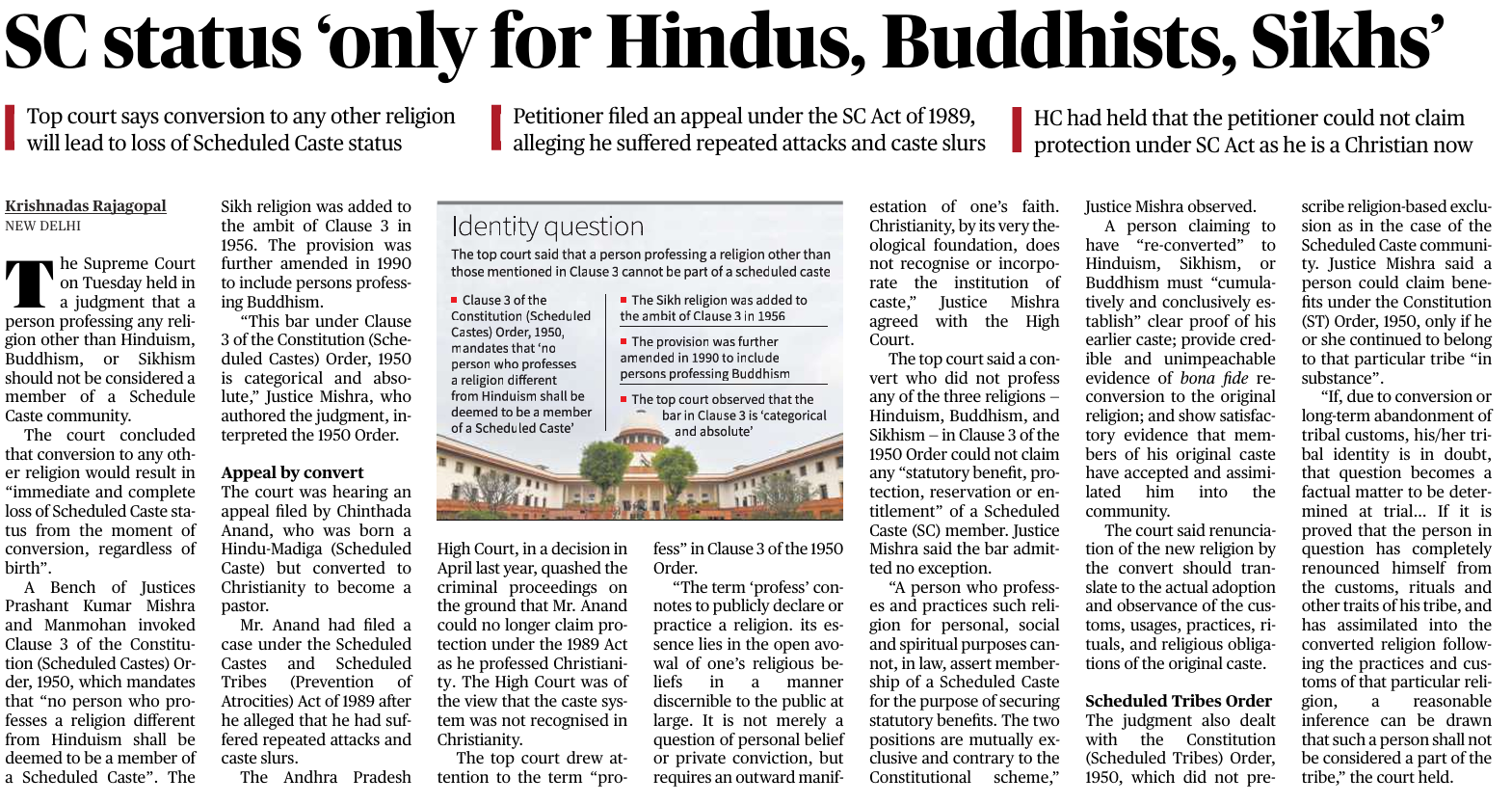 SC status ‘only for Hindus, Buddhists, Sikhs’
GS Paper II:
• Indian Constitution – Equality, Fundamental Rights
• Vulnerable Sections – SCs/STs welfare
• Judiciary – Significant Judgments
Context
The Supreme Court ruled that Scheduled Caste (SC) status is restricted to Hindus, Sikhs, and Buddhists, as per the Constitution (Scheduled Castes) Order, 1950.
Conversion to any other religion (e.g., Christianity or Islam) leads to loss of SC status.
Case involved a person who converted to Christianity but sought protection under the SC/ST (Prevention of Atrocities) Act, 1989.
Prelims Concepts –
1. Article 341 – Scheduled Castes
Empowers the President to specify SCs for each State/UT.
Parliament can include/exclude groups from the list.
2. Constitution (Scheduled Castes) Order, 1950
Provides the legal list of SCs.
Originally: Only Hindus eligible
Amendments:
1956 → Included Sikhs
1990 → Included Buddhists
📌 Key Clause (Clause 3):
A person professing a religion other than Hinduism, Sikhism, Buddhism → Not eligible for SC status
UPSC MCQ
Q. With reference to the Scheduled Caste status in India, which one of the following statements is correct?
A) Scheduled Caste status is based solely on caste and is independent of religion.
B) A person converting from Hinduism to Christianity retains Scheduled Caste status if social discrimination continues.
C) Parliament has no role in modifying the list of Scheduled Castes once notified by the President.
D) A person professing Sikhism or Buddhism can be recognised as a Scheduled Caste.
Answer: D) A person professing Sikhism or Buddhism can be recognised as a Scheduled Caste.
Explanation:
A : Incorrect – SC status is religion-linked, not purely caste-based.
B : Incorrect – Conversion leads to loss of SC status.
C : Incorrect – Parliament can amend the SC list (Art 341).
D : Correct – Sikhs (1956) and Buddhists (1990) are included.
 PSLV setbacks will help in learning, says ISRO chief
GS Paper III:
• Science and Technology – Space Technology
• Achievements of Indians in Science & Technology
• Indigenization of Technology
Context
The ISRO Chairman stated that the recent PSLV-C61/EOS-09 and PSLV-C62/EOS-N1 missions, which faced issues, should be viewed as learning opportunities rather than failures. The anomalies occurred in the third stage (PS3) of the rocket.
Key concepts:
PSLV – India’s Workhorse Launch Vehicle
PSLV (Polar Satellite Launch Vehicle) is ISRO’s most reliable rocket.
Used for:
Launching Earth observation satellites
Placing satellites into polar and sun-synchronous orbits
Nature of the Setbacks
PSLV-C61/EOS-09 (May 2025):
Issue in third stage (PS3)
Mission not fully accomplished
PSLV-C62/EOS-N1 (Jan 2025):
Anomaly in PS3 stage
Did not meet mission objectives
📌 Both were described as “marginal misses”, not total failures
3. Importance of the Third Stage (PS3)
PSLV has four stages:
PS1 – Solid fuel
PS2 – Liquid fuel
PS3 – Solid fuel (critical for altitude & velocity gain)
PS4 – Liquid fuel (final orbital insertion)
⚠️ Any issue in PS3:
Affects trajectory
Prevents proper orbit insertion
4. ISRO’s Learning-Oriented Approach
Failures seen as:
Data-rich events
Opportunities for system improvement
📌 Institutional culture:
Encourages innovation + resilience
UPSC MCQ:
With reference to the Polar Satellite Launch Vehicle (PSLV), consider the following statements:
PSLV uses only solid fuel in all its stages.
The third stage (PS3) of PSLV uses solid propulsion.
PSLV is primarily used for placing satellites into polar and sun-synchronous orbits.
Which of the statements given above is/are correct?
A) 2 and 3 only
B) 1 and 2 only
C) 3 only
D) 1, 2 and 3
Answer: A) 2 and 3 only
Explanation:
Statement 1 : Incorrect – PSLV uses alternating solid and liquid stages, not only solid.
Statement 2 : Correct – PS3 is a solid fuel stage.
Statement 3 : Correct – PSLV is mainly used for polar/Sun-synchronous orbits
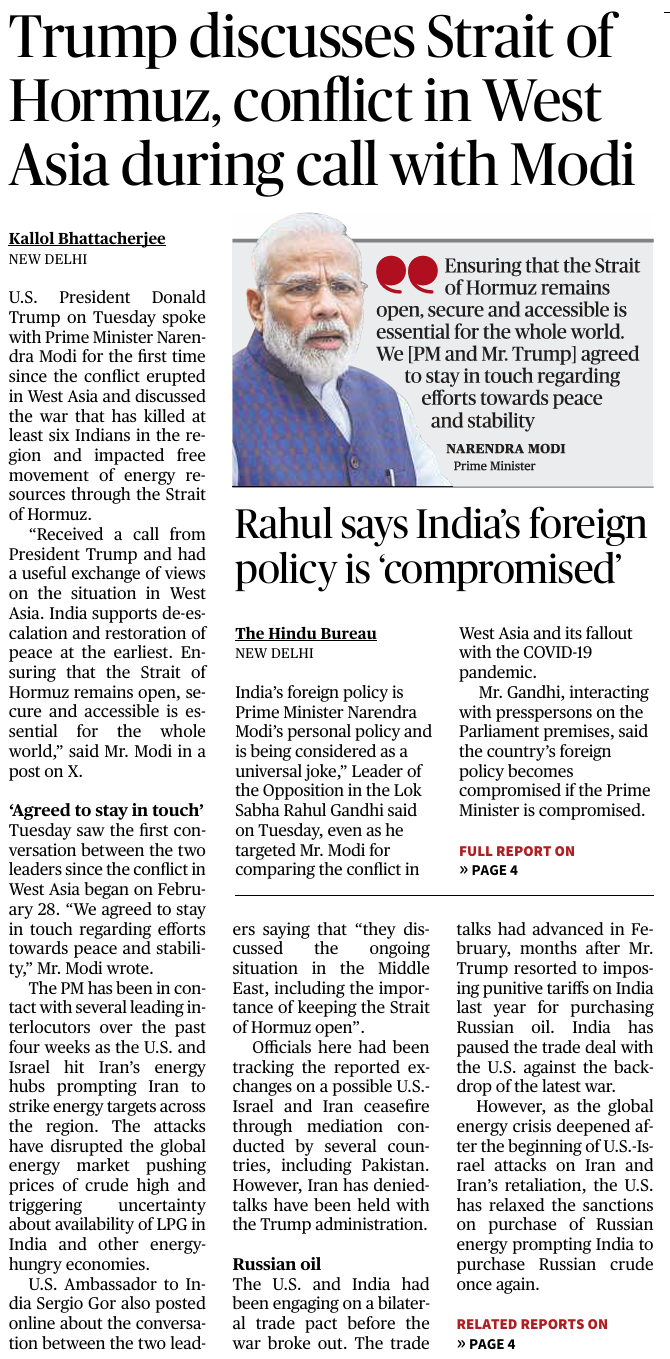 Trump discusses Strait of Hormuz, conflict in West Asia during call with Modi
GS Paper II:
• International Relations – India and West Asia
• Bilateral Relations (India–USA)
• Effect of Policies of Developed Countries on India
Context
Amid escalating tensions in West Asia, U.S. President Donald Trump and Prime Minister Narendra Modi discussed:
The ongoing conflict involving Iran and Israel
Ensuring free movement of energy resources through the Strait of Hormuz
The broader impact on global oil prices and India’s energy security
Key prelims pinter:
1. Strategic Importance of the Strait of Hormuz
Connects:
Persian Gulf → Gulf of Oman → Arabian Sea
Handles:
~20% of global oil trade
📌 For India:
Major share of crude imports pass through this route
Any disruption → energy crisis + inflation
2. Impact of West Asia Conflict
a) Disruption of Energy Supplies
Attacks on energy infrastructure
Increased uncertainty in supply chains
b) Rising Oil Prices
Global crude prices surge
Leads to:
Inflation
Fiscal pressure on importing countries like India
c) Geopolitical Instability
Escalation between:
Iran
Israel
Risk of wider regional war
3. India’s Position
a) Call for De-escalation
Advocates:
Peace
Dialogue
Stability
b) Strategic Balancing
Maintains relations with:
USA
Iran
Israel
👉 Reflects multi-alignment policy
c) Energy Security Focus
Ensuring:
Continuous oil supply
Stable prices

 Launch your Graphy