The Hindu Analysis March 21st
The Hindu News Analysis – 21st March, 2026
1. India’s Iran stance does fuel a foreign policy debate (GS-2)
2. ‘Undemocratic’ politics in Great Nicobar over land (GS-3)
3. Iran steps up attacks on Israel, Gulf energy sites (GS-2)
4. Provide more funds to APEDA: House panel (GS-3)
5. RBI injects ₹25,101 cr. in banking system via 3-day VRR auction (GS-3)
India’s Iran stance does fuel a foreign policy debate
GS Paper II:
• India and its neighbourhood- relations
• Effect of policies and politics of developed countries on India’s interests
• International relations
Context
The article discusses the ongoing debate in India regarding its response to the Israel–US conflict with Iran, particularly India’s diplomatic silence on the assassination of Iran’s Supreme Leader. It evaluates whether India’s stance reflects pragmatic national interest or a deviation from its traditional foreign policy principles like strategic autonomy.
Detailed Analysis:
Arguments For (Supporting Government’s Stand)
1. Primacy of National Interest
Foreign policy is inherently interest-driven, not value-driven.
U.S.: Largest trading partner, critical for defence and technology.
Gulf: Hosts ~10 million Indians and is key for remittances and energy security.
👉 Hence, avoiding antagonizing these partners is seen as pragmatic.
2. Realist Foreign Policy Approach (Nehruvian Logic Reinterpreted)
Even though Nehru is associated with idealism, he emphasized national interest as core.
The government’s stance reflects a “cold calculation” aligning with realism.
3. Geopolitical Assessment
The government may have assessed that the Israel–US bloc would prevail, making it rational to align indirectly.
Ensures India remains on the “winning side” in global power dynamics.
4. Diaspora and Energy Concerns
Welfare of Indians in the Gulf is a top priority.
Gulf region remains critical for:
Oil imports
Remittance flows
👉 Any strong pro-Iran stance could jeopardize these interests.
Arguments Against (Criticism of Government’s Stand)
1. Erosion of Strategic Autonomy
India traditionally maintained balanced relations (Non-Aligned legacy).
Perceived tilt toward the U.S.-Israel axis undermines independent foreign policy identity.
2. Diplomatic Insensitivity
Not condoling Iran’s Supreme Leader’s assassination is seen as:
A departure from diplomatic norms
A signal of selective morality
3. Missed Opportunity for Balanced Diplomacy
India could have:
Condemned the assassination
Simultaneously maintained ties with the West
👉 Reflects lack of nuanced diplomacy.
4. Ideological Influence on Foreign Policy
The article argues foreign policy should not be influenced by ruling party ideology.
PM’s Israel visit and perceived affinity indicate ideological tilt.
5. Poor Diplomatic Signalling
Lower-level representation (Foreign Secretary vs EAM/PM) in condolence diplomacy:
Sent a weak message to Iran
Could affect long-term bilateral trust
Way Forward
1. Reinforce Strategic Autonomy
Move beyond labels and ensure genuine independent decision-making.
Avoid over-alignment with any bloc.
2. Adopt Multi-Alignment Strategy
Balance relations among:
U.S.
Iran
Gulf countries
Israel
👉 Continue India’s “issue-based alignment” approach.
3. Improve Diplomatic Signalling
Symbolic gestures (condolences, representation) matter.
Maintain consistency in diplomatic conduct.
4. Transparent Communication
Government should clearly explain:
Rationale behind decisions
Alignment with national interest
👉 Strengthens democratic accountability.
5. Prioritise Diaspora & Energy Security with Balance
Safeguard diaspora and energy needs without alienating traditional partners like Iran.
Conclusion
The debate reflects a deeper tension in India’s foreign policy between realism and principle. While national interest remains paramount, India must ensure that short-term strategic gains do not undermine long-term diplomatic credibility and strategic autonomy. A calibrated, balanced, and transparent approach is essential in an increasingly polarised global order.
UPSC Mains Question
Q. “India’s response to the Iran crisis reflects a shift from strategic autonomy to strategic alignment.” Critically examine in the context of India’s evolving foreign policy. (250 words)
Source: The Hindu
‘Undemocratic’ politics in Great Nicobar over land
GS Paper III:
• Environmental conservation
• Land reforms
• Infrastructure development
Context
The article discusses the controversy surrounding land acquisition for the Great Nicobar mega infrastructure project. It highlights tensions between development objectives, settler demands, and the rights of indigenous tribal communities (especially Shompen – a PVTG), raising concerns about democratic processes, compensation, and environmental sustainability.
Detailed Analysis:
Challenges
1. Inadequate Compensation & Inequity
Settler families (ex-servicemen descendants) allege very low compensation rates.
Wide disparity compared to compensation in mainland/island tourism projects.
Creates conflict between settlers and administration.
2. Marginalisation of Tribal Communities
Indigenous groups like Shompen (PVTG) largely absent from decision-making.
Pressure on Nicobarese to surrender land.
Violation of protections under:
Forest Rights Act (FRA)
Tribal reserve safeguards
3. Democratic Deficit
Lack of free, prior, and informed consent (FPIC).
Decisions appear top-down with limited participation of local communities.
Representation paradox: settler leaders seeking justice while enabling land alienation.
4. Procedural & Legal Lapses
Issues in:
Land acquisition process
Social Impact Assessment (SIA)
Concerns over due process violations under RFCTLARR Act, 2013.
5. Environmental Concerns
Denotification of ~84 sq. km of tribal reserve land.
Threat to:
Pristine forests
Unique biodiversity
Potential irreversible ecological damage.
6. Conflict Between Stakeholders
Settlers vs Indigenous tribes
Local communities vs State
Development vs Rights
👉 Leads to social tensions and governance challenges.
Significance
1. Strategic Importance
Great Nicobar lies in the Indo-Pacific region → crucial for:
Maritime security
Trade routes
2. Economic Development
Mega project aims at:
Infrastructure growth
Employment generation
Regional development
3. National Security
Enhances India’s presence in strategically sensitive waters.
4. Governance Test Case
Reflects how India balances:
Development
Democracy
Tribal rights
Way Forward
1. Ensure Inclusive Decision-Making
Implement Free, Prior and Informed Consent (FPIC).
Strengthen Gram Sabha role in tribal areas.
2. Protect Tribal Rights
Strict enforcement of:
Forest Rights Act (FRA)
PVTG safeguards
Avoid forced displacement.
3. Fair & Equitable Compensation
Revise compensation to:
Reflect market value
Ensure livelihood security
4. Strengthen Environmental Safeguards
Conduct rigorous:
Environmental Impact Assessment (EIA)
Minimise ecological damage.
5. Transparent Governance
Improve:
Public consultation
Accountability mechanisms
6. Balanced Development Model
Integrate:
Strategic needs
Ecological sustainability
Social justice
Conclusion
The Great Nicobar issue highlights the complex intersection of development, democracy, and rights. While strategic infrastructure is essential, ignoring tribal voices and ecological concerns risks long-term instability and injustice. A participatory, transparent, and sustainable approach is key to reconciling competing interests.
UPSC Mains Question:
Q. Examine the issues related to land acquisition in India and its impact on vulnerable communities. (250 words)
Source: The Hindu
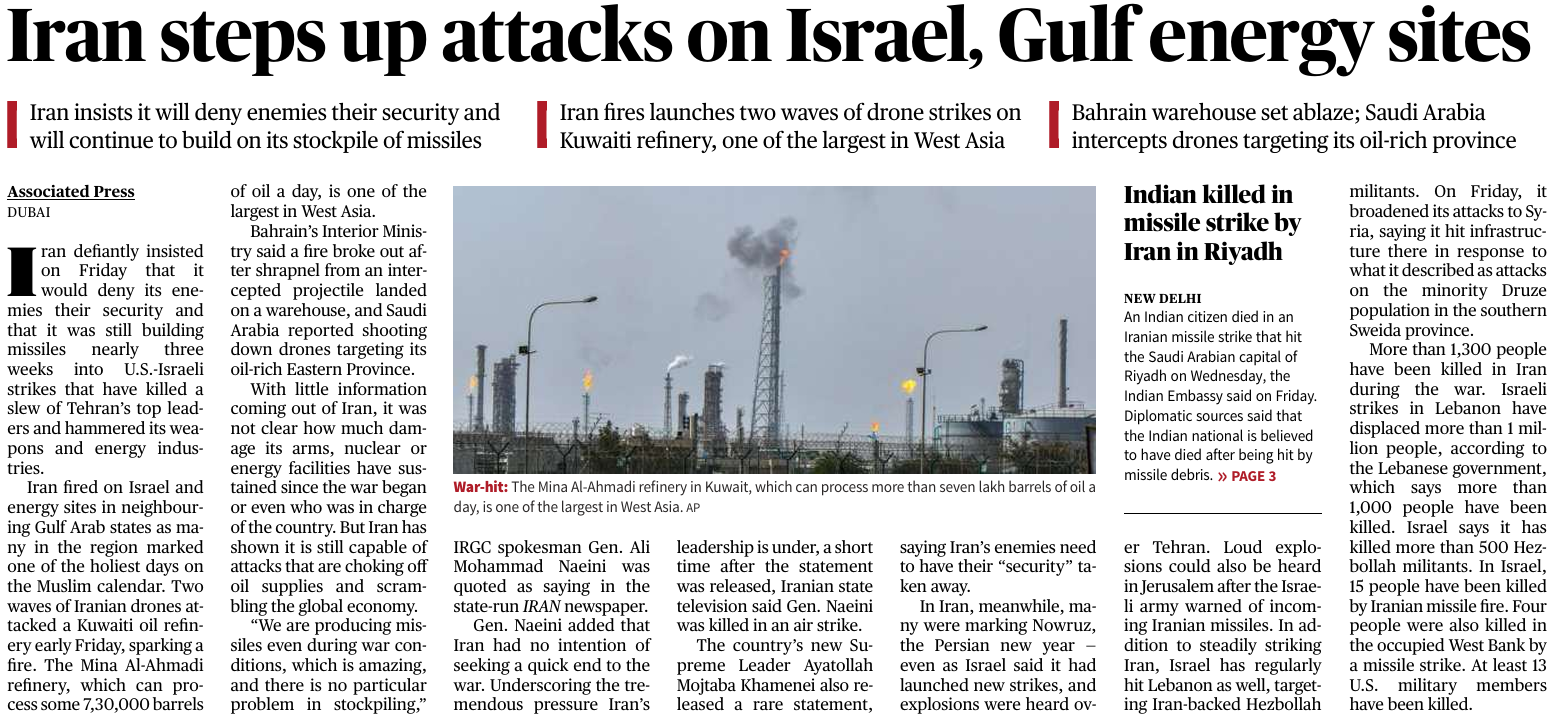
Iran steps up attacks on Israel, Gulf energy sites
GS Paper II:
• Effect of policies and politics of developed countries on India’s interests
• International relations
Context
The article highlights the escalation of conflict between Iran and Israel, with Iran launching drone and missile attacks on Israel and Gulf energy infrastructure (e.g., Kuwaiti refinery). The conflict is expanding geographically, affecting West Asia’s stability, global oil supply chains, and Indian interests (diaspora & energy security).
Nature of Escalation
Iran has intensified attacks through:
Drone strikes on oil refineries (Kuwait)
Missile strikes impacting Gulf countries
Israel continues counter-attacks on:
Iranian assets
Iran-backed groups (e.g., Hezbollah in Lebanon)
👉 Indicates a shift from proxy conflict to direct confrontation.
Expansion of Conflict Zone
Conflict is no longer limited to Iran–Israel:
Spread to Gulf nations (Saudi Arabia, Bahrain, Kuwait)
Impact on Syria and Lebanon
👉 Raises risk of a regional war in West Asia.
Targeting Energy Infrastructure
Key oil facilities (like Mina Al-Ahmadi refinery) targeted
Consequences:
Disruption in oil production and supply
Spike in global crude prices
Threat to maritime routes (e.g., Strait of Hormuz indirectly)
Prelims pointers:
1. Strait of Hormuz
Narrow sea passage between Persian Gulf and Gulf of Oman
Handles ~20% of global oil trade
Bordered by Iran (north) and Oman/UAE (south)
👉 Any conflict here → global oil price spike
2. Persian Gulf vs Gulf of Oman
Persian Gulf: Enclosed, oil-rich region (Saudi Arabia, Iran, Kuwait, UAE)
Gulf of Oman: Connects Persian Gulf to Arabian Sea
👉 Strategic maritime linkage for energy transport
3. Mina Al-Ahmadi Refinery (Kuwait)
One of the largest oil refineries in West Asia
Key for Kuwait’s oil exports
👉 Targeting refineries = disrupting downstream energy supply
4. OPEC (Organization of the Petroleum Exporting Countries)
Group of major oil-exporting nations (e.g., Iran, Saudi Arabia, Iraq)
Controls oil production to influence prices
👉 Conflict among members destabilizes oil markets
Established: 1960 (Baghdad Conference)
Type: Intergovernmental organization
HQ: Vienna, Austria
Founding Members: Iran, Iraq, Kuwait, Saudi Arabia, Venezuela ⭐
Members (~12): Algeria, Congo, Equatorial Guinea, Gabon, Iran, Iraq, Kuwait, Libya, Nigeria, Saudi Arabia, UAE, Venezuela
Key Role:
👉 Controls oil production → influences global oil prices
Important Facts:
Gabon rejoined (2016)
Angola exited (2024)
Qatar left (2019)
OPEC+ includes Russia
UPSC Prelims MCQ
Q. Consider the following statements regarding the Organization of the Petroleum Exporting Countries (OPEC):
It was established in 1960 at the Baghdad Conference.
Its headquarters is located in Geneva, Switzerland.
All major oil-producing countries of the world are members of OPEC.
Venezuela is one of the founding members of OPEC.
How many of the above statements are correct?
A) Only one
B) Only two
C) Only three
D) All four
Answer:
B) Only two
Explanation
1 – Correct (1960, Baghdad)
2 – Incorrect (HQ is Vienna, not Geneva)
3 – Incorrect (USA, Russia are NOT members)
4 – Correct (Venezuela is founding member)
Source: The Hindu
Provide more funds to APEDA: House panel
GS Paper III:
• Agriculture and allied activities
• Food processing and export promotion
Context
A Parliamentary Standing Committee has recommended increased budgetary allocation to APEDA (Agricultural and Processed Food Products Export Development Authority) to help farmers and exporters meet global standards, traceability requirements, and compliance norms.
About APEDA
1. Establishment & Nature
Full Form: Agricultural and Processed Food Products Export Development Authority
Type: Statutory body
Established: 1985 (APEDA Act)
Replaced: Processed Food Export Promotion Council (PFEPC)
Ministry: Ministry of Commerce & Industry
2. Objective
Promote and develop export of scheduled agricultural & processed food products
3. Scheduled Products (Important ⭐)
Products listed under APEDA Act
Exporters must register with APEDA
Examples:
Fruits & Vegetables
Meat & Poultry
Dairy products
Processed foods (biscuits, confectionery, bakery)
Honey, Jaggery
4. Key Functions
Fix standards & specifications for exports
Registration of exporters
Improve packaging & marketing
Ensure quality through inspection
Provide training & capacity building
Conduct surveys & feasibility studies
Collect & publish trade statistics
Provide financial assistance & guidelines
5. Additional Roles
Monitors import of sugar
Secretariat for:
National Accreditation Board (NAB)
Under NPOP (National Programme for Organic Production)
👉 Important for organic exports certification
6. Organisation Structure
Headed by a Chairman (appointed by Central Government)
Headquarters: New Delhi
7. Regional Presence
Multiple regional offices across India (e.g., Mumbai, Bengaluru, Hyderabad, Kolkata, Guwahati, etc.)
UPSC Prelims MCQ
Q. Consider the following statements regarding the Agricultural and Processed Food Products Export Development Authority (APEDA):
It is a statutory body established under an Act of Parliament in 1985.
It functions under the Ministry of Agriculture and Farmers Welfare.
Exporters of scheduled products are required to register with APEDA.
APEDA is responsible for monitoring the import of sugar.
How many of the above statements are correct?
A) Only one
B) Only two
C) Only three
D) All four
Answer:
C) Only three
Explanation
1 – Correct (APEDA Act, 1985)
2 – Incorrect (It comes under Ministry of Commerce & Industry)
3 – Correct (Mandatory registration)
4 – Correct (Monitors sugar import)
RBI injects ₹25,101 cr. in banking system via 3-day VRR auction
GS Paper III:
• Indian Economy – Banking & Monetary Policy
• Inflation and liquidity management
Context
The Reserve Bank of India (RBI) injected ₹25,101 crore liquidity into the banking system through a 3-day Variable Rate Repo (VRR) auction to address a temporary liquidity crunch, mainly due to advance tax outflows.
Variable Repo Rate (VRR)
1. Definition
Variable Repo Rate (VRR):
A short-term liquidity adjustment tool of RBI where banks borrow funds at market-determined interest rates through auctions.
2. Key Feature (Core Idea ⭐)
Interest rate is not fixed by RBI
Determined through competitive bidding by banks
3. How VRR Works
RBI conducts auctions (1–14 days maturity)
Banks:
Bid for amount
Quote interest rate they are willing to pay
RBI accepts most favourable bids
Final rate = auction-determined VRR
👉 Rate is generally above Reverse Repo Rate (floor of corridor)
4. VRR vs Fixed Repo Rate
Parameter
Variable Repo Rate (VRR)
Fixed Repo Rate
Interest Rate
Market-determined (auction)
Fixed by RBI
Flexibility
High
Low
Market Response
Dynamic
Static
Usage
During liquidity fluctuations
Regular policy tool
5. VRR under LAF
Part of Liquidity Adjustment Facility (LAF)
Helps RBI:
Manage short-term liquidity
Align market rates with policy repo rate
6. Functions / Importance
Provides short-term liquidity to banks
Maintains financial stability
Improves monetary policy transmission
Controls interest rate volatility
7. Key Features
Flexible tenure: 1–14 days (or more)
Auction-based mechanism
Market-responsive tool
Operates within LAF corridor (Repo–Reverse Repo)
UPSC Prelims MCQ
Q. Consider the following statements regarding Variable Rate Repo (VRR):
Under VRR, the interest rate is determined through an auction mechanism based on bids by banks.
The interest rate under VRR is pre-fixed by the Reserve Bank of India.
Which of the statements given above is/are correct?
A) 1 only
B) 2 only
C) Both 1 and 2
D) Neither 1 nor 2
Answer:
A) 1 only
Explanation 🧠
Statement 1 – Correct
→ VRR rate is market-determined via auction
Statement 2 – Incorrect
→ Pre-fixed rate applies to repo, not VRR





 Launch your Graphy