The Hindu Analysis March 19th & 20th March




News Analysis – 19th & 20th March, 2026
1. India’s future demographic challenges (GS-3, GS-1)
2. Oil, power, and politics of disruption (GS-2, GS-3)
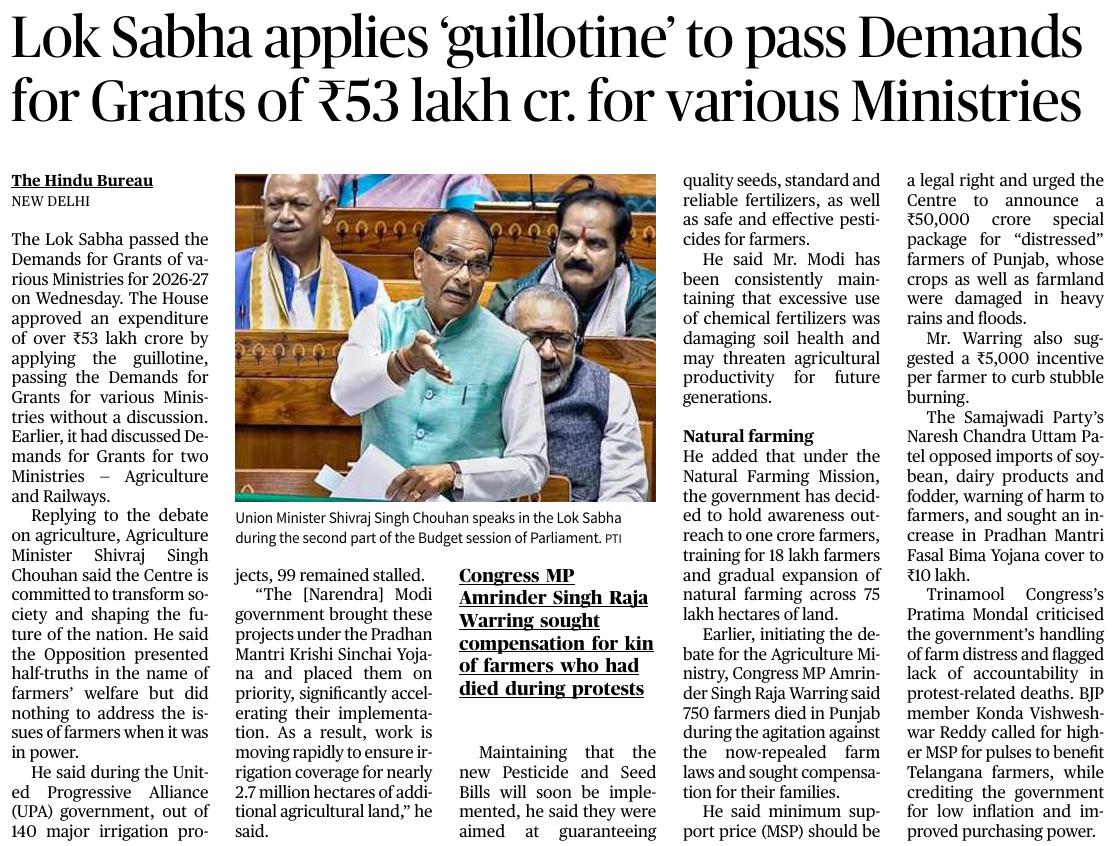
3. Lok Sabha applies ‘guillotine’ to pass Demands for Grants of ₹53 lakh cr. for various Ministries (GS-2)
4. Large Hadron Collider discovers a new particle (GS-3)
5. Israel conducts waves of attacks on Beirut; to strike river crossings (GS-2)
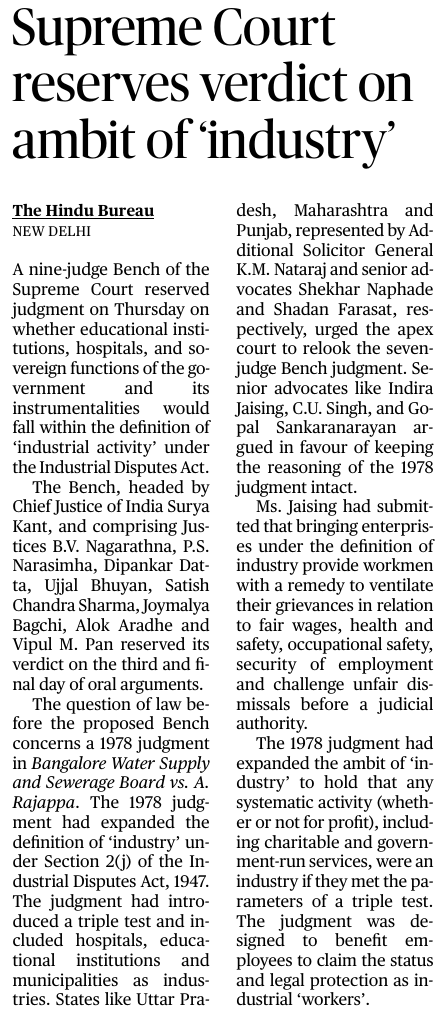
6. Supreme Court reserves verdict on ambit of ‘industry’
(GS-2)
7. West Asia crisis rattles ‘fragmented’ global aluminium supply chain (GS-2, GS-3)
8. First an oil shock, now a strong dollar surprise? (GS-3)
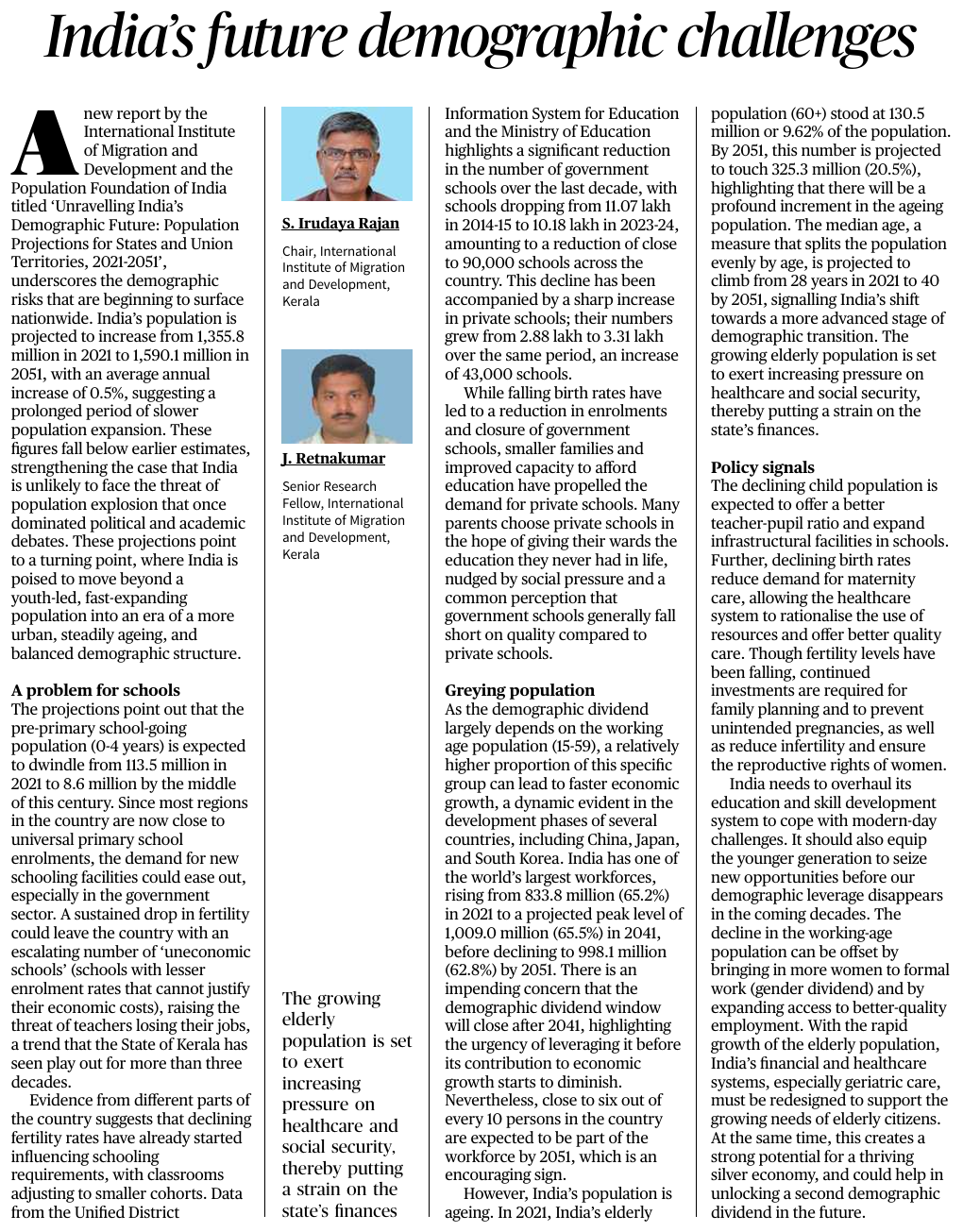 India’s future demographic challenges
GS Paper I:
• Population and associated issues
• Urbanisation and demographic transition
GS Paper III:
• Human resource development
• Inclusive growth and employment
Context
The article is based on a report by the International Institute of Migration and Development and the Population Foundation of India, highlighting India’s transition from a young population to an ageing society, along with its implications for education, workforce, and public policy.
Detailed Analysis
1. India’s Demographic Transition: Key Trends
India’s population growth is slowing (0.5% annual growth).
Shift from a youth-dominated population → ageing and balanced demographic structure.
Median age rising from 28 (2021) → 40 (2051).
Indicates India is entering an advanced stage of demographic transition.
👉 Insight: India is moving from demographic dividend phase → demographic burden phase.
2. Declining Fertility & Its Impact on Education
Falling Child Population
0–4 age group projected to decline significantly.
Leads to reduced demand for schooling infrastructure.
Structural Changes in Education
Government schools declining:
From 11.07 lakh → 10.18 lakh
Private schools increasing:
Driven by quality perception + rising incomes
Implications
Risk of:
“Uneconomic schools” (low enrolment)
Teacher job losses
Regional evidence: Seen in Kerala model
👉 Key Issue: Quantity → Quality shift in education demand
3. Changing Nature of Demographic Dividend
Working-age population:
Peaks around 2041
Declines thereafter
India still has:
~60% population in working age by 2051
Challenge
Dividend is time-bound
Needs:
Skill development
Employment generation
👉 Core Idea: Demographic dividend is not automatic—it is policy-dependent.
4. Ageing Population: Emerging Crisis
Elderly population:
130 million (2021) → 325 million (2051)
Share increases from 9.6% → 20.5%
Impacts
Rising burden on:
Healthcare system (especially geriatric care)
Social security systems
State finances
👉 Transition: From youth pressure → ageing pressure
5. Economic & Social Implications
Positive Signals
Lower fertility:
Better teacher-pupil ratio
Improved healthcare quality
Opportunity for:
Human capital deepening
Negative Risks
Shrinking workforce after 2041
Increased dependency ratio
Fiscal stress due to ageing population
6. Gender Dimension & Labour Force
Solution to workforce decline:
Increase female labour force participation (FLFP)
Benefits
“Gender dividend”
Offsets shrinking workforce
Enhances inclusive growth
👉 Critical Gap: India’s FLFP remains structurally low
7. Policy Signals Highlighted in the Article
Education reforms:
Focus on quality + skilling
Healthcare reforms:
Rational resource allocation due to lower fertility
Strengthen:
Family planning
Reproductive rights
Employment:
Create high-quality jobs
Ageing preparedness:
Redesign:
Pension systems
Geriatric care infrastructure
Challenges
Premature closure of demographic dividend window
Weak skilling ecosystem
Low female workforce participation
Rising old-age dependency
Inequality in access to quality education
Fiscal pressure on welfare systems
Significance
Marks India’s shift to a mature demographic economy
Opportunity to:
Achieve high-income status
Build human capital-driven growth
Potential for:
“Silver economy” (elderly-driven demand sector)
Way Forward
1. Human Capital Investment
Skill-based education aligned with industry
NEP implementation with focus on employability
2. Labour Market Reforms
Promote female employment
Encourage formalisation
3. Ageing Policy Framework
Universal pension coverage
Expand geriatric healthcare services
4. Education System Restructuring
Consolidate underutilized schools
Improve public school quality
5. Healthcare System Strengthening
Shift from maternal focus → geriatric care readiness
Conclusion
India stands at a demographic crossroads—with a shrinking youth base and rapidly rising elderly population. The success of its future growth depends on how effectively it utilizes the remaining demographic dividend while preparing for an ageing society. Strategic investments in human capital, gender inclusion, and social security will determine whether this transition becomes an opportunity or a crisis.
UPSC Mains Question:
India is witnessing a shift from a demographic dividend phase to an ageing society. Discuss the implications of this transition on India’s socio-economic structure. (250 words)
Source: The Hindu
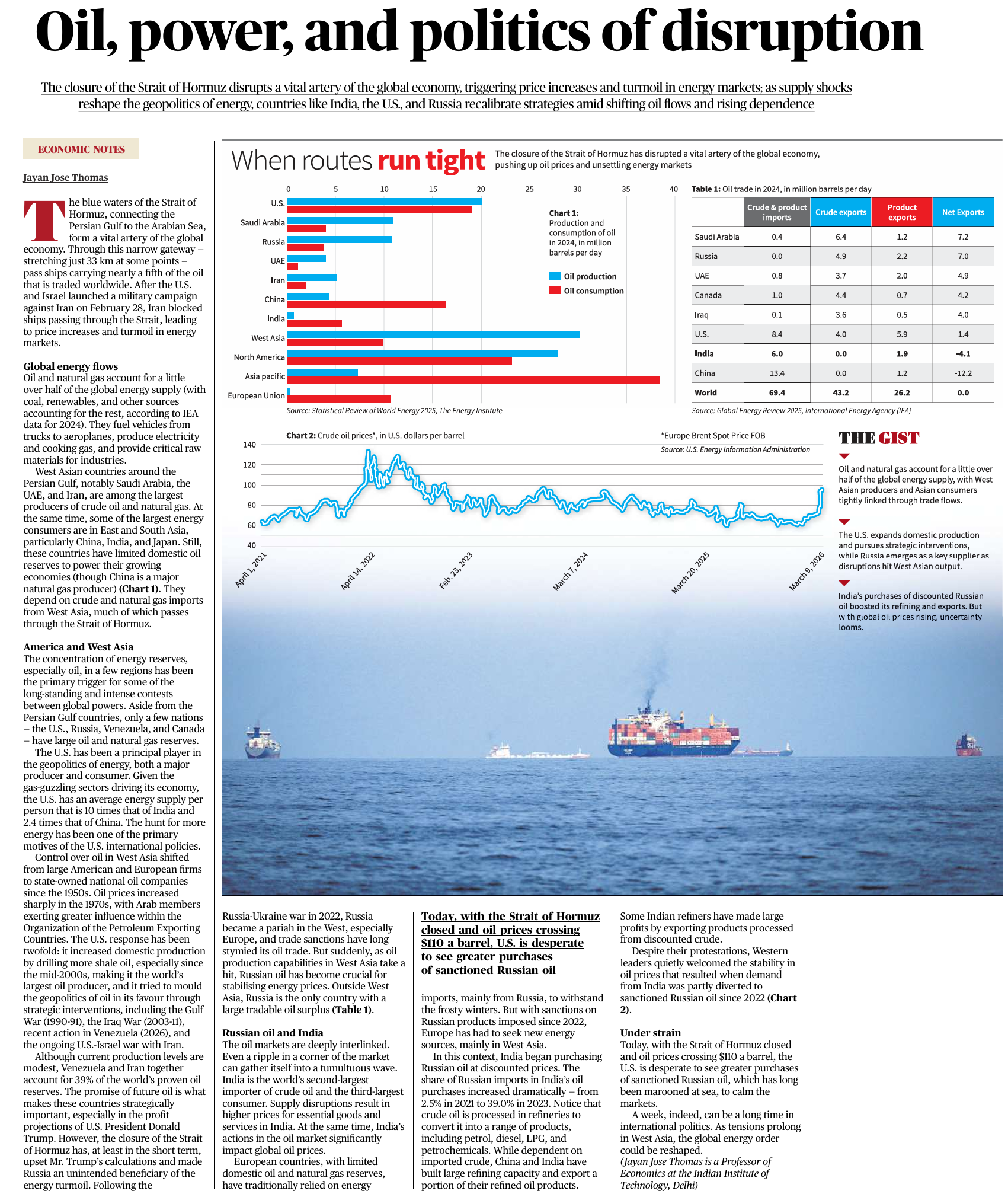
Oil, power, and politics of disruption
GS Paper II:
• International relations – West Asia geopolitics, India’s foreign policy
• Effect of policies of developed countries on India
GS Paper III:
• Energy security
• Infrastructure (energy logistics)
• Economy – inflation, global supply shocks
Context
The article discusses the geopolitical and economic consequences of the closure of the Strait of Hormuz, a critical chokepoint for global oil supply. It highlights how disruptions in oil flows reshape global energy markets, impact prices, and force countries like India, the U.S., and Russia to recalibrate strategies.
Detailed Analysis
1. Strategic Importance of the Strait of Hormuz
One of the world’s most critical energy chokepoints.
Around 1/5th of global oil trade passes through it.
Connects oil-rich Persian Gulf to global markets.
Implication:
Any disruption → immediate price spikes + supply insecurity + global inflationary pressure.
2. Global Energy Flow Dynamics
Oil & gas account for over half of global energy supply.
West Asia dominates production, while:
Asia (China, India) → major consumers
Europe → dependent on imports
Increasing interdependence:
Producers rely on markets
Consumers rely on secure supply routes
3. Role of Major Powers
United States
Dual role: major producer + consumer
Increasing domestic production (shale revolution)
Strategic interventions:
Gulf War, Iraq War, Venezuela sanctions
Aim: control supply chains + stabilize markets
Russia
Post-2022 (Ukraine war), pivoted to Asia
Emerged as a key oil supplier to India
Uses energy exports as a geopolitical tool
West Asia
Holds ~two-thirds of global oil reserves
Internal conflicts + external interventions = instability
Oil politics tied to OPEC influence
4. India’s Position in the Energy Geopolitics
2nd largest crude importer
3rd largest energy consumer
Heavy dependence on West Asian oil via Hormuz
Key Trends:
Increased imports of discounted Russian oil
Boost in refining capacity & exports
Strategic balancing between:
West (U.S./Europe)
Russia
West Asian nations
Vulnerability:
Supply disruptions → inflation, fiscal stress, CAD widening.
5. Economic Impact of Disruptions
Oil prices crossing $110/barrel due to crisis.
Leads to:
Higher transport & production costs
Imported inflation
Pressure on developing economies
Shipping disruptions → global supply chain breakdown
6. Shifting Energy Geopolitics
Declining Western dominance in oil control
Rise of:
Asia-centric demand
Russia-Asia energy corridor
Sanctions have reconfigured trade flows:
Europe shifts away from Russia
India & China increase Russian imports
7. Structural Changes in Energy Markets
Countries diversifying:
Supply sources
Transport routes
Strategic reserves
Growing importance of:
Refining hubs (India)
Energy diplomacy
Long-term contracts
Key Challenges
1. Supply Vulnerability
Over-dependence on a few chokepoints (Hormuz)
2. Geopolitical Conflicts
West Asia instability + great power rivalry
3. Price Volatility
Sudden spikes disrupt macroeconomic stability
4. Sanctions & Fragmentation
Parallel energy markets emerging (West vs non-West)
Significance
Highlights energy security as national security
Shows shift from globalized energy markets → fragmented blocs
Underlines India’s role as a key refining and redistribution hub
Emphasizes geopolitics shaping economics, not vice versa
Way Forward
1. Diversification of Energy Sources
Reduce dependence on West Asia
Increase imports from:
Russia, Africa, Latin America
2. Strategic Petroleum Reserves (SPR)
Expand buffer stocks to handle shocks
3. Renewable Energy Push
Reduce fossil fuel dependence (solar, wind, green hydrogen)
4. Strengthen Energy Diplomacy
Balanced relations with:
U.S., Russia, Gulf countries
5. Alternative Transport Routes
Develop:
International North-South Transport Corridor (INSTC)
Maritime diversification
Conclusion
The disruption of the Strait of Hormuz is not just an energy crisis but a geopolitical turning point. It reflects the deep entanglement of oil, power, and global politics, where supply chains, strategic alliances, and economic stability are tightly interwoven. For India, the challenge lies in balancing energy security with geopolitical pragmatism, while accelerating the transition toward a more resilient and diversified energy future.
UPSC Mains Question:
Discuss the strategic importance of maritime chokepoints like the Strait of Hormuz in shaping global energy markets.
How do such vulnerabilities impact India’s economic stability? (250 words)
Source: The Hindu
 Lok Sabha applies ‘guillotine’ to pass Demands for Grants of ₹53 lakh cr. for various Ministries
GS Paper II:
• Parliament and State Legislatures – functioning, procedures
• Budgetary process and financial accountability
Context
The Lok Sabha passed the Demands for Grants (2026–27) amounting to over ₹53 lakh crore by applying the guillotine procedure, meaning the remaining demands were approved without detailed discussion due to time constraints.
What is the Guillotine in Parliamentary Procedure?
A mechanism used during the Budget Session.
When time allocated for discussing Demands for Grants expires:
All remaining demands are put to vote at once without discussion.
Ensures timely passage of the budget.
Nature: Procedural necessity but reduces legislative scrutiny.
Budgetary Process: Where Guillotine Fits
Budget presentation
General discussion
Department-wise Demands for Grants discussion
Guillotine (if time insufficient)
Appropriation Bill
Finance Bill
Guillotine occurs at stage 4, limiting detailed debate.
Demands for Grants
Show ministry-wise expenditure proposals.
Presented only in Lok Sabha.
Each ministry submits one demand.
Important:
Voted expenditure → Requires approval of Lok Sabha
Charged expenditure → Not voted (e.g., CAG, SC judges’ salaries)
Cut Motions
(MPs can reduce demands)
Types:
Policy Cut → Reduce to ₹1 (symbolic rejection)
Economy Cut → Reduce amount by a specified sum
Token Cut → Reduce by ₹100 (highlight specific grievance)
Rarely passed in practice.
UPSC Prelims MCQ:
Q. With reference to the “Guillotine” procedure in the Indian Parliament, consider the following statements:
It is applied in both Lok Sabha and Rajya Sabha to expedite legislative business.
It allows pending Demands for Grants to be put to vote without discussion.
It is explicitly mentioned in the Constitution of India.
Which of the statements given above is/are correct?
(a) 2 only
(b) 1 and 2 only
(c) 2 and 3 only
(d) 1, 2 and 3
Answer: (a)
Explanation:
Statement 1 : Only in Lok Sabha
Statement 2 : Core feature
Statement 3 : Not constitutional, only procedural
Source: The Hindu
 Large Hadron Collider discovers a new particle
GS Paper III:
• Science and Technology – developments and applications
• Awareness in the fields of Physics (Particle Physics)
Context
Scientists at CERN’s Large Hadron Collider (LHC) have discovered a new subatomic particle named Xi-cc-plus (Ξcc⁺⁺). This discovery contributes to a deeper understanding of quantum chromodynamics (QCD) and the fundamental structure of matter.
Prelims Concepts:
1. Large Hadron Collider (LHC)
World’s largest particle accelerator.
Located at CERN (Geneva):
Spans France–Switzerland border
Features:
27 km circular tunnel
~100 m underground
Purpose:
Accelerate particles (mainly protons) to near light speed
Collide them to study fundamental particles
👉 Prelims Trap: Not located entirely in one country
2. CERN
European Organization for Nuclear Research
One of the largest particle physics labs in the world
Known for:
Discovery of Higgs Boson (2012)
3. Standard Model of Particle Physics
Framework explaining:
Fundamental particles
Three forces:
Electromagnetic
Weak nuclear
Strong nuclear
Does NOT include gravity
4. Quarks (Fundamental Particles)
Six flavours:
Up, Down
Charm, Strange
Top, Bottom
👉 Combine to form hadrons
5. Hadrons
Particles made of quarks:
Types:
Baryons → 3 quarks
Example: Proton (uud), Neutron (udd)
Mesons → 1 quark + 1 antiquark
6. Exotic Hadrons
Non-conventional combinations:
Tetraquarks (4 quarks)
Pentaquarks (5 quarks)
👉 Important emerging research area
7. New Particle: Xi-cc-plus (Ξcc⁺⁺)
A baryon
Composition:
2 charm quarks + 1 up quark
Characteristics:
Heavier than proton
Short-lived
Significance:
Helps study quark interactions
8. Quantum Chromodynamics (QCD)
Theory explaining:
Strong nuclear force
Governs:
Binding of quarks inside protons/neutrons
Uses concept of:
Color charge (not actual color)
9. Strong Nuclear Force
Strongest fundamental force
Acts between:
Quarks (inside nucleons)
Responsible for:
Stability of atomic nucleus
UPSC Prelims MCQ:
Q. With reference to the Large Hadron Collider (LHC), consider the following statements:
It accelerates only protons for collision experiments.
It is located on the border of two European countries.
It is primarily designed to generate nuclear energy.
Which of the statements given above is/are correct?
(a) 2 only
(b) 1 and 2 only
(c) 1 only
(d) 2 and 3 only
Answer: (a)
Explanation:
Statement 1 : Also accelerates heavy ions (e.g., lead ions)
Statement 2 correct
Statement 3 : Not for energy generation
Source: The Hindu
I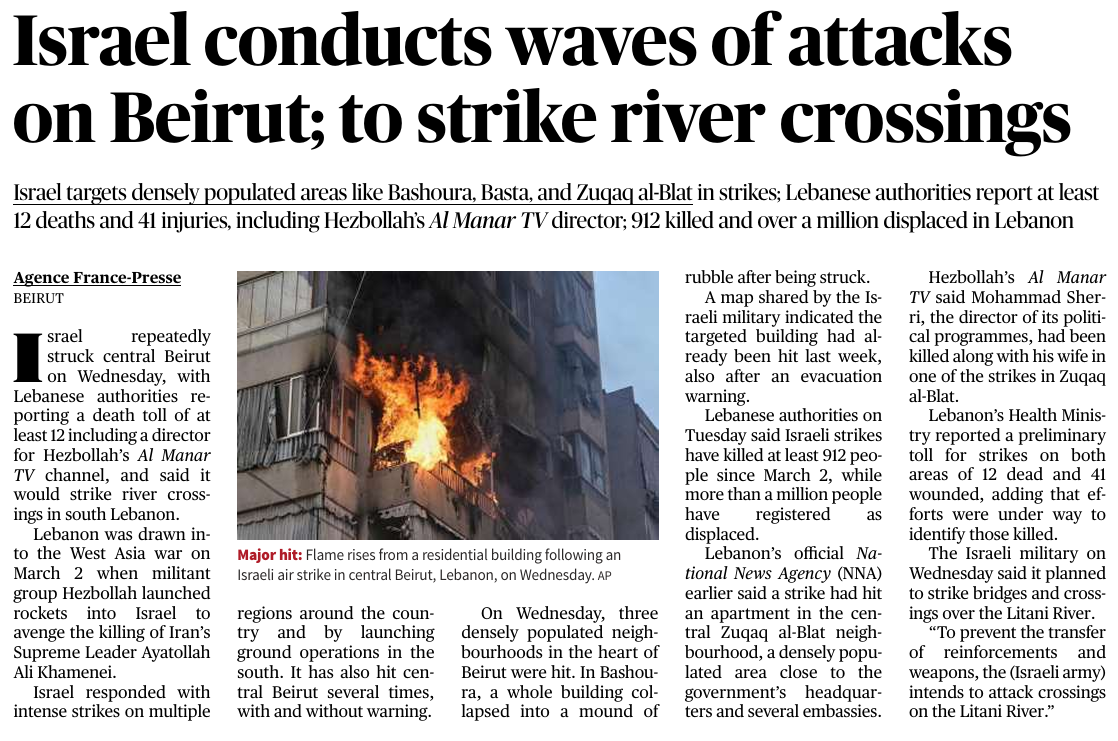 srael conducts waves of attacks on Beirut; to strike river crossings
GS Paper II:
• International relations – West Asia conflicts
• India and its neighbourhood/global strategic interests
Context
The article reports escalating conflict between Israel and Hezbollah in Lebanon, with Israeli airstrikes on Beirut and plans to target river crossings to disrupt militant logistics. The situation reflects broader instability in West Asia, linked to regional geopolitical tensions.
Prelims Concepts:
1. Hezbollah
A Shia Islamist militant group + political party based in Lebanon
Supported by Iran
Formed in 1980s during Israeli occupation of Lebanon
👉 Key Features:
Armed wing (military operations)
Political participation in Lebanon
Considered a terrorist organization by many countries
2. Lebanon – Key Facts
Capital: Beirut
Located in West Asia (Middle East)
Borders:
Israel (south)
Syria (north & east)
Political system:
Confessional system (power-sharing among religious groups)
3. Litani River
Major river in Lebanon
Flows entirely within Lebanon
Important for:
Irrigation
Strategic military movements
👉 Prelims Trap: Does NOT flow into another country
4. Proxy Warfare
Conflict where:
Major powers support local actors instead of direct fighting
👉 Example:
Iran → supports Hezbollah
Israel → directly targets Hezbollah
5. International Humanitarian Law (IHL)
Also called Law of Armed Conflict
Based on:
Geneva Conventions
Core Principles:
Distinction → Civilians vs combatants
Proportionality → No excessive force
Necessity → Only required military force
UPSC Prelims MCQ:
Q. Which of the following countries share a border with Lebanon?
Israel
Jordan
Syria
Iraq
Select the correct answer:
(a) 1 and 3 only
(b) 1, 2 and 3 only
(c) 2 and 4 only
(d) 1, 3 and 4 only
Answer: (a)
 Supreme Court reserves verdict on ambit of ‘industry’
GS Paper II:
• Judiciary – Structure, powers, and judicial review
• Governance – Role of institutions and quasi-judicial bodies
Context
A nine-judge Constitution Bench of the Supreme Court has reserved its verdict on whether institutions like hospitals, educational institutions, and sovereign government functions fall under the definition of “industry” as per the Industrial Disputes Act, 1947. The issue revisits the landmark 1978 judgment in Bangalore Water Supply vs. A. Rajappa, which expanded the scope of “industry”.
What does “Judgment Reserved” mean?
When a court “reserves judgment”, it means:
👉 The court has completed hearing arguments from all parties
👉 But does NOT give the decision immediately
👉 Instead, it postpones the verdict to a later date
Prelims Concepts:
1. Industrial Disputes Act, 1947
Key law governing industrial relations in India
Deals with:
Investigation and settlement of disputes
Strikes and lockouts
Section 2(j) → Defines “industry”
👉 Prelims Trap: Definition is very broad and judicially interpreted, not strictly limited to manufacturing.
2. Definition of “Industry” (Core Idea)
Includes:
Systematic activity
Employer–employee relationship
Production/distribution of goods or services
❌ Not restricted to profit-making entities
3. Bangalore Water Supply Case (1978)
Landmark Supreme Court judgment
Expanded scope of “industry”
✔ Key Contribution:
Introduced Triple Test:
Systematic activity
Employer–employee cooperation
Goods/services production
👉 Included:
Hospitals
Educational institutions
Municipal bodies
4. Sovereign vs Non-Sovereign Functions
Sovereign Functions (excluded generally):
Defence
Law & order
Judiciary
Non-Sovereign Functions (can be included):
Education
Healthcare
Welfare services
👉 Prelims Trap: Not all government activities are sovereign.
5. Constitution Bench
Bench of 5 or more judges
Set up to decide:
Constitutional interpretation
Important legal questions
👉 Here: 9-judge bench (rare → indicates importance)
6. Legal Significance of Being an “Industry”
If an entity is classified as an industry:
Workers get:
Protection against unfair dismissal
Right to raise industrial disputes
Access to labour courts
Prelims Practice MCQ
Q. With reference to the definition of ‘industry’ under the Industrial Disputes Act, 1947, consider the following statements:
Profit motive is essential for an activity to be classified as an industry.
All functions of the government are excluded from the definition of industry.
Which of the statements given above is/are correct?
(a) 1 only
(b) 2 only
(c) Both 1 and 2
(d) Neither 1 nor 2
Answer: (d) Neither 1 nor 2
Explanation:
Statement 1 → Profit motive is not necessary
Statement 2 → Only sovereign functions are excluded, not all government functions
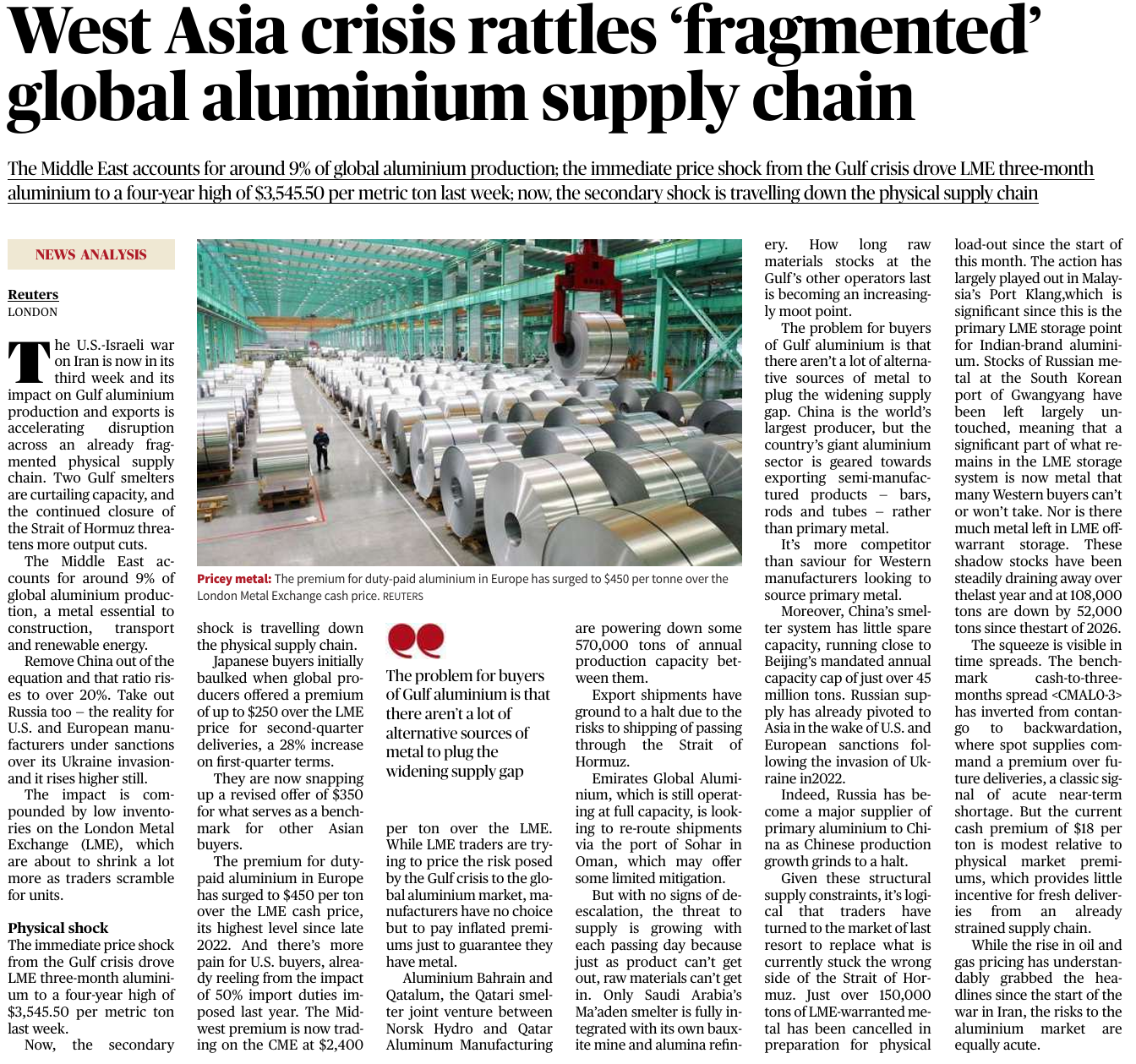 West Asia crisis rattles ‘fragmented’ global aluminium supply chain
GS Paper II:
• International relations – West Asia crisis and global impact
• Effect of external conflicts on India
GS Paper III:
• Industrial sector (metals, core industries)
• Supply chain disruptions
• Economy – inflation, commodities
Context
The ongoing West Asia (Gulf) crisis, particularly tensions involving Iran and disruption in the Strait of Hormuz, has triggered a sharp rise in aluminium prices and exposed vulnerabilities in the already fragmented global aluminium supply chain.
Prelims concepts
1. Aluminium – Key Facts
Non-ferrous metal (does not contain iron)
Extracted from Bauxite ore
Process:
Bauxite → Alumina (Bayer process)
Alumina → Aluminium (Hall-Héroult process)
👉 Prelims Trap: Aluminium production is highly energy-intensive
2. Uses of Aluminium
Construction (lightweight, corrosion-resistant)
Transport (aircraft, automobiles)
Electrical (conductivity)
Renewable energy (solar panels, EVs)
3. London Metal Exchange (LME)
World’s leading market for:
Industrial metals (Aluminium, Copper, Zinc, etc.)
Determines global benchmark prices
👉 Prelims Trap: Not an Indian body (based in London)
4. Primary vs Secondary Aluminium
✔ Primary Aluminium
Produced directly from bauxite
Energy-intensive
✔ Secondary Aluminium
Produced by recycling scrap
Less energy required
5. Supply Chain Fragmentation
Breakdown of integrated global supply chains into:
Regional blocs
Politically aligned trade networks
👉 Caused by:
Wars
Sanctions
Trade restrictions
8. China in Aluminium Market
Largest producer globally
Focuses more on:
Semi-manufactured products (bars, rods, sheets)
👉 Prelims Trap: Not always a major exporter of primary aluminium
Practice MCQ
Q. With reference to aluminium production and trade, consider the following statements:
Aluminium is produced from bauxite through an energy-intensive process.
London Metal Exchange determines benchmark prices for industrial metals.
China is the largest exporter of primary aluminium in the world.
Which of the statements given above is/are correct?
(a) 1 and 2 only
(b) 2 only
(c) 1 and 3 only
(d) 1, 2 and 3
Answer: (a) 1 and 2 only
Explanation:
Statement 1 – Aluminium production from bauxite is highly energy-intensive.
Statement 2 – London Metal Exchange (LME) sets global benchmark prices for metals.
Statement 3 – China mainly exports semi-manufactured aluminium, not primary aluminium.
First an oil shock, now a strong dollar surprise?
GS Paper III:
• Indian economy – external sector
• Inflation, exchange rates, global financial markets
Context
The West Asia conflict and oil shock have triggered a strong appreciation of the U.S. dollar, which has emerged as a safe-haven asset. This unexpected dollar strength is influencing global trade, financial markets, and particularly affecting emerging economies.
Why is the Dollar Strengthening?
U.S. seen as:
Stable economy
Energy self-sufficient
Strong performance of:
U.S. stocks
U.S. bond markets
Dollar outperforming:
Japanese Yen
Swiss Franc (traditional safe havens)
Impact on Emerging Economies (India focus)
1. Currency Depreciation
Rupee weakens against dollar
2. Higher Import Costs
Especially:
Oil imports → inflation
3. External Debt Burden
Countries with dollar-denominated debt suffer:
Higher repayment costs
4. Capital Outflows
Investors shift to U.S. markets
Prelims concepts:
1. Safe-Haven Assets
Assets investors prefer during uncertainty
✔ Examples:
U.S. Dollar
Gold
U.S. Treasury Bonds
Swiss Franc
👉 Prelims Trap: Yen & Swiss franc are safe havens, but USD dominates globally
2. Dollar Index (DXY)
Measures value of U.S. dollar against a basket of major currencies
Includes
Euro, Yen, Pound, etc.
👉 Rise in DXY = Dollar strengthening
3. Dollar Appreciation
When value of USD increases relative to other currencies
Effects:
Imports cheaper for U.S.
Exports costlier for other countries
4. Dollar-Denominated Debt
Loans taken in U.S. dollars
👉 If local currency depreciates:
Repayment becomes costlier
Practice MCQ
Q. With reference to global financial markets, consider the following statements:
A rise in the Dollar Index indicates weakening of the U.S. dollar.
Countries with high dollar-denominated debt are vulnerable when their currency depreciates.
U.S. Treasury bonds are generally considered safe-haven assets.
Which of the statements given above is/are correct?
(a) 2 and 3 only
(b) 1 and 2 only
(c) 1 and 3 only
(d) 1, 2 and 3
Answer: (a) 2 and 3 only
Explanation:
Statement 1 → Rise in Dollar Index = stronger dollar
Statement 2 → Depreciation increases repayment burden
Statement 3 → U.S. bonds are safe assets

 Launch your Graphy