The Hindu Analysis March 15th & 16th March
The Hindu News Analysis – 15th & 16th March, 2026
1. What is the Essential Commodities Act? (GS-3)
2. Building India’s climate resilience with water at the core
(GS-3)
3. U.S. bombs Kharg Island; Iran hits back (GS-2)
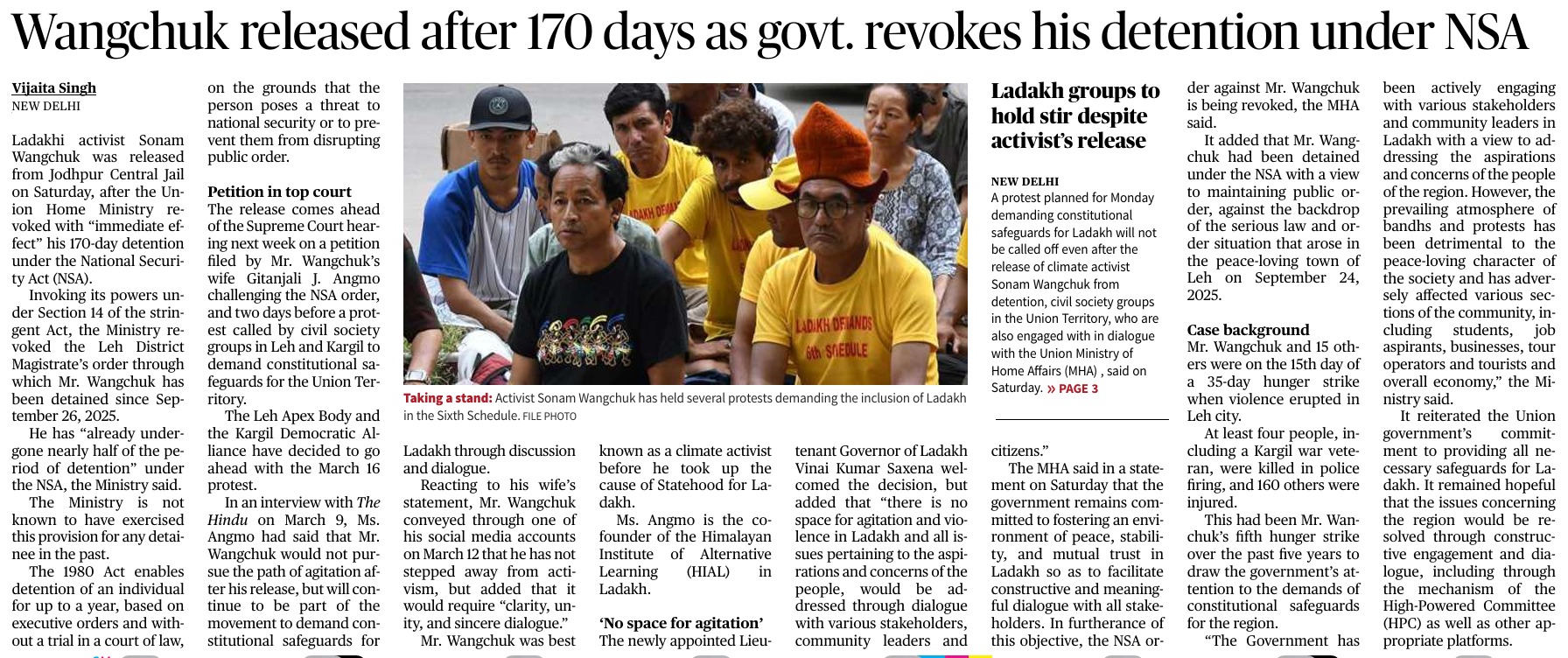
4. Wangchuk released after 170 days as govt. revokes his detention under NSA (GS-2)
5. I41 of 166 tiger deaths in country last year reported in Maharashtra (GS-3)
6. Experts clash over HALEU-Th fuel for Indian nuclear reactors (GS-3)
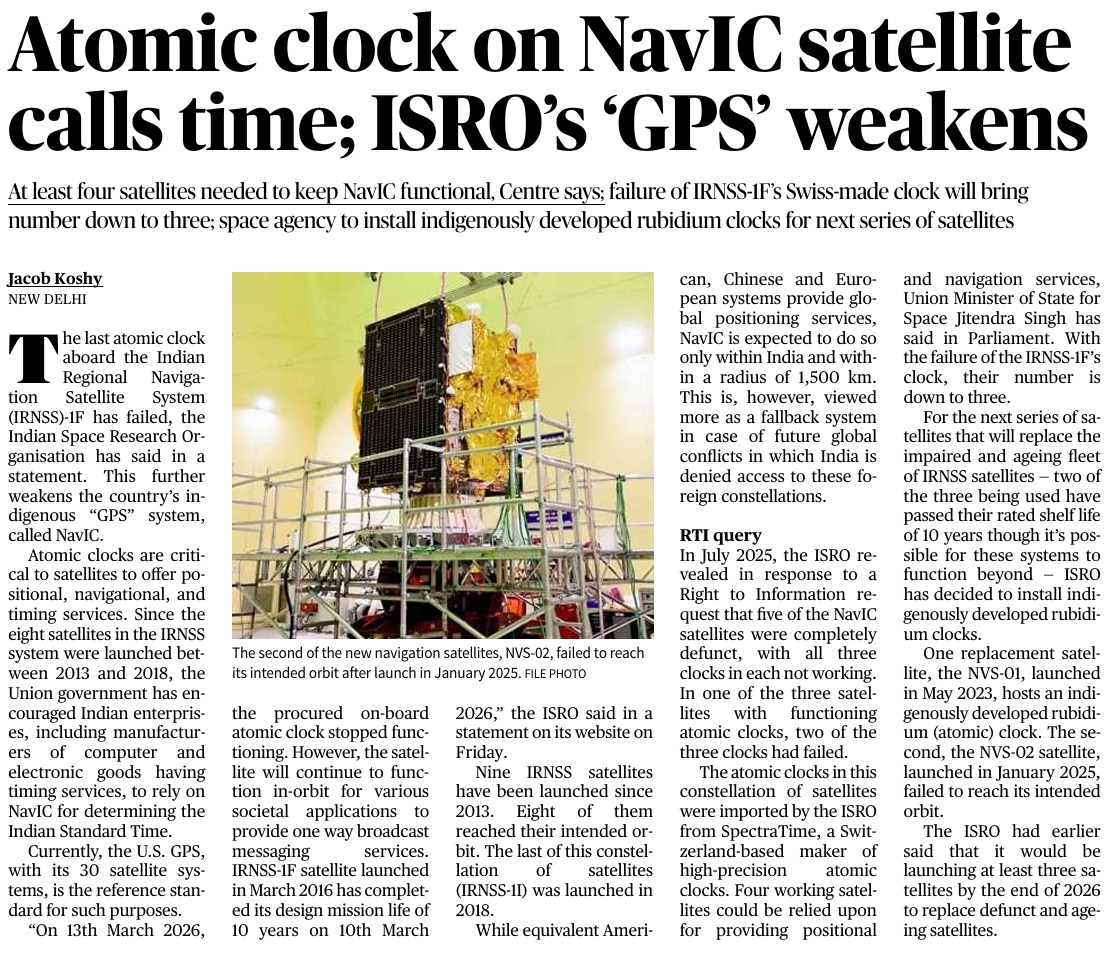
7. Atomic clock on NavIC satellite calls time; ISRO’s ‘GPS’ weakens (GS-3)
8. Pure electoral rolls are bedrock of any democracy, says CEC Gyanesh Kumar (GS-2)
9. Veena exponent Jayanthi Kumaresh to receive Sangita Kalanidhi award at Music Academy’s 100th Conference (GS-1)
10. India-EU ties in focus as Jaishankar visits Brussels (GS-2)
What is the Essential Commodities Act?
GS Paper III:
Food processing and related industries in India
Government policies and interventions for development in various sectors
Energy security
Context
Amid rising geopolitical tensions in West Asia and the disruption risks around the
Strait of Hormuz, the Union government has invoked provisions of the Essential Commodities Act, 1955. The step aims to manage India’s LPG and natural gas supply, increase domestic LPG production, prioritise household consumption, and regulate allocation during potential supply disruptions.
Detailed Analysis:
What is the Essential Commodities Act (ECA), 1955?
The Essential Commodities Act, 1955 empowers the Central Government to regulate the production, supply, distribution, and pricing of commodities considered essential for public welfare.
Key Powers under the Act
Regulate production and supply of essential commodities.
Ensure equitable distribution at fair prices.
Impose stock limits and price controls.
Prevent hoarding, black marketing, and profiteering.
Control storage, transport, and distribution during shortages.
Commodities Covered
The government can notify commodities such as:
Food grains
Edible oils and pulses
Drugs and pharmaceuticals
Fertilisers
Fuels (including LPG or natural gas during crises)
Past Use of the Act
The Act has historically been invoked to manage shortages:
Wheat, sugar, and pulses shortages in the past.
COVID-19 lockdown (2020) to prevent hoarding and black marketing of essential goods.
Why Has the Act Been Invoked Now?
The immediate trigger is geopolitical tensions in West Asia affecting energy supplies.
Key Reasons
Risk to Strait of Hormuz shipping route
About 20% of global oil passes through this chokepoint.
Heavy dependence on imports
India imports around 50% of its LPG consumption.
High dependence on Persian Gulf
Around 90% of LPG imports come through the Strait of Hormuz.
Domestic production gap
India produced 12.8 million tonnes of LPG in 2024–25.
Annual consumption is 31.3 million tonnes.
Natural Gas dependence
India consumes about 189 MMSCMD of gas, with 52% imported.
These vulnerabilities prompted emergency intervention.
How Will the Order Affect LPG Production?
The government issued directives to refineries and petrochemical units.
Key Measures
Diversion of petrochemical feedstock
Propane and butane streams must be used for LPG production instead of petrochemical manufacturing.
Coverage of refineries
Public sector refineries:
Indian Oil Corporation (IOCL)
Bharat Petroleum Corporation Limited (BPCL)
Hindustan Petroleum Corporation Limited (HPCL)
Private sector:
Reliance Industries
Nayara Energy
Exclusive supply for households
LPG from these refineries will be supplied only to Oil Marketing Companies (OMCs) to ensure household supply.
Impact on commercial sector
Commercial LPG supply has been deprioritised, affecting restaurants, hotels, and other businesses.
How Does the Regulation Affect Natural Gas Supply?
The government has created a priority-based gas allocation system.
Allocation Priority
Household PNG (piped natural gas)
Transport sector (CNG)
Gas required for LPG production
Fertiliser sector (70% supply assured)
Industrial sectors (about 80% allocation)
This framework overrides earlier contracts to ensure essential use.
Significance of the Move
Energy security during geopolitical crisis.
Protection of household cooking fuel supply.
Prevention of panic buying and hoarding.
Stabilisation of LPG prices and availability.
Ensuring fertiliser production continuity for agriculture.
Challenges
Impact on petrochemical industries due to diversion of feedstock.
Commercial sector disruption, especially restaurants and hotels.
Dependence on Middle East energy routes remains high.
Limited domestic LPG and gas production capacity.
Way Forward
Diversify import sources beyond the Persian Gulf.
Expand strategic LPG and gas reserves.
Boost domestic gas exploration under policies like HELP and OALP.
Promote renewable energy and electrification of cooking (e.g., induction cooking).
Improve pipeline infrastructure and storage capacity.
Conclusion
The invocation of the Essential Commodities Act, 1955 highlights India’s vulnerability to global energy disruptions. While the measure ensures short-term supply stability for essential sectors, long-term resilience requires diversified energy sources, increased domestic production, and strategic reserves to strengthen India’s energy security.
UPSC Mains Question:
Energy security has become an important dimension of India’s economic policy. In this context, analyse how the Essential Commodities Act can help the government respond to supply disruptions. (250 words)
Source: The Hindu
Building India’s climate resilience with water at the core
GS Paper III:
• Environmental conservation
• Disaster management
• Climate change and its impact
Context
The article discusses outcomes of COP30 at Belém (Brazil) where the Belém Adaptation Indicators were introduced under the UAE Framework for Global Climate Resilience. These indicators emphasise water systems (WASH – Water, Sanitation and Hygiene) as central to climate resilience.
For India, where most climate impacts manifest through water, the framework offers a pathway to integrate water management, infrastructure planning, and climate adaptation policies.
Detailed Analysis
1. Climate Change is Experienced Through Water
The article argues that climate change impacts are most visible through disruptions in water systems.
Major manifestations include:
Floods inundating urban areas
Droughts affecting rural livelihoods
Glacial melt destabilising Himalayan rivers
Saltwater intrusion contaminating coastal aquifers
Erratic monsoons disrupting agriculture and food security
Additional challenge:
Agriculture contributes ~40% of anthropogenic methane emissions through rice cultivation, livestock, and organic waste.
Thus, water management becomes central to climate adaptation and food security.
2. Belém Adaptation Indicators
The 59 Belém Adaptation Indicators aim to move climate resilience from an abstract concept to measurable governance outcomes.
Key focus areas
(a) Climate-resilient water and sanitation systems
Address water scarcity
Build resilience to floods and droughts
Ensure universal access to safe drinking water
Upgrade sanitation systems to withstand climate shocks
(b) Climate-informed water governance
Multi-hazard early warning systems by 2027
Strengthening hydrometeorological services
Updating national water vulnerability assessments by 2030
These indicators aim to institutionalize resilience within governance frameworks.
3. India’s Existing Institutional Foundations
India already has several initiatives aligned with climate-resilient water management.
Jal Shakti governance reforms
Consolidation of water governance under Ministry of Jal Shakti (2019)
Focus on integrated water resource management
National Aquifer Mapping Programme (NAQUIM)
Maps groundwater resources
Supports aquifer-level groundwater management plans
National Mission for Clean Ganga (NMCG)
Integrates sewage treatment, biodiversity conservation, and digital monitoring
Strengthens river ecosystem resilience
These initiatives demonstrate that India is not starting from scratch.
4. Key Challenges to Water-Centred Climate Resilience
1. Uneven water scarcity
Water availability varies widely across regions
Rural and urban areas face different vulnerabilities
2. Climate disasters are largely water-related
Most disasters in India involve water:
Floods
Droughts
Cyclones
Glacial lake outburst floods
Yet WASH infrastructure remains underprepared for extreme events.
3. Fragile adaptation finance
Global climate finance goals aim to mobilize $1.3 trillion annually by 2035, but:
Access to funds remains limited
Water projects are often seen as sectoral infrastructure, not climate investments.
4. Digital fragmentation
Despite vast hydrological and meteorological data, India lacks:
Integrated AI-driven real-time water data systems
Seamless coordination across planning, budgeting, and governance platforms.
5. Belém Indicators as a Governance Tool
The indicators should not be treated as a bureaucratic checklist, but as a strategic dashboard for resilience.
If implemented properly, they can:
Integrate climate adaptation into development planning
Align institutional missions with global climate commitments
Improve monitoring and accountability
6. Water as the Anchor of Climate Action
The article stresses that water must anchor climate policy.
Implementation must be:
Swift
Equitable
Technologically robust
Resilience should be measured by whether water systems continue functioning during climate shocks, such as floods and droughts.
Way Forward
1. Integrate Water and Climate Governance
Climate adaptation should be embedded in water management institutions, budgets, and planning frameworks.
2. Strengthen Climate-Resilient Infrastructure
Develop water systems capable of withstanding:
Floods
Droughts
Extreme weather events
3. Expand Early Warning Systems
Universal multi-hazard early warning systems should be implemented by 2027.
4. Improve Climate Finance Access
Water projects must be recognised as core climate investments to attract adaptation finance.
5. Build Integrated Digital Water Platforms
Use AI-driven real-time hydrological and meteorological data for better decision-making.
6. Promote Community-led Water Governance
Local institutions and communities must be involved in:
Watershed management
Groundwater conservation
Climate adaptation planning.
Conclusion
Climate resilience in India cannot be built without placing water at the centre of policy and governance. With increasing climate variability, ensuring resilient water systems—from groundwater to rivers to urban supply networks—will determine the country’s ability to protect livelihoods, agriculture, and ecosystems.
By aligning domestic reforms with the Belém Adaptation Indicators, India can transform water management into a core pillar of climate adaptation and sustainable development, while also offering a model for the Global South.
UPSC Mains Question
Q. Climate change impacts are largely experienced through water systems. In this context, examine the role of water management in building climate resilience in India. (250 words)
Source: The Hindu
U.S. bombs Kharg Island; Iran hits back
GS Paper II:
• Effect of policies and politics of developed and developing countries on India’s interests
• International relations – important international institutions and geopolitics
Context
Escalating tensions in West Asia have intensified after the United States carried out strikes on
Kharg Island, a crucial hub for Iran’s oil exports. Iran has threatened retaliatory strikes on U.S.-linked oil, economic, and energy infrastructure in the region. The developments raise concerns about the security of the Strait of Hormuz, through which a significant share of global oil trade passes.
About Kharg Island
Location
Kharg Island is a small coral island in Iran located in the northern Persian Gulf.
It lies about 30 km off the Iranian mainland.
The island is positioned close to the Strait of Hormuz, a critical global oil shipping route.
Physical Features
The island is composed mainly of rocky limestone.
It is one of the few Persian Gulf islands with natural freshwater, stored within porous limestone formations.
Highest point: Mount Didehban (about 87 m above sea level).
Climate is hot and humid, typical of the Persian Gulf region.
Development as an Oil Hub
The discovery of offshore oil fields in the early 1960s triggered rapid development.
Pipelines connected the island to:
Offshore oil fields in the Persian Gulf
Oil fields in Khuzistan province in Iran.
By the early 1970s, Kharg became Iran’s largest oil-loading terminal.
Strategic and Economic Importance
Handles about 90% of Iran’s crude oil exports.
Storage capacity: ~28 million barrels of oil.
Loading capacity: ~7 million barrels per day.
Capable of loading 8–9 supertankers simultaneously, including:
VLCC (Very Large Crude Carrier)
ULCC (Ultra Large Crude Carrier).
Historical Significance
During the Iran–Iraq War (1980–1988), the island was repeatedly bombed in the “Tanker War”.
Oil facilities were heavily damaged but reconstructed in the early 1990s.
Strategic Importance
Its proximity to the Strait of Hormuz makes it critical for:
Global oil supply chains
Iran’s economy and energy exports
Geopolitical tensions in West Asia
UPSC Prelims MCQ
Q. Consider the following statements regarding Kharg Island:
It serves as Iran’s largest oil-loading terminal and handles the majority of the country’s crude oil exports.
It lies very close to the Strait of Malacca, making it strategically important for global oil trade.
The island has natural freshwater stored in porous limestone formations.
Which of the statements given above are correct?
A. 1 and 3 only
B. 2 and 3 only
C. 1 only
D. 1, 2 and 3
Answer: A
Explanation
Statement 1 – Correct: Kharg Island is Iran’s main oil export terminal, handling a major share of its crude exports.
Statement 2 – Incorrect: It is near the Strait of Hormuz, not the Strait of Malacca.
Statement 3 – Correct: The island contains freshwater stored in porous limestone, which is unusual for islands in the Persian Gulf.
Source: The Hindu
Wangchuk released after 170 days as govt. revokes his detention under NSA
GS Paper II:
• Indian Constitution – Fundamental Rights
• Parliament and State Legislatures – issues related to preventive detention laws
• Government policies and interventions
Context
Ladakhi climate activist Sonam Wangchuk was released after 170 days of detention when the Union Home Ministry revoked his detention under the National Security Act. The detention had been ordered by the Leh District Magistrate citing threats to public order amid protests in Ladakh demanding constitutional safeguards for the region.
Prelims Concepts:
1. National Security Act (NSA), 1980
National Security Act is a preventive detention law enacted on 23 September 1980.
Allows Central and State Governments to detain a person without formal charges or trial.
Maximum detention period: Up to 12 months.
Detention aims to prevent activities that threaten national security, public order, or essential supplies/services.
Grounds of detention may be withheld for up to 10 days.
Legal representation before the Advisory Board is not allowed.
Detention orders can be issued by District Magistrates or Police Commissioners.
Constitutional Basis
Article 22(3)(b): Permits preventive detention laws.
Article 22(4): Detention beyond 3 months requires approval of an Advisory Board.
Historical Background (Prelims Facts)
Colonial laws: Bengal Regulation III (1818), Defence of India Act (1915), Rowlatt Act (1919).
Post-independence:
Preventive Detention Act, 1950 (expired 1969)
MISA, 1971 (repealed 1978)
NSA enacted in 1980.
2. Sixth Schedule of the Indian Constitution
The Sixth Schedule provides for the administration of tribal areas in:
Assam
Meghalaya
Tripura
Mizoram
Enacted under Article 244(2) and Article 275(1) of the Constitution.
It grants autonomy to tribal communities to protect their culture, land, and resources.
Autonomous Districts and Regions
Tribal areas are organised into Autonomous Districts.
The Governor has the power to:
Create, reorganise, or modify autonomous districts.
Divide districts into Autonomous Regions if multiple tribes exist.
Autonomous District Councils (ADCs)
Each autonomous district has an Autonomous District Council with legislative, administrative, and judicial powers.
Composition
Total Members: 30
26 elected by adult franchise
4 nominated by the Governor
Powers of ADCs
Councils can make laws on:
Land use
Forest management (except reserved forests)
Customary laws and social practices
Village administration
Historical Basis
The Sixth Schedule is based on the recommendations of the Bordoloi Committee (North-East Frontier Tribal and Excluded Areas Sub-Committee of the Constituent Assembly).
UPSC Prelims MCQ
Q. With reference to the Sixth Schedule of the Indian Constitution, consider the following statements:
It provides for the creation of Autonomous District Councils in certain tribal areas of North-East India.
The members of Autonomous District Councils are entirely elected through adult franchise.
The councils can make laws on matters such as land, forests (except reserved forests), and customary laws.
Which of the statements given above are correct?
A. 1 and 3 only
B. 2 and 3 only
C. 1 and 2 only
D. 1, 2 and 3
Answer: A
Explanation
Statement 1 – Correct: Sixth Schedule provides Autonomous District Councils (ADCs) for tribal areas in the North-East.
Statement 2 – Incorrect: Councils have 30 members – 26 elected and 4 nominated by the Governor, so not all are elected.
Statement 3 – Correct: Councils can legislate on land, forests (except reserved forests), village administration, and customary laws.
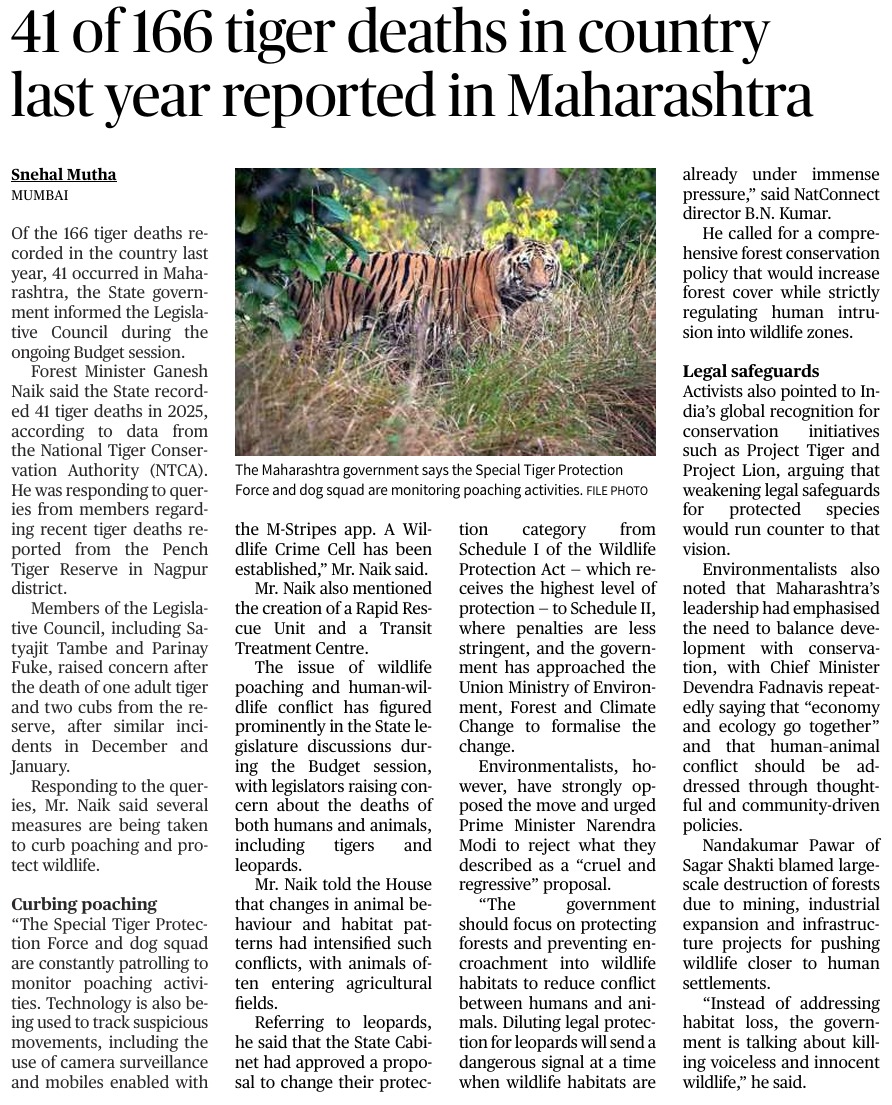
41 of 166 tiger deaths in country last year reported in Maharashtra
GS Paper III:
• Conservation
• Environmental pollution and degradation
• Biodiversity and wildlife protection
Context
Data from the
National Tiger Conservation Authority (NTCA) shows that 41 of the 166 tiger deaths recorded in India in 2025 occurred in Maharashtra. The issue was discussed in the State Legislative Council amid concerns over poaching, habitat loss, and increasing human–wildlife conflict.
Key Points from the Article
1. Rising Tiger Deaths
166 tiger deaths were recorded across India in 2025.
41 deaths occurred in Maharashtra, the highest among states.
Many incidents were reported from Pench Tiger Reserve in Nagpur district.
2. Reasons for Tiger Mortality
Major causes include:
Poaching
Human–wildlife conflict
Habitat fragmentation
Natural causes and territorial fights
Expansion of agriculture and infrastructure into forest areas
Changes in animal behaviour and habitat patterns have increased the chances of animals entering agricultural fields and human settlements.
Measures Taken by Maharashtra Government
Anti-Poaching Measures
Deployment of Special Tiger Protection Force (STPF).
Use of dog squads and patrol teams.
Surveillance using camera traps and the M-STrIPES monitoring system.
Institutional Measures
Establishment of a Wildlife Crime Cell.
Creation of a Rapid Response Unit.
Development of Transit Treatment Centres for injured wildlife.
Prelims Concepts
1. National Tiger Conservation Authority (NTCA)
The National Tiger Conservation Authority is a statutory body under the Wildlife Protection Act.
Established in 2005 following recommendations of the Tiger Task Force.
Functions under the Ministry of Environment, Forest and Climate Change (MoEFCC).
Functions
Implements Project Tiger.
Approves and manages Tiger Reserves in India.
Monitors tiger population and conservation activities.
Provides funding and guidelines to states for tiger protection.
2. Wildlife Protection Act, 1972 – Schedules
The Act classifies species into six schedules with different levels of protection.
Schedule
Protection Level
Schedule I & II
Highest protection, strict penalties
Schedule III & IV
Protected but lower penalties
Schedule V
Vermin species (can be hunted)
Schedule VI
Protected plants
Tiger is listed under Schedule I, receiving the highest level of protection.
3. M-STrIPES (Monitoring System for Tigers – Intensive Protection and Ecological Status)
A software-based monitoring system used by forest departments.
Developed by the National Tiger Conservation Authority (NTCA).
Helps in:
Tracking tiger movements
Monitoring patrol routes
Preventing poaching
Recording ecological data
UPSC Prelims MCQ
Q. With reference to tiger conservation in India, consider the following statements:
The National Tiger Conservation Authority is a statutory body under the Wildlife Protection Act.
Tigers are listed under Schedule I of the Wildlife Protection Act, 1972.
M-STrIPES is a satellite navigation system developed by ISRO to track tigers.
Which of the statements given above are correct?
A. 1 and 2 only
B. 2 and 3 only
C. 1 and 3 only
D. 1, 2 and 3
Answer: A
Explanation
Statement 1 – Correct: NTCA is a statutory body under the Wildlife Protection Act, 1972.
Statement 2 – Correct: Tigers receive the highest protection under Schedule I.
Statement 3 – Incorrect: M-STrIPES is a monitoring software used by forest departments, not a satellite navigation system developed by ISRO.
Experts clash over HALEU-Th fuel for Indian nuclear reactors
GS Paper III:
• Science and Technology – Nuclear technology
• Energy security
• Indigenisation of technology
Context
A study by scientists at the Bhabha Atomic Research Centre (BARC) published in Current Science questioned the viability of using HALEU-Thorium (HALEU-Th) fuel for India’s current nuclear reactors. The study triggered debate among nuclear scientists and industry experts over its safety, technical feasibility, and relevance to India’s nuclear energy programme.
Prelims Concepts
1. HALEU (High Assay Low Enriched Uranium)
HALEU refers to uranium enriched to between 5% and 20% Uranium-235 (U-235).
Conventional nuclear reactors typically use uranium enriched below 5%.
HALEU allows:
Higher burn-up of fuel
Longer reactor operation cycles
Reduced fuel waste
2. Thorium as Nuclear Fuel
Thorium-232 is a fertile material, not directly fissile.
It converts into Uranium-233, which can sustain nuclear reactions.
India has large thorium reserves, especially in monazite sands along the Kerala and Tamil Nadu coasts.
Importance for India
Central to India’s three-stage nuclear power programme.
3. Pressurised Heavy Water Reactor (PHWR)
India’s most common nuclear reactor design.
Uses:
Natural uranium as fuel
Heavy water (D₂O) as moderator and coolant
Features
Does not require enriched uranium.
Forms the backbone of India’s current nuclear power fleet.
4. India’s Three-Stage Nuclear Power Programme
Developed by Homi J. Bhabha to utilise India’s limited uranium and large thorium reserves.
Stage
Reactor Type
Fuel
Stage 1
PHWR
Natural uranium
Stage 2
Fast Breeder Reactors
Plutonium
Stage 3
Thorium-based reactors
Uranium-233 from thorium
UPSC Prelims MCQ
Q. With reference to nuclear fuel technology, consider the following statements:
HALEU (High Assay Low Enriched Uranium) contains uranium enriched between 5% and 20% of Uranium-235.
Thorium-232 is a fissile material that can directly sustain a nuclear chain reaction.
Pressurised Heavy Water Reactors (PHWRs) in India generally use natural uranium as fuel.
Which of the statements given above are correct?
A. 1 and 3 only
B. 2 and 3 only
C. 1 and 2 only
D. 1, 2 and 3
Answer: A
Explanation
Statement 1 – Correct: HALEU is uranium enriched to 5–20% U-235.
Statement 2 – Incorrect: Thorium-232 is fertile, not fissile; it converts to Uranium-233 to sustain reactions.
Statement 3 – Correct: India’s PHWR reactors use natural uranium and heavy water as moderator/coolant.
Atomic clock on NavIC satellite calls time; ISRO’s ‘GPS’ weakens
GS Paper III:
• Science and Technology – Space technology
• Indigenisation of technology
• Applications of satellite technology
Context
The failure of the last atomic clock onboard **NavIC satellite IRNSS-1F has reduced the number of operational satellites capable of providing positioning services. This weakens India’s indigenous navigation system, prompting Indian Space Research Organisation (ISRO) to plan replacement satellites with indigenously developed rubidium atomic clocks.
Prelims Concepts:
1. IRNSS – NavIC
NavIC (IRNSS) is an independent regional navigation satellite system developed by the Indian Space Research Organisation (ISRO).
Designed to provide accurate position, navigation, and timing services in India and surrounding regions.
Coverage Area
Primary Service Area: India and up to 1,500 km beyond its borders.
Extended Service Area: Between
30° South – 50° North latitude
30° East – 130° East longitude.
Satellite Constellation
Total 7 satellites in the NavIC constellation.
3 satellites placed in Geosynchronous Orbit (GSO).
4 satellites placed in Inclined Geosynchronous Orbit (IGSO).
Services Provided
Standard Positioning Service (SPS)
Available to all civilian users.
Restricted Service (RS)
Encrypted service for authorised users (mainly defence).
Frequency Bands Used
L5 band
S band
Accuracy
Expected positioning accuracy of better than 20 metres in the primary service area.
Interoperability with Other GNSS
NavIC signals are interoperable with global navigation systems such as:
GPS (USA)
GLONASS (Russia)
Galileo (EU)
BeiDou (China)
2. Atomic Clock in Navigation Satellites
Atomic clocks provide precise timing signals needed to calculate location accurately.
Even nanosecond errors can lead to large positioning errors.
Type Used: Rubidium atomic clocks are commonly used in navigation satellites.
UPSC Prelims MCQ
Q. With reference to NavIC, consider the following statements:
It provides positioning services over India and up to about 1,500 km beyond its borders.
It uses satellites placed only in Geostationary Orbit.
Atomic clocks onboard the satellites provide precise timing for navigation.
Which of the statements given above are correct?
A. 1 and 3 only
B. 2 and 3 only
C. 1 and 2 only
D. 1, 2 and 3
Answer: A
Explanation
1 – Correct: NavIC covers India and ~1500 km around it.
2 – Incorrect: Satellites are placed in both GEO and GSO orbits.
3 – Correct: Atomic clocks are essential for accurate positioning.
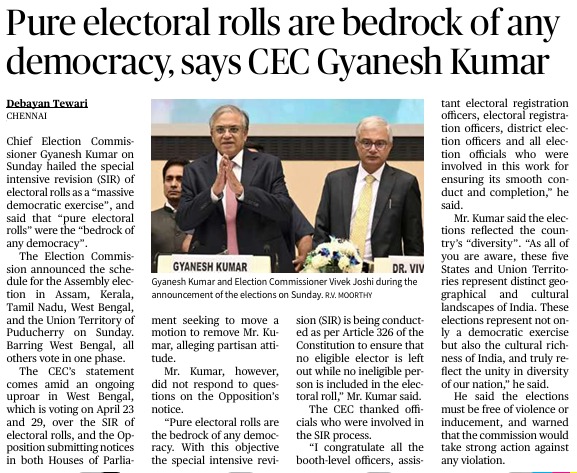
Pure electoral rolls are bedrock of any democracy, says CEC Gyanesh Kumar
GS Paper II:
• Appointment to various Constitutional posts, powers, functions and responsibilities of various Constitutional Bodies
• Issues related to electoral reforms
Context
The Chief Election Commissioner (CEC) Gyanesh Kumar emphasized that accurate and clean electoral rolls are the foundation of a democratic system. The statement comes amid the Special Intensive Revision (SIR) of electoral rolls announced by the Election Commission of India (ECI) ahead of elections in Assam, Kerala, Tamil Nadu, West Bengal, and Puducherry. The move has also sparked political debate and opposition criticism.
Prelims Concepts
1. Electoral Roll (Voter List)
An electoral roll is the official list of persons eligible to vote in an election.
Prepared and maintained by the Election Commission of India (ECI).
Only those whose names appear in the electoral roll of a constituency can vote.
Governed primarily by the Representation of the People Act, 1950.
Key features
Separate electoral roll for each constituency.
Continuous updating to include new voters (18+) and remove deceased or shifted voters.
Citizens can apply for inclusion through Form 6.
2. Special Intensive Revision (SIR) of Electoral Rolls
A comprehensive revision exercise conducted by the Election Commission to ensure accuracy and purity of voter lists.
Objectives
Remove duplicate entries
Delete names of deceased or ineligible voters
Add new eligible voters
Correct demographic details
Officials involved
Electoral Registration Officer (ERO)
Assistant Electoral Registration Officer (AERO)
Booth Level Officer (BLO)
District Election Officer (DEO)
3. Election Commission of India (ECI)
A constitutional body responsible for conducting elections to:
Lok Sabha
Rajya Sabha
State Legislatures
President
Vice-President
Constitutional Provision
Article 324: Provides the superintendence, direction, and control of elections to the ECI.
Composition
Chief Election Commissioner (CEC)
Election Commissioners (ECs)
Appointment
Appointed by the President of India.
4. Representation of the People Acts
Representation of the People Act, 1950
Deals with allocation of seats and preparation of electoral rolls.
Representation of the People Act, 1951
Deals with conduct of elections, qualifications and disqualifications of candidates, and election disputes.
UPSC Prelims MCQ
Q. With reference to the Electoral Rolls in India, consider the following statements:
Electoral rolls are prepared and maintained under the Representation of the People Act, 1950.
Only citizens whose names appear in the electoral roll of a constituency are eligible to vote in that constituency.
Preparation and revision of electoral rolls are carried out under the supervision of the Election Commission of India.
Which of the statements given above are correct?
A. 1 and 2 only
B. 2 and 3 only
C. 1 and 3 only
D. 1, 2 and 3
Answer: D
Explanation:
The Representation of the People Act, 1950 governs preparation and revision of electoral rolls.
A person can vote only if their name appears in the electoral roll of that constituency.
The process is supervised by the Election Commission of India under Article 324.
Veena exponent Jayanthi Kumaresh to receive Sangita Kalanidhi award at Music Academy’s 100th Conference
GS Paper I:
• Indian culture – salient aspects of Art Forms, Literature and Architecture from ancient to modern times
Context
The Music Academy, Chennai announced that renowned veena exponent Jayanthi Kumaresh will receive the prestigious Sangita Kalanidhi award during the 100th Conference and Concerts of the Music Academy, scheduled in December. The announcement marks a significant milestone in the history of Carnatic music institutions and awards.
About Sangita Kalanidhi Award:
It is considered the highest award in the field of Carnatic music.
The award is conferred by the Madras Music Academy.
The award comprises a gold medal and a birudu patra (citation).
It is a landmark institution in the history of the fine arts. It emerged as an offshoot of the All India Congress Session held in Madras in December 1927.
What is Carnatic Music?
Carnatic music is commonly associated with southern India including the states of Andhra Pradesh, Telangana, Karnataka, Kerala, and Tamil Nadu, but also practised in Sri Lanka.
It is one of two major genres of Indian classical music that evolved from ancient Hindu traditions, the other being Hindustani music, which emerged as a distinct form in northern India as a result of Persian and Islamic influences.
UPSC Prelims MCQ
Q. With reference to the Sangita Kalanidhi Award, consider the following statements:
It is considered the highest award in the field of Carnatic music.
It is conferred by the Madras Music Academy.
The award consists of a gold medal and a birudu patra (citation).
Which of the statements given above are correct?
A. 1 only
B. 1 and 2 only
C. 2 and 3 only
D. 1, 2 and 3
Answer: D
Explanation:
All the statements are correct. Sangita Kalanidhi is regarded as the highest honour in Carnatic music, awarded by the Madras Music Academy, and it includes a gold medal and a birudu patra (citation).
India-EU ties in focus as Jaishankar visits Brussels
GS Paper II:
• India and its neighbourhood-relations
• Bilateral, regional and global groupings and agreements involving India and/or affecting India’s interests
Context
External Affairs Minister S. Jaishankar visited Brussels for talks with senior leaders of the European Union. The visit aims to strengthen India-EU relations and advance negotiations on the proposed Free Trade Agreement (FTA) between India and the EU.
Purpose of the Visit
The visit focuses on strengthening India-EU strategic and economic cooperation.
Key engagements:
Meeting with Kaja Kallas (Vice-Prsident of the European commission)
Participation in the India-EU Ministerial Meeting involving foreign ministers of EU member states.
Discussions on advancing negotiations for the India-EU Free Trade Agreement.
India-EU Free Trade Agreement (FTA)
India and the EU resumed FTA negotiations in 2022 after a long pause.
Objectives:
Expand trade and investment flows.
Reduce tariffs and regulatory barriers.
Improve market access for goods and services.
Potential benefits:
Greater access for Indian IT, pharmaceuticals, and services sectors.
Increased European investment in manufacturing, technology, and green energy.
Strategic Importance of India-EU Relations
The EU is one of India’s largest trading partners and a major source of foreign investment.
Areas of cooperation:
Trade and economic partnerships
Climate and clean energy transition
Digital governance and technology
Maritime security and Indo-Pacific cooperation
Schengen Area
A group of European countries that have abolished internal border controls.
Allows passport-free travel between participating states.
Key point for prelims:
Not all EU countries are in the Schengen Area, and some non-EU countries are part of Schengen.
UPSC Prelims MCQ:
Q. Consider the following statements about India–EU relations:
The EU’s Carbon Border Adjustment Mechanism (CBAM) imposes carbon-linked charges on selected industrial imports, including sectors such as steel and aluminium.
India seeks tariff cuts in competitive export sectors, while the EU prioritises regulatory alignment in digital and data standards.
Which of the statements given above is/are correct?
A. 1 only
B. 2 only
C. Both 1 and 2
D. Neither 1 nor 2
Answer: C. Both 1 and 2
Exp:
CBAM applies carbon charges to steel, aluminium, cement, fertilisers, hydrogen, and electricity. These are the primary sectors covered under the mechanism. Hence, Statement I is correct.
India aims for tariff concessions in textiles, pharma, chemicals, digital services. EU seeks regulatory harmonisation in areas like digital privacy, data governance, and environmental standards. Hence, Statement II is correct.






 Launch your Graphy