The Hindu Analysis March 12th & 13th March
The Hindu News Analysis – 12th & 13th March, 2026
1. A revision of GDP and its implications (GS-3)
2. Holding up half the sky on India’s farms (GS-2 & GS-3)
3. Global energy concerns mount as Iran hits ships
(GS-2 & GS-3)
4. SC upholds ‘right to die’ for man in vegetative state (GS-2)
5. RSP gets highest number of votes, says Nepal’s EC
(GS-2)
6. SC to study what constitutes ‘personal data’ in DPDP laws
(GS-2)
7. India co-sponsors resolution passed by UNSC against Iran
(GS-2)
8. VBSA Bill is a ‘solution’ to current challenges, says UGC
(GS-2)
9. ‘Parental income alone cannot set creamy layer status’
(GS-2)
A revision of GDP and its implications
GS Paper III:
• Indian Economy and issues relating to planning, mobilisation of resources, growth, development and employment
• National Income accounting and statistical indicators
Context
The National Statistical Office (NSO) has released a revised GDP series with 2022-23 as the new base year, replacing the earlier 2011-12 base year series. The revision aims to better reflect structural changes in the Indian economy and improve statistical accuracy. However, the revision has also reopened debates about the reliability of past GDP estimates and methodological transparency.
Gross Domestic Product (GDP)
1. Meaning of GDP
Gross Domestic Product (GDP) is the total monetary value of all final goods and services produced within a country’s geographical boundaries during a specific period (usually one year).
It is the most widely used indicator to measure the size and performance of an economy.
In India, GDP is estimated by the National Statistical Office (NSO) under the Ministry of Statistics and Programme Implementation (MoSPI).
2. Key Features of GDP
Measures economic activity within a country.
Includes only final goods and services to avoid double counting.
Calculated for a specific time period (quarterly or annually).
Includes output produced by domestic and foreign firms operating within the country.
Expressed in monetary terms.
3. Methods of Calculating GDP
There are three standard approaches used to calculate GDP.
1. Production (Value Added) Method
GDP is calculated as the sum of Gross Value Added (GVA) of all sectors.
Formula:
GDP=GVA+Taxes on products−Subsidies on productsGDP = GVA + Taxes\ on\ products - Subsidies\ on\ productsGDP=GVA+Taxes on products−Subsidies on products
Where GVA represents value added by agriculture, industry, and services sectors.
2. Income Method
GDP is calculated by adding all incomes earned in the economy.
Components include:
Wages and salaries
Rent
Interest
Profits
3. Expenditure Method
GDP is measured as the total spending on final goods and services.
GDP=C+I+G+(X−M)GDP = C + I + G + (X - M)GDP=C+I+G+(X−M)
Where:
C = Consumption expenditure
I = Investment expenditure
G = Government expenditure
X = Exports
M = Imports
4. Types of GDP
1. Nominal GDP
Measured at current market prices.
Includes the impact of inflation.
2. Real GDP
Measured at constant prices using a base year.
Reflects the actual growth of the economy.
5. Difference Between GDP and GVA
Aspect
GDP
GVA
Meaning
Total value of final goods and services
Value added by producers
Formula
GDP = GVA + taxes − subsidies
Sector-wise output minus intermediate consumption
Use
Measures overall economic size
Shows sectoral performance
Detailed Analysis
1. Why GDP Series is Revised Periodically
GDP estimates are revised every 5–10 years to ensure that economic measurement reflects structural changes.
Key reasons:
Change in production patterns and emergence of new sectors.
Improved data availability and updated methodologies.
Alignment with United Nations System of National Accounts (SNA) standards.
Updating base year prices to remove distortions caused by inflation.
Thus, rebasing helps in producing more accurate estimates of real economic activity.
2. Key Changes in the New GDP Series
a) Reduction in the Absolute Size of GDP
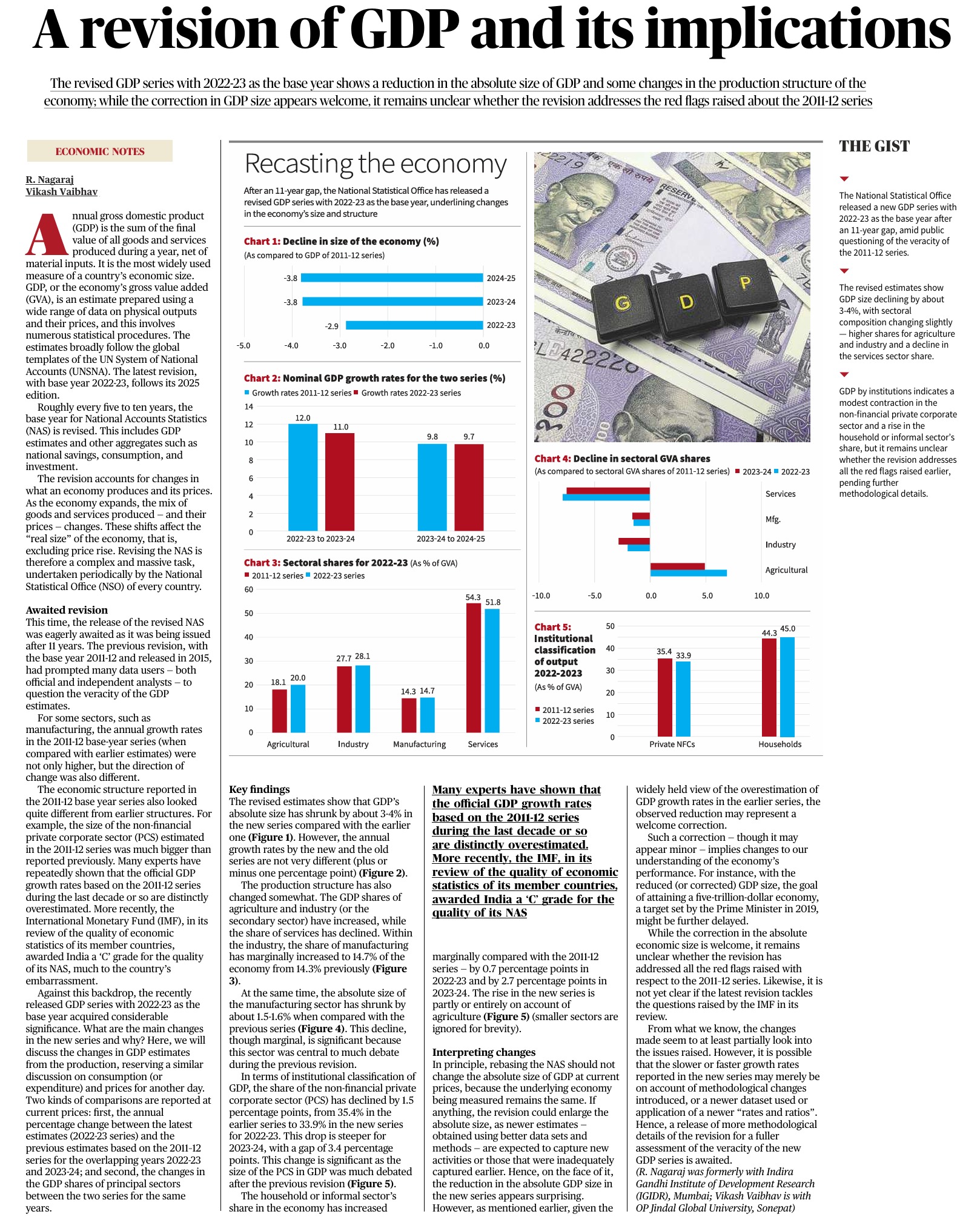
The revised estimates show GDP size declining by about 3–4% compared with the earlier series.
This does not mean the economy shrank; rather, it reflects improved measurement methods and data corrections.
b) Changes in Sectoral Composition
The revised data indicate shifts in sectoral contributions:
Agriculture and Industry shares increased slightly
Services share declined marginally
Within industry, manufacturing share increased slightly
This suggests that the earlier series may have overestimated services sector expansion.
3. Institutional Composition Changes
The revision also altered the institutional classification of output:
Non-financial private corporate sector share declined.
Household/informal sector share increased.
This change is important because the earlier series had been criticized for overestimating formal corporate sector output.
4. Growth Rates: Old vs New Series
While the absolute GDP level changed, the growth rates remain broadly similar between the two series.
Example:
Growth rates in the 2022-23 to 2024-25 period show only minor differences between the old and new series.
This suggests that economic growth trends remain largely unchanged, even though measurement adjustments were made.
5. Concerns about the Earlier GDP Series
The 2011-12 series faced significant criticism from economists and institutions:
Mismatch with ground-level indicators
Weak private investment
Low credit growth
Job stagnation
Overestimation concerns
Several economists argued growth rates were inflated during the 2010s.
International criticism
The IMF review of India’s macroeconomic statistics reportedly gave “C grade” for quality of national accounts statistics, raising questions about methodology.
The new revision partly responds to these concerns.
6. Interpretation of the GDP Revision
Rebasing should ideally not change the economy itself, only improve measurement.
Possible interpretations:
Statistical correction: Better datasets replaced older proxies.
Improved coverage: New sectors or activities captured more accurately.
Methodological refinement: Updated estimation techniques.
However, the article notes that methodological transparency remains limited, making it difficult to fully evaluate the changes.
7. Implications for India’s Economy
a) Economic Size
With the revised lower GDP size, India’s progress toward becoming a $5 trillion economy could take slightly longer.
b) Policy Planning
Better data helps in designing fiscal and industrial policies.
c) Credibility of Economic Statistics
Accurate GDP data improves investor confidence and international credibility.
d) Understanding Structural Transformation
The revision provides a more realistic picture of sectoral contributions, particularly manufacturing and informal sectors.
8. Remaining Issues
Despite the revision, several concerns persist:
Limited disclosure of methodology
Uncertainty about whether the revision fully addresses earlier criticisms
Need for greater transparency in data sources and estimation techniques
Without detailed methodological notes, the revision cannot be fully assessed by researchers.
Conclusion
The rebasing of India’s GDP series to 2022-23 is a necessary step in updating national accounts and correcting possible distortions in earlier estimates. While the revision shows a slightly smaller economy and changes in sectoral composition, the overall growth trajectory remains broadly similar. However, greater methodological transparency and improved statistical capacity are essential to enhance the credibility of India’s economic data and ensure informed policymaking.
UPSC Mains Question
Q. Periodic revision of GDP base year is essential for accurate measurement of economic performance. In this context, examine the implications of India’s recent GDP series revision with 2022–23 as the base year. (15 Marks, 250 words)
Source: The Hindu
Holding up half the sky on India’s farms
GS Paper II:
• Role of women and women’s organisations
GS Paper III:
• Agriculture and allied sectors
• Inclusive growth and issues related to employment
Context
The article highlights the critical role played by women in India’s agricultural economy and the paradox that despite their large participation in farming and allied activities, women remain undercounted, underpaid, and undervalued. It draws on village-level surveys and labour statistics to show that women form a substantial share of the agricultural workforce but face low wages, limited asset ownership, and inadequate policy recognition.
Detailed Analysis:
Challenges
1. Underestimation of Women’s Work
Official surveys such as the Periodic Labour Force Survey (PLFS) often fail to capture the full extent of women’s agricultural labour.
Women’s work is frequently home-based, seasonal, unpaid, or intertwined with care work, leading to underreporting.
Many women engaged in farming do not identify themselves as “workers.”
2. Rising Informal and Self-Employment
A large proportion of rural women workers are classified as self-employed rather than wage workers.
Self-employment rose from 60% in 2011-12 to about 73% in 2023-24.
This reflects lack of wage employment opportunities rather than entrepreneurial empowerment.
3. Gender Wage Gap
Women agricultural workers earn significantly less than men.
Example from the article:
Women workers earned less than ₹300 per day in surveyed villages.
Average national wage for women agricultural labourers was ₹384 per day (Labour Bureau).
Women’s wages in some regions were less than half of men’s wages.
4. Low Earnings from Livestock Activities
Women are the primary workers in livestock rearing, especially dairy and poultry.
However, estimated earnings from livestock were very low (around ₹100 per day in some cases).
Much of this labour remains unpaid family labour.
5. Limited Asset Ownership
Despite heavy participation in agriculture, only about 10% of rural women own land.
Lack of land ownership restricts:
Access to credit
Eligibility for government schemes
Decision-making power in farming.
6. Mechanisation and Decline of Wage Labour
Mechanisation in agriculture has reduced demand for labour.
Women, who are largely engaged in manual agricultural tasks, are disproportionately affected.
Economic Contribution of Women to Indian Agriculture: Significance
1. Major Share in Agricultural Workforce
Women constitute nearly half of India’s agricultural workforce.
In crop cultivation and livestock rearing, women perform a large share of manual tasks.
2. Backbone of Livestock Sector
Women are the primary workforce in dairy and poultry, which are among the fastest-growing segments of agriculture.
3. Contribution to Food Security
Women’s labour sustains crop production, livestock care, and household nutrition, making them central to food security and rural livelihoods.
4. Rural Economic Stability
Their work supports household incomes and resilience, particularly in smallholder farming systems.
Way Forward
1. Better Data Collection
Improve labour surveys to capture women’s unpaid and informal agricultural work.
Use time-use surveys and gender-disaggregated data.
2. Strengthening Wage Protection
Enforce equal wages for equal work under labour laws.
Expand minimum wage coverage in agriculture.
3. Enhancing Land and Asset Ownership
Promote joint land titles for women farmers.
Improve women’s access to credit, insurance, and agricultural inputs.
4. Skill Development and Mechanisation Access
Provide training in modern agricultural technologies.
Ensure women’s access to farm machinery and extension services.
5. Recognition of Women Farmers
Officially recognise women as “farmers” rather than only labourers.
Ensure their inclusion in schemes such as crop insurance, PM-KISAN, and agricultural subsidies.
Conclusion
Women are the backbone of India’s agricultural economy, contributing significantly to crop cultivation, livestock rearing, and rural livelihoods. However, their labour remains invisible, undervalued, and poorly remunerated. Addressing data gaps, improving wages, enhancing land rights, and recognising women as farmers are essential steps toward achieving inclusive and gender-equitable agricultural development.
UPSC Mains Question
Q. Women play a crucial role in sustaining India’s agricultural economy, yet their contribution remains largely unrecognised and undervalued. Discuss the issues faced by women in agriculture and suggest measures to address them. (15 Marks, 250 words)
Source: The Hindu
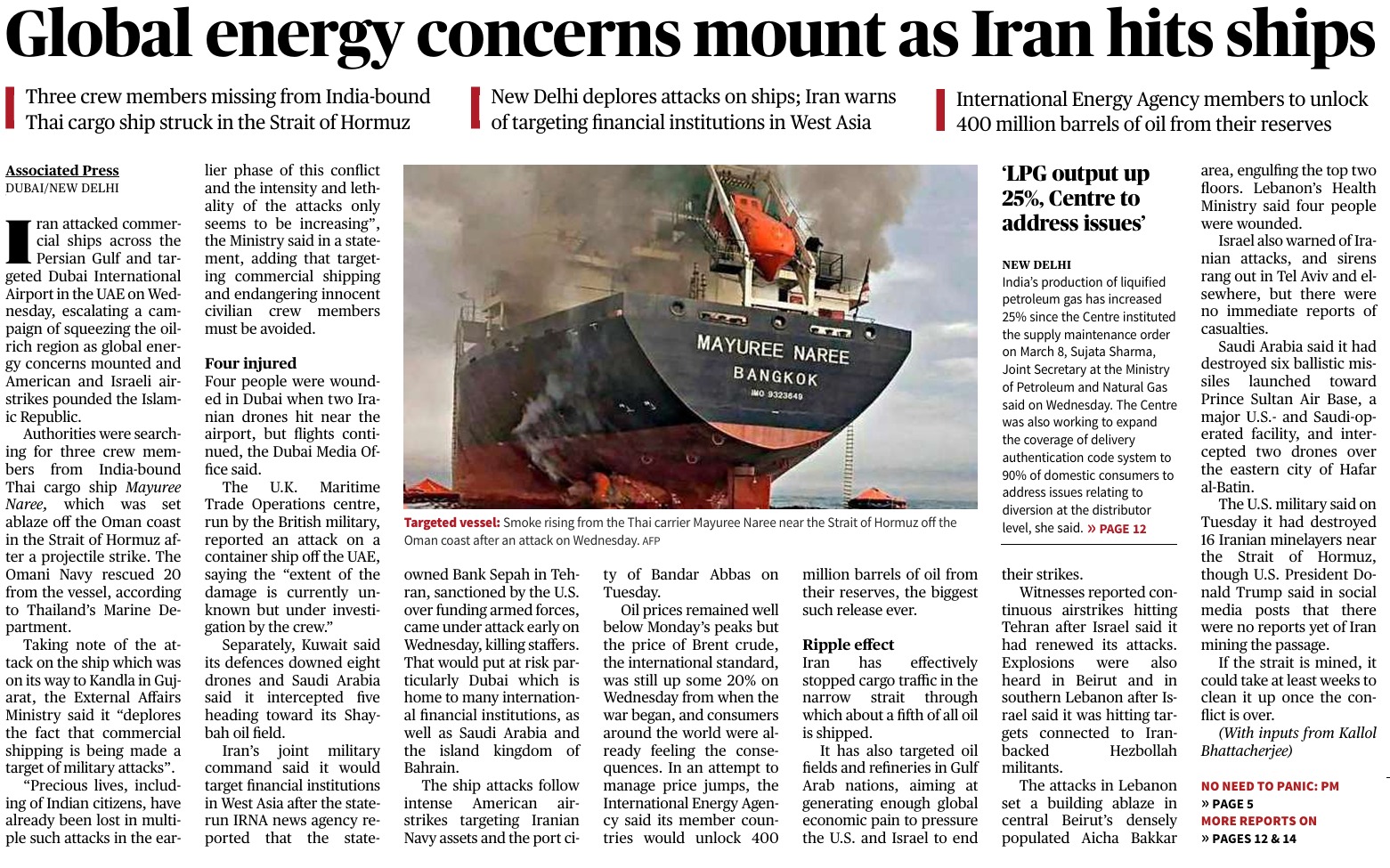 Global energy concerns mount as Iran hits ships
GS Paper II:
• India and its neighbourhood – relations
• Effect of policies and politics of developed and developing countries on India’s interests
GS Paper III:
• Energy security
• Infrastructure: Energy
• Impact of global conflicts on the Indian economy
Context
Iran has launched attacks on commercial ships in the Persian Gulf and the Strait of Hormuz, including an India-bound Thai cargo ship (Mayuree Naree). The escalation is linked to the wider Iran–Israel conflict, raising global concerns about energy security, maritime trade, and oil supply disruptions, as the Strait of Hormuz is one of the world’s most critical oil transit chokepoints.
Prelims Concepts
1. Strait of Hormuz
The Strait of Hormuz is a narrow waterway connecting the Persian Gulf with the Gulf of Oman and the Arabian Sea.
It lies between Iran (north) and Oman & UAE (south).
It is one of the most important global oil chokepoints.
Key Facts
Nearly 20% of global oil trade passes through this strait.
Major oil exporters using this route include Saudi Arabia, Iraq, Kuwait, UAE, and Iran.
The strait is only about 33 km wide at its narrowest point, with limited shipping lanes.
Strategic Petroleum Reserves (SPR)
Strategic Petroleum Reserves are emergency oil stocks maintained by governments to tackle supply disruptions or price shocks.
Purpose
Energy security during wars or crises
Stabilizing domestic fuel prices
Ensuring uninterrupted supply
India’s Strategic Petroleum Reserve Locations
Visakhapatnam (Andhra Pradesh)
Mangaluru (Karnataka)
Padur (Karnataka)
Additional sites planned:
Chandikhol (Odisha)
Padur Phase-2
International Energy Agency (IEA)
Established in 1974 after the 1973 oil crisis.
Headquarters: Paris, France.
Functions
Ensures energy security among member countries.
Coordinates release of strategic oil reserves during crises.
Provides energy policy analysis and forecasts.
Global Oil Chokepoints
Important chokepoints frequently asked in UPSC:
Chokepoint
Location
Strait of Hormuz
Persian Gulf – Gulf of Oman
Strait of Malacca
Indian Ocean – South China Sea
Bab-el-Mandeb
Red Sea – Gulf of Aden
Suez Canal
Mediterranean Sea – Red Sea
Bosporus Strait
Black Sea – Mediterranean
UPSC Prelims MCQ
Q. With reference to Strategic Petroleum Reserves (SPR) in India, consider the following statements:
Strategic Petroleum Reserves are emergency crude oil stocks maintained to address supply disruptions.
In India, Strategic Petroleum Reserves are managed by the Indian Strategic Petroleum Reserves Limited (ISPRL).
All the existing Strategic Petroleum Reserve facilities in India are located along the eastern coast.
Which of the statements given above are correct?
A. 1 only
B. 1 and 2 only
C. 2 and 3 only
D. 1, 2 and 3
Correct Answer: B
Explanation
Statement 1 – Correct: SPRs are stored to handle oil supply shocks, wars, or global crises.
Statement 2 – Correct: They are managed by Indian Strategic Petroleum Reserves Limited (ISPRL) under the Ministry of Petroleum and Natural Gas.
Statement 3 – Incorrect: India’s SPR facilities are located at
Visakhapatnam (Andhra Pradesh)
Mangaluru (Karnataka)
Padur (Karnataka)
Since two are on the western coast, not all are on the eastern coast.
SC upholds ‘right to die’ for man in vegetative state
GS Paper II:
• Judiciary and its functioning
• Fundamental Rights
• Issues relating to health and ethical governance
Context
The Supreme Court of India upheld the right to die with dignity for a 32-year-old man who had been in a persistent vegetative state (PVS) for nearly 13 years. The Court allowed the withdrawal of Clinically Assisted Nutrition and Hydration (CANH) as part of passive euthanasia, following the constitutional principles laid down in earlier judgments.
1. What is Passive Euthanasia
Passive euthanasia refers to withdrawing or withholding life-sustaining treatment when recovery is impossible.
It differs from active euthanasia, where a deliberate act is done to end life.
In this case, the Court allowed withdrawal of CANH, which sustains life in patients who cannot eat or drink.
2. Constitutional Basis
The decision is rooted in Article 21 of the Constitution.
Article 21:
Right to life includes the right to live with dignity, and therefore also the right to die with dignity in certain circumstances.
The Court emphasized that allowing a patient in irreversible medical condition to die naturally preserves human dignity.
3. Supreme Court Guidelines on Passive Euthanasia
The judgment follows the landmark 2018 Supreme Court Constitution Bench ruling in the Common Cause case, which recognised:
Passive euthanasia as legally permissible
Validity of living wills (advance medical directives)
Key safeguards include:
Approval by medical boards
Judicial oversight
Protection against misuse.
4. Court’s Observations in the Case
The Court observed that:
The patient had irreversible brain injury and remained in a vegetative state for over a decade.
The family had made sincere efforts for long-term care.
Allowing withdrawal of treatment was an act of compassion and dignity, not abandonment.
The Court also directed that the patient be shifted to palliative care.
5. Ethical and Legal Issues Involved
Ethical concerns
Balancing sanctity of life vs dignity in death
Preventing misuse of euthanasia provisions
Legal concerns
Ensuring strict procedural safeguards
Avoiding coercion or financial motivations.
6. Importance of the Judgment
Reinforces patient autonomy and dignity.
Strengthens implementation of living wills in India.
Provides clarity on end-of-life medical decisions.
Promotes palliative care as a humane alternative.
UPSC Prelims MCQ
Q. With reference to euthanasia in India, consider the following statements:
Passive euthanasia involves withdrawing or withholding life-sustaining treatment from a patient.
Active euthanasia is legally permitted in India under certain circumstances.
The Supreme Court has recognised the validity of living wills (advance medical directives).
Which of the statements given above are correct?
A. 1 only
B. 1 and 3 only
C. 2 and 3 only
D. 1, 2 and 3
Correct Answer: B
Explanation
Statement 1 – Correct: Passive euthanasia refers to withdrawing life-support such as ventilators, feeding tubes, etc.
Statement 2 – Incorrect: Active euthanasia is illegal in India.
Statement 3 – Correct: In the 2018 Common Cause judgment, the Supreme Court recognised living wills and allowed passive euthanasia under strict safeguards.
RSP gets highest number of votes, says Nepal’s EC
GS Paper II:
• India and its neighbourhood – relations
• Political developments in neighbouring countries
Context
The Rastriya Swatantra Party (RSP) secured the highest votes under the Proportional Representation system in Nepal’s parliamentary elections, which use a mixed FPTP–PR electoral system.
The rise of the Rastriya Swatantra Party, led by Rabi Lamichhane, reflects growing public support—especially among younger and urban voters—for a new generation of leadership (often described as Gen-Z/young leadership politics). Many voters in Nepal are increasingly seeking fresh political alternatives beyond traditional parties, indicating a shift in the country’s political landscape.
Significance
1. Rise of New Political Forces
The strong performance of RSP reflects public dissatisfaction with traditional parties.
2. Changing Political Landscape
Nepal’s politics is witnessing fragmentation and emergence of new political actors.
3. Implications for Governance
Coalition governments may become more common due to multi-party representation.
4. Regional Importance
Political stability in Nepal is significant for India’s neighbourhood policy and regional diplomacy.
SC to study what constitutes ‘personal data’ in DPDP laws
GS Paper II:
• Judiciary and its role in interpretation of laws
• Fundamental Rights – Right to Privacy
• Government policies and interventions for development in various sectors (Data Protection Law)
Context
The Supreme Court of India has agreed to examine what qualifies as “personal data” under the Digital Personal Data Protection (DPDP) Act, 2023. The issue arose from a petition filed by journalist Geeta Seshu and the Software Freedom Law Center, arguing that the law may restrict access to information necessary for journalism and public interest reporting.
The case questions whether the current interpretation of personal data could undermine the Right to Information (RTI) and limit transparency regarding individuals holding public office.
DPDP Act, 2023
The Digital Personal Data Protection Act, 2023 was enacted to regulate collection, processing, and storage of personal data in India.
It aims to protect citizens’ digital privacy while allowing lawful processing of data for legitimate purposes.
The law was introduced after the Supreme Court recognised the Right to Privacy as a fundamental right in the 2017 Puttaswamy judgment.
Core Issue Before the Supreme Court
The Court is examining:
What constitutes “personal data”?
Whether information related to public officials should still be treated as personal data.
How to balance privacy with the public’s right to know.
Chief Justice D.Y. Chandrachud asked an important constitutional question:
At what point should data about a person holding public office be considered public rather than private?
This highlights the tension between privacy rights and democratic accountability.
Prelims Concepts
1. Digital Personal Data Protection (DPDP) Act, 2023
India’s primary law regulating collection, storage, and processing of digital personal data.
Applies to:
Digital personal data collected within India, and
Data processed outside India if it relates to offering goods or services in India.
Key actors:
Data Principal – the individual whose data is being processed.
Data Fiduciary – entity deciding the purpose and means of processing data.
Data Processor – processes data on behalf of the fiduciary.
Key Features
Consent-based data processing.
Penalties up to ₹250 crore for violations.
Establishment of Data Protection Board of India.
2. Personal Data
Personal data means any data about an individual who is identifiable by or in relation to such data.
Examples
Name
Phone number
Aadhaar number
Email ID
Location data
Biometric information
3. Data Principal
The individual to whom the personal data relates.
Example:
If a company collects your phone number for service delivery, you are the Data Principal.
4. Data Fiduciary
The person, company, or government entity that determines:
the purpose of collecting data
how the data will be used.
Example:
Social media companies
E-commerce platforms
Government departments
5. Data Protection Board of India
A statutory body established under the DPDP Act.
Functions:
Monitor compliance with the Act
Impose penalties for violations
Handle complaints regarding data breaches.
6. Right to Information (RTI) Act, 2005 – Personal Information Clause
Section 8(1)(j):
Personal information can be exempt from disclosure if it causes an unwarranted invasion of privacy.
However, information may still be disclosed if larger public interest justifies it.
7. Right to Privacy
Recognised as a Fundamental Right under Article 21.
Established by the Supreme Court in the 2017 Justice K.S. Puttaswamy case.
UPSC Prelims MCQ
Q. Consider the following statements regarding the Digital Personal Data Protection Act, 2023:
A Data Principal refers to the entity that processes personal data on behalf of the government.
The Act establishes the Data Protection Board of India to enforce its provisions.
Penalties under the Act may extend up to ₹250 crore.
Which of the statements given above is/are correct?
(a) 1 only
(b) 2 and 3 only
(c) 1 and 3 only
(d) 1, 2 and 3
Answer: (b) 2 and 3 only
(Statement 1 is incorrect because a Data Principal is the individual whose data is processed.)
India co-sponsors resolution passed by UNSC against Iran
GS Paper II:
• India and its neighbourhood and international relations
• Bilateral, regional and global groupings and agreements involving India (UN, GCC)
• Effect of policies and politics of developed and developing countries on India’s interests
Context
India co-sponsored a UNSC resolution with 134 countries and the GCC demanding the immediate cessation of Iran’s attacks on GCC countries amid rising West Asia tensions. The resolution passed with 13 votes in favour while China abstained. India supported it citing civilian safety, protection of the Indian diaspora in the Gulf, and energy security interests.
India’s Strategic Rationale for Supporting the Resolution
Protection of Indian Diaspora
Around 9 million Indians live and work in GCC countries.
Their safety and economic well-being are a key foreign policy priority.
Energy Security
The Gulf region supplies:
about 50% of India’s crude oil imports
nearly 90% of LPG imports.
Stability in the Gulf is therefore critical for India’s economic security.
Maritime Security
Iran has been accused of threatening international navigation, including around the Strait of Hormuz, a vital oil transit chokepoint.
India relies heavily on secure sea lanes for energy imports and trade.
Prelims Concepts
1. United Nations Security Council (UNSC)
One of the six principal organs of the United Nations responsible for maintaining international peace and security.
Total Members: 15
5 Permanent Members (P5): United States, United Kingdom, Russia, China, France
10 Non-Permanent Members: elected for 2-year terms by the UN General Assembly.
Special Powers of P5
Each permanent member has veto power, meaning they can block any substantive resolution.
2. UNSC Resolution
A formal decision or expression of opinion adopted by the Security Council.
Requires:
At least 9 votes in favour, and
No veto from any permanent member.
Types
Binding resolutions (under Chapter VII of the UN Charter) – legally enforceable.
Non-binding resolutions – recommendations.
3. Abstention in UNSC Voting
When a member chooses not to vote either for or against a resolution.
An abstention by a permanent member does not count as a veto.
Example from the article:
China abstained, but the resolution still passed with 13 votes in favour.
4. Gulf Cooperation Council (GCC)
A regional political and economic alliance in West Asia.
Members (6):
Saudi Arabia
United Arab Emirates
Qatar
Kuwait
Oman
Bahrain
Established: 1981
Headquarters: Riyadh, Saudi Arabia.
UPSC Prelims MCQ
Q. With reference to the United Nations Security Council (UNSC), consider the following statements:
The Security Council consists of 15 members including five permanent members.
A resolution requires at least nine votes and no veto by permanent members to be adopted.
Abstention by a permanent member count as a veto.
Which of the statements given above is/are correct?
(a) 1 and 2 only
(b) 2 and 3 only
(c) 1 and 3 only
(d) 1, 2 and 3
Answer: (a) 1 and 2 only
Explanation:
Statement 1: Correct – UNSC has 15 members (5 permanent + 10 non-permanent).
Statement 2: Correct – A resolution needs 9 votes and no veto by permanent members.
Statement 3: Incorrect – Abstention by a permanent member is not a veto.
VBSA Bill is a ‘solution’ to current challenges, says UGC
GS Paper II:
• Government policies and interventions for development in various sectors and issues arising out of their design and implementation
Context
The University Grants Commission (UGC) and All India Council for Technical Education (AICTE) told a Joint Parliamentary Committee that the Viksit Bharat Shiksha Adhishthan (VBSA) Bill, 2025 can address challenges in India’s higher education regulatory system. The Bill proposes creating a single umbrella regulatory body to replace existing institutions like UGC, AICTE, and NCTE.
Objective of the VBSA Bill
The Bill aims to reform India’s fragmented higher education regulatory structure.
Key goals include:
Creating a single umbrella commission (VBSA) for higher education regulation.
Integrating regulatory functions such as:
Accreditation
Standard-setting
Regulation
This aligns with reforms proposed in the National Education Policy (NEP) 2020, which recommended streamlining regulatory bodies.
Structure Proposed under the Bill
The Viksit Bharat Shiksha Adhishthan (VBSA) will function as the umbrella body.
Under it, three councils will operate:
Regulatory Council – governance and compliance of institutions.
Standards Council – academic standards and quality benchmarks.
Accreditation Council – institutional evaluation and accreditation.
This structure aims to separate regulatory functions to avoid conflict of interest.
Prelims Concepts
1. University Grants Commission (UGC)
A statutory body established under the UGC Act, 1956.
Works under the Ministry of Education.
Functions:
Coordination and maintenance of standards in higher education
Recognition of universities
Disbursement of grants to universities and colleges.
2. All India Council for Technical Education (AICTE)
A statutory body established under the AICTE Act, 1987.
Responsible for regulation and development of technical education in India.
3. Concurrent List (Seventh Schedule)
Both Union and State governments can make laws on subjects in the Concurrent List.
Examples:
Education
Forests
Marriage and divorce
Trade unions
UPSC Prelims MCQ
Q. Consider the following bodies related to higher education in India:
University Grants Commission (UGC)
All India Council for Technical Education (AICTE)
National Council for Teacher Education (NCTE)
Which of the above are statutory bodies?
(a) 1only
(b) 1 and 2 only
(c) 1, 2 and 3
(d) 2 and 3 only
Answer: (c) 1, 2 and 3.
Explanation:
UGC – Statutory body under the UGC Act, 1956 regulating higher education standards.
AICTE – Statutory body under the AICTE Act, 1987 regulating technical education.
NCTE – Statutory body under the NCTE Act, 1993 regulating teacher education.
Hence, all three are statutory bodies.
‘Parental income alone cannot set creamy layer status’
GS Paper II:
• Issues relating to development and management of social sector/services relating to welfare schemes
• Government policies and interventions for development in various sectors and issues arising out of their design and implementation
Context
The Supreme Court ruled that creamy layer status for Other Backward Classes (OBCs) cannot be determined solely on the basis of parental income. The judgment clarified that the creamy layer exclusion is status-based and not purely income-based, addressing long-standing confusion in applying the criteria, particularly for children of public sector and government employees.
Prelims Concepts
1. Creamy Layer
Refers to the socially and economically advanced members within the OBC category.
Such individuals are excluded from reservation benefits to ensure benefits reach the truly backward sections.
2. OBC Reservation
27% reservation in central government jobs and educational institutions for Other Backward Classes (OBCs).
3. Income Limit for Creamy Layer
The current income threshold is ₹8 lakh per year.
Families earning above this limit are generally considered part of the creamy layer (with certain exceptions depending on occupation/status).
4. Indra Sawhney Case (1992)
Also known as the Mandal Commission case.
The Supreme Court:
Upheld 27% reservation for OBCs.
Introduced the concept of creamy layer exclusion.
Capped total reservations at 50% (with certain exceptions).
UPSC Prelims MCQ
Q. With reference to the ‘creamy layer’ in India’s reservation system, consider the following statements:
The concept of creamy layer applies to Other Backward Classes (OBCs).
The concept of creamy layer was introduced by the Supreme Court in the Indra Sawhney (1992) judgment.
Which of the statements given above is/are correct?
(a) 1 only
(b) 2 only
(c) Both 1 and 2
(d) Neither 1 nor 2
Answer: (c) Both 1 and 2.
Explanation:
Statement 1: Correct – Creamy layer concept applies to OBCs to exclude advanced sections from reservation.
Statement 2: Correct – It was introduced by the Supreme Court in the Indra Sawhney (1992) case.

 Launch your Graphy