The Hindu Analysis Feb 25th




The Hindu News Analysis – 25th February, 2026
1. An Israel visit — its strategic, economic, regional impact (GS-2)
2. Does the Data Act dilute the Right to Information Act?(GS-2)
3. Health Ministry set to roll out free HPV vaccination plan targeting girls aged 14 (GS-2 & GS-3)
4. Panel to probe repeated failures of PSLV, says ISRO (GS-3)
5. Union Cabinet nod for ‘Kerala’ to become ‘Keralam’ (GS-2)
6. Amid DoT push, WhatsApp appears to test SIM-binding(GS-2 & GS-3)
7. Show of power (GS-3)
An Israel visit — its strategic, economic, regional impactGS Paper II:
• India and its neighbourhood – relations
• Bilateral, regional and global groupings and agreements
• Effect of policies and politics of developed countries on India’s interests
Context
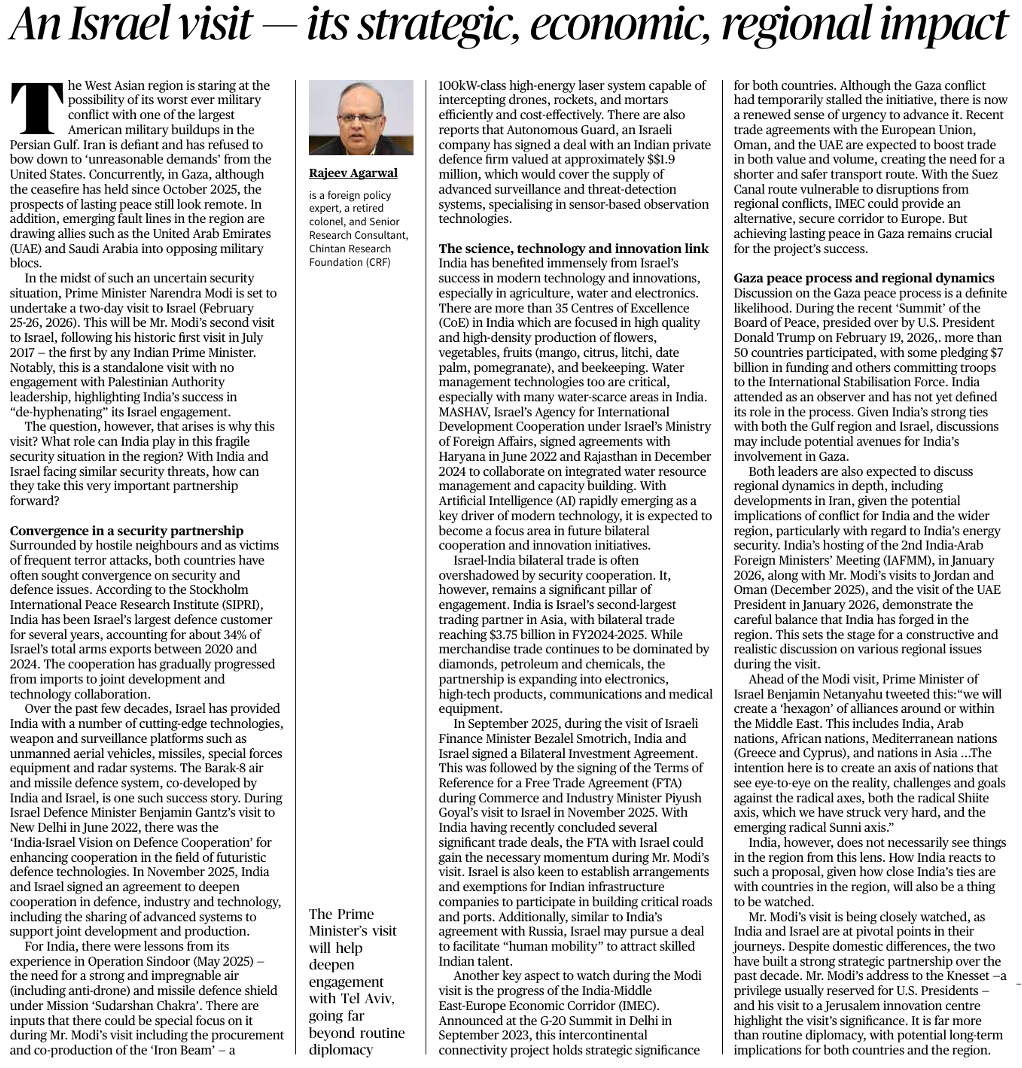
Prime Minister Narendra Modi’s two-day visit to Israel (February 25–26, 2026) comes amid heightened geopolitical tensions in West Asia — including the Gaza conflict, Iran’s assertiveness, and emerging regional fault lines.Notably, this is a standalone visit (without engagement with the Palestinian Authority), reflecting India’s continued “de-hyphenation” policy — engaging Israel and Palestine independently.The visit signals:
- Strategic consolidation of defence ties
- Expansion into technology and economic cooperation
- Engagement with evolving regional connectivity projects like IMEC
Detailed Analysis:Convergence in a Security Partnership
India and Israel share similar security concerns — hostile neighbourhoods, terrorism, missile threats.
1. Defence Trade and Technology
- India has been Israel’s largest defence customer, accounting for ~34% of Israel’s arms exports (2020–24).
- Shift from buyer–seller to joint development and co-production.
- Key example: Barak-8 missile defence system (jointly developed).
- Focus on:
- UAVs
- Missiles
- Radar systems
- Special forces equipment
- Iron Beam laser-based air defence system (100 kW class high-energy system)
2. Post-Operation Sindoor LessonsThe article hints at India’s need for:
- Strong multi-layered air defence
- Drone interception capabilities
- Laser-based systems for cost-effective neutralisation
This aligns with India’s defence modernisation under
Atmanirbhar Bharat.
Science, Technology and Innovation LinkBeyond defence, Israel’s strength lies in innovation.
1. Agriculture & Water Management- Over 35 Centres of Excellence in India.
- Focus on:
- High-density horticulture
- Beekeeping
- Water-use efficiency
- Collaborations with:
- Haryana (2022)
- Rajasthan (2024)
Israel’s expertise is critical for India’s
water-scarce regions.
2. Artificial Intelligence & Advanced Tech- AI emerging as new frontier of bilateral cooperation.
- Private defence deals (~$1.9 billion) in surveillance and sensor-based systems.
- Expanding into electronics, high-tech products, communication and medical equipment.
Economic and Trade ExpansionThough overshadowed by defence ties, economic relations are strengthening.
- India is Israel’s second-largest trading partner in Asia.
- Bilateral trade: ~$3.75 billion (FY2024–25).
- Dominant sectors:
- Diamonds
- Petroleum
- Chemicals
Emerging sectors:
- Electronics
- Infrastructure
- Human mobility arrangements
- FTA under negotiation
Recent agreements with EU, Oman and UAE also create scope for multi-layered trade corridors.
Regional Connectivity: IMECThe India–Middle East–Europe Economic Corridor (IMEC), announced at the G20 Summit (Delhi, 2023), is a major strategic project.
Significance:
- Alternative to vulnerable Suez Canal route
- Secure trade corridor to Europe
- Strategic counter to China’s BRI
- Boosts energy and supply chain resilience
However, Gaza stability remains critical for IMEC’s viability.
Gaza Peace Process and Regional DynamicsIndia attended the recent international discussions as an observer.Key dynamics:
- Over 50 countries involved
- $7 billion pledged for stabilisation
- Gulf–Israel–US axis evolving
India’s balancing strategy:
- Strong ties with Israel
- Deep relations with Gulf states (UAE, Oman)
- Engagement with Iran
This reflects India’s
multi-alignment doctrine.
Significance of the Visit1. Deepens defence co-production and tech transfer
2. Expands innovation-driven economic ties
3. Strengthens India’s role in West Asian geopolitics
4. Reinforces IMEC as a strategic connectivity initiative5. Symbolises India’s strategic autonomy and balancing diplomacy
Challenges
1. Gaza instability threatening regional projects
2. Iran–Israel tensions impacting energy security
3. Balancing Arab partnerships with closer Israel ties
4. Domestic political sensitivities in the region
5. Execution risks in IMEC
Way Forward
1. Move from defence import to joint R&D and manufacturing
2. Fast-track the India–Israel FTA
3. Institutionalise AI and emerging tech collaboration
4. Actively participate in Gaza stabilisation dialogue
5. Integrate IMEC with India’s SAGAR and Indo-Pacific vision
6. Maintain calibrated diplomacy with Iran and Gulf states
Conclusion
The visit marks more than routine diplomacy — it reflects a maturing partnership expanding from security cooperation to technology, trade and regional connectivity.In a volatile West Asia, India seeks not just strategic convergence with Israel but also a broader stabilising role in the region. The success of this engagement will depend on balancing defence cooperation, economic expansion and geopolitical prudence. UPSC Mains Question:
Q. In a volatile West Asian geopolitical landscape, India’s engagement with Israel reflects strategic autonomy rather than alignment. Examine.Source: The Hindu
Does the Data Act dilute the Right to Information Act?GS Paper II:
•
Constitution of India — features, amendments, significant provisions
•
Separation of powers•
Transparency and accountability in governance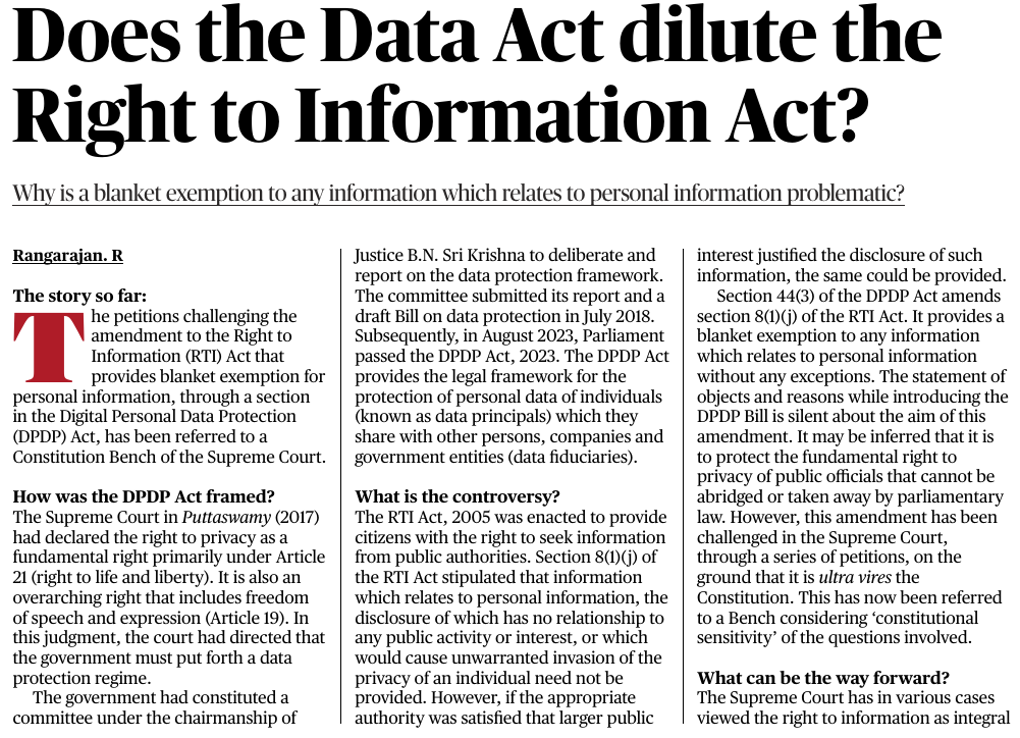
Context
Petitions challenging amendments to the Right to Information (RTI) Act, 2005 through the Digital Personal Data Protection (DPDP) Act, 2023 have been referred to a Constitution Bench of the Supreme Court.The core issue is whether granting a blanket exemption to personal information under the DPDP Act dilutes the citizens’ right to information, which flows from Article 19(1)(a).
Detailed Analysis:
Background1. RTI Act, 2005
- Enacted to promote transparency, accountability, and participatory democracy.
- Section 8(1)(j): Exempted personal information unless larger public interest justified disclosure.
- Embedded a balancing test between privacy and transparency.
2. Puttaswamy Judgment (2017)- Recognised Right to Privacy as a fundamental right under Article 21.
- Introduced the doctrine of proportionality.
- Directed creation of a data protection regime.
3. DPDP Act, 2023- Provides statutory framework for personal data protection.
- Section 4(3) amends Section 8(1)(j) of RTI.
- Introduces a blanket exemption for personal information without explicit public interest override.
What is the Controversy?Earlier under RTI:
- Disclosure allowed if:
- It related to public activity
- It served larger public interest
- It did not cause unwarranted invasion of privacy
After amendment:
- Any information relating to personal data may be denied.
- Absence of a clear public interest balancing clause.
Core Constitutional Question:
Does Parliament, while protecting privacy (Article 21), disproportionately curtail freedom of speech and right to information (Article 19(1)(a))?Petitioners argue the amendment is:
- Ultra vires the Constitution
- Violative of the proportionality principle
- Undermining democratic accountability
Arguments For the Amendment1. Strengthens Privacy Protection
Aligns with fundamental right to privacy
2. Prevents Misuse of Personal Data Reduces risk of data harassment
3. Harmonises Digital Governance Creates unified data protection architecture
4. Protects Individual Dignityo Ensures protection from unnecessary exposure
Arguments Against the Amendment
1. Weakens Transparency Framework Removes public interest override May shield information about public officials’ conduct
2. Fails Proportionality Test Blanket restriction instead of case-by-case assessment
3. Expands Scope of Exemptiono Ambiguous definition of personal information
4. Chilling Effect on Accountability Restricts investigative journalism Limits citizen oversightSignificance of the Case
- Clarifies relationship between:
- Article 19(1)(a) (Right to Information)
- Article 21 (Right to Privacy)
- Tests limits of parliamentary amendment power
- Shapes India’s digital constitutionalism
- Impacts future of open government framework
Challenges in Balancing Privacy and Transparency1. Definitional Ambiguity
Broad interpretation of “personal information” may include data linked to public duties, leading to over-withholding of information.
2. Risk of Bureaucratic Overreacho Public authorities may invoke privacy exemption mechanically, diluting RTI’s spirit.
3. Absence of Public Interest Overrideo Without a balancing clause, genuine cases involving corruption, misuse of office, conflict of interest may remain undisclosed.
4. Proportionality and Constitutional Scrutiny
o Blanket exemptions may not satisfy the four-pronged proportionality test (legitimate aim, suitability, necessity, balancing).
5. Impact on Democratic Accountability
Weakening RTI could undermine citizen participation, media scrutiny, and anti-corruption mechanisms.
6. Digital Governance Complexityo In an era of big data and e-governance, distinguishing between personal and public data becomes increasingly complex.
Way Forward
1. Reinstate explicit public interest override
2. Narrowly define personal data relating to public officials
3. Incorporate statutory proportionality test
4. Issue detailed guidelines for Information Commissions
5. Develop a harmonised interpretative framework reconciling RTI and DPDP
6. Strengthen institutional safeguards for transparency with privacyConclusionThe issue is not privacy versus transparency, but achieving a constitutional balance between two fundamental rights.While the DPDP Act seeks to protect informational privacy in a digital age, it must not erode the transformative power of the RTI Act as a cornerstone of democratic accountability.The Supreme Court’s ruling will determine whether India’s data regime complements or constrains its transparency framework.
Mains Practice Question
Q. “The Digital Personal Data Protection Act, 2023 raises constitutional concerns regarding the balance between privacy and transparency.” Critically examine.Source: The Hindu
Health Ministry set to roll out free HPV vaccination plan targeting girls aged 14GS Paper II:
• Issues relating to development and management of
Social Sector/Health• Government policies and interventions
GS Paper III:• Science and Technology – applications
• Public health
Context
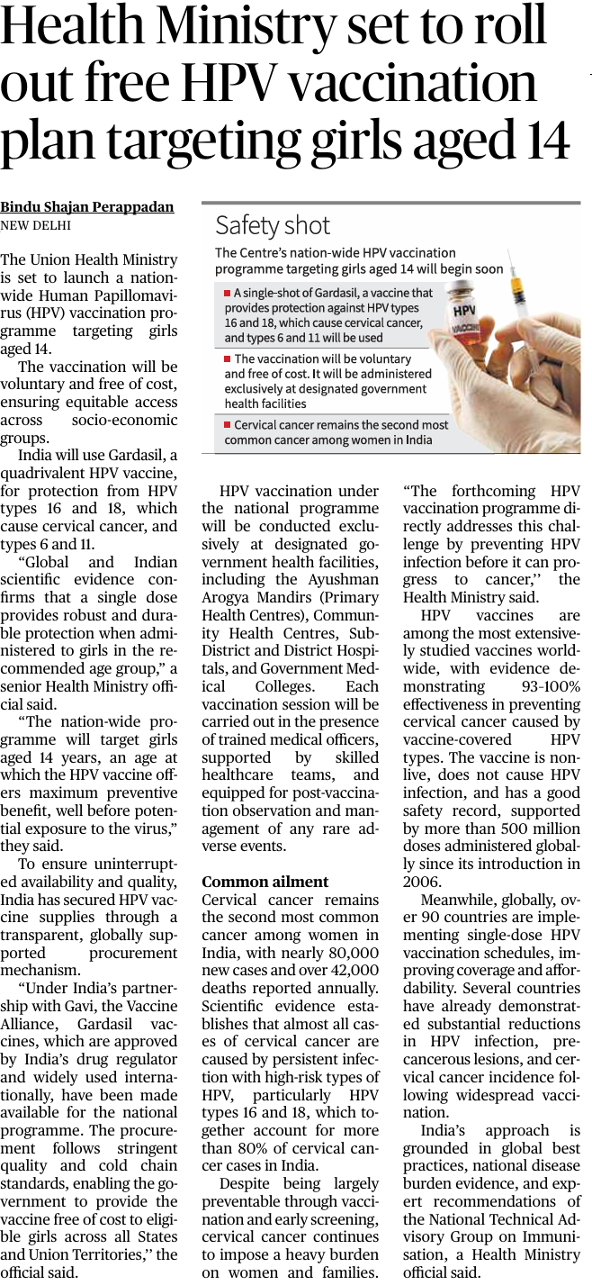
The Union Health Ministry will soon launch a nationwide free HPV vaccination programme for 14-year-old girls.The programme will use a single-dose Gardasil vaccine, administered voluntarily at designated government health facilities, aiming to reduce the burden of cervical cancer in India. Significance of the HPV Vaccination Programme1. Preventive Public Health Intervention
- HPV types 16 & 18 cause majority of cervical cancer cases.
- Types 6 & 11 cause genital warts.
- Single-dose vaccination offers maximum preventive benefit before viral exposure.
2. Reduces Disease Burden- India reports nearly 80,000 new cases and 42,000 deaths annually due to cervical cancer.
- Vaccines show 93–100% effectiveness against vaccine-covered HPV types.
3. Gender-Sensitive Health Policy- Focus on adolescent girls ensures early intervention.
- Strengthens women’s health outcomes.
4. Equitable Access- Free vaccination ensures socio-economic inclusivity.
- Supported through Gavi partnership and transparent procurement mechanisms.
5. Alignment with Global Best Practices- Over 90 countries have adopted single-dose HPV schedules.
- Supported by National Technical Advisory Group on Immunisation (NTAGI).
Key Prelims Pointers:Cervical Cancer- Caused primarily by persistent HPV infection.
- Second most common cancer among women in India.
- Preventable through:
- Vaccination
- Screening (Pap smear, HPV DNA test)
Human Papillomavirus (HPV)What is HPV?- Human Papillomavirus (HPV) is a small, double-stranded DNA virus.
- Over 100 types exist.
- Low-risk types → genital warts
- High-risk types (especially 16 & 18) → cancers
Link with Cervical Cancer- Persistent infection with high-risk HPV types (16 & 18) causes nearly 70–80% of cervical cancer cases.
- HPV is responsible for about 5% of all cancers worldwide.
- Cervical cancer develops slowly through precancerous lesions if infection is not cleared.
Transmission- Spread through intimate skin-to-skin contact.
- Sexually transmitted via vaginal, anal, or oral sex.
- Infects both men and women.
Natural Course- In most cases, the immune system clears the virus naturally.
- Persistent high-risk infection may progress to cervical cancer over time.
Prevention- No specific treatment for HPV infection.
- HPV vaccines are preventive, not curative.
- Vaccine stimulates the immune system to produce protective antibodies, preventing infection and thereby reducing cervical cancer risk.
- Most effective when given before sexual exposure (adolescence).
UPSC Prelims MCQQ. Consider the following statements with reference to Human Papillomavirus (HPV):1. Human Papillomavirus is a double-stranded DNA virus.2. Persistent infection with high-risk HPV types can lead to cervical cancer.3. HPV vaccines can cure existing HPV infection and cervical cancer.
How many of the statements given above are correct?(a) Only one
(b) Only two
(c) All three
(d) None
Answer: (b) Only twoExplanationStatement 1 – CorrectHPV is a
small, double-stranded DNA virus belonging to the papillomavirus family.
Statement 2 – CorrectPersistent infection with
high-risk HPV types (especially 16 & 18) is the primary cause of
cervical cancer.
Statement 3 – IncorrectHPV vaccines are
preventive, not curative.
They:
- Prevent infection by high-risk HPV types
- Do not cure existing infection or cancer
Panel to probe repeated failures of PSLV, says ISROGS Paper III:
• Achievements of Indians in
Science & Technology•
Space technology and its applications
• Indigenisation of technology
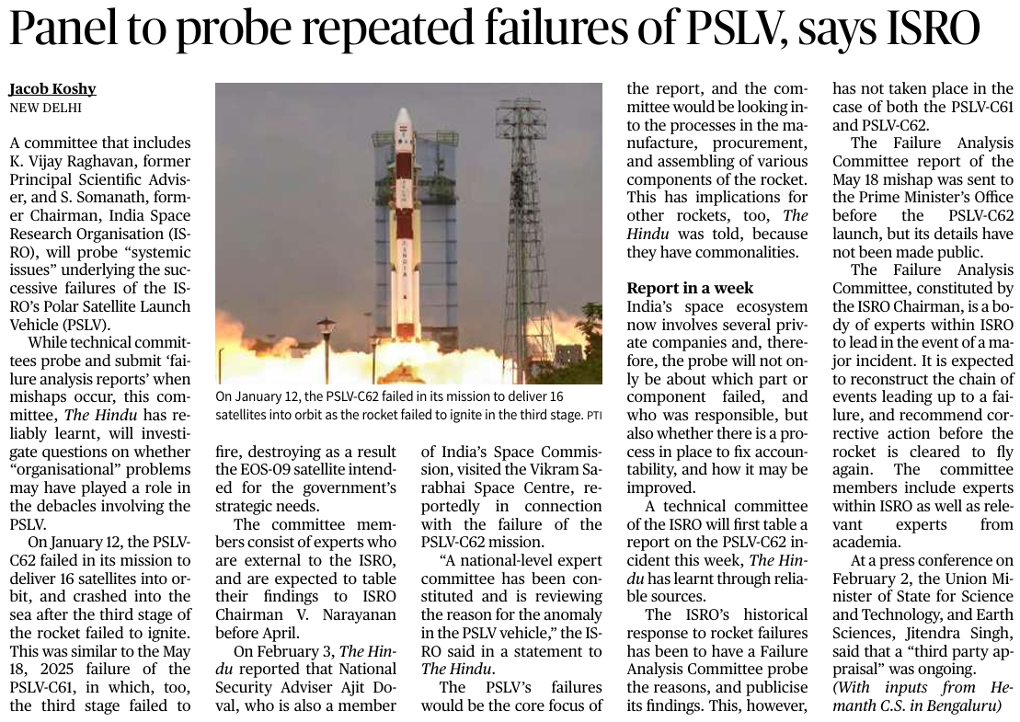
ContextFollowing consecutive failures of PSLV-C61 (May 2025) and PSLV-C62 (January 12, 2026) — both involving third-stage ignition failure — ISRO has constituted a national-level expert committee to examine systemic and organisational issues behind the mishaps.The panel includes:
- Former Principal Scientific Adviser K. Vijay Raghavan
- Former ISRO Chairman S. Somanath
- External experts to ensure independent evaluation
Significance of the Probe1. Ensuring Reliability of India’s Launch EcosystemPSLV is central to:
- Commercial satellite launches
- Government strategic missions
- International space collaborations
2. Impact on Private Space SectorIndia’s space ecosystem now includes:
- Private players under IN-SPACe reforms
- Repeated failures may affect:
- Investor confidence
- Global launch contracts
3. Institutional AccountabilityThe committee will examine:
- Manufacturing processes
- Procurement systems
- Quality control mechanisms
- Organisational accountability
Polar Satellite Launch Vehicle (PSLV)About- India’s third-generation launch vehicle, developed by ISRO.
- First successful launch: October 1994.
- Known as ISRO’s “workhorse” launcher.
- Specialised in launching satellites into:
- Low Earth Orbit (LEO)
- Sun-Synchronous Polar Orbit (SSPO)
- First Indian rocket to use liquid propulsion stages.
Structure (Four-Stage Rocket – Solid + Liquid Mix)1.
PS1 (First Stage)o
Solid propulsion (HTPB propellant).o Provides initial lift-off thrust.o
PSLV-XL variant includes 6 solid strap-on boosters for heavier payloads.2.
PS2 (Second Stage)o
Liquid propulsion (Vikas engine).o Fuel:
UDMHo Oxidiser:
N₂O₄o Ensures controlled ascent and trajectory correction.3.
PS3 (Third Stage)o
Solid propulsion (HTPB).o Operates in near-vacuum phase.o Critical for achieving required orbital velocity.4.
PS4 (Fourth Stage)o
Liquid propulsion (MMH + MON).o Enables precise orbital insertion.o Supports multi-satellite and multi-orbit missions.
Major Achievements- Launched Chandrayaan-1 (Moon mission).
- Launched Mars Orbiter Mission (Mangalyaan).
- Successfully deployed numerous foreign commercial satellites.
UPSC Prelims MCQQ. With reference to the Polar Satellite Launch Vehicle (PSLV), consider the following statements:1. PSLV is a four-stage launch vehicle using a combination of solid and liquid propulsion.2. PSLV is primarily used for placing satellites into Geostationary Transfer Orbit (GTO).
How many of the statements given above are correct?(a) Only one
(b) Both
(c) None
(d) Neither 1 nor 2
Answer: (a) Only oneExplanation:Statement 1 – CorrectPSLV follows a
four-stage configuration:
Solid (PS1) – Liquid (PS2) – Solid (PS3) – Liquid (PS4).
Statement 2 – IncorrectPSLV is mainly used for:
- Low Earth Orbit (LEO)
- Sun-Synchronous Polar Orbit (SSPO)
For heavier payloads into
Geostationary Transfer Orbit (GTO), India primarily uses
GSLV.
Union Cabinet nod for ‘Kerala’ to become ‘Keralam’GS Paper II:
•
Indian Constitution — Amendments & Provisions
•
Federalism• Parliament and State Legislatures
ContextThe Union Cabinet has approved the Kerala government’s proposal to change the State’s name from “Kerala” to “Keralam”, reflecting its Malayalam linguistic identity.The proposal will now follow the constitutional procedure under Article 3 for alteration of the name of a State. Constitutional Procedure to Change the Name of a State (Article 3)Constitutional BasisUnder Article 3 of the Constitution of India, Parliament has the power to:
- Form new States
- Increase or diminish the area of any State
- Alter boundaries
- Alter the name of any State
Procedure1.
Presidential Recommendationo A Bill for changing a State’s name can be introduced in Parliament
only with the prior recommendation of the President.2.
Reference to State Legislatureo The President refers the Bill to the concerned
State Legislature for expressing its views within a specified time.o This is a
consultative mechanism reflecting cooperative federalism.o The State’s views are
not binding on Parliament.3.
Parliamentary Approvalo After the prescribed period, the Bill is taken up in Parliament.o It must be passed by a
simple majority (like an ordinary law).4.
Presidential Assento The Bill is sent to the President for assent.o After assent, the Act comes into force and the State’s name is officially changed.
Article 4 Clarification- Laws made under Articles 2 and 3 may amend the First and Fourth Schedules.
- Such laws are not treated as Constitutional Amendments under Article 368.
UPSC Prelims MCQQ. With reference to Article 3 of the Constitution of India, consider the following statements:1. A Bill for altering the name of a state can be introduced in Parliament only on the recommendation of the President.2. The views expressed by the concerned State Legislature on such a Bill are binding on Parliament.3. A law made under Article 3 is deemed to be a Constitutional Amendment under Article 368.How many of the statements given above are correct?(a) Only one
(b) Only two
(c) All three
(d) None
Answer: (a) Only oneExplanation:Statement 1 – CorrectUnder
Article 3, a Bill to alter the name, area, or boundaries of a State can be introduced
only with the prior recommendation of the President.
Statement 2 – IncorrectThe concerned State Legislature’s views are
advisory in nature and
not binding on Parliament.
Statement 3 – IncorrectAs per
Article 4, a law made under Article 3 is
not considered a Constitutional Amendment under Article 368, even if it amends the First or Fourth Schedule.
Amid DoT push, WhatsApp appears to test SIM-binding GS Paper II:
• Issues relating to
e-governance & digital communication• Regulatory bodies and statutory authorities
GS Paper III:• Cyber security
• IT and digital infrastructure
ContextWhatsApp appears to be testing compliance measures related to the
SIM-binding directive issued by the
Department of Telecommunications (DoT) in November 2025.The directive mandates messaging platforms to ensure that a user’s registered SIM card is provisioned on the device used to access the service.
SIM BindingWhat is SIM Binding?- SIM Binding is a security mechanism that permanently links a user’s messaging or authentication service to the physical SIM card used during registration.
- The registered SIM acts as a hardware-based identity token.
- If the original SIM is removed or inactive, the application stops functioning or restricts access.
- Aims to strengthen identity verification and prevent misuse.
Regulatory Authority- Implemented by the Department of Telecommunications (DoT).
- Introduced under the Telecommunication Cybersecurity Amendment Rules, 2025.
Key Regulatory Concept- Telecommunication Identifier User Entity (TIUE):
- Refers to online services that use a phone number as an identifier.
- Brings digital communication platforms under enhanced regulatory oversight for cybersecurity.
Objective- Prevent SIM-swap fraud and impersonation.
- Strengthen cybersecurity and traceability in digital communication.
- Enhance national security and regulatory compliance.
UPSC Prelims MCQQ. With reference to SIM Binding in India, consider the following statements:1. SIM Binding permanently links a messaging service to the physical SIM card used during registration.2. Under SIM Binding, the application may stop functioning if the original registered SIM is not present in the device.3. The concept of Telecommunication Identifier User Entity (TIUE) refers only to traditional telecom service providers such as mobile network operators.How many of the statements given above are correct?(a) Only one
(b) Only two
(c) All three
(d) None
Answer: (b) Only twoExplanation:Statement 1 – CorrectSIM Binding links a user’s messaging or authentication service to the
physical SIM card used during registration.
Statement 2 – CorrectIf the original SIM is removed or inactive, the application may
restrict or stop access, as the SIM acts as a hardware-based identity token.
Statement 3 – IncorrectTIUE (Telecommunication Identifier User Entity) includes
online services that use a phone number as an identifier, not just traditional telecom operators.
Show of powerGS Paper III:
•
Defence and Security• Modernisation of Armed Forces
ContextAn Indian Air Force (IAF) Chinook helicopter was seen performing during a full-dress rehearsal of Exercise Vayu Shakti–2026 at the Pokhran Field Firing Range, Rajasthan, ahead of the February 27 firepower display.The biennial exercise highlights the IAF’s combat readiness, precision strike capability, and integrated multi-domain operations.About Exercise Vayu Shakti
- Conducted by the Indian Air Force.
- Held at Pokhran Field Firing Range.
- A large-scale live firepower demonstration.
- Showcases:
- Air-to-ground strikes
- Precision-guided munitions
- Integrated air-land battle capabilities
- Coordination among fighter jets, helicopters, UAVs and ground forces
Chinook Helicopter (CH-47F)About- CH-47F Chinook is a heavy-lift, multi-mission helicopter.
- Primary heavy transport aircraft of the U.S. Army.
- Manufactured by Boeing.
- India operates around 15 Chinook helicopters (IAF).
Key Features- Twin-engine, tandem rotor heavy-lift helicopter.
- Integrated digital cockpit system.
- Triple hook system for carrying large or multiple external loads.
- Monolithic airframe with vibration reduction.
- Advanced cargo-handling capability.

 Launch your Graphy