There are no items in your cart
Add More
Add More
| Item Details | Price | ||
|---|---|---|---|





1. India’s federalism is in need of a structural reset (GS-2)
2. Single genome-editing strategy can help treat multiple disorders (GS-3)
3. NGT gives clearance to Great Nicobar project (GS-3)
4. January trade deficit widens before U.S. tariff relief kicks in
(GS-3)
5. NPCI extends ‘UPI One World’ to AI Summit foreign visitors
(GS-3)
6. Unemployment in India rose slightly to 5% in January: Govt. (GS-3)
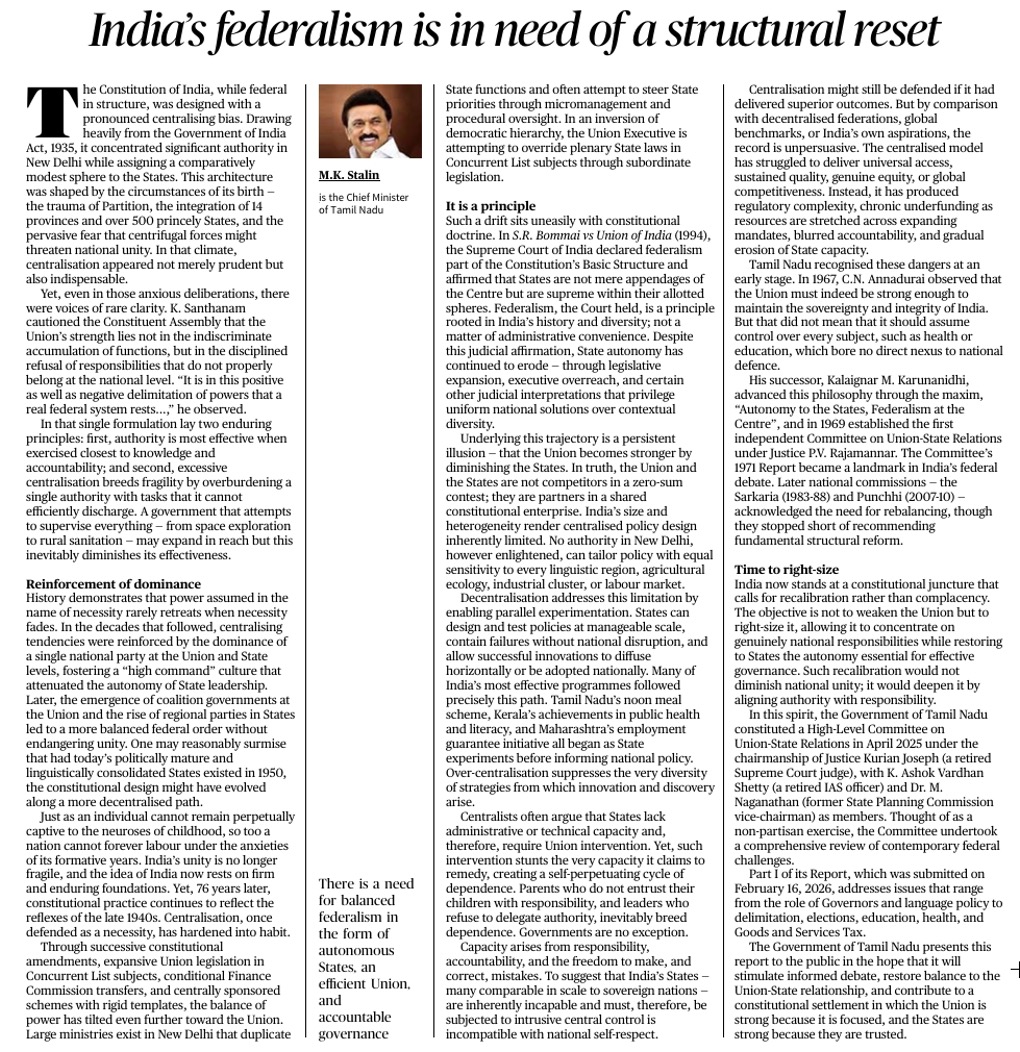
The article discusses the growing centralisation in India’s federal structure and argues that Indian federalism requires a structural reset. While the Constitution created a federal polity with a strong Centre (influenced by the Government of India Act, 1935), the author argues that excessive centralisation today undermines state autonomy, innovation, and accountability.
• The debate is framed around constitutional principles, judicial interpretations, historical evolution, and contemporary political practice.
Detailed Analysis:
Historical Background
1. Constitutional Design
• India was structured as a “Union of States” with a clear centralising bias.
• The Union List is extensive; residuary powers lie with the Centre.
• Emergency provisions further strengthen the Union.
However, the framers intended disciplined central authority, not unchecked dominance.
K. Santhanam warned that strength of the Union lies in proper delimitation of functions, not accumulation.
2. Judicial Interpretation
• S.R. Bommai v. Union of India (1994) declared federalism part of the Basic Structure.
• The Supreme Court affirmed that States are not mere appendages of the Centre.
Despite this, operational trends have favoured increasing central dominance.
3. Political Evolution
• Single-party dominance era strengthened centralisation.
• Coalition era (post-1989) rebalanced Centre–State relations.
• The rise of strong regional parties revived state autonomy.
• However, renewed centralisation tendencies are visible in recent years.
Key Issues Highlighted in the Article
1. Legislative Encroachment
• Increasing use of Union authority in Concurrent List subjects.
• Subordinate legislation and procedural oversight overriding plenary state laws.
2. Administrative Centralisation
• Expansion of centrally sponsored schemes.
• Large Union ministries duplicating state functions.
• One-size-fits-all policy approaches ignoring regional diversity.
3. Fiscal Imbalance
• Conditional Finance Commission transfers.
• Proliferation of centrally sponsored schemes reduces fiscal autonomy.
4. Role of Governors
• Political use of gubernatorial office affecting state autonomy.
• Discretionary powers influencing state politics.
Significance of Federal Reset
1. Improved Governance
Decentralisation allows:
• Local experimentation
• Tailored policy responses
• Faster course correction
Example:
• Tamil Nadu’s noon meal scheme
• Kerala’s public health model
• Maharashtra’s employment initiatives
Many successful national policies began as state experiments.
2. Innovation and Diversity
India’s size and heterogeneity require:
• Region-specific policies (agriculture, ecology, labour markets)
• Parallel experimentation without nationwide disruption
Centralised uniformity suppresses diversity-driven innovation.
3. Accountability and Responsibility
Capacity grows with responsibility.
Excessive Union intervention:
• Creates dependency culture
• Weakens state accountability
• Encourages political blame-shifting
True federalism aligns authority with responsibility.
4. Strengthening National Unity
Contrary to fears:
• Autonomy strengthens unity.
• Cooperative federalism reduces alienation.
• Strong States do not weaken the Union.
Unity emerges from trust, not control.
Challenges to Recalibration
1. Concerns of National Integration
o Fear of fragmentation.
o Security and uniformity arguments.
2. Administrative Capacity Gaps
o Some States lack institutional strength.
o Centre intervenes citing governance failures.
3. Political Centralisation
o Dominant national leadership.
o Weak intergovernmental institutional mechanisms.
4. Institutional Weakness
o Inter-State Council remains underutilised.
o Finance Commission recommendations often conditional.
Way Forward
1. Right-Sizing the Union
• Limit Union intervention to genuinely national concerns.
• Avoid micro-management in Concurrent subjects.
2. Revitalise Intergovernmental Forums
• Strengthen Inter-State Council.
• Institutionalise structured federal dialogue.
3. Fiscal Federalism Reform
• Reduce tied grants.
• Enhance untied transfers.
• Improve GST Council consensus mechanisms.
4. Clarify Role of Governors
• Codify conventions.
• Minimise partisan discretion.
5. Encourage State-Level Policy Innovation
• Promote competitive federalism.
• Recognise state best practices nationally.
Conclusion
India stands at a constitutional juncture where recalibration, not confrontation, is required. A structurally balanced federal system would:
• Enhance accountability
• Promote innovation
• Improve governance outcomes
• Strengthen national unity
Federalism is not a zero-sum contest between the Union and States. A strong Union depends on strong, autonomous, and trusted States.
A structural reset would not weaken India, it would deepen its democratic foundations.
UPSC Mains Question
“Indian federalism was designed with a centralising bias, but contemporary governance demands a structural recalibration.” Discuss in the light of recent trends in Centre–State relations.
(250 words)
Source: The Hindu
Context
• The article discusses a breakthrough genome-editing approach that can potentially treat multiple genetic disorders caused by nonsense mutations using a single strategy, instead of designing separate treatments for each disease.
• The study, published in Nature, introduces a technique called Prime Editing-mediated Read-through of Premature Termination Codons (PERT).
Detailed Analysis
1️. Understanding Nonsense Mutations
• Genetic disorders often arise from errors in DNA.
• A nonsense mutation inserts a premature “stop” signal in the DNA sequence.
• This leads to incomplete protein production.
• Such mutations account for ~25% of all known disease-causing genetic changes.
• Diseases like cystic fibrosis, Batten disease, and Tay-Sachs can result from these mutations.
Problem: Each mutation affects a different protein at a different position → traditionally requires separate treatment development → slow and expensive.
2️. Why Current Approaches Are Limited
• Most gene therapies are mutation-specific.
• Every disease (and often every mutation within a disease) requires:
o Separate drug design
o Clinical trials
o Regulatory approvals
This makes treatment development particularly difficult for rare genetic disorders.
3️. The New Strategy: Prime Editing + PERT
Researchers from the Broad Institute, Harvard University, and the University of Minnesota developed a method that:
• Uses prime editing (a refined CRISPR-based tool).
• Reprograms certain tRNA genes to suppress premature stop codons.
• Enables the cell to “ignore” faulty stop signals.
• Allows full-length protein production without altering global protein synthesis.
Instead of correcting each mutation individually, this method addresses the common mechanism behind many disorders.
4️. Repurposing tRNA: The Core Innovation
Cells translate DNA → mRNA → Protein.
• tRNA molecules read codons (three-letter sequences).
• Normally, stop codons signal termination.
• Researchers engineered tRNAs to:
o Recognize premature stop codons
o Insert the correct amino acid
o Continue protein synthesis
They modified four tRNA types (for leucine, arginine, tyrosine, and serine).
To improve efficiency:
• Thousands of tRNA variants were engineered.
• Prime editing tool PE6c enhanced insertion efficiency.
• Efficiency improved to 60–80% in human cells (compared to 10–20% in traditional homology-directed repair).
5️. Evidence from Laboratory and Animal Models
In cell models:
• Restored protein production in multiple disease models.
• High efficiency and precision.
In mouse models (Hurlers syndrome model):
• AAV9 vector used for delivery.
• Restored 1.7% of normal enzyme activity.
• Even small enzyme recovery significantly reduced disease severity.
• No major toxicity observed.
This suggests therapeutic potential, especially for enzyme-deficiency disorders.
6️. Safety and Technical Concerns
Despite promising results, challenges remain:
• Off-target editing risk.
• Long-term safety in humans unknown.
• Delivery challenges across tissues.
• Immune responses to viral vectors.
• Ensuring the approach doesn’t interfere with normal stop codons.
Researchers stress that extensive safety validation is required before clinical use.
Significance
1. Gene-Agnostic Breakthrough
One strategy for multiple diseases → cost-effective and scalable.
2. Boost to Rare Disease Treatment
Rare disorders often lack funding; a universal approach lowers development barriers.
3. Advances Precision Medicine
Instead of replacing genes, it corrects protein synthesis mechanism.
4. Strengthens India’s Biotech Aspirations
Relevance for:
• Indigenous gene therapy research
• Biotechnology policy
• Affordable precision medicine under public health programs
Way Forward
1. Conduct large-scale animal and safety studies.
2. Improve delivery systems (non-viral options).
3. Regulatory frameworks for genome editing must evolve.
4. Ethical oversight in germline editing (though current study is somatic editing).
5. Public investment in gene therapy platforms for rare diseases.
Conclusion
The study represents a paradigm shift in genome editing. By targeting the shared mechanism of nonsense mutations rather than individual genes, the PERT-based prime editing approach may enable treatment of multiple genetic disorders using a single platform technology.
• While significant safety and delivery challenges remain, the innovation marks a crucial step toward scalable and gene-agnostic precision medicine.
UPSC Mains Question
Q. Recent advances in genome-editing have moved from mutation-specific therapies to gene-agnostic approaches. Examine the significance of such a shift in the context of treating rare genetic disorders. What are the ethical and regulatory challenges involved? (250 words)
Source: The Hindu
 Launch your Graphy