The Hindu Analysis April 7th

The Hindu News Analysis – 7th April, 2026
1. Climate change as a public health emergency (GS-2, GS-3)
2. What TB reveals about India’s urban health system
(GS-2, GS-3)
3. ‘New Bangladesh-India ties will avoid mistakes of past’
(GS-2)
4. SC refuses to interfere with environmental nod to Kerala’s Kozhikode-Wayanad tunnel project (GS-3, GS-2)
5. CSR initiatives must focus on high-impact projects: experts
(GS-3)
Climate change as a public health emergency
GS Paper II:
• Issues relating to development and management of health
• Vulnerable sections and public health challenges
GS Paper III:
• Environmental degradation
• Climate change and its impact
• Food security
Context:
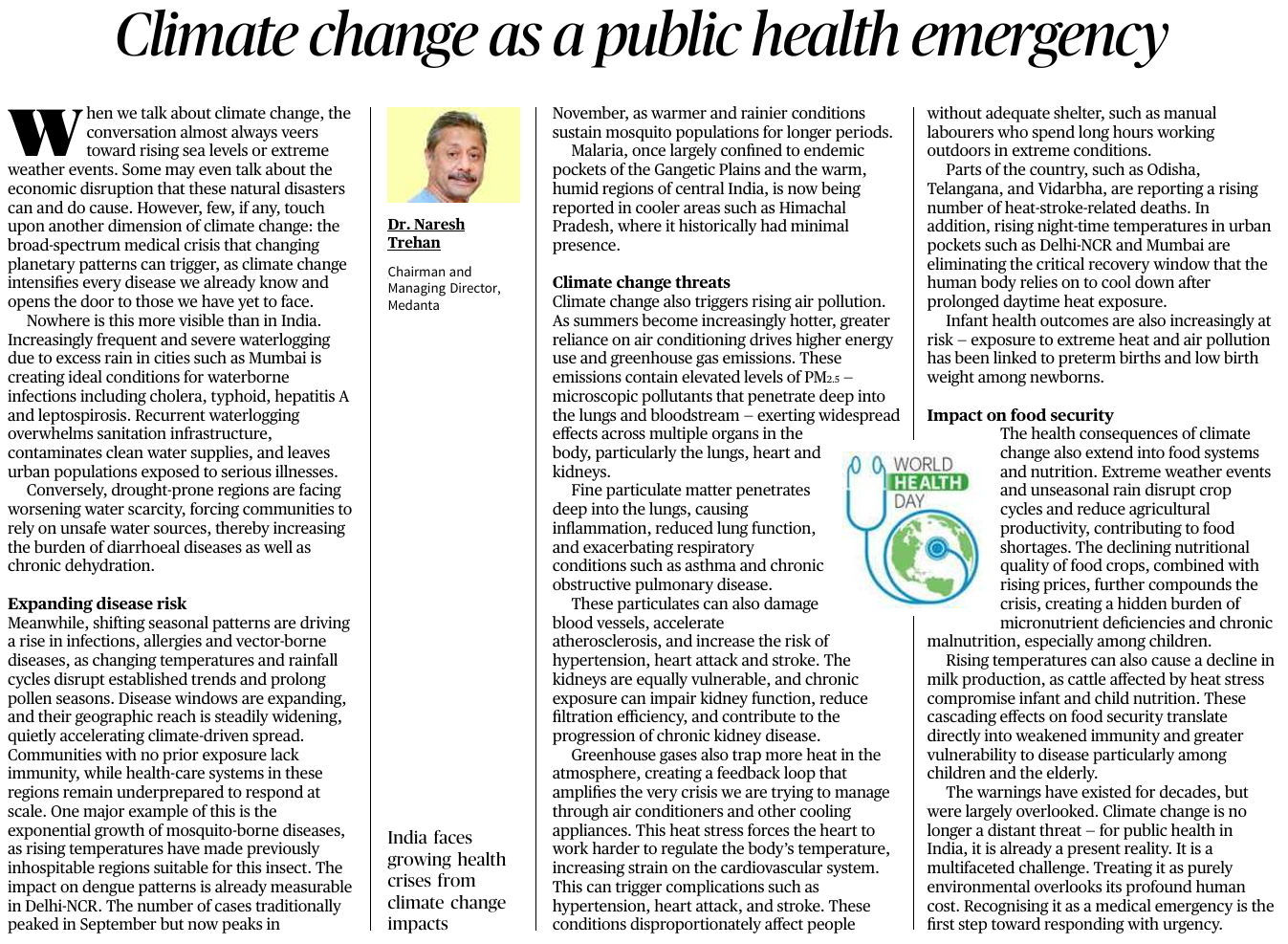
The article highlights how climate change is no longer just an environmental issue, but a serious and evolving public health crisis, particularly in India. It links changing climate patterns with disease spread, pollution, heat stress, and food insecurity.
Detailed Analysis:
1. Climate Change as a Health Multiplier
Climate change intensifies existing diseases and introduces new risks.
Impacts are systemic, affecting water, air, food, and ecosystems.
India is particularly vulnerable due to:
High population density
Urban flooding (e.g., Mumbai)
Poor sanitation infrastructure
2. Water-Related Health Risks
Urban flooding → contamination of drinking water
Leads to diseases like cholera, typhoid, hepatitis A, leptospirosis
Drought conditions → reliance on unsafe water
Causes diarrhoeal diseases and dehydration
👉 Dual burden: Floods + Droughts both increase disease vulnerability
3. Expanding Disease Patterns (Vector-Borne Diseases)
Changing temperature and rainfall patterns:
Expand mosquito habitats
Increase transmission periods
Example:
Malaria and dengue spreading to new regions (e.g., cooler areas like Himachal Pradesh)
Communities lack immunity and preparedness
4. Air Pollution and Health Impacts
Rising temperatures → more air conditioning use → higher emissions
Increase in PM2.5 levels leads to:
Lung inflammation
Asthma, COPD
Cardiovascular diseases (heart attack, stroke)
Kidney damage
👉 Air pollution acts as a force multiplier of climate-related health risks
5. Heat Stress and Mortality
Increasing heatwaves and night-time temperatures:
Reduce body’s recovery time
Leads to:
Heat strokes
Cardiovascular stress
Most affected:
Outdoor workers
Urban poor
Regions like Odisha, Telangana, Vidarbha reporting rising deaths
6. Impact on Vulnerable Groups
Infants:
Higher risk of preterm births and low birth weight
Elderly & poor:
Limited access to cooling, healthcare
Urban slum populations:
Exposure to extreme heat + pollution
7. Food Security and Nutrition Crisis
Climate change disrupts:
Crop cycles
Agricultural productivity
Leads to:
Food shortages
Rising prices
Results in:
Hidden hunger (micronutrient deficiency)
Chronic malnutrition, especially in children
Additional impact:
Heat stress reduces milk production, affecting nutrition
8. Systemic Health Burden
Weakening of immune systems
Increased vulnerability to diseases
Overburdened healthcare systems
👉 Climate change creates a cascade effect across health systems
Significance:
1. Shift in Policy Perspective
Moves climate change from:
Environmental issue → Public health emergency
2. Need for Urgent Response
Recognizing it as a medical emergency ensures:
Faster policy action
Resource prioritisation
3. Human-Centric Approach
Highlights direct human costs, not just ecological damage
4. Relevance for India
India faces:
Dual burden of climate vulnerability + weak health infrastructure
Makes the issue critical for governance and planning
Conclusion:
Climate change is no longer a distant or abstract threat—it is a present and escalating public health emergency. Addressing it requires integrating climate policy with health systems, adopting preventive strategies, and ensuring protection for vulnerable populations. Recognizing this linkage is the first step toward effective and urgent action.
UPSC Mains question
Q. Discuss how changing climate patterns are altering the epidemiology of diseases in India. What are the implications for healthcare preparedness?
Source: The Hindu
 What TB reveals about India’s urban health system
GS Paper II:
• Issues relating to development and management of health
• Vulnerable sections and inclusive governance
GS Paper III:
• Urbanisation and associated challenges
• Social sector (health)
Context:
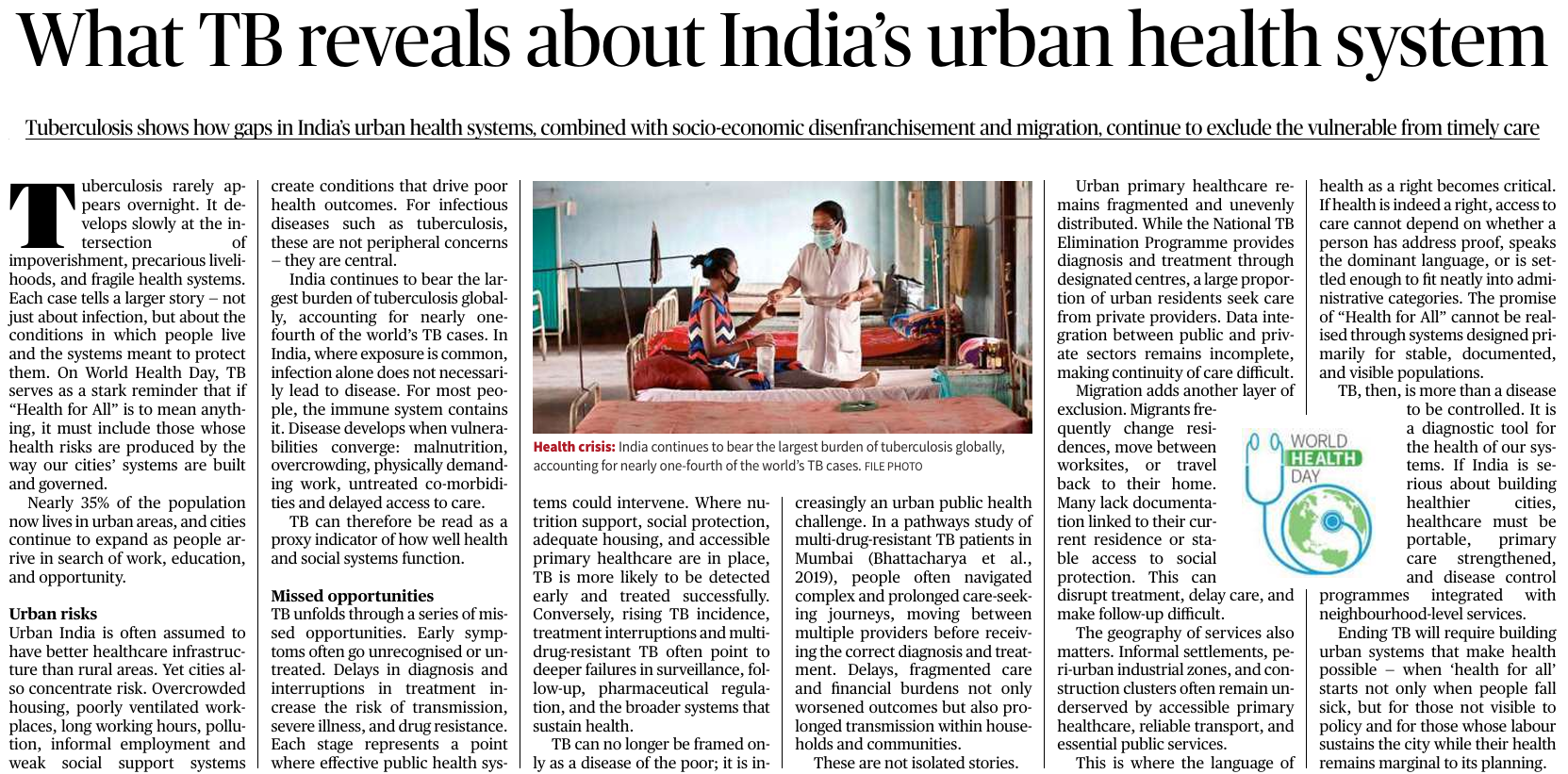
The article argues that tuberculosis (TB) is not just a medical issue but a diagnostic lens to understand failures in India’s urban health system, especially in the context of rapid urbanisation, migration, and socio-economic inequalities.
Detailed Analysis:
1. TB as a Reflection of Structural Inequality
TB thrives at the intersection of:
Poverty
Malnutrition
Overcrowding
Weak healthcare access
India accounts for ~25% of global TB burden, indicating systemic gaps.
👉 Thus, TB is a proxy indicator of social and health system failure
2. Urbanisation Without Health Planning
~35% of India’s population lives in cities, but:
Urban health infrastructure is uneven and inadequate
Cities assumed to have better healthcare, but:
Slums and informal settlements lack access
Issues:
Poor ventilation, overcrowding → ideal for TB spread
3. Missed Opportunities in Care Continuum
TB progression reflects multiple system failures:
Delayed diagnosis (symptoms ignored)
Interrupted treatment
Weak follow-up mechanisms
Consequences:
Increased transmission
Emergence of drug-resistant TB
4. Fragmented Healthcare System
Urban healthcare is:
Split between public and private sectors
Problems:
Lack of coordination
Poor data integration
Patients navigate:
Multiple providers → delayed correct diagnosis
5. Migration as a Barrier
Migrants:
Frequently shift locations
Lack address proof or documentation
Leads to:
Disrupted treatment cycles
Exclusion from welfare and health schemes
👉 Mobility vs static health systems = structural mismatch
6. Geographical Inequity in Service Delivery
Informal settlements & peri-urban areas:
Underserved by healthcare services
Lack of:
Transport
Nearby clinics
Public services
7. Overdependence on Private Sector
Many patients rely on private healthcare providers
Issues:
High out-of-pocket expenditure
Non-standard treatment practices
Weak regulation worsens outcomes
8. Weak Public Health Systems
Gaps in:
Surveillance
Follow-up
Preventive care
Focus remains curative, not preventive
9. Exclusion from Rights-Based Healthcare
“Health for All” is undermined because:
Systems cater to stable, documented populations
Marginal groups:
Migrants, urban poor → remain invisible
Conclusion:
The article highlights that TB is not merely a disease but a systemic indicator of urban governance failure. It exposes how inequitable urbanisation, fragmented healthcare, and social exclusion undermine India’s public health goals. Addressing TB effectively requires integrated urban planning, strengthened primary healthcare, and a rights-based inclusive approach, ensuring that no vulnerable population is left behind.
Mains Question
Q. “Tuberculosis is not merely a public health issue but a reflection of systemic failures in India’s urban health governance.” Discuss with reference to urbanisation, migration, and healthcare delivery challenges.

New Bangladesh-India ties will avoid mistakes of past’
GS Paper II:
• India and its neighbourhood relations
• Bilateral, regional and global groupings
Context:
Following political changes in Bangladesh after the exit of Sheikh Hasina, the new leadership under PM Tarique Rahman signals a reset in India-Bangladesh relations, focusing on people-to-people engagement and institutional dialogue to overcome past tensions.
1. Diplomatic & Political Shift
Change in Leadership: Bangladesh has transitioned from the era of Sheikh Hasina (following the August 5, 2024 uprising) to a new government led by Prime Minister Tarique Rahman.
"People-to-People" Focus: The new diplomatic stance emphasizes broad social ties over relationships centered on specific individuals or political parties to ensure long-term stability and avoid "past mistakes."
2. Bilateral Infrastructure & Energy
India-Bangladesh Friendship Pipeline (IBFP): A critical energy project mentioned for cooperation.
Context: It carries high-speed diesel (HSD) from Siliguri (West Bengal, India) to Parbatipur (Dinajpur, Bangladesh).
Energy Crisis Management: Reference to India sending 5,000 tonnes of high-speed diesel to Bangladesh to mitigate energy shortages caused by regional instability.
3. Water Diplomacy
Ganga Water Treaty: Mentioned as a key item for renewal.
Context: The 1996 treaty is a 30-year agreement for sharing the waters of the Ganges River at the Farakka Barrage. It is set to expire in 2026, making its renegotiation a high-priority "difficult issue."
4. Security & Border Management
Border Firing: A recurring point of friction.
India’s Stance: Actions are directed at criminal gangs and smugglers to maintain border security.
Bangladesh’s Stance: Calls for "zero border killing," arguing that suspects should be apprehended and subjected to judicial processes rather than being fired upon.
UPSC MCQ
Q. With reference to India–Bangladesh relations, consider the following statements:
Bangladesh is a key partner in India’s Act East Policy and connectivity with the Northeast.
The India-Bangladesh Friendship Pipeline is related to the supply of natural gas from Bangladesh to India.
Border management issues, including civilian casualties, have been a source of tension between the two countries.
Which of the statements given above is/are correct?
(a) 1 and 3 only
(b) 2 only
(c) 1 and 2 only
(d) 1, 2 and 3
Answer:
(a) 1 and 3 only
Explanation:
Statement 1 – Correct: Bangladesh is crucial for India’s connectivity to the Northeast and Act East Policy.
Statement 2 – Incorrect: The Friendship Pipeline is for diesel supply from India to Bangladesh, not natural gas.
Statement 3 – Correct: Border issues, including firing incidents, remain a concern in bilateral relations.
 SC refuses to interfere with environmental nod to Kerala’s Kozhikode-Wayanad tunnel project
GS Paper II:
• Judiciary – powers and role of Supreme Court
• Separation of powers
GS Paper III:
• Environmental impact assessment
• Infrastructure development vs environmental conservation
Context:
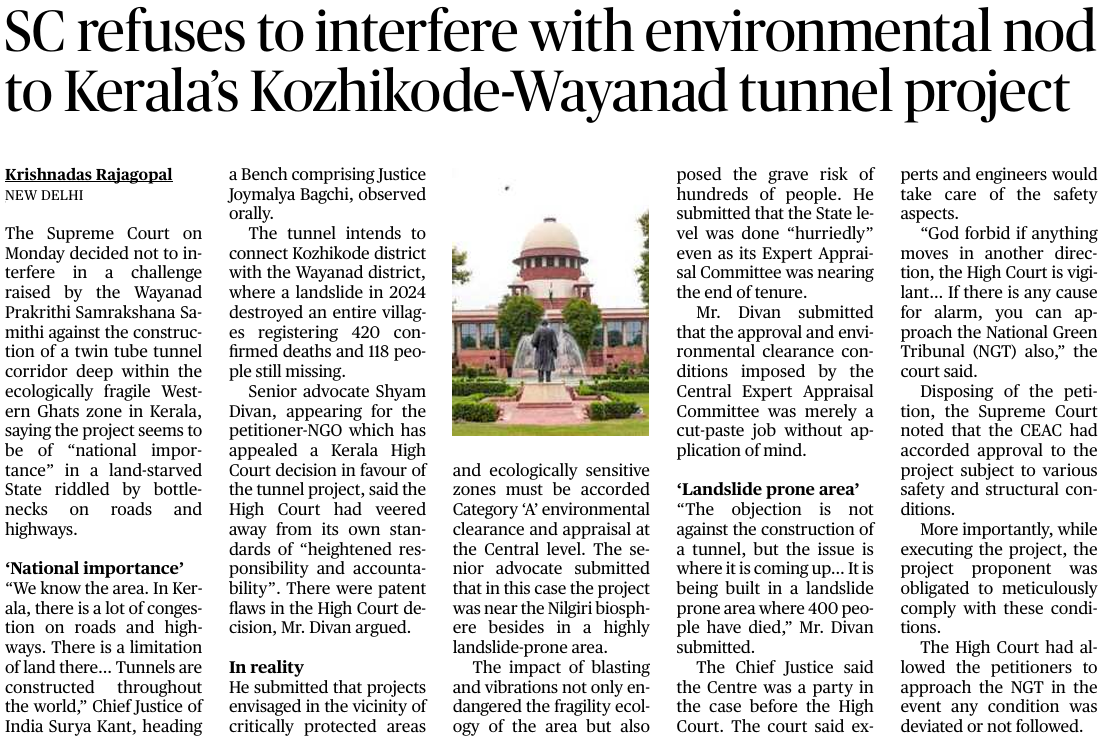
The Supreme Court declined to interfere with the environmental clearance granted for the Kozhikode–Wayanad tunnel project in Kerala, emphasizing judicial restraint and directing stakeholders to approach the National Green Tribunal (NGT) for environmental grievances.
1. Project Overview & Connectivity
Location: Connects Kozhikode and Wayanad districts in Kerala.
Infrastructure: A twin-tube tunnel corridor designed to bypass the congested and landslide-prone mountain passes (Thamarassery Ghat).
Strategic Importance: Labeled by the Supreme Court as a project of "national importance" and a "lifeline" for a land-starved state like Kerala, which faces severe road bottlenecks and high population density.
2. Environmental Impact Assessment (EIA) Framework
The legal challenge revolved around the categorization of the project under the EIA Notification, 2006:
Category ‘A’ Projects: These require mandatory prior environmental clearance from the Central Government (Ministry of Environment, Forest and Climate Change - MoEFCC) based on the recommendations of the Expert Appraisal Committee (EAC).
Category ‘B’ Projects: These are appraised at the State level by the State Level Expert Appraisal Committee (SEAC) and State Environment Impact Assessment Authority (SEIAA).
Key Legal Point: The petitioners argued the project was processed "hurriedly" at the state level, but the Court noted that the Central Expert Appraisal Committee (CEAC) had eventually accorded approval subject to rigorous safety conditions.
3. Ecological Sensitivity: Western Ghats
Location Sensitivity: The tunnel is deep within the Western Ghats, an ecologically fragile region.
Proximity to Protected Areas: The project site is near the Nilgiri Biosphere Reserve (India’s first biosphere reserve, established in 1986).
Disaster Context: The 2024 Wayanad landslides (which caused 420 deaths) were cited as a reason for caution, highlighting the risk of using blasting/vibrations in landslide-prone zones.
4. Judicial & Regulatory Bodies
Supreme Court's Stance: The Court applied the Principle of Sustainable Development, balancing the urgent need for infrastructure with environmental safeguards. It refused to stop the project but mandated strict compliance with safety conditions.
National Green Tribunal (NGT): The SC granted the petitioners "liberty" to approach the NGT if any environmental conditions are violated during construction.
Note: The NGT is a specialized body (est. 2010) for the effective and expeditious disposal of cases relating to environmental protection.
UPSC MCQ
Q. With reference to environmental governance in India, consider the following statements:
The National Green Tribunal (NGT) was established under the National Green Tribunal Act, 2010 to handle environmental disputes.
The Environmental Impact Assessment (EIA) process in India is legally mandated under the Environment (Protection) Act, 1986.
The Supreme Court cannot decline to hear environmental cases once a petition is filed under Article 32.
Which of the statements given above is/are correct?
(a) 1 and 2 only
(b) 2 only
(c) 1 and 3 only
(d) 1, 2 and 3
Answer:
(a) 1 and 2 only
Explanation:
Statement 1 – Correct: NGT is a specialised body for effective and expeditious disposal of environmental cases.
Statement 2 – Correct: EIA is governed by notifications issued under the Environment (Protection) Act, 1986.
Statement 3 – Incorrect: The Supreme Court has discretionary jurisdiction under Article 32 and may decline intervention, especially when alternative remedies (like NGT) exist.
 CSR initiatives must focus on high-impact projects: experts
GS Paper III:
• Inclusive growth and development
• Role of corporate sector in development
• Science & Technology (innovation ecosystem)
Context:
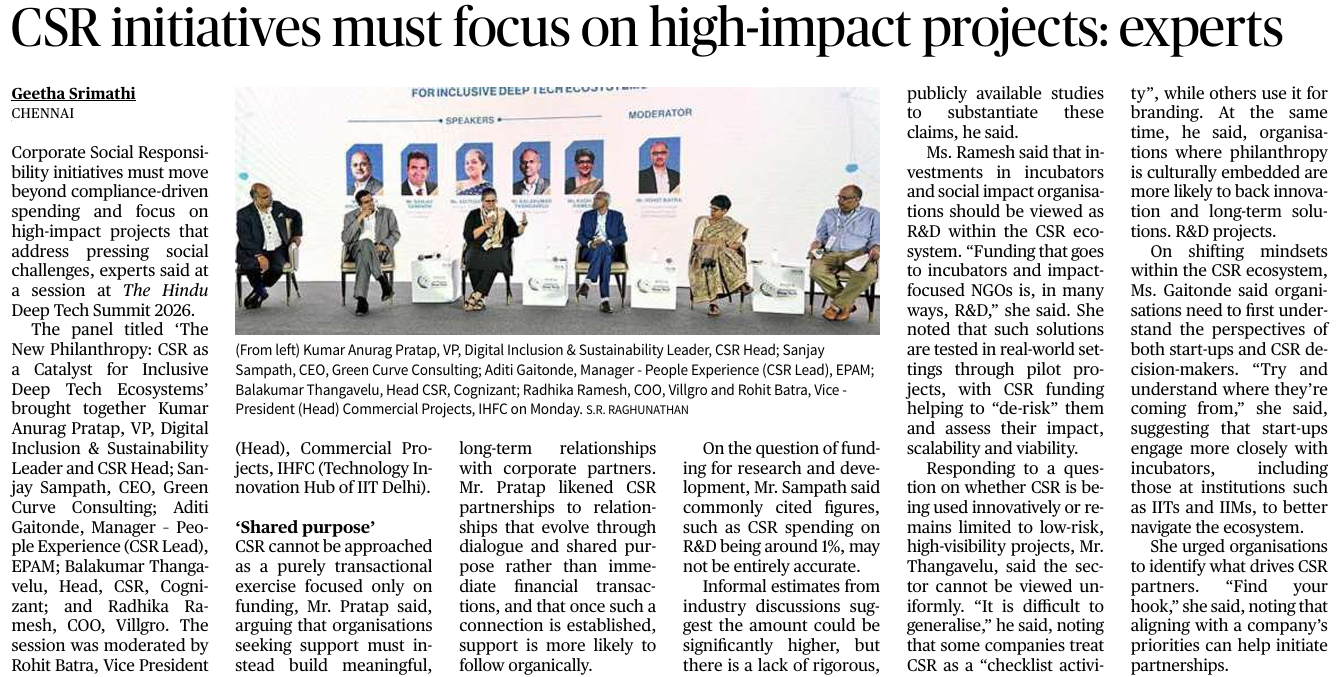
At The Hindu Deep Tech Summit 2026, experts emphasized that Corporate Social Responsibility (CSR) should shift from compliance-driven spending to high-impact, innovation-led interventions, especially in areas like deep tech, social impact, and inclusive development.
Prelims concepts
Statutory Framework of CSR in India
While the article discusses "high-impact projects," the underlying legal concepts are essential:
Companies Act, 2013: India was the first country to make CSR mandatory under Section 135.
Applicability: Companies meeting any of these three criteria in the preceding financial year:
Net worth of ₹500 crore or more.
Turnover of ₹1,000 crore or more.
Net profit of ₹5 crore or more.
Spending Requirement: At least 2% of the average net profits made during the three immediately preceding financial years.
CSR as a Catalyst for Deep Tech & R&D
The article introduces a shift from "checklist philanthropy" to "Deep Tech" support:
Deep Tech: Refers to startups based on tangible engineering innovation or scientific advances (e.g., AI, biotechnology, robotics).
R&D in CSR: Schedule VII of the Companies Act allows CSR funds to be used for R&D projects in the fields of science, technology, engineering, and medicine.
Incubators: Contributions to public-funded incubators (like those in IITs and IIMs) are eligible CSR activities. The article emphasizes that funding for these incubators "de-risks" innovation by testing solutions in real-world settings.
Administrative & Regulatory Bodies
Ministry of Corporate Affairs (MCA): The primary regulator for CSR compliance in India.
High-Level Committee on CSR: Often referenced in Prelims regarding recommendations to expand the scope of CSR (e.g., the Injeti Srinivas Committee).
UPSC MCQ
Q. With reference to Corporate Social Responsibility (CSR) in India, consider the following statements:
CSR provisions are governed under the Companies Act, 2013.
Companies are mandated to spend at least 2% of their average net profits of the last three years on CSR activities.
Which of the statements given above is/are correct?
(a) 1 only
(b) 2 only
(c) Both 1 and 2
(d) Neither 1 nor 2
Answer:
(c) Both 1 and 2
Explanation:
Statement 1 – Correct: CSR is mandated under Section 135 of the Companies Act, 2013.
Statement 2 – Correct: Eligible companies must spend at least 2% of their average net profits (last 3 years) on CSR activities.




 Launch your Graphy