The Hindu Analysis April 3rd
The Hindu News Analysis – 3rd April, 2026
1. ECI transfer controversy, top court’s clarifications (GS-2)
2. A path to peace in West Asia beyond Pakistan talks (GS-2)
3. Iran fires missiles at Israel, Gulf states as Trump talks of winding down war (GS-2)
4. Governor bound by Cabinet’s advice on remission: Madras HC (GS-2)
5. ‘West Asia crisis hits Helium supplies’ (GS-3)
 ECI transfer controversy, top court’s clarifications
GS Paper II:
• Constitutional bodies – Election Commission of India
• Separation of powers & federalism
• Governance and accountability
Context
The
Election Commission of India (ECI) transferred several senior bureaucrats in election-bound States (e.g., West Bengal), raising concerns about legality, federal overreach, and administrative disruption. The issue reached judicial scrutiny, leading to clarifications by the Supreme Court regarding Article 324 and limits on ECI’s powers.
Detailed Analysis
1. Core Issue: ECI vs State Authority
ECI transferred key officials (Chief Secretary, DGP, etc.) without prior consent of State governments.
States argued:
Violation of federal structure
Administrative paralysis
ECI justified:
Necessary for ensuring free and fair elections
Key Question:
Can ECI override State control over bureaucrats in the name of electoral integrity?
2. Article 324 – Scope and Nature of Powers
Article 324 gives ECI plenary powers for:
Superintendence
Direction
Control of elections
Supreme Court Interpretation (from Mohinder Singh Gill case):
Article 324 is a reservoir of power
Can be used when:
No specific law exists
Cannot be used when:
Law already occupies the field
Implication:
ECI’s power is broad but not absolute
3. Limitations on ECI’s Powers
The Court clarified two key constraints:
(a) Supremacy of Law
If Parliament/State Legislature has made laws → ECI must follow them
Cannot override statutory provisions
(b) Rule of Law & Natural Justice
ECI decisions must:
Be fair and reasonable
Follow procedural justice
Cannot act arbitrarily
4. Issue of Statutory Backing
Transfers of All India Services (IAS/IPS) governed by:
All India Services Act
Service rules
These officers:
Are under State government control when serving in States
No explicit legal provision:
Allowing ECI to transfer such officers directly
Conclusion:
→ ECI lacks clear statutory authority for such transfers
5. Federalism Concerns
State Public Services fall under State List (Seventh Schedule)
Transfers without State consent:
Undermine cooperative federalism
Create administrative instability
6. Supreme Court’s Key Clarifications
Article 324 gives plenary powers, but:
Not unfettered
ECI:
Cannot bypass laws made by legislature
Cannot act arbitrarily
Transfers:
Must have legal backing
ECI’s role:
Ensure elections, not take over governance
7. Concern of “Unchecked Power”
ECI traditionally depends on:
State machinery for elections
Frequent transfers:
May demoralize civil servants
Raise suspicion of bias without due process
Court’s View:
“Unchecked power is alien to constitutional order”
Significance of the Issue
Clarifies limits of constitutional bodies
Reinforces:
Rule of law
Federal balance
Prevents:
Institutional overreach
Challenges
Balancing:
Electoral integrity vs federal autonomy
Absence of:
Clear legal framework for such situations
Risk of:
Political misuse (both by States & Centre)
Way Forward
Enact clear statutory guidelines:
On ECI’s powers over officials during elections
Strengthen:
Consultative mechanisms with States
Ensure:
Transparent criteria for transfers
Judicial oversight:
To prevent arbitrary actions
Conclusion
The controversy highlights a classic constitutional tension between free and fair elections and federal governance. While Article 324 empowers the ECI significantly, the Supreme Court has reaffirmed that such power must operate within the boundaries of law, fairness, and federalism, ensuring that no institution becomes supreme over the Constitution itself.
Mains Question
Q. Examine the scope and limitations of the powers of the Election Commission of India under Article 324 of the Constitution.
Source: The Hindu
 A path to peace in West Asia beyond Pakistan talks
GS Paper II:
• International Relations – West Asia conflict
• India’s foreign policy
• Role of international organisations (UN)
Context
A recent diplomatic initiative led by Pakistan, involving countries like Saudi Arabia, Türkiye, and Egypt, aims to explore pathways for peace in West Asia. However, the article argues that such efforts are only preliminary and insufficient given the deep-rooted geopolitical tensions, lack of trust, and absence of credible enforcement mechanisms.
Detailed Analysis
1. Illusion of Diplomatic Breakthrough
The Islamabad meeting appears significant but is only a small step.
Real challenge lies in:
Implementation
Reconciling conflicting interests
Talks lack clarity, authority, and enforceability
2. Ceasefire as the First but Difficult Step
Peace process must begin with a ceasefire
However:
No side is ready to concede
No clear “victory” for any party
U.S. and Israel have shifting and aggressive objectives
Iran remains resilient and unwilling to surrender
3. Strategic and Political Constraints
Domestic politics:
Leaders cannot appear weak
Military dynamics:
Ongoing strikes undermine negotiations
War has not reached a stage of mutual exhaustion
4. Trust Deficit and Escalation Risks
Zero trust among stakeholders
U.S. actions (e.g., attacks during negotiations) deepen suspicion
Iran distrusts mediators like Saudi Arabia and UAE
Regional tensions:
Pakistan-Iran friction
Türkiye’s internal Kurdish issue
5. Weak Mediation Framework
Pakistan-led initiative lacks:
Neutrality
Global legitimacy
China’s role:
Limited to proposals and persuasion
Effective mediation requires:
Credible, accepted third party
6. Enforcement Challenge
Even if ceasefire is agreed:
Who ensures compliance?
Requires:
Military presence
International mandate
Only United Nations-backed force can provide legitimacy
UNSC divisions make this difficult
7. Lessons from History (Suez Crisis 1956)
UN peacekeeping succeeded when:
Major powers supported it
“Uniting for Peace” resolution:
Alternative when UNSC is blocked
Key takeaway:
UN works only when powerful nations cooperate
8. Role of Global Powers
U.S.: Central but inconsistent actor
China: Emerging diplomatic player
Gulf countries: Financial and regional influence
ASEAN countries: Potential neutral supporters
9. India’s Strategic Opportunity
India should:
Avoid direct entanglement
Engage diplomatically with all sides
Potential role:
Lead Global South initiative at UN
Advocate ceasefire and dialogue
Leverage:
Strategic autonomy
Credibility across blocs
Conclusion
The article highlights that peace in West Asia cannot be achieved through limited or symbolic diplomatic efforts. It requires credible mediation, enforceable ceasefire mechanisms, and cooperation among major powers. India, by mobilising the Global South and engaging multilaterally, can contribute meaningfully, but only within a carefully balanced diplomatic framework.
Mains Question
Q. Discuss the challenges in achieving peace in West Asia and evaluate the role of international and regional actors in facilitating a sustainable ceasefire.
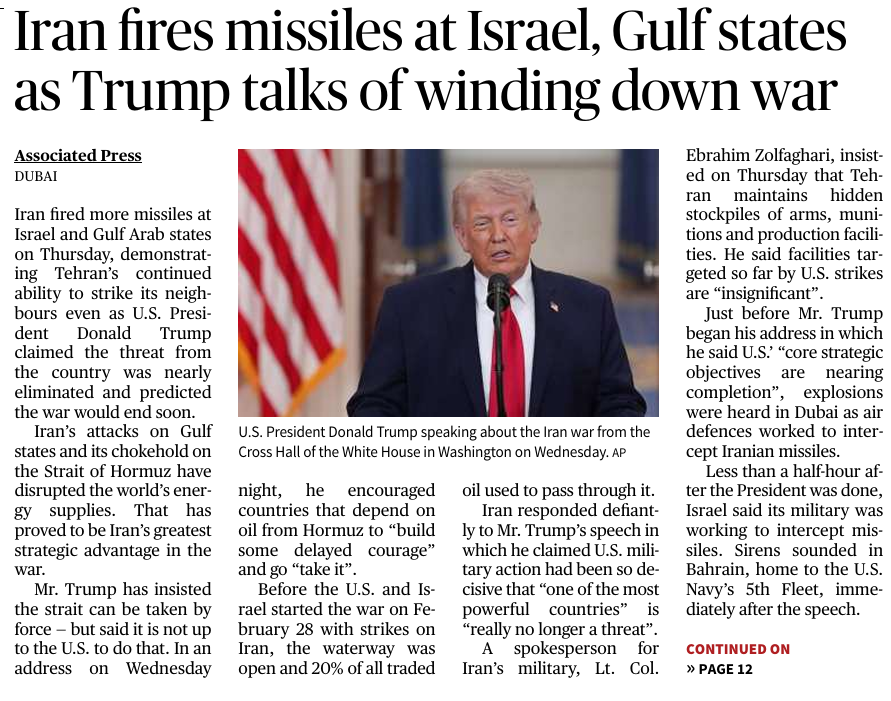
Iran fires missiles at Israel, Gulf states as Trump talks of winding down war
GS Paper II:
• International Relations – West Asia conflict
• Effect of policies of developed countries (USA)
• India’s interests in West Asia
Context
Amid escalating tensions in West Asia, Iran launched missile attacks targeting Israel and Gulf states, signalling its continued military capability. Simultaneously, U.S. President Donald Trump indicated that the war may soon end, even as hostilities and regional instability persist.
Escalation Despite De-escalation Claims
Iran’s missile strikes demonstrate:
Continued offensive capability
Willingness to expand conflict beyond Israel
Contradiction:
U.S. claims war is nearing completion
Ground reality shows ongoing escalation
Prelims concepts
1. Geopolitics & Strategic Locations
Strait of Hormuz: A vital "chokemarket" or maritime "chokepoint." It connects the Persian Gulf with the Gulf of Oman and the Arabian Sea.
Strategic Importance: It is the world's most important oil transit point. The article notes that 20% of all traded oil passes through this narrow waterway, making its disruption a major threat to global energy security.
Gulf Arab States: Refers to the members of the Gulf Cooperation Council (GCC), including Bahrain (mentioned as the home of the U.S. Navy’s 5th Fleet), the UAE (Dubai), Saudi Arabia, Qatar, Kuwait, and Oman.
2. International Relations & Defense
Air Defence Systems: Technology designed to intercept and destroy incoming missiles or aircraft (e.g., Israel's Iron Dome or the U.S. Patriot system). The article mentions these systems were active in Dubai and Israel.
Asymmetric Warfare: Iran’s use of missiles and the threat to close a global trade artery (the Strait) to counter the conventional military superiority of the U.S. and Israel.
3. Economics
Energy Security: The uninterrupted availability of energy sources at an affordable price. Disruption in the Strait of Hormuz leads to "supply shocks," which typically cause a spike in global crude oil prices.
Global Supply Chains: The article highlights how regional instability can have a "cascading effect" on global trade, specifically regarding energy supplies.
Prelims MCQ
Q. Consider the following statements regarding the recent West Asia conflict:
The Strait of Hormuz handles a significant share of global oil trade.
Iran’s missile strikes were limited only to Israel and did not affect Gulf countries.
The United States maintains a naval presence in the Gulf region.
Which of the statements given above is/are correct?
A) 1 and 3 only
B) 1 only
C) 2 and 3 only
D) 1, 2 and 3
Answer:
A) 1 and 3 only
Explanation:
Statement 1: Correct – Strait of Hormuz is a key global oil chokepoint.
Statement 2: Incorrect – Iran targeted both Israel and Gulf states.
Statement 3: Correct – U.S. Navy’s 5th Fleet operates in the region.
Governor bound by Cabinet’s advice on remission: Madras HC
GS Paper II:
• Indian Constitution – Executive (Governor)
• Centre–State relations
• Separation of powers & judicial review
Context
A Full Bench of the Madras High Court clarified that the Governor is bound by the advice of the Council of Ministers while exercising powers under Article 161 (remission of sentences). The ruling resolves conflicting earlier judgments and reinforces constitutional principles regarding the Governor’s role.
Prelims concepts:
1. Constitutional Power of the Governor
Article 161: Grants the Governor the power to grant pardons, reprieves, respites, or remissions of punishment, or to suspend, remit, or commute the sentence of any person convicted of an offense against State Law.
Key Distinction (Remission): Remission reduces the period of the sentence without changing its character (e.g., reducing 10 years of rigorous imprisonment to 5 years).
Death Penalty: Unlike the President (under Article 72), the Governor cannot grant a full pardon for a death sentence, though they can suspend, remit, or commute it.
2. Binding Nature of Advice
Discretion vs. Advice: The Madras High Court clarified that the Governor has no independent discretion in matters of remission.
Article 163: General principle that the Governor shall exercise functions with the aid and advice of the Council of Ministers (CoM).
The Ruling: The Governor is "bound by the advice," meaning they cannot take a different view from the Cabinet even if they personally disagree.
3. Landmark Judicial Precedents
Maru Ram v. Union of India (1980): The Madras HC cited this landmark Supreme Court case. It held that the "Governor" in Article 161 (and President in Article 72) actually means the State/Central Government. The personal opinion of the Head of State is irrelevant; they must act on the Cabinet's advice.
Judicial Review: While the Governor's power is executive, the exercise of that power is subject to limited judicial review if it is found to be arbitrary, mala fide, or based on irrelevant considerations.
4. Judicial Hierarchy & Benches
Division Bench: Typically consists of two judges.
Full Bench: Usually consists of three or more judges. It is formed when there are "conflicting decisions" between two different Division Benches on the same legal point.
Reference: A process where a smaller bench asks a larger bench to provide an "authoritative pronouncement" on a disputed legal question.
Prelims MCQ
Q. Consider the following statements regarding the powers of the Governor in India:
The Governor is bound by the advice of the Council of Ministers while exercising powers under Article 161 related to remission of sentences.
The Governor can exercise absolute discretion in granting remission, independent of the State Cabinet’s advice.
Article 161 of the Constitution deals with the power of the Governor to grant pardons, reprieves, respites, or remissions.
Which of the statements given above is/are correct?
A) 1 and 3 only
B) 1 only
C) 2 and 3 only
D) 1, 2 and 3
Answer:
A) 1 and 3 only
Explanation:
Statement 1: Correct – Governor is bound by Cabinet advice (as clarified by courts).
Statement 2: Incorrect – No absolute discretion in such matters.
Statement 3: Correct – Article 161 deals with clemency powers of the Governor.
‘West Asia crisis hits Helium supplies’
GS Paper III:
• Energy security & critical resources
• Industrial growth – semiconductor ecosystem
• Science & Technology applications (MRI, superconductors)
Context
The ongoing geopolitical tensions in West Asia, particularly disruptions in Qatar (a major helium exporter), have severely impacted global helium supplies. India, being fully import-dependent, faces risks to critical sectors like healthcare and semiconductor manufacturing.
Prelims concepts:
1. Scientific Properties of Helium (He)
Noble Gas: It is a colorless, odorless, tasteless, non-toxic, and inert gas. It is the second lightest and second most abundant element in the observable universe.
Liquid Helium: It has the lowest boiling point of any element.
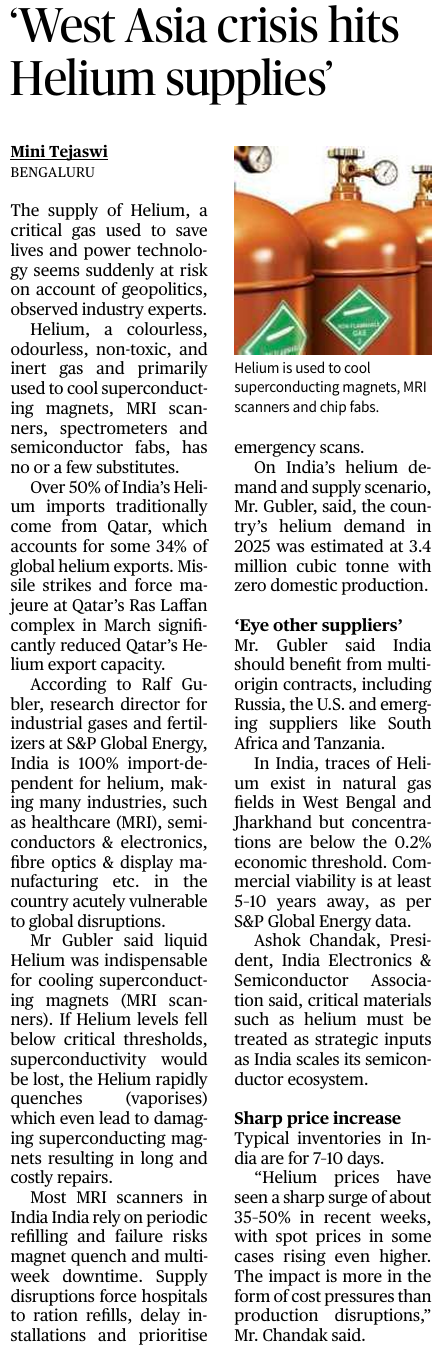
Superconductivity: Liquid helium is used to cool superconducting magnets to extremely low temperatures (near absolute zero). This property is indispensable for:
Healthcare: MRI (Magnetic Resonance Imaging) scanners.
Technology: Semiconductor fabrication (chips), fiber optics, and spectrometers.
Quenching: If helium levels drop below a critical threshold in an MRI, the magnets lose superconductivity and the liquid helium rapidly vaporizes—a process called a "quench," which can damage the equipment.
2. Geography & Resources
Global Supply: Qatar is a massive player, accounting for roughly 34% of global helium exports.
India's Scenario: * 100% Import Dependent: India currently has zero domestic production of helium.
Primary Source: Over 50% of India's helium imports traditionally come from Qatar.
Domestic Traces: Traces of helium are found in natural gas fields in West Bengal and Jharkhand.
Economic Threshold: For helium extraction from natural gas to be commercially viable, it usually needs a concentration of at least 0.2%. Indian reserves are currently below this threshold.
Alternative Suppliers: Major producers include the U.S. and Russia, with emerging suppliers in South Africa and Tanzania.
Prelims MCQ
Q. Consider the following statements regarding Helium:
Helium is a chemically inert gas primarily used in cooling superconducting magnets in MRI machines.
India is largely self-sufficient in helium production due to domestic reserves in eastern India.
Helium has viable substitutes in most of its industrial and medical applications.
Which of the statements given above is/are correct?
A) 1 only
B) 1 and 2 only
C) 2 and 3 only
D) 1, 2 and 3
Answer:
A) 1 only
Explanation:
Statement 1: Correct – Helium is inert and crucial for MRI cooling.
Statement 2: Incorrect – India is almost fully import dependent.
Statement 3: Incorrect – Helium has no easy substitutes in key uses.


 Launch your Graphy