The Hindu Analysis April 30th
The Hindu News Analysis – 30th April, 2026
1. South Asian power balance shifts toward Pakistan (GS-2, GS-3)
2. NSO survey shows better health-seeking behaviour (GS-3, GS-2)
3. U.S. returns 657 trafficked artefacts to India in $14 million restitution (GS-1, GS-2)
4. India and Sri Lanka reaffirm maritime ties through bilateral diving exercise in Colombo (GS-3, GS-2)
5. Govt. proposes E100 as approved fuel (GS-3)
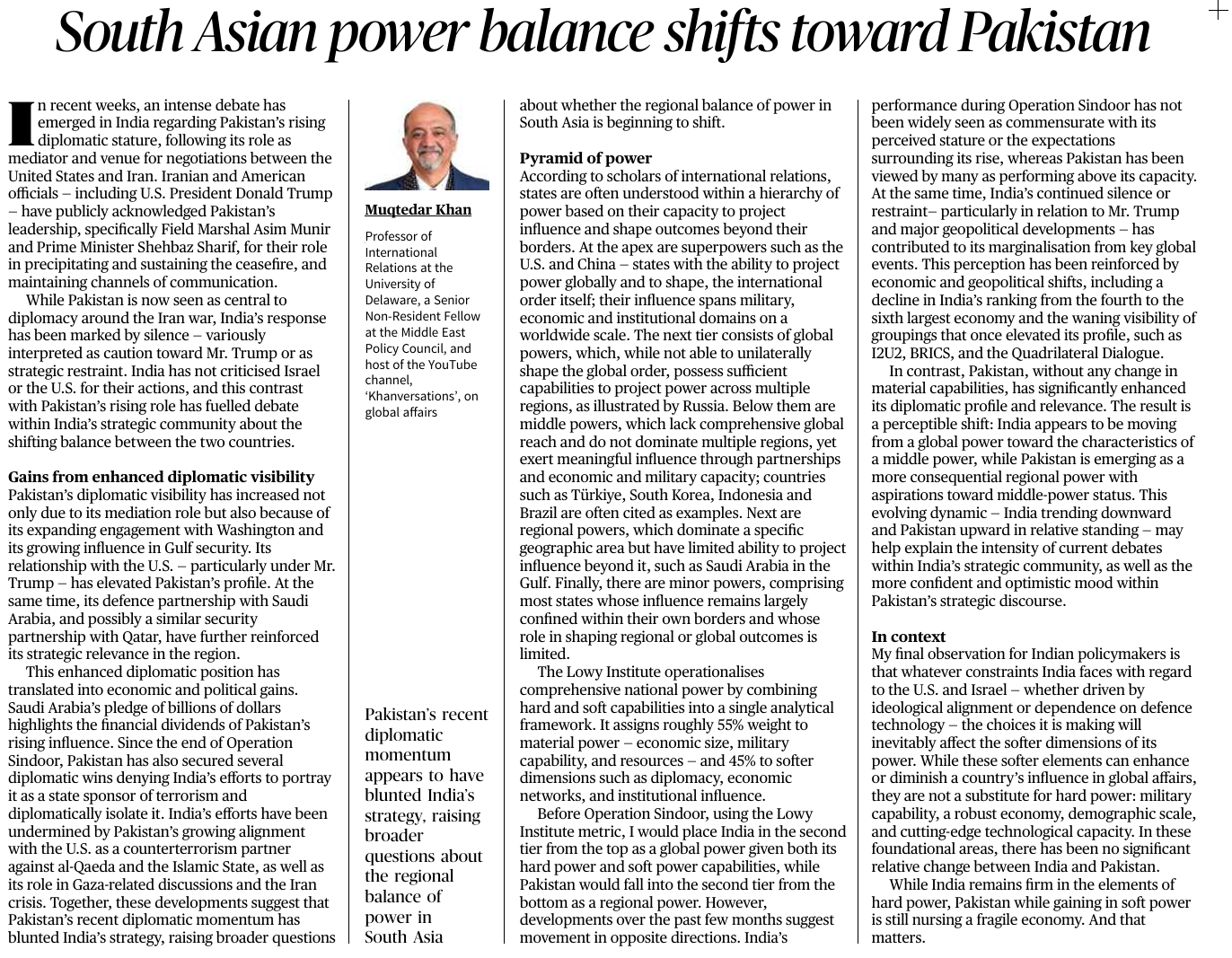
South Asian power balance shifts toward Pakistan
GS Paper II:
India and its neighbourhood- relations
Bilateral, regional and global groupings
Effect of policies of developed countries (U.S.)
GS Paper III:
Security challenges and external state actors
Role of diplomacy in national security
Context
Pakistan’s recent diplomatic activism—especially its role in mediating between the U.S. and Iran—has triggered debate in India.
Global acknowledgment (including by U.S. leadership) of Pakistan’s role has elevated its diplomatic profile.
Simultaneously, India’s restrained response in global developments has raised concerns about its relative strategic positioning in South Asia.
Detailed Analysis
1. Pakistan’s Rising Diplomatic Visibility
Pakistan has positioned itself as a key intermediary in global conflicts, particularly the U.S.-Iran situation.
Strengthening ties with:
United States
Saudi Arabia and Gulf countries
Gains:
Financial promises (e.g., Saudi investments)
Strategic recognition in global security issues
It has successfully:
Countered India’s narrative of isolating Pakistan diplomatically
Projected itself as a counterterrorism partner
2. India’s Strategic Restraint and Its Costs
India has largely maintained strategic silence on major global developments.
Possible reasons:
Avoid antagonising the U.S.
Maintaining balanced diplomacy
However, consequences include:
Reduced visibility in global diplomacy
Perception of passivity
Decline in global economic ranking (4th → 6th as mentioned)
3. Understanding “Pyramid of Power”
International relations classify states based on their ability to project power:
Level
Type of Power
Examples
Top
Superpowers
U.S., China
Second
Global powers
Russia
Third
Middle powers
Türkiye, South Korea
Fourth
Regional powers
Saudi Arabia
Bottom
Minor powers
Most countries
Lowy Institute framework:
45% weight → Soft power (diplomacy, networks)
👉 Earlier:
India → Upper-tier (global power category)
Pakistan → Lower-tier (regional power)
👉 Now (as per article’s argument):
India trending downward in influence
Pakistan gaining importance as a middle-power aspirant
4. Hard Power vs Soft Power Dynamics
India
Strong in:
Military capability
Economic base
Technology and demographics
Weakness:
Underutilisation of soft power diplomacy
Pakistan
Weak in:
Economy
Structural stability
Strong in:
Diplomatic agility
Strategic positioning in geopolitical conflicts
➡️ Key Insight:
Soft power gains can shift perceptions even without major changes in hard power.
5. Declining Influence of Indian Groupings
Reduced prominence of:
I2U2
BRICS
Quadrilateral Dialogue (Quad)
Indicates:
Weakening of platforms that earlier amplified India’s global voice
6. Perception vs Reality
Perception Shift:
Pakistan seen as “punching above its weight”
India seen as “underperforming”
Reality Check:
India still dominates in:
Economy
Military strength
Technology
Pakistan continues to face:
Fragile economy
Structural vulnerabilities
👉 Conclusion:
Shift is more perceptual (soft power) than structural (hard power).
Significance
Highlights importance of diplomatic activism in modern geopolitics
Shows how middle powers can leverage global crises to enhance influence
Underlines that strategic silence can reduce global visibility
Challenges
For India
Balancing strategic autonomy with proactive diplomacy
Reviving global leadership image
Strengthening multilateral engagement
For Pakistan
Sustaining gains without strong economic base
Avoiding overdependence on external actors
Way Forward
India should:
Adopt proactive diplomacy, not just strategic restraint
Leverage platforms like:
G20
BRICS
Quad
Integrate hard + soft power effectively
Increase visibility in global conflict mediation
Pakistan should:
Convert diplomatic gains into economic stability
Maintain credibility in global engagements
Conclusion
While Pakistan’s recent diplomatic surge has created a perception of shifting power in South Asia, the fundamental balance still favours India due to its superior hard power. However, the article rightly highlights that in today’s world, perception shaped by diplomacy can significantly influence geopolitical standing. The real takeaway is not Pakistan’s rise alone, but India’s need to recalibrate its diplomatic strategy to match its material capabilities.
UPSC Mains Question
Q. “Recent geopolitical developments indicate a perceptual shift in the balance of power in South Asia in favour of Pakistan.” Critically examine this statement in the context of hard power vs soft power dynamics and India’s diplomatic strategy. (250 words)
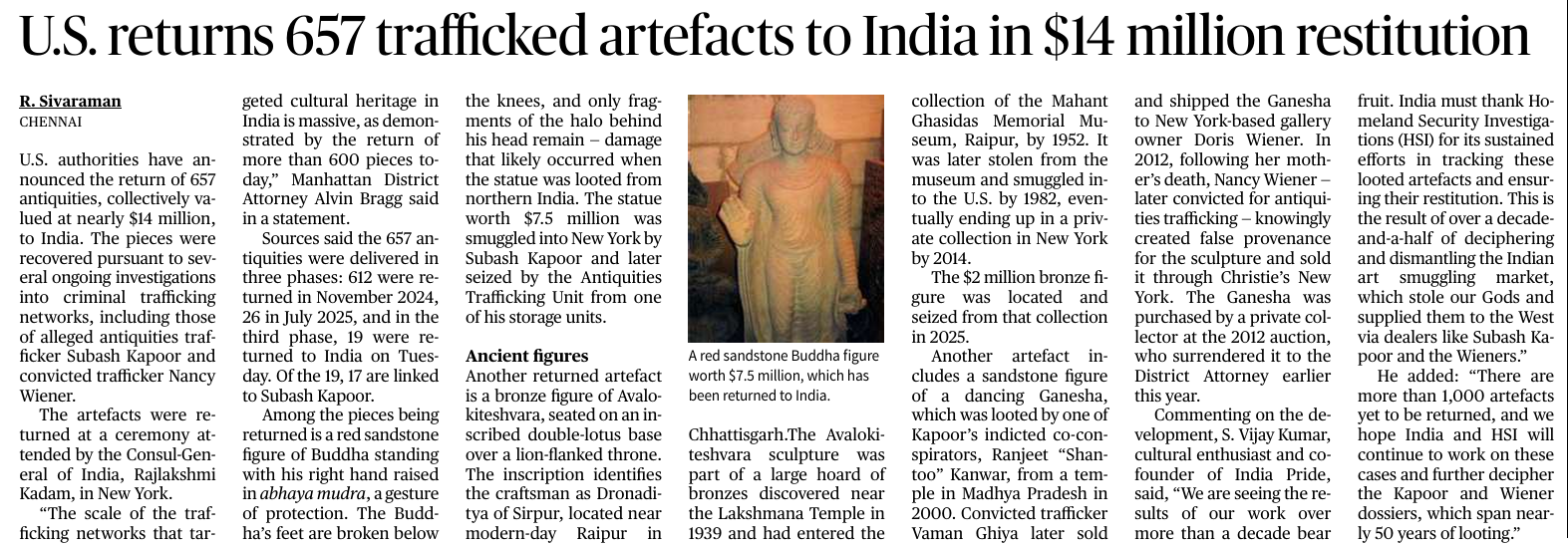
U.S. returns 657 trafficked artefacts to India in $14 million restitution
GS Paper I:
Indian culture – art forms, sculptures, heritage conservation
GS Paper II:
India–U.S. relations
International cooperation in cultural heritage protection
Context
The United States has returned 657 trafficked antiquities to India, valued at nearly $14 million.
The recovery is part of long-term investigations into global art trafficking networks, including those linked to Subash Kapoor and Nancy Wiener.
It reflects growing international cooperation in repatriation of cultural property.
Prelims concepts
1. Major Artefacts Returned
The restitution involves several historically and artistically significant pieces:
Red Sandstone Buddha: A standing figure with the right hand raised in abhaya mudra (a gesture of protection). The statue is notably damaged below the knees with only fragments of the halo remaining.
Bronze Avalokiteshvara: A figure seated on an inscribed double-lotus base over a lion-flanked throne.
Inscriptions: It identifies the craftsman as Dronaditya of Sirpur.
Origin: Part of a large hoard of bronzes discovered near the Lakshmana Temple in 1939 (Chhattisgarh).
Sandstone Dancing Ganesha: A sculpture looted from a temple in Madhya Pradesh in 2000.
2. Artistic & Iconographic Terms
Abhaya Mudra: A symbolic hand gesture in Indian religions representing safety, protection, and reassurance.
Avalokiteshvara: A prominent Bodhisattva in Mahayana Buddhism who embodies the compassion of all Buddhas.
Sirpur: An ancient site in modern-day Raipur, Chhattisgarh, known for its historical Buddhist and Hindu monuments.
Red Sandstone: Frequently associated with the Mathura School of Art, known for producing early Buddhist and Hindu iconography.
3. Key Locations and Sites
Lakshmana Temple (Sirpur, Chhattisgarh): A 7th-century brick temple dedicated to Lord Vishnu, highlighting the regional importance of Chhattisgarh in historical bronze and stone art.
Mahant Ghasidas Memorial Museum (Raipur): The institution from which the Avalokiteshvara sculpture was originally stolen before being smuggled into the U.S..
UPSC MCQ
Q. Consider the following statements regarding repatriation of cultural artefacts to India:
The return of antiquities by foreign countries to India is facilitated by international cooperation and investigations into illicit trafficking networks.
The Antiquities and Art Treasures Act, 1972 regulates the export and preservation of antiquities in India.
All antiquities exported from India before 1972 are considered illegal and must be mandatorily returned.
Which of the statements given above is/are correct?
(a) 1 and 2 only
(b) 2 and 3 only
(c) 1 and 3 only
(d) 1, 2 and 3
Answer:
(a) 1 and 2 only
Explanation:
Statement 1: Correct – Repatriation is often the result of international collaboration and criminal investigations.
Statement 2: Correct – The 1972 Act governs antiquities, including export restrictions.
Statement 3: Incorrect – Antiquities exported before 1972 are not automatically illegal; legality depends on the laws applicable at that time and proof of illicit removal.
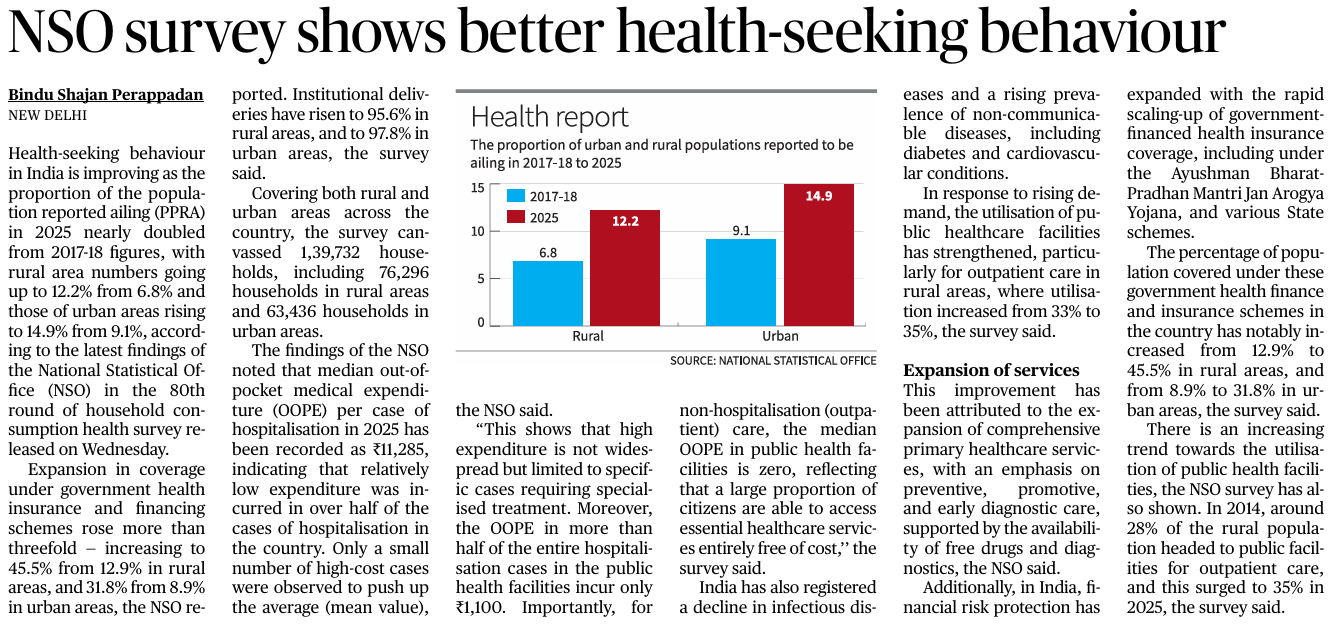
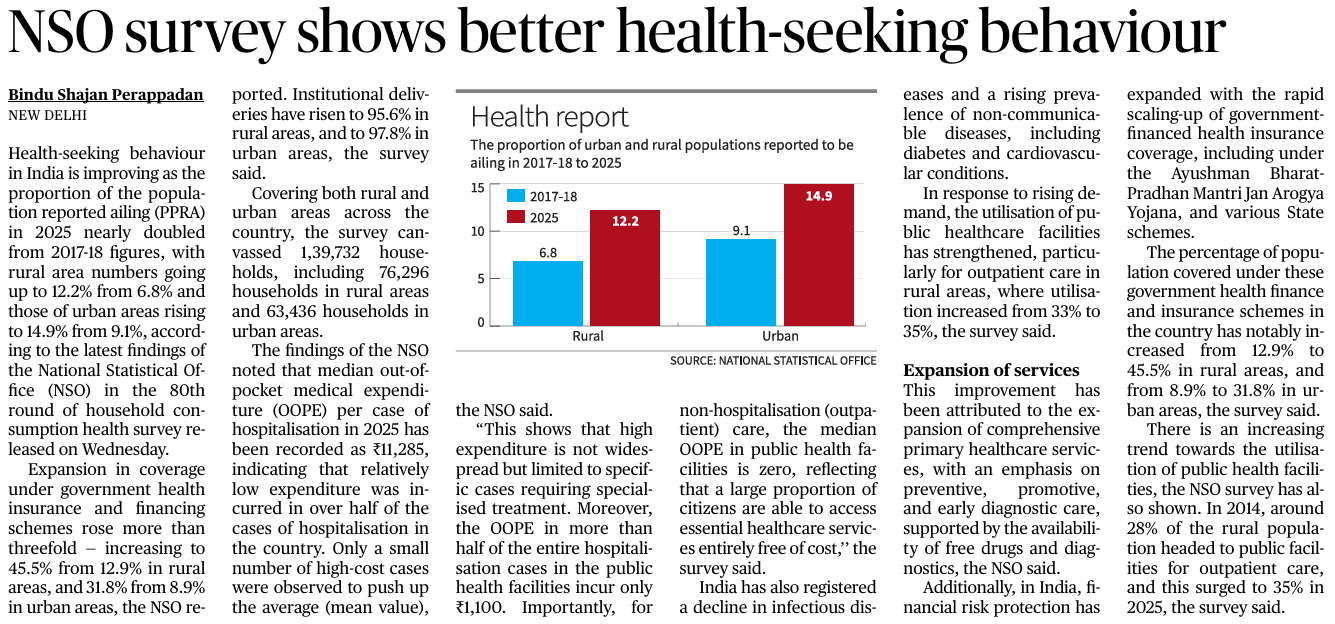
NSO survey shows better health-seeking behaviour
GS Paper II:
Issues relating to development and management of social sector (Health)
Government policies and interventions (Ayushman Bharat, public health systems)
GS Paper III:
Human resource development (Health outcomes)
Inclusive growth and social development
Context
The National Statistical Office (NSO) 80th round survey highlights improved health-seeking behaviour in India.
There is a significant rise in people reporting ailments (PAPRA) and increased utilisation of public healthcare facilities, supported by expanded insurance coverage.
Key concepts
1. Institutional and Survey Overview
Conducting Body: The survey was conducted by the National Statistical Office (NSO).
Survey Details: It is the 80th round of the household consumption health survey.
2. Key Health Indicators & Trends
Proportion of Population Reported Ailing (PPRA):
The PPRA has nearly doubled from 2017-18 to 2025.
Rural: Increased from 6.8% to 12.2%.
Urban: Increased from 9.1% to 14.9%.
Institutional Deliveries: These have risen significantly, reaching 95.6% in rural areas and 97.8% in urban areas.
Epidemiological Shift: There is a noted decline in infectious diseases alongside a rising prevalence of Non-Communicable Diseases (NCDs) like diabetes and cardiovascular conditions.
3. Government Health Insurance & Schemes
Expansion of Coverage: Participation in government health finance and insurance schemes rose more than threefold.
Rural Coverage: Increased from 12.9% to 45.5%.
Urban Coverage: Increased from 8.9% to 31.8%.
Major Schemes Mentioned: Ayushman Bharat-Pradhan Mantri Jan Arogya Yojana (AB-PMJAY) and various State-specific schemes.
4. Public Healthcare Utilization
Shift in Preference: There is an increasing trend toward using public healthcare facilities, especially for outpatient care.
Outpatient Care (Rural): Utilization of public facilities rose from 33% (in 2014) to 35% (in 2025).
Focus Areas: Growth is attributed to the expansion of comprehensive primary healthcare, emphasizing preventive, promotive, and early diagnostic care.
India and Sri Lanka reaffirm maritime ties through bilateral diving exercise in Colombo
GS Paper II:
India and its neighbourhood relations
Bilateral agreements and regional cooperation (IOR)
GS Paper III:
Security challenges in maritime domain
Role of armed forces in disaster management
Context
India and Sri Lanka conducted the 4th edition of IN-SLN DIVEX 2026 in Colombo.
The exercise involved joint diving operations, strengthening maritime cooperation and interoperability between the two navies.
It aligns with India’s broader MAHASAGAR vision in the Indian Ocean Region (IOR).
Prelims concepts
1. Exercise IN-SLN DIVEX 2026
Nature: It is a bilateral diving exercise between the Indian Navy and the Sri Lanka Navy.
Edition: The 2026 event marked the fourth edition of the exercise.
Location: Conducted in Colombo, Sri Lanka.
Objective: To strengthen interoperability through advanced deep-sea diving evolutions and enhance operational coordination.
2. Key Naval Assets and Operations
INS Nireekshak: The Indian Navy's specialized diving support and submarine rescue vessel deployed for this exercise.
Deep-sea Diving: Divers successfully executed dives beyond 55 metres, boosting joint capabilities in underwater search, rescue, and salvage.
Mixed Gas Diving: Conducted over World War-era wrecks, specifically the SS Worcester and SS Perseus off the coast of Colombo.
3. Strategic Initiatives and Humanitarian Aid
MAHASAGAR Vision: The exercise aligns with this vision, which stands for "Maritime and Holistic Advancement for Security and Growth Across Regions."
Aarogya Maitri Initiative: As part of humanitarian cooperation, India handed over two BHISM cubes to Sri Lanka.
BHISM: Stands for Bharat Health Initiative for Sahyog, Hita and Maitri.
Function: These are portable hospital units designed to enhance disaster response and medical preparedness.
UPSC MCQ
Q. Consider the following statements regarding the India–Sri Lanka bilateral diving exercise (IN-SLN DIVEX 2026):
The exercise includes joint deep-sea diving, search and rescue, and salvage operations to enhance interoperability between the two navies.
The exercise is conducted under the framework of the Quadrilateral Security Dialogue (Quad) to strengthen Indo-Pacific security cooperation.
Which of the statements given above is/are correct?
(a) 1 only
(b) 2 only
(c) Both 1 and 2
(d) Neither 1 nor 2
Answer:
(a) 1 only
Explanation:
Statement 1: Correct – The exercise focuses on underwater operations such as diving, search & rescue, and salvage to improve coordination.
Statement 2: Incorrect – It is a bilateral India–Sri Lanka exercise, not conducted under the Quad framework.
Govt. proposes E100 as approved fuel
GS Paper III:
Energy security
Environment & pollution control
Infrastructure (transport sector reforms)
Science & technology in everyday life (alternative fuels)
Context
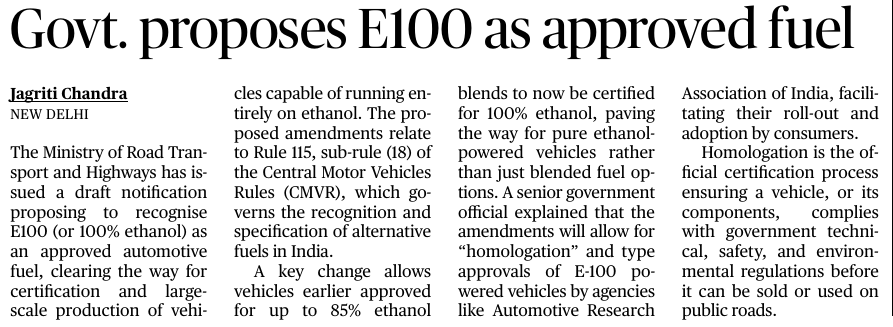
The Ministry of Road Transport & Highways has proposed recognising E100 (100% ethanol) as an approved automobile fuel under the Central Motor Vehicles Rules (CMVR).
This enables certification (homologation) of vehicles that run entirely on ethanol, beyond current blended fuels (like E20).
Prelims concepts
1. E100 (100% Ethanol)
Definition: The Ministry of Road Transport and Highways (MoRTH) has proposed recognizing E100 as an approved automotive fuel.
Significance: This clears the path for the certification and large-scale production of vehicles capable of running entirely on ethanol, moving beyond the previous limits of blended fuel.
Previous Limit: Earlier regulations allowed for vehicles to be approved for up to 85% ethanol blends.
2. Regulatory Framework: CMVR, 1989
Central Motor Vehicles Rules (CMVR): The proposed amendments relate specifically to Rule 115, sub-rule (18) of the CMVR.
Mandate: This rule governs the recognition and technical specifications of alternative fuels in India.
Implementation: The move involves issuing a draft notification to modify these rules to include 100% ethanol as a standalone fuel category.
3. The Concept of "Homologation"
Definition: Homologation is the official certification process that ensures a vehicle, or its components, complies with government technical, safety, and environmental regulations.
Requirement: A vehicle must undergo homologation before it can be legally sold or used on public roads.
Impact: The new amendments will allow for the "type approval" of E100-powered vehicles by specialized agencies.
 Launch your Graphy