The Hindu Analysis April 2nd
The Hindu News Analysis – 2nd April, 2026
1. A West Asia security rethink amid America’s role (GS-2)
2. A textbook, criticism, the Court and contempt (GS-2)
3. India to renew push for faster FTA implementation during PM’s EU visit (GS-2, GS-3)
4. NASA begins fuelling rocket for first lunar trip in 50 years
(GS-3)
5. SEZ export units can sell locally at lower tax rate (GS-3)
A West Asia security rethink amid America’s role
GS Paper II:
• International relations – India and its neighbourhood
• Effect of policies of developed countries on India
Context
The ongoing U.S.–Israel confrontation with Iran and the broader instability in West Asia (Middle East) has triggered a reassessment of regional security architecture, especially among Gulf nations. Questions are emerging about the reliability of the United States as a security guarantor and the need for regional alternatives.
Detailed Analysis
1. Changing Nature of West Asian Security
The conflict involving U.S., Israel, and Iran is no longer isolated; it risks becoming region-wide.
Strategic chokepoints like the Strait of Hormuz are under threat, impacting global oil flows.
Iran’s doctrine of retaliation across the region (proxy warfare) adds complexity.
Implication:
West Asia is shifting from external security dependence (U.S.) → regional self-reliance.
2. Declining Credibility of the United States
Despite being a long-time security provider, the U.S. response has been:
Inconsistent (e.g., limited response to attacks on Saudi oil facilities in 2019)
Transactional (asking Gulf partners to share costs)
Increasing U.S. energy self-sufficiency reduces its stakes in the region.
Conclusion:
Gulf nations perceive the U.S. as a less reliable and less committed partner.
3. Rise of Regional Security Initiatives
Countries like Saudi Arabia, UAE, Qatar, Kuwait are:
Enhancing intra-Gulf cooperation
Attempting conflict management within the region
Example:
Saudi–Iran rapprochement (2023) brokered by China
These efforts reflect:
Desire for strategic autonomy
Shift toward multi-polar security arrangements
4. Pakistan’s Strategic Repositioning
Pakistan is attempting to:
Act as a mediator between Iran and the U.S.
Reassert its role within the Islamic world
Motivations:
Economic crisis → need for geopolitical relevance
Leveraging ties with both U.S. and Islamic countries
However:
Raises concerns for India due to:
Pakistan’s proximity to Iran
Potential diplomatic balancing that may affect regional equations
5. Internal Shifts within the Gulf
Gulf Cooperation Council (GCC) states are:
Moving past internal divisions (e.g., Qatar blockade crisis)
Building collective resilience mechanisms
Criticism of bodies like the Arab League indicates:
Institutional inefficiency
Need for reformed regional governance
6. Emerging Concerns and Risks
Israel’s assertive military actions could escalate tensions further
Increasing Iran–Israel rivalry risks wider conflict
Gulf states may:
Act more independently (unilateralism)
Hedge between U.S., China, and regional powers
7. Big Strategic Questions Raised
Can a regional security system exist without U.S. dominance?
Is Iran’s inclusion necessary for lasting stability?
Will Asian powers like India and China play a larger role?
Can Gulf countries maintain unity despite internal differences?
Significance
For West Asia
Marks a transition toward a post-American security order
Encourages regional ownership of security
For India
Critical due to:
Energy dependence (major oil imports from Gulf)
Diaspora presence
India may need to:
Adopt multi-alignment strategy
Engage with all stakeholders (Iran, Gulf, Israel, U.S.)
Challenges
Deep-rooted sectarian divides (Shia–Sunni)
Lack of trust among regional actors
Weak regional institutions
External power competition (U.S. vs China vs Russia)
Ongoing conflicts (Yemen, Gaza, Iran tensions)
Way Forward
1. Inclusive Regional Security Framework
Incorporate Iran, GCC, and external stakeholders
Move toward collective security dialogue platforms
2. Reduced Overdependence on External Powers
Gulf nations to strengthen:
Defense cooperation
Intelligence sharing
3. Role for Middle Powers (India)
India can:
Act as a neutral stabilizing force
Promote energy security partnerships
Support multilateral dialogue forums
4. Institutional Reforms
Strengthen or redesign:
Arab League
Regional diplomatic mechanisms
Conclusion
The West Asian region is at a strategic inflection point, where reliance on the U.S. is being questioned and new regional security paradigms are emerging. However, without inclusive cooperation (especially involving Iran) and institutional strengthening, these efforts may remain fragile. The evolving order presents both risks and opportunities, particularly for countries like India that are deeply tied to the region’s stability.
UPSC Mains question
Q. “West Asia is witnessing a shift from external security dependence to regional security autonomy.” Critically analyse.
Source: The Hindu
 A textbook, criticism, the Court and contempt
GS Paper II:
• Judiciary – Structure, organisation and functioning
• Separation of powers
• Freedom of speech and expression
Context
The article discusses the controversy surrounding an NCERT textbook and the Supreme Court’s response, raising broader questions about the use of contempt of court powers, limits of criticism, and the balance between judicial authority and free speech.
Detailed Analysis
1. Nature and Types of Contempt of Court
Civil Contempt: Disobedience of court orders.
Criminal Contempt:
Obstructing justice
Prejudicing proceedings
Scandalising or lowering the authority of courts
Key Concern:
Criminal contempt, especially “scandalising the court,” is subjective and risks misuse.
2. Judiciary and Public Trust
Courts derive legitimacy not from force but from:
Public confidence and trust
Perception of fairness and integrity
Repeated negative portrayals (even if motivated) can:
Undermine institutional credibility
Affect judicial functioning indirectly
3. Importance of Criticism in Democracy
Judiciary is not immune from criticism.
Constructive criticism:
Promotes accountability and transparency
Strengthens democracy
Historical stance:
Judges like Justice Sabyasachi Mukherjee and Justice P.B. Gajendragadkar emphasized openness to criticism.
Core Idea:
Criticism should trigger introspection, not suppression.
4. Limits to Free Speech
Criticism must:
Be fact-based and reasoned
Avoid reckless or malicious attacks
Distinction:
Fair criticism → acceptable
Motivated denigration → harmful
5. Judicial Restraint in Using Contempt Powers
Contempt power should be:
Used sparingly and cautiously
Not driven by ego or personal offense
Overuse risks:
Chilling effect on free speech
Perception of judiciary as intolerant to dissent
6. “Broad Shoulders” Doctrine
Courts should develop tolerance toward criticism.
Example:
CJI Barucha’s view → Courts must have “broad shoulders” to endure comments
Reinforces:
Institutional maturity
Democratic ethos
7. Global Perspective
Reference to Lord Denning (UK):
Courts should not use contempt to:
Defend dignity artificially
Suppress criticism
Emphasizes:
Freedom of speech as paramount
8. Where Should the Line Be Drawn?
Contempt should apply only when:
There is clear obstruction of justice
Or deliberate, malicious attempts to undermine judiciary
Not for:
Academic critique
Honest public debate
9. Institutional Challenges Highlighted
Judicial system faces:
Delays and backlog
Allegations of corruption
Lack of internal accountability mechanisms
Suppressing criticism diverts attention from:
Need for reforms
Significance
Reinforces balance between:
Judicial independence
Fundamental Right (Article 19(1)(a))
Protects:
Democratic discourse
Institutional legitimacy
Challenges
Subjectivity in defining “scandalising the court”
Risk of misuse of contempt powers
Maintaining dignity vs allowing dissent
Weak internal accountability systems
Way Forward
1. Clear Guidelines on Contempt
Narrow interpretation of criminal contempt
Define objective standards
2. Promote Judicial Accountability
Strengthen:
In-house mechanisms
Transparency in functioning
3. Encourage Constructive Criticism
Academia, media, and civil society should:
Engage responsibly
Provide evidence-based critique
4. Judicial Restraint
Courts must:
Avoid overreaction
Uphold constitutional morality over institutional ego
Conclusion
The judiciary’s true strength lies in public trust, not coercive authority. While protecting its dignity is essential, excessive use of contempt powers risks undermining democratic values. A balanced approach—encouraging fair criticism while curbing malicious attacks—is key to preserving both judicial integrity and freedom of expression.
Mains Question
Q. “The power of contempt of court is essential for maintaining judicial authority, but its misuse can undermine democratic freedoms.” Critically examine in the context of freedom of speech and judicial accountability in India.
India to renew push for faster FTA implementation during PM’s EU visit
GS Paper II:
• India and Europe relations
• Bilateral, regional and global groupings
GS Paper III:
• Economy – Trade and external sector
• Globalisation and its impact
Context
Prime Minister Narendra Modi’s upcoming visit to Europe aims to accelerate the India–EU Free Trade Agreement (FTA) process. The visit includes engagements with EU Parliament, Nordic countries, and bilateral meetings, with a focus on trade, technology, and strategic cooperation amid global uncertainties like the West Asia conflict.
Prelims concepts
1. India-EU Free Trade Agreement (FTA)
The FTA is a comprehensive bilateral agreement aimed at reducing tariffs and non-tariff barriers to increase trade in goods and services.
Objective: To unlock opportunities for businesses, MSMEs, and skilled professionals.
Ratification Process: Requires approval from both the Indian government and the European Parliament.
Significance: This would be a milestone in the India-EU strategic partnership, which has faced delays for over a decade.
2. Multilateral Summits & Platforms
The article mentions several key diplomatic groupings:
Nordic Summit: A summit involving India and the five Nordic countries: Denmark, Finland, Iceland, Norway, and Sweden. These nations are key partners for India in green technology, maritime security, and innovation.
G-7 Summit (Outreach): The G-7 comprises Canada, France, Germany, Italy, Japan, the U.K., and the U.S. India is frequently invited as an "outreach" partner to discuss global issues like climate change and supply chain resilience.
3. Bilateral Diplomatic Engagements
Specific focus areas mentioned for European partners include:
The Netherlands: Focus on defense, water management, innovation, and trade. The Netherlands is one of India's largest trading partners in Europe and a major source of FDI.
France (Évian-les-Bains): Serving as the host for the G-7 outreach, highlighting the deep strategic partnership between New Delhi and Paris.
UPSC MCQ
Q.Which of the following countries are part of the European Union (EU)?
Norway
Sweden
Denmark
Iceland
Select the correct answer using the code below:
A) 2 and 3 only
B) 1, 2 and 3 only
C) 2, 3 and 4 only
D) 1, 3 and 4 only
A) 2 and 3 only
Sweden and Denmark are EU members.
Norway and Iceland are not EU members (they are part of EEA).
NASA begins fuelling rocket for first lunar trip in 50 years
GS Paper III:
• Science and Technology – Space technology
• Awareness in space missions and developments
Context
NASA has initiated the fuelling of its Artemis II mission, marking humanity’s first crewed lunar mission in over 50 years since Apollo 17 (1972). The mission aims to send astronauts around the Moon, signalling a renewed era of space exploration.
1. The Artemis Program
The Artemis Program is a NASA-led international mission to return humans to the Moon, establish a sustainable presence, and use it as a "stepping stone" for future missions to Mars.
Artemis I (2022): An uncrewed flight test of the Space Launch System (SLS) and Orion spacecraft around the Moon.
Artemis II (2026): The first crewed mission of the program. It is a lunar flyby (not a landing) to test life-support systems.
Artemis III (Planned 2028): Scheduled to land the first woman and the first person of color on the lunar south pole.
2. Space Launch System (SLS)
The SLS is NASA's "super heavy-lift" launch vehicle, currently the most powerful rocket in the world.
Propulsion: Uses a combination of Liquid Hydrogen (LH2) as fuel and Liquid Oxygen (LOX) as an oxidizer.
Core Stage: Powered by four RS-25 engines (upgraded versions of the Space Shuttle engines).
Boosters: Two five-segment Solid Rocket Boosters provide over 75% of the thrust during the first two minutes of flight.
3. Mission Trajectory: Free-Return Trajectory
Unlike the Apollo missions that often entered a low lunar orbit, Artemis II uses a Free-Return Trajectory.
Mechanism: The spacecraft uses Earth's and the Moon's gravity to "slingshot" around the lunar far side.
4. Artemis II Crew & International Cooperation
Partnerships: While NASA leads, the program involves the ESA (European Space Agency), CSA (Canada), and JAXA (Japan). The Orion Service Module is notably provided by the ESA.
5. Comparison: Apollo vs. Artemis
Feature
Apollo Program (1961–1972)
Artemis Program (Current)
Launch Vehicle
Saturn V
Space Launch System (SLS)
Spacecraft
Apollo Command/Service Module
Orion Spacecraft
Destination
Lunar Equatorial Region
Lunar South Pole
Goal
Short-term exploration ("Flags and Footprints")
Long-term sustainable presence & Gateway
Crew Capacity
3 Astronauts
4 Astronauts
UPSC MCQ
With reference to NASA’s Artemis programme, consider the following statements:
Artemis II is the first mission in the Artemis programme.
Artemis II will carry astronauts around the Moon without landing.
The programme aims to establish a sustained human presence on the Moon.
Which of the statements given above is/are correct?
A) 2 and 3 only
B) 1 and 2 only
C) 1 and 3 only
D) 1, 2 and 3
A) 2 and 3 only
Statement 1 is incorrect → Artemis I was the first mission (uncrewed).
SEZ export units can sell locally at lower tax rate
GS Paper III:
• Indian Economy – Industrial policy
• Export promotion and SEZs
• Globalisation and trade
Context
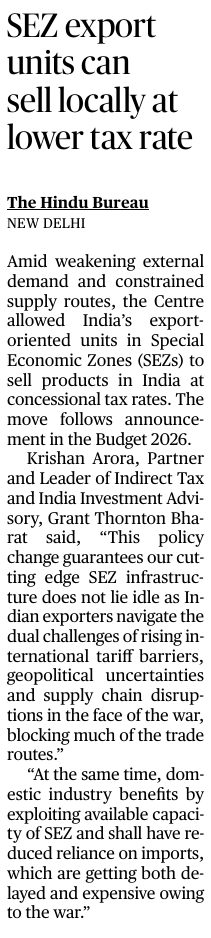
In response to weak global demand, supply chain disruptions, and geopolitical tensions, the Government of India has allowed Special Economic Zone (SEZ) units to sell in the domestic market at concessional tax rates, as announced in Budget 2026.
1. Special Economic Zones (SEZs)
An SEZ is a specifically delineated duty-free enclave and is deemed to be foreign territory for the purposes of trade operations, duties, and tariffs.
Objective: To generate additional economic activity, promote exports of goods and services, and create employment.
Legal Framework: Governed by the SEZ Act, 2005 and SEZ Rules, 2006.
Governance: The Department of Commerce (Ministry of Commerce and Industry) is the nodal agency.
Approval: A three-tier administrative setup consisting of the Board of Approval (Apex Body), the Approval Committee, and the Development Commissioner.
2. SEZ Sales in Domestic Tariff Area (DTA)
The DTA refers to the area within India that is outside the SEZs.
General Rule: Historically, goods sold from an SEZ into the DTA were treated as imports. They were subject to full customs duties (Basic Customs Duty + Integrated GST).
The Change (Budget 2026): Export-oriented units in SEZs can now sell products locally at concessional tax rates.
Rationale: * External Demand Weakness: Hedging against falling international demand due to global conflicts.
Supply Chain Disruptions: Utilizing idle capacity within SEZs to serve domestic markets when imports are delayed or expensive.
Import Substitution: Reducing reliance on foreign goods by using high-quality infrastructure already present in India.
3. Key Economic Terms from the Article
Export-Oriented Units (EOUs): Units undertaking to export their entire production of goods and services (except permissible sales in DTA).
Indirect Tax: Taxes levied on goods and services (like GST or Customs Duty) rather than income or profits.
Non-Tariff Barriers: Trade restrictions that are not in the form of a tariff (e.g., quotas, embargoes, or stringent technical standards).
Supply Chain Resilience: The ability of a trade route to withstand geopolitical "shocks" (like the wars mentioned in the text).
4. Comparison: EOU vs. SEZ
While the article mentions "export-oriented units in SEZs," it is important to distinguish the two for Prelims:
Feature
SEZ (Special Economic Zone)
EOU (Export Oriented Unit)
Location
Must be within a specific designated zone.
Can be located anywhere in India.
Status
Treated as "Foreign Territory" for trade.
Treated as a unit within India with tax benefits.
Minimum Investment
High (usually requires large land parcels).
Relatively lower.
Approval
Approved by the Board of Approval (BoA).
Approved by the Development Commissioner.
UPSC MCQ:
With reference to Special Economic Zones (SEZs) in India, consider the following statements:
SEZs are treated as foreign territory only for customs duties.
Units in SEZs are primarily set up to promote exports.
Domestic Tariff Area (DTA) sales from SEZs are treated as imports.
Which of the statements given above is/are correct?
A) 2 and 3 only
B) 1 and 2 only
C) 1 and 3 only
D) 1, 2 and 3
A) 2 and 3 only
Statement 1 is incorrect → SEZs are treated as foreign territory for trade operations broadly, not just customs.




 Launch your Graphy