There are no items in your cart
Add More
Add More
| Item Details | Price | ||
|---|---|---|---|




 India, New Zealand sign ‘historic’ trade deal
GS Paper II:
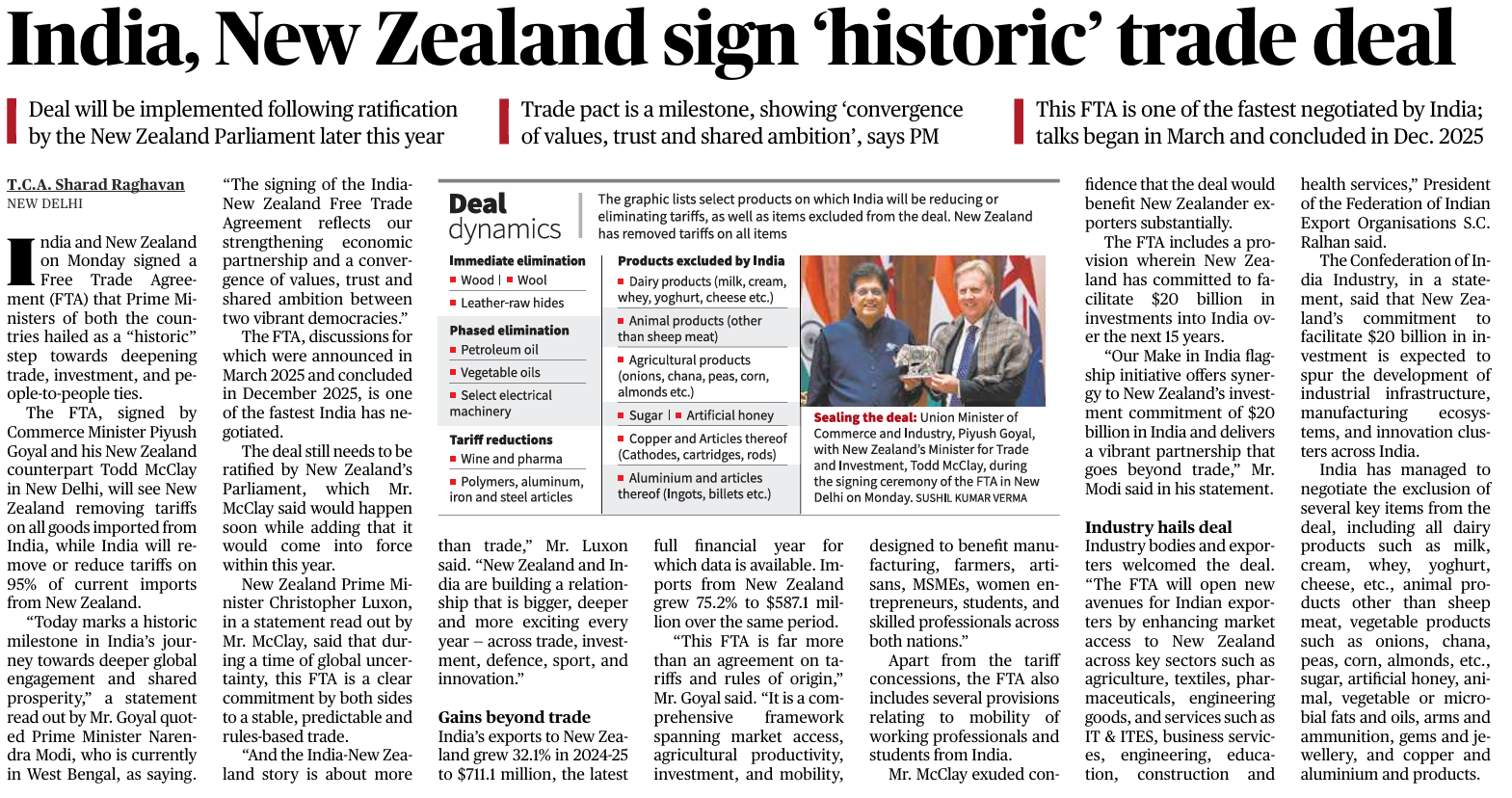
India and New Zealand have signed a Free Trade Agreement (FTA) aimed at boosting trade, investment, and people-to-people ties. The deal is being described as one of the fastest negotiated FTAs by India, reflecting strategic economic engagement in a changing global order.
India-New Zealand Free Trade Agreement (FTA)
An FTA is a pact between two or more nations to reduce barriers to imports and exports among them. Under a free trade policy, goods and services can be bought and sold across international borders with little or no government tariffs, quotas, subsidies, or prohibitions.
Timeline: One of India’s fastest-negotiated deals (started March 2025, concluded December 2025).
Reciprocity: New Zealand: Removing tariffs on all goods imported from India.
India: Removing or reducing tariffs on 95% of current imports from New Zealand.
Investment Commitment: New Zealand has committed to facilitating $20 billion in investments into India over the next 15 years.
Key Features of the FTA
Tariff Liberalisation:
New Zealand will eliminate tariffs on all Indian goods
India will reduce/eliminate tariffs on 95% of imports from New Zealand
Phased Approach:
Immediate elimination: wool, wood, leather products
Gradual reduction: petroleum oils, vegetable oils, machinery
Sensitive Sector Protection (India):
Dairy products (milk, cheese, etc.)
Agricultural products (onions, pulses, almonds, etc.)
This reflects India’s cautious approach to protect farmers
Export Opportunities for India
Sectors benefiting:
Textiles
Pharmaceuticals
Engineering goods
IT & services (ITeS, education, construction)
Improved market access in New Zealand
UPSC MCQ
Q. Consider the following statements regarding the India–New Zealand Free Trade Agreement (FTA):
New Zealand has agreed to eliminate tariffs on all goods imported from India.
India has excluded all agricultural products from tariff reductions under the agreement.
Which of the statements given above is/are correct?
(a) 1 only
(b) 2 only
(c) Both 1 and 2
(d) Neither 1 nor 2
Answer: (a) 1 only
Explanation:
Statement 1 is correct: New Zealand will eliminate tariffs on all Indian goods.
Statement 2 is incorrect: India has not excluded all agricultural products, only selected sensitive items (like dairy and some crops) are excluded.
 Can middle school students engage with AI?
Context
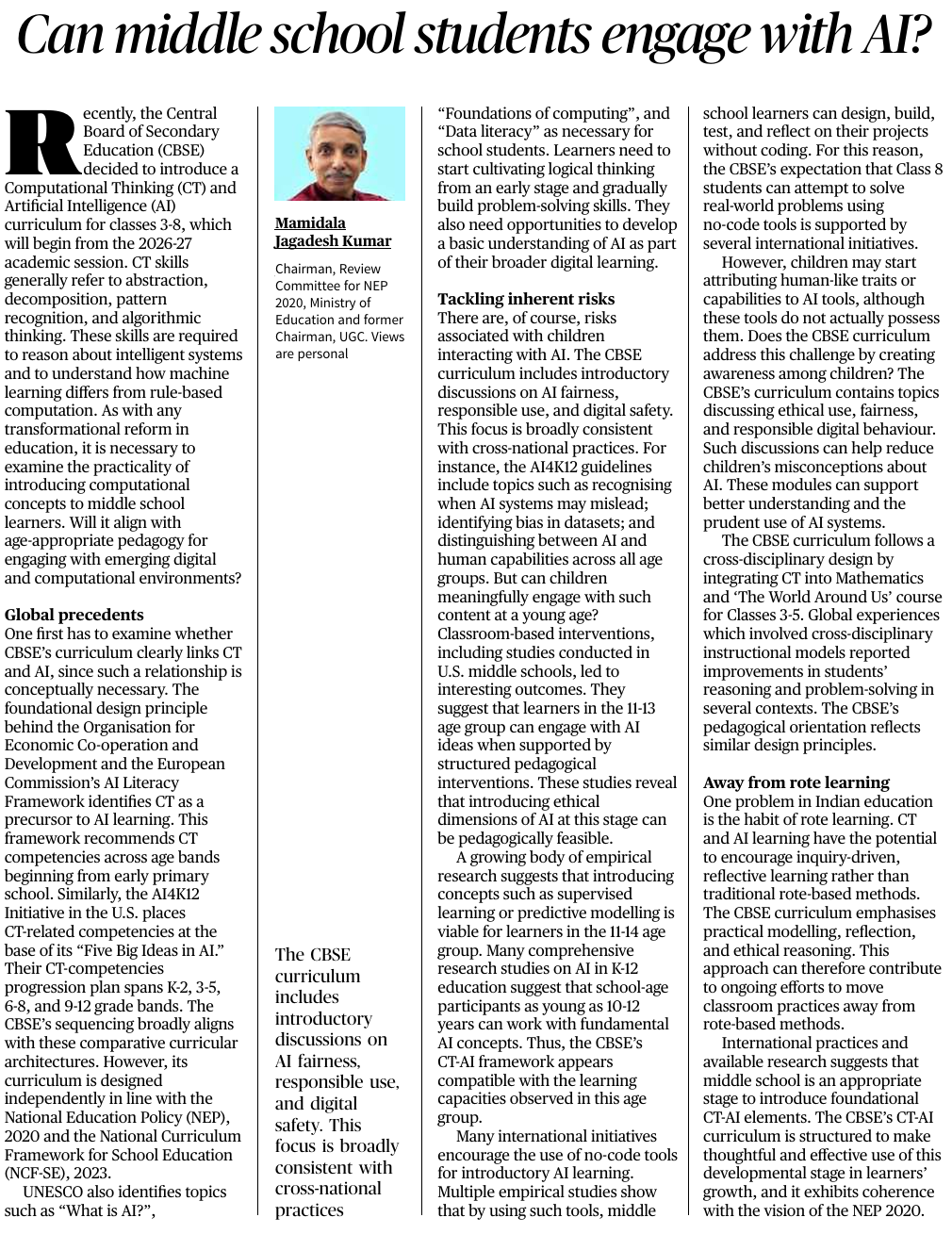
The CBSE’s decision to introduce Computational Thinking (CT) and Artificial Intelligence (AI) for Classes 3–8 from the 2026–27 academic session has triggered debate on whether middle school students (ages 10–13) can meaningfully engage with AI concepts in an age-appropriate and pedagogically sound manner.
Detailed Analysis
1. Rationale Behind Introducing AI at Middle School Level
Early Skill Development:
CT skills (abstraction, decomposition, pattern recognition) build logical reasoning
Digital Literacy:
AI is becoming integral to everyday life → early exposure is necessary
Alignment with NEP 2020:
Emphasis on 21st-century skills and experiential learning
2. Global Best Practices & Pedagogical Alignment
OECD & European Commission:
CT identified as a precursor to AI learning
AI4K12 Framework (USA):
Introduces AI concepts progressively from early grades
Cross-disciplinary Approach:
Integration with Mathematics and Environmental Studies (“World Around Us”)
No-code Tools:
Enable students to design solutions without complex programming
👉 Inference: CBSE’s framework is broadly aligned with global standards and age-appropriate learning models.
3. Feasibility: Can Children Really Learn AI?
Research shows:
Students aged 10–12 can grasp basic AI concepts
11–13 age group can engage with supervised learning, prediction models
Learning is effective when:
Supported by structured pedagogy
Focus is on conceptual understanding, not coding complexity
👉 Conclusion: Engagement is feasible if pedagogy is simplified and experiential.
4. Tackling Risks & Ethical Concerns
Key Risks
Anthropomorphism (treating AI as human-like)
Bias in datasets
Misuse and overdependence
CBSE’s Approach
Inclusion of:
AI ethics & fairness
Responsible digital behaviour
Data awareness & bias recognition
👉 This aligns with responsible AI frameworks globally
5. Transforming Learning: Moving Away from Rote
Encourages:
Inquiry-based learning
Problem-solving and critical thinking
Promotes:
Reflection, experimentation, and real-world application
👉 Potential to address a key weakness of Indian education: rote learning culture
6. Challenges
Teacher Preparedness:
Lack of trained faculty in AI/CT
Infrastructure Gaps:
Digital divide across schools
Curriculum Overload:
Risk of burdening students
Implementation Quality:
Urban-rural disparity
7. Significance
Builds future-ready workforce
Enhances innovation ecosystem
Strengthens digital empowerment at grassroots level
Positions India in AI-driven global economy
8. Way Forward
Capacity Building:
Teacher training in AI pedagogy
Phased Implementation:
Pilot projects before nationwide rollout
Inclusive Access:
Bridging digital divide via public investment
Focus on Ethics:
Strengthen responsible AI education
Continuous Evaluation:
Feedback-based curriculum refinement
Conclusion
Introducing AI and CT at the middle school level is both feasible and necessary, provided it is implemented with age-appropriate pedagogy, ethical grounding, and strong institutional support. If executed well, it can transform India’s education system from rote-based to innovation-driven learning.
UPSC Mains Question
Q. Introducing Artificial Intelligence (AI) and Computational Thinking (CT) at the middle school level can transform India’s education system, but its success depends on effective implementation. Discuss.
 Chairman of Rajya Sabha recognises the merger of AAP defectors with BJP
Context
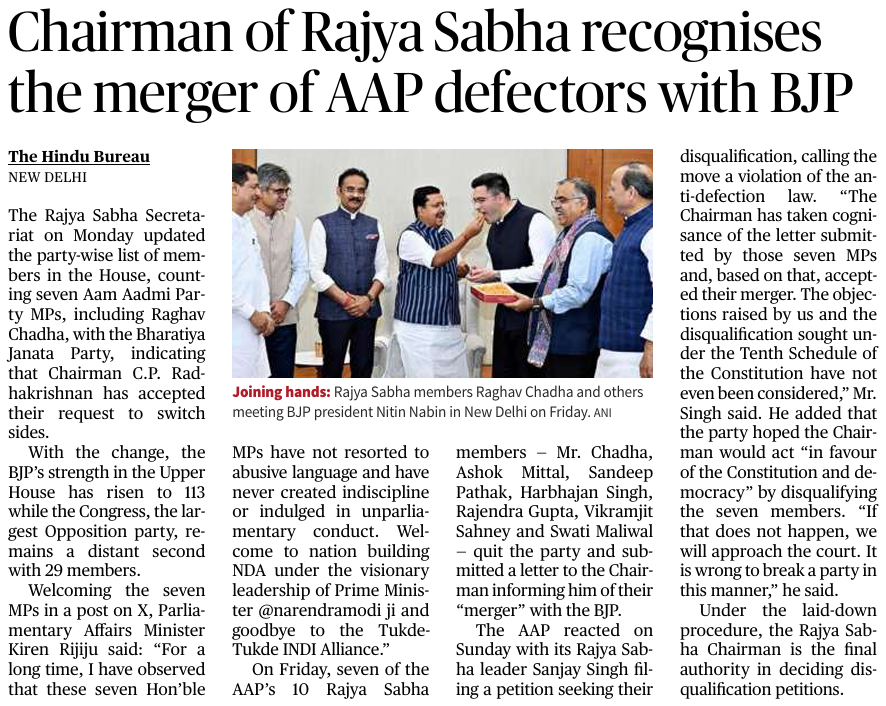
The Rajya Sabha Chairman has recognised the merger of seven AAP MPs with the BJP, increasing BJP’s strength in the Upper House. This decision comes amid petitions seeking disqualification under the Tenth Schedule, raising questions about the interpretation of the anti-defection law.
Prelims concepts
1. The Tenth Schedule (Anti-Defection Law)
Added by the 52nd Amendment Act, 1985, the Tenth Schedule was designed to prevent political defections prompted by the lure of office or similar considerations.
Grounds for Disqualification
Voluntary Give Up: If an elected member voluntarily gives up the membership of a political party.
Voting Against Mandate: If they vote or abstain from voting in the House contrary to any direction issued by the political party (the "Whip").
Independent Members: If an independent candidate joins a political party after election.
Nominated Members: If they join a political party after the expiry of six months from the date on which they take their seat.
2. The "Merger" Exception
The article mentions a "merger" of seven out of ten members. This is the primary legal shield against disqualification.
The 2/3rds Rule: Under the law, a member shall not be disqualified if their original political party merges with another party, provided at least two-thirds of the members of the legislature party have agreed to the merger.
Context from Article: AAP has 10 members in the Rajya Sabha. Since 7 members (which is > 66.6%) joined the BJP, they are seeking protection under this merger clause.
Note: Originally, the 52nd Amendment allowed for a "split" (1/3rd members), but the 91st Amendment Act, 2003 deleted this provision. Now, only a merger (2/3rds) is recognized.
3. Role of the Rajya Sabha Chairman
The Chairman (the Vice-President of India) acts as the adjudicating authority in the Upper House.
Decision-Making Power: The question of disqualification on the ground of defection is decided by the Chairman or the Speaker of such House.
Finality of Decision: According to the Tenth Schedule, the decision of the Chairman is final. However, in the Kihoto Hollohan case (1992), the Supreme Court ruled that this decision is subject to Judicial Review on grounds of mala fides, perversity, etc.
UPSC MCQ
Q. Consider the following statements regarding the Anti-Defection Law in India:
Under the Tenth Schedule, disqualification on grounds of defection does not apply if at least two-thirds of the members of a legislative party agree to merge with another party.
The decision of the Chairman of the Rajya Sabha on disqualification of members under the Tenth Schedule is completely immune from judicial review.
Which of the statements given above is/are correct?
(a) 1 only
(b) 2 only
(c) Both 1 and 2
(d) Neither 1 nor 2
Answer: (a) 1 only
Explanation:
Statement 1 is correct: The 2/3rd merger exception protects members from disqualification under the Anti-Defection Law.
Statement 2 is incorrect: The Chairman’s decision is subject to judicial review (as held in Kihoto Hollohan case, 1992).
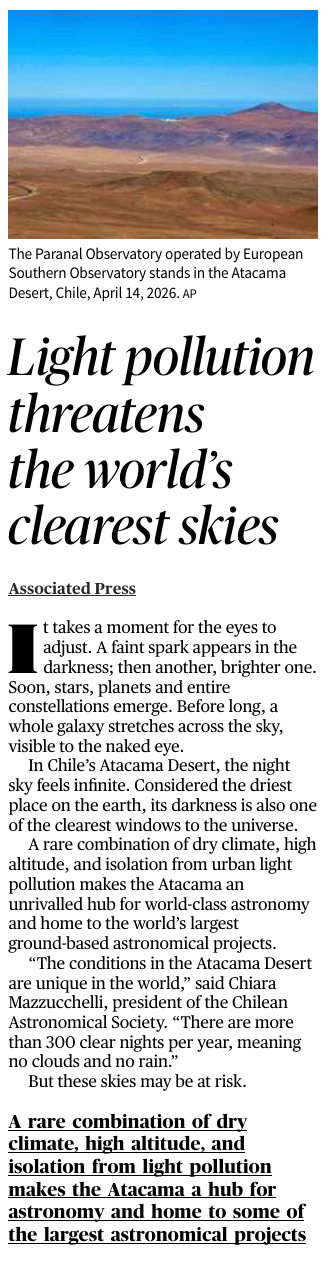
Context
The Atacama Desert in Chile, known for having some of the clearest night skies on Earth, is facing increasing threats from light pollution due to urbanisation, mining, and energy projects, endangering its status as a global hub for astronomy.
Prelims concepts
1. Geographical Context: Atacama Desert
The Atacama is a staple in geography for its extreme environmental characteristics.
Location: Situated in Chile, South America.
Aridity: Considered the driest place on Earth.
Reasoning: It lies in a double "rain shadow" created by the Andes Mountains to the east and the Chilean Coast Range to the west.
Ideal Astronomy Conditions:
Dry Climate: Minimal moisture means less atmospheric distortion.
High Altitude: Many observatories are at altitudes exceeding 3,000 meters, placing them above a large portion of the Earth’s atmosphere.
Clarity: Offers over 300 clear nights per year with negligible cloud cover or rain.
2. Science & Technology: Major Observatories
The article highlights Chile as a hub for ground-based astronomical infrastructure.
Paranal Observatory: Operated by the European Southern Observatory (ESO).
Extremely Large Telescope (ELT):
Currently under construction (scheduled for completion in 2030).
Uses 798 mirrors with a light-gathering area of nearly 1,000 square meters.
Expected to be 15 times sharper than the Hubble Space Telescope.
3. Environment:
Light Pollution: Defined as the presence of anthropogenic (human-made) light in the night environment. It interferes with astronomical research by brightening the night sky (skyglow).
4. Key Comparative Concept: Ground-based vs. Space-based Telescopes
Feature
Ground-based (e.g., ELT)
Space-based (e.g., Hubble/JWST)
Location
High-altitude deserts (Atacama)
Earth's orbit or Lagrange points
Atmosphere
Must look through the atmosphere
Operates above the atmosphere
Maintenance
Easier to repair and upgrade
Difficult/impossible to repair
Cost
Generally cheaper for the same size
Extremely expensive
UPSC MCQ
Q. Consider the following statements regarding astronomical observatories in the Atacama Desert:
The Atacama Desert provides ideal conditions for astronomy due to its high altitude, dry climate, and minimal cloud cover.
Light pollution primarily originates from natural sources such as stars and atmospheric phenomena.
Which of the statements given above is/are correct?
(a) 1 only
(b) 2 only
(c) Both 1 and 2
(d) Neither 1 nor 2
Answer: (a) 1 only
Explanation:
Statement 1 is correct: The Atacama Desert’s unique conditions make it one of the best places for astronomical observations.
Statement 2 is incorrect: Light pollution is mainly caused by artificial human-made lighting, not natural sources.
 TRAI attempts to promote public WiFi hotspots, again
Context
The Telecom Regulatory Authority of India (TRAI) has once again released a consultation paper to revive public WiFi hotspots in India, an initiative that has struggled for nearly a decade due to regulatory, commercial, and infrastructural challenges.
Prelims concepts
1. Regulatory Authority: TRAI
Status: It is a statutory body established by the Telecom Regulatory Authority of India Act, 1997.
Objective: To provide a fair and transparent policy environment which promotes a level playing field and facilitates fair competition.
Function in Article: Issuing a consultation paper to seek stakeholder responses on how to scale public WiFi hotspots.
2. PM-WANI (Prime Minister’s Wi-Fi Access Network Interface)
Objective: To increase broadband proliferation across the country.
Key Components:
PDO (Public Data Office): Small shops or establishments that will establish, maintain, and operate WANI-compliant Wi-Fi Access Points and deliver broadband services to subscribers.
PDOA (Public Data Office Aggregator): An aggregator of PDOs who will look after functions like Authorization and Accounting.
App Provider: Will register users and discover WANI-compliant hotspots in the nearby area.
Central Registry: Maintained by C-DOT, it will keep details of App Providers, PDOAs, and PDOs.
Current Status: The article notes that while the target was 10 lakh hotspots, less than half have been rolled out four years after the deadline.
UPSC MCQ
Q. Consider the following statements regarding public WiFi initiatives in India:
The PM-WANI scheme aims to create a nationwide network of public WiFi hotspots through Public Data Offices (PDOs).
High leased line costs and strict authentication requirements have acted as barriers to the growth of public WiFi hotspots.
Which of the statements given above is/are correct?
(a) 1 only
(b) 2 only
(c) Both 1 and 2
(d) Neither 1 nor 2
Answer: (c) Both 1 and 2
Explanation:
Statement 1 is correct: PM-WANI is designed to expand public WiFi through PDOs.
Statement 2 is correct: High costs and regulatory requirements (like OTP authentication) have hindered growth.
 Launch your Graphy