The Hindu Analysis April 23rd


The Hindu News Analysis – 23rd April, 2026
1. Beyond trade deals to building a new architecture
(GS-3, GS-2)
2. INS Nireekshak arrives in Colombo for bilateral exercise
(GS-2, GS-3)
3. Extreme heat threatens food systems, warn UN agencies
(GS-3)
4. Norms tweaked to blend non-petroleum sources with ATF
(GS-3)
5. Toxic workplaces take lives of 8.4 lakh people annually
(GS-2, GS-3)
Beyond trade deals to building a new architecture
GS Paper II:
India and its neighbourhood & global relations
Bilateral, regional and global groupings
GS Paper III:
Indian Economy – Globalisation
Science & Technology (AI, digital public infrastructure)
Context
India recently signed major trade agreements with the EU and the U.S. While these are significant, the article argues that global trade is increasingly shaped by geopolitics rather than pure economics, exposing vulnerabilities in India’s current approach.
Detailed Analysis
1. Breakdown of the Old Global Trade Order
Earlier: Trade based on efficiency and comparative advantage
Now: Shift towards geopolitics-driven trade restrictions
U.S. imposing tariffs on India (Russian oil issue)
China weaponising supply chains (APIs, electronics)
Result: Unpredictable and politicised trade environment
👉 Insight: Globalisation is transitioning into “strategic interdependence”
2. India’s Structural Vulnerabilities
Heavy dependence on:
China → APIs, electronics, rare earths
Taiwan → semiconductor chips
Global markets → technology & investment
Weakening of fallback options:
Russia no longer a reliable counterbalance post-Ukraine war
👉 Conclusion: India’s strategic autonomy space is shrinking
3. Limits of Current Strategy
India follows a multi-alignment approach (ties with all major powers)
Problem:
Over-dependence on big powers (U.S./China)
Bilateral deals are temporary and politically fragile
👉 These are described as “tactical wins, not structural solutions”
4. Shift to Sectoral Partnerships (Core Argument)
What is proposed?
Move from:
Broad trade agreements
➝ To sector-specific, small-group partnerships
Features:
Limited countries
Focused sectors (e.g., AI, chips, space)
Shared standards & supply chains
👉 Goal: Build resilient ecosystems, not just trade flows
5. Historical Precedent: European Model
Example: 1951 European Coal and Steel Community
Strategy:
Start with key sectors
Build economic interdependence
Gradually evolve into larger integration (EU)
👉 Lesson: Functional cooperation → Political stability
6. Leveraging India’s Strengths
India can lead in:
a) Digital Public Infrastructure (DPI)
UPI, Aadhaar, DigiLocker
Exportable governance model
Competes with:
China’s surveillance model
U.S. Big Tech dominance
b) Artificial Intelligence Ecosystem
India → talent + data
Partners:
France → open AI research
Japan → hardware
UAE → capital
👉 Opportunity: Build “third AI ecosystem” (non-US, non-China)
7. Strategic Advantage of Standard-Setting
Whoever sets technical standards:
Gains long-term influence
Shapes global markets
👉 Shift from:
“Rule taker” ➝ “Rule maker”
8. Immediate Action Plan (Starting Point)
Focus on 3 pilot sectors:
Space
Digital infrastructure
Artificial Intelligence
Key features:
Autonomous decision-making (not dependent on global bodies)
Ability to:
Certify supply chains
Set safety/technical rules
Key Takeaways
Trade agreements alone are insufficient in a geopolitically fractured world
India must:
Reduce dependence on major powers
Build issue-based coalitions with middle powers
Future global order will be shaped by:
Standards
Technology ecosystems
Strategic partnerships
Way Forward
Develop sectoral minilateral frameworks (AI alliance, semiconductor coalition)
Invest in domestic capacity building (R&D, manufacturing)
Promote open digital standards globally
Align with middle powers rather than over-relying on superpowers
Institutionalise partnerships with legal and governance mechanisms
Conclusion
India must transition from a passive participant in global trade to an active architect of new economic structures. The future lies not in isolated trade deals, but in building resilient, technology-driven partnerships that shape global rules and standards.
UPSC Mains Question
Q. In an era where geopolitics increasingly shapes global trade, India must move beyond traditional trade agreements to build sector-specific strategic partnerships. Discuss.
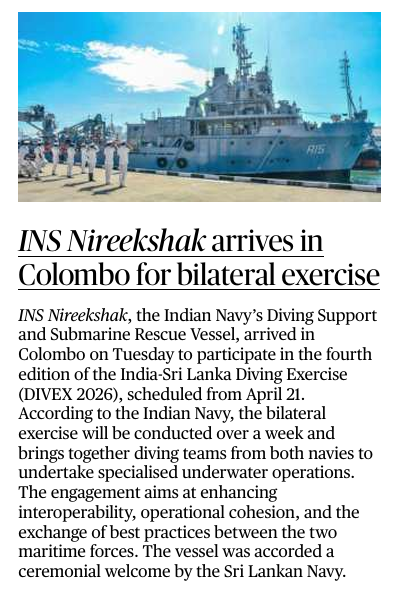
INS Nireekshak arrives in Colombo for bilateral exercise
GS Paper II:
India and its neighbourhood relations
Bilateral agreements and military cooperation
GS Paper III:
Security challenges in maritime domain
Defence cooperation and capacity building
Context
The Indian Navy’s vessel INS Nireekshak has reached Colombo to participate in the India–Sri Lanka Diving Exercise (DIVEX 2026), aimed at strengthening naval cooperation through joint underwater operations.
Prelims concepts
1. INS Nireekshak (A15)
The vessel is a specialized platform, and it is important to distinguish it from standard combat ships like frigates or destroyers.
Role: It is a Diving Support and Submarine Rescue Vessel (DSV). Its primary mission is to support underwater operations and rescue trapped submariners.
Key Capabilities:
Submarine Rescue: Equipped with two Deep Submergence Rescue Vehicles (DSRV) capable of operating at depths up to 300 meters.
Saturation Diving: It has recompression chambers and a diving bell to support saturation divers, who can stay at extreme depths for extended periods.
Dynamic Positioning (DP): A critical technology that allows the ship to maintain a fixed position automatically, even in rough seas, which is essential for safe diving operations.
2. India-Sri Lanka Maritime Cooperation
Bilateral exercises are a recurring Prelims topic. Note the specific series mentioned:
DIVEX 2026: A specialized bilateral diving exercise. This 4th edition (April 2021-27, 2026) focuses on "underwater interoperability."
Other Major Exercises with Sri Lanka:
SLINEX: The flagship bilateral naval exercise (surface/combat focused).
Dosti: A trilateral coast guard exercise involving India, Sri Lanka, and the Maldives.
Mitra Shakti: A bilateral army exercise.
UPSC MCQ
Q. Consider the following statements regarding INS Nireekshak and DIVEX 2026:
INS Nireekshak is a submarine of the Indian Navy used for combat operations in the Indian Ocean Region.
The India–Sri Lanka Diving Exercise (DIVEX) focuses on enhancing interoperability in underwater rescue and diving operations.
Which of the statements given above is/are correct?
a) 1 only
b) 2 only
c) Both 1 and 2
d) Neither 1 nor 2
Answer: b) 2 only
Explanation:
Statement 1 : Incorrect — INS Nireekshak is a Diving Support Vessel (DSV), not a combat submarine.
Statement 2 : Correct — DIVEX focuses on underwater operations, rescue missions, and interoperability between the two navies.
Extreme heat threatens food systems, warn UN agencies
GS Paper III:
Agriculture – Cropping patterns, food security
Environment – Climate change and its impacts
Disaster management
Context
A report by the UN agencies (FAO & WMO) highlights that extreme heat events are intensifying due to climate change, posing a severe threat to global agri-food systems, livelihoods, and food security.
Prelims concepts
1. Marine Heatwaves (MHWs)
The article highlights a significant surge in ocean temperatures, a major trend for 2024–2026.
Definition: Periods of abnormally high sea surface temperatures (SST) relative to the expected climate.
Key Statistic: In 2024, 91% of the world’s oceans experienced at least one marine heatwave.
Consequences: Deoxygenation: Warmer water holds less dissolved oxygen, leading to mass fish mortality.
Coral Bleaching: Stressing symbiotic algae (zooxanthellae) out of coral tissues.
2. Key Metrics & Physiological Indicators
Understanding how heat is measured and its biological impact is essential for questions on climate resilience.
Thermal Humidity Index (THI): A measure used to assess the combined effects of air temperature and humidity on the body.
It is the primary indicator for Heat Stress in livestock.
Impact: In dairy cattle, high THI leads to a 15% to 25% drop in milk production and reduced fertility.
Nighttime Respiration Rates: Normally, plants build energy stores via photosynthesis during the day and rest at night.
High nighttime temperatures force crops to maintain high respiration rates after dark, consuming the energy stores (carbohydrates) they built during the day, leading to stunted growth.
3. Climate Projections & Food Security
The report quantifies the relationship between temperature rises and crop yield.
The 6% Rule: For every 1°C rise in average global temperatures, the yields of maize, rice, soya, and wheat fall by approximately 6%.
The Risk Multiplier: Extreme heat does not act in isolation; it intensifies other disasters such as:
Droughts and Wildfires.
Pest Outbreaks: Higher temperatures can speed up the metabolic and reproductive rates of certain pests.
4. Institutional Framework
Two major UN agencies are mentioned as the primary authorities for these warnings:
Agency
Headquarters
Role mentioned in Article
Food and Agriculture Organization (FAO)
Rome, Italy
Monitoring agrifood systems and climate-resilient farming.
World Meteorological Organization (WMO)
Geneva, Switzerland
Tracking global temperature records and weather extremes.
UPSC MCQ
Q. Consider the following statements regarding extreme heat and food systems:
Extreme heat primarily affects crop yields but has minimal impact on livestock and fisheries.
Marine heatwaves can reduce oxygen levels in water, thereby threatening fish stocks.
Which of the statements given above is/are correct?
a) 1 only
b) 2 only
c) Both 1 and 2
d) Neither 1 and 2
Answer: b) 2 only
Explanation:
Statement 1 : Incorrect — Extreme heat affects multiple components of agri-food systems, including crops, livestock (milk production, fertility), and fisheries.
Statement 2 : Correct — Marine heatwaves deplete oxygen levels, posing a serious threat to fish populations.
Norms tweaked to blend non-petroleum sources with ATF
GS Paper III:
Infrastructure – Aviation sector
Science & Technology – Alternative fuels
Context
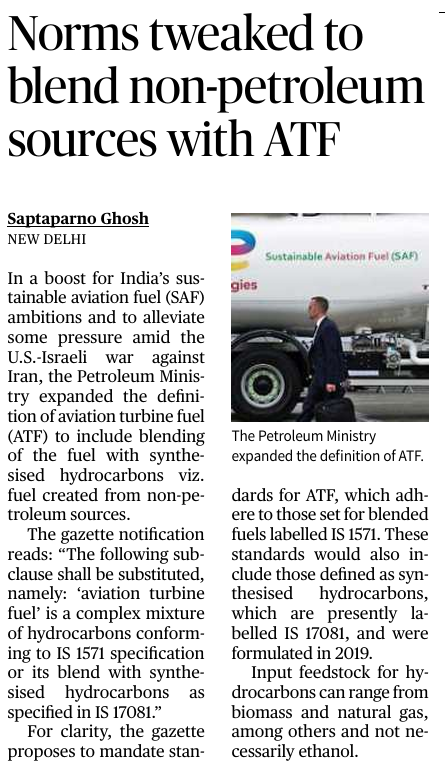
The Petroleum Ministry has expanded the definition of Aviation Turbine Fuel (ATF) to allow blending with synthesised hydrocarbons (non-petroleum sources), boosting India’s push for Sustainable Aviation Fuel (SAF).
Prelims Concepts
1. Sustainable Aviation Fuel (SAF)
The core concept of the article is the shift toward SAF, which is critical for "decarbonizing" the aviation sector, one of the hardest industries to transition to green energy.
Definition: SAF is a "drop-in" fuel, meaning it can be blended with conventional fossil-based Aviation Turbine Fuel (ATF) without requiring major modifications to aircraft engines or fuel supply systems.
Feedstock Diversity: Unlike transport petrol which primarily uses ethanol, SAF synthesized hydrocarbons can be derived from:
Biomass: Agricultural waste, algae, and forestry residues.
Non-Petroleum Sources: Municipal solid waste (MSW) and used cooking oil.
Natural Gas: Can be converted via the Fischer-Tropsch process.
Environmental Impact: It can reduce lifecycle carbon emissions by up to 80% compared to traditional jet fuel.
2. Policy Framework: Bio-Aviation Turbine Fuel
This move aligns with India's broader climate goals and energy security.
CORSIA & LTAG: India is a signatory to the Carbon Offsetting and Reduction Scheme for International Aviation (CORSIA) and the Long-Term Aspirational Goal (LTAG) of the International Civil Aviation Organization (ICAO), which aims for net-zero carbon emissions from aviation by 2050.
National Policy on Biofuels (2018): While initially focused on ethanol blending for petrol (E20), this recent tweak expands the scope to the aviation sector.
UPSC MCQ
Q. Consider the following statements regarding Aviation Turbine Fuel (ATF) norms in India:
The revised norms allow blending of ATF with synthesised hydrocarbons derived from non-petroleum sources.
Sustainable Aviation Fuel (SAF) used in blending must necessarily be derived from ethanol.
Which of the statements given above is/are correct?
a) 1 only
b) 2 only
c) Both 1 and 2
d) Neither 1 nor 2
Answer: a) 1 only
Explanation:
Statement 1 : Correct — The government has expanded ATF definition to include blending with synthesised hydrocarbons (non-petroleum sources).
Statement 2 : Incorrect — SAF can be derived from various sources like biomass, waste oils, natural gas, and not necessarily ethanol.
Toxic workplaces take lives of 8.4 lakh people annually
GS Paper II:
Welfare schemes for vulnerable sections
Issues relating to development and management of social sector
GS Paper III:
Economy – Labour and employment
Inclusive growth & human resource development
Context
A report by the International Labour Organization (ILO) highlights that over 8.4 lakh deaths annually are linked to workplace psychosocial risks, making it a major global public health and economic concern.
Prelims concepts
1. The International Labour Organization (ILO)
Nature: It is the only tripartite UN agency. It brings together governments, employers, and workers.
Established: 1919 by the Treaty of Versailles.
Headquarters: Geneva, Switzerland.
Key Reports:
World Employment and Social Outlook
Global Wage Report
World Social Protection Report
Report Mentioned in article: "The psychosocial working environment: global developments and pathways for action" (as mentioned in the article).
2. Psychosocial Risks & Health Metrics
Psychosocial Risk Factors: These include job strain, effort-reward imbalance, job insecurity, long working hours (more than 48 hours/week), and workplace harassment.
DALYs (Disability-Adjusted Life Years): A critical health metric.
Definition: One DALY represents the loss of the equivalent of one year of full health.
3. Economic Impact: The GDP Link
The report quantifies the "cost of toxicity" on the global economy.
Global GDP Loss: Psychosocial risk factors result in an estimated 1.37% loss of global GDP annually.
Mechanism: This loss is driven by reduced organizational productivity, absenteeism (taking leave due to illness), and "presenteeism" (working while sick or unmotivated).
UPSC MCQ
Q. Consider the following statements regarding the International Labour Organization (ILO):
The International Labour Organization is the only tripartite UN agency that includes representatives of governments, employers, and workers.
The International Labour Organization was established after the Second World War as part of the Bretton Woods institutions.
Which of the statements given above is/are correct?
a) 1 only
b) 2 only
c) Both 1 and 2
d) Neither 1 nor 2
Answer: a) 1 only
Explanation:
Statement 1 : Correct — ILO is unique for its tripartite structure (governments, employers, workers).
Statement 2 : Incorrect — ILO was established in 1919 after World War I under the Treaty of Versailles, not after WWII nor as a Bretton Woods institution.




 Launch your Graphy