There are no items in your cart
Add More
Add More
| Item Details | Price | ||
|---|---|---|---|
1. U.S.-Iran talks in doubt; truce expiring today (GS-2)
2. Challenges for India’s informal urban workforce
(GS-1, GS-3)
3. India-Africa Summit to focus on development initiatives
(GS-2)
4. Govt. moots stricter norms for content generated using AI
(GS-2, GS-3)
5. SBI seeks review of SC verdict barring use of spectrum as an ‘asset’ in IBC proceedings (GS-2, GS-3)
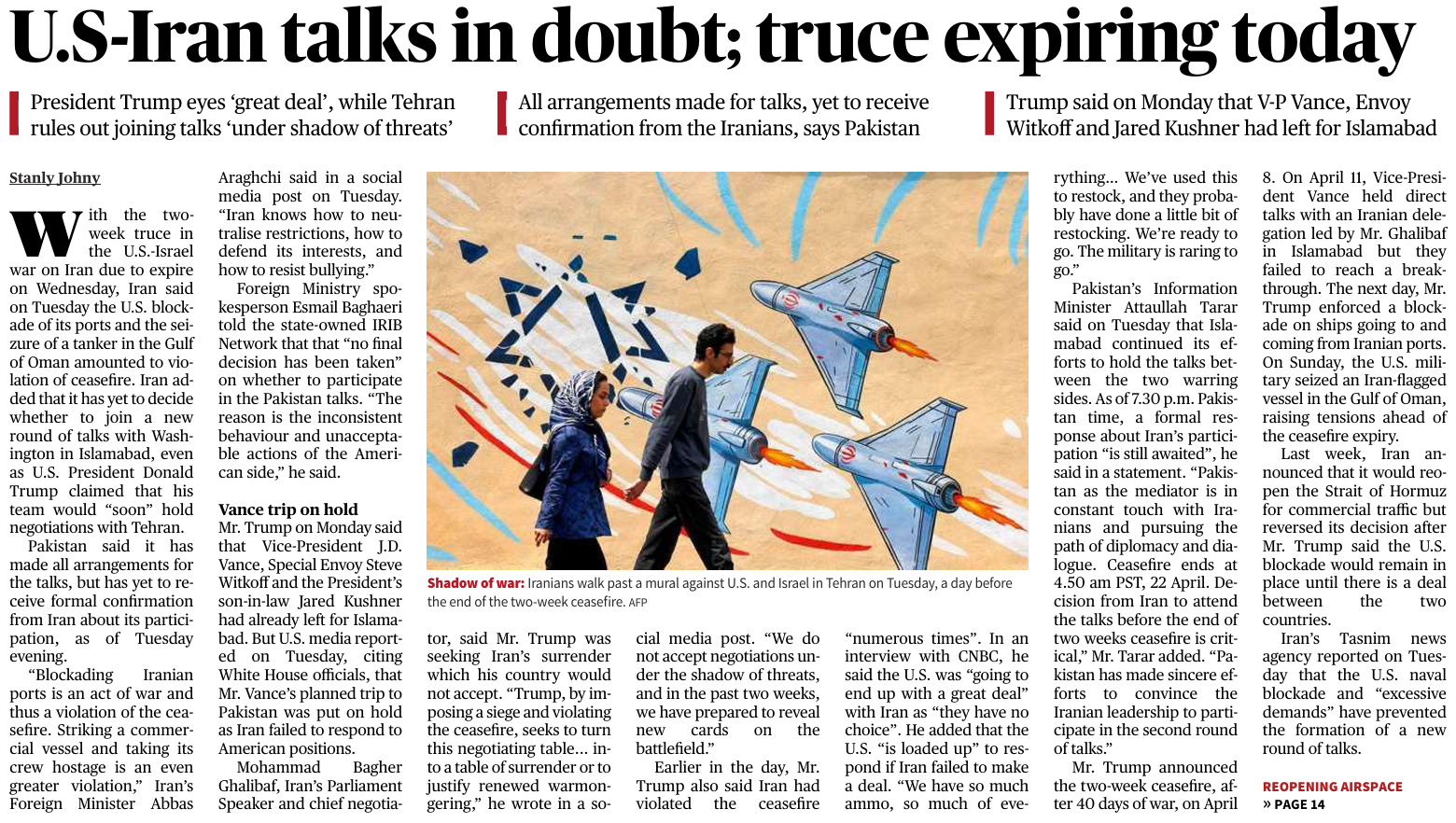
A two-week ceasefire in the ongoing U.S.-Israel–Iran conflict is about to expire.
The U.S. is pushing for negotiations, possibly in Islamabad (mediated by Pakistan).
Iran has not confirmed participation, citing U.S. “threat-based diplomacy.”
Meanwhile, military escalation continues (blockades, tanker seizures, airspace tensions).
Key concepts
1. International Relations & Diplomacy
Mediator Role: Pakistan is acting as the facilitating "third party." In international law, this involves Good Offices (bringing parties together) or Mediation (actively proposing solutions).
Ceasefire vs. Truce: The article mentions a "two-week truce." A truce is usually an informal, temporary halt to fighting, whereas a ceasefire is often more formal and regulated by specific terms.
"Shadow of Threats" Diplomacy: Iran’s refusal to talk under "the shadow of threats" refers to the concept of Coercive Diplomacy—using the threat of force to influence an adversary's behavior.
2. Maritime Law & Security
The article highlights several actions that fall under the United Nations Convention on the Law of the Sea (UNCLOS):
Blockade: Defined as an act of war where a belligerent prevents entry to or exit from an enemy's coast. Iran claims the U.S. blockade is a "violation of the ceasefire."
Seizure of Vessels: The mention of "striking a commercial vessel" and "seizing an Iran-flagged vessel" involves issues of Freedom of Navigation and Right of Visit on the high seas.
Strait of Hormuz: A critical global choke point. Under international law, it is subject to the regime of "Transit Passage," meaning ships and aircraft have the right to pass through for continuous and expeditious transit.
3. Key Geography (Mapping)
If this were a real-world scenario, you would need to locate these specific areas mentioned in the text:
Gulf of Oman: The body of water connecting the Arabian Sea with the Strait of Hormuz.
Strait of Hormuz: The narrow waterway between Iran and Oman.
Islamabad: The capital of Pakistan, serving as the diplomatic venue.
 Urbanisation – Problems and remedies
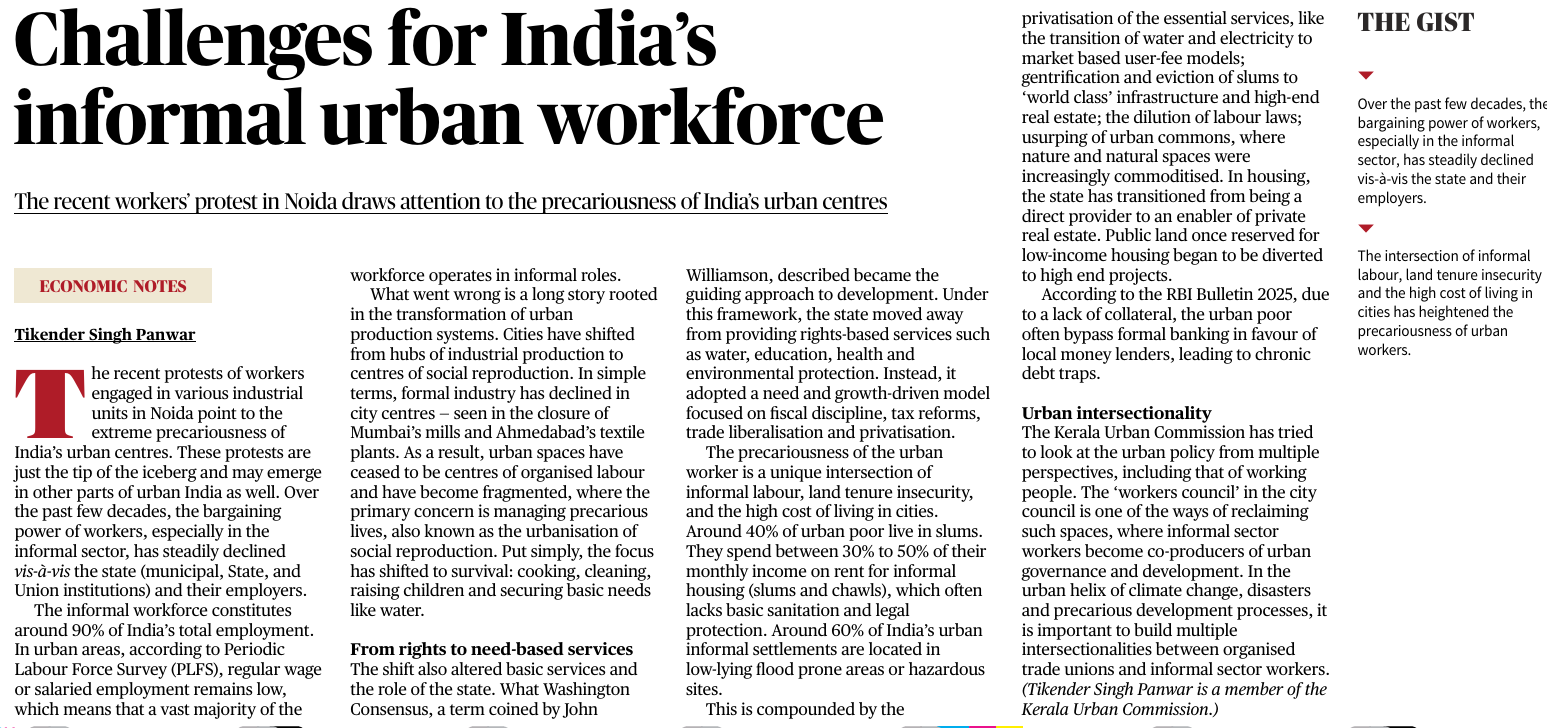
Context:
The Noida workers’ protests have exposed the deep vulnerabilities of India’s urban informal workforce.
Despite rapid urbanisation, ~90% of workers remain informal, lacking security and basic protections.
Detailed Analysis
Challenges
1. Structural Informalisation of Jobs
Decline of formal industrial employment
Rise of casual, gig, and contract work
Lack of job security and stability
2. Weak Bargaining Power
Absence of:
Trade unions
Legal safeguards
Workers unable to negotiate wages/conditions
3. Housing Insecurity
~40% urban population in slums
High rent burden (30–50% income)
Lack of:
Tenure security
Basic services
4. Shift to Market-Led Urban Governance
Privatisation of essential services
User-fee based access limits affordability
State retreat from welfare provisioning
5. Financial Exclusion
No access to formal banking/credit
Dependence on informal lenders
Leads to chronic indebtedness
6. Spatial Inequality & Displacement
Gentrification and “world-class city” projects
Evictions and loss of urban commons
7. Intersectional Vulnerabilities
Overlap of:
Informal work
Poor housing
High living costs
Many settlements in hazard-prone areas
Why This Issue Matters (Critical Implications)
1. Majority Workforce Affected
Informal sector = backbone of India’s urban economy
2. Threat to Inclusive Growth
Growth benefits bypass informal workers
👉 Leads to widening urban inequality
3. Risk of Urban Unrest
Precarity → protests (e.g., Noida)
👉 Challenges law & order and governance
4. Economic Productivity Loss
Poor living and working conditions
👉 Lower efficiency and output
5. Climate & Disaster Risks
Informal settlements in vulnerable areas
👉 Weakens urban resilience
6. Demographic Dividend at Risk
Youth trapped in insecure jobs
👉 Potential demographic burden
Way Forward
1. Rights-Based Urban Development
Ensure universal access to:
Housing
Water
Basic services
2. Universal Social Security
Expand coverage of:
Health insurance
Pensions
E-Shram database
3. Urban Employment Guarantee
Provide:
Wage security
Public employment opportunities
4. Affordable Housing & Tenure Security
Promote:
Rental housing
In-situ slum redevelopment
5. Strengthen Labour Institutions
Support:
Trade unions
Worker collectives
6. Improve Financial Inclusion
Expand:
Formal credit access
Regulated microfinance
7. Participatory Governance
Include informal workers in:
Urban planning
Decision-making (workers’ councils)
Conclusion
India’s urban economy depends heavily on informal workers, yet their vulnerabilities remain unaddressed. A shift toward inclusive, rights-based and worker-centric urban policy is essential for sustainable and equitable urbanisation.
UPSC Mains Question
Q. “Urban informal workers form the backbone of India’s cities, yet remain the most vulnerable.” Examine the challenges they face and suggest measures for inclusive urban development. (250 words)
Approach
Intro: 90% workforce informal → growth without security
Body
Challenges:
Job insecurity (gig/casual)
No social security
Housing precarity
Weak bargaining power
Financial exclusion
Why it matters:
Drives urban economy
Inequality & unrest risk
Low productivity
Way forward:
Universal social security
Urban employment guarantee
Affordable housing
Labour rights + unions
Conclusion: Shift to inclusive, rights-based urbanisation
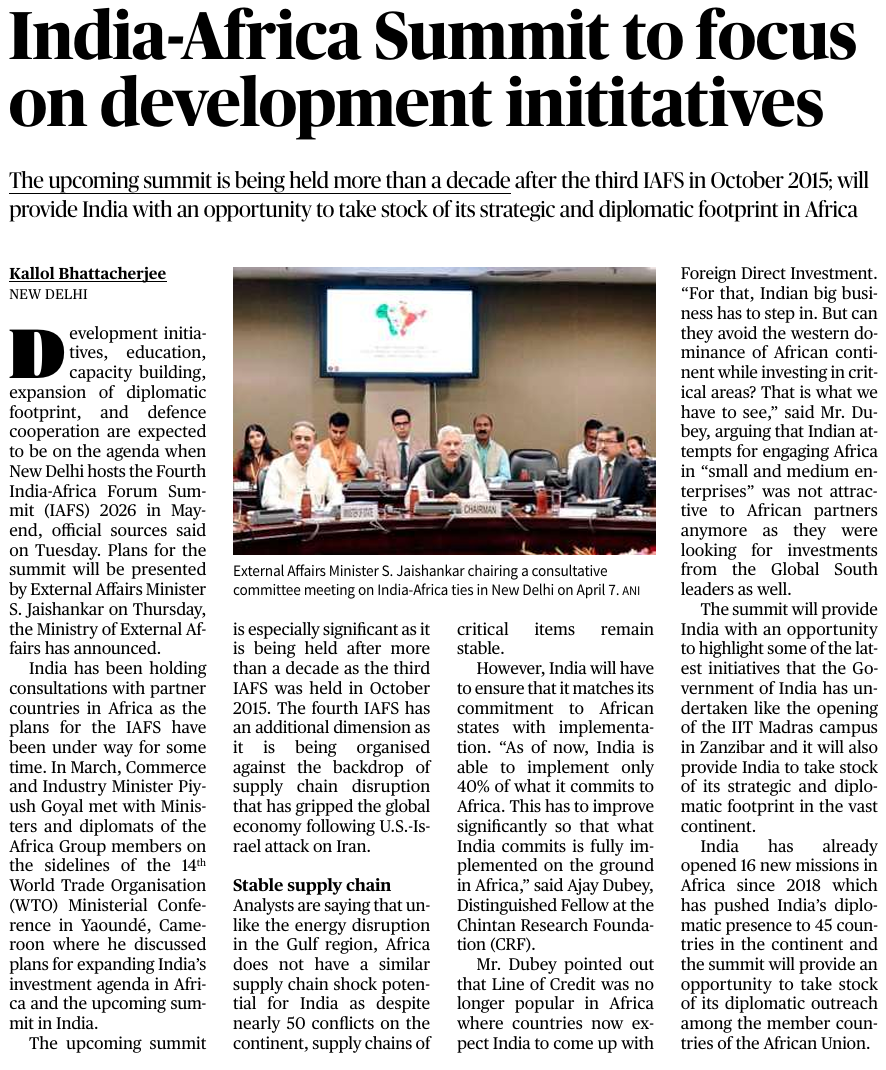
Context:
The 4th India-Africa Forum Summit (IAFS 2026) is scheduled after a gap of over a decade (last held in 2015).
Occurs amid global supply chain disruptions and changing geopolitical dynamics.
Prelims concepts
1. Institutional Framework: India-Africa Forum Summit (IAFS)
The official platform for African-Indian relations.
Timeline: IAFS-I (2008): New Delhi, India.
IAFS-II (2011): Addis Ababa, Ethiopia.
IAFS-III (2015): New Delhi (Largest gathering, involving all 54 African nations).
IAFS-IV (2026): To be held in May 2026 in New Delhi after a 10-year hiatus.
Representation: Unlike the first two summits which used the "Banjul Formula" (only 15 countries), the summits now involve the entire African Union (AU).
2. Diplomatic Outreach: "18 Missions Strategy"
Context: The article mentions India opening 16 new missions in Africa since 2018.
Current Standing: India now has a diplomatic presence in 45 African countries.
3. Development Finance: Line of Credit (LoC)
Concept: A "Line of Credit" is a "soft loan" provided on concessional interest rates.
Implementation: In India, these are largely operated through the EXIM Bank (Export-Import Bank of India) under the IDEAS (Indian Development and Economic Assistance Scheme).
4. Educational Diplomacy & Human Capital
IIT Madras Zanzibar (Tanzania): This is the first-ever international campus of an IIT. It represents a shift from just providing scholarships (ITEC) to building infrastructure for "Capacity Building" on African soil.
5. Global Governance & Multilateralism
Global South Solidarity: The summit aims to align India and Africa on reforms for the UN Security Council and the WTO.
African Union (AU) in G20: India’s role in securing permanent membership for the AU during its G20 Presidency (2023) is a foundational context for IAFS-IV.
Mapping Practice
Zanzibar (Tanzania): Locate on the East African coast. It is an archipelago in the Indian Ocean.
Yaoundé (Cameroon): Identify its location in Central Africa (near the Gulf of Guinea).
UPSC MCQ
Q. Consider the following statements regarding the India-Africa Forum Summit (IAFS):
The fourth India-Africa Forum Summit is being held after more than a decade since the last summit in 2015.
Lines of Credit (LoC) provided by India are increasingly preferred by African countries as the primary mode of development finance.
Which of the statements given above is/are correct?
a) 1 only
b) 2 only
c) Both 1 and 2
d) Neither 1 nor 2
Answer:
a) 1 only
Explanation:
Statement 1 : Correct – The 4th IAFS is happening after a gap of over a decade (last in 2015).
Statement 2 : Incorrect – LoCs are losing popularity, with African countries expecting more effective and diverse investment models.
Context:
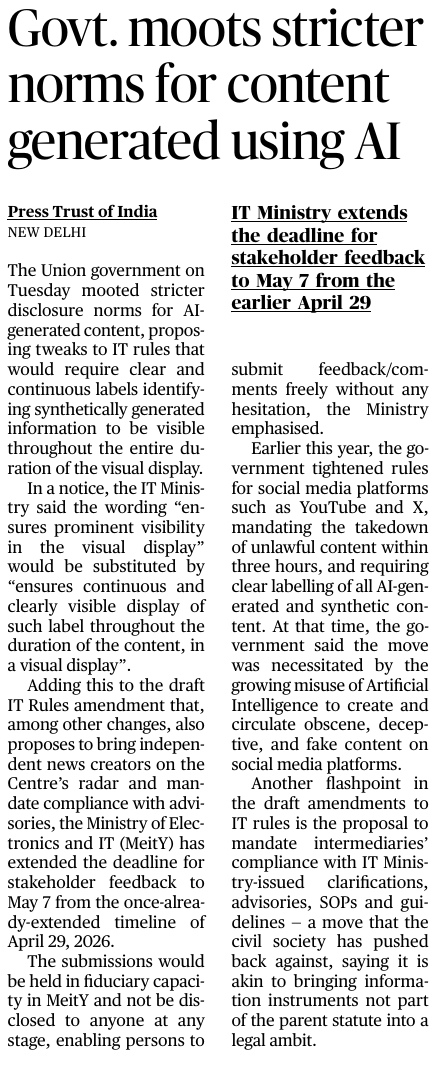
The Union government has proposed stricter IT Rules for AI-generated content.
Focus on mandatory labelling, visibility norms, and platform accountability amid rising misuse of AI.
Prelims concepts
1. Regulatory Framework: IT Rules, 2021 & 2026 Amendments
Parent Statute: The rules are framed under Section 87 of the Information Technology Act, 2000.
Synthetically Generated Information (SGI): A new legal term used to define content (audio, visual, or text) created or altered using AI/Machine Learning to appear real.
Disclosure Norms:
Old Standard: Labels required "prominent visibility" (often interpreted as a watermark at the start or end).
New Proposed Standard: Labels must be continuous and clearly visible throughout the entire duration of the visual display. This aims to prevent users from cropping out or missing temporary disclaimers.
2. Intermediary Liability & "Safe Harbour"
Safe Harbour (Section 79): Under the IT Act, intermediaries (like X, YouTube, Meta) are generally not liable for third-party data or content hosted by them, provided they follow "due diligence."
Flashpoint: The 2026 draft proposes that compliance with Advisories, SOPs, and Guidelines issued by MeitY (Ministry of Electronics and Information Technology) is mandatory to retain this "Safe Harbour" protection.
3. Takedown Timelines (2026 Standards)
The 2026 amendments significantly accelerated the speed at which platforms must act:
Unlawful Content: Takedown required within 3 hours of a court/government order (reduced from 36 hours).
Non-consensual/Obscene Content (Deepfakes): Takedown required within 2 hours (reduced from 24 hours).
4. Expansion of "News Publisher" Definition
Independent News Creators: The draft seeks to bring individual YouTubers, podcasters, and social media influencers who comment on "news and current affairs" under the Code of Ethics
Institutional Oversight: These creators would be subject to the same oversight as digital news portals, including the Inter-Departmental Committee (IDC) which can recommend content removal or public apologies.
Context:
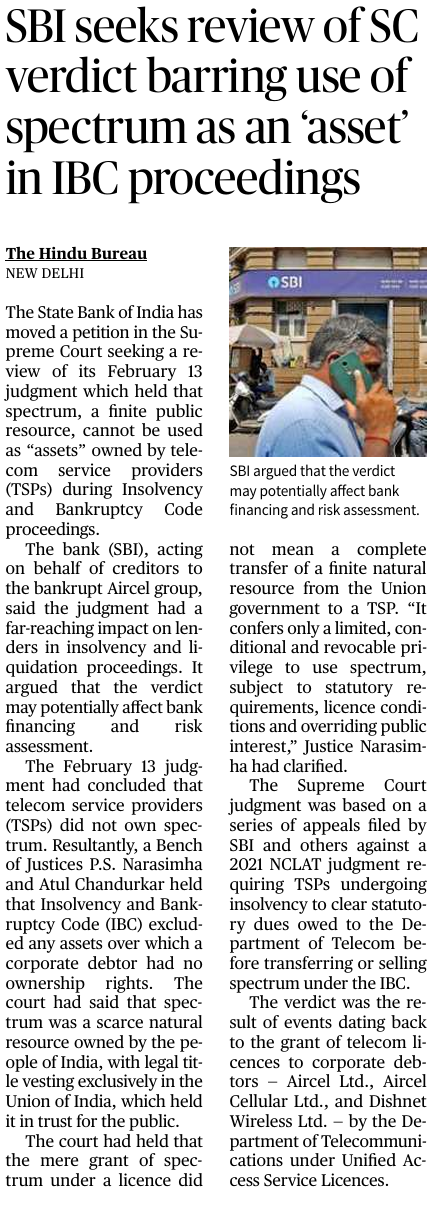
State Bank of India (SBI) has approached the Supreme Court seeking a review of its February 13 judgment.
The judgment held that telecom spectrum is a public resource and cannot be treated as an asset of telecom companies under the IBC.
Issue arose in insolvency cases like Aircel.
Prelims concepts
1. Legal & Constitutional Framework
Public Trust Doctrine: The Court reaffirmed that natural resources like spectrum belong to the "people of India." The Union of India acts only as a Public Trustee and does not own it in a private sense.
Article 39(b): The judgment is rooted in this Directive Principle of State Policy (DPSP), which mandates that the ownership and control of the material resources of the community must be distributed to best subserve the common good.
Limited Privilege vs. Ownership: The Court distinguished between the "right to use" and "ownership." A TSP (Telecom Service Provider) has a limited, conditional, and revocable privilege to use spectrum, not a proprietary interest.
2. Insolvency and Bankruptcy Code (IBC), 2016
Asset Identification (Section 18 & 36): The IBC explicitly excludes assets over which a corporate debtor has no ownership rights from the liquidation pool. Since TSPs do not "own" the spectrum, it cannot be used to pay off creditors in a resolution plan.
Intangible Assets (Ind AS-38): In accounting, spectrum usage rights are listed as "intangible assets." However, the Court ruled that accounting standards do not determine legal ownership.
Operational vs. Financial Debt: While lenders (like SBI) are Financial Creditors, the Department of Telecommunications (DoT) is often an Operational Creditor. However, this judgment effectively gives DoT priority because the spectrum must revert to the State if dues aren't paid, bypassing the standard "waterfall mechanism" of the IBC.
UPSC MCQ
Q. Consider the following statements regarding telecom spectrum and the Insolvency and Bankruptcy Code (IBC):
Under the IBC framework, only those assets over which the corporate debtor has ownership rights can be included in the insolvency resolution process.
The Supreme Court held that telecom spectrum can be transferred freely by telecom companies during insolvency proceedings.
Which of the statements given above is/are correct?
a) 1 only
b) 2 only
c) Both 1 and 2
d) Neither 1 nor 2
Answer:
a) 1 only
 Launch your Graphy