There are no items in your cart
Add More
Add More
| Item Details | Price | ||
|---|---|---|---|





The Hindu Analysis April 21st
1. 9.8 lakh voters deleted from Odisha rolls ahead of SIR (GS-2)
2. The strategic vulnerability in India’s LPG supply model
(GS-2, GS-3)
3. Long UPSC prep cycles take a toll on aspirants’ mental health
(GS-2, GS-4)
4. India’s forests could nearly double carbon storage by 2100, study finds (GS-3)
5. Sundarbans may be less blue than it seems (GS-3)
6. Core sector activity contracts 0.4% in March on war impact
(GS-3)
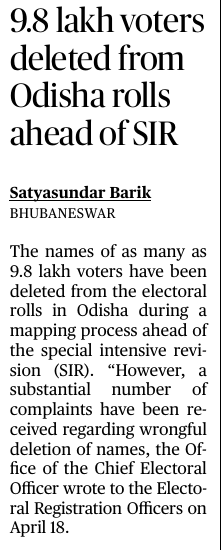
Around 9.8 lakh voters have been deleted from electoral rolls in Odisha.
This occurred during Special Intensive Revision (SIR) of electoral rolls.
Concerns raised regarding wrongful deletion of eligible voters.
The Chief Electoral Officer (CEO) has flagged complaints to Electoral Registration Officers.
The Special Intensive Revision (SIR) is a rigorous, nationwide exercise recently launched by the Election Commission of India (ECI) to overhaul and sanitize the electoral rolls. Unlike the annual "Summary Revision," SIR involves a comprehensive, house-to-house verification process.
1. Legal Basis
Article 324: Grants the ECI power of superintendence, direction, and control of elections.
Section 21(3) of Representation of the People Act (RPA), 1950: Specifically empowers the ECI to order a "special revision" of the electoral roll for any constituency or part of a constituency.
Section 16 & 19 (RPA 1950): Define the criteria for voter eligibility (citizen, 18+ years, "ordinarily resident").
2. Why is SIR "Special" and "Intensive"?
Historically, intensive revisions involve a fresh enumeration where the list is built from scratch. The current SIR (2025–2026) is the first major exercise of its kind in nearly 21 years (the last being in 2002–2004).
Feature
Special Summary Revision (SSR)
Special Intensive Revision (SIR)
Frequency
Annual
Occasional (usually before major polls)
Method
Focuses on new additions and voluntary updates.
House-to-house verification by Booth Level Officers (BLOs).
Scope
Smaller scale updates.
Mass identification of Dead, Shifted, and Duplicate (DSD) voters.
Verification
Often document-based.
Mandatory physical verification at the doorstep.
UPSC MCQ
Q. Consider the following statements regarding Special Intensive Revision (SIR) of electoral rolls:
It is conducted by the Election Commission of India under the Representation of the People Act, 1950 to update and purify electoral rolls.
During SIR, deletion of names can be done only after obtaining prior approval from the concerned High Court.
Which of the statements given above is/are correct?
A. 1 only
B. 2 only
C. Both 1 and 2
D. Neither 1 nor 2
Answer: A. 1 only
Explanation:
Statement 1 – Correct:
SIR is a legally backed exercise under the Representation of the People Act, 1950 to remove ineligible voters and include eligible ones.
Statement 2 – Incorrect:
No requirement of High Court approval for deletion of names. The process is handled administratively by Electoral Registration Officers (EROs) with due procedure (notice, verification, etc.).
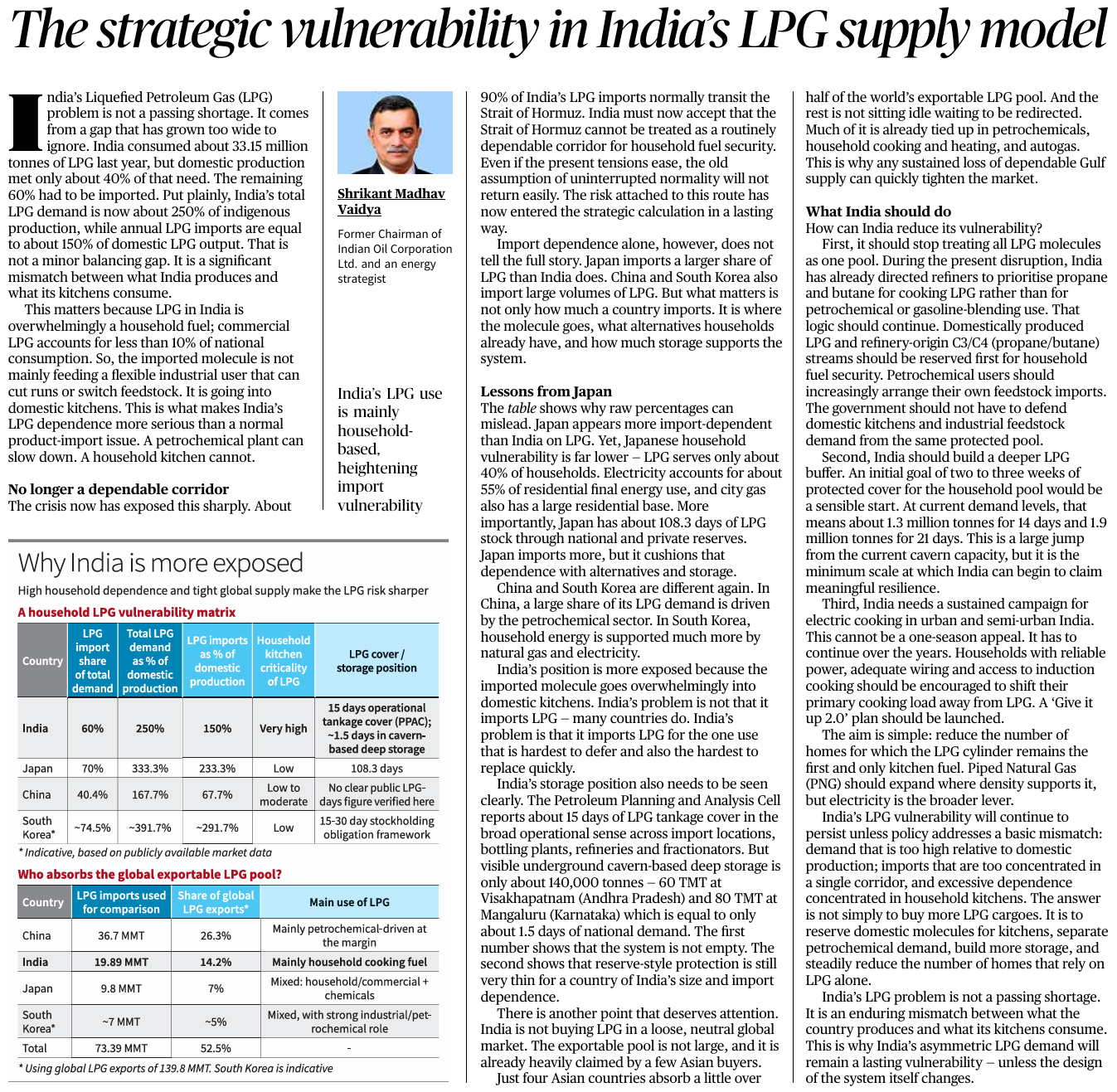 The strategic vulnerability in India’s LPG supply model
Context
India faces structural vulnerability in LPG supply, not just temporary shortages.
High import dependence (~60%) and household-centric consumption expose risks.
Geopolitical tensions (e.g., Strait of Hormuz disruptions) aggravate supply insecurity.
Detailed Analysis
1. Nature of India’s LPG Vulnerability
Domestic production meets only ~40% of demand.
Imports ≈ 150% of domestic production → heavy external reliance.
LPG is primarily used for household cooking (essential use), unlike other countries where industrial use dominates.
👉 Implication:
Demand is inelastic → cannot reduce consumption easily during crises.
2. Supply Chain Risks
~90% of LPG imports pass through Strait of Hormuz.
Any disruption (conflict, blockade) can:
Severely affect supplies
Trigger price spikes
👉 Corridor is no longer reliably secure.
3. Comparison with Other Countries
Country
Key Feature
Vulnerability
Japan
High imports but strong storage (~108 days)
Low
China
LPG used in petrochemicals
Moderate
South Korea
Diversified energy (gas + electricity)
Low
India
Household-heavy LPG use + low storage
Very High
👉 India’s issue is not just imports, but lack of alternatives + low storage.
4. Storage Deficit
Only ~15 days of operational LPG storage
Deep storage (caverns) ≈ 1.5 days of national demand
👉 Far below global best practices → weak shock absorption.
5. Global Market Constraints
LPG export market is:
Limited
Already tied up in long-term contracts
Gulf region dominates supply → concentration risk
6. Core Structural Problem
India imports LPG for the least substitutable use (household cooking).
Unlike petrochemical use, households:
Cannot delay consumption
Cannot easily switch fuels
👉 Makes India uniquely vulnerable.
🚧 Challenges
Overdependence on imports + single route
Low storage capacity
Lack of fuel diversification in households
Poor segmentation between domestic & industrial demand
Weak long-term energy transition strategy
🌟 Significance
Directly impacts:
Energy security
Food security (cooking fuel)
Inflation & fiscal burden (subsidies)
Affects poor households disproportionately
Strategic issue during geopolitical conflicts
Way Forward
✅ 1. Segregate LPG Usage
Prioritize LPG for households
Petrochemical sector should:
Source separately
Use alternative feedstocks
✅ 2. Enhance Storage Capacity
Build strategic LPG reserves (like crude oil reserves)
Target: 2–3 weeks minimum buffer
✅ 3. Promote Energy Diversification
Scale up:
Electric cooking (induction)
PNG (Piped Natural Gas)
Reduce exclusive dependence on LPG
✅ 4. Supply Diversification
Reduce reliance on:
Strait of Hormuz
Explore:
Multiple sourcing nations
Long-term contracts
Conclusion
India’s LPG challenge is structural and strategic, not temporary. The combination of high import dependence, low storage, and household-centric usage creates a unique vulnerability. Addressing this requires system-level redesign, focusing on diversification, storage, and smarter allocation—not just increasing imports.
UPSC Mains Question
Q. India’s LPG supply model reflects a structural vulnerability rather than a temporary supply issue. Examine the reasons behind this vulnerability and suggest measures to enhance India’s LPG security. (250 words)
Approach
1. Introduction (2–3 lines)
Define LPG importance (household fuel, energy security)
Mention high import dependence → structural issue
2. Core Body
A. Reasons for Vulnerability
High import dependence (~60%)
Household-centric use → inelastic demand
Over-reliance on Strait of Hormuz
Low storage capacity (~15 days)
Limited global export pool
B. Implications
Energy insecurity
Inflation/subsidy burden
Impact on poor households
C. Solutions / Way Forward
Segregate domestic vs industrial LPG use
Build strategic reserves (2–3 weeks buffer)
Promote alternatives (PNG, electric cooking)
3. Conclusion (1–2 lines)
Need structural reforms for long-term resilience in energy security
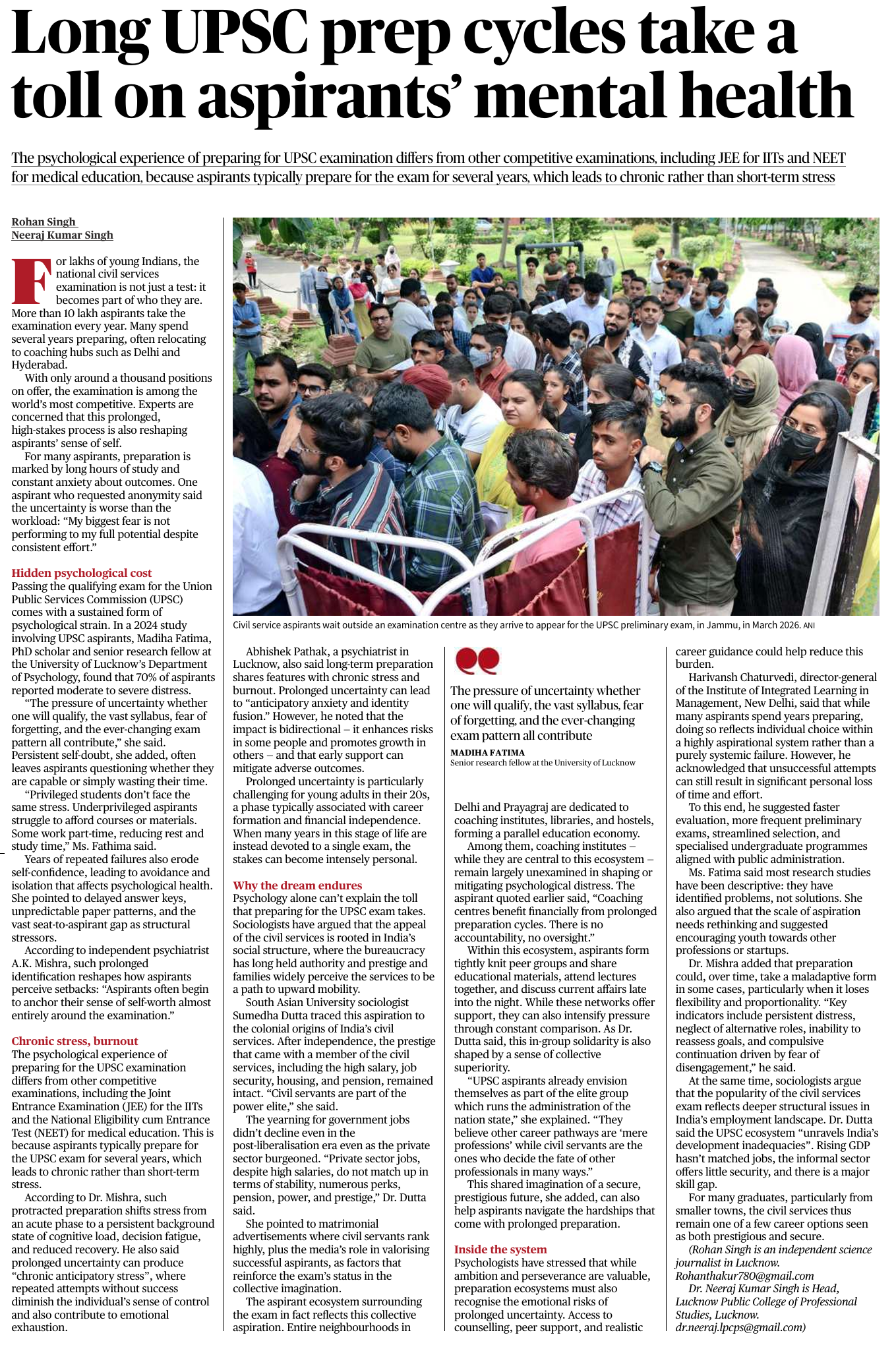 Long UPSC prep cycles take a toll on aspirants’ mental health
Context
UPSC preparation has evolved into a multi-year, high-stakes process.
Leads to chronic psychological stress, unlike short-term exam pressure (e.g., JEE/NEET).
Studies indicate ~70% aspirants experience moderate to severe distress.
Detailed Analysis
1. Unique Nature of UPSC Preparation
Long duration (often 3–5 years)
Limited vacancies (~1000) vs lakhs of aspirants
Preparation becomes identity-centric, not just academic
👉 Result: Shift from goal-oriented effort → life-defining struggle
2. Psychological Challenges
⚠️ a) Chronic Stress & Burnout
Continuous uncertainty → anticipatory anxiety
Repeated failures → loss of self-confidence
⚠️ b) Identity Crisis
Aspirants define self-worth by exam outcome
Failure leads to identity diffusion
⚠️ c) Cognitive & Emotional Impact
Fatigue, reduced focus
Emotional exhaustion
Decline in decision-making ability
⚠️ d) Social Isolation
Long study hours + relocation to coaching hubs
Reduced family/social interaction
3. Structural Issues in the Ecosystem
Coaching-driven ecosystem → lack of regulation
Delayed exam cycles / unpredictability
Lack of career alternatives & guidance
Peer comparison → toxic competition
4. Socio-economic Dimensions
Underprivileged aspirants face:
Financial strain
Limited access to resources
Sociological factors:
Civil services seen as prestige + upward mobility
Family & societal expectations intensify pressure
5. Why the Dream Endures
High social status & job security
Historical prestige of bureaucracy
Lack of equally secure alternatives in job market
👉 Creates a self-reinforcing aspirational cycle
Challenges
No structured mental health support system
Lack of exit pathways for aspirants
Increasing time-cost of preparation
Weak integration with higher education/employment pathways
🌟 Significance
Impacts:
Youth productivity & demographic dividend
Mental health burden on society
Raises questions on:
Sustainability of current exam ecosystem
Ethical responsibility of state & institutions
Way Forward
✅ 1. Institutional Reforms
Reduce exam cycle duration & uncertainty
Increase frequency of prelims / streamline process
✅ 2. Mental Health Support
Counseling centres in:
Coaching hubs (Delhi, Prayagraj)
Peer-support systems
✅ 3. Career Diversification
Link UPSC prep with:
Public policy programs; Skill-based employment
✅ 4. Regulation of Coaching Industry
Ensure:
Transparency; Accountability
Conclusion
The UPSC preparation crisis reflects a deeper structural and societal issue, where aspiration, uncertainty, and limited opportunities intersect. Addressing it requires systemic reforms, mental health support, and broader employment diversification to ensure that ambition does not come at the cost of well-being.
UPSC Mains Question
Q. “The prolonged and uncertain nature of UPSC preparation has transformed it from an academic pursuit into a psychological challenge.” Critically examine the factors responsible for mental health issues among aspirants and suggest measures to address them. (250 words
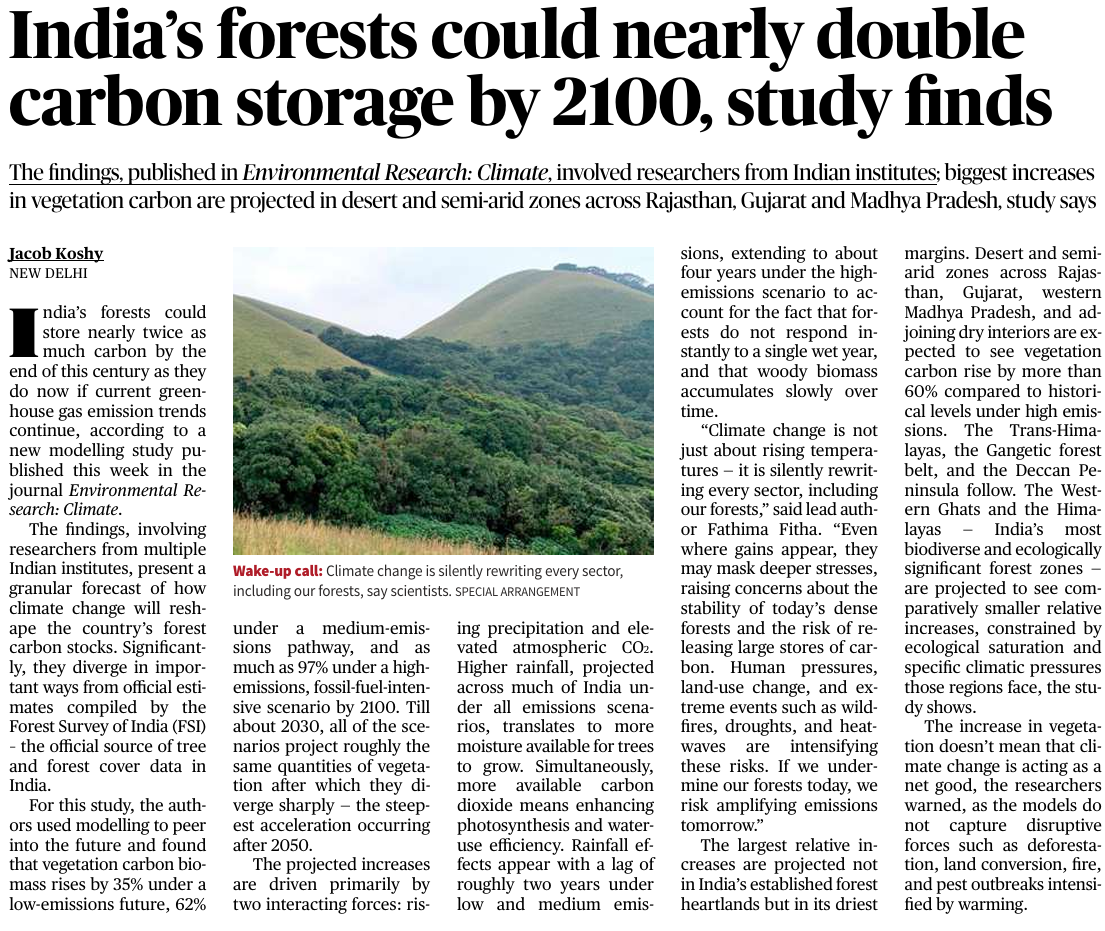 India’s forests could nearly double carbon storage by 2100, study finds
Context
A study published in Environmental Research: Climate suggests that India’s forests may nearly double their carbon storage by 2100.
Increase driven by higher CO₂ levels and rainfall, especially in semi-arid and desert regions.
However, results diverge from Forest Survey of India (FSI) estimates and raise concerns about ecological stability.
Prelims concepts
1. Carbon Stock and Sequestration
The study focuses on Vegetation Carbon (Living Biomass). It is important to distinguish this from the total Carbon Stock reported in official government documents.
Carbon Stock: The total amount of carbon stored in a forest ecosystem (in living biomass, deadwood, litter, and soil).
India State of Forest Report (ISFR) 2021 Data: * Total carbon stock in India's forests: 7,204 million tonnes.
Largest pool: Soil Organic Carbon (SOC), which accounts for roughly 56% of the total stock.
Key Divergence: The article notes that this new modelling study (using dynamic global vegetation models) projects a much higher increase in vegetation carbon than current Forest Survey of India (FSI) estimates, suggesting that official data might be underestimating the "CO₂ fertilization effect."
2. The "CO₂ Fertilization Effect" vs. Vulnerability
The article explains a complex paradox: while carbon storage increases, forest health might decline.
CO₂ Fertilization: As atmospheric $CO_2$ levels rise, plants can perform photosynthesis more efficiently and improve Water Use Efficiency (WUE). This leads to increased woody biomass.
The Catch: This growth is "silent" and can mask Ecological Stress. Faster growth does not always mean a healthier ecosystem; it can lead to "unstable" forests that are more prone to pests, wildfires, and droughts.
Lag Effect: The study found a 2-year lag between increased rainfall and its effect on carbon storage, showing that forests do not recover instantly from climate shocks.
3. Regional Variations (Mapping the Impact)
Region
Projected Change
Reason / Constraint
Arid/Semi-Arid (Gujarat, Rajasthan)
Highest Relative Increase
These regions are starting from a low baseline; increased rainfall and CO_2 have a more visible impact on sparse vegetation.
Western Ghats & Himalayas
Modest/Smaller Increase
These are already "dense" forests. They are limited by Ecological Saturation (they are already at or near their maximum capacity to store carbon).
Trans-Himalayas & Deccan
High Growth
Significant increases are expected as these zones respond to changing precipitation patterns.
UPSC MCQ
Q. Consider the following statements regarding forest carbon storage in India:
An increase in forest carbon stock necessarily indicates improved biodiversity and ecological health of forests.
Climate change–induced increases in rainfall and atmospheric CO₂ can enhance vegetation growth and carbon sequestration.
Which of the statements given above is/are correct?
A. 1 only
B. 2 only
C. Both 1 and 2
D. Neither 1 nor 2
Answer: B. 2 only
Explanation:
Statement 1 – Incorrect:
Higher carbon stock does not always mean healthier forests. It may result from monocultures or mask ecological stress and biodiversity loss.
Statement 2 – Correct:
Increased CO₂ (fertilization effect) and rainfall can boost photosynthesis and biomass growth, thereby increasing carbon sequestration.
 Sundarbans may be less blue than it seems
Context
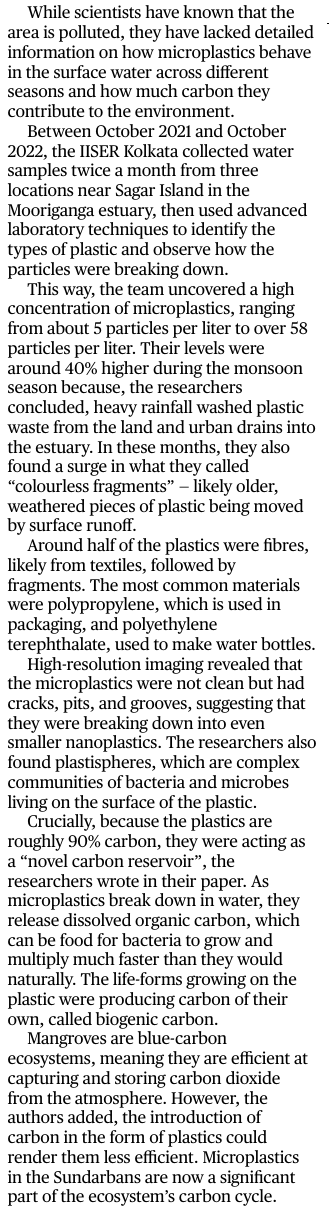
A study by IISER Kolkata highlights that microplastics are altering the carbon dynamics of the Sundarbans.
These plastics interfere with the natural blue-carbon function of mangroves in the Bay of Bengal.
Key points
Sundarbans: The world’s largest contiguous mangrove forest.
Confluence: Formed by the delta of the Ganga, Brahmaputra, and Meghna rivers.
Transboundary: Shared between India (West Bengal) and Bangladesh.
Prelims concepts
1. Blue Carbon Ecosystems
The article identifies the Sundarbans as a "Blue Carbon" ecosystem.
Definition: Blue carbon is the carbon captured by the world's ocean and coastal ecosystems (Mangroves, Seagrasses, and Salt Marshes).
Efficiency: Mangroves are significantly more efficient at sequestering carbon than terrestrial forests because they store carbon not just in biomass but deep within their anoxic (oxygen-poor) soils for millennia.
Threat: The study suggests that plastic pollution makes these ecosystems "less blue" by interfering with their natural carbon burial efficiency.
2. Microplastics as a "Novel Carbon Reservoir"
The article introduces a paradoxical concept: plastics, which are roughly 90% carbon, are acting as a new, artificial carbon storage unit in the water.
Carbon Leaching: As microplastics weather, they release Dissolved Organic Carbon (DOC).
Biogenic Carbon: This DOC acts as a "fast food" for bacteria. The carbon produced by these rapidly multiplying microbes is termed "biogenic carbon."
Ecological Impact: This process disrupts the natural food web and alters the Carbon Budget of the Bay of Bengal.
3. The "Plastisphere"
This is a specific term for the ecosystem created by human-made plastic waste.
Definition: It refers to the complex communities of bacteria, algae, and other microbes (microbiomes) living on the surface of plastic debris.
Size Spectrum: Microplastics (< 5mm) further break down into Nanoplastics (< 1µm), which have higher surface areas for microbial colonization.
UPSC MCQ
Q. Consider the following statements regarding microplastics in mangrove ecosystems like the Sundarbans:
Microplastics can host microbial communities known as the “plastisphere,” which contribute to biogenic carbon production.
Microplastics enter estuarine ecosystems only through marine currents and not via riverine inputs.
The degradation of microplastics can release dissolved organic carbon into aquatic systems.
Which of the statements given above is/are correct?
A. 1 and 3 only
B. 2 and 3 only
C. 1 and 2 only
D. 1, 2 and 3
Answer: A. 1 and 3 only
Explanation:
Statement 1 – Correct:
Microplastics host microbial communities (plastisphere) that generate biogenic carbon.
Statement 2 – Incorrect:
Microplastics also enter via riverine inputs (e.g., Ganga, Brahmaputra), not just marine currents.
Statement 3 – Correct:
As microplastics degrade, they release dissolved organic carbon (DOC) into water.
 Core sector activity contracts 0.4% in March on war impact
Context
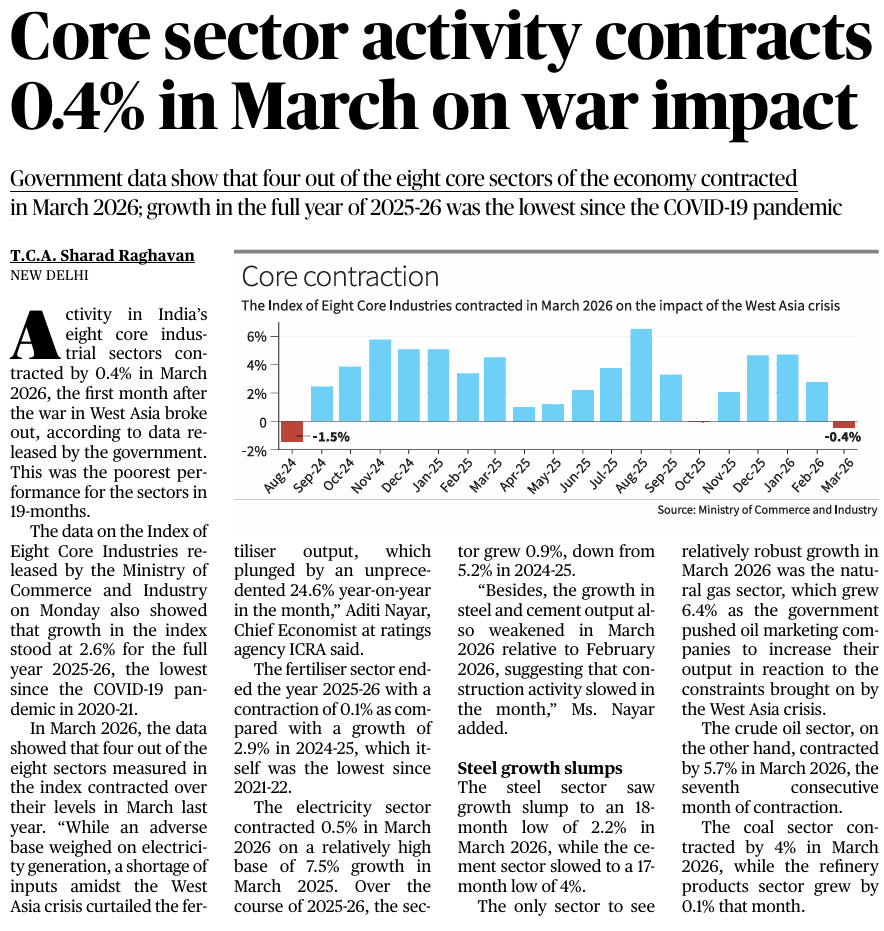
India’s Index of Eight Core Industries (ICI) contracted by 0.4% in March 2026.
Triggered by West Asia (Middle East) crisis, affecting supply chains.
Annual growth (2025–26) at 2.6%, lowest since COVID-19 period.
Prelims concepts
1. Index of Eight Core Industries (ICI)
The ICI is a monthly production volume index that acts as an "advance indicator" of industrial performance.
Released By: Office of Economic Adviser (OEA), Department for Promotion of Industry and Internal Trade (DPIIT), Ministry of Commerce & Industry.
Base Year: Currently 2011-12.
Weightage in IIP: The eight core industries comprise 40.27% of the weight of items included in the Index of Industrial Production (IIP).
2. Components and Relative Weightage
It is crucial to remember the weightage of the eight sectors in descending order:
Refinery > Electricity > Steel > Coal > Crude Oil > Gas > Cement > Fertilizer (Smallest).
 Launch your Graphy