There are no items in your cart
Add More
Add More
| Item Details | Price | ||
|---|---|---|---|


The Hindu News Analysis – 20th April, 2026
1. Anti-sacrilege Bill has now become law with assent of Governor, says Punjab CM (GS-2)
2. Differentiating welfare and development (GS-2, GS-3)
3. ‘Nuclear plants require lifetime commitment’ (GS-3)
4.ED searches house of Kolkata police officer; arrests businessman (GS-2)
5. CBI arrests senior DGCA official on graft charge (GS-2)
Context
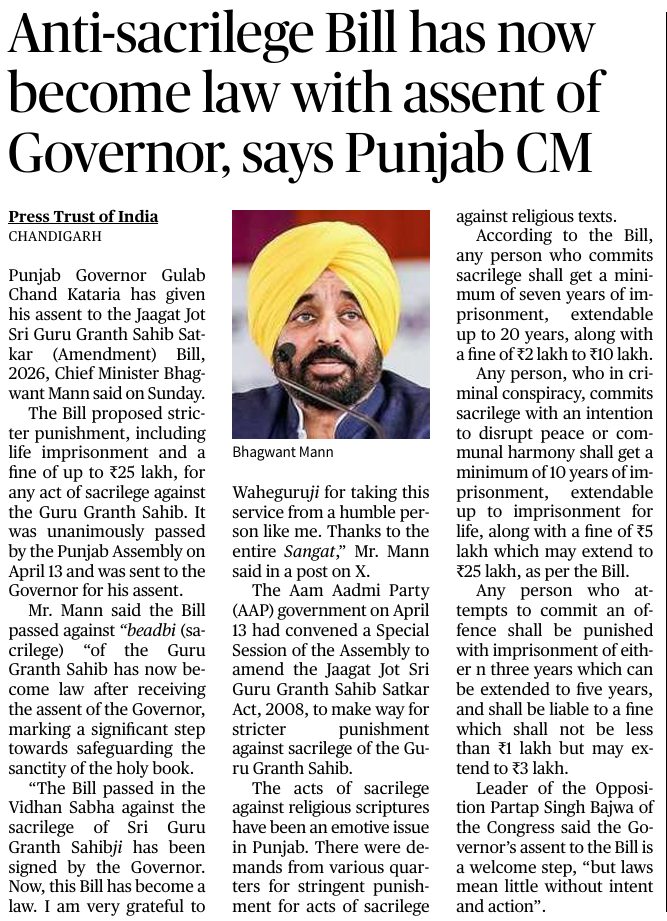
The Punjab Governor has given assent to the Punjab Prevention of Offences Against Holy Scripture (Amendment) Bill, 2026.
The Bill aims to impose stricter punishments for sacrilege, especially concerning the Guru Granth Sahib.
Comes amid rising incidents of sacrilege and demands for stronger legal deterrence.
Prelims concepts
1. Constitutional Provisions
The article highlights the legislative process involving the State Executive and Legislature.
Governor’s Assent (Article 200): When a Bill is passed by the State Legislature, it is presented to the Governor. The Governor has four options:
Give assent (the Bill becomes Law/Act).
Withhold assent.
Return the Bill (if not a Money Bill) for reconsideration.
Reserve the Bill for the consideration of the President (Article 201).
Special Sessions: The article mentions a "Special Session" convened on April 13. While the Constitution doesn't explicitly define a "Special Session," the State Government can request the Governor to summon the House under Article 174(1) for specific urgent legislative business.
Vidhan Sabha (Legislative Assembly): The lower house of the State Legislature which has the power to initiate and pass ordinary and money bills.
2. What is Sri Guru Granth Sahib?
The Sri Guru Granth Sahib is the holy scripture of Sikhism.
It is unique because it is regarded not just as a book, but as the eternal living Guru of Sikhs.
Historical Background
Compiled initially by Guru Arjan Dev (5th Sikh Guru) in 1604.
Later expanded by Guru Gobind Singh (10th Guru).
In 1708, Guru Gobind Singh declared it as the final and eternal Guru, ending the line of human Gurus.
Context
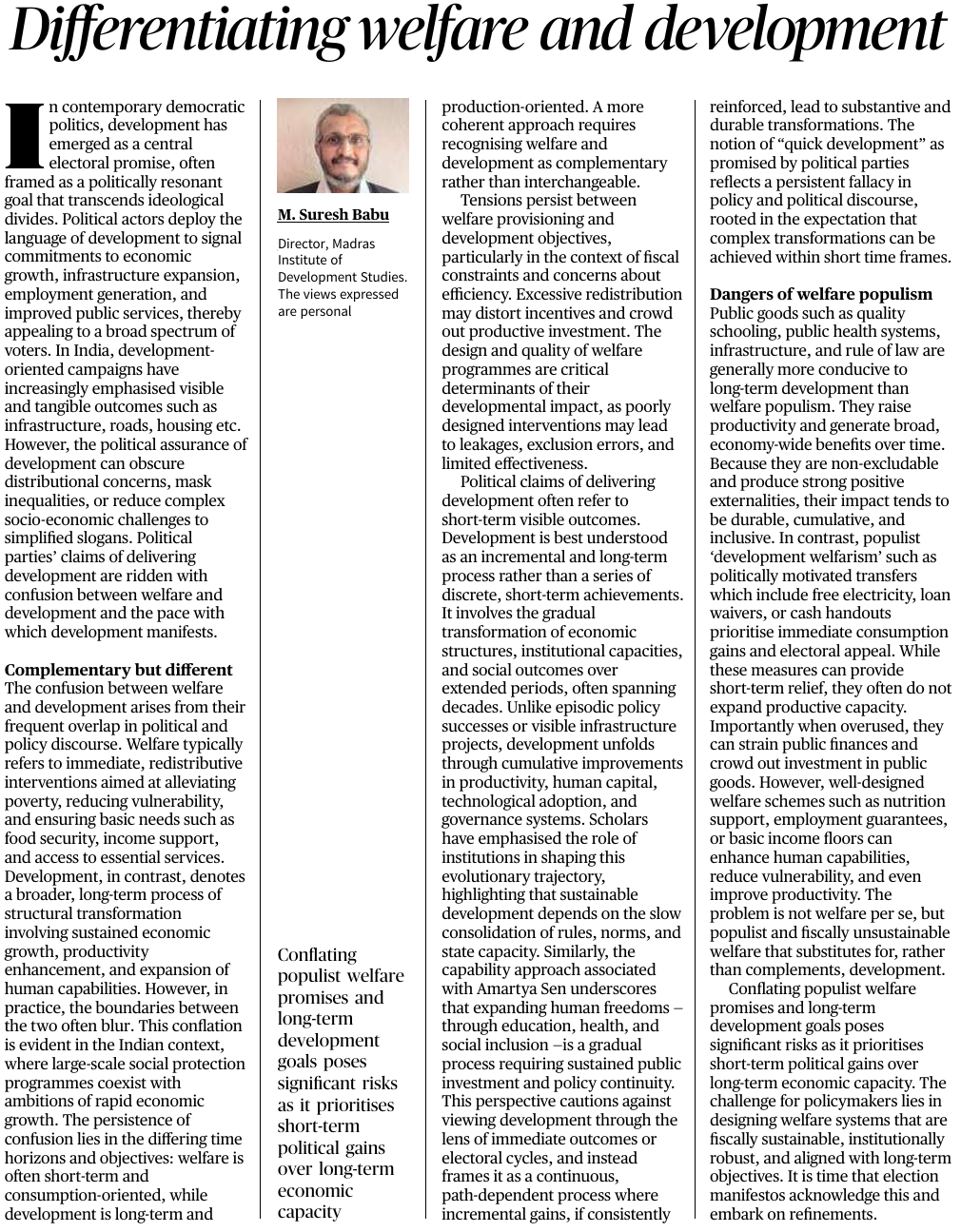
In democratic politics, “development” is widely used as an electoral promise, often conflated with welfare measures.
The article highlights the conceptual confusion between welfare (short-term relief) and development (long-term structural transformation), especially in India.
Detailed Analysis
1. Conceptual Difference: Welfare vs Development
Aspect
Welfare
Development
Nature
Immediate, redistributive
Long-term, structural
Objective
Poverty alleviation, basic needs
Economic growth & capacity building
Time Horizon
Short-term
Long-term
Examples
Subsidies, cash transfers
Infrastructure, education, health
2. Why Confusion Arises
Political discourse often blends both for electoral appeal.
Welfare schemes coexist with development goals → blurred boundaries.
“Quick development” promises oversimplify a slow, cumulative process.
3. Nature of Development
Incremental & long-term (not instant results)
Involves:
Institutional strengthening
Human capital formation
Technological adoption
Linked to ideas of Amartya Sen (capability approach):
Development = expansion of freedoms
Requires sustained public investment
4. Role of Welfare (Positive Side)
Reduces vulnerability and inequality
Enhances human capabilities
Examples:
Nutrition support
Employment guarantees
✔ Well-designed welfare can complement development
5. Risks of Welfare Populism
A. Economic Risks
Strains public finances
Crowds out investment in infrastructure and public goods
B. Productivity Concerns
Excessive redistribution may distort incentives
Limits long-term growth potential
C. Political Risks
Focus on short-term electoral gains
Neglect of long-term structural reforms
6. Importance of Public Goods
True development driven by:
Education
Health systems
Infrastructure
Rule of law
👉 These create:
Durable, inclusive, and cumulative benefits
7. Core Argument of the Article
Problem is not welfare itself, but:
Populist and fiscally unsustainable welfare
Welfare should support, not substitute, development.
Significance
Clarifies a key UPSC theme: growth vs redistribution debate
Helps understand:
Policy prioritization
Fiscal discipline
Inclusive development strategies
Challenges
Balancing equity (welfare) and efficiency (growth)
Political pressure for short-term gains
Fiscal constraints
Designing targeted and effective welfare schemes
Way Forward
1. Complementary Approach
Integrate welfare with development (not treat them as substitutes)
2. Fiscal Prudence
Avoid unsustainable subsidies
Prioritize productive expenditure
3. Focus on Human Capital
Invest in education, health, and skills
4. Institutional Strengthening
Improve governance and policy implementation
5. Outcome-Based Policy Design
Focus on long-term impact rather than short-term visibility
Conclusion
A clear distinction between welfare and development is essential for sound policymaking. Sustainable progress lies in aligning welfare measures with long-term developmental goals, ensuring both equity and economic growth without succumbing to short-term populism.
Mains Question
Q. Distinguishing between welfare and development is crucial for sustainable policymaking. Examine in the context of India. (250 words)
Approach
Intro:
Welfare = short-term, redistributive relief;
Development = long-term structural transformation → often conflated in India.
Body:
• Key Differences:
Time: short-term vs long-term
Nature: consumption support vs capacity/productivity building
• Why Distinction Matters:
Prevents fiscal stress
Avoids populist policies
Ensures sustainable and inclusive growth
• Interlinkage:
Welfare (health, education) → builds human capital
Development → generates resources to sustain welfare
• Challenges:
Electoral populism
Poor targeting
Weak implementation
Way Forward:
Rationalise subsidies
Focus on human capital & infrastructure
Improve governance
Conclusion:
Balanced approach needed → welfare for equity + development for long-term growth
 ‘Nuclear plants require lifetime commitment’
Context
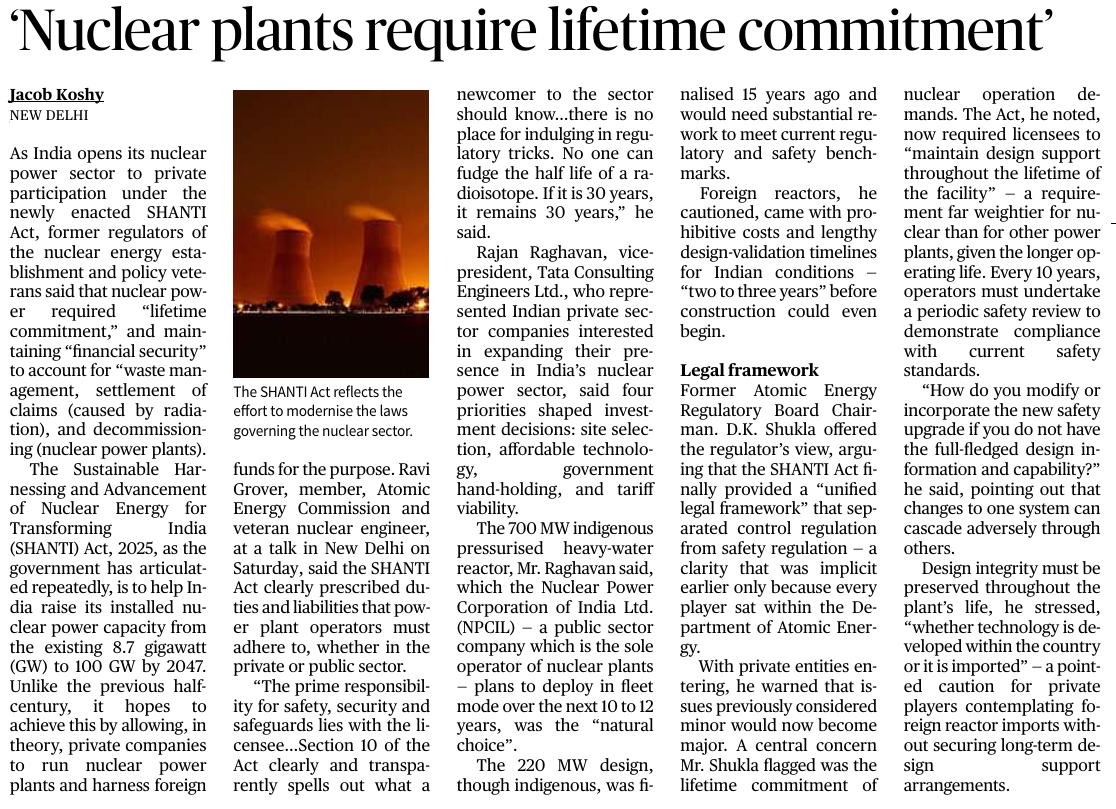
With the enactment of the SHANTI Act, 2025, India is opening the nuclear sector to private participation.
Experts emphasize that nuclear energy requires a “lifetime commitment” in terms of safety, finance, and regulation.
1. SHANTI Act, 2025
The Sustainable Harnessing and Advancement of Nuclear Energy for Transforming India (SHANTI) Act is the primary legal driver mentioned.
Objective: To scale India's nuclear capacity from 8.7 GW to 100 GW by 2047.
Private Participation: It breaks the decades-long monopoly of the public sector (NPCIL), allowing private companies to run nuclear plants and harness foreign funds.
Section 10: Explicitly defines the duties and liabilities of plant operators (licensees) regarding safety, security, and safeguards.
Regulatory Separation: It provides a unified legal framework that clearly separates control regulation from safety regulation—a crucial step for transparency when private players are involved.
2. Institutional Framework
Atomic Energy Commission (AEC): The apex body under the Department of Atomic Energy (DAE), which reports directly to the Prime Minister. It formulates nuclear policies.
Atomic Energy Regulatory Board (AERB): The watchdog that ensures nuclear and radiation safety. The article highlights that the SHANTI Act clarifies its regulatory role over both public and private entities.
Nuclear Power Corporation of India Ltd. (NPCIL): Currently the sole public sector operator. It is a Public Sector Enterprise under the DAE.
3. Technical Concepts & Reactor Types
The article mentions specific indigenous technologies being deployed in "fleet mode."
Pressurised Heavy-Water Reactor (PHWR):
Uses Unenriched Natural Uranium as fuel.
Uses Heavy Water ($D_{2}O$) as both moderator and coolant.
The 700 MW and 220 MW designs mentioned are the backbone of India's indigenous nuclear program.
Radioisotopes & Half-life:
Radioisotope: An unstable form of a chemical element that releases radiation as it decays.
Half-life: The time required for half of the atoms of a radioactive substance to decay. This is a constant physical property that "no one can fudge," making long-term waste management a scientific certainty.
UPSC MCQ
Q. Consider the following statements:
Nuclear power plants require management of radioactive waste even after the plant ceases operation.
The SHANTI Act, 2025 allows private sector participation in nuclear power generation in India.
Nuclear power plants generally have lower initial capital costs compared to thermal power plants.
Which of the statements given above is/are correct?
A. 1 and 2 only
B. 2 and 3 only
C. 1 and 3 only
D. 1, 2 and 3
Answer:
A. 1 and 2 only
Explanation:
Statement 1 ✔️ Waste management is a long-term responsibility
Statement 2 ✔️ SHANTI Act enables private participation
Statement 3 Nuclear plants have high initial capital costs

Context
The Enforcement Directorate (ED) conducted searches at the residence of a Kolkata Police officer and linked premises.
A businessman was arrested in a money laundering case.
The action comes close to elections, raising allegations of political targeting.
Prelims concepts
1. Enforcement Directorate (ED)
The ED is a specialized financial investigation agency under the Department of Revenue, Ministry of Finance.
Statutory Mandate: It enforces two key laws:
Prevention of Money Laundering Act, 2002 (PMLA): A criminal law to prevent money laundering and provide for the confiscation of property derived from laundering.
Foreign Exchange Management Act, 1999 (FEMA): A civil law to facilitate external trade and promote the orderly development of the foreign exchange market in India.
Powers of Search and Seizure: Under PMLA, the ED has significant powers to conduct searches (raids) and seize assets (cash, gold, property) if they are suspected to be "proceeds of crime."
Admissibility of Statements: Unlike the general police, statements made to ED officers are admissible as evidence in court (upheld by the Supreme Court in the Vijay Madanlal Choudhary case).
2. Money Laundering
Placement: Moving "dirty money" into the legal financial system (e.g., depositing cash).
Layering: Creating complex layers of financial transactions to hide the source (e.g., wire transfers, shell companies).
Integration: Bringing the laundered money back into the economy as "clean" wealth (e.g., buying real estate or gold, as mentioned in the article).
UPSC MCQ
Q. Consider the following statements:
The Enforcement Directorate (ED) enforces the Prevention of Money Laundering Act (PMLA).
The ED functions under the Ministry of Home Affairs.
Money laundering involves disguising illegally obtained money as legitimate income.
Which of the statements given above is/are correct?
A. 1 and 3 only
B. 2 and 3 only
C. 1 and 2 only
D. 1, 2 and 3
Answer:
A. 1 and 3 only
Explanation:
Statement 1 ✔️ ED enforces PMLA
Statement 2 ❌ ED functions under the Department of Revenue, Ministry of Finance
Statement 3 ✔️ Definition of money laundering
Context
The CBI arrested a senior DGCA official for allegedly accepting bribes to grant approvals.
Case highlights corruption in regulatory bodies, particularly in aviation safety oversight.
Prelims concepts
Directorate General of Civil Aviation (DGCA)
The DGCA is the regulatory body in the field of Civil Aviation, primarily dealing with safety issues.
Status: It is a statutory body under the Aircraft (Amendment) Act, 2020.
Parent Ministry: Ministry of Civil Aviation.
Key Responsibilities:
Regulation of air transport services to/from/within India.
Enforcement of civil air regulations and airworthiness standards.
Licensing of pilots, aircraft maintenance engineers, and air traffic controllers.
Investigation of minor aviation accidents/incidents.
Airworthiness
In the context of the article, "Airworthiness" refers to the measure of an aircraft's suitability for safe flight.
Certification: A "Certificate of Airworthiness" is mandatory for any aircraft to operate.
Directorate Responsibilities: This specific wing of the DGCA ensures that aircraft are maintained according to international standards (ICAO) and that all parts and repairs meet strict safety protocols.
Key Legal & Procedural Terms
First Information Report (FIR): A document prepared by the police after receiving information about the commission of a cognizable offense. It is not defined in the IPC or CrPC, though Section 154 of the CrPC (now Section 173 of Bharatiya Nagarik Suraksha Sanhita) refers to it.
Graft: A form of political/administrative corruption where an official uses their authority for personal gain (bribery).
Prevention of Corruption (Amendment) Act, 2018:
It criminalizes both the giving and taking of a bribe.
It provides a shield for "good faith" decisions but allows for the investigation of officials caught "red-handed" in bribe-seeking.
UPSC MCQ
Q. Consider the following statements:
The Directorate General of Civil Aviation (DGCA) is responsible for regulating civil aviation safety in India.
The Central Bureau of Investigation (CBI) derives its powers from the Delhi Special Police Establishment Act.
The Prevention of Corruption Act applies only to elected representatives and not to government officials.
Which of the statements given above is/are correct?
A. 1 and 2 only
B. 2 and 3 only
C. 1 and 3 only
D. 1, 2 and 3
Answer:
A. 1 and 2 only
Explanation:
Statement 1 ✔️ DGCA regulates aviation safety
Statement 2 ✔️ CBI operates under DSPE Act, 1946
Statement 3 PCA applies to public servants (including officials), not just elected representatives
 Launch your Graphy