There are no items in your cart
Add More
Add More
| Item Details | Price | ||
|---|---|---|---|





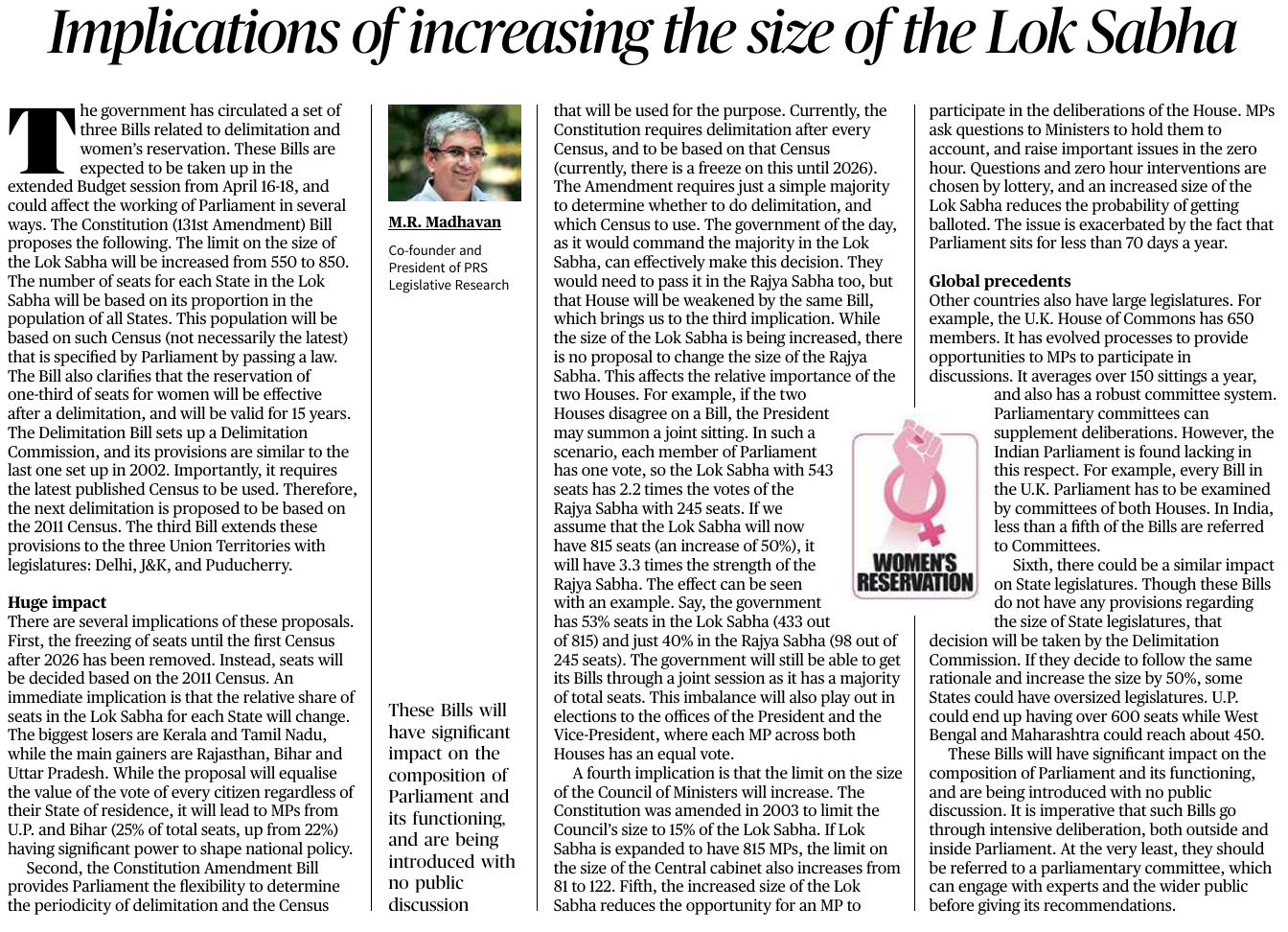 Implications of increasing the size of the Lok Sabha
Context
The government has proposed:
Increasing Lok Sabha seats from 550 → 850
Conducting delimitation based on 2011 Census
Implementing 33% women’s reservation post-delimitation
Current freeze on delimitation (since 1976, extended till 2026) is proposed to end.
Detailed Analysis
1. Impact on Federal Balance (Centre–State Relations)
Seat redistribution will depend on population share.
Winners: Uttar Pradesh, Bihar, Rajasthan
Losers: Kerala, Tamil Nadu (due to population control success)
👉 Implication:
Undermines the principle of cooperative federalism
Creates a north–south political imbalance
Penalizes states that implemented effective population policies
2. Shift in Parliamentary Power Dynamics
No change proposed in Rajya Sabha strength
Lok Sabha dominance increases significantly:
Earlier ratio: ~2.2 times Rajya Sabha
After expansion: ~3.3 times
👉 Implication:
Weakens the bicameral balance
Rajya Sabha’s role as a federal chamber gets diluted
Joint sittings will overwhelmingly favor Lok Sabha
3. Impact on Legislative Functioning
Larger Lok Sabha → more MPs → reduced individual participation:
Lower probability of asking questions
Reduced chance in Zero Hour interventions
Parliament already sits < 70 days/year
👉 Implication:
Decline in quality of deliberation
MPs’ accountability role weakens
4. Expansion of Executive (Council of Ministers)
Constitutional cap: 15% of Lok Sabha strength
If Lok Sabha increases to 815+:
Ministers increase from ~81 → ~122
👉 Implication:
Larger executive → greater patronage politics
Weakens separation of powers
5. Electoral and Political Consequences
Larger states gain more MPs → stronger influence in:
Government formation
Presidential & Vice-Presidential elections
👉 Implication:
National politics may become demographically skewed
6. Women’s Reservation Linkage
Reservation effective only after delimitation
Valid for 15 years
👉 Implication:
Positive step for gender representation
But implementation delayed and tied to contentious delimitation
7. Impact on State Legislatures
Though not explicitly stated, Delimitation Commission may:
Increase size of State Assemblies proportionately
👉 Implication:
Administrative and financial burden
Larger states (UP) may exceed 600 MLAs
8. Lack of Deliberation & Institutional Concerns
Bills introduced with minimal public debate
Not mandatorily referred to Parliamentary Committees
👉 Implication:
Weakens legislative scrutiny
Reduces participatory policymaking
Global Comparison
UK House of Commons: ~650 members
Strong committee system ensures deliberation
India:
Less than 20% bills go to committees
👉 Lesson: Size must be matched with institutional reforms
Significance
Positive Aspects
Better representation ratio (MP per population improves)
Facilitates women’s reservation
Reflects demographic realities
Concerns
Federal imbalance
Weakening of Rajya Sabha
Decline in deliberative democracy
Expansion of executive power
Challenges
Political resistance from southern states
Consensus on Census base year
Managing logistical complexity (new constituencies)
Ensuring fair representation vs equity dilemma
Way Forward
1. Balanced Delimitation Formula
Combine:
Population
Performance indicators (HDI, governance)
2. Strengthen Rajya Sabha
Consider proportional increase
Enhance its legislative powers
3. Parliamentary Reforms
Increase number of sitting days
Mandatory committee scrutiny of bills
4. Decouple Women’s Reservation
Implement independently of delimitation delays
5. Institutional Safeguards
Independent Delimitation Commission
Transparent methodology
Conclusion
The expansion of the Lok Sabha is not merely a numerical adjustment but a structural transformation of India’s parliamentary democracy. While it enhances representation, it risks distorting federal balance and weakening deliberative institutions. The reform must therefore be accompanied by institutional strengthening, federal sensitivity, and democratic safeguards to ensure it deepens rather than dilutes Indian democracy.
UPSC Mains Question
Q. “The proposed increase in the size of the Lok Sabha through delimitation has far-reaching implications for India’s federal balance and parliamentary functioning.” Discuss the potential benefits and challenges of this reform. Suggest measures to address the associated concerns. (250 words)
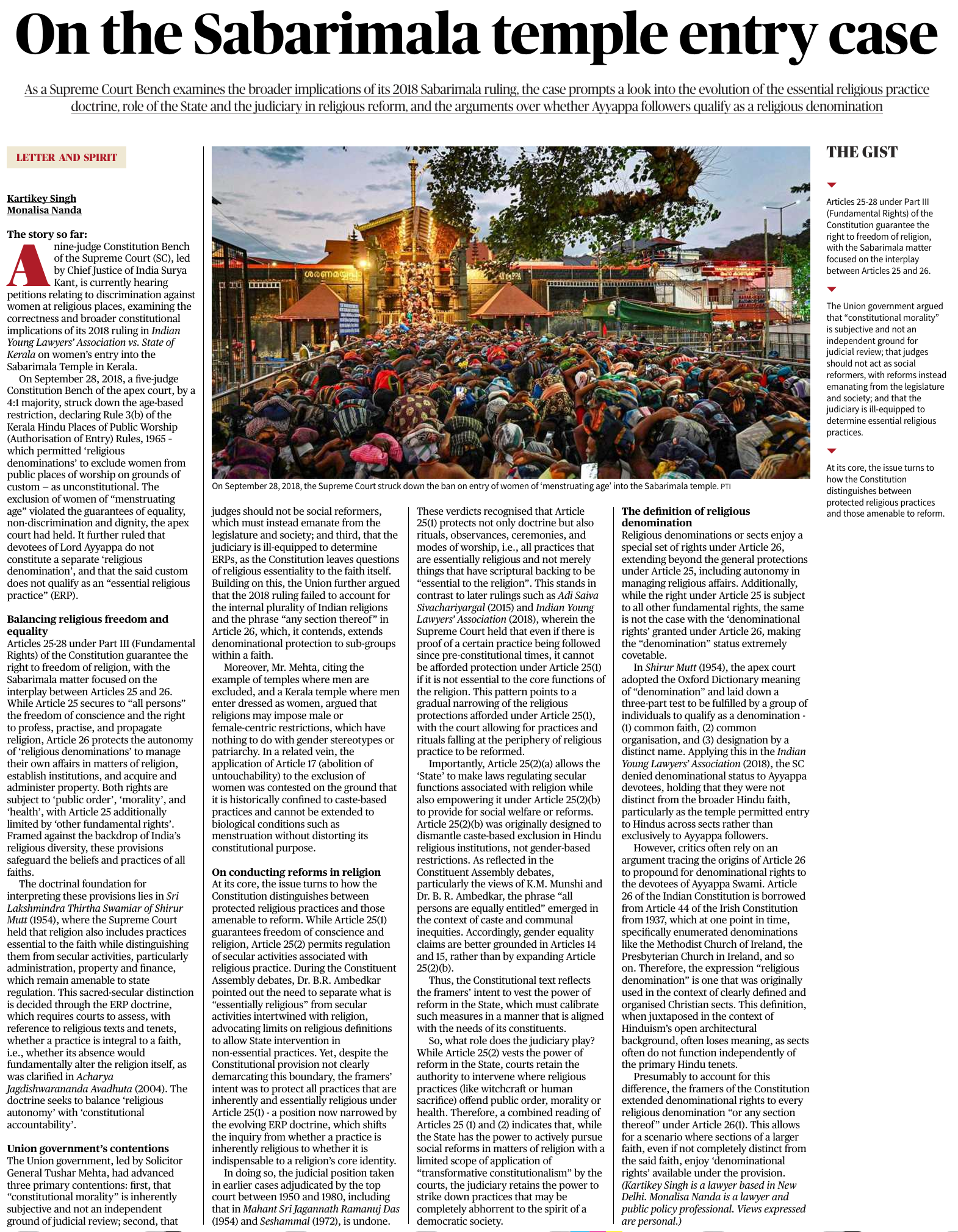
On the Sabarimala temple entry case
Context
A 9-judge bench of the Supreme Court is examining broader constitutional questions arising from the 2018 Sabarimala verdict.
The core issues include:
Essential Religious Practices (ERP) doctrine
Scope of Articles 25 & 26
Whether Ayyappa devotees constitute a religious denomination
Role of judiciary vs legislature in religious reforms
Detailed Analysis
1. Background of the 2018 Sabarimala Judgment
In Indian Young Lawyers Association v. State of Kerala (2018):
SC allowed entry of women (10–50 years) into Sabarimala.
Struck down Rule 3(b) of Kerala Temple Entry Act.
Basis:
Violation of Articles 14 (equality), 15 (non-discrimination), 25 (freedom of religion).
Court held:
Ayyappa devotees do not form a separate religious denomination.
The restriction is not an Essential Religious Practice (ERP).
2. Core Constitutional Tension: Articles 25 vs 26
Article 25
Article 26
Individual right to freedom of religion
Collective rights of religious denominations
Subject to public order, morality, health
Greater autonomy in religious affairs
Conflict:
Women’s right to worship (Art 25)
vs
Temple’s autonomy (Art 26)
3. Essential Religious Practices (ERP) Doctrine
Evolution:
Origin: Shirur Mutt Case (1954)
Courts determine:
Whether a practice is essential to religion
Issues:
Courts entering theological domain
Lack of objective standards
Over time:
ERP doctrine has narrowed religious protections
In Sabarimala:
SC ruled exclusion of women is not essential
4. Religious Denomination Debate
Criteria (Shirur Mutt Case):
Common faith
Common organisation
Distinct name
Court’s Position:
Ayyappa devotees:
Not distinct from broader Hinduism
Temple open to all Hindus → no exclusivity
Counter-view:
Critics argue:
Ayyappa worship has distinct practices (vratham, celibacy norms)
Should qualify as denomination
5. Role of Judiciary vs State in Religious Reform
Two competing views:
(A) Reformist Approach (Judiciary Active)
Courts should:
Uphold constitutional morality
Eliminate discriminatory practices
Example: Sabarimala, Triple Talaq
(B) Restraint Approach (Legislature-led Reform)
Judiciary should not:
Act as social reformer
Decide religious doctrines
Reform should come from:
Society + Legislature
6. Constitutional Morality vs Social Traditions
Government argued:
“Constitutional morality” should not override judicial restraint
Debate:
Should courts impose modern values on traditional practices?
7. Expanding Scope of Article 25(2)
Allows:
State intervention for social reform
Debate:
Can gender equality override religious freedom?
8. Broader Implications of the Case
Impacts:
Other cases:
Entry of women in mosques
Female genital mutilation (Dawoodi Bohra case)
Determines:
Future of ERP doctrine
Boundaries of judicial intervention in religion
Significance
Defines:
Indian model of secularism (principled distance)
Balances:
Individual rights vs group rights
Clarifies:
Limits of judicial activism
Shapes:
Gender justice within religious spaces
Challenges
Lack of clarity in ERP doctrine
Risk of:
Judicial overreach
Difficulty in:
Balancing faith vs equality
Diverse religious practices → uniform standard hard
Way Forward
Develop clearer criteria for ERP
Promote:
Dialogue-based reform within communities
Judiciary should:
Maintain balance between reform & restraint
Legislature:
Take proactive role in social reform laws
Ensure:
Harmony between Fundamental Rights & religious freedom
Conclusion
The Sabarimala case represents a constitutional crossroads—testing how India reconciles faith, equality, and judicial power. The final outcome will not just decide temple entry but redefine the relationship between religion and the Constitution in a plural society.
Mains Question
Q. “The Sabarimala verdict reflects the tension between constitutional morality and religious autonomy.” Critically examine. (250 words)
Context
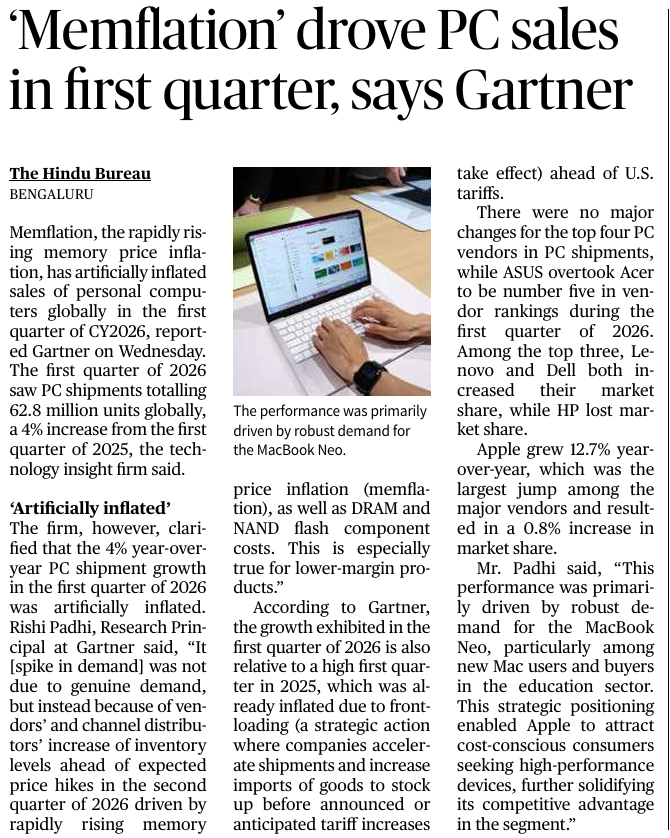
Global PC shipments increased by 4% in Q1 2026 (62.8 million units).
Growth driven not by real demand but by “memflation” — rising memory chip prices (DRAM & NAND).
Vendors stocked inventory in anticipation of future price hikes and tariffs.
1. Key Economic Terminology
Memflation: A portmanteau of "Memory" and "Inflation." It refers specifically to the rapidly rising price inflation of memory components (such as DRAM and NAND flash).
Front-loading: A strategic economic action where companies accelerate shipments and increase imports of goods to stock up inventory before anticipated price hikes, tariff increases, or supply disruptions take effect.
Artificial Inflation of Demand: When reported growth (like the 4% increase in PC shipments) does not reflect "genuine" consumer demand but is instead driven by vendors and distributors building up inventory to hedge against future costs.
2. Supply Chain & Component Concepts
DRAM (Dynamic Random-Access Memory): A type of semiconductor memory used for the working data and machine code in computers. It is volatile memory.
NAND Flash: A type of non-volatile storage technology that does not require power to retain data (used in SSDs and USB drives).
Lower-margin Products: Products with a small difference between the cost of production and the selling price. The article notes these are especially sensitive to component cost hikes like "Memflation."
UPSC MCQ:
Q. Which of the following best describes the term “Memflation” as used in the context of PC sales?
A) A surge in consumer demand for high-end computers due to technological advancements
B) A rise in overall inflation caused by increased production of memory chips
C) An increase in memory component prices leading to artificial inflation of PC shipments due to inventory stocking
D) A decline in PC sales due to shortage of memory components
Answer: C) An increase in memory component prices leading to artificial inflation of PC shipments due to inventory stocking
Explanation:
“Memflation” refers specifically to rising prices of memory components (DRAM, NAND).
This led vendors to stockpile inventory in advance, artificially boosting shipment data.
It does not reflect real demand growth, but a strategic supply-side response.
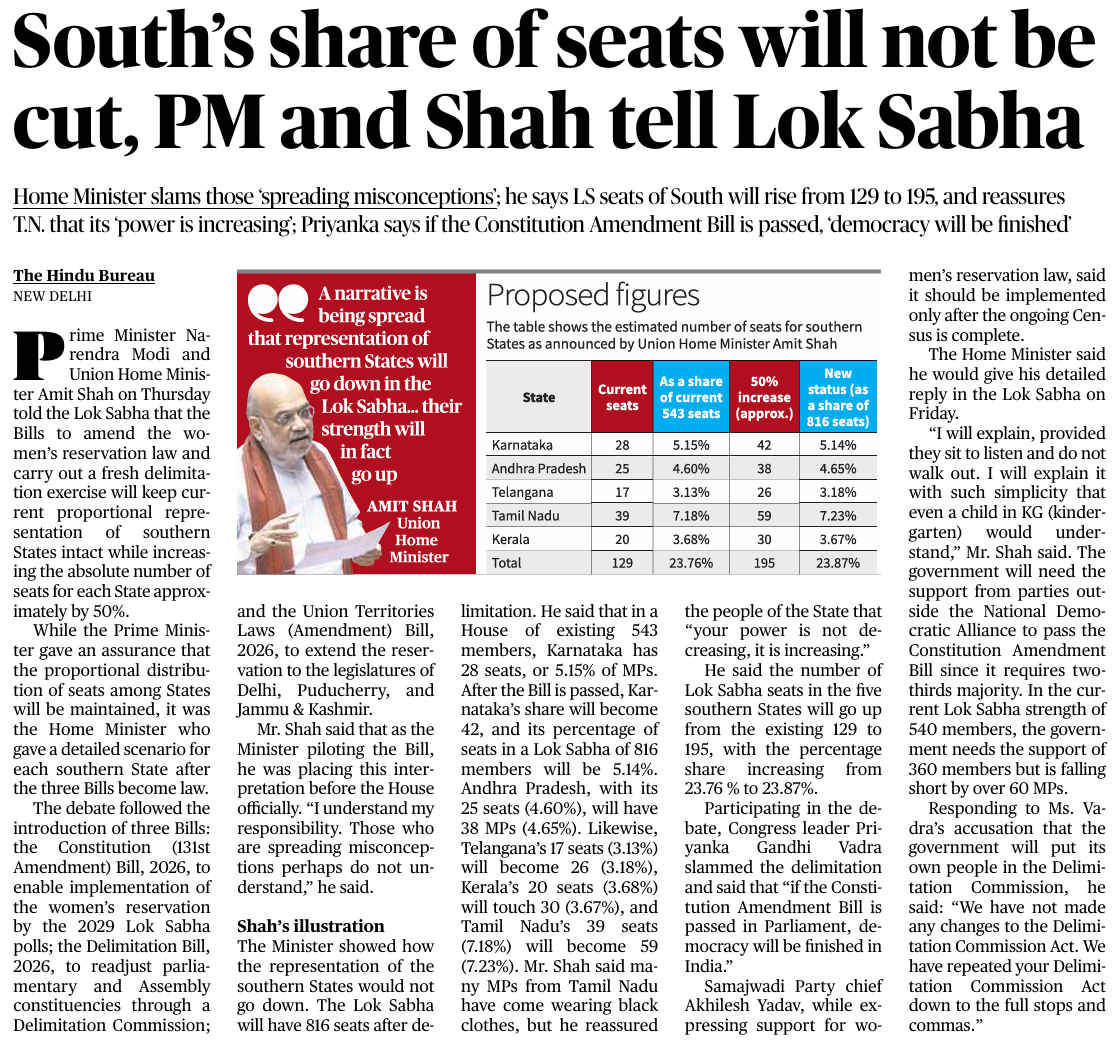 South’s share of seats will not be cut, PM and Shah tell Lok Sabha
Context
Debate in Lok Sabha on:
Delimitation exercise (post-2026 freeze)
Women’s Reservation Bill implementation
Concerns from southern States:
Fear of loss of political representation due to lower population growth
Government reassurance:
No reduction in proportional share
Absolute seats of southern States will increase
Prelims concepts
1. Delimitation Commission & Exercise
Delimitation is the act of redrawing boundaries of Lok Sabha and State Assembly seats to represent changes in population.
Constitutional Basis: Under Article 82, Parliament enacts a Delimitation Act after every Census. Under Article 170, States also get divided into territorial constituencies as per the Delimitation Act.
The 84th Amendment Act, 2001: This froze the number of seats in the Lok Sabha based on the 1971 Census until the first census after 2026.
Current Context: The article mentions the Delimitation Bill, 2026, which seeks to readjust parliamentary and assembly constituencies. This is a prerequisite for implementing the Women's Reservation Law by the 2029 polls.
2. Proportional Representation & Federalism
A major concern in Indian federalism is that states that successfully implemented population control (mostly in the South) might lose seats relative to states with high population growth (mostly in the North).
Current Status: The five southern states currently hold 129 seats out of 543 (approx. 23.76%).
The "50% Increase" Proposal: The government proposes increasing the total strength of the Lok Sabha to 816 seats.
Maintaining Proportionality: The key claim in the article is that the absolute number of seats for southern states will rise (to 195), and their relative share will remain nearly constant (approx. 23.87%) to ensure their political voice is not diminished.
3. Women’s Reservation (Constitution 131st Amendment Bill)
The article links the delimitation exercise directly to the implementation of the Nari Shakti Vandan Adhiniyam.
Requirement: The reservation of one-third of seats for women in Lok Sabha and State Assemblies is legally tied to the completion of a fresh census and subsequent delimitation.
Legislative Status: The article refers to the Constitution (131st Amendment) Bill, 2026, specifically aimed at extending these reservations to the legislatures of Union Territories like Delhi, Puducherry, and Jammu & Kashmir.
UPSC MCQ
Q. Consider the following statements regarding delimitation in India:
Delimitation is carried out by an independent commission whose orders have the force of law and cannot be challenged in courts.
The number of Lok Sabha seats allotted to each State has been frozen based on the 1971 Census until 2026.
Delimitation only involves redrawing constituency boundaries and does not affect the allocation of seats among States.
Which of the statements given above is/are correct?
A) 1 and 2 only
B) 2 and 3 only
C) 1 and 3 only
D) 1, 2 and 3
Answer: A) 1 and 2 only
Explanation:
Statement 1 – Correct: Delimitation Commission is independent, and its orders cannot be challenged in court.
Statement 2 – Correct: Seat allocation among States is frozen based on 1971 Census till 2026.
Statement 3 – Incorrect: Delimitation also includes allocation of seats among States, not just boundary redrawing.
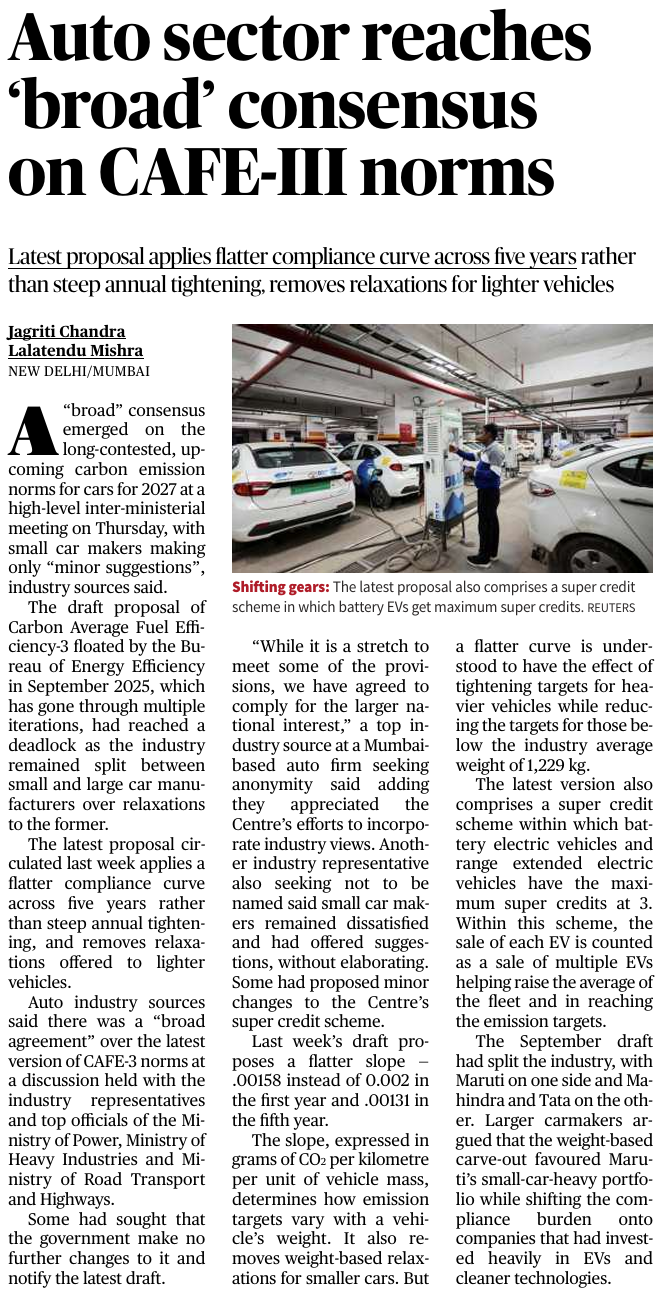
Context
Government is finalizing CAFE-III (Corporate Average Fuel Efficiency) norms for cars (target year ~2027).
Earlier disagreements within auto industry (small vs large car makers).
Now a “broad consensus” has emerged on revised norms.
Prelims concepts
1. What are CAFE Norms?
CAFE stands for Corporate Average Fuel Efficiency (or Economy).
Objective: To lower the fuel consumption (and consequently $CO_2$ emissions) of a manufacturer’s entire fleet of vehicles.
Targeting the Fleet: Unlike BS-VI (Bharat Stage) norms, which focus on individual vehicle exhaust emissions (pollutants like NO_x and Particulate Matter), CAFE norms target the average fuel efficiency of all cars sold by a manufacturer in a financial year.
Mechanism: If the average fuel consumption of a manufacturer's fleet exceeds the set limit, they face heavy penalties.
2. CAFE-III: The 2027 Shift
The article discusses the upcoming third phase of these norms, set to take effect in 2027.
Implementation Agency: The norms are floated by the Bureau of Energy Efficiency (BEE) under the Ministry of Power.
The "Flatter Compliance Curve": Instead of a steep annual jump in requirements, the government has proposed a gradual tightening over five years. This gives manufacturers more time to adjust their production lines.
Removal of Weight-Based Relaxations: Earlier drafts had relaxations for lighter vehicles (small cars). The new consensus removes these to ensure all segments contribute to emission reduction.
3. Key Ministerial Stakeholders
Policy formation in this sector involves a multi-ministerial approach:
Ministry of Power: (Through the BEE) sets the technical efficiency targets.
Ministry of Heavy Industries: Oversees the auto sector's growth and implementation of schemes like FAME.
Ministry of Road Transport and Highways (MoRTH): Responsible for the overall regulation of vehicles and safety.
UPSC MCQ
Q. Consider the following statements regarding Corporate Average Fuel Efficiency (CAFE) norms:
CAFE norms regulate the average carbon dioxide emissions of a vehicle manufacturer’s fleet.
CAFE norms in India are based entirely on engine capacity and are independent of vehicle weight.
Which of the statements given above is/are correct?
A) 1 only
B) 2 only
C) Both 1 and 2
D) Neither 1 nor 2
Answer: A) 1 only
Explanation:
Statement 1 – Correct: CAFE norms target fleet-average CO₂ emissions.
Statement 2 – Incorrect: CAFE norms consider vehicle weight, not just engine capacity.
 India laps up most of Venezuelan, Russian crude oil
Context
Due to the Iran war and disruption in the Strait of Hormuz, global crude shipments declined.
India increased imports from Russia and Venezuela, emerging as a major destination for diverted oil supplies.
Prelims concepts
1. Geographical & Strategic Chokepoints
Strait of Hormuz: A vital maritime chokepoint between the Persian Gulf and the Gulf of Oman. It is the world's most important oil artery; the article notes its closure has led to a 9.5% reduction in global seaborne crude shipments.
Suez Canal: Mentioned as a transit route for Russian tankers originating from the Black Sea bound for Indian ports.
Yanbu (Red Sea): A key Saudi Arabian port. The article notes Saudi Arabia increased shipments from here to bypass the Persian Gulf disruptions.
Strait of Hormuz vs. Persian Gulf: The article clarifies that countries outside the Persian Gulf (like Venezuela and Russia) are now accounting for 85% of increased global shipments to fill the vacuum.
2. Organizational & Economic Terms
BIMCO (Baltic and International Maritime Council): One of the largest international shipping associations representing shipowners; it provides the primary data cited in the article.
Seaborne Shipments: Refers to goods (crude oil here) transported via sea as opposed to pipelines.
Open-Source Data Tracking: The use of publicly available information (like satellite AIS data for tankers) to monitor trade flows.
UPSC MCQ
Q. Consider the following statements:
Disruptions in key maritime chokepoints can lead to rerouting of global crude oil shipments.
An increase in global crude oil shipments always leads to a decline in international oil prices.
Which of the statements given above is/are correct?
A) 1 only
B) 2 only
C) Both 1 and 2
D) Neither 1 and 2
Answer: ✅ A) 1 only
Explanation:
Statement 1: Correct
Supply disruptions force exporters to reroute shipments to alternative markets.
Statement 2: Incorrect
Oil prices depend on multiple factors (demand, geopolitics, speculation); increased supply does not always guarantee price fall.
 EU planning to include 180 more products under CBAM
Context
The European Union (EU) plans to expand the scope of the Carbon Border Adjustment Mechanism (CBAM).
Around 180 additional products may be included from 2028.
Could increase carbon-related costs on Indian exports.
1. Core Concept: What is CBAM?
The Carbon Border Adjustment Mechanism (CBAM) is a carbon tariff imposed by the EU on carbon-intensive products imported into the bloc.
Objective: To prevent "Carbon Leakage"—a situation where EU-based companies move their production to countries with less stringent environmental rules to avoid costs, or where EU products are replaced by more carbon-intensive imports.
Mechanism: Importers buy CBAM certificates corresponding to the carbon price that would have been paid had the goods been produced under the EU’s internal rules (EU Emissions Trading System - ETS).
Status in 2026: CBAM has transitioned from its "transitional phase" (2023–2025) into its compliance phase (started January 1, 2026). Importers must now pay for embedded emissions rather than just reporting them.
2. The New Proposal: Expansion to 180 Products
The article reports a draft recommendation to broaden the scope significantly by January 2028.
Targeting Downstream Products: While the current phase covers raw materials (Steel, Aluminium, Cement, Fertilizer, Hydrogen, and Electricity), the expansion targets 180 downstream manufactured goods.
Key Items Included:
Fabricated metal products (tubes, pipes, fasteners).
Structural components and machinery parts.
Aluminium containers and finished engineering goods.
Auto components and industrial equipment.
Significance: This marks a shift from taxing "raw commodities" to taxing "finished industrial goods," moving deeper into the global manufacturing value chain.
3. Impact on India
India is one of the top countries vulnerable to CBAM due to its high export volume to the EU and the carbon intensity of its manufacturing.
Engineering Sector Risk: The Engineering Export Promotion Council (EEPC) and GTRI highlight that engineering goods—India's largest export category—will now face direct carbon tax exposure.
The FTA Conflict: India and the EU recently moved toward operationalizing a Free Trade Agreement (FTA). While the FTA reduces traditional tariffs to zero, CBAM acts as a new "Climate-linked Trade Barrier," potentially neutralizing the benefits of the FTA for Indian exporters.
Compliance Burden: Indian firms will need installation-level data, supply-chain traceability, and verified emissions reports to avoid "default values" (which are intentionally set high by the EU to discourage non-reporting).
UPSC MCQ
Q. Consider the following statements regarding the Carbon Border Adjustment Mechanism (CBAM):
CBAM can affect the competitiveness of exports from developing countries in international markets.
CBAM encourages exporting countries to adopt cleaner production technologies to reduce carbon emissions.
Which of the statements given above is/are correct?
A) 1 only
B) 2 only
C) Both 1 and 2
D) Neither 1 nor 2
Answer: C) Both 1 and 2
Explanation:
Statement 1 – Correct: Additional carbon costs can reduce export competitiveness.
Statement 2 – Correct: It creates incentives for decarbonisation and green technology adoption.
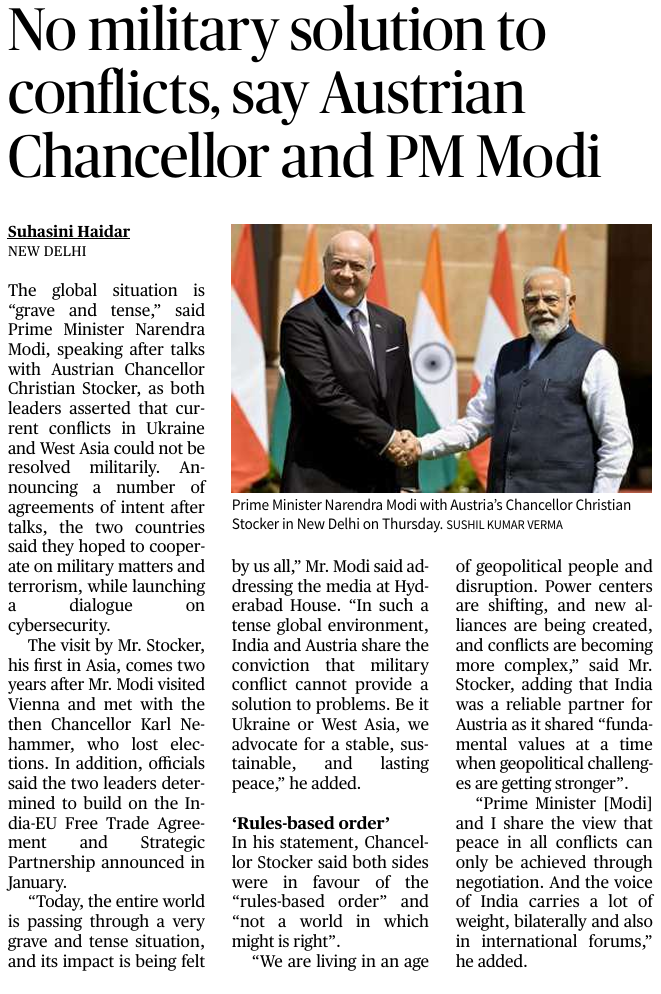 No military solution to conflicts, say Austrian Chancellor and PM Modi
Context
PM Modi and Austrian Chancellor emphasized:
No military solution to global conflicts (Ukraine, West Asia)
Focus on:
Dialogue, diplomacy, and rules-based order
Visit strengthens:
India–Austria bilateral ties
Prelims concepts
1. India-Austria Bilateral Relations
Historical Milestone: This is the first visit by an Austrian Chancellor to India in four decades.
Strategic Transition: The relationship has evolved from "Close and Friendly" to a Strategic Partnership, particularly following PM Modi’s visit to Vienna in 2024 and the recent January 2026 agreements.
Key Sectors: Cooperation is centered on infrastructure (Delhi Metro, Atal Tunnel), high technology (semiconductors, quantum tech), and sustainable energy.
2. New Defense & Security Frameworks
The article and supplementary outcomes highlight a significant expansion into security:
Military Cooperation: A Letter of Intent (LoI) was exchanged to institutionalize cooperation in military matters, defense industry, and technology.
Cybersecurity Dialogue: The two nations have launched a formal Institutional Cybersecurity Dialogue to address shared digital threats.
Counter-Terrorism: Both sides agreed to establish a Joint Working Group (JWG) on Counter-Terrorism, condemning cross-border terrorism and terror financing.
UN Peacekeeping: A new partnership has been formed between India's Centre for UN Peacekeeping and the Austrian Armed Forces International Centre (AUTINT).
3. India-EU Economic Integration
The article references the broader India-EU framework which governs much of the India-Austria trade:
FTA Status: Negotiations for the India-EU Free Trade Agreement (FTA) were concluded in January 2026.
Trade Scope: The FTA provides India with preferential access to approximately 97% of EU tariff lines.
Strategic Agenda: The "Towards 2030: Joint India-EU Comprehensive Strategic Agenda" (endorsed Jan 2026) serves as the roadmap for integrating supply chains and regulatory alignment (e.g., on CBAM and deforestation regulations).
 Launch your Graphy