The Hindu Analysis April 15th
The Hindu News Analysis – 15th April, 2026
1. Food worth ₹1.55 lakh cr. wasted annually (GS-3, GS-2)
2. Mapping the legislative vacuum in India’s heat crisis
(GS-3, GS-2)
3. Constitution Amendment Bill moots possible change in size of State Assemblies (GS-2)
4. India to host Foreign Minister-level meet of BRICS, Quad
(GS-2)
5. West Asia war threatens to push 2.5 mn into poverty: UNDP
(GS-3, GS-2)
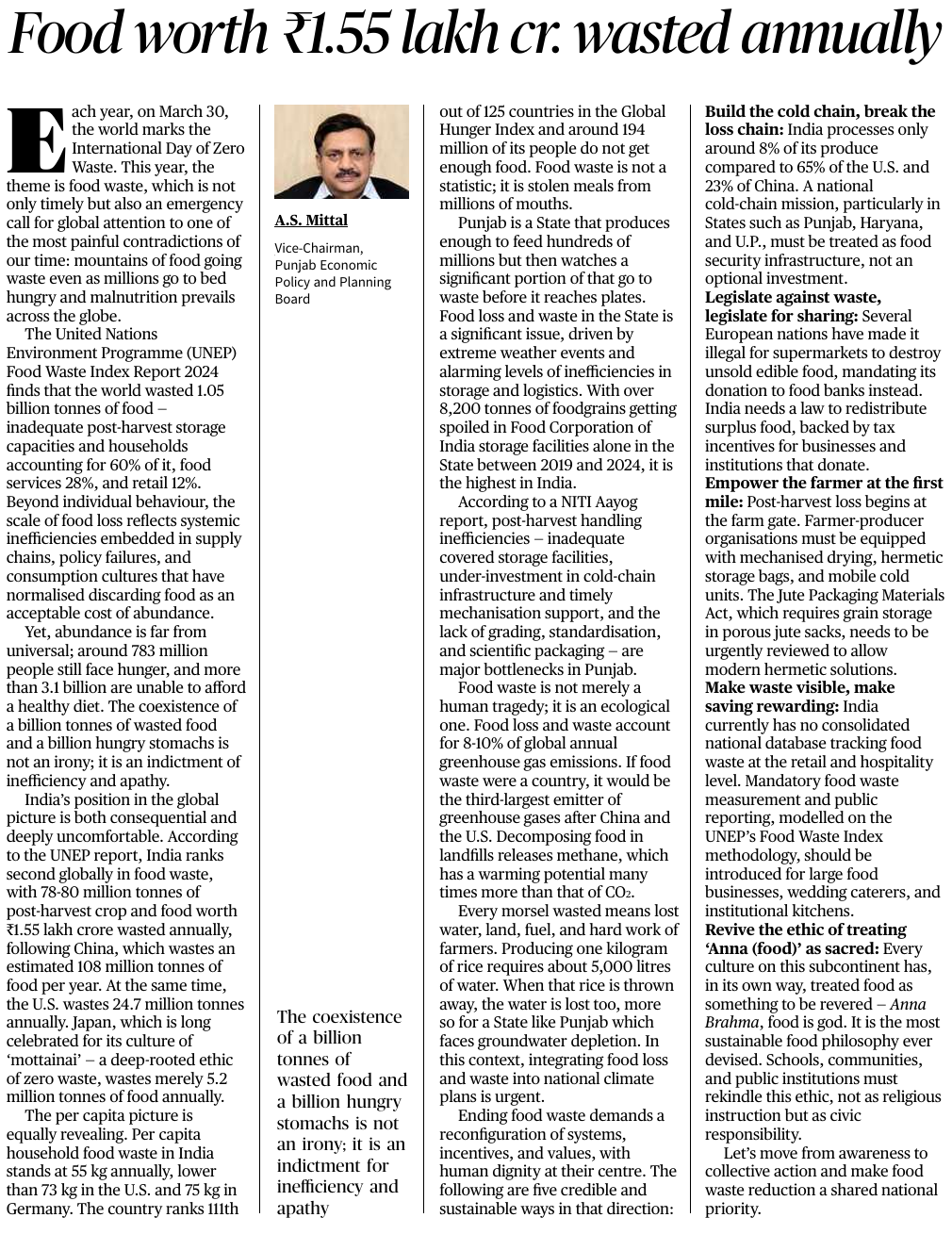
Food worth ₹1.55 lakh cr. wasted annually
GS Paper III:
Food processing and related industries
Food security
Environmental degradation and climate change
Agriculture and post-harvest management
GS Paper II:
Government policies and interventions
Issues of poverty and hunger
Context
On the occasion of the International Day of Zero Waste (March 30), the article underscores the alarming scale of food wastage globally and in India. Drawing from the UNEP Food Waste Index Report 2024, it highlights how India wastes massive quantities of food despite persistent hunger and malnutrition, pointing toward systemic inefficiencies rather than mere individual behavior.
Detailed Analysis
1. ⚖️ The Core Paradox: Abundance vs Hunger
India wastes ₹1.55 lakh crore worth of food annually (~78–80 million tonnes).
At the same time:
Millions remain food insecure
A large population cannot afford a nutritious diet
🔍 Interpretation:
This is not a production problem but a distribution and governance failure
Reflects:
Inequity in access
Weak last-mile delivery systems
👉 The paradox exposes a disconnect between agricultural success and food security outcomes
2. 🏗️ Structural Nature of Food Waste
The article strongly argues that food waste is systemic, not just behavioral.
a) Post-Harvest Losses
Occur before food reaches consumers
Causes:
Poor storage infrastructure
Lack of scientific warehousing
Inadequate transportation
👉 Example: Grain spoilage in FCI storage
b) ❄️ Cold Chain Deficiency
India processes only ~8% of produce
Global comparison:
USA: ~65%
China: ~23%
🔍 Implication:
Perishable items (fruits, vegetables, dairy) suffer maximum loss
Indicates underinvestment in agro-logistics
c) 🚜 Farm-Level Constraints
Loss begins at the first mile
Issues:
Lack of mechanised drying
Absence of modern storage (hermetic bags)
Weak Farmer Producer Organisations (FPOs)
👉 Farmers forced into distress sale → wastage
d) 🛒 Retail & Consumption Patterns
Food wastage normalized in:
Weddings
Hospitality sector
Urban households
👉 Reflects cultural and behavioural dimensions, but secondary to structural causes
3. 🌍 Environmental & Ecological Dimension
Food waste is a hidden environmental crisis.
a) 🌡️ Climate Change Impact
Contributes 8–10% of global GHG emissions
If food waste were a country → 3rd largest emitter
b) 💧 Resource Depletion
1 kg rice ≈ 5000 litres of water
Waste = loss of:
Water
Energy
Fertilizers
c) 🧪 Methane Emissions
Landfill waste releases methane
Methane has higher warming potential than CO₂
👉 Thus, food waste is directly linked to:
Climate change
Groundwater crisis
Sustainability challenges
4. India-Specific Dimensions
a) 📊 Scale of the Problem
India ranks 2nd globally in food waste
Absolute waste is huge despite lower per capita waste
b) 🌾 Punjab Case Study
High production state but:
Significant pre-consumption losses
Storage and logistics inefficiencies
👉 Shows that production surplus ≠ food security
c) 📉 Data Deficiency
No centralized system to:
Measure food waste
Track supply chain losses
👉 Leads to policy blindness
5. ⚙️ Governance and Policy Gaps
a) ❌ Absence of Legal Framework
No law mandating:
Food redistribution
Donation of surplus food
b) 🧩 Fragmented Policy Approach
Food security policies focus on:
Production (MSP, PDS)
Ignore:
Loss minimisation
c) 🏢 Weak Institutional Accountability
No mandatory reporting for:
Hotels
Retail chains
Caterers
6. 🧭 Ethical and Cultural Dimension
Traditional Indian ethos:
Food seen as “Anna Brahma” (sacred)
Modern consumption:
Shift toward consumerism and waste culture
👉 The crisis is also a value-system erosion
🚀 Way Forward (Multi-Dimensional Strategy)
1. 🏗️ Infrastructure Reforms
Develop:
Cold chain networks
Modern warehouses
Food processing clusters
👉 Treat as core economic + food security infrastructure
2. ⚖️ Legislative Action
Enact laws to:
Prevent destruction of edible food
Mandate food donation
Provide:
Tax incentives for businesses
3. 🚜 Farmer-Centric Solutions
Strengthen:
FPOs
Agro-processing at local level
Promote:
Mechanisation
Scientific storage
4. 📊 Data & Monitoring Systems
Create:
National Food Waste Database
Introduce:
Mandatory reporting standards
5. 🌍 Climate Policy Integration
Include food waste reduction in:
NDCs
State climate action plans
6. 🧠 Behavioural Change
Awareness campaigns:
Responsible consumption
Institutional reforms:
Food audits in events and hotels
7. 🔄 Circular Economy Approach
Promote:
Food recovery systems
Composting
Waste-to-energy
Conclusion
Food waste in India is a systems failure spanning agriculture, infrastructure, governance, and societal values. Tackling it requires a holistic, multi-sectoral strategy integrating technology, policy, behavioural change, and ethical revival. Reducing food waste is not only essential for food security but also critical for achieving sustainable development and climate goals.
Mains Question
Q. “Food waste in India is primarily a governance and infrastructure failure rather than a behavioural issue.” Discuss with suitable examples and suggest reforms.
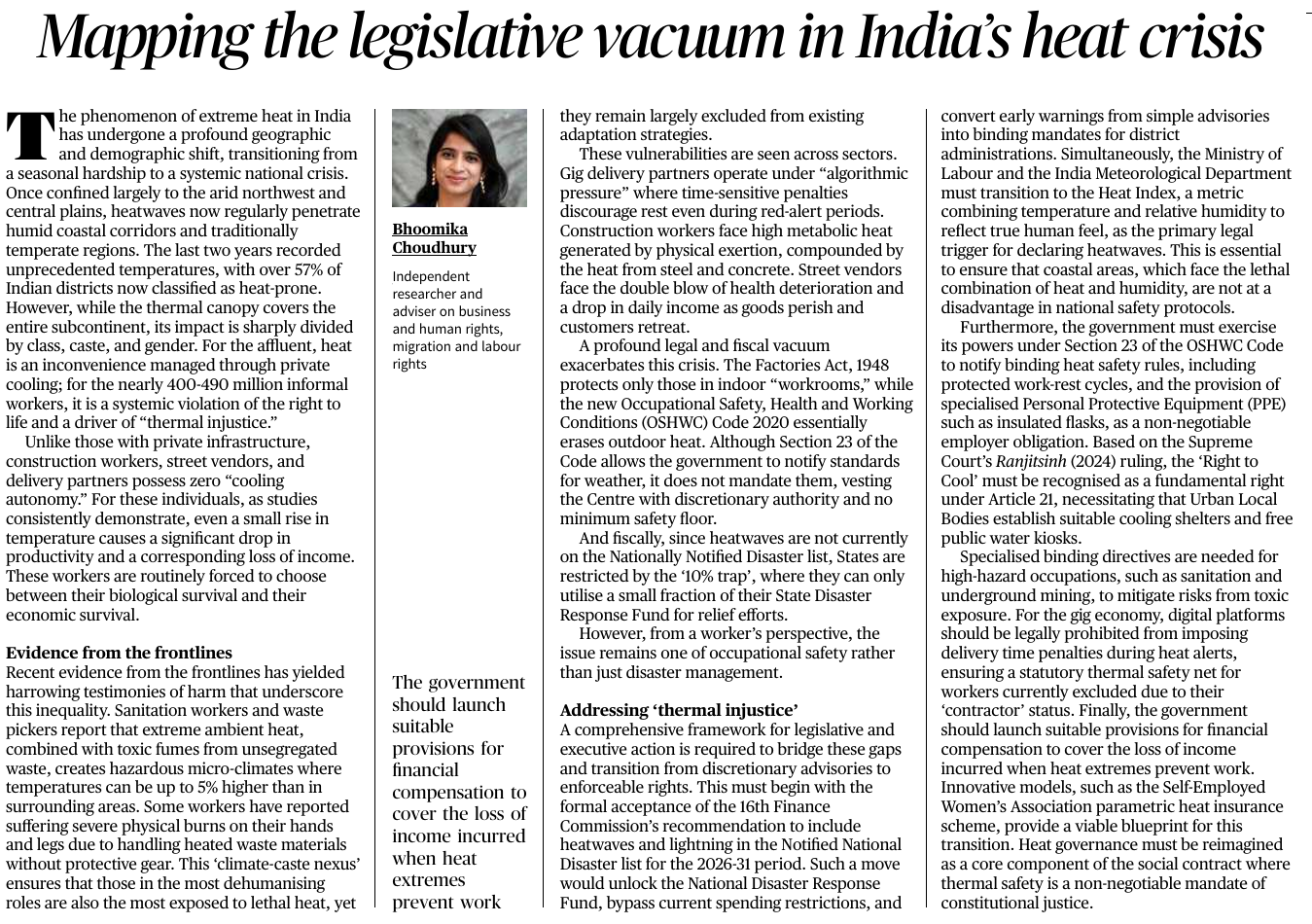 Mapping the legislative vacuum in India’s heat crisis
GS Paper II:
Government policies and interventions
Welfare schemes for vulnerable sections
Issues related to labour rights
GS Paper III:
Disaster management
Climate change and its impact
Environmental degradation
Context
India’s heatwaves are no longer seasonal events but a systemic national crisis, affecting over 57% of districts. The article argues that despite rising risks, there exists a legislative and policy vacuum, especially in protecting informal workers and outdoor labourers, leading to what is termed “thermal injustice.”
Detailed Analysis
1. 🌡️ Transformation of Heatwaves into a Structural Crisis
Heatwaves have expanded:
From northwest & central India → coastal & humid regions
Increasing frequency and intensity:
Last two years recorded unprecedented temperatures
🔍 Implication:
Heatwaves are no longer episodic disasters
They represent a chronic climate risk
👉 Shift required: Disaster response → Long-term adaptation governance
2. ⚖️ Thermal Inequality and Social Justice Dimension
a) Class Divide
Affluent वर्ग:
Access to ACs, cooling infrastructure
Informal workers (~400–490 million):
No cooling access
Forced to work in extreme heat
👉 Leads to “thermal injustice” = unequal exposure to climate risk
b) Occupational Vulnerability
Most affected:
Construction workers
Street vendors
Sanitation workers
Gig workers
c) Gender & Caste Angle
Marginalised groups are:
Overrepresented in high-risk jobs
Least protected
👉 Heat crisis becomes a multidimensional inequality issue
3. 🏗️ Evidence from Ground (Human Impact)
Sanitation workers face:
Heat + toxic fumes → hazardous microclimates
Waste pickers:
Burns from heated waste materials
Productivity loss:
Even slight temperature rise reduces income
👉 Workers face a survival dilemma:
Work → Health risk
Stop work → Income loss
4. ⚙️ Legislative and Policy Vacuum
a) ❌ Inadequate Labour Laws
Factories Act, 1948:
Covers indoor workplaces only
OSHWC Code, 2020:
Does not adequately address outdoor heat exposure
👉 Result: Majority workforce remains unprotected
b) ⚠️ Discretionary Heat Safety Framework
Section 23 of OSHWC Code:
Allows government to notify safety standards
BUT:
No mandatory provisions
No minimum safety floor
c) 🌪️ Disaster Management Gap
Heatwaves:
Not in National Notified Disaster List
States constrained by:
“10% SDRF spending cap”
👉 Limits financial response capacity
d) 💰 Fiscal Vacuum
No:
Income compensation mechanisms
Insurance for heat-related livelihood loss
5. 🚨 Emerging Risks Across Sectors
a) 📦 Gig Economy
Workers face:
Algorithmic pressure (delivery deadlines)
No flexibility during heat alerts
b) 🏗️ Construction Sector
High metabolic heat + ambient heat
c) 🧹 Urban Informal Sector
Street vendors & sanitation workers:
High exposure
No protective infrastructure
6. 🧭 Key Concept: Heat as a Rights Issue
Supreme Court (Ranijit Singh, 2024):
Recognised Right to Cool under Article 21
👉 Heat protection = Fundamental Right (Right to Life)
🚀 Way Forward
1. ⚖️ Legal Recognition & Reform
Include heatwaves in:
National Disaster List
Make heat safety:
Legally enforceable (not advisory)
2. 🌡️ Adopt Scientific Heat Metrics
Shift to:
Heat Index (temperature + humidity)
Better reflects:
Real human discomfort and risk
3. 🏢 Workplace Safety Regulations
Mandatory:
Work-rest cycles
PPE (cooling gear, hydration kits)
Special provisions for:
High-risk occupations
4. 💰 Income Protection Mechanisms
Compensation for:
Lost wages during heatwaves
Promote:
Parametric heat insurance models
5. 🏙️ Urban Governance Measures
Cooling infrastructure:
Shelters
Water kiosks
Role of:
Urban Local Bodies (ULBs)
6. 📦 Gig Economy Regulation
Prohibit:
Penalties during heat alerts
Ensure:
Worker safety rights
7. 🧩 Institutional Integration
Coordination between:
IMD
Labour Ministry
State governments
Conclusion
India’s heat crisis exposes a deep legislative and governance gap, where climate risks intersect with labour vulnerability and social inequality. Addressing it requires a rights-based, legally enforceable, and worker-centric framework, transforming heat governance from advisory relief to enforceable protection.
Mains Question
Q. “Heatwaves in India are no longer environmental events but socio-economic crises rooted in legislative gaps.” Examine and suggest reforms to address thermal injustice.
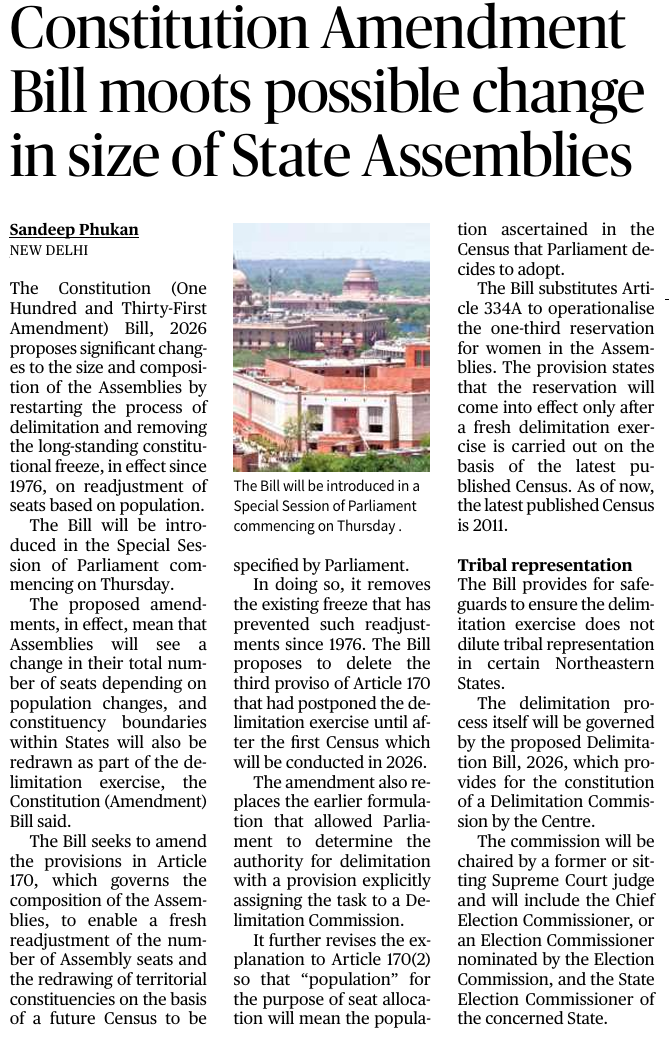 Constitution Amendment Bill moots possible change in size of State Assemblies
GS Paper II:
Parliament and State Legislatures – structure, functioning
Representation of People Act & electoral reforms
Federalism and Centre–State relations
Women representation in legislatures
Context
The Constitution (One Hundred and Thirty-First Amendment) Bill, 2026 proposes restarting the delimitation process and removing the freeze on readjustment of Assembly seats (since 1976). It also links delimitation with the implementation of women’s reservation in State Assemblies.
Prelims concepts
1. Constitutional Provisions & Amendments
The Bill targets specific Articles that govern the structure of Indian democracy:
Article 170: This article governs the composition of Legislative Assemblies (Vidhan Sabhas). It stipulates that the number of seats and their territorial division must be based on the population from the last preceding census.
The 1976 Freeze: The 42nd Amendment Act of 1976 froze the seat allocation based on the 1971 Census to encourage family planning. This freeze was later extended by the 84th Amendment (2001) until the first census after 2026.
Article 334A: A newly substituted article to operationalize one-third (33%) reservation for women in State Assemblies. Note that this is contingent upon the completion of the delimitation exercise.
2. Delimitation: Process and Commission
Delimitation is the act of redrawing boundaries of Lok Sabha and Assembly seats to represent changes in population.
The Delimitation Commission: A high-power body whose orders have the force of law and cannot be challenged in any court.
Composition (as per the Bill):
Chairperson: A retired or sitting Supreme Court Judge.
Ex-officio Members: The Chief Election Commissioner (or an Election Commissioner nominated by the EC) and the State Election Commissioner of the concerned state.
The Trigger: The exercise will be based on the data from the "latest published Census" (slated for 2026).
3. Key Policy Shifts
The 2026 Bill introduces several critical changes to the status quo:
Feature
Existing Provision
Proposed Change (2026 Bill)
Seat Re-adjustment
Frozen since 1976 (based on 1971 Census).
Freeze removed; seats to be adjusted based on the 2026 Census.
Authority
Vague "authority as Parliament may determine."
Explicitly assigns the task to a Delimitation Commission.
Women's Reservation
Passed in principle but not yet operational.
Tied directly to the completion of the post-2026 delimitation.
Tribal Safeguards
General representation rules.
Specific safeguards to ensure no dilution of tribal representation in Northeastern States.
4. Definitions & Terms to Know
"Population": For the purpose of seat allocation, it now specifically refers to the population ascertained in the Census that Parliament decides to adopt (moving away from the 1971 benchmark).
UPSC MCQ
Q. With reference to the Constitution (One Hundred and Thirty-First Amendment) Bill, 2026, consider the following statements:
The Bill proposes to remove the freeze on readjustment of seats in State Legislative Assemblies that has been in place since 1976.
The delimitation exercise under the Bill will be conducted on the basis of the latest Census to be published after 2026.
The Bill mandates immediate implementation of one-third reservation for women in State Assemblies irrespective of delimitation.
Which of the statements given above is/are correct?
(a) 1 and 2 only
(b) 2 and 3 only
(c) 1 and 3 only
(d) 1, 2 and 3
✅ Correct Answer: (a) 1 and 2 only
🔍 Explanation:
Statement 1 – Correct: The Bill removes the constitutional freeze (since 1976) on seat readjustment.
Statement 2 – Correct: Delimitation will be based on the latest Census after 2026.
Statement 3 – Incorrect: Women’s reservation will not be immediate; it will be implemented only after delimitation.
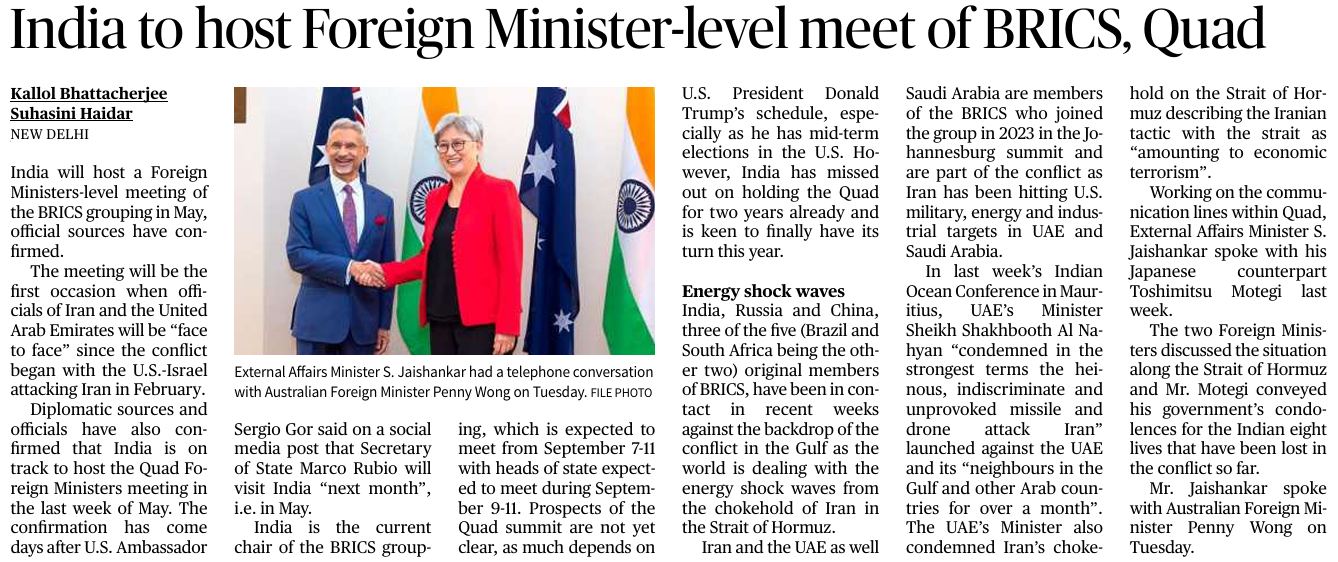 India to host Foreign Minister-level meet of BRICS, Quad
GS Paper II:
International relations
Bilateral, regional and global groupings (BRICS, Quad)
India and its neighbourhood & global diplomacy
Context
India is set to host Foreign Ministers-level meetings of BRICS and the Quad in May, marking a significant diplomatic moment amid:
West Asia tensions (Iran–Israel conflict)
Global energy insecurity
India’s effort to balance relations across competing geopolitical blocs
Prelims concepts
1. International Groupings: BRICS & Quad
BRICS (Brazil, Russia, India, China, South Africa +)
India's Role: India is the current chair of the BRICS grouping for 2026.
Expansion Context: The article references the 2023 Johannesburg Summit, where the group expanded to include members like Iran, UAE, and Saudi Arabia.
Diplomatic Significance: The upcoming May meeting in India will be the first time officials from Iran and the UAE meet "face to face" since the outbreak of regional conflict in February.
The Quad (Quadrilateral Security Dialogue)
Members: India, United States, Japan, and Australia.
Strategic Meet: India is scheduled to host the Quad Foreign Ministers meeting in the last week of May.
Key Personnel: The article mentions interaction between S. Jaishankar (India), Marco Rubio (U.S. Secretary of State), Penny Wong (Australia), and Toshimitsu Motegi (Japan).
2. Strategic Geography: The Strait of Hormuz
The conflict in the Gulf has placed a spotlight on this critical maritime chokepoint.
Geographic Importance: It connects the Persian Gulf with the Gulf of Oman and the Arabian Sea.
Economic Impact: It is the world's most important oil transit chokepoint; any disruption causes "energy shock waves" globally.
Security Concerns: The text highlights Iran’s "chokehold" on the Strait, which the UAE has described as "economic terrorism."
3. Key Conferences and Locations
Indian Ocean Conference (IOC): Recently held in Mauritius. This is a key forum for maritime cooperation among littoral states in the Indian Ocean Region (IOR).
Venue for Quad Summit: While Foreign Ministers meet in May, the potential Heads of State summit is eyed for September 7-11, depending on international political schedules (e.g., U.S. mid-term elections).
UPSC MCQ
Q. With reference to BRICS and Quad, consider the following statements:
BRICS currently includes both Iran and the United Arab Emirates as its members.
The Quad is a formal military alliance with a mutual defence treaty among its members.
India has not hosted a Quad Foreign Ministers’ meeting for the past few years prior to the proposed meeting in 2026.
Which of the statements given above is/are correct?
(a) 1 and 3 only
(b) 2 and 3 only
(c) 1 only
(d) 1, 2 and 3
✅ Correct Answer: (a) 1 and 3 only
🔍 Explanation
Statement 1 – Correct: Both Iran and UAE joined BRICS in 2023 (Johannesburg Summit).
Statement 2 – Incorrect: Quad is not a military alliance; it is an informal strategic grouping without a defence pact.
Statement 3 – Correct: India has not hosted a Quad Foreign Ministers’ meet for some years, and is now set to host one.
 West Asia war threatens to push 2.5 mn into poverty: UNDP
GS Paper II:
International relations – West Asia
Effect of policies of developed/developing countries on India
GS Paper III:
Inclusive growth and poverty
Economy – external shocks (energy, inflation)
Human development (HDI)
Context
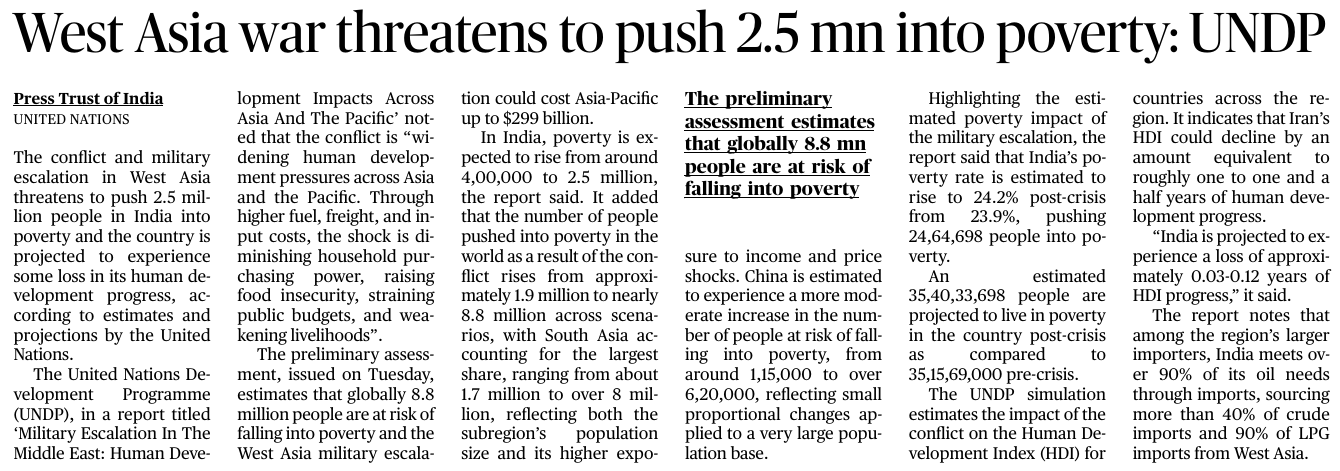
A UNDP report warns that the ongoing West Asia conflict could push 2.5 million people in India into poverty, while 8.8 million globally are at risk. The crisis is expected to affect energy prices, inflation, and human development outcomes, especially in import-dependent economies like India.
1. UNDP and the Human Development Index (HDI)
The UNDP is the lead agency for the UN’s global development network.
Human Development Index (HDI): A composite index measuring average achievement in three basic dimensions:
Long and healthy life (Life expectancy at birth).
Knowledge (Expected years of schooling and Mean years of schooling).
Decent standard of living (GNI per capita based on Purchasing Power Parity).
Conflict Impact: The report notes that India is projected to lose approximately 0.03-0.12 years of HDI progress. For comparison, Iran could see a decline equivalent to 1.5 years of progress.
2. Poverty Estimation and Projections
The report highlights how external shocks translate into domestic poverty.
Poverty Spike: In India, the number of people in poverty is expected to rise from 4 lakh to 2.5 million (specifically reaching ~24.64 lakh people).
Poverty Rate: India's poverty rate is estimated to rise from 23.9% to 24.2% post-crisis.
Global Context: Globally, 8.8 million people are at risk of falling into poverty, with South Asia accounting for the largest share (up to 8 million) due to its large population base and exposure to price shocks.
3. Economic Transmission Channels
The article identifies how a war in West Asia affects the Indian economy through "Imported Inflation" and supply chain disruptions:
Fuel & Freight: Higher energy prices and shipping costs diminish household purchasing power.
Food Insecurity: Rising input costs (like fertilizers or fuel for transport) strain public budgets and raise food prices.
Energy Dependence: India is highly vulnerable because it:
Meets over 90% of its oil needs through imports.
Sources more than 40% of crude imports from West Asia.
Sources 90% of LPG imports from West Asia.
UPSC MCQ
Q. With reference to the economic impact of the West Asia conflict, consider the following statements:
The conflict is expected to increase poverty in India primarily due to rising fuel prices and inflationary pressures.
India imports more than 90% of its crude oil requirements, making it highly vulnerable to West Asia instability.
The UNDP report estimates that globally less than 5 million people are at risk of falling into poverty due to the conflict.
Which of the statements given above is/are correct?
(a) 1 and 2 only
(b) 2 and 3 only
(c) 1 only
(d) 1, 2 and 3
✅ Correct Answer: (a) 1 and 2 only
🔍 Explanation
Statement 1 – Correct:
Conflict → fuel price rise → inflation → reduced purchasing power → increased poverty.
Statement 2 – Correct:
India imports:
~90% crude oil
>40% total imports
~90% LPG from West Asia
→ High vulnerability
Statement 3 – Incorrect:
UNDP estimates 8.8 million globally at risk, not less than 5 million.




 Launch your Graphy