The Hindu Analysis April 10th
The Hindu News Analysis – 10th April, 2026
1. Have elections in India become plutocratic? (GS-2)
2. Nari Shakti, India’s defining reform for the next decade
(GS-2)
3. West Asia war cuts India’s growth outlook to 6.6% (GS-3)
4. Follow rituals and observances of a temple or stay out, says SC Bench hearing Sabarimala case (GS-2)
5. Retired personnel and families protest as government notifies CAPF law (GS-3)
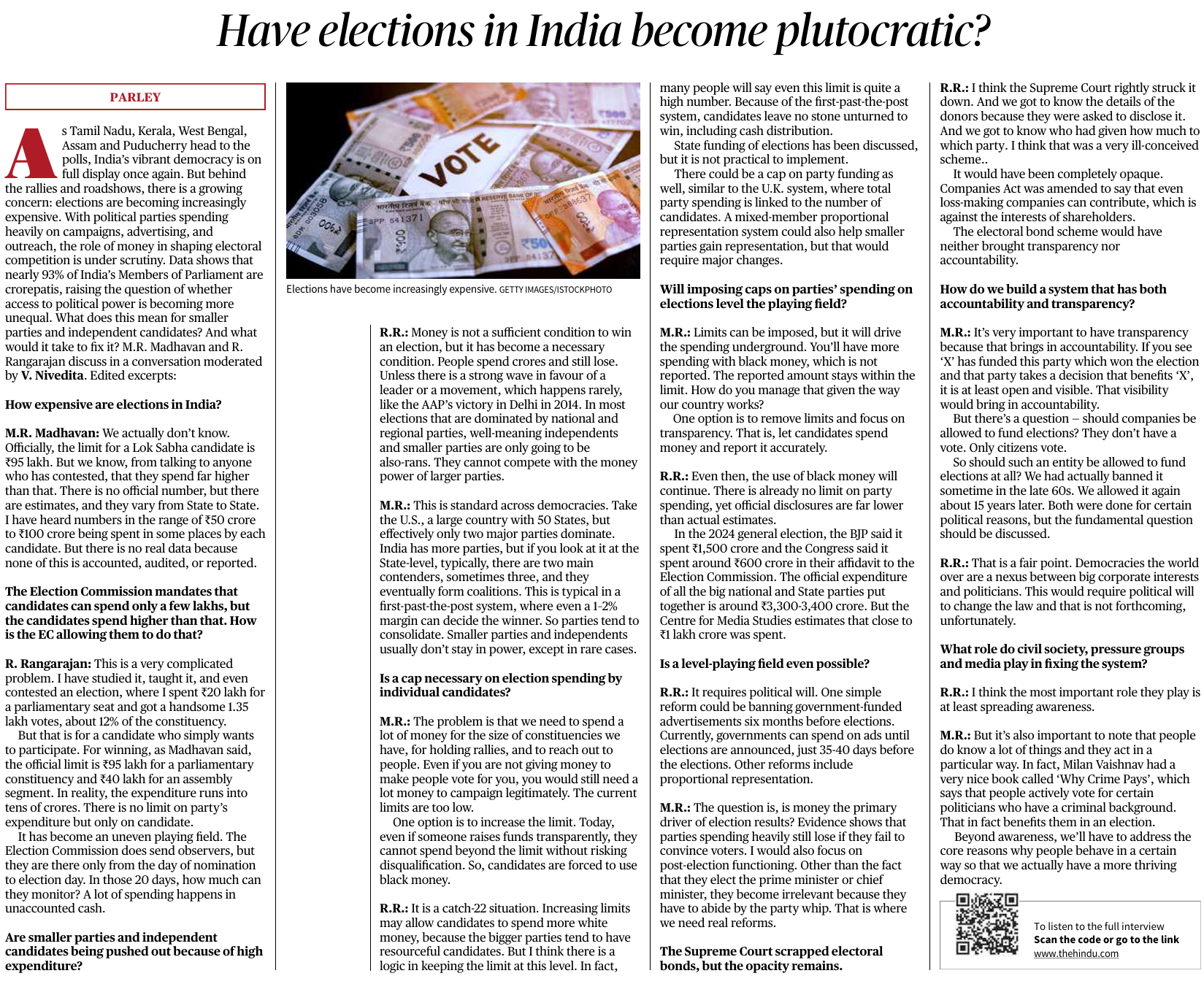
Have elections in India become plutocratic?
GS Paper II:
Election process and electoral reforms
Role of Election Commission
Transparency and accountability
Context
The article (Parley discussion) examines whether Indian elections are increasingly dominated by money power, making them tilt towards plutocracy (rule by the wealthy). It highlights the rising cost of elections, opacity in political funding, and structural issues in the electoral system.
Detailed Analysis
Arguments FOR: Elections becoming plutocratic
1. Escalating Election Expenditure
Official limits (₹95 lakh for Lok Sabha) are grossly unrealistic
Ground reports suggest ₹50–100 crore per candidate in some cases
Absence of audited data → indicates systemic underreporting
➡️ Elections becoming capital-intensive contests
2. Uneven Playing Field
Wealthier parties dominate:
Advertising
Campaign logistics
Voter outreach
Smaller parties and independents:
Unable to match financial muscle
Reduced electoral competitiveness
➡️ Leads to exclusion of grassroots voices
3. Black Money & Informal Spending
Significant campaign financing occurs via:
Cash distribution
Unaccounted expenditure
Monitoring is weak beyond official campaign window
➡️ Encourages parallel economy in politics
4. Opaque Political Funding
Corporate donations lack adequate transparency
Electoral bonds (now scrapped) enabled:
Anonymous donations
Potential quid pro quo politics
5. Electoral System Incentives
First-Past-The-Post (FPTP):
Small vote swings determine outcomes
Encourages excessive spending to influence marginal voters
Arguments AGAINST: Elections not fully plutocratic
1. Money is Not Sufficient
Electoral outcomes still influenced by:
Political narratives
Leadership charisma
Social coalitions
Example: Low-resource parties winning during strong political waves
2. Voter Autonomy
Indian voters:
Often resist direct vote-buying
Vote based on welfare, identity, governance
3. Institutional Checks Exist
Election Commission:
Sets spending limits
Monitors campaign expenditure
Judiciary has intervened (e.g., scrapping electoral bonds)
4. Multi-Party Democracy
Presence of multiple parties prevents complete domination by wealthy elites
Regional parties often emerge despite financial disadvantages
Key Analytical Insights
1. “Necessary but Not Sufficient” Role of Money
Money has become a threshold condition:
Without it → cannot compete
With it → not guaranteed victory
2. Structural vs Behavioural Issue
Problem is not just corruption but:
System design (FPTP, large constituencies)
Campaign style (mass outreach costs)
3. Transparency vs Regulation Debate
Two competing approaches:
Caps on spending → may push money underground
Transparency-first approach → allow spending but ensure disclosure
4. Corporate Funding Dilemma
Key question:
Should non-voting entities (companies) fund elections?
Raises concerns of:
Policy capture
Shareholder interest violation
Challenges
Unrealistic expenditure ceilings
Weak enforcement and monitoring
Lack of transparency in funding
Corporate-political nexus
Marginalisation of smaller actors
Prevalence of black money
Way Forward
1. Radical Transparency
Mandatory disclosure of:
Donors
Party-wise funding
Real-time digital tracking
2. Reform Spending Framework
Increase realistic limits
Include party expenditure caps
3. Strengthen Election Commission
Extend monitoring beyond campaign period
Use data analytics and AI tools
4. Debate State Funding
Partial state funding to:
Reduce private dependence
Level playing field
5. Electoral System Reforms (Long-term)
Consider proportional representation elements
Reduce excessive dependence on money for marginal gains
6. Civic Awareness & Behavioural Change
Voter awareness against vote-buying
Role of media and civil society
Conclusion
Indian elections are not fully plutocratic yet, but the growing centrality of money poses a serious challenge to democratic fairness. The real issue lies in systemic distortions and lack of transparency, not merely the presence of money. Ensuring accountability, transparency, and level playing field will determine whether India sustains its democratic ethos or drifts towards plutocracy.
Mains Question
Q. Examine how campaign finance and electoral funding mechanisms affect the level playing field in Indian democracy. Suggest reforms. (250 words)
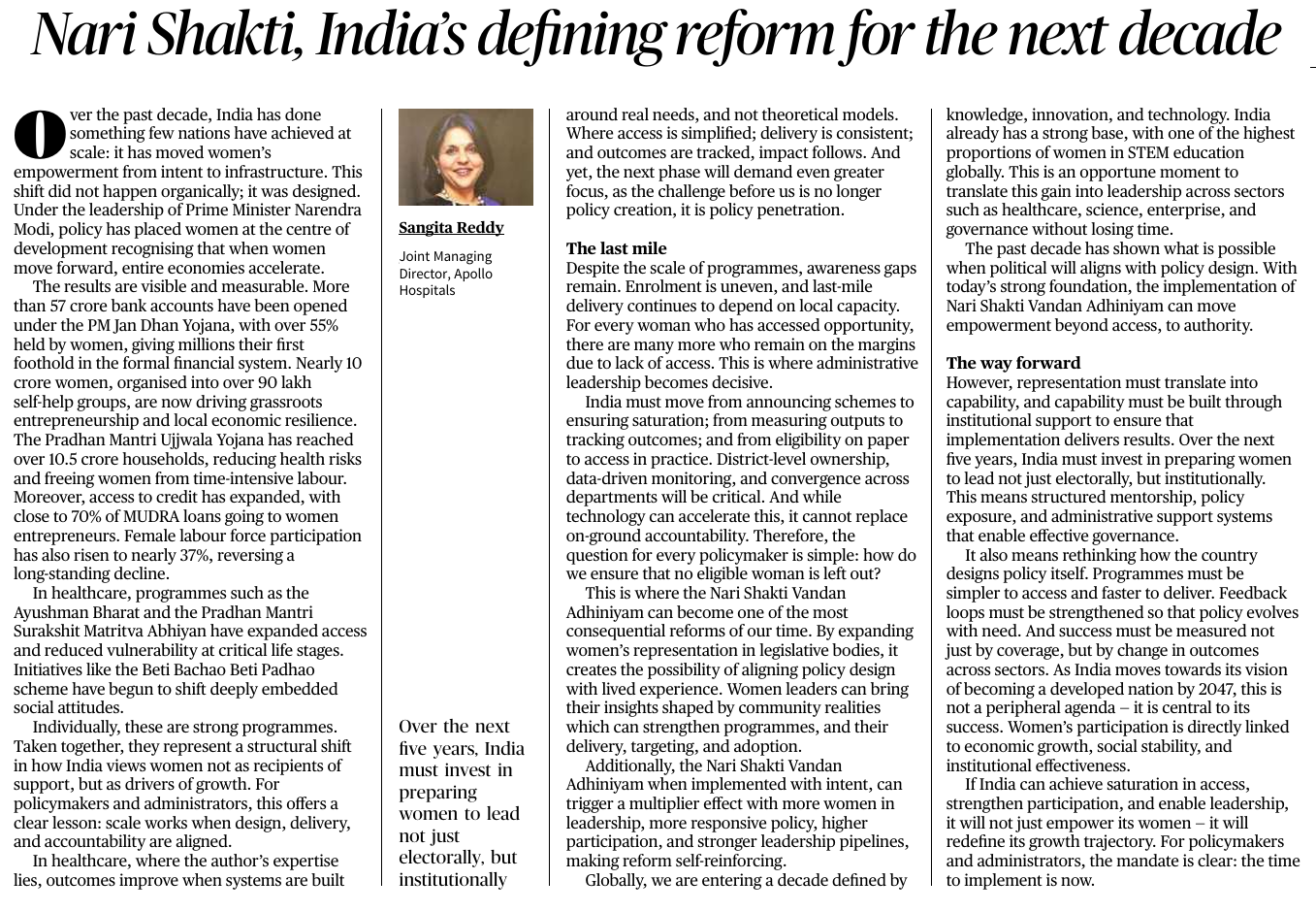 Nari Shakti, India’s defining reform for the next decade
GS Paper II:
Role of women and women’s organisations
Government policies and interventions for development
Issues relating to development and management of social sector
Context
The article highlights India’s transition from intent-based women empowerment to institutionalised empowerment, emphasizing that the next phase of reform must focus on policy penetration and leadership representation, especially through initiatives like the Nari Shakti Vandan Adhiniyam (Women’s Reservation Act).
Detailed Analysis
1. Shift from Intent to Infrastructure
Over the last decade, India has moved beyond symbolic empowerment to systemic inclusion of women.
Key achievements:
Financial inclusion: Over 55% of Jan Dhan accounts held by women
Self-help groups (SHGs): Massive grassroots mobilisation
Ujjwala Yojana: Reduced drudgery and health risks
MUDRA loans: ~70% to women entrepreneurs
This marks a structural shift—women as drivers of growth, not just beneficiaries.
2. Sectoral Gains and Social Transformation
Healthcare: Ayushman Bharat, PM Matru Vandana Yojana improved maternal health access
Social change: Beti Bachao Beti Padhao influencing gender norms
Labour force participation: Rising after long stagnation
➡️ These indicate multi-dimensional empowerment—economic, social, and health-related.
3. The Core Challenge: Policy Penetration (Last Mile Problem)
Despite scale, gaps remain:
Uneven awareness
Weak last-mile delivery
Dependence on local administrative capacity
Shift required:
From scheme announcement → scheme saturation
From output measurement → outcome tracking
From paper eligibility → real access
➡️ Governance challenge is now implementation quality, not policy design.
4. Role of Nari Shakti Vandan Adhiniyam
Enhances women’s representation in legislatures
Expected outcomes:
Better alignment of policies with ground realities
Increased participation and leadership pipelines
Creation of a multiplier effect in governance
➡️ Moves empowerment from access → authority
5. Importance of Leadership and Institutional Capacity
Representation alone is insufficient without:
Capacity building
Mentorship and training
Administrative support systems
Emphasis on preparing women to lead:
Not just electorally
But institutionally and administratively
6. Global and Future Context
India has a strong base:
High proportion of women in STEM education
Opportunity:
Translate education into leadership in governance, enterprise, and science
Aligns with India’s Viksit Bharat 2047 vision
Challenges
Persistent last-mile delivery gaps
Social and cultural barriers limiting participation
Lack of institutional support systems
Risk of token representation without real authority
Data gaps in tracking outcomes vs outputs
Significance
Women’s empowerment directly impacts:
Economic growth
Social stability
Governance effectiveness
Marks a transition to inclusive and sustainable development
Positions women as central to India’s development trajectory
Way Forward
Ensure scheme saturation through local-level accountability
Strengthen data-driven governance and monitoring
Build institutional capacity for women leaders
Simplify policy design for ease of access
Establish feedback loops for adaptive policymaking
Focus on outcome-based evaluation across sectors
Conclusion
India stands at a critical juncture where women-led development can redefine its growth model. The success of reforms like the Nari Shakti Vandan Adhiniyam will depend not just on representation, but on effective implementation, institutional support, and leadership development. The coming decade could thus become India’s defining era of gender-inclusive transformation.
Mains Question
Q. “India’s next phase of women empowerment lies not in policy creation but in effective policy penetration and leadership representation.” Discuss in the context of recent initiatives like the Nari Shakti Vandan Adhiniyam. (250 words)
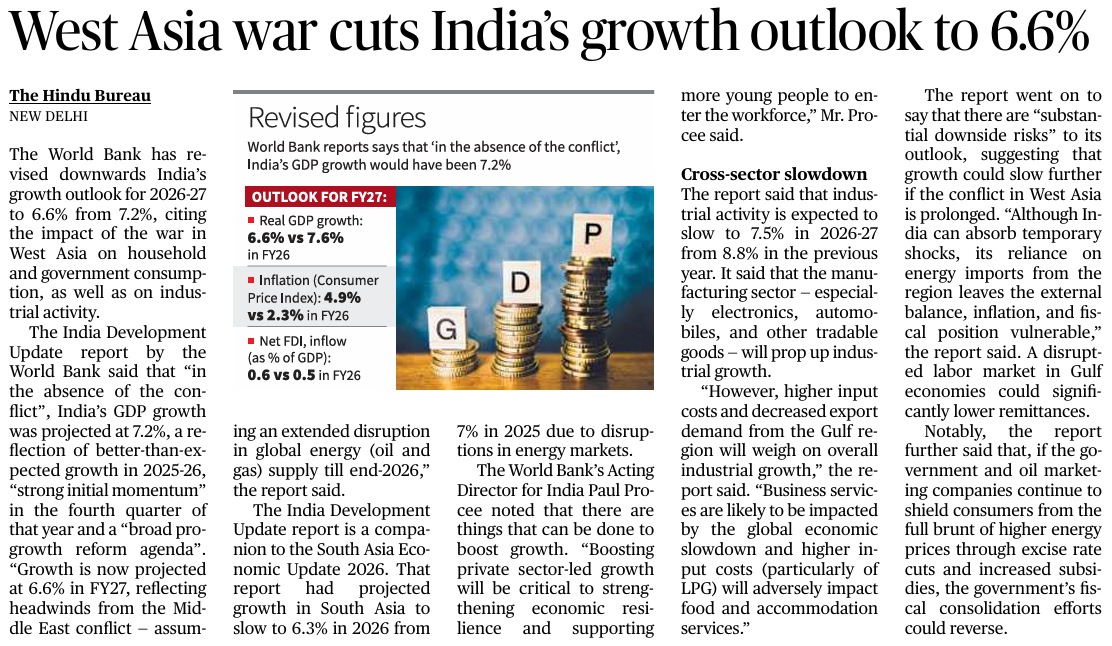 West Asia war cuts India’s growth outlook to 6.6%
GS Paper III:
Indian Economy and growth
External sector and vulnerabilities
Inflation and macroeconomic stability
Globalisation and its impact on India
Context
The World Bank’s India Development Update has revised India’s GDP growth forecast for FY27 to 6.6% (from 7.2%), attributing the slowdown primarily to the West Asia conflict, which is affecting energy prices, trade flows, and overall economic stability.
Growth Indicators & National Income
Real GDP Growth: This refers to the inflation-adjusted measure of the value of all goods and services produced by an economy in a financial year. The article mentions a revision from 7.2% to 6.6%.
UPSC Pointer: Know the difference between Real GDP (constant prices) and Nominal GDP (current prices). Real GDP is calculated using a Base Year (currently 2011-12).
Household & Government Consumption: These are two of the four components of GDP calculated via the Expenditure Method:
GDP = C + I + G + (X - M)
Where $C$ is Private Final Consumption Expenditure and $G$ is Government Final Consumption Expenditure.
External Sector & Investment
Foreign Direct Investment (FDI): Mentioned as a percentage of GDP (0.6%).
UPSC Pointer: FDI involves a long-term interest and usually implies a management stake (10% or more in a listed company). Contrast this with FPI (Foreign Portfolio Investment), which is "hot money" and more volatile.
Remittances: The article warns that a disrupted labor market in the Gulf could lower remittances.
UPSC Pointer: India is the world’s largest recipient of remittances. These are recorded in the Current Account (under Private Transfers) of the Balance of Payments (BoP).
External Balance: Refers to the sustainability of the Current Account Deficit (CAD) and Trade Balance, especially sensitive to energy (oil/gas) import bills.
Global Institutions
World Bank: The source of the "India Development Update" and "South Asia Eco Update."
UPSC Pointer: Unlike the IMF (which focuses on short-term BoP crises and financial stability), the World Bank focuses on long-term reconstruction and development.
Reports by World Bank: World Development Report, Global Economic Prospects, and Ease of Doing Business (now discontinued/replaced).
UPSC MCQ
Q. Consider the following statements regarding the impact of the West Asia conflict on India’s economy:
The World Bank revised India’s GDP growth for FY27 downward primarily due to disruptions in energy markets and global trade.
A decline in remittances from the Gulf region can adversely affect domestic consumption in India.
Which of the statements given above is/are correct?
A) 1 only
B) 2 only
C) Both 1 and 2
D) Neither 1 nor 2
Answer: C) Both 1 and 2
Explanation:
Statement 1: Correct – Growth downgraded due to energy shocks and global slowdown.
Statement 2: Correct – Gulf disruptions reduce remittances, impacting consumption.
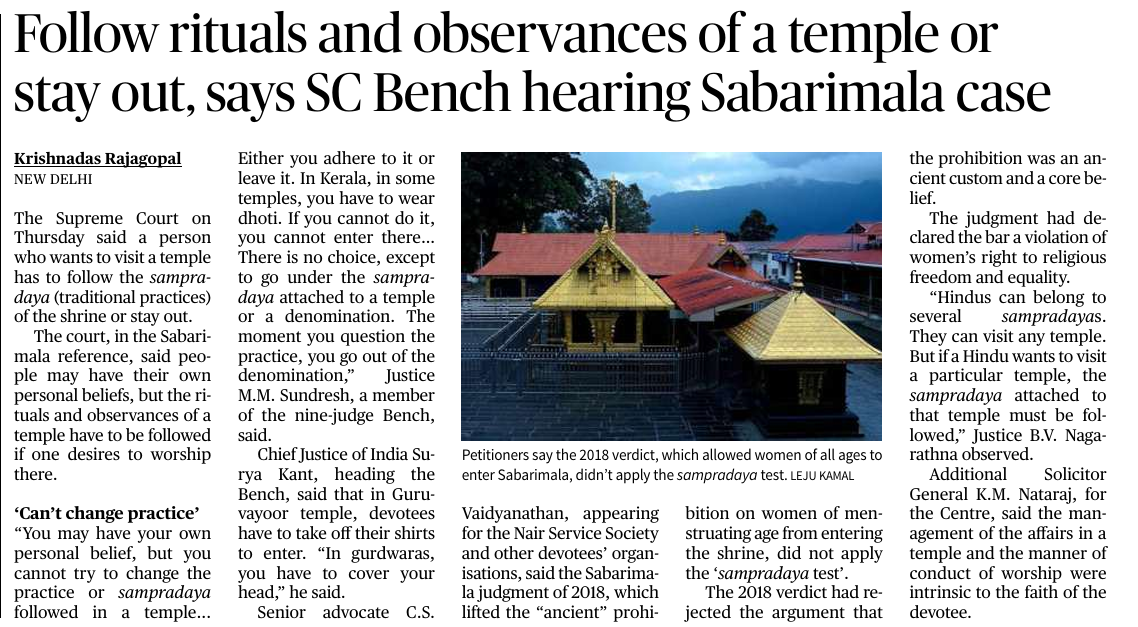
Follow rituals and observances of a temple or stay out, says SC Bench hearing Sabarimala case
GS Paper II:
Fundamental Rights
Judiciary and constitutional interpretation
Freedom of religion vs equality debate
Context
The Supreme Court Constitution Bench, while hearing the Sabarimala case, observed that devotees must follow the religious practices (sampradaya) of a temple if they wish to worship there. This reopens the debate between individual rights and denominational autonomy.
1. Essential Religious Practices (ERP) Doctrine
While the article uses the term sampradaya (traditional practices), in Indian Constitutional law, this falls under the "Essential Religious Practices" doctrine.
The Concept: Developed by the Supreme Court (starting with the Shirur Mutt case in 1954), it dictates that only those practices which are "essential" or "integral" to a religion are protected under the Constitution.
UPSC Pointer: The court determines what is essential based on religious texts and long-standing customs. In the 2018 judgment, the court had initially ruled that the ban on women was not an essential practice.
2. Freedom of Religion (Articles 25–28)
The case revolves around the tension between individual rights and the rights of religious denominations.
Article 25: Guarantees freedom of conscience and the right to freely profess, practice, and propagate religion to individuals. It is subject to public order, morality, and health.
Article 26: Gives religious denominations the right to manage their own affairs in matters of religion.
Article Snippet: The Bench suggests that if a person wants to worship at a specific shrine, they must follow that shrine's sampradaya.
3. The 9-Judge Bench (Review & Reference)
The article mentions a nine-judge Bench headed by the Chief Justice.
Larger Bench Reference: Usually, if a smaller Bench (like the 5-judge Bench in 2018) feels a case involves a "substantial question of law" regarding the interpretation of the Constitution, it can be referred to a larger Bench.
UPSC Pointer: Under Article 145, the minimum number of judges for cases involving constitutional interpretation is five (a Constitution Bench).
4. Right to Equality vs. Religious Freedom
The article highlights the clash between:
Article 14 (Equality) and Article 15 (Non-discrimination): Used in the 2018 verdict to allow women of all ages to enter.
Article 26 (Denominational Rights): Used by the temple board to argue that their specific traditions (excluding women of a certain age) should be protected as a unique "sectarian" practice.
UPSC MCQ
Q. Consider the following statements:
Article 26 of the Constitution grants religious denominations the right to manage their own affairs in matters of religion.
The Supreme Court has consistently held that all religious practices are immune from judicial review under the Essential Religious Practices doctrine.
Which of the statements given above is/are correct?
A) 1 only
B) 2 only
C) Both 1 and 2
D) Neither 1 nor 2
Answer: A) 1 only
Explanation:
Statement 1: Correct – Article 26 protects denominational autonomy.
Statement 2: Incorrect – Only essential religious practices are protected; courts can review non-essential practices.
Retired personnel and families protest as government notifies CAPF law
GS Paper III:
Internal security
Role and management of security forces
Context
The government has notified the CAPF (General Administration) Act, 2026, triggering protests by retired CAPF personnel and their families. The opposition centres around service conditions, promotions, and deputation of IPS officers into senior positions.
Prelims concepts
1. Central Armed Police Forces (CAPFs)
The CAPFs are uniformed nomenclature for seven central security forces in India under the authority of the Ministry of Home Affairs (MHA).
The Seven Forces: BSF, CRPF, CISF, ITBP, SSB, NSG, and AR (Assam Rifles).
Nodal Ministry: Unlike the Indian Armed Forces (Army, Navy, Air Force) which fall under the Ministry of Defence, CAPFs report to the Home Ministry.
Role: They are responsible for internal security, border guarding (BSF, ITBP, SSB), and assisting states in maintaining law and order.
2. Legislative Process & Presidential Assent
The article mentions the Bill was passed by Parliament and received the President's Assent.
Article 111: Deals with the President's power to give assent to Bills passed by Parliament. The President can:
Give assent (Bill becomes an Act).
Withhold assent.
Return the Bill (if not a Money Bill) for reconsideration.
Notification: Once a Bill receives assent, it is notified in the Gazette of India, which is the official public record.
3. Personnel Management: Deputation vs. Cadre
A central conflict in the article is the reservation of top-tier posts for IPS officers on deputation versus Organised Group 'A' Service (OGAS) officers.
Deputation: A process where an officer from one service (like IPS) is temporarily assigned to another department or force (like CRPF).
Cadre Officers: These are officers recruited directly into the specific force (e.g., joining as Assistant Commandant in BSF).
The Conflict: Direct-entry CAPF officers have long litigated for "Non-Functional Financial Upgradation" (NFFU) and OGAS status to ensure better career progression, similar to other civil services.





 Launch your Graphy