The Hindu Analysis 9th June 2026 for UPSC, APPSC & TSPSC Exams
The Hindu News Analysis – 9th June, 2026
1. What is lost and gained in NFHS-6 (GS-2, GS-3)
2. India expanded its nuclear arsenal in 2025, says SIPRI (GS-2, GS-3)
3. President presents gallantry awards to security personnel
(GS-2, GS-3)
4. Zojila Tunnel between Kashmir and Kargil to see final breakthrough
(GS-1, GS-3)
5. Xi and Kim express hopes for greater ties between China and North Korea (GS-2)
 What is lost and gained in NFHS-6
GS Paper II
Issues relating to development and management of Social Sector/Services relating to Health
Welfare schemes for vulnerable sections of the population
Government policies and interventions for development
GS Paper III
Human Resource Development
Inclusive Growth and issues arising from it
Context
The preliminary fact sheets of the
National Family Health Survey (NFHS)-6 (2023–24) indicate improvements in child nutrition, maternal healthcare, institutional deliveries, and women's internet usage. However, the latest round has reduced the number of indicators reported in the preliminary release, omitting several important health and demographic metrics that were available in NFHS-5.
Detailed Analysis
Significance of NFHS-6 Findings
1. Improvement in Maternal and Child Health
Mothers receiving at least four antenatal check-ups increased significantly.
Institutional deliveries continued to rise, indicating better access to healthcare facilities.
Child nutrition indicators showed improvement compared to previous rounds.
2. Digital Inclusion of Women
Women's internet usage registered notable growth.
Reflects expanding digital access and potential benefits from digital governance initiatives.
3. Introduction of New Governance Indicators
NFHS-6 added questions relating to:
Digital literacy
Direct Benefit Transfers (DBTs)
Self-help group (SHG) membership
Financial transactions and inclusion
These indicators help assess the effectiveness of welfare delivery mechanisms.
4. Enhanced Biomarker-Based Assessment
Nutrition indicators are now linked with dedicated biomarker surveys.
Data on obesity and nutrient deficiencies are being collected through improved scientific methods.
Challenges and Concerns
1. Removal of Key Indicators
Several critical indicators present in NFHS-5 are absent from the preliminary fact sheet:
Anaemia prevalence
Infant and child mortality
Sex ratio at birth
Sanitation coverage
Clean cooking fuel usage
Cancer screening indicators
This reduces the comprehensiveness of early-stage analysis.
2. Anaemia Data Exclusion
Anaemia remains a major public health concern.
NFHS-5 showed widespread prevalence across women and children.
Its omission from preliminary results limits assessment of nutrition programmes such as:
Poshan Abhiyaan
Anaemia Mukt Bharat
3. Loss of District-Level Insights
Certain indicators are no longer available at district level, affecting:
Localized policy planning
Targeted interventions
Monitoring of regional disparities
4. Reduced Comparability
Removal of long-running indicators disrupts trend analysis.
Researchers and policymakers may find it difficult to compare progress across survey rounds.
5. Delay in Access to Critical Health Data
Some indicators are being shifted to separate surveys and reports.
Fragmentation may delay policy responses and reduce ease of data utilization.
What Changes Were Made?
Indicators Added
Digital literacy
Direct Benefit Transfer access
Self-help group participation
Financial inclusion indicators
Hepatitis B and Hepatitis C testing
Expanded nutrition and biomarker measurements
Indicators Removed from Preliminary Release
Anaemia
Infant mortality
Child mortality
Sex ratio at birth
Sanitation coverage
Clean cooking fuel use
Cancer screening indicators
Methodological Changes
Greater emphasis on biomarker-based measurement.
Certain health indicators are being tracked separately through dedicated surveys.
Comparison: NFHS-5 vs NFHS-6
Aspect
NFHS-5
NFHS-6
Total indicators in preliminary release
131
101
Digital literacy
Not included
Included
DBT-related questions
Limited
Expanded
Anaemia data
Included
Excluded from preliminary release
Cancer screening
Included
Excluded
Sex ratio at birth
Included
Excluded
Biomarker focus
Limited
Expanded
Women's internet use
Lower
Higher
Way Forward
1. Restore Core Health Indicators
Critical indicators such as anaemia, mortality rates, and sex ratio at birth should continue to be reported prominently in preliminary releases.
2. Ensure Data Continuity
Maintaining long-term indicators is essential for tracking developmental trends and evaluating policy effectiveness.
3. Strengthen District-Level Reporting
Granular data should remain available to support decentralized planning and evidence-based governance.
4. Integrate New and Traditional Indicators
Digital inclusion and financial access indicators should complement—not replace—core health and demographic metrics.
5. Improve Transparency
Clear explanations for methodological changes and indicator removal should be provided to enhance credibility and public trust.
Conclusion
NFHS-6 reflects encouraging progress in maternal healthcare, child nutrition, institutional deliveries, and women's digital empowerment. However, the exclusion of several foundational health and demographic indicators from the preliminary fact sheets raises concerns about the survey's ability to provide a comprehensive snapshot of India's social development. A balanced approach that incorporates both emerging governance indicators and traditional health metrics is essential for effective policy formulation and monitoring.
UPSC Mains Question
Q. The findings of the National Family Health Survey (NFHS) play a crucial role in shaping India's health and social sector policies. In the context of NFHS-6, examine the importance of such large-scale surveys for evidence-based governance and discuss the challenges arising from changes in survey coverage and indicators.
 India expanded its nuclear arsenal in 2025, says SIPRI
GS Paper III
Security Challenges and their Management
Defence Technology and Modernisation
Internal and External Security Linkages
GS Paper II
India and its Neighbourhood Relations
Bilateral, Regional and Global Groupings
Context
According to the
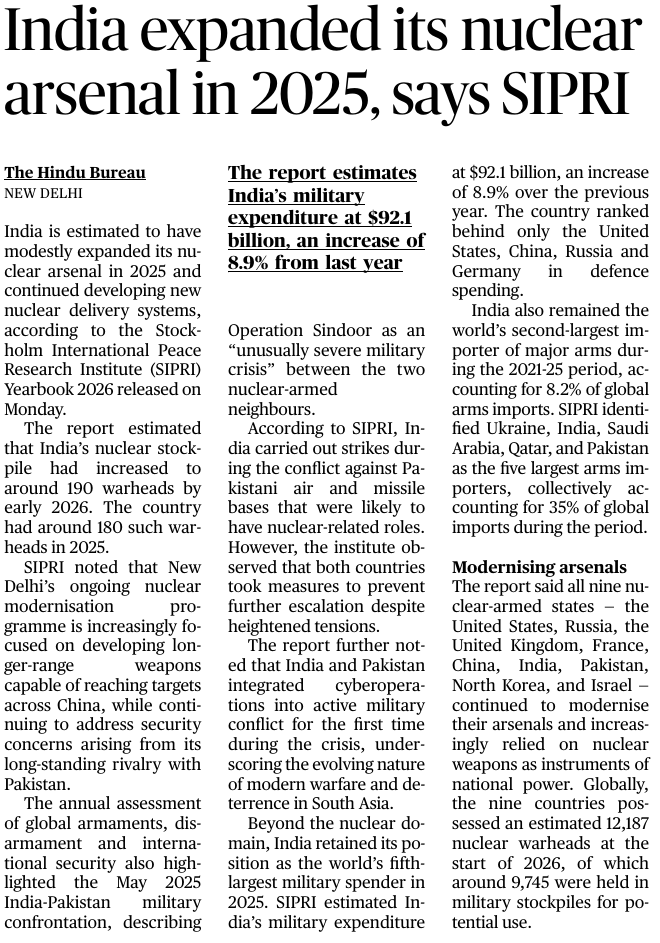
Stockholm International Peace Research Institute (SIPRI) Yearbook 2026, India modestly expanded its nuclear arsenal from about 180 warheads in 2025 to around 190 warheads in early 2026. The report also highlighted India's continuing modernization of nuclear delivery systems, rising defence expenditure, and evolving strategic competition in South Asia.
Prelims concepts
Stockolm International Peace Research Institute (SIPRI)
What it is: An international independent institute dedicated to research into conflict, armaments, arms control, and disarmament.
Key Publication: The SIPRI Yearbook, which provides an annual assessment of global armaments, disarmament, and international security.
2. India’s Nuclear Arsenal & Strategic Orientation
Warhead Count: India’s nuclear stockpile increased to around 190 warheads by early 2026 (up from around 180 in 2025).
Modernisation Focus: New Delhi’s nuclear modernisation programme is increasingly focused on developing longer-range weapons capable of reaching targets across China, while maintaining deterrence posture against Pakistan.
The Global Picture: India is among the nine nuclear-armed states (US, Russia, UK, France, China, India, Pakistan, North Korea, and Israel). Together, these countries possessed an estimated 12,187 nuclear warheads at the start of 2026.
3. Defense Economics & Military Spending
India's Global Rank: India retained its position as the world's fifth-largest military spender in 2025.
Spending Figures: India’s military expenditure stood at $92.1 billion (an 8.9% increase over the previous year).
Top Spenders Hierarchy: India ranks behind the United States, China, Russia, and Germany.
4. International Arms Trade Dynamics (2021-25)
Import Ranking: India remains the world's second-largest importer of major arms during the 2021–25 period.
Global Share: India accounted for 8.2% of global arms imports.
Top 5 Global Importers: Ukraine, India, Saudi Arabia, Qatar, and Pakistan (collectively accounting for 35% of global imports).
Prelims MCQ
Q. Consider the following statements regarding the findings of the SIPRI Yearbook 2026:
1. India's nuclear modernization programme is increasingly focused on developing longer-range weapons capable of reaching targets across China.
2. India remained the world's second-largest arms importer during the period 2021–25.
3. SIPRI reported that all nuclear-armed states continued to modernise their nuclear arsenals.
Which of the statements given above is/are correct?
A) 1 and 2 only
B) 2 and 3 only
C) 1 and 3 only
D) 1, 2 and 3
Answer: D) 1, 2 and 3
Explanation:
Statement 1: Correct. SIPRI noted India's growing emphasis on longer-range nuclear delivery systems.
Statement 2: Correct. India remained the second-largest arms importer globally during 2021–25.
Statement 3: Correct. SIPRI observed that all nine nuclear-armed states continued to modernise their nuclear arsenals.

President presents gallantry awards to security personnel
GS Paper II
Constitutional Offices
Role of the President of India
GS Paper III
Security Challenges and their Management
Role of Armed Forces, CAPFs and Police Forces in Internal Security
Context
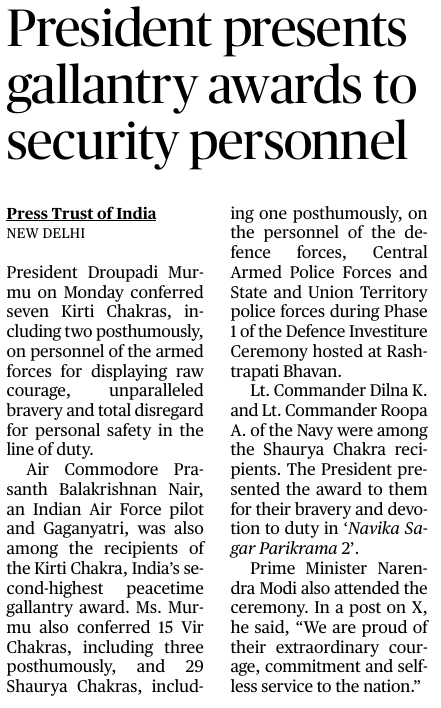
President Droupadi Murmu conferred gallantry awards on personnel of the Armed Forces, Central Armed Police Forces (CAPFs), and State/UT Police Forces during the Defence Investiture Ceremony at Rashtrapati Bhavan. The awards included 7 Kirti Chakras, 15 Vir Chakras, and 29 Shaurya Chakras, with several awards being conferred posthumously.
Prelims concepts
1. Gallantry Awards in India
Gallantry awards are instituted by the Government of India to honour acts of bravery and sacrifice of officers/personnel of the Armed Forces, other lawfully constituted forces, and civilians.
A. Peacetime Gallantry Awards
Unlike wartime awards (Param Vir Chakra, Maha Vir Chakra, Vir Chakra), these are awarded for conspicuous gallantry otherwise than in the face of the enemy.
Kirti Chakra: India’s second-highest peacetime gallantry award. (Ashoka Chakra is the highest; Shaurya Chakra is the third-highest).
Shaurya Chakra: Awarded for gallantry otherwise than in the face of the enemy.
B. Wartime Gallantry Awards
Vir Chakra: India's third-highest wartime gallantry award (preceded by Param Vir Chakra and Maha Vir Chakra), awarded for acts of gallantry in the presence of the enemy.
Prelims Note: Gallantry awards can be conferred posthumously (as highlighted by the multiple posthumous awards mentioned in the text). They are conferred by the President of India, who is the Supreme Commander of the Armed Forces.
2. Key Current Affairs & Personalities Mentioned
A. Gaganyaan Mission Connection
Air Commodore Prasanth Balakrishnan Nair: An Indian Air Force pilot and selected Gaganyatri (astronaut-designate for India's human spaceflight mission, Gaganyaan). He was a recipient of the Kirti Chakra.
B. Navika Sagar Parikrama 2
What it is: A significant maritime circumnavigation voyage by the Indian Navy.
Key Awardees: Lt. Commander Dilna K. and Lt. Commander Roopa A. were awarded the Shaurya Chakra for their bravery and devotion to duty during this expedition.
Prelims MCQ
Q. Consider the following statements regarding Gallantry Awards in India:
1. The Kirti Chakra is India's second-highest peacetime gallantry award.
2. The Shaurya Chakra is awarded only to personnel of the Armed Forces.
3. Gallantry awards such as the Kirti Chakra, Shaurya Chakra, and Vir Chakra can be awarded posthumously.
Which of the statements given above is/are correct?
A) 1 and 3 only
B) 2 only
C) 1 and 2 only
D) 1, 2 and 3
Answer: A) 1 and 3 only
Explanation:
Statement 1: Correct. Kirti Chakra is the second-highest peacetime gallantry award after the Ashoka Chakra.
Statement 2: Incorrect. The Shaurya Chakra can be awarded to personnel of the Armed Forces as well as members of Central Armed Police Forces, police forces, and civilians.
Statement 3: Correct. Gallantry awards may be conferred posthumously.
 Zojila Tunnel between Kashmir and Kargil to see final breakthrough
GS Paper III
Infrastructure
Border Area Development
Security Challenges and their Management
GS Paper I
Physical Geography of India
Himalayan Region
Context
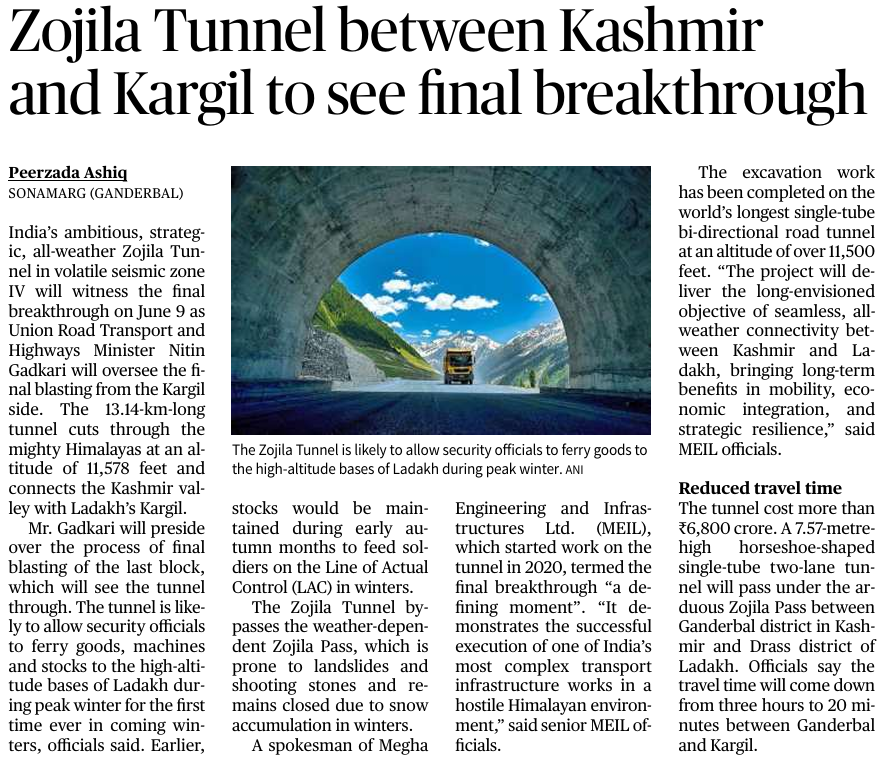
The 13.14-km Zojila Tunnel, being constructed beneath the Zojila Pass in the Himalayas, is set to achieve its final breakthrough. The project aims to provide all-weather connectivity between Kashmir and Ladakh, reducing travel time significantly and enhancing strategic, economic, and social integration.
Prelims points
1. Geographical & Location Features
Connectivity: The tunnel connects the Kashmir Valley (specifically Ganderbal district) with Ladakh (specifically Drass district / Kargil).
Mountain Pass Bypassed: It bypasses the treacherous Zojila Pass on National Highway 1 (NH 1), which is notoriously prone to heavy snowfall, avalanches, landslides, and shooting stones.
Altitude: Situated at an altitude of 11,578 feet (over 3,500 meters) in the Himalayan mountain range.
Seismic Zone: Located in Seismic Zone IV (a high-damage risk zone), making its engineering highly complex.
2. Salient Engineering & Technical Features
Global Record: It is the world’s longest single-tube, bi-directional road tunnel at an altitude of over 11,500 feet.
It is a 7.57-metre-high horseshoe-shaped single-tube, two-lane tunnel.
3. Socio-Economic & Strategic Significance
A. All-Weather Strategic Mobility
Winter Connectivity: Historically, the Zojila Pass remains closed for nearly six months during peak winter due to massive snow accumulation, completely cutting off Ladakh from the rest of India. The tunnel provides seamless, all-weather connectivity.
Defense Capabilities: It allows security forces to efficiently ferry essential goods, heavy machinery, and military stocks to high-altitude forward bases near the Line of Actual Control (LAC) during peak winter, eliminating the need to stockpile heavily during autumn.
B. Travel Logistics & Economic Integration
Travel Time Reduction: The travel time across the arduous pass will drop drastically from three hours to just 20 minutes between Ganderbal and Kargil.
Economic Boost: Ensures regular supply chains, round-the-year tourism, and economic integration for the Union Territory of Ladakh.
Prelims MCQ
Q. Consider the following statements regarding the Zojila Tunnel Project:
1. It is being constructed beneath the Zojila Pass to provide all-weather connectivity between Kashmir and Ladakh.
2. The tunnel will reduce travel time between Ganderbal and Kargil from about three hours to around twenty minutes.
3. The project is located in a region classified under Seismic Zone V.
Which of the statements given above is/are correct?
A) 1 and 2 only
B) 2 and 3 only
C) 1 and 3 only
D) 1, 2 and 3
Answer: A) 1 and 2 only
Explanation:
Statement 1: Correct. The Zojila Tunnel is designed to provide all-weather connectivity between Kashmir and Ladakh.
Statement 2: Correct. The tunnel is expected to reduce travel time from about 3 hours to 20 minutes.
Statement 3: Incorrect. The article states that the tunnel is being constructed in Seismic Zone IV, not Zone V.
Xi and Kim express hopes for greater ties between China and North Korea
GS Paper II
India and its Neighbourhood
Bilateral, Regional and Global Groupings
Effect of Policies and Politics of Developed and Developing Countries on India's Interests
Context
Chinese President Xi Jinping and North Korean leader Kim Jong-un reaffirmed their commitment to deepen bilateral cooperation during Xi's visit to Pyongyang. The development highlights the continuing strategic partnership between China and North Korea amid evolving geopolitical dynamics in East Asia.
Important points
Origins of China–North Korea Relations
Diplomatic relations were established in 1949.
China supported North Korea during the Korean War (1950–53).
The relationship is often described as being "as close as lips and teeth."
Treaty of Friendship
The Treaty of Friendship, Cooperation and Mutual Assistance (1961) remains the foundation of bilateral relations.
It contains provisions for mutual support in the event of external aggression.
Strategic Importance
North Korea serves as a strategic buffer between China and U.S.-allied South Korea.
China remains North Korea's largest trading partner and economic lifeline.
Implications for India
Security Dimension
Developments on the Korean Peninsula affect the broader Indo-Pacific security environment.
Strategic Partnerships
India maintains close relations with:
South Korea
Japan
United States
Changes in regional alignments may influence India's strategic calculations.
Global Governance
Stability in Northeast Asia remains important for global trade, supply chains, and international security.
Locations mentioned in news
Pyongyang: The capital and largest city of the Democratic People's Republic of Korea (North Korea), situated on the Taedong River.
Yalu and Tumen Rivers: (Static extension) The natural river borders that separate China from North Korea, critical for cross-border trade corridors.




 Launch your Graphy