There are no items in your cart
Add More
Add More
| Item Details | Price | ||
|---|---|---|---|





A watershed moment in India’s defence posture
GS Paper II
India and its neighbourhood relations
Bilateral relations and security challenges
Role of executive leadership in national security decision-making
GS Paper III
Security challenges and their management
Role of external state and non-state actors in creating internal security challenges
Defence technology, indigenisation of defence production
Various security forces and agencies and their mandate
Context
Operation Sindoor was launched by India on May 7, 2025, in response to the Pahalgam terror attack of April 22, 2025. The article argues that the operation marked a decisive doctrinal shift in India’s defence posture — from “reactive restraint” to a proactive and integrated national security strategy involving calibrated military retaliation, escalation control, and emphasis on indigenous defence capability.
Detailed Analysis
New Indian Doctrine
Shift from “Reactive Restraint” to “Zero Tolerance”
Historically, India often relied on diplomatic pressure and strategic restraint after terror attacks, especially against a nuclear-armed Pakistan. The article argues that Operation Sindoor marks a departure from this approach.
Key doctrinal shifts include:
Cross-border terrorism now treated as an “act of war”
Greater willingness to use calibrated military force
Rejection of nuclear blackmail as a deterrent against retaliation
Establishment of new strategic “red lines”
This reflects India’s attempt to strengthen deterrence credibility.
Political-Military Integration
The article highlights unprecedented coordination between:
Political leadership
Indian Army
Indian Air Force
Indian Navy
Features of this integration:
Clear political directives
Rapid operational execution
Joint-service targeting and planning
Unified escalation management
The operation demonstrated movement toward integrated theatre-style functioning even before formal restructuring is fully completed.
Military Audaciousness and Escalation Control
Precision and Scale of Response
According to the article:
India struck multiple terror hubs in Pakistan
Follow-up air operations targeted Pakistani military infrastructure
Indian air defence systems reportedly neutralised retaliatory threats
The article presents this as a demonstration of:
Precision warfare
Network-centric capability
Real-time operational responsiveness
Strategic signalling
Escalation Under Nuclear Overhang
A major theme is India’s ability to:
Escalate conventionally
Avoid uncontrolled escalation
Maintain political control over military action
This is significant because India-Pakistan conflict dynamics are shaped by the presence of nuclear weapons.
The operation is portrayed as an example of:
Limited war strategy
Controlled retaliation
Coercive signalling without full-scale war
Strategic Significance
1. Strengthening Deterrence
The operation seeks to establish that:
Terror attacks will invite direct costs
State-sponsored terrorism will face retaliation
Nuclear threats cannot permanently shield proxy warfare
2. Emergence of a “New Normal”
The article repeatedly stresses the emergence of a “new normal” where:
India responds faster
Military retaliation becomes more acceptable
Strategic patience has limits
This represents continuity from:
Surgical strikes (2016)
Balakot airstrike (2019)
Expanded retaliatory doctrine in 2025
3. Message to Global Community
The article suggests India demonstrated:
Capacity for precise military operations
Responsible escalation control
Ability to operate under international scrutiny
This strengthens India’s image as a capable regional power.
Accelerating Indigenous Defence Growth
Push for Aatmanirbharta in Defence
The article strongly links military success with indigenous systems.
Areas highlighted:
Aerospace
Cyber systems
Artificial Intelligence
Missile defence
Defence manufacturing
The emphasis is on:
“Innovate, Design and Manufacture”
Reducing import dependence
Strengthening domestic defence industry
Role of Private Sector and Startups
The article argues that defence indigenisation cannot rely only on:
DRDO
Defence PSUs
It calls for:
Greater private sector integration
MSME participation
Startup-driven innovation ecosystems
This aligns with broader reforms in India’s defence industrial base.
Challenges and Concerns
Risk of Escalation
Even calibrated retaliation carries risks:
Miscalculation
Accidental escalation
Wider military confrontation
Nuclear-armed adversaries create uncertainty in crisis management.
Sustainability of High Operational Readiness
Maintaining:
Continuous preparedness
Technological superiority
Integrated operational capability
requires substantial financial and institutional investment.
Way Forward
Institutionalise Jointness
India should accelerate:
Theatre commands
Integrated planning structures
Joint operational doctrines
to improve coordinated warfare capability.
Deepen Defence Indigenisation
Focus areas:
Semiconductor ecosystem
Advanced aerospace systems
Cyber warfare capability
AI-enabled defence systems
India must reduce technological vulnerabilities.
Develop Credible Counter-Terror Doctrine
A long-term framework should combine:
Military deterrence
Intelligence cooperation
Border management
Diplomatic isolation of terror sponsors
Strengthen Strategic Communication
India should clearly communicate:
Red lines
Objectives of military action
Commitment to escalation control
This reduces ambiguity and enhances deterrence credibility.
Conclusion
Operation Sindoor represents a major evolution in India’s strategic and military thinking. It reflects a transition from reactive restraint to calibrated assertiveness backed by political resolve, military integration, and technological capability. While the approach strengthens deterrence and strategic confidence, sustaining such a posture will require institutional reforms, defence indigenisation, and careful escalation management in a nuclearised regional environment.
UPSC Mains Question
Q. Operation Sindoor marks a shift in India’s defence doctrine from ‘reactive restraint’ to calibrated strategic assertiveness. Discuss the significance and challenges of this transformation in India’s national security posture.
Context
During the Sabarimala review case, the Supreme Court cautioned against excessive judicial intervention in religious practices, stating that frequent challenges to religious customs could affect social harmony and India’s long-standing religious traditions. The debate concerns balancing constitutional morality, religious freedom, and judicial restraint in matters of faith.
Prelims concepts
Key Constitutional Concepts
1. The Essential Religious Practices (ERP) Test
While not explicitly named in the snippet, the discussion revolves around this doctrine. Established in the Shirur Mutt case (1954), it allows the Court to determine which practices are "essential" to a religion (and thus protected under Article 25) and which are secular or superstitious (and thus subject to state regulation).
2. Freedom of Religion (Articles 25–28)
Article 25: Guarantees freedom of conscience and the right to freely profess, practice, and propagate religion. However, this is subject to public order, morality, and health.
Article 26: Grants religious denominations the right to manage their own affairs in matters of religion.
3. Constitutional Morality vs. Religious Faith
The article captures a debate between:
The Judiciary's View: Cautioning against "opening the floodgates" to petitions that could disrupt the social fabric of a "civilisational" country.
The Petitioner's View: Arguing that India is a "civilisation governed by a Constitution," meaning fundamental rights must prevail over practices that violate human dignity (e.g., excommunication).
Institutions & Cases Mentioned
The Sabarimala Review Case
The article mentions a nine-judge Bench. This bench was constituted to examine broader questions arising from the 2018 Sabarimala verdict, including:
The scope of judicial review in matters of faith.
The interplay between the right to equality (Article 14) and religious freedom.
The rights of "religious denominations" vs. individual fundamental rights.
The Dawoodi Bohra Community Case
Specifically mentions the practice of excommunication. This refers to the power of a religious head to expel a member, a practice previously struck down by courts but currently under re-examination regarding its compatibility with the Maharashtra Protection of People from Social Boycott Act.
UPSC MCQ
Q. With reference to the Essential Religious Practices (ERP) doctrine in India, consider the following statements:
The Supreme Court determines whether a practice is essential to a religion based primarily on the doctrines of that religion itself.
Practices declared non-essential under the ERP doctrine can be subjected to State regulation or constitutional scrutiny.
Which of the statements given above is/are correct?
A. 1 only
B. 2 only
C. Both 1 and 2
D. Neither 1 nor 2
Answer:
C. Both 1 and 2
Explanation:
Statement 1 is correct: Under the ERP doctrine, courts examine religious texts, doctrines, and practices to determine essentiality.
Statement 2 is correct: Non-essential practices do not receive absolute constitutional protection and may be regulated by the State.
Context
The article discusses the constitutional role of the Governor in ensuring the formation of a stable government in situations of a hung Assembly. Referring to Supreme Court judgments such as the S.R. Bommai Case and Rameshwar Prasad Case, it argues that the Governor’s primary duty is to explore all possibilities of government formation before recommending President’s Rule under Article 356.
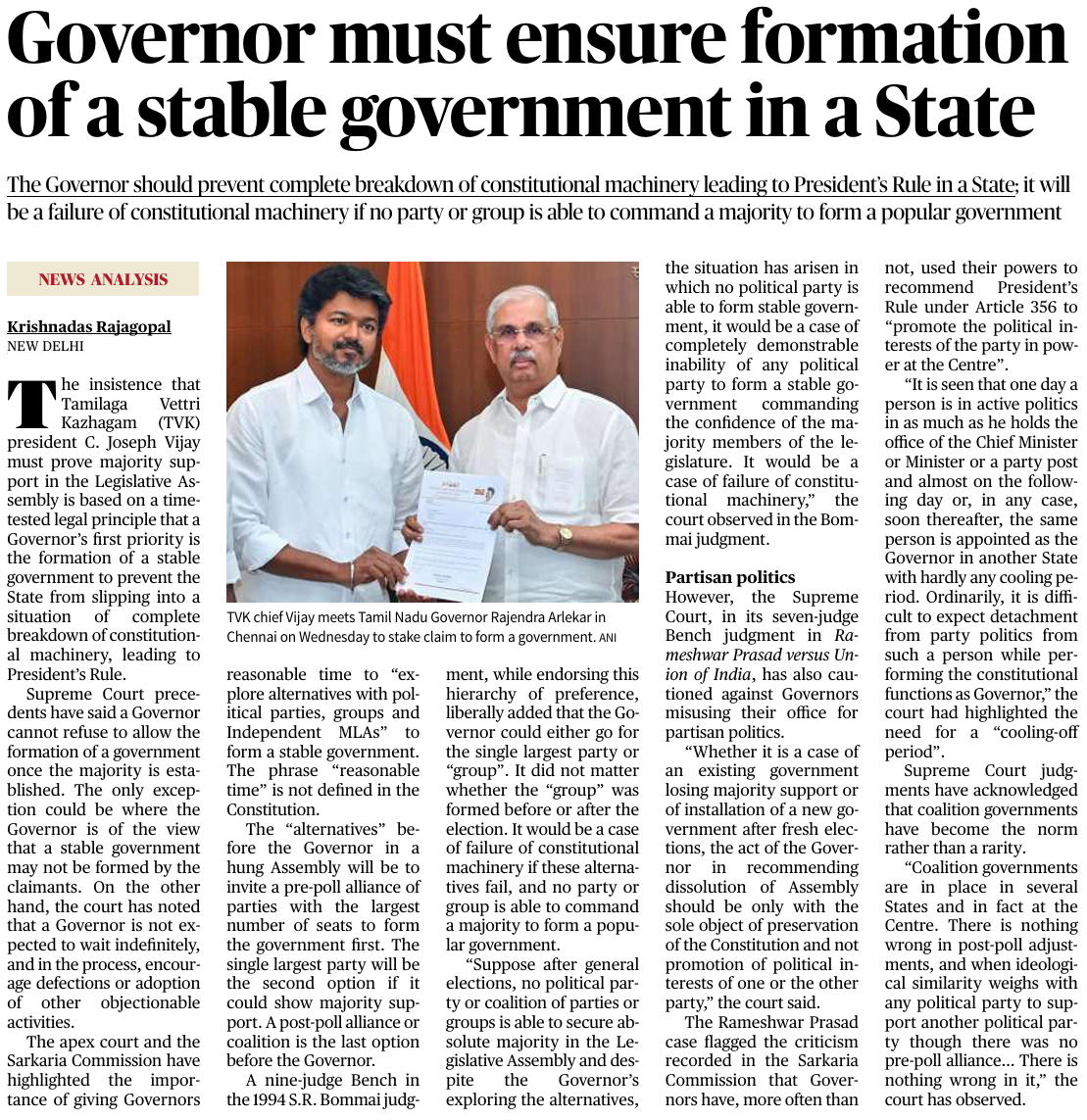
The debate gained relevance after TVK president Vijay staked claim to form a government in Tamil Nadu.
Prelims concepts
1. Role of the Governor in Government Formation
The Governor’s primary constitutional duty is to ensure the formation of a stable government to prevent a "failure of constitutional machinery."
Discretionary Power: The Governor exercises "situational discretion" when no single party has a clear majority in the Legislative Assembly.
Priority of Invitation: Following the Sarkaria Commission recommendations and the S.R. Bommai (1994) judgment, the Governor should explore options in this hierarchy:
Pre-poll alliance of parties.
Single largest party (SLP) that stakes a claim with the support of others.
Post-poll alliance of parties.
A coalition of parties where some join the government and others provide support from outside.
2. Article 356 (President’s Rule)
Definition: Article 356 provides for the imposition of President's Rule in a state if the Governor reports (or the President is otherwise satisfied) that the state government cannot be carried on in accordance with the provisions of the Constitution.
Grounds: A "hung assembly" where no party or group is able to command a majority is considered a failure of constitutional machinery.
Judicial Safeguard: The S.R. Bommai case established that the recommendation for President's Rule is subject to judicial review to prevent partisan misuse of the office.
3. Landmark Supreme Court Judgments
The article highlights specific legal precedents that govern the Governor's conduct:
S.R. Bommai vs. Union of India (1994): * A nine-judge bench judgment.
Emphasized that the floor of the Assembly (Floor Test) is the only place to prove a majority, not the Governor's subjective opinion.
The Governor must explore all alternatives before recommending Article 356.
Rameshwar Prasad vs. Union of India (2006):
A five-judge bench judgment.
Cautioned against Governors using their office for partisan politics.
Stated that the Governor cannot shut out a post-poll alliance just because it was formed after the elections.
4. Recommendations of Commissions
Sarkaria Commission: Recommended that the Governor should be a detached figure and not a person who has been in active politics in the recent past (the concept of a "cooling-off period").
Function: To preserve the federal structure and ensure the Governor acts as a "bridge" between the Centre and the State rather than an agent of the party in power at the Centre.
5. Key Terms to Note Term
Context
Hung Assembly
A situation where no single political party or pre-poll alliance has an absolute majority of seats.
Post-poll Adjustment
Political parties coming together after election results to form a majority; SC views this as a legitimate democratic exercise.
Reasonable Time
The period given by a Governor to parties to prove their majority; notably, this term is not defined in the Constitution.
Constitutional Machinery
The system of governance as prescribed by the Constitution; its "breakdown" is the prerequisite for President's Rule.
UPSC MCQ
Q. With reference to the discretionary powers of the Governor in India, consider the following statements:
The Constitution explicitly lays down the order of preference the Governor must follow in inviting parties to form government in a hung Assembly.
The Supreme Court in the S.R. Bommai case held that the majority of a government should ordinarily be tested on the floor of the House.
Which of the statements given above is/are correct?
A. 1 only
B. 2 only
C. Both 1 and 2
D. Neither 1 nor 2
Answer:
B. 2 only
Explanation:
Statement 1 is incorrect: The Constitution does not explicitly prescribe the order of preference; such conventions emerged through commissions like the Sarkaria Commission and judicial interpretations.
Statement 2 is correct: The S.R. Bommai judgment emphasised floor tests as the proper method to determine legislative majority.
Context
Indian private space-tech company Skyroot Aerospace raised $60 million in funding, taking its valuation above $1 billion and making it a unicorn. The funding round was led by Sherpalo Ventures and GIC, reflecting growing investor confidence in India’s private space sector.
The development highlights the rapid expansion of India’s commercial space ecosystem after policy reforms encouraging private participation.
Prelims concepts
1. Startup Ecosystem: The "Unicorn" Status
In the venture capital and startup industry, a Unicorn is a term used to describe a privately held startup company with a valuation of over $1 billion.
Key Characteristics: They are typically private companies (not yet listed on a stock exchange).
The valuation is based on funding rounds and growth potential rather than current profits.
Indian Context: India has one of the largest startup ecosystems globally. Skyroot becoming a unicorn is a significant milestone for the Indian DeepTech and SpaceTech sectors.
2. SpaceTech Sector in India (Privatization)
The article highlights the shift toward private participation in space, a major focus of recent government reforms.
IN-SPACe (Indian National Space Promotion and Authorization Centre): An independent nodal agency under the Department of Space (DoS) to promote, authorize, and supervise private sector activities in the space domain.
NewSpace India Limited (NSIL): The commercial arm of ISRO, responsible for enabling Indian industries to take up high-technology space-related activities.
Key Achievement: Skyroot Aerospace was the first Indian private company to launch a rocket into space (Vikram-S) under the 'Prarambh' mission in 2022.
UPSC MCQ
Q. With reference to India’s space sector reforms, consider the following statements:
IN-SPACe functions as a regulatory and facilitation agency for private participation in the Indian space sector.
NewSpace India Limited (NSIL) is the commercial arm of ISRO.
Private companies in India are permitted only to manufacture satellites and are not allowed to develop launch vehicles.
Which of the statements given above are correct?
A. 1 and 2 only
B. 2 and 3 only
C. 1 and 3 only
D. 1, 2 and 3
Answer:
A. 1 and 2 only
Explanation:
Statement 1 is correct: IN-SPACe was established to facilitate and regulate private sector participation in space activities.
Statement 2 is correct: NSIL is the commercial arm of ISRO.
Statement 3 is incorrect: Private firms like Skyroot Aerospace and Agnikul Cosmos are developing launch vehicles in India.
Context
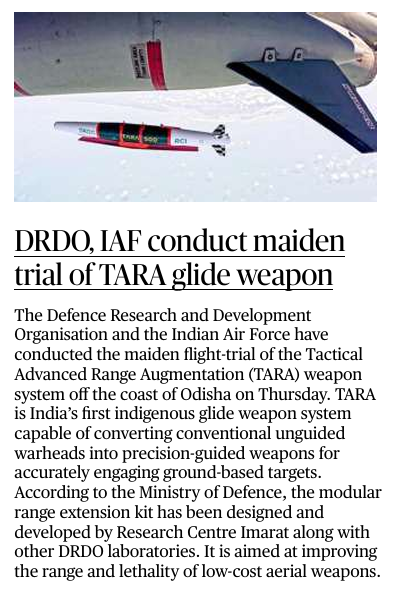
The Defence Research and Development Organisation (DRDO) and the Indian Air Force (IAF) successfully conducted the maiden trial of the Tactical Advanced Range Augmentation (TARA).
Prelims concepts
What is TARA?
TARA (Tactical Advanced Range Augmentation) is:
An indigenous glide weapon system
Developed by DRDO’s Research Centre Imarat (RCI)
Designed to convert unguided aerial bombs into smart precision weapons
It uses:
Guidance systems
Control fins
Range-extension mechanisms
to improve:
Accuracy
Stand-off strike capability
Operational effectiveness
Significance of TARA
Precision Warfare: Converts unguided bombs into accurate precision weapons, improving strike efficiency and reducing collateral damage.
Cost-Effective Capability: Upgrades existing bomb inventory instead of developing costly new missiles.
Stand-Off Strike Advantage: Enables aircraft to attack targets from safer distances, improving survivability.
Defence Indigenisation: Strengthens Aatmanirbhar Bharat by reducing dependence on imported precision-guided weapons.
 Calcutta HC rejects Centre’s objections to pleas against Great Nicobar project
Context
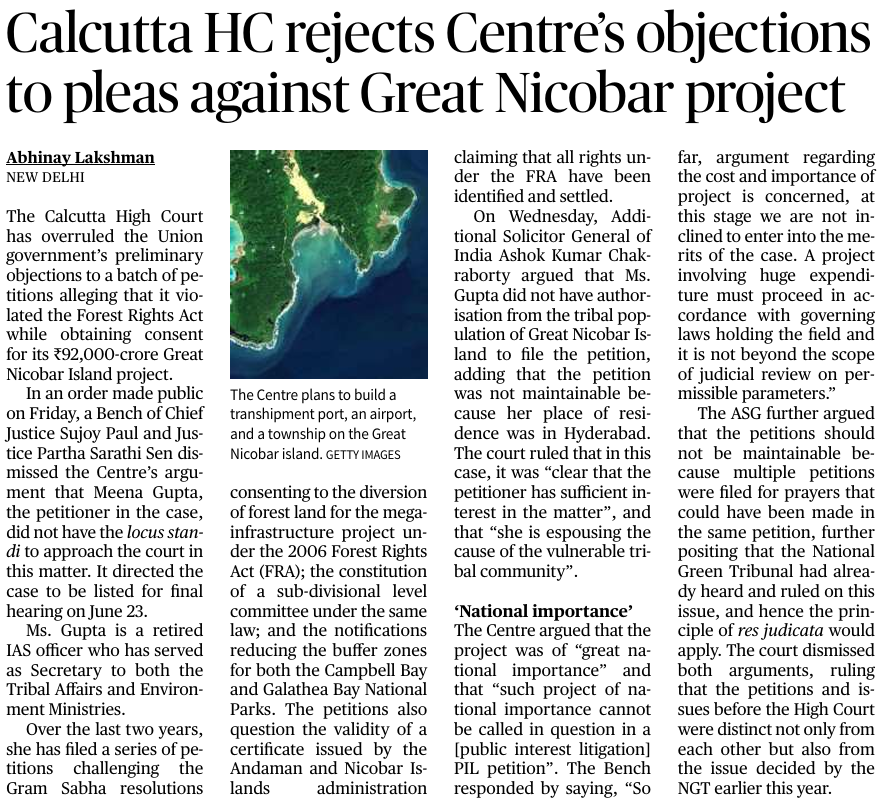
The Calcutta High Court rejected the Union government’s preliminary objections against petitions challenging the ₹72,000-crore Great Nicobar Island infrastructure project. The petitions allege violations of the Forest Rights Act (FRA), improper environmental clearances, and dilution of ecological safeguards.
The project includes:
A transshipment port
An airport
A township
Power infrastructure
Prelims concepts
Great Nicobar Island
Location: It is the southernmost island of the Andaman and Nicobar archipelago.
Southernmost Tip: Indira Point, located on this island, is the southernmost point of India's territory.
Protected Areas: It houses the Great Nicobar Biosphere Reserve, which includes Campbell Bay National Park and Galathea Bay National Park.
Strategic Project: A ₹92,000-crore project is planned here, featuring an international transshipment port, an airport, and a township.
Forest Rights Act (FRA), 2006
Full Name: The Scheduled Tribes and Other Traditional Forest Dwellers (Recognition of Forest Rights) Act, 2006.
Beneficiaries: It recognizes the rights of Forest Dwelling Scheduled Tribes (FDST) and Other Traditional Forest Dwellers (OTFD) who have resided in forests for generations.
Types of Rights:
Title rights: Ownership of land being cultivated by forest dwellers.
Use rights: Access to minor forest produce and grazing grounds.
Relief and development rights: Rehabilitation in case of illegal eviction and access to basic amenities.
Forest management rights: Right to protect and regenerate community forest resources.
Gram Sabha
Definition: A village assembly consisting of all persons whose names are included in the electoral rolls for the Panchayat at the village level.
Authority in FRA: The Gram Sabha is the authority to initiate the process for determining the nature and extent of individual or community forest rights.
Consent Requirement: Its consent is mandatory for the diversion of forest land for non-forest purposes, a key point of contention in the Great Nicobar project.
Judicial Principles
Judicial Review: A fundamental power of the High Courts and the Supreme Court to examine the legality of executive actions and legislative acts. The Calcutta High Court affirmed that projects of "national importance" are still subject to this review.
Locus Standi: The legal capacity of a person to approach the court. In Public Interest Litigation (PIL), this rule is relaxed to allow individuals to espouse the cause of vulnerable communities.
Res Judicata: A legal principle preventing the same dispute from being litigated twice between the same parties once a final judgment is reached.
National Green Tribunal (NGT)
Establishment: Created under the National Green Tribunal Act, 2010, for effective and expeditious disposal of cases relating to environmental protection.
Mandate: It handles civil cases involving substantial questions related to the environment and implementation of laws listed in Schedule I of the NGT Act.
Jurisdiction: While NGT handles environmental merits, High Courts retain jurisdiction over legal and constitutional violations, such as those related to the FRA.
Context
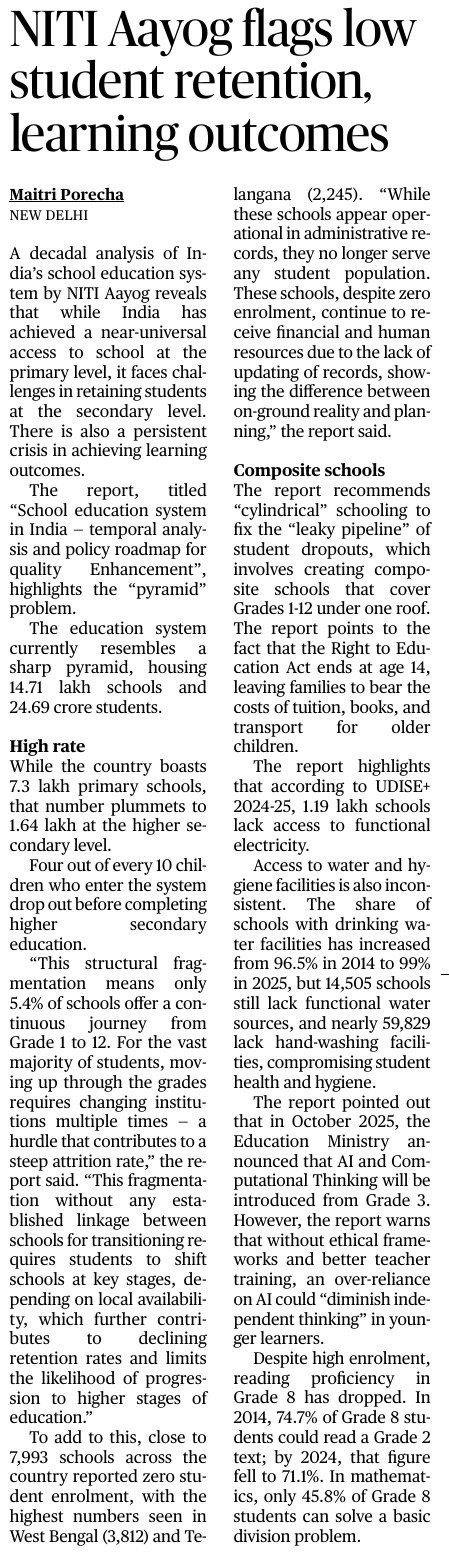
A NITI Aayog report on India’s school education system highlights that while access to primary education has become nearly universal, major challenges remain in:
Student retention at secondary level
Learning outcomes
Infrastructure gaps
School transition mechanisms
The report describes India’s school system as a “sharp pyramid” with high dropout rates as students move to higher classes.
Key Findings of the Report
1. Dropout and Retention Crisis
Four out of ten students drop out before completing higher secondary education.
Number of schools sharply declines from primary to secondary level.
Only 5.4% of schools provide continuous education from Grade 1–12.
This creates a “leaky pipeline” in education.
2. Fragmented School Structure
Students often need to:
Change schools multiple times
Shift institutions at key stages
This affects:
Continuity in education
Student retention
Progression to higher education
3. Poor Learning Outcomes
The report highlights declining foundational learning:
Reading proficiency among Grade 8 students has fallen.
Only 45.8% of Grade 8 students can solve basic division problems.
This reflects concerns over quality of learning despite improved enrolment.
4. Infrastructure Deficits
According to UDISE+ data:
Many schools lack functional electricity.
Thousands lack drinking water and handwashing facilities.
This impacts:
Student health
Hygiene
Learning environment
5. Concerns Regarding AI Integration
The report cautions that excessive dependence on AI tools without:
Better teacher training
Strong ethical frameworks
could reduce independent thinking among students.
 Launch your Graphy