There are no items in your cart
Add More
Add More
| Item Details | Price | ||
|---|---|---|---|







 CONTENTs

• Structure, organisation and functioning of the Judiciary
• Government policies and interventions for vulnerable sections
• Issues relating to fundamental rights (Freedom of speech vs. restrictions)
Context
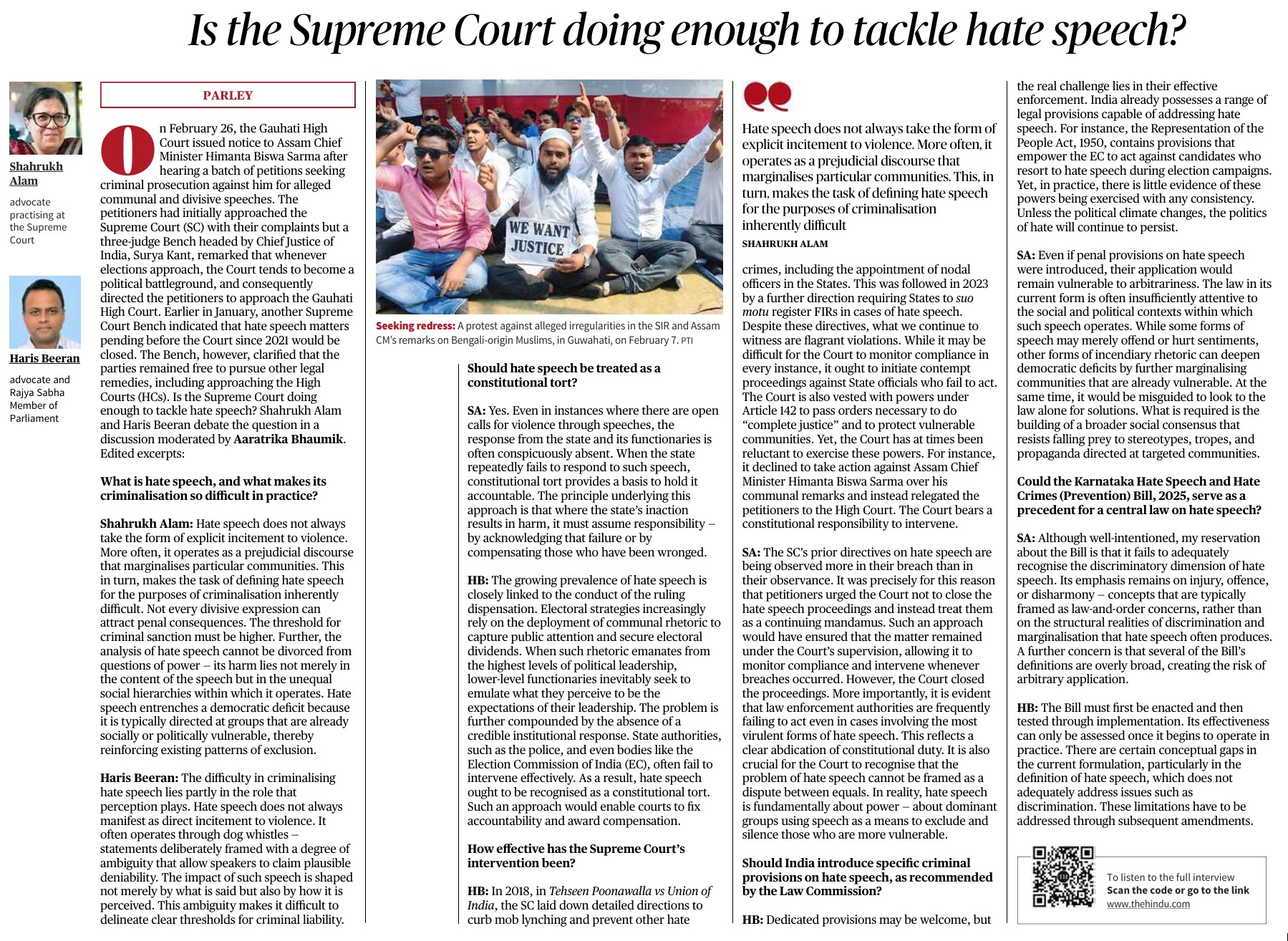
The article discusses whether the Supreme Court of India is doing enough to address the growing problem of hate speech, particularly in politically charged environments. The debate was triggered after the Gauhati High Court issued notice to Assam CM Himanta Biswa Sarma over alleged communal remarks, while the Supreme Court asked petitioners to approach the High Court instead of directly seeking its intervention.The discussion between legal experts Shahrukh Alam and Haris Beeran evaluates the effectiveness of judicial interventions and whether stronger legal mechanisms are needed.What is Hate Speech?
1. Constitutional Protection and Limits
2. Legal ProvisionsBharatiya Nyaya Sanhita (BNS), 2023
The debate shows that while the Supreme Court has issued guidelines and possesses strong constitutional powers, its impact remains limited due to weak enforcement by state institutions and the complex nature of hate speech itself. Addressing the issue requires a combination of judicial vigilance, institutional accountability, legal clarity, and political will.
UPSC Mains Question:
Q. Despite several judicial directives, hate speech continues to persist in India. Examine the limitations of judicial intervention in tackling hate speech and suggest measures to improve enforcement. (250 words)
Source: The Hindu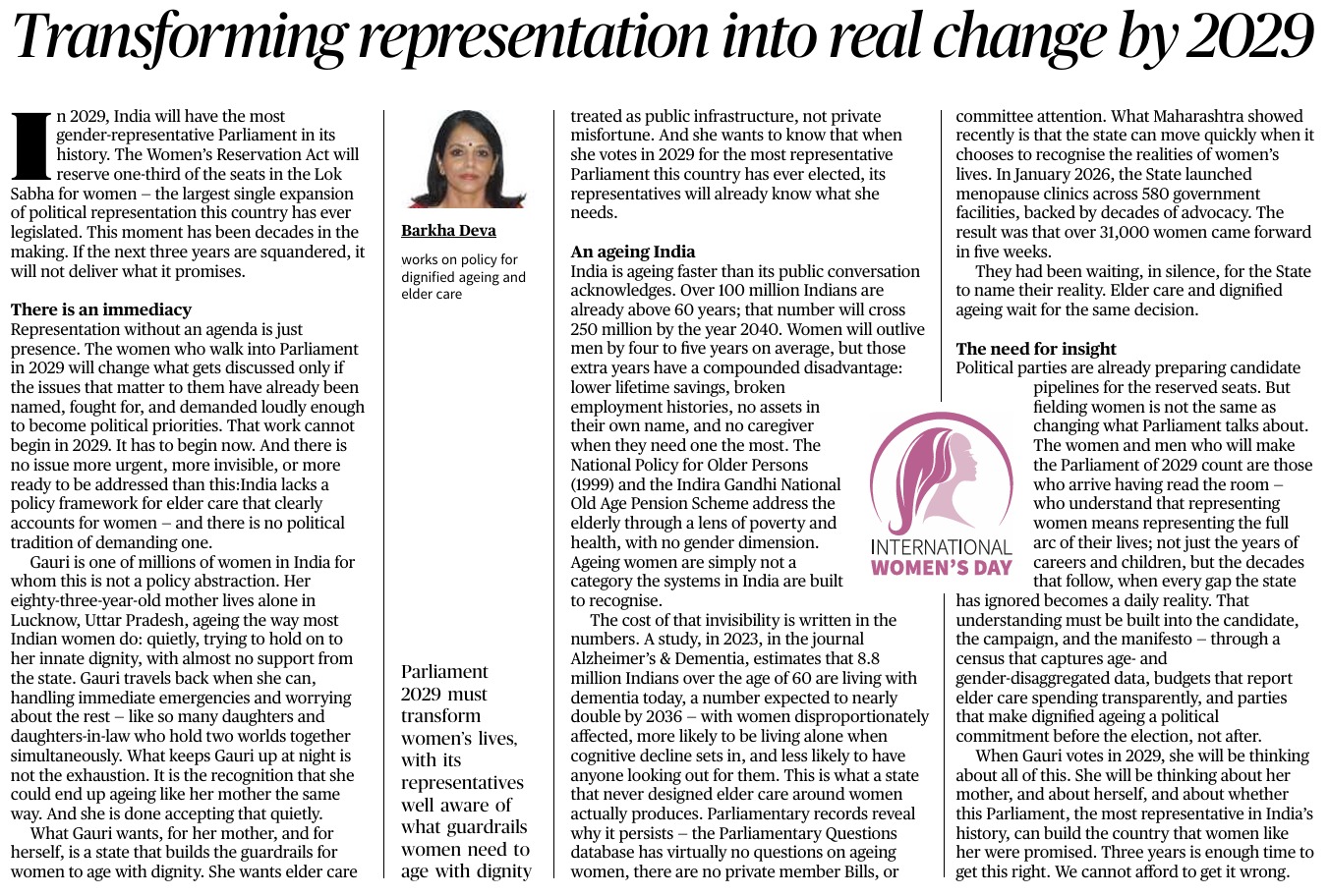

India is set to witness a historic shift in political representation with the implementation of the Women’s Reservation Act, which will reserve one-third of seats in the Lok Sabha for women from the 2029 elections. The article argues that while increased representation is a major democratic milestone, mere presence of women in Parliament will not automatically transform women’s lives. For meaningful change, political institutions must address structural issues such as ageing, elder care, and gender-sensitive welfare policies.
Detailed Analysis:
Why Representation Alone is Not Enough
1. Political presence vs policy transformation
Representation without a clear policy agenda may only result in symbolic participation.
Women entering Parliament in 2029 will influence policymaking only if issues affecting women are already recognised as political priorities.
2. Need for agenda-setting before 2029
Policy debates on elder care, ageing, and women’s social security must begin now.
Without early policy groundwork, the opportunity created by increased representation may be wasted.
3. Changing the nature of parliamentary discourse
Political parties may focus on fielding female candidates, but true change requires transforming the issues Parliament discusses.
Gendered Realities of Ageing in India
1. Feminisation of ageing
Women live longer than men by about 4–5 years, leading to a growing population of elderly women.
However, these additional years often come with economic insecurity and social vulnerability.
2. Economic disadvantages
Many ageing women face:
Lower lifetime earnings
Interrupted work histories
Limited property ownership
Reduced savings and pension coverage
These structural disadvantages make elderly women more dependent on family support.
3. Living alone and social isolation
Elderly women are more likely to live alone due to widowhood and migration of younger family members.
This increases risks related to health care, safety, and emotional well-being.
4. Health challenges
A 2023 study in the journal Alzheimer’s & Dementia estimates that 8.8 million Indians over 60 currently live with dementia, with women disproportionately affected.
These numbers are expected to nearly double by 2036.
Policy Gaps in Addressing Elderly Women’s Needs
1. Lack of gender perspective in ageing policies
Existing programmes treat ageing mainly through poverty or health frameworks, ignoring gendered vulnerabilities.
Examples include:
National Policy for Older Persons (1999)
Indira Gandhi National Old Age Pension Scheme (IGNOAPS)
These policies do not sufficiently address women’s economic and social vulnerabilities in old age.
2. Elder care treated as private responsibility
In India, elder care is largely seen as a family responsibility rather than a public policy issue.
This leaves many elderly women without adequate state support.
3. Limited political and parliamentary attention
Parliamentary records show very few questions, debates, or bills addressing ageing women.
This reflects the institutional invisibility of the issue.
Lessons from Emerging State-Level Initiatives
The article highlights the example of Maharashtra’s menopause clinics launched in 2026 across 580 government facilities.
Over 31,000 women accessed services within five weeks.
This demonstrates that targeted policy interventions can address neglected women’s health issues quickly and effectively.
Such initiatives show that political recognition of women’s issues can lead to rapid policy responses.
Need for Evidence-Based Policymaking
1. Gender-disaggregated data
Policies must rely on data capturing age, gender, and social vulnerabilities to understand the realities of ageing women.
2. Transparent budgeting
Governments should clearly report public spending on elder care services, ensuring accountability.
3. Political commitment
Political parties should integrate dignified ageing and elder care into:
Candidate selection
Election campaigns
Party manifestos
Way Forward
1. Recognise elder care as public infrastructure
Elder care must be treated as a public policy priority similar to health or education, not just a family obligation.
2. Build gender-sensitive ageing policies
Policies should address:
Financial security
Accessible healthcare
Social protection for elderly women.
3. Strengthen parliamentary engagement
Parliament should promote:
Dedicated debates on ageing
Committee studies
Legislative initiatives addressing elderly women’s needs.
4. Link women’s representation with governance reforms
The success of the Women’s Reservation Act will depend on whether women representatives can shape policy agendas reflecting lived realities of women.
Conclusion
The implementation of the Women’s Reservation Act marks a transformative moment in India’s democratic history. However, representation alone cannot guarantee social change.
To ensure that the historic increase in women’s representation leads to real improvements in women’s lives, India must prioritise gender-sensitive policies, particularly in areas such as ageing, elder care, and social security. Only then will political representation translate into meaningful and inclusive governance.
UPSC Mains Question:
The Women’s Reservation Act marks a historic expansion of political representation in India. Discuss how increased representation of women in Parliament can translate into gender-responsive policymaking. (250 words)
Source: The Hindu

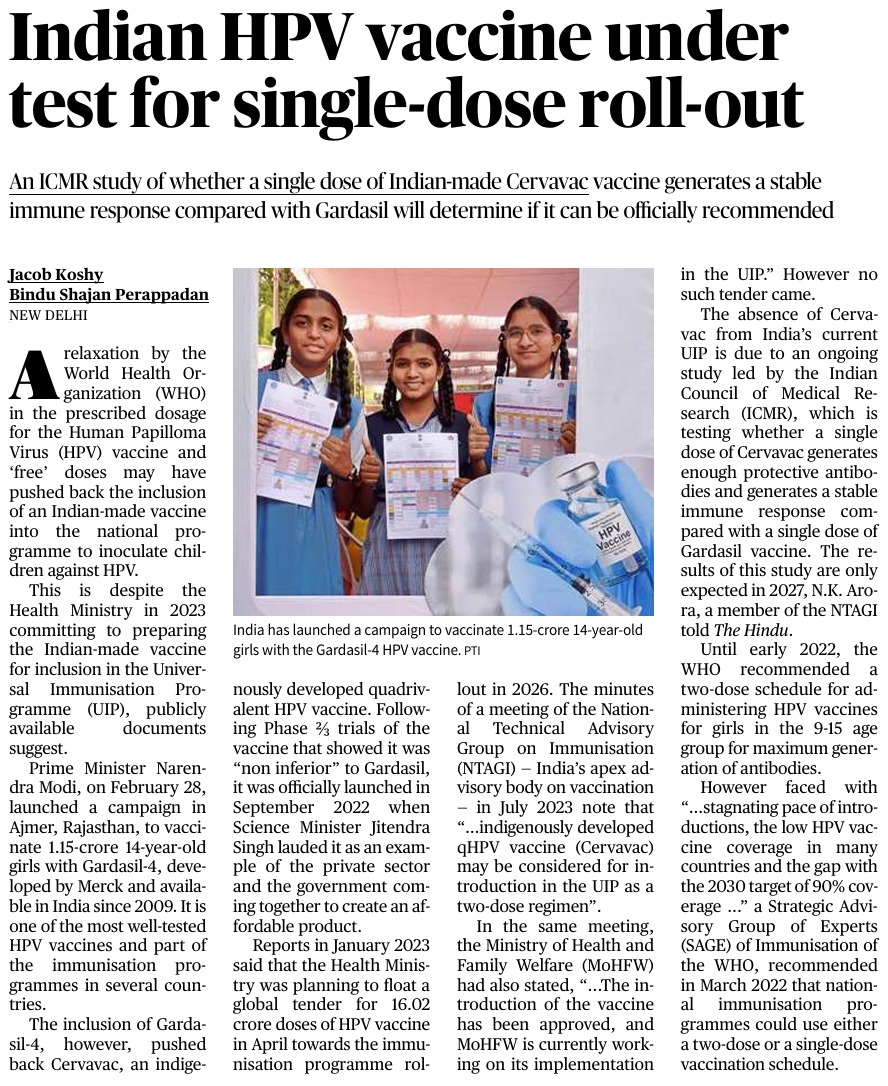
India is examining the possibility of introducing a single-dose Human Papillomavirus (HPV) vaccine in its national immunisation programme. An ongoing Indian Council of Medical Research (ICMR) study is assessing whether a single dose of the indigenously developed Cervavac vaccine can generate a stable immune response comparable to Gardasil, the currently used HPV vaccine. The results of this study will determine whether the vaccine can be incorporated into India’s Universal Immunisation Programme (UIP).About HPV and HPV VaccinesHuman Papillomavirus (HPV)
Gardasil-4 – Developed by Merck; protects against four HPV strains.
Cervavac – India’s indigenously developed quadrivalent HPV vaccine produced by the Serum Institute of India.
GS Paper II:
• Issues relating to development and management of social sector/services relating to health
• Government policies and interventions for development in various sectors
Context
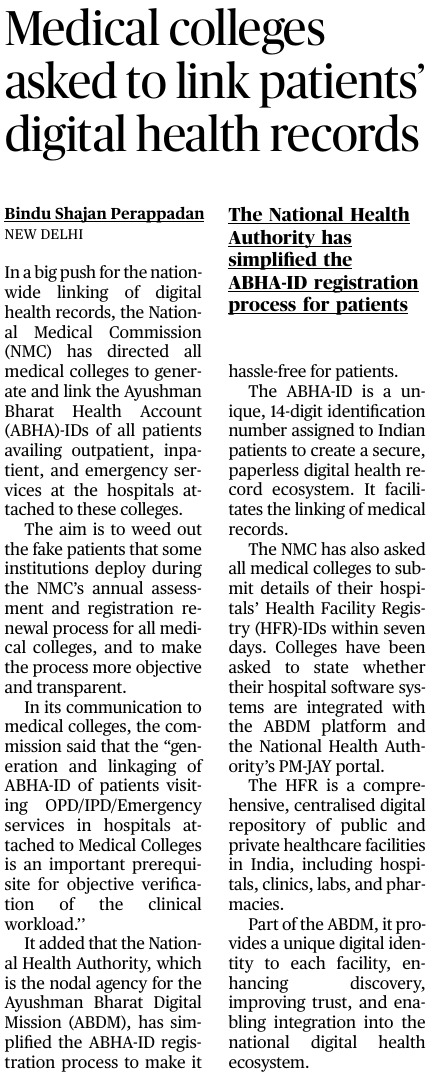
In a major push toward digital healthcare integration, the National Medical Commission (NMC) has directed all medical colleges to generate and link Ayushman Bharat Health Account (ABHA) IDs of patients visiting hospitals attached to medical colleges. This initiative is part of the Ayushman Bharat Digital Mission (ABDM), aimed at creating a nationwide digital health ecosystem.
About Ayushman Bharat Digital Mission (ABDM)
The Ayushman Bharat Digital Mission, launched in 2021, aims to build an integrated digital health infrastructure across India.
Key components
1. ABHA ID (Ayushman Bharat Health Account)
A unique 14-digit identification number for individuals.
Enables secure storage and sharing of digital health records across healthcare providers.
2. Health Facility Registry (HFR)
A centralised database of healthcare facilities including hospitals, clinics, laboratories, and pharmacies. Provides a unique digital identity for each facility.
Objectives of the NMC Directive
1. Strengthening digital health integration
Q. With reference to the Ayushman Bharat Digital Mission (ABDM), consider the following statements:

• Security challenges and their management in border areas
• Role of external state and non-state actors in maritime security
Context
The Indian Navy launched search and rescue (SAR) operations after receiving a distress call from the Iranian vessel IRIS Dena near the coast of Sri Lanka. The operation was conducted in coordination with Sri Lankan maritime authorities, highlighting India’s role as a net security provider in the Indian Ocean Region (IOR).
Indian Naval Assets Involved
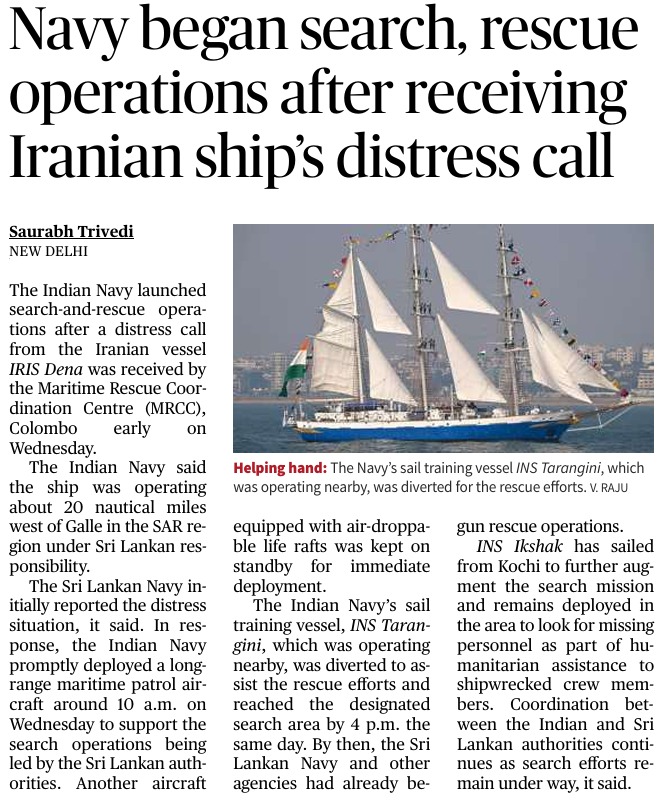
1. INS Tarangini
A sail training vessel of the Indian Navy.
It was operating nearby and was diverted to assist in rescue efforts.
2. INS Ikshak
A naval vessel deployed from Kochi to strengthen the search mission.
3. Maritime Patrol Aircraft
A long-range maritime patrol aircraft was deployed to support the search operation.
4. Rescue equipment
Aircraft equipped with air-droppable life rafts were kept ready for emergency rescue operations.
Q. Consider the following statements:
Answer: a) 1 onlyExplanation:
 Launch your Graphy