The Hindu Analysis 4th June 2026 for UPSC, APPSC & TSPSC Exams.
The Hindu News Analysis – 4th June, 2026
1. After Maoism, the next battle is for Adivasi trust (GS-2, GS-3)
2. Union Cabinet approves ₹9,585-crore scheme to cut pollution in Delhi-NCR (GS-2, GS-3)
3. Russia delivers fourth squadron of the S-400 air defence system
(GS-2, GS-3)
4. Centre mulls policy to boost E85 fuel uptake (GS-3)
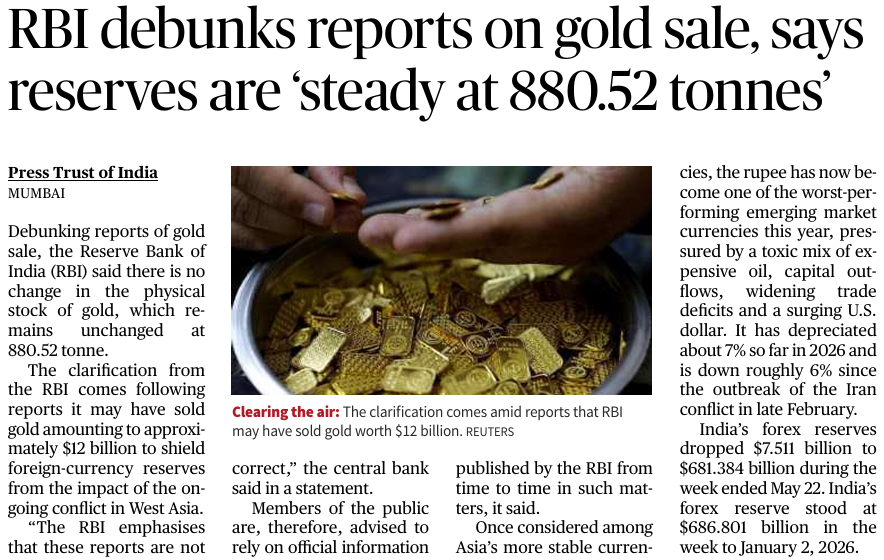
5. RBI debunks reports on gold sale, says reserves are ‘steady at 880.52 tonnes’ (GS-3)
 After Maoism, the next battle is for Adivasi trust
GS Paper II
Welfare schemes for vulnerable sections
Panchayati Raj Institutions
Governance and grassroots democracy
Fifth Schedule and Tribal Administration
GS Paper III
Left Wing Extremism (LWE)
Internal Security
Inclusive development and governance in tribal areas
Context
Following the Government's declaration that India became Maoist-free on March 31, 2026, the Union Home Minister emphasized that the struggle against Maoism would remain incomplete until the people of Bastar are integrated into the mainstream. The article argues that while security operations have achieved significant success, sustainable peace requires building trust among Adivasis through constitutional governance, empowerment, and protection of their rights.
Detailed Analysis
Historical Background
Constitutional Framework for Tribal Areas
The Constitution envisages a special governance framework for Scheduled Areas through:
Fifth Schedule provisions
Panchayats (Extension to Scheduled Areas) Act (PESA), 1996
Gram Sabha-centred local self-governance
The objective is to safeguard tribal identity, customs, resources, and decision-making powers.
Maoist Insurgency in Bastar
Maoists gained influence by exploiting governance deficits and tribal grievances.
Issues related to jal, jungle and zameen (water, forest and land) became major sources of discontent.
Security operations have significantly weakened Maoist networks, creating an opportunity for long-term peacebuilding.
From Security Gains to Durable Peace
Moving Beyond Military Success
Elimination of Maoist influence alone cannot ensure lasting peace.
Long-term stability depends upon addressing socio-economic and governance concerns.
Building Trust Between State and Adivasis
Decades of conflict have created mistrust towards government institutions.
Responsive and participatory governance is essential to bridge this gap.
Strengthening Constitutional Self-Governance
Effective implementation of PESA can empower Gram Sabhas.
Greater local participation enhances democratic legitimacy and accountability.
Protecting Tribal Rights
Recognition of community rights over land, forests and natural resources is crucial.
Protection of traditional rights reduces alienation and social tensions.
Ensuring Inclusive Development
Better infrastructure, healthcare, education, communication and welfare delivery can improve quality of life.
Development initiatives should complement tribal autonomy rather than undermine it.
Challenges
Poor Implementation of PESA
States have adopted varying approaches to implementation.
Gram Sabha powers are often diluted in practice.
Weak Grassroots Institutions
Bureaucratic structures frequently overshadow elected local bodies.
Decision-making often remains top-down.
Land and Forest-Related Grievances
Disputes involving mining, displacement and resource extraction continue to persist.
Concerns regarding ownership and control of natural resources remain unresolved.
Trust Deficit
Historical neglect and prolonged conflict have created scepticism towards state institutions.
Welfare measures alone may not be sufficient to rebuild confidence.
Attempts to Bypass Community Consent
Instances of weakening Gram Sabha authority undermine the spirit of self-governance.
Development projects sometimes proceed without meaningful local participation.
Way Forward
Implement PESA in Letter and Spirit
Strengthen the decision-making authority of Gram Sabhas.
Ensure mandatory consultation and consent mechanisms function effectively.
Strengthen Constitutional Safeguards
Protect tribal rights under the Fifth Schedule and related legislations.
Ensure effective enforcement of legal protections.
Address Jal, Jungle and Zameen Concerns
Resolve land and forest disputes through transparent and participatory mechanisms.
Balance economic development with tribal rights and environmental sustainability.
Promote Participatory Governance
Encourage community involvement in planning and implementation of development projects.
Adopt a bottom-up approach to governance.
Improve Service Delivery
Enhance access to education, healthcare, livelihood opportunities and public services.
Strengthen grievance redressal mechanisms.
Focus on Justice-Based Development
Measure success through improvements in human development and institutional trust rather than security indicators alone.
Ensure that development outcomes are equitable and inclusive.
Conclusion
The decline of Maoism marks a significant achievement in India's internal security landscape. However, lasting peace in Bastar will depend on the government's ability to uphold constitutional guarantees, empower Gram Sabhas, protect tribal rights, and foster genuine participatory governance. Winning the trust of Adivasis is the critical next step in transforming security gains into sustainable peace and development.
UPSC Mains Question
Q. The elimination of Left-Wing Extremism is only the first step; lasting peace in tribal regions depends on strengthening constitutional governance and tribal self-rule. Examine in the context of the Panchayats (Extension to Scheduled Areas) Act (PESA), 1996.

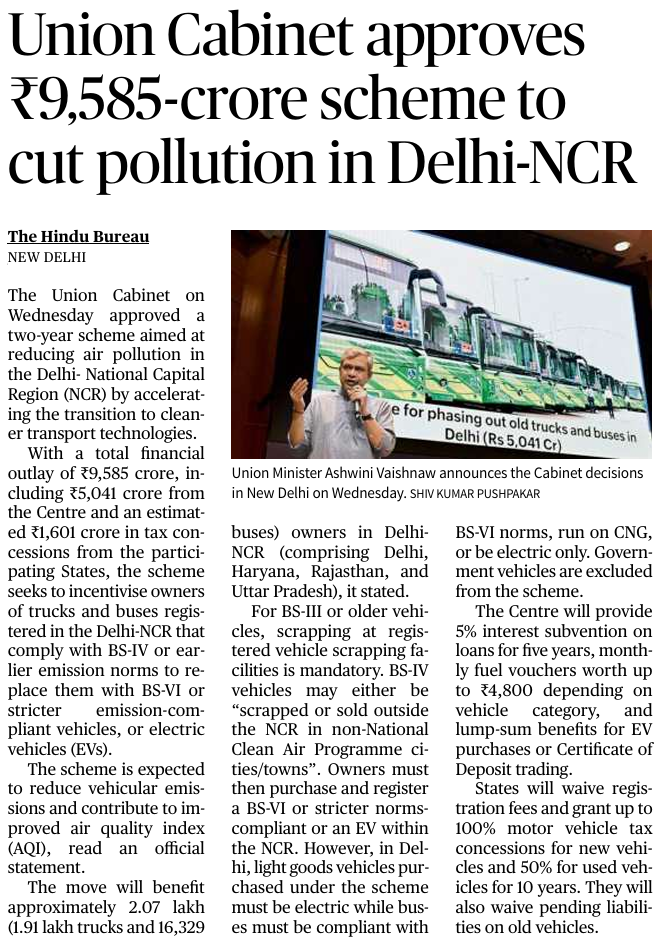 Union Cabinet approves ₹9,585-crore scheme to cut pollution in Delhi-NCR
GS Paper II
Government policies and interventions
Centre–State relations
Governance and environmental regulation
GS Paper III
Environmental Pollution and Degradation
Air Pollution
Sustainable Development
Clean Energy and Green Mobility
Context
The Union Cabinet has approved a ₹9,585-crore two-year scheme aimed at reducing air pollution in the Delhi-NCR region by accelerating the transition to cleaner transport technologies. The scheme seeks to phase out older polluting vehicles and promote the adoption of BS-VI-compliant and electric vehicles (EVs) through financial incentives, tax concessions, and scrappage measures.
Prelims concepts
1. Delhi-NCR Vehicular Pollution Reduction Scheme
Objective: A two-year scheme aimed at accelerating the transition to cleaner transport technologies by replacing old trucks and buses in the Delhi-NCR region.
Target Vehicles: Incentivizes owners of trucks and buses registered in Delhi-NCR that comply with BS-IV or earlier emission norms to replace them with BS-VI (or stricter) vehicles or Electric Vehicles (EVs).
Specific Rules for Delhi: Light goods vehicles purchased under this scheme in Delhi must be electric. Buses must be BS-VI compliant, run on CNG, or be electric only.
Exclusions: Government vehicles are strictly excluded from the scheme.
Incentives (Centre): 5% interest subvention on loans for five years, monthly fuel vouchers (up to ₹4,800), and lump-sum benefits for EV purchases or Certificate of Deposit trading.
Incentives (States): Waiver of registration fees, up to 100% motor vehicle tax concessions for new vehicles (and 50% for used vehicles for 10 years), and waiver of pending liabilities on old vehicles.
2. Bharat Stage (BS) Emission Norms
Context in Article: The scheme mandates replacing BS-III and BS-IV vehicles with BS-VI compliant ones.
Key Prelims Facts: BS norms are emission standards instituted by the Government of India to regulate the output of air pollutants from internal combustion engines and spark-ignition engine equipment, including motor vehicles. The transition directly to BS-VI (skipping BS-V) was a major environmental policy step in India to drastically reduce sulfur content in fuel and lower nitrogen oxide emissions.
3. National Clean Air Programme (NCAP)
Context in Article: BS-IV vehicles replaced under this scheme may be sold outside the NCR, but only in "non-National Clean Air Programme cities/towns".
Key Prelims Facts: Launched by the Ministry of Environment, Forest and Climate Change (MoEFCC), NCAP is a long-term, time-bound, national-level strategy to tackle the air pollution problem across India in a comprehensive manner. By restricting the resale of polluting vehicles to non-NCAP cities, the government is preventing the displacement of severe air pollution to other vulnerable, highly polluted "non-attainment" cities monitored under this program.
UPSC MCQ
Q. Consider the following statements regarding the recently approved Clean Mobility Scheme for Delhi-NCR:
1. The scheme aims to replace older polluting trucks and buses with BS-VI-compliant or electric vehicles through financial incentives and scrappage measures.
2. Government-owned vehicles are eligible for incentives under the scheme to accelerate fleet modernization.
Which of the statements given above is/are correct?
A) 1 only
B) 2 only
C) Both 1 and 2
D) Neither 1 nor 2
Answer: A) 1 only
Explanation:
Statement 1 is correct: The scheme seeks to phase out older vehicles and promote BS-VI-compliant and electric vehicles through incentives, tax concessions, and scrappage provisions.
Statement 2 is incorrect: Government vehicles are excluded from the scheme's benefits.
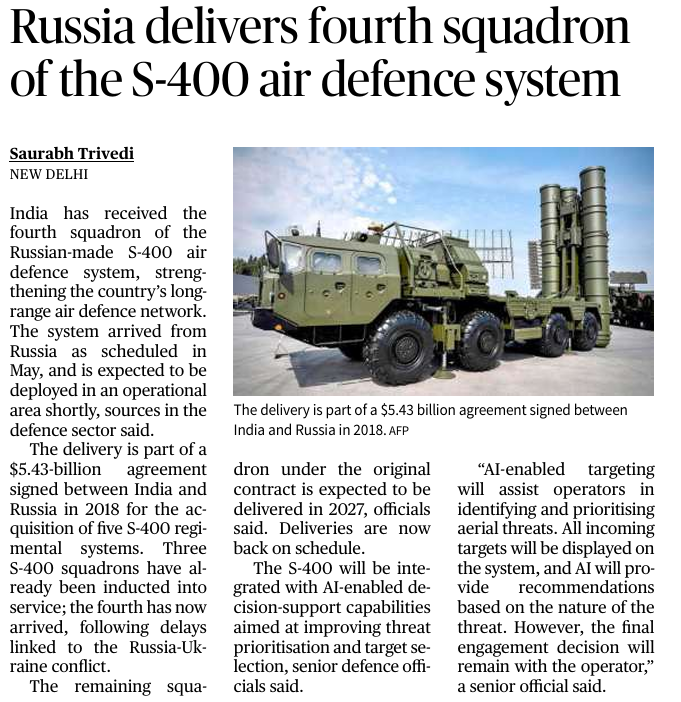 Russia delivers fourth squadron of the S-400 air defence system
GS Paper II
India and its neighbourhood and bilateral relations
India–Russia Relations
GS Paper III
Security Challenges and their Management
Defence Technology
Modernisation of Security Forces
Context
India has received the fourth squadron of the S-400 Triumf air defence system from Russia under the $5.43 billion agreement signed in 2018. The induction strengthens India's long-range air defence network and enhances its capability to counter a wide range of aerial threats. The fifth and final squadron is expected to be delivered in 2027.
Prelims concepts
Key Features of the S-400 System
Long-range surface-to-air missile (SAM) system.
Capable of engaging:
Fighter aircraft
Bombers
Drones/UAVs
Cruise missiles
Ballistic missiles
Can simultaneously track and engage multiple targets.
Operational range up to 400 km (depending on missile type).
Integrated radar, command-and-control, and interceptor systems.
AI-enabled decision-support capabilities are being incorporated for threat prioritisation.
Significance
Strengthens Air Defence: Enhances protection against aircraft, drones, cruise missiles, and ballistic missiles.
Boosts Deterrence: Increases India's ability to deter and respond to aerial threats.
Addresses Two-Front Challenge: Improves preparedness along both western and northern borders.
Enhances Integrated Defence: Improves coordination between radar, missile, and command systems.
Technological Edge: AI-enabled threat prioritisation enhances operational efficiency and situational awareness.
Reinforces India–Russia Ties: Reflects continued strategic defence cooperation between the two countries.
UPSC MCQ
Q. Consider the following statements regarding the S-400 Triumf air defence system:
1. The S-400 can simultaneously track and engage multiple aerial targets at long ranges.
2. The S-400 system is designed primarily for anti-submarine warfare operations.
Which of the statements given above is/are correct?
A) 1 only
B) 2 only
C) Both 1 and 2
D) Neither 1 nor 2
Answer: A) 1 only
Explanation:
Statement 1 is correct: The S-400 is a long-range, multi-layered air defence system capable of tracking and engaging multiple aerial threats simultaneously.
Statement 2 is incorrect: The S-400 is an air defence missile system, not an anti-submarine warfare platform.
 Centre mulls policy to boost E85 fuel uptake
GS Paper III
Energy Security
Biofuels
Environmental Pollution and Degradation
Sustainable Development
Context
The Government is considering a supportive policy framework to accelerate the adoption of E85 fuel (85% ethanol blended with 15% gasoline). The initiative aims to promote cleaner fuels, reduce crude oil imports, generate income for farmers and distilleries, and strengthen India's biofuel economy.
Prelims concepts
1. E85 Fuel and the Ethanol Blending Programme (EBP)
The Centre is actively formulating policies to accelerate the adoption of E85 fuel, which comprises a high-ethanol blend of 85% ethanol and 15% gasoline. Under the broader Ethanol Blended Petrol (EBP) Programme, the government aims to diversify its fuel basket to ensure energy security, drastically reduce greenhouse gas emissions, and minimize reliance on imported crude oil.
Economic Impact: The article highlights that shifting even 1% of annual petrol vehicle sales to E85 during the Ethanol Supply Year 2026-27 could reduce crude oil imports by approximately 0.28 lakh metric tonnes. This translates to an estimated ₹195 crore in foreign exchange savings while generating massive rural demand, yielding nearly ₹266 crore in payments to distillers and ₹160 crore directly to farmers.
Environmental Impact: This fractional shift to E85 is estimated to achieve a net CO2 reduction of nearly 0.86 lakh metric tonnes, heavily supporting India's climate commitments and reducing urban vehicular pollution.
Ethanol Supply Year (ESY): For administrative tracking, procurement, and policy implementation, the ESY is defined as the period from November 1st of a given year to October 31st of the following year.
2. Flex-Fuel Vehicles (FFVs)
The transition to higher ethanol blends like E85 necessitates the adoption of Flex-Fuel Vehicles (FFVs). The recent launch of flex-fuel motorcycles by manufacturers like Hero MotoCorp marks the expansion of this crucial technology into the mass-market two-wheeler segment.
Technological Adaptation: Standard internal combustion engines are currently optimized for E20. They cannot efficiently or safely run on high ethanol blends because ethanol is hygroscopic (absorbs water) and can be corrosive. FFVs are equipped with modified engines, specialized sensors, and robust fuel lines to handle these chemical properties.
Versatility: The defining characteristic of FFVs is their operational flexibility; they are engineered to run seamlessly on a varying mixture of fuels, from the current standard E20 all the way up to E85 or even pure E100.
UPSC MCQ
Q. Consider the following statements regarding ethanol blending in India:
1. E85 fuel contains 85% ethanol and 15% gasoline.
2. Adoption of E85 fuel can contribute to reducing crude oil imports and lowering carbon emissions.
Which of the statements given above is/are correct?
A) 1 only
B) 2 only
C) Both 1 and 2
D) Neither 1 nor 2
Answer: C) Both 1 and 2
Explanation:
Statement 1 is correct: E85 is a fuel blend consisting of 85% ethanol and 15% gasoline.
Statement 2 is correct: Greater use of ethanol-based fuels can reduce dependence on imported crude oil and contribute to lower greenhouse gas emissions compared to conventional fossil fuels.
RBI debunks reports on gold sale, says reserves are ‘steady at 880.52 tonnes’
GS Paper III
Indian Economy and Banking
Foreign Exchange Reserves
Monetary Policy and Central Banking
Context
The Reserve Bank of India (RBI) clarified that reports suggesting it had sold gold worth about $12 billion to protect foreign exchange reserves are incorrect. The RBI stated that India's physical gold reserves remain unchanged at 880.52 tonnes, reaffirming the stability of the country's gold holdings amid global economic uncertainties.
Key Concepts
1. Foreign Exchange Reserves (Forex)
Managed by the RBI to ensure external sector stability.
Comprise:
Foreign Currency Assets (FCA) (largest component)
Gold Reserves
Special Drawing Rights (SDRs) of IMF
Reserve Tranche Position (RTP) with IMF
RBI is the sole custodian under the RBI Act, 1934 and FEMA, 1999.
2. RBI's Gold Reserves
RBI clarified that India's gold reserves remain unchanged at 880.52 tonnes.
Gold serves as:
A reserve diversification asset
A hedge against inflation
A safe-haven asset during geopolitical crises
Gold is stored both in India and abroad.
Reserve valuation may change with gold prices even when physical holdings remain unchanged.
3. Currency Depreciation
Depreciation: Fall in currency value due to market forces in a floating exchange rate system.
Devaluation: Deliberate reduction in currency value by authorities under a fixed exchange rate system.
Major Causes of Rupee Depreciation
Capital Outflows by foreign investors.
Trade Deficit due to higher imports than exports.
Rising Crude Oil Prices increasing import bills and Current Account Deficit (CAD).
Impact
Imports become costlier, leading to imported inflation.
Exports may become relatively more competitive in global markets.
Prelims MCQ
Q. Consider the following statements regarding gold reserves held by central banks:
1. Gold reserves help diversify a country's foreign exchange reserve portfolio.
2. Gold is considered a reserve asset because its value is not directly dependent on the economic performance of any single country.
Which of the statements given above is/are correct?
A) 1 only
B) 2 only
C) Both 1 and 2
D) Neither 1 nor 2
Answer: C) Both 1 and 2.
Explanation:
Statement 1 is correct: Gold is an important component of a country's foreign exchange reserves. Holding gold helps central banks diversify their reserve portfolio, reducing dependence on foreign currencies such as the US Dollar, Euro, or Yen.
Statement 2 is correct: Gold is considered a safe-haven reserve asset because its value is not directly tied to the economic performance, monetary policy, or fiscal conditions of any single country. Therefore, it acts as a store of value during periods of global financial or geopolitical uncertainty.





 Launch your Graphy