The Hindu Analysis 4 May 2026
The Hindu News Analysis – 4th May, 2026
1. Keeping India’s carbon money at home (GS-2, GS-3)
2. Nepal raises Lipulekh issue; India says no ‘historical’ record (GS-2)
3. Mission Drishti, world’s first OptoSAR satellite, launched (GS-3)
4. Govt. issues guidelines on childhood diabetes care (GS-3, GS-2)
5. Andaman sets two Guinness World Records in two days
(GS-3, GS-1)
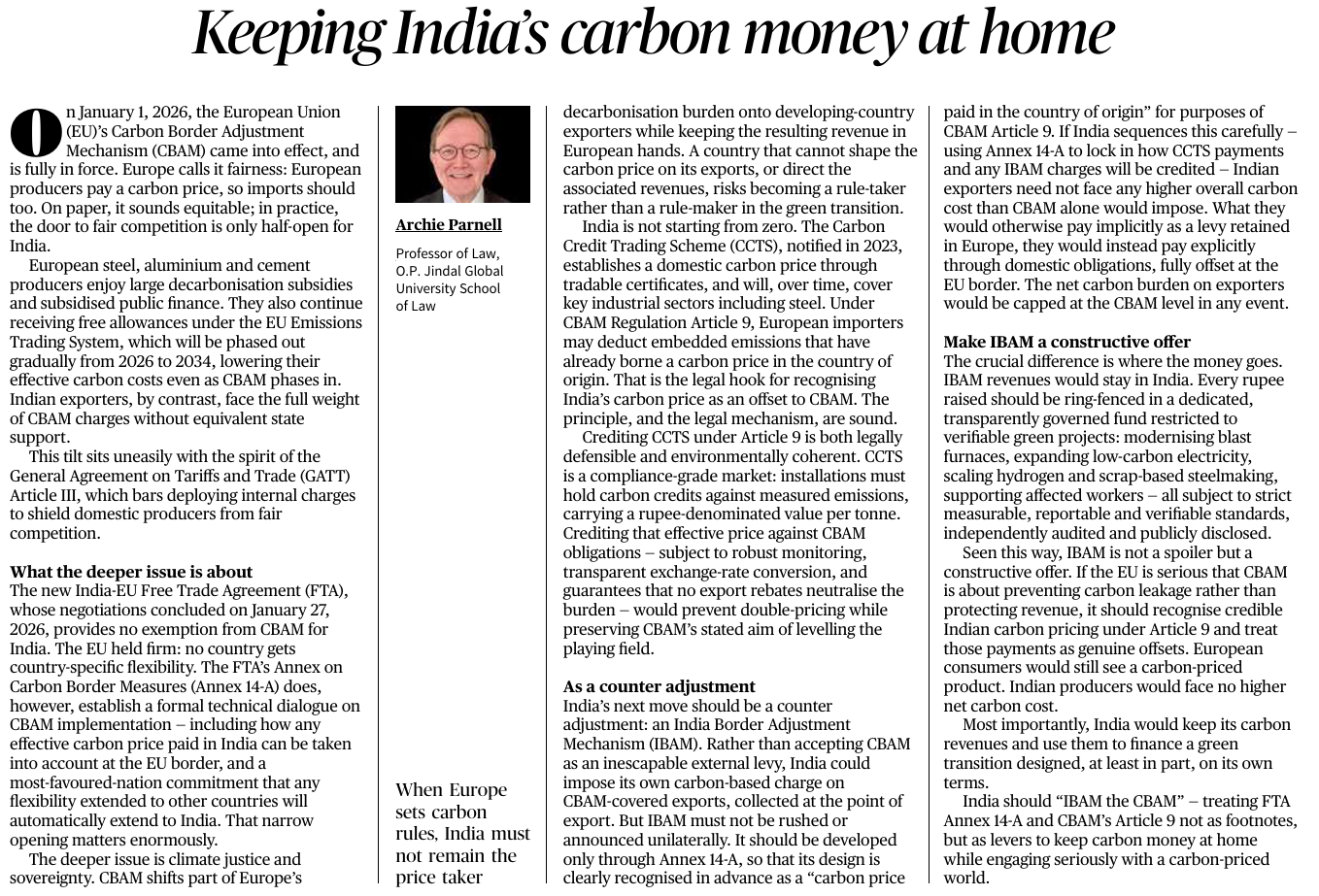
Keeping India’s carbon money at home
GS Paper III:
Environmental pollution & degradation
Climate change – policies & international agreements
Indian economy – external sector & trade policy
GS Paper II:
International relations – India-EU relations
Bilateral agreements (FTA)
Context
It imposes a carbon cost on imports (steel, aluminium, cement, etc.) entering the EU.
India faces competitive disadvantages, as EU producers already receive subsidies and free allowances.
The article argues that India should retain carbon revenues domestically rather than letting them flow to Europe.
Detailed Analysis
1. CBAM: Fair in Theory, Unequal in Practice
CBAM aims to create a level playing field by taxing imports based on carbon emissions.
However:
EU industries still receive subsidies and free emission allowances.
Indian exporters face full carbon costs without state support.
This creates a structural asymmetry, undermining fair competition.
2. Conflict with Global Trade Norms
CBAM potentially conflicts with GATT Article III:
It discourages discrimination against imports.
The mechanism:
Functions like a hidden protectionist tool.
Shifts decarbonisation burden onto developing countries.
3. The Deeper Issue: Climate Justice & Sovereignty
CBAM:
Transfers carbon revenues from developing countries to the EU.
Risks turning countries like India into “rule-takers” in global climate governance.
Raises concerns of:
Climate inequity
Loss of fiscal sovereignty
4. Opportunity in India-EU FTA
The India-EU Free Trade Agreement (FTA):
Does not exempt India from CBAM.
But Annex 14-A allows:
Recognition of carbon prices paid in India.
Technical dialogue on implementation.
This creates a policy window for India to negotiate.
5. India’s Existing Mechanism: CCTS
India has already introduced the Carbon Credit Trading Scheme (CCTS):
A domestic carbon pricing system.
Covers major industrial sectors.
Key advantage:
Under CBAM Article 9, carbon prices paid domestically can be credited against EU obligations.
👉 Implication:
India can avoid double taxation if its system is properly recognized.
6. Proposed Strategy: IBAM (India Border Adjustment Mechanism)
What is IBAM?
A domestic carbon charge on exports covered by CBAM.
Collected within India instead of EU borders.
Why IBAM matters:
Prevents revenue outflow to Europe.
Converts a loss into a domestic resource.
7. IBAM as a Constructive Policy Tool
Revenues can be channelled into:
Green industrial transition
Hydrogen and clean energy
Low-carbon steel production
Worker reskilling
Governance Principles Suggested:
Dedicated green transition fund
Transparency and auditability
Strict MRV (Measurable, Reportable, Verifiable standards)
8. Strategic Framing: “IBAM the CBAM”
India should:
Use FTA provisions + CBAM Article 9
Ensure domestic carbon payments are recognized internationally
Outcome:
No additional burden on exporters
Revenue retained domestically
Key Challenges
EU may resist recognizing India’s carbon pricing fully.
Institutional readiness for:
Monitoring emissions
Transparent credit systems
Risk of:
Trade tensions
Compliance complexity for exporters
Significance
Ensures economic sovereignty in climate policy
Supports domestic green industrialisation
Strengthens India’s position as a rule-maker, not rule-taker
Aligns climate goals with development priorities
Way Forward
Operationalise CCTS effectively with strong MRV systems
Negotiate firmly in FTA framework for recognition under CBAM
Introduce IBAM in a calibrated, WTO-compliant manner
Create a Green Transition Fund using carbon revenues
Build institutional capacity for carbon markets and compliance
Conclusion
The article highlights that CBAM is not just an environmental policy but a geoeconomic instrument. India’s response must go beyond compliance to strategic adaptation. By leveraging domestic carbon pricing and introducing IBAM, India can retain its carbon revenues, protect exporters, and finance its own green transition, thereby balancing climate responsibility with economic sovereignty.
UPSC Mains Question
Q. “Carbon border taxes are reshaping global trade dynamics.” Discuss their implications for India and suggest an appropriate policy response.
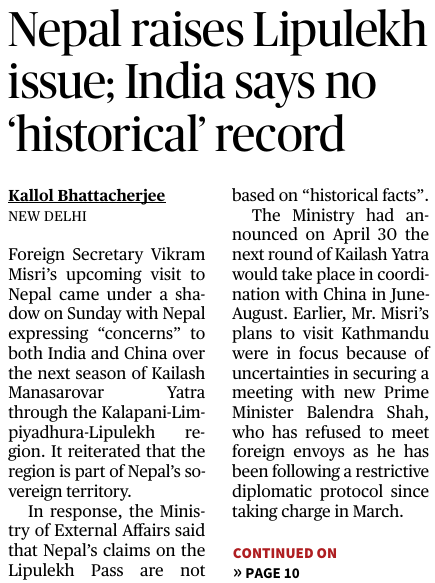
Nepal raises Lipulekh issue; India says no ‘historical’ record
GS Paper II:
India and its neighbourhood – relations
Bilateral relations – India-Nepal
Border disputes
Context
Nepal has raised concerns over the Lipulekh-Kalapani-Limpiyadhura region, claiming it as part of its sovereign territory.
India has rejected these claims, stating there is no historical basis.
The issue resurfaces ahead of the Kailash Mansarovar Yatra, which passes through this region.
Prelims concepts
1. Geographical Locations & Disputes
The article highlights a sensitive tri-junction area involving India, Nepal, and China.
Kalapani-Limpiyadhura-Lipulekh Region: A disputed territory located at the tri-junction of India, Nepal, and Tibet (China).
Lipulekh Pass: A Himalayan pass that serves as a vital link for trade and pilgrimage between India and the Tibet Autonomous Region of China.
Strategic Importance: This region is a point of contention as Nepal claims it as part of its sovereign territory, while India maintains its position based on historical administration and records.
2. International Relations & Pilgrimage
The diplomatic friction is currently centered around a major religious circuit.
Kailash Manasarovar Yatra: A significant pilgrimage to Mount Kailash and Lake Manasarovar in Tibet.
Diplomatic Coordination: The Yatra requires coordination between the Indian Ministry of External Affairs and Chinese authorities.
Transit Route: One of the primary routes for this pilgrimage passes through the Lipulekh region, which has led to Nepal expressing "concerns" over the upcoming season (June–August).
UPSC MCQ
Q. Consider the following statements regarding the Lipulekh-Kalapani-Limpiyadhura dispute:
The dispute between India and Nepal is primarily due to differing interpretations of the origin of the Kali River as defined in the Treaty of Sugauli (1816).
Lipulekh Pass is located at the tri-junction of India, Nepal, and Bhutan.
Which of the statements given above is/are correct?
(a) 1 only
(b) 2 only
(c) Both 1 and 2
(d) Neither 1 nor 2
Answer:
(a) 1 only
Explanation:
Statement 1 – Correct: The core issue is the disagreement over the origin of the Kali River.
Statement 2 – Incorrect: Lipulekh Pass lies at the India–Nepal–China (Tibet) tri-junction, not Bhutan.
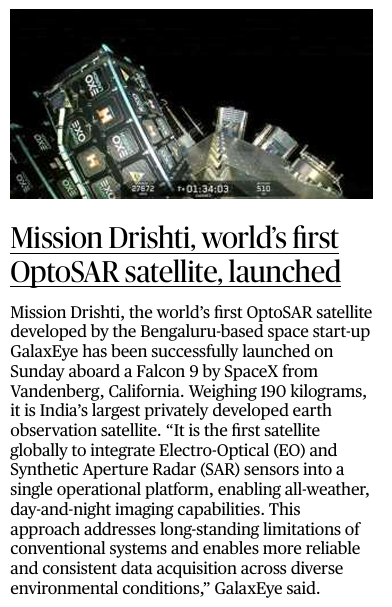
Mission Drishti, world’s first OptoSAR satellite, launched
GS Paper III:
Science & Technology – Space technology
Applications of space technology (remote sensing, earth observation)
Achievements of Indians in S&T
Context
Mission Drishti, developed by Bengaluru-based startup
GalaxEye, has been launched aboard a SpaceX Falcon 9 rocket.
Prelims concepts
Mission Overview
Mission Name: Mission Drishti.
Developer: GalaxEye, a private space start-up based in Bengaluru, India.
Launch Vehicle: Falcon 9 by SpaceX.
Launch Site: Vandenberg, California.
Key Milestone: It is India’s largest privately developed Earth observation satellite, weighing 190 kilograms.
Core Technology: OptoSAR
Mission Drishti is the world's first OptoSAR satellite, which integrates two distinct sensing technologies into a single operational platform:
A. Electro-Optical (EO) Sensors
Mechanism: These sensors function similarly to a high-powered camera, capturing visible light reflected from the Earth's surface.
Utility: Provides high-resolution, color-accurate imagery used for detailed visual identification.
B. Synthetic Aperture Radar (SAR)
Mechanism: An active sensing technology that emits microwave pulses and measures the reflection back to the satellite.
Utility: Unlike optical sensors, SAR can "see" through clouds, smoke, and darkness, providing data regardless of weather or lighting conditions.
Key Advantages for Earth Observation
The integration of EO and SAR addresses the limitations found in conventional, single-sensor systems:
All-Weather Imaging: The SAR component ensures the satellite remains functional during heavy cloud cover or monsoon seasons.
Day-and-Night Capability: Allows for consistent monitoring 24/7.
Reliable Data Acquisition: By combining both datasets, the satellite provides more comprehensive and consistent information across diverse environmental conditions.
UPSC MCQ
Q. Consider the following statements regarding Mission Drishti (OptoSAR satellite):
It is the world’s first satellite to integrate Electro-Optical (EO) and Synthetic Aperture Radar (SAR) sensors on a single platform.
Synthetic Aperture Radar (SAR) enables imaging only during clear weather and daylight conditions.
Which of the statements given above is/are correct?
(a) 1 only
(b) 2 only
(c) Both 1 and 2
(d) Neither 1 nor 2
Answer:
(a) 1 only
Explanation:
Statement 1 – Correct: Mission Drishti combines EO and SAR, enabling advanced observation capabilities.
Statement 2 – Incorrect: SAR works in all-weather, day-and-night conditions, unlike optical sensors which depend on light and clear skies.
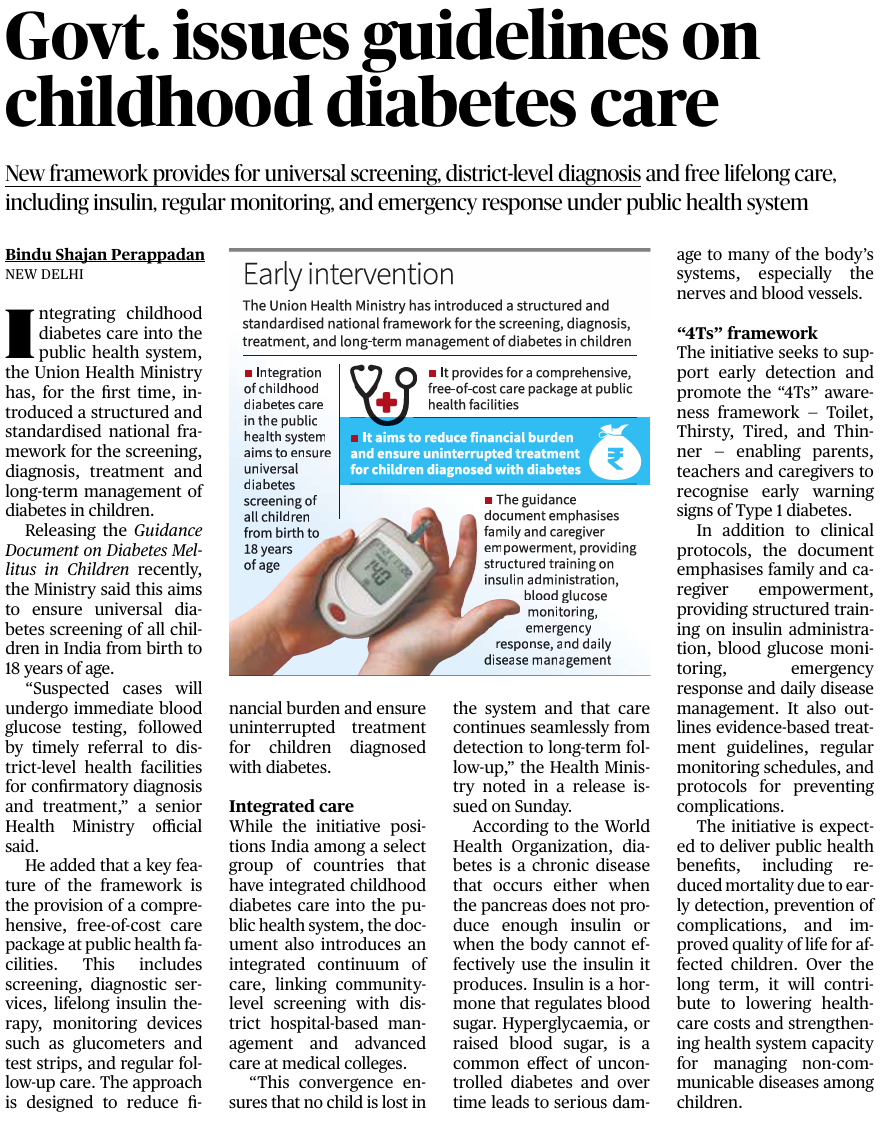
Govt. issues guidelines on childhood diabetes care
GS Paper II:
Issues relating to development and management of social sector (Health)
Government policies and interventions for vulnerable sections
GS Paper III:
Science & Technology in everyday life (health technologies like insulin, monitoring devices)
Context
The Union Health Ministry has introduced a structured national framework for screening, diagnosis, treatment, and long-term management of childhood diabetes.
It integrates childhood diabetes care into the public health system for the first time with universal screening and free lifelong care.
Prelims concepts
National Framework for Childhood Diabetes Care
The Union Health Ministry has introduced a "Guidance Document on Diabetes Mellitus in Children" to standardize the screening and management of diabetes in the pediatric population.
Target Group: Aims for universal screening of all children from birth to 18 years of age.
Three-Tier Care Integration: Links community-level screening with district hospital-based management and advanced care at medical colleges.
Free-of-Cost Care Package: Includes screening, diagnostic services, lifelong insulin therapy, and monitoring devices (like glucometers and test strips).
Objective: To reduce financial burden, ensure uninterrupted treatment, and lower mortality due to early detection.
Medical Concepts & Definitions
Understanding the biological basis mentioned in the framework is crucial for Science and Technology sections.
Concept
Description
Diabetes Mellitus
A chronic disease occurring when the pancreas does not produce enough insulin or the body cannot effectively use it.
Insulin
A hormone produced by the pancreas that regulates blood sugar.
Hyperglycaemia
Raised blood sugar levels; a common effect of uncontrolled diabetes.
Long-term Effects
Uncontrolled diabetes leads to serious damage to nerves and blood vessels over time.
The "4Ts" Awareness Framework
The initiative promotes the "4Ts" to help parents, teachers, and caregivers recognize early warning signs of Type 1 diabetes:
Toilet: Frequent urination.
Thirsty: Excessive thirst.
Tired: Extreme fatigue.
Thinner: Unexplained weight loss.
Public Health Significance
Global Positioning: This initiative places India among a select group of countries that have integrated childhood diabetes care into their public health systems.
NCD Management: It strengthens the health system’s capacity for managing Non-Communicable Diseases (NCDs) among children.
Caregiver Empowerment: Beyond clinical protocols, the document emphasizes training caregivers in insulin administration and emergency response.
Andaman sets two Guinness World Records in two days
GS Paper I:
Geography – Islands of India (Andaman & Nicobar)
GS Paper III:
Environment & biodiversity (marine ecosystem)
Tourism and economic development
Context
The Andaman and Nicobar Islands achieved two Guinness World Records:
Tallest underwater human stack at Swaraj Dweep
Largest underwater national flag display
These events aim to promote the islands as a global diving and eco-tourism destination.
Key Prelims Concepts
1. Geography & Places in News
Swaraj Dweep:
Former Name: Havelock Island.
Context: Renamed in 2018 as a tribute to Netaji Subhash Chandra Bose.
Significance: Known for its pristine marine ecosystem and is being promoted as a global diving destination.
Andaman and Nicobar Islands (ANI):
Location: An archipelago in the Bay of Bengal.
Strategic Importance: Acts as India’s maritime gateway to Southeast Asia.
2. Governance & Administration
Union Territory (UT) Structure:
The islands are administered by a Lieutenant Governor (Lt. Gov.) appointed by the President of India.
Tourism Promotion: The UT administration is actively using world-record feats to highlight "advanced diving capabilities" and boost the blue economy through tourism.





 Launch your Graphy