The Hindu Analysis 3rd June 2026 for UPSC, APPSC & TSPSC Exams

The Hindu News Analysis – 3rd June, 2026
1. The future of India’s chip industry (GS-2, GS-3)
2. The ‘harvest’ China wants is one India cannot afford (GS-2, GS-3)
3. Indigenous RudraM-II missile clears flight trials (GS-3)
4. Govt. to replace WPI with Producer Price Index, new series from June 15 (GS-3)
5. Odisha govt. clears key road for Vedanta’s mining project (GS-3)
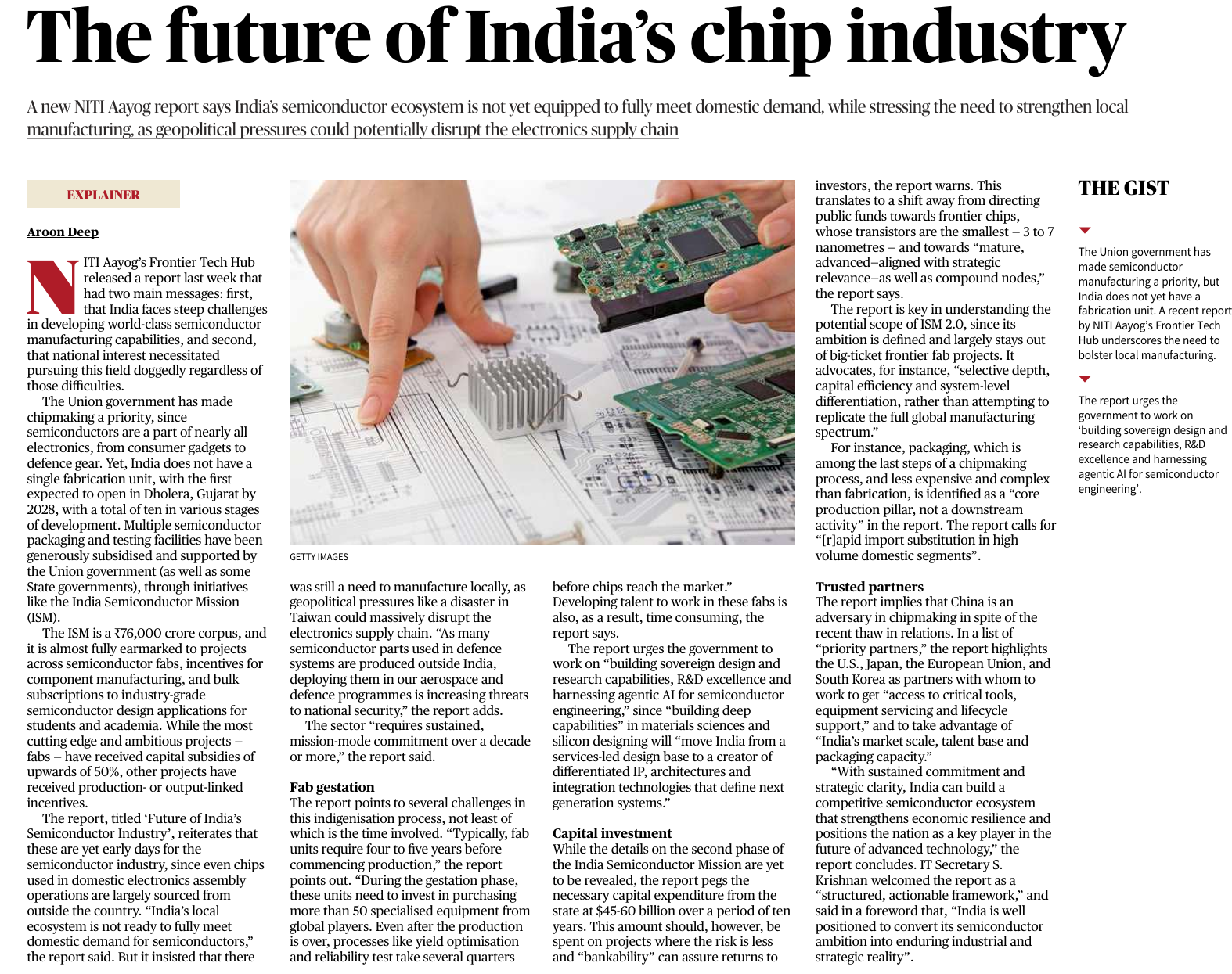
The future of India’s chip industry
GS Paper IIIScience and Technology – Developments and their Applications
Indigenization of Technology and Developing New Technology
Industrial Policy and Growth
Infrastructure: Electronics and Semiconductor Ecosystem
GS Paper II
Government Policies and Interventions for Development of Industries
Context
A recent
NITI Aayog report, "Future of India’s Semiconductor Industry", highlights that India's semiconductor ecosystem remains in its early stages and is not yet capable of fully meeting domestic demand. While significant policy support has been provided through the India Semiconductor Mission (ISM), the report emphasizes the need for sustained investments, indigenous capabilities, talent development, and strategic partnerships to build a globally competitive semiconductor industry.
Detailed Analysis
Challenges
1. Absence of Mature Fabrication Capacity
India currently lacks an operational semiconductor fabrication (fab) facility.
The first major fabrication plant is expected to become operational only in the coming years.
Dependence on imported chips continues across critical sectors.
2. High Capital Requirements
Semiconductor manufacturing requires enormous upfront investment.
Long gestation periods make projects financially risky.
Investor confidence depends on stable policy support over decades.
3. Long Gestation Period
Fab facilities generally take 4–5 years before commercial production begins.
Yield optimization and reliability testing require additional time.
Returns on investment are slow compared to other manufacturing sectors.
4. Dependence on Foreign Equipment and Inputs
Advanced manufacturing equipment is sourced from a limited number of countries.
Supply-chain disruptions can affect domestic production plans.
5. Talent and Skill Deficit
Advanced chip manufacturing requires highly specialized engineers and researchers.
Need for expertise in:
Semiconductor design
Materials science
Process engineering
Artificial Intelligence-driven chip design
6. Geopolitical Vulnerabilities
Global semiconductor supply chains are concentrated in a few regions.
Geopolitical tensions, particularly in East Asia, can disrupt supplies.
Dependence on imports poses risks to economic and national security.
Why Semiconductor Self-Reliance Matters
1. National Security Imperative
Semiconductors are critical for defence systems, surveillance technologies, aerospace and strategic communications.
Reduces dependence on external suppliers for sensitive technologies.
2. Economic Resilience
Minimizes vulnerability to global supply chain disruptions.
Supports stable growth of India's electronics manufacturing sector.
3. Technological Sovereignty
Enhances India's ability to develop and control critical technologies.
Supports the vision of Atmanirbhar Bharat in high-tech sectors.
4. Enabling Digital Transformation
Forms the backbone of emerging technologies such as:
Artificial Intelligence (AI)
Internet of Things (IoT)
5G/6G networks
Electric Vehicles (EVs)
Data Centres
5. Global Competitiveness
Helps India integrate into global semiconductor value chains.
Creates opportunities for exports, innovation and high-skilled employment.
6. Strategic Positioning in Geopolitics
Semiconductors have become a key arena of global technological competition.
A strong domestic ecosystem enhances India's bargaining power and strategic autonomy.
Way Forward
Strengthen the India Semiconductor Mission (ISM) with sustained policy and financial support.
Focus on chip design, advanced packaging, and specialty semiconductors.
Invest in R&D, skilled manpower, and industry-academia collaboration.
Expand ATMP (Assembly, Testing, Marking and Packaging) capabilities.
Build trusted international partnerships for technology and supply-chain resilience.
Conclusion
India's semiconductor journey requires sustained policy support, investment, innovation, and skilled manpower. By focusing on its comparative advantages and strengthening domestic capabilities, India can emerge as a resilient and globally competitive semiconductor hub.
UPSC Mains question
Q. India's quest for semiconductor self-reliance is both an economic necessity and a strategic imperative. Discuss the challenges in developing a robust semiconductor ecosystem in India and suggest measures to strengthen the sector.
 The ‘harvest’ China wants is one India cannot afford
GS Paper II
India and its neighbourhood relations
Bilateral, regional and global groupings involving India
Effect of policies and politics of developed and developing countries on India's interests
GS Paper III
Security challenges and their management in border areas
Internal security and border management
Context
The article discusses China's renewed proposal for an “early harvest” approach to resolving the India–China boundary dispute, particularly in the Sikkim sector. The author argues that accepting a sector-wise settlement instead of a comprehensive package settlement could undermine India's long-term strategic interests and strengthen China's position in sensitive border regions.
Detailed Analysis
Historical Background
Evolution of Boundary Negotiations
India and China have held several rounds of negotiations to resolve the boundary dispute.
The 2005 Agreement on Political Parameters and Guiding Principles envisaged a package settlement covering all sectors of the boundary dispute.
The agreement established a sequence:
Political parameters
Framework for settlement
Delineation and demarcation
China's “Early Harvest” Proposal
First floated by Chinese Ambassador Luo Zhaohui in 2017.
Suggests resolving relatively less contentious sectors first and leaving difficult sectors for later.
India has traditionally opposed this approach, fearing an unequal exchange of concessions.
Challenges
1. Risk of Fragmenting the Package Settlement
Sector-wise negotiations may dilute the comprehensive approach envisaged in the 2005 agreement.
China could secure gains in favourable sectors while delaying settlement elsewhere.
2. Strategic Vulnerability in Sikkim
Sikkim is linked to the India–Bhutan–China tri-junction issue.
Any settlement based on China's interpretation could strengthen Beijing's claims near the Siliguri Corridor, India's narrow link to the Northeast.
3. Doklam Implications
China has expanded infrastructure and military presence near Doklam after the 2017 standoff.
A Sikkim-focused settlement may increase pressure on Bhutan regarding its boundary negotiations with China.
4. Normalisation without Resolution
China may seek diplomatic progress while maintaining advantages on the ground.
There is concern that talks could become a mechanism for managing perceptions rather than solving disputes.
5. Continued Tensions Along the LAC
Since the 2020 Eastern Ladakh crisis, trust between the two countries has eroded.
Border management remains fragile despite ongoing dialogue.
Significance
For India
Preserves negotiating leverage across all sectors.
Protects strategic interests around the Siliguri Corridor and Bhutan.
Prevents creation of precedents that could affect future territorial claims.
For Regional Stability
A durable settlement would reduce military tensions.
Greater border stability can improve broader India–China relations.
For International Relations
Demonstrates India's commitment to negotiated solutions while safeguarding sovereignty.
Reinforces principles of territorial integrity and status quo.
Way Forward
1. Adhere to the 2005 Framework
Maintain commitment to a comprehensive package settlement.
Avoid standalone agreements that undermine overall negotiations.
2. Link Progress to Peace and Tranquillity
Restoration of normalcy along the Line of Actual Control (LAC) should remain a prerequisite for broader progress.
3. Strengthen Coordination with Bhutan
Ensure close consultation on tri-junction and Doklam-related issues.
Protect mutual strategic interests in the Himalayan region.
4. Enhance Border Infrastructure and Surveillance
Continue improving connectivity, logistics and military preparedness in border areas.
5. Pursue Sustained Political Engagement
Maintain diplomatic channels while ensuring negotiations are backed by strategic clarity and reciprocity.
Conclusion
The article argues that China's proposal for an “early harvest” settlement in Sikkim may appear pragmatic but could weaken India's long-term negotiating position. Given the strategic significance of the India–China boundary dispute, especially after the 2020 Ladakh crisis, India should continue to pursue a comprehensive settlement framework, ensure stability along the LAC, and avoid concessions that provide short-term diplomatic gains at the cost of long-term national interests.
UPSC Mains Question
Q. India–China boundary negotiations involve not only territorial issues but also wider strategic and geopolitical considerations. Examine the challenges associated with sector-wise settlement proposals and discuss the way forward for a durable boundary resolution. (250 words)

Indigenous RudraM-II missile clears flight trials
GS Paper III
Achievements of Indians in Science & Technology
Indigenization of Technology and Developing New Technology
Defence Technology and Security
Context
The Defence Research and Development Organisation (DRDO) and the Indian Air Force (IAF) successfully completed flight trials of the indigenous RudraM-II air-to-surface missile. The trials validated all critical subsystems and flight parameters, marking a significant milestone in India's pursuit of self-reliance in advanced defence technologies.
Prelims Concepts:
RudraM-II Missile
Name: RudraM-II
Type: Air-to-Surface missile.
Origin: Indigenously developed in India.
Developing Agency: Defence Research and Development Organisation (DRDO).
Primary User: Indian Air Force (IAF).
Strategic Significance
Precision Strike: Designed to strengthen India's precision strike capabilities.
Indigenization: Marks a significant milestone in advancing self-reliance (Atmanirbhar Bharat) in defence technology.
Testing and Validation
Launch Platform: Test-fired from an airborne platform (fighter aircraft) under extreme release conditions.
Testing Facility: Monitored and validated by the Integrated Test Range (ITR) located in Chandipur (Odisha).
Validation: The flight trials successfully validated the performance of all critical subsystems and flight parameters through a network of tracking instruments.
UPSC MCQ
Q. Consider the following statements regarding the RudraM-II missile:
1. RudraM-II is an indigenously developed air-to-surface missile designed for precision strike missions.
2. The missile has been developed jointly by the Indian Air Force and Hindustan Aeronautics Limited (HAL).
Which of the statements given above is/are correct?
(a) 1 only
(b) 2 only
(c) Both 1 and 2
(d) Neither 1 nor 2
Answer: (a) 1 only
Explanation:
Statement 1 is correct. RudraM-II is an indigenous air-to-surface missile developed to enhance precision strike capabilities.
Statement 2 is incorrect. The missile has been developed by the Defence Research and Development Organisation (DRDO), not jointly by the IAF and HAL.
Govt. to replace WPI with Producer Price Index, new series from June 15
GS Paper III
Indian Economy and issues relating to Planning, Mobilization of Resources
Inflation and Monetary Policy
Growth and Development
Context
The Government has announced a gradual transition from the Wholesale Price Index (WPI) to the Producer Price Index (PPI) over the next five years. The Department for Promotion of Industry and Internal Trade (DPIIT) will release new series of Output PPI, Trial Input PPI, and Services PPI, aiming to provide a more comprehensive measure of inflation across the economy.
Prelims Concepts:
Transition from WPI to PPI
1. The Major Policy Shift
The Transition: The Central Government will phase out the Wholesale Price Index (WPI) over the next five years and replace it with a more detailed Producer Price Index (PPI).
Transition Period: Both indices (revised WPI and new PPI) will be released concurrently for the next five years to allow users to adjust, after which WPI will be completely discontinued.
Rationale: To offer a more realistic assessment of inflationary trends in the economy. It aligns with global best practices adopted by advanced economies and the recommendations of the International Monetary Fund (IMF).
2. Updates to the Wholesale Price Index (WPI)
Releasing Agency: Department for Promotion of Industry and Internal Trade (DPIIT) under the Ministry of Commerce and Industry.
New Base Year: The base year for the WPI series is being updated to 2022-23 (replacing the existing 2011-12 base year).
Frequency: Compiled on a monthly basis.
3. Producer Price Index (PPI) Framework
Releasing Agency: DPIIT.
Structure: The new PPI will have three specific indices:
Output PPI: Tracks price movements of goods produced. (Compiled monthly).
Trial Input PPI: Tracks price movements of items used as inputs in an industry.
Services PPI: Tracks prices in the services sector.
Economic Significance: Having both Input and Output PPIs helps in understanding how inflation experienced by producers of raw materials (inputs) is passed through to the final goods they produce (output).
4. Focus on Services PPI
Initial Coverage: In its first phase, the Services PPI will cover seven specific services:
Banking
Securities Transaction
Insurance
Management of Pension Funds
Railways
Air (Passenger)
Telecom
More services will be added in subsequent phases based on data availability.
WPI vs. PPI: Key Differences
Feature
Wholesale Price Index (WPI)
Producer Price Index (PPI)
Scope of Coverage
Covers only Goods (Primary Articles, Fuel & Power, Manufactured Products).
Covers both Goods and Services.
Point of Measurement
Measures prices at the wholesale level (first point of bulk transaction).
Measures basic prices received strictly at the producer's gate (ex-factory).
Indirect Taxes
Excluded (since the 2011-12 base year revision).
Excluded.
Economic Utility
Tracks bulk transaction inflation in the economy.
Tracks the producer's exact cost burdens and pricing power by comparing input costs to output prices.
Prelims MCQ
Q. Consider the following statements regarding the Producer Price Index (PPI):
1. PPI measures price changes at the producer level and can include both goods and services.
2. The Wholesale Price Index (WPI) in India currently includes services as a major component.
Which of the statements given above is/are correct?
(a) 1 only
(b) 2 only
(c) Both 1 and 2
(d) Neither 1 nor 2
Answer: (a) 1 only
Explanation:
Statement 1 is correct. PPI measures price movements from the producer's perspective and can cover goods as well as services.
Statement 2 is incorrect. WPI primarily measures wholesale prices of goods and does not comprehensively cover services.
India losing ability to build its own instruments: climate science report
GS Paper III
Science and Technology – Indigenization of Technology
Environment and Climate Change
Conservation and Environmental Impact Assessment
Research and Development
GS Paper II
Government Policies and Interventions for Development of Science & Technology
Prelims Concepts:
Mega Science Vision-2035 (MSV) Report
The Mega Science Vision-2035 (MSV) exercise is historically utilized by the government to plan large-scale, long-horizon projects in complex fields such as nuclear and high-energy physics. Recently, this exercise was expanded to encompass new scientific domains, yielding a critical roadmap for the country's environmental strategy.
1. About the MSV Report on Climate Research
Expanded Scope: For the first time, the MSV exercise has been extended to cover climate research, ecology, and astronomy.
Nodal Institution: The report was prepared by the Indian climate research community with the Indian Institute of Science (IISc), Bengaluru, acting as the nodal institution.
Submission Authority: It was submitted to the Office of the Principal Scientific Adviser (PSA) to the Union government.
2. Core Challenges Identified
Scientific Credibility Deficit: India relies heavily on imported climate observation equipment that often remains uncalibrated, leading to incorrect data reporting and questioning the credibility of Indian science.
Procurement Bottlenecks (GeM Portal): The mandate to use the Government e-Marketplace (GeM) for public institutions forces procurement from the lowest-bidding registered vendors. This hampers scientists who require highly customized, premium-standard equipment, while alternative global tenders cause severe bureaucratic delays.
Renewable Energy Blindspots: The report cautions against the "uncontrolled" growth of renewable energy. It emphasizes that the long-term climate and ecological consequences of massive solar and wind plant installations remain poorly understood and require rigorous study.
3. Key Economic & Environmental Terminology
The MSV report advocates for the integration of specific economic principles into India's energy transition strategy to ensure accountability and accurate impact assessment.
Social Cost of Carbon: The report recommends devising scientific methods to estimate this cost, which is defined as the economic cost of damages resulting from emitting one extra ton of carbon dioxide into the atmosphere.
Polluter Pays Principle: A mechanism proposed to stop the atmosphere from being used as a "dumping ground" for emissions.
Indigenous Earth System Model: A major project proposal to build an Indian climate model from "first principles," distinguishing it from existing Indian models which are merely adaptations of U.S. or European models.
4. India's Climate Commitments (Factual Update)
Target: India has pledged to achieve 500 GW of non-fossil electricity capacity by 2030.
Progress Status: As per the article, India successfully crossed the halfway mark for installed electricity capacity from non-fossil sources in 2025.




 Launch your Graphy