The Hindu Analysis 2nd June 2026 for UPSC, APPSC & TSPSC Exams
The Hindu News Analysis – 2nd June, 2026
1. Why do cities get polluted in summer? (GS-3)
2. Industrial output slows to 4.9% in new data series (GS-3)
3. Centre clears five new judges for SC; strength rises to 37 (GS-2)
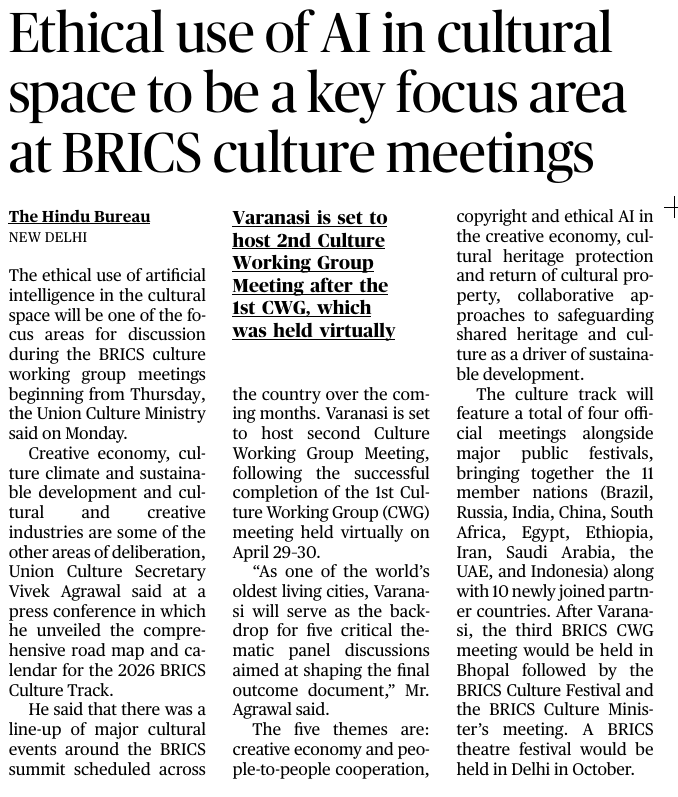
4. Ethical use of AI in cultural space to be a key focus area at BRICS culture meetings (GS-2, GS-3, GS-1)
5. Delhi HC recognises ‘right to be forgotten’, lays down rules for de-indexing judicial records (GS-2, GS-3)
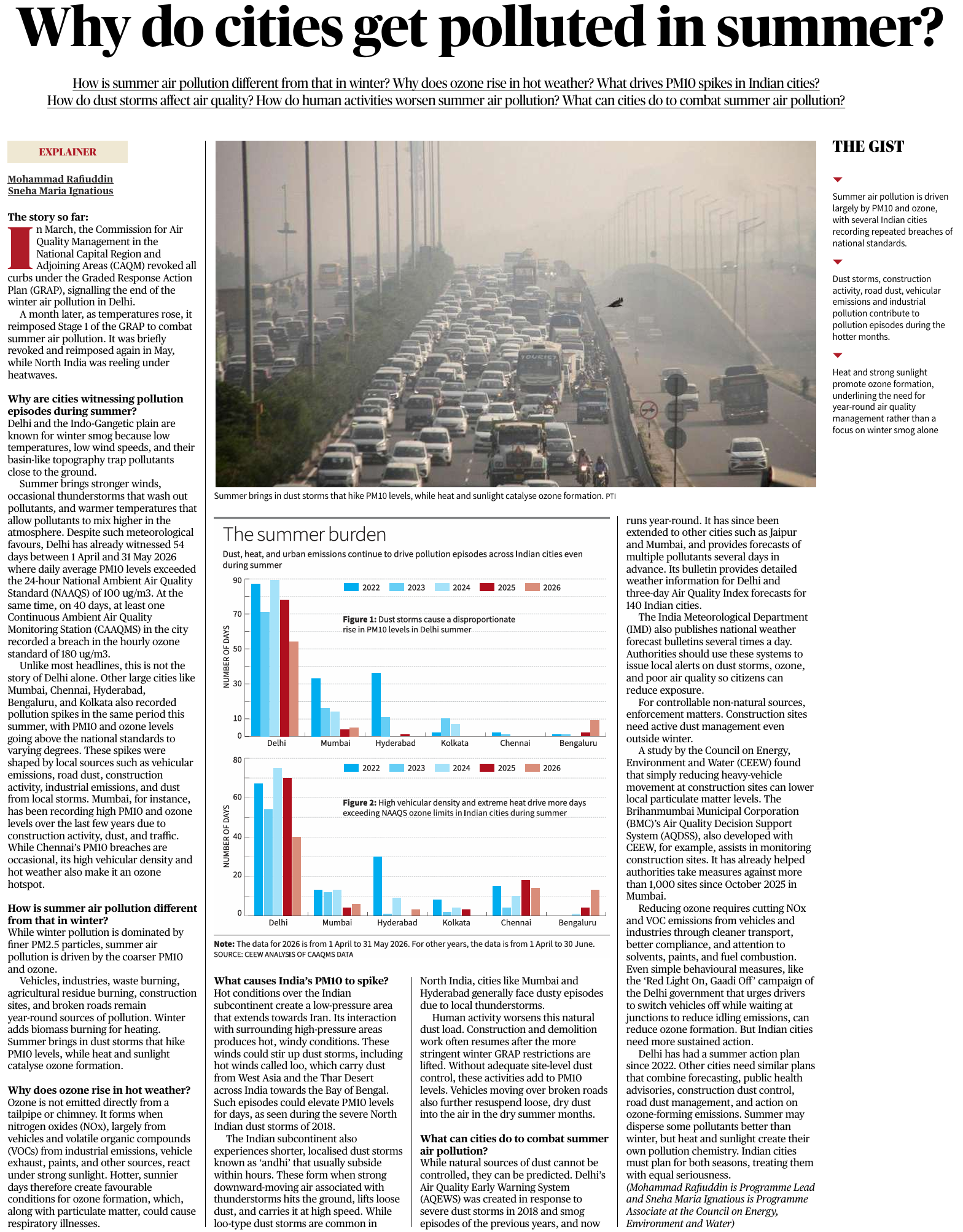
Why do cities get polluted in summer?
GS Paper III
Environmental Pollution and Degradation
Conservation and Environmental Impact Assessment
Disaster Management (Dust Storms and Heatwaves)
Urban Environmental Challenges
Context
The Commission for Air Quality Management (CAQM) recently revoked and reimposed restrictions under the Graded Response Action Plan (GRAP) in Delhi due to rising summer pollution levels. Contrary to the common perception that air pollution is mainly a winter phenomenon, several Indian cities experience significant pollution episodes during summer driven by PM10 dust and ground-level ozone.
Detailed Analysis
Why are cities witnessing pollution episodes during summer?
1. Rise in PM10 Concentration
Summer pollution is dominated by PM10 (coarse particulate matter) rather than PM2.5.
Major sources:
Dust storms from western India and the Thar Desert
Road dust resuspension
Construction and demolition activities
Vehicular movement on unpaved roads
Industrial emissions
2. Dust Storms and Strong Winds
Hot conditions create low-pressure zones over northwestern India.
Strong winds transport dust across large regions.
Dust storms can sharply increase PM10 concentrations for several days.
3. Urban Activities
Human activities amplify natural dust:
Construction work
Mining operations
Heavy traffic
Poor road maintenance
Open dumping of debris
4. Regional Variations
Different cities experience different pollution drivers:
City
Major Summer Pollutant
Delhi
PM10 from dust storms
Mumbai
Dust and local thunderstorm-related episodes
Hyderabad
Dust storms and ozone formation
Chennai
Ozone due to heat and traffic emissions
Bengaluru
Mixed urban pollution sources
How is summer air pollution different from winter pollution?
Aspect
Winter Pollution
Summer Pollution
Dominant Pollutant
PM2.5
PM10 and Ozone
Meteorology
Low temperature, stagnant air
High temperature, strong sunlight
Dispersion
Poor
Better but dust transport increases
Major Sources
Biomass burning, heating, vehicles
Dust storms, road dust, construction, ozone formation
Visibility
Dense smog
Dust haze and photochemical smog
Winter
Temperature inversion traps pollutants near the surface.
Calm winds reduce dispersion.
Biomass burning and heating emissions increase.
Summer
Strong winds disperse some pollutants but transport large quantities of dust.
High temperatures accelerate chemical reactions leading to ozone formation.
Why does ozone rise in hot weather?
Formation of Ground-Level Ozone
Ozone is a secondary pollutant.
It forms when:
Nitrogen Oxides (NOx)
Volatile Organic Compounds (VOCs)
react under strong sunlight.
Factors Promoting Ozone Formation
High temperatures
Intense solar radiation
Vehicular emissions
Industrial emissions
Paints and solvents
Impacts
Respiratory illnesses
Asthma aggravation
Reduced lung function
Crop damage
Ecosystem stress
Significance of the Issue
Public Health Concerns
Increased respiratory diseases
Cardiovascular risks
Greater vulnerability among children and elderly
Economic Costs
Productivity losses
Increased healthcare expenditure
Work disruptions during severe pollution episodes
Environmental Impact
Damage to vegetation
Reduced agricultural productivity
Degradation of urban ecosystems
Governance Challenge
The focus on winter smog often leads to neglect of year-round air quality management.
Challenges
Natural Sources Difficult to Control
Dust storms cannot be prevented.
Climate variability may intensify extreme weather events.
Weak Urban Dust Management
Poor enforcement at construction sites.
Inadequate road cleaning.
Lack of paved shoulders and dust barriers.
Rising Vehicle Emissions
Growing urban traffic generates NOx and VOC emissions.
Traffic congestion increases idling emissions.
Limited Public Awareness
Citizens often associate pollution only with winter smog.
Ozone pollution remains poorly understood.
What can cities do to combat summer air pollution?
Improve Dust Control
Mechanized road sweeping
Water sprinkling at construction sites
Covering construction material
Strict dust-management protocols
Strengthen Forecasting Systems
Expand early-warning systems for:
Dust storms
Ozone episodes
Heatwave-linked pollution
Reduce Vehicular Emissions
Promote public transport
Encourage electric mobility
Reduce traffic congestion
Enforce anti-idling measures
Integrated Air Quality Management
Year-round monitoring
City-specific pollution strategies
Coordination among urban local bodies, pollution control boards, and meteorological agencies
Way Forward
Shift from a winter-centric approach to a year-round air quality strategy.
Integrate air pollution management with heatwave action plans.
Develop city-specific interventions targeting local pollution sources.
Strengthen dust-control regulations and enforcement.
Reduce ozone precursors through cleaner transport and industrial practices.
Improve forecasting and public alert systems to minimize exposure.
Conclusion
Summer air pollution is emerging as a major environmental and public health challenge in Indian cities. While winter smog remains a serious concern, rising PM10 levels from dust storms and increasing ozone formation due to heat and sunlight demand equal policy attention. Effective air quality management requires a continuous, season-sensitive, and city-specific approach rather than focusing solely on winter pollution episodes.
UPSC Mains Question
Q. Air pollution in India is increasingly becoming a year-round challenge rather than a seasonal winter phenomenon. Discuss the causes of summer air pollution in Indian cities and suggest measures for effective air quality management throughout the year.
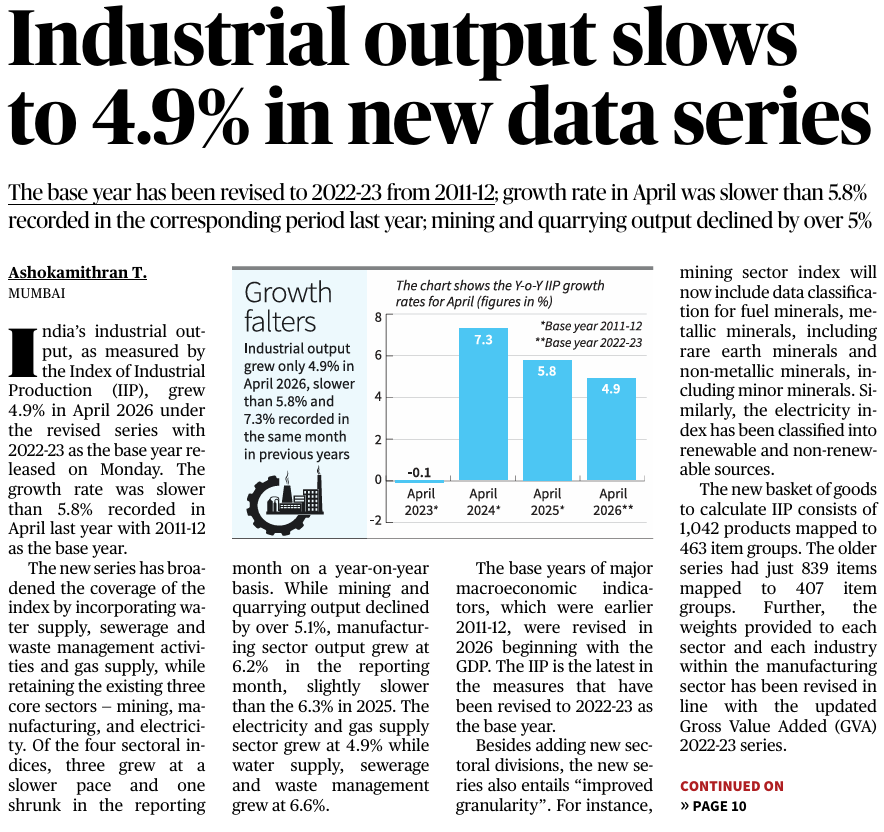 Industrial output slows to 4.9% in new data series
GS Paper III
Indian Economy and Planning
Inclusive Growth and Industrial Development
Infrastructure and Core Industries
Context
India's Index of Industrial Production (IIP) grew by 4.9% in April 2026 under the revised series with 2022-23 as the new base year, compared to 5.8% growth in April 2025 and 7.3% in April 2024. The revised series expands sectoral coverage and aligns industrial statistics with the updated Gross Value Added (GVA) framework.
What is the Index of Industrial Production (IIP)?
It is a composite indicator measuring short-term changes in industrial output.
Compiled by the National Statistical Office (NSO).
Released monthly.
Tracks production across major industrial sectors.
Revision of Base Year
Base years are periodically revised to:
Reflect structural changes in the economy.
Incorporate new products and industries.
Improve statistical accuracy.
Align with national income accounting practices.
Old Base Year: 2011-12
New Base Year: 2022-23
Significance of the Revised IIP Series
1. Better Representation of the Economy
Inclusion of sectors such as:
Water supply
Sewerage
Waste management
Gas supply
2. Improved Granularity
Fuel minerals, rare earth minerals, and non-metallic minerals are separately classified.
Electricity sector classification improved into renewable and non-renewable sources.
3. Wider Product Coverage
Indicator
Old Series
New Series
Products
839
1,042
Item Groups
407
463
4. Better Policy Formulation
Provides more accurate assessment of industrial trends.
Helps RBI and government formulate monetary and industrial policies.
5. Alignment with GVA Series
Sectoral weights revised according to the latest economic structure.
UPSC MCQ
Q. Consider the following statements regarding the Index of Industrial Production (IIP):
1. The base year of the latest IIP series has been revised from 2011-12 to 2022-23.
2. The revised IIP series includes water supply, sewerage, waste management and gas supply as a separate sector.
3. The Index of Industrial Production measures changes in the value of industrial output at current market prices.
Which of the statements given above is/are correct?
(a) 1 and 2 only
(b) 2 and 3 only
(c) 1 and 3 only
(d) 1, 2 and 3
Answer: (a) 1 and 2 only
Explanation:
Statement 1: Correct.
Statement 2: Correct.
Statement 3: Incorrect. IIP measures changes in the volume of production, not the value of output at current market prices.
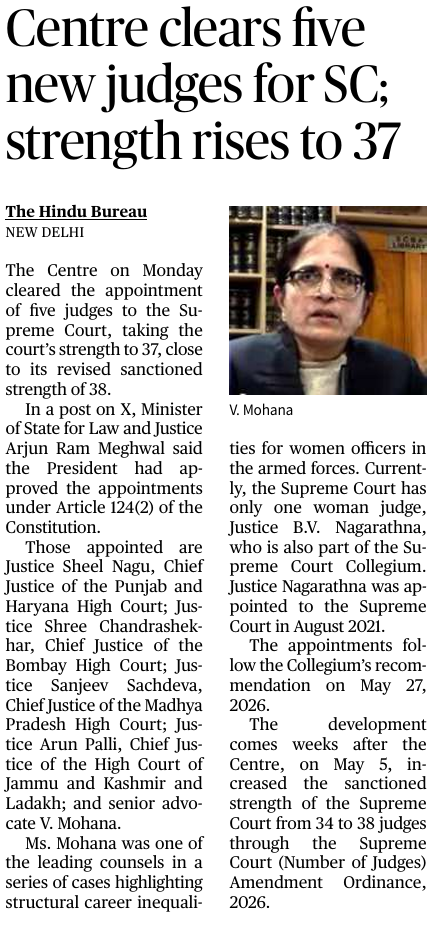
Centre clears five new judges for SC; strength rises to 37
GS Paper II
Structure, Organisation and Functioning of the Judiciary
Separation of Powers
Appointment to Various Constitutional Posts
Judicial Reforms
Context
The Union Government has approved the appointment of five judges to the Supreme Court, increasing its working strength from 32 to 37 judges, close to the sanctioned strength of 38 judges. The appointments were made by the President under Article 124(2) following recommendations of the Supreme Court Collegium.
Prelims concepts
1. Constitutional Provisions for Judicial Appointments
Appointment of Supreme Court Judges
The Provision: Article 124(2) states that every Judge of the Supreme Court shall be appointed by the President by warrant under his hand and seal after consultation with such of the Judges of the Supreme Court and of the High Courts in the States as the President may deem necessary for the purpose.
The Collegium Element: In practice, this "consultation" has been interpreted by the Supreme Court (through the Three Judges Cases) to mean "concurrence" of the Supreme Court Collegium. The executive clearances follow the formal recommendations made by the Collegium.
2. Sanctioned Strength of the Supreme Court
Power to Increase Strength
A major takeaway from the article is the recent shift in the court's maximum capacity.
Parliamentary Authority: Under Article 124(1) of the Constitution, it is Parliament that has the power to prescribe and increase the strength of the Supreme Court. The Constitution originally provided for a Chief Justice and 7 other Judges, leaving room for Parliament to increase this number by law.
The Recent Amendment: Centre recently increased the sanctioned strength of the Supreme Court from 34 to 38 judges through the Supreme Court (Number of Judges) Amendment Ordinance, 2026.
Current Status: With the appointment of the 5 new judges mentioned in the text, the working strength of the Supreme Court has risen to 37 judges, leaving it just one short of its newly revised sanctioned strength of 38.
3. Channels of Appointment to the Supreme Court
From the High Court Bench (Judicial Service): Elevation of sitting High Court Chief Justices or Judges.
Examples from text: Justice Sheel Nagu (Punjab and Haryana HC), Justice Shree Chandrashekhar (Bombay HC), Justice Sanjeev Sachdeva (Madhya Pradesh HC), and Justice Arun Palli (Jammu and Kashmir and Ladakh HC).
Directly from the Bar (Advocates): Elevation of a Senior Advocate directly to the Supreme Court bench.
Example from text: Senior Advocate V. Mohana.
Prelims Note: This fits under the constitutional qualification criteria of having been an advocate of a High Court (or two or more such Courts in succession) for at least 10 years.
UPSC MCQ
Q. Consider the following statements regarding the Supreme Court of India:
1. The President appoints Supreme Court judges under Article 124(2) of the Constitution.
2. The sanctioned strength of the Supreme Court was increased from 34 to 38 judges in 2026.
3. Every judge appointed to the Supreme Court must necessarily be a serving Chief Justice of a High Court.
Which of the statements given above is/are correct?
(a) 1 and 2 only
(b) 2 and 3 only
(c) 1 and 3 only
(d) 1, 2 and 3
Answer: (a) 1 and 2 only
Explanation:
Statement 1: Correct. Supreme Court judges are appointed by the President under Article 124(2).
Statement 2: Correct. The sanctioned strength was increased from 34 to 38 judges through legislative action.
Statement 3: Incorrect. A Supreme Court judge may be appointed from among High Court judges or directly from the Bar as a distinguished jurist/senior advocate meeting constitutional qualifications. V. Mohana's appointment is an example of elevation from the Bar.
Ethical use of AI in cultural space to be a key focus area at BRICS culture meetings
GS Paper II
Important International Groupings and Agreements
GS Paper III
Artificial Intelligence
Intellectual Property Rights
Indigenization of Technology
GS Paper I
Indian Culture
Conservation of Heritage
Context
India, under its 2026 BRICS Chairship, is hosting a series of BRICS Culture Working Group (CWG) meetings. A major theme of these discussions is the ethical use of Artificial Intelligence (AI) in the cultural sector, focusing on copyright protection, cultural heritage preservation, creative industries, and sustainable cultural development.
Varanasi will host the Second Culture Working Group Meeting, following the first virtual meeting held in April 2026.
Prelims concepts
Institutional Framework: BRICS Culture Track (2026)
The article details the operational structure and execution of the BRICS cultural cooperation pillar.
Nodal Ministry (India): The Union Ministry of Culture is the anchor body driving the domestic execution of these meetings.
Structure of the Culture Track: The institutional roadmap for the 2026 Culture Track features a total of four official meetings alongside major public festivals, culminating in the BRICS Culture Minister’s meeting.
Chronology of the Culture Working Group (CWG) Meetings:
1st CWG Meeting: Held virtually on April 29–30.
2nd CWG Meeting: Hosted physically in Varanasi, Uttar Pradesh.
3rd CWG Meeting: Scheduled to be held in Bhopal, Madhya Pradesh.
Allied Events: The calendar also includes a BRICS Culture Festival and a BRICS theatre festival scheduled to be held in Delhi in October.
3. Core Thematic Pillars and Policy Focus Areas
The core deliberations are structured around five critical thematic panel discussions aimed at shaping the final outcome document.
The 5 Core Themes:
Creative economy and people-to-people cooperation (including copyright and ethical AI in the creative economy).
Cultural heritage protection and the return of cultural property.
Collaborative approaches to safeguarding shared heritage.
Culture as a driver of sustainable development.
Culture climate and sustainable development / cultural and creative industries.
Emerging Tech Intersection: A primary focus area highlighted by the article is the governance of emerging technologies—specifically emphasizing the ethical use of Artificial Intelligence (AI) and copyright frameworks within the cultural space and creative economy.
 Delhi HC recognises ‘right to be forgotten’, lays down rules for de-indexing judicial records
GS Paper II
Judiciary
Fundamental Rights
Right to Privacy
GS Paper III
Cyber Security
Data Protection
Information Technology
Context
The Delhi High Court has recognized the "Right to be Forgotten" (RTBF) as an aspect of the Right to Privacy under Article 21 of the Constitution. The Court laid down a framework for de-indexing judicial records and masking personal information from publicly accessible digital platforms where continued disclosure no longer serves a legitimate public purpose.
The judgment arose from petitions seeking removal of personal information from search engine results and online judicial databases.
Prelims concepts
1. Constitutional Basis of the 'Right to be Forgotten'
The judgment by the Delhi High Court firmly anchors this evolving legal concept within existing fundamental rights.
Constitutional Source: The Delhi High Court held that the "right to be forgotten" flows directly from the constitutional right to privacy under Article 21 (Protection of life and personal liberty).
Core Definition: It enables individuals to seek the removal or restriction of their personal information from public digital accessibility.
The Balancing Test: This right is not absolute; it is triggered when the digital availability of such personal data no longer serves a legitimate public purpose.
2. Status of Statutory Legislation vs. Judicial Enforcement
Absence of Specific Statutory Framework: The court explicitly remarked that "India presently lacks a comprehensive statutory framework explicitly governing the right to be forgotten".
Role of Constitutional Courts: The High Court clarified that the lack of specific legislation does not preclude constitutional courts (the Supreme Court and High Courts) from recognizing and enforcing this fundamental right under their constitutional jurisdiction.
3. Operational Mechanics: De-indexing and Masking
The judgment lays down a functional framework for how the right to be forgotten is to be practically executed within the legal and digital ecosystem.
De-indexing: This rules that search engines, legal database platforms, and other digital intermediaries can be directed to remove specific judgments, orders, and related reportage from name-based search results. It removes the digital pathway to the file rather than deleting the original record entirely.
Masking: This involves redacting or hiding personal identifiers directly from publicly accessible court records to protect individual identities.
4. Targeted Beneficiaries / Grounds for Relief
The framework outlines who can claim a grievance based on "disproportionate and continuing harm to their reputations, dignity, and life prospects" due to name-based searchability. The court identified specific categories of affected individuals:
Persons who have been acquitted of criminal charges.
Parties involved in matrimonial disputes.
Persons whose legal proceedings have been quashed or settled.
Individuals whose names appeared incidentally in judicial records.





 Launch your Graphy