The Hindu Analysis 29th May 2026 for UPSC, APPSC & TSPSC Exams


The Hindu News Analysis – 29th May, 2026
1. A revival of sedition tied to consent (GS-2, GS-3)
2. Chandrayaan-2 finds ‘possible presence’ of ice in lunar south pole
(GS-3)
3. India, China hold talks on border delimitation (GS-2, GS-3)
4. 36 regional parties record income decline (GS-2)
5. Power shift in Karnataka as Siddaramaiah resigns (GS-2, GS-4)
A revival of sedition tied to consent
GS Paper II
Fundamental Rights
Judiciary and judicial review
Separation of powers
Government policies and issues arising out of implementation
GS Paper III
Internal security laws
Role of media and free speech in democracy
Context
The Supreme Court on May 21 clarified that trials, appeals, and proceedings under Section 124A (sedition) of the Indian Penal Code may continue if the accused persons consent to face trial. This partially revives sedition proceedings even while the constitutional validity of the provision remains pending before the Supreme Court in the Vombatkere case.
Historical Background
Origin of Sedition Law
Sedition traces its roots to the British colonial period.
It emerged from the English Statute of Westminster, 1275.
Section 124A IPC was introduced by the British to suppress nationalist dissent.
Post-Independence Debate
Jawaharlal Nehru called sedition “highly objectionable and obnoxious”.
Despite criticism, the provision continued in the statute book.
Kedar Nath Singh Case (1962)
The Supreme Court upheld sedition law but narrowed its scope:
Mere criticism of the government is not sedition.
Only speech inciting violence or public disorder can attract punishment.
Detailed Analysis
Supreme Court’s Recent Clarification
The Court stated:
If accused persons voluntarily agree, pending sedition trials and appeals may continue.
Earlier 2022 directions had effectively kept sedition proceedings in abeyance.
The latest clarification creates an exception based on consent of the accused.
Constitutional Questions
Pending Validity of Section 124A
The constitutionality of sedition law is still under examination.
Lower courts may now proceed with trials under a law whose legality remains undecided.
This creates uncertainty in criminal justice administration.
Impact on Fundamental Rights
The provision is criticised for:
Chilling free speech and dissent
Restricting democratic criticism of government
Potential misuse against political opponents and activists
Equality Before Law Concerns
The clarification may violate Article 14 because:
Some accused may consent for speedy disposal, while others may wait.
This creates unequal treatment among similarly placed individuals.
Significance of the Judgment
Faster Disposal of Pending Cases
The Court aimed to reduce prolonged pendency.
Accused persons willing to clear their names can pursue trial.
Judicial Flexibility
The order attempts to balance:
Personal liberty
Judicial efficiency
Pending constitutional adjudication
Challenges and Concerns
Unequal Consequences
Two categories of accused may emerge:
Those consenting to trial under sedition law
Those waiting for the Supreme Court verdict
This creates inconsistency in legal outcomes.
Risk of Coercive Consent
Accused persons facing prolonged uncertainty may “consent” merely to escape indefinite delay.
Such consent may not be fully voluntary.
Continuing Colonial Legacy
Sedition remains associated with colonial suppression of dissent.
Critics argue democratic India should not retain such provisions.
Chilling Effect on Speech
Even pending proceedings:
discourage criticism of government
weaken democratic discourse
create fear among journalists, activists, and citizens
Burden on the State
The State must justify:
why sedition remains necessary in a democracy
whether existing laws on public order and national security are insufficient
whether restrictions on speech meet constitutional standards of proportionality
Way Forward
Early Constitutional Adjudication
The Supreme Court should:
urgently decide the validity of sedition law
remove prolonged uncertainty in criminal proceedings
Clear Safeguards Against Misuse
If retained:
sedition must be narrowly defined
strict thresholds for violence and incitement should apply
Shift Towards Democratic Free Speech Standards
India should:
move away from colonial-era speech restrictions
strengthen protection for legitimate dissent and criticism
Legislative Reform
The government may:
repeal or substantially amend sedition provisions
harmonise security concerns with constitutional liberties
Conclusion
The Supreme Court’s clarification partially revives sedition proceedings while the constitutional challenge remains unresolved. Though intended to reduce judicial delay, the order creates legal uncertainty and unequal consequences for accused persons. The larger issue remains whether a colonial-era sedition law is compatible with constitutional democracy, free speech, and modern civil liberties in India.
UPSC Mains Question
Q. The continued existence of sedition laws raises serious concerns regarding free speech and democratic dissent in India. Examine in the light of recent Supreme Court observations on Section 124A IPC.
Chandrayaan-2 finds ‘possible presence’ of ice in lunar south pole
GS Paper III
Science and Technology – Space Technology
Achievements of Indians in Science & Technology
Awareness in the fields of Space
Context
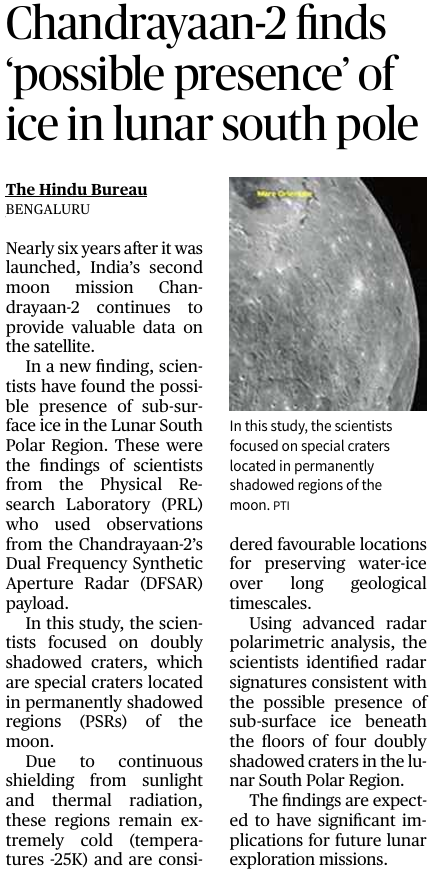
Nearly six years after its launch, Chandrayaan-2 has provided fresh evidence suggesting the possible presence of sub-surface water ice beneath the lunar south polar region. Scientists from the Physical Research Laboratory (PRL) used data from the Dual Frequency Synthetic Aperture Radar (DFSAR) onboard the Chandrayaan-2 orbiter.
Prelims concepts
India's Lunar Exploration Journey
Chandrayaan-1 (2008)
Confirmed the presence of water molecules on the Moon.
Carried NASA’s Moon Mineralogy Mapper (M3).
Chandrayaan-2 (2019)
Consisted of Orbiter, Vikram Lander, and Pragyan Rover.
Although the lander crashed, the orbiter remains operational and continues scientific observations.
Chandrayaan-3 (2023)
Successfully achieved a soft landing near the lunar south pole.
Made India the first country to land near the Moon’s south polar region.
Space Technology & Lunar Exploration
1. Key Finding & Mission Context
Mission: Chandrayaan-2 (India’s second lunar mission, launched roughly six years ago).
Discovery: Scientists have found the possible presence of sub-surface water-ice in the Lunar South Polar Region.
Institution: The research was conducted by scientists from the Physical Research Laboratory (PRL).
2. Payload / Technology Used
Instrument: Dual Frequency Synthetic Aperture Radar (DFSAR).
Function: This payload was crucial for observing and capturing radar signatures from the moon's surface.
Methodology: The scientists utilized advanced radar polarimetric analysis to identify radar signatures consistent with sub-surface ice.
3. Important Scientific Terms & Lunar Geography
Permanently Shadowed Regions (PSRs): These are regions on the moon that experience continuous shielding from sunlight and thermal radiation.
Characteristics: They are extremely cold environments. (Note: The article mentions temperatures of "-25K", which is scientifically a typo by the publisher as the Kelvin scale cannot be negative; it likely refers to ~25 Kelvin).
Significance: Due to these extreme conditions, PSRs are considered highly favorable locations for preserving water-ice over long geological timescales.
Doubly Shadowed Craters: A specific sub-category of craters located within the PSRs. The study specifically identified sub-surface ice beneath the floors of four such doubly shadowed craters.
4. Future Implications
These findings are significant for planning future lunar exploration missions, specifically concerning in-situ resource utilization (using local lunar water for life support or rocket propellant).
UPSC MCQ
Q. With reference to the recent findings of Chandrayaan-2 regarding the Moon’s south polar region, consider the following statements:
1. The findings are based on observations made by the Dual Frequency Synthetic Aperture Radar (DFSAR) onboard the Chandrayaan-2 orbiter.
2. The study focused on permanently shadowed regions (PSRs) located near the lunar equator.
3. Water ice can potentially serve as a source of oxygen and rocket fuel for future lunar missions.
Which of the statements given above is/are correct?
A) 1 only
B) 1 and 2 only
C) 1 and 3 only
D) 1, 2 and 3
Answer: C) 1 and 3 only
Explanation:
Statement 1 is correct: The discovery was based on data from the Dual Frequency Synthetic Aperture Radar (DFSAR) aboard Chandrayaan-2.
Statement 2 is incorrect: The study focused on permanently shadowed craters in the lunar south polar region, not near the equator.
Statement 3 is correct: Lunar water ice can be used to produce drinking water, oxygen, and hydrogen-based rocket fuel, making it valuable for future exploration missions.
India, China hold talks on border delimitation
GS Paper II
India and its Neighbourhood Relations
Bilateral, Regional and Global Groupings
Agreements involving India and affecting India's interests
GS Paper III
Border Management
Internal Security Challenges
Security of Borders
Context
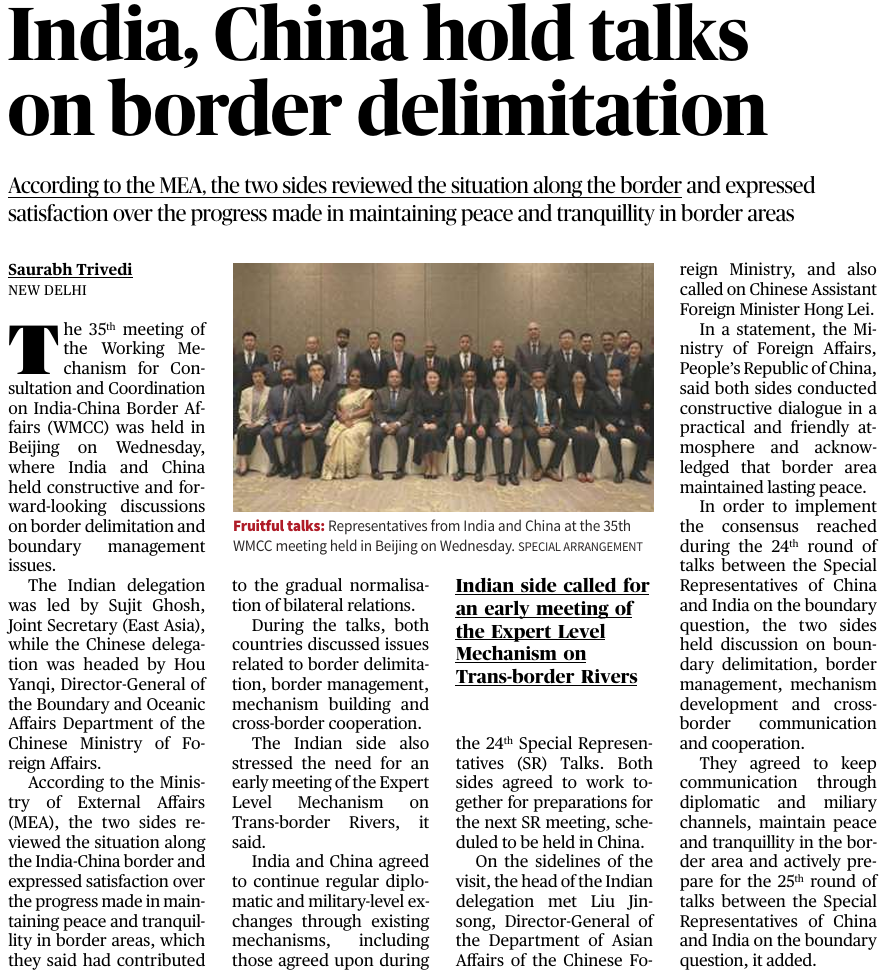
The 35th meeting of the Working Mechanism for Consultation and Coordination on India-China Border Affairs (WMCC) was held in Beijing. Both countries reviewed the border situation, expressed satisfaction over maintaining peace and tranquillity, and discussed border delimitation, border management, and cross-border cooperation.
1. Key Diplomatic Mechanisms
WMCC (Working Mechanism for Consultation and Coordination on India-China Border Affairs):
Context: The article highlights the 35th meeting of the WMCC held in Beijing.
Mandate: It serves as an institutional framework for consultation on border delimitation, boundary management, cross-border cooperation, and maintaining peace along the Line of Actual Control (LAC).
Special Representatives (SR) Talks:
Context: A higher-level bilateral dialogue specifically focused on resolving the boundary question.
Status: The recent talks aim to implement the consensus reached during the 24th round of SR talks and involve preparations for the upcoming 25th round, scheduled to be held in China.
Expert Level Mechanism on Trans-border Rivers:
Context: A dedicated institutional mechanism to discuss hydrological data sharing and issues related to shared river systems (such as the Brahmaputra/Yarlung Tsangpo).
Recent Development: The Indian side specifically stressed the need for an early meeting of this mechanism.
2. Meeting Highlights & Outcomes
Focus Areas: Discussions centered on border delimitation, boundary management, and mechanism building.
Delegation Leadership: The Indian delegation was led by the Joint Secretary (East Asia) of the Ministry of External Affairs (MEA), while the Chinese side was led by the Director-General of the Boundary and Oceanic Affairs Department.
Agreements Reached:
To continue regular exchanges through both diplomatic and military-level channels.
Both sides expressed satisfaction over the progress made in maintaining peace and tranquillity in border areas, viewing it as a step toward the gradual normalization of bilateral relations.

36 regional parties record income decline
GS Paper II
Electoral Reforms
Representation of People Act
Election Commission of India
Political Parties and Democratic Governance
Context
According to an analysis by the Association for Democratic Reforms (ADR), the combined income of 36 recognised regional political parties declined by 51.6% in FY 2024–25. Despite lower earnings, their combined expenditure exceeded income by nearly 20%, raising concerns about political finance transparency and sustainability.
Association for Democratic Reforms
The Association for Democratic Reforms (ADR) is an apolitical, non-governmental organization established in 1999 by a group of IIM Ahmedabad professors to advocate for systemic electoral and political transparency in India.
Core Objective: To reduce the criminalization of politics and ensure strict financial accountability and inner-party democracy within political parties.
Landmark Achievement: Their foundational Public Interest Litigation (PIL) led to the historic 2002 Supreme Court ruling that mandates all election candidates to publicly disclose their criminal, financial, and educational backgrounds prior to contesting.
Key Platforms: ADR operates the National Election Watch and Myneta.info portals, which analyze and publish comprehensive data on candidate affidavits, election expenditures, and political party funding.
Major Findings
Sharp Decline in Income
Combined income fell from ₹2,463 crore (2023–24) to ₹1,193 crore (2024–25).
Decline of ₹1,270 crore (51.6%).
Expenditure Exceeded Income
Total expenditure stood at ₹1,433 crore.
Spending exceeded income by about ₹240 crore.
Delayed Financial Disclosure
ADR analysed only 36 out of 67 recognised regional parties.
Remaining parties had not submitted audited accounts within the prescribed deadline.
 Power shift in Karnataka as Siddaramaiah resigns
GS Paper II
State Government and Politics
Political Parties and Pressure Groups
Issues Related to Governance and Public Administration
GS Paper IV
Public Service Values and Political Leadership
Context
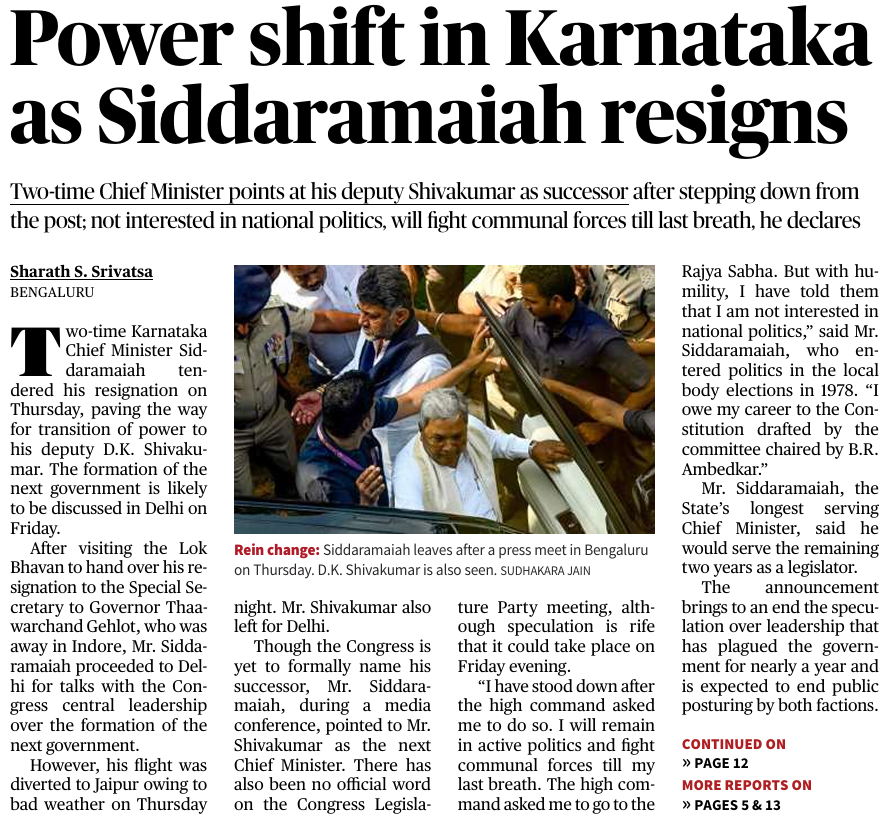
Karnataka Chief Minister Siddaramaiah resigned, paving the way for Deputy Chief Minister D.K. Shivakumar to assume leadership. The transition follows directions from the Congress high command and brings to an end prolonged speculation over leadership change in the State.
Prelims concepts
1. The Chief Minister and the Governor
Resignation Process: The article details the outgoing Chief Minister, Siddaramaiah, submitting his resignation to the Governor (Thaawarchand Gehlot). Constitutionally, under Article 164, the Chief Minister holds office during the pleasure of the Governor, and therefore, the resignation is formally addressed and tendered to the Governor.
Administrative Delegation: In an interesting administrative detail, the resignation was handed over to the Special Secretary to the Governor at the Lok Bhavan because the Governor was out of station.
2. The Rajya Sabha (Council of States)
Shift to National Politics: The article mentions a request from the party high command for the outgoing CM to move to the Rajya Sabha.
Relevance: The Rajya Sabha is the Upper House of Parliament representing the States and Union Territories. Transitioning from a Member of the Legislative Assembly (MLA) to a Member of Parliament (MP) in the Rajya Sabha is a standard mechanism for moving a state leader into national-level politics.
3. Constitutional History Reference
Drafting Committee: The outgoing CM specifically credited his career to the Constitution drafted by the committee chaired by Dr. B.R. Ambedkar.
Prelims Link: For exams, it is crucial to remember that the Drafting Committee was set up on August 29, 1947, with Dr. Ambedkar as its Chairman, tasked with preparing the draft of the new Constitution.
UPSC MCQ
Q. Consider the following statements regarding the office of the Chief Minister in India:
1. The Chief Minister is the real executive head of the State government.
2. The Governor can dismiss a Chief Minister who continues to enjoy the confidence of the Legislative Assembly.
3. A person who is not a member of the State Legislature can be appointed as Chief Minister, provided he/she becomes a member within six months.
Which of the statements given above is/are correct?
A) 1 and 2 only
B) 1 and 3 only
C) 2 and 3 only
D) 1, 2 and 3
Answer: B) 1 and 3 only
Explanation:
Statement 1 is correct: The Chief Minister is the de facto executive head of the State government.
Statement 2 is incorrect: The Governor cannot ordinarily dismiss a Chief Minister who enjoys the confidence of the Legislative Assembly.
Statement 3 is correct: Under Article 164(4), a non-legislator can be appointed Chief Minister but must become a member of the State Legislature within six months.

 Launch your Graphy