The Hindu Analysis 28th May 2026 for UPSC, APPSC & TSPSC Exams
The Hindu News Analysis – 28th May, 2026
1. UPSC releases provisional answer key of Prelims exam (GS-2)
2. The battle against AI misinformation (GS-2, GS-3)
3. SC upholds SIR, says it is EC’s constitutional duty (GS-2, GS-4)
4. Supreme Court Collegium recommends four HC judges, woman advocate to top court (GS-2)
5. Critical sectors must have quantum-safe encryption: task force
(GS-3)
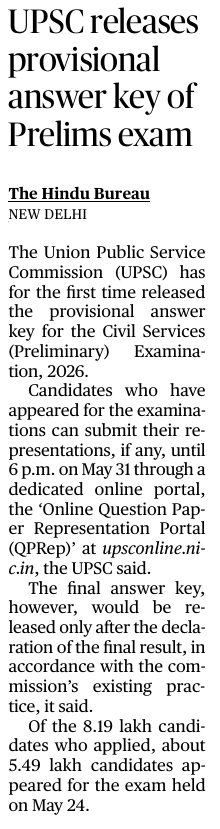
UPSC releases provisional answer key of Prelims exam
GS Paper II
Constitutional Bodies
Government policies and interventions
Transparency and accountability in governance
GS Paper IV
Ethics in public administration
Accountability and transparency mechanisms
Context
For the first time, t
he Union Public Service Commission has released the provisional answer key for the Civil Services Preliminary Examination 2026. Candidates can raise objections through the Online Question Paper Representation Portal (QPRep) before the final answer key is published after declaration of results.
What is New in This Step?
Traditionally, UPSC released the answer key only after completion of the entire examination process.
The new move introduces:
Provisional answer key before final results
Opportunity for candidates to challenge answers
Online grievance redressal mechanism
This reflects a shift towards a more transparent and participatory examination process.
Significance of the Decision
1. Enhances Transparency
Candidates can verify answers immediately after the exam.
Reduces ambiguity regarding evaluation standards.
2. Strengthens Accountability
UPSC becomes more answerable regarding disputed questions.
Expert scrutiny improves credibility of the examination system.
3. Reduces Litigation
Early objection mechanism may reduce court cases related to answer discrepancies.
4. Improves Candidate Confidence
Builds trust in the fairness and integrity of the examination process.
5. Aligns with Digital Governance
Use of the QPRep portal reflects adoption of e-governance tools in recruitment processes.
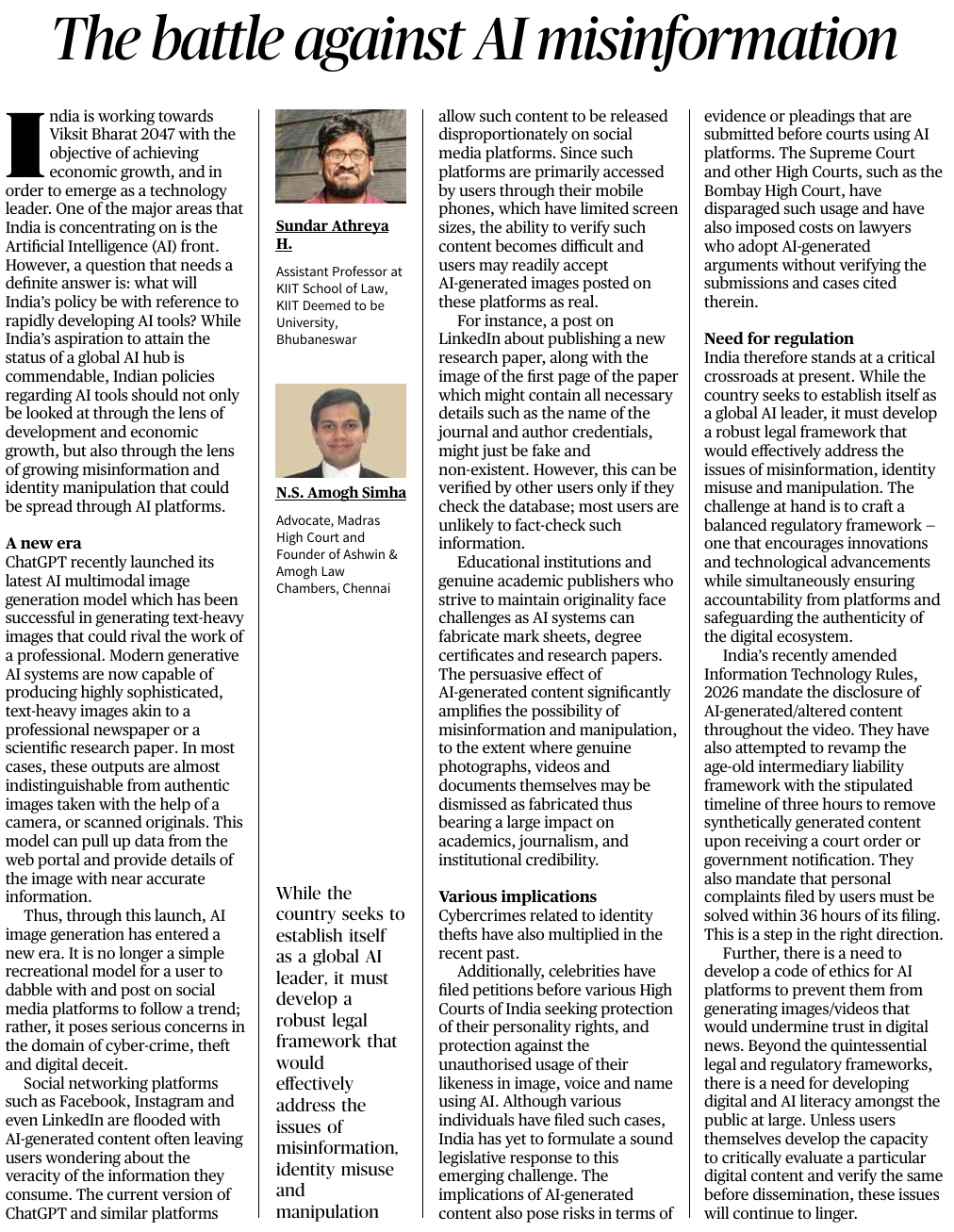 The battle against AI misinformation
GS Paper II
Government policies and interventions
Issues relating to cyber security
Governance and regulation of emerging technologies
GS Paper III
Artificial Intelligence and emerging technologies
Cyber security challenges
Internal security and digital threats
GS Paper IV
Ethics in technology
Accountability and responsible innovation
Context
The article discusses the growing challenge of AI-generated misinformation and identity manipulation in India amid rapid advances in generative Artificial Intelligence. It highlights concerns regarding deepfakes, fake academic content, cybercrime, and the urgent need for a balanced regulatory framework.
Detailed Analysis
Rise of Generative AI
Recent advances in generative AI models have enabled the creation of:
Highly realistic images
Fake videos and documents
Synthetic academic papers
Deepfake voices and identities
Modern AI systems can now generate content that is often indistinguishable from authentic material, increasing risks of deception and manipulation.
Major Concerns Raised
1. Spread of AI-driven Misinformation
AI-generated content spreads rapidly through social media platforms.
Mobile-based consumption makes verification difficult.
Users often fail to fact-check visually convincing AI content.
2. Threat to Academic Integrity
AI tools can fabricate:
Degree certificates
Mark sheets
Research papers
Academic credentials
This threatens the credibility of educational and research institutions.
3. Identity Theft and Personality Rights
Deepfakes can misuse:
Facial likeness
Voice samples
Personal identity
Celebrities and individuals have increasingly approached courts seeking protection against unauthorized AI-generated content.
4. Risks to Judicial Processes
AI-generated pleadings and fabricated legal submissions can:
Mislead courts
Distort evidence
Undermine judicial integrity
Indian courts have cautioned lawyers against using unverified AI-generated submissions.
Significance of the Issue
1. National Security and Social Stability
Large-scale misinformation campaigns can:
Influence public opinion
Trigger communal tensions
Manipulate elections
Threaten democratic institutions
2. Erosion of Trust
Deepfakes weaken trust in:
Digital media
Journalism
Academic research
Legal systems
Eventually, even genuine content may be dismissed as fake.
3. Economic and Cybersecurity Risks
AI-enabled frauds and identity thefts can:
Increase cybercrime
Cause financial losses
Exploit vulnerable users
Regulatory Challenges
1. Balancing Innovation and Regulation
India aims to become a global AI leader while also:
Preventing misuse
Protecting citizens
Preserving innovation ecosystems
2. Difficulty in Detection
AI-generated content is evolving rapidly, making:
Detection harder
Fact-checking slower
Enforcement mechanisms weaker
3. Cross-border Nature of Platforms
Most AI and social media platforms operate globally, complicating:
Jurisdiction
Accountability
Enforcement of Indian laws
Government Measures
Information Technology Rules, 2026
The amended IT Rules mandate:
Disclosure of AI-generated or altered content
Faster grievance redressal
Removal of synthetic content within prescribed timelines upon court/government orders
These measures attempt to strengthen intermediary accountability.
Way Forward
Enact comprehensive AI laws defining deepfakes and platform accountability.
Develop ethical AI standards ensuring transparency and responsible use.
Promote digital literacy to help citizens identify misinformation.
Deploy deepfake detection, watermarking, and authenticity verification tools.
Strengthen international cooperation on AI governance and cybercrime control.
Conclusion
Generative AI offers major opportunities but also increases risks of misinformation, identity theft, and cyber deception. India must build a balanced regulatory framework that promotes innovation while safeguarding trust, accountability, and digital integrity.
UPSC Mains Question
Q. AI-generated misinformation poses a serious challenge to democracy, privacy, and institutional credibility.” Discuss the challenges posed by generative AI in India and examine the need for a balanced regulatory framework.
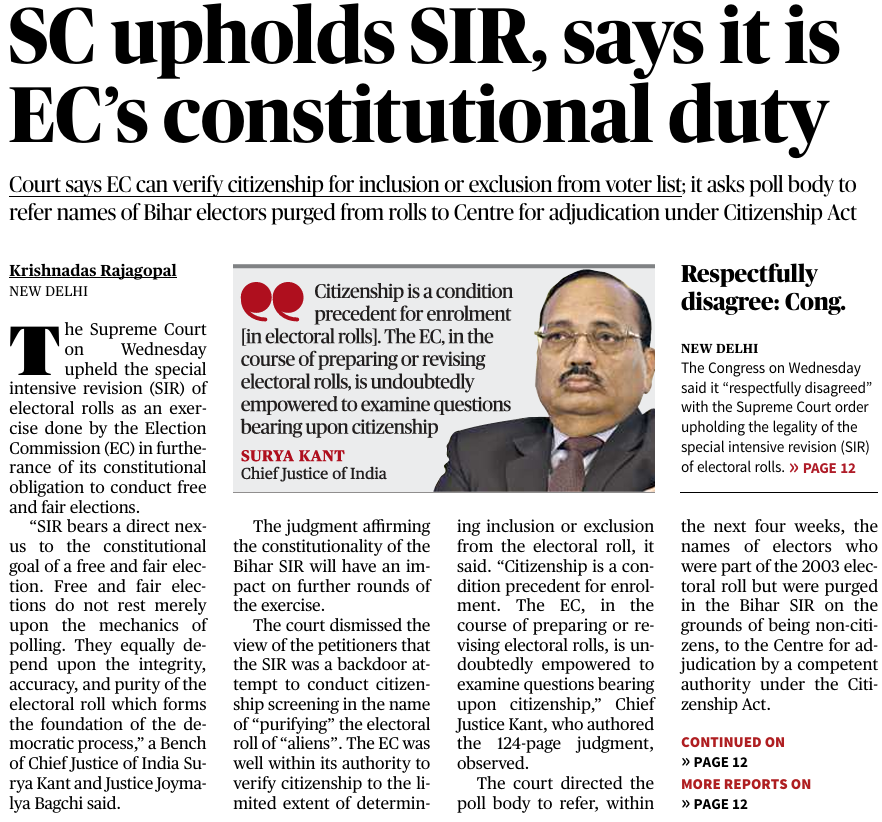
SC upholds SIR, says it is EC’s constitutional duty
GS Paper II
Election Commission of India
Representation of People
Constitutional bodies and democratic governance
GS Paper IV
Ethics in public administration
Integrity of electoral processes
Context
The Supreme Court of India upheld the legality of the Special Intensive Revision (SIR) of electoral rolls conducted by the Election Commission of India in Bihar. The Court held that verifying citizenship for inclusion or exclusion from voter rolls falls within the constitutional duty of the Election Commission to ensure free and fair elections.
Prelims concepts
1. Special Intensive Revision (SIR)
What it is: An exercise conducted by the Election Commission (EC) to revise, update, and "purify" electoral rolls.
Constitutional Validity: The Supreme Court (SC) has upheld the SIR, stating it bears a direct nexus to the EC's constitutional obligation to conduct free and fair elections.
Purpose: The SC noted that free and fair elections depend on the "integrity, accuracy, and purity of the electoral roll," making SIR a foundational democratic exercise.
2. Powers of the Election Commission (EC) Regarding Citizenship
Verification Authority: The EC is constitutionally empowered to verify a person's citizenship, but strictly for the limited extent of determining their inclusion or exclusion from the electoral roll.
Examining Credentials: While preparing or revising electoral rolls, the EC has the authority to examine questions bearing upon an individual's citizenship status.
Not a "Backdoor" NRC: The court dismissed arguments that SIR is a backdoor attempt to conduct general citizenship screening; its sole legal focus is the electoral roll.
3. Prerequisites for Voter Enrolment
Condition Precedent: The judgment explicitly states that being an Indian citizen is a "condition precedent" (an absolute prerequisite) for enrolment in the electoral rolls.
4. Division of Power: EC vs. The Centre
Purging vs. Adjudicating: While the EC can purge (remove) names from the voter list on the grounds of a person being a non-citizen, the EC does not have the final say on their legal citizenship status in the country.
The Citizenship Act: The final adjudication of whether someone is an "alien" or a citizen falls under the purview of the Centre. The SC directed the EC to refer the names of purged electors (specifically noting the 2003 Bihar electoral roll revision) to the Centre for proper adjudication by a competent authority under the Citizenship Act.
UPSC MCQ
Q. Consider the following statements regarding the Election Commission of India (ECI):
1. The Election Commission derives its powers related to supervision and conduct of elections from Article 324 of the Constitution.
2. Citizenship is a mandatory condition for enrollment in electoral rolls in India.
3. The Supreme Court held that the Election Commission has no authority to examine questions related to citizenship during electoral roll revision.
Which of the statements given above is/are correct?
A) 1 and 2 only
B) 2 and 3 only
C) 1 and 3 only
D) 1, 2 and 3
Answer: A) 1 and 2 only
Explanation:
Statement 1 is correct: Article 324 vests the Election Commission with powers of superintendence, direction, and control of elections.
Statement 2 is correct: Only citizens of India are eligible for enrollment in electoral rolls.
Statement 3 is incorrect: The Supreme Court held that the EC can examine citizenship-related questions during preparation and revision of electoral rolls.
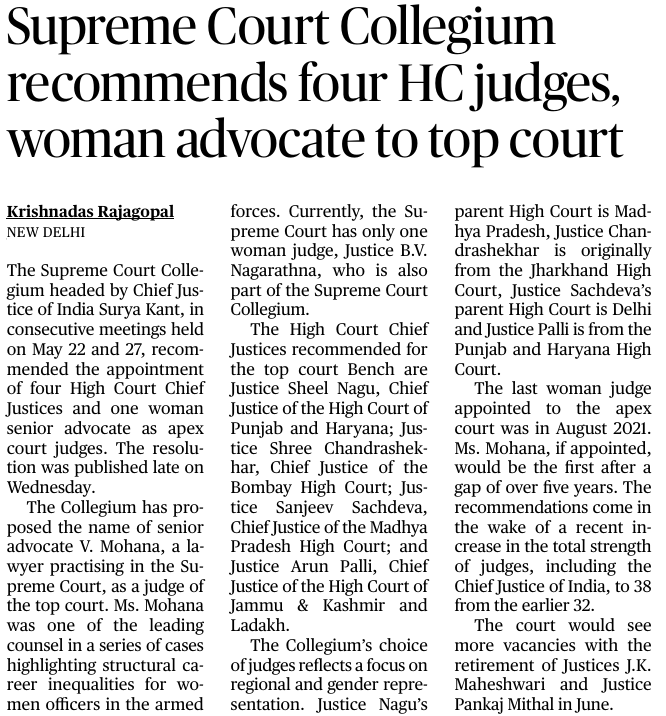
Supreme Court Collegium recommends four HC judges, woman advocate to top court
GS Paper II
Judiciary
Appointment of judges
Separation of powers
Judicial reforms and transparency
Context
The Supreme Court Collegium recommended the appointment of four High Court Chief Justices and senior advocate V. Mohana as judges of the Supreme Court of India. The recommendations highlight concerns regarding judicial vacancies, gender representation, and regional diversity in the higher judiciary.
Prelims concepts
1. The Supreme Court Collegium System
The appointment of judges to the Supreme Court and High Courts is governed by the Collegium system, a mechanism evolved through judgments of the Supreme Court rather than a direct Constitutional provision.
Composition: The Supreme Court Collegium is headed by the Chief Justice of India (CJI) and currently includes other senior-most judges of the apex court (such as Justice B.V. Nagarathna, as mentioned in the text).
Functions: It recommends the elevation of High Court Chief Justices, High Court Judges, and senior advocates directly from the Bar to the Supreme Court.
Parent High Court: When elevating a High Court Chief Justice, the Collegium considers regional representation based on their "parent" High Court (the court where they initially started their judicial career or practice).
2. Women's Representation in the Apex Court
The representation of women in the higher judiciary remains a critical topic for Indian Polity and social justice discussions. The recent recommendations highlight an effort to address structural inequalities and gender representation.
Current Status: Presently, the Supreme Court has only one sitting woman judge, Justice B.V. Nagarathna.
Elevation from the Bar: The Collegium has recommended Senior Advocate V. Mohana, a lawyer practicing in the Supreme Court. If appointed, this marks a direct elevation from the Bar to the Bench, a provision explicitly allowed under Article 124(3) of the Constitution for "distinguished jurists" or advocates with at least 10 years of High Court practice.
Historical Gap: The last woman judge appointed to the apex court was in August 2021, highlighting a significant chronological gap in female appointments.
3. Sanctioned Strength of the Supreme Court
The total number of judges in the Supreme Court is determined by Parliament through legislation (the Supreme Court (Number of Judges) Act, 1956) and is periodically updated to manage pendency and ensure diverse representation.
Recent Increase: The article notes a recent increase in the total strength of Supreme Court judges. The sanctioned strength, including the Chief Justice of India, has now been raised to 38 (up from the earlier strength of 32).
Constant Flux: The actual working strength fluctuates frequently due to continuous retirements (e.g., upcoming retirements of Justices J.K. Maheshwari and Pankaj Mithal) and new appointments, requiring the Collegium to hold consecutive meetings to fill vacancies.
UPSC MCQ
Q. Consider the following statements regarding the Collegium System in India:
1. The Supreme Court Collegium for appointment of Supreme Court judges consists of the Chief Justice of India and four senior-most judges of the Supreme Court.
2. The Collegium system is explicitly mentioned in the Constitution of India.
3. The Second Judges Case (1993) gave primacy to the judiciary in judicial appointments.
Which of the statements given above is/are correct?
A) 1 and 2 only
B) 1 and 3 only
C) 2 and 3 only
D) 1, 2 and 3
Answer: B) 1 and 3 only
Explanation:
Statement 1 is correct: The Supreme Court Collegium comprises the CJI and four senior-most Supreme Court judges.
Statement 2 is incorrect: The Collegium system is not mentioned in the Constitution; it evolved through judicial pronouncements.
Statement 3 is correct: The Second Judges Case (1993) established judicial primacy in appointments and laid the foundation for the Collegium system.
Critical sectors must have quantum-safe encryption: task force
GS Paper III
Cyber Security
Emerging technologies
Science and Technology developments
Critical Information Infrastructure protection
Context
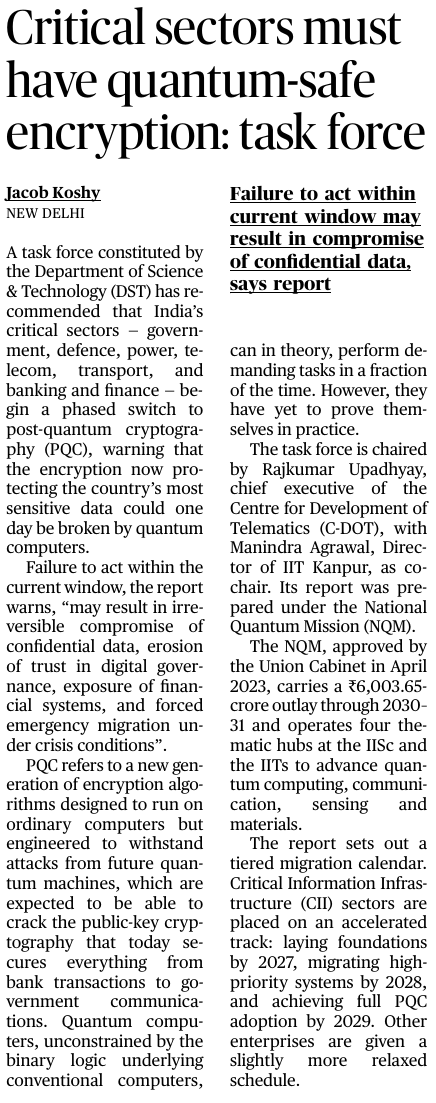
A task force constituted by the Department of Science and Technology recommended that India’s critical sectors adopt Post-Quantum Cryptography (PQC) to safeguard sensitive data from future quantum computing threats.
What is Post-Quantum Cryptography (PQC)?
PQC refers to encryption systems designed to:
Run on conventional computers
Resist attacks from future quantum computers
Quantum computers may eventually break current public-key cryptographic systems that secure:
Banking transactions
Government communications
Defence systems
Telecom networks
Why is Quantum Computing a Threat?
Unlike classical computers using binary logic (0 and 1), quantum computers use:
Qubits
Quantum superposition
Quantum entanglement
This enables them to solve certain problems exponentially faster than conventional systems.
As a result:
Existing encryption methods may become vulnerable.
Sensitive data stored today could be decrypted in the future (“harvest now, decrypt later” risk).
National Quantum Mission (NQM)
India launched the National Quantum Mission in 2023.
Objectives:
Advance quantum computing
Develop quantum communication systems
Promote quantum sensing and materials research
Features:
Outlay of ₹6,003 crore
Mission period till 2030–31
Technology hubs at IISc and IITs
UPSC MCQ:
Q. With reference to Post-Quantum Cryptography (PQC), consider the following statements:
1. Post-Quantum Cryptography is designed to secure data against attacks from future quantum computers.
2. Quantum computers use qubits instead of the binary logic used in classical computers.
3. India’s National Quantum Mission focuses only on quantum computing and excludes communication and sensing technologies.
Which of the statements given above is/are correct?
A) 1 and 2 only
B) 2 and 3 only
C) 1 and 3 only
D) 1, 2 and 3
Answer: A) 1 and 2 only
Explanation:
Statement 1 is correct: PQC aims to create encryption systems resistant to attacks by quantum computers.
Statement 2 is correct: Quantum computers use qubits and principles like superposition and entanglement.
Statement 3 is incorrect: India’s National Quantum Mission covers quantum computing, communication, sensing, and materials research.





 Launch your Graphy