The Hindu Analysis 27th May 2026 for UPSC, APPSC & TSPSC Exams
The Hindu News Analysis – 27th May, 2026
1. The judiciary’s role in complete justice (GS-2)
2. SC to examine if law is diluting the count of wetlands in India (GS-3)
3. ‘Forex reserves can be used when sentiments pull rupee down’
(GS-3)
4. India, U.S. draw up deal on rare earth elements (GS-2, GS-3)
5. Quad lays out maritime measures amid Iran war (GS-2, GS-3)
The judiciary’s role in complete justice
GS Paper II
Judiciary: Structure, powers and functioning
Separation of powers
Judicial activism vs judicial overreach
Constitutional provisions and landmark judgments
Context
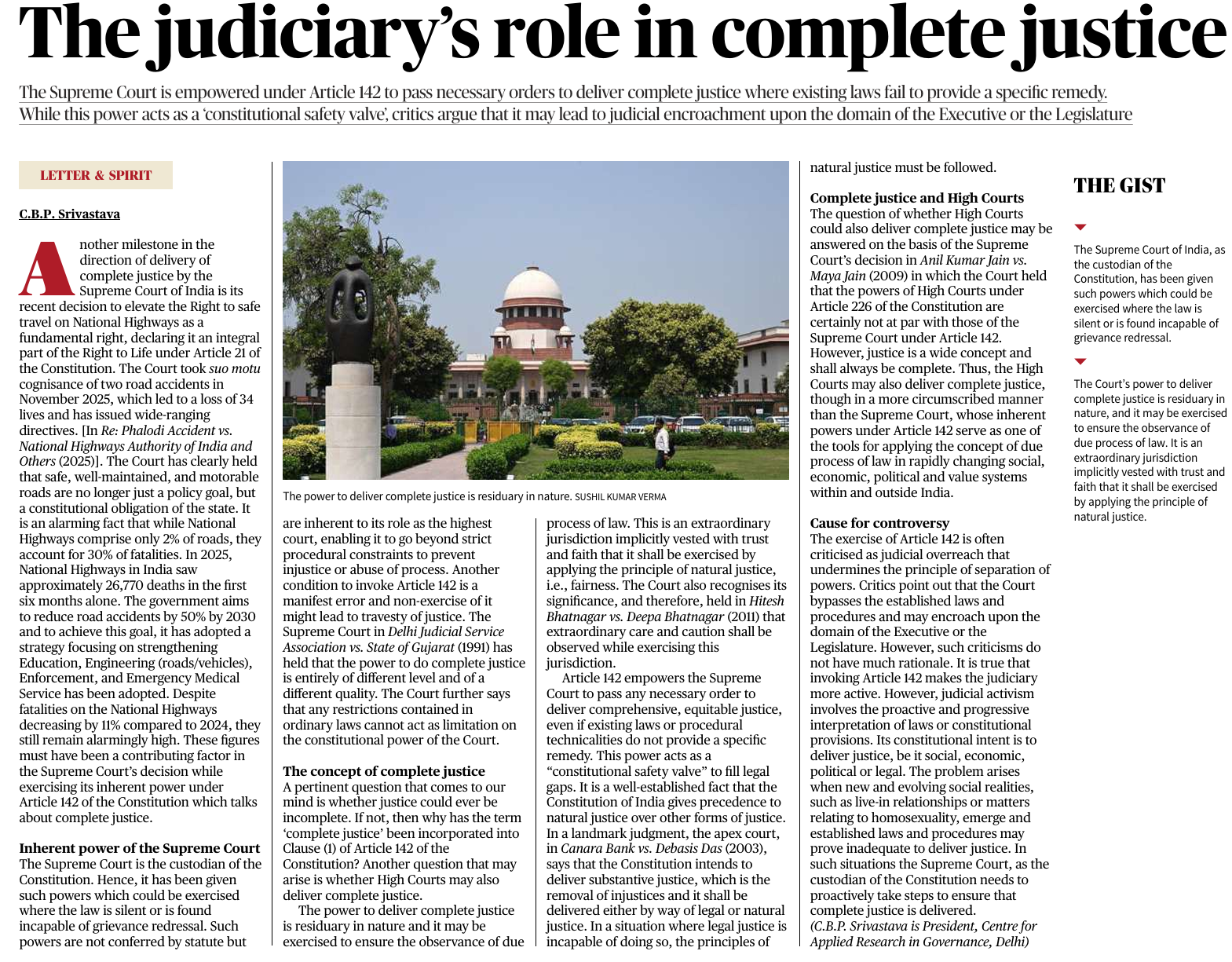
The article examines the Supreme Court’s use of Article 142, which empowers it to deliver “complete justice” in situations where ordinary laws or procedures fail to provide adequate remedies. The discussion gained prominence after the Court recognised safe travel on highways as part of the Right to Life under Article 21.
Detailed Analysis
Constitutional Basis of Complete Justice
Article 142
Article 142 empowers the Supreme Court to pass any decree or order necessary to ensure complete justice in matters before it.
This power:
is constitutional, not statutory,
is extraordinary in nature,
acts as a residual remedy where laws are silent or inadequate.
The Court views itself as the custodian of the Constitution, responsible for ensuring justice beyond procedural technicalities.
Why Such Powers Are Needed
Modern governance and society often create situations where:
laws are outdated,
legal gaps exist,
procedural rigidity causes injustice.
In such circumstances, strict adherence to statutes may defeat the broader objective of justice. Article 142 enables the Court to bridge these gaps.
Examples
The Supreme Court has used Article 142 in matters related to:
environmental protection,
interfaith/inter-caste marriages,
dissolution of irretrievably broken marriages,
protection of fundamental rights,
governance failures.
The recent highway safety case reflects the judiciary’s willingness to expand constitutional protections under Article 21.
Relationship Between Law and Justice
The article highlights an important constitutional debate:
Should courts follow only the “letter of law” or also uphold the “spirit of justice”?
Article 142 reflects the constitutional preference for substantive justice over mere procedural compliance.
This aligns with:
natural justice,
equity,
constitutional morality,
protection of rights.
Significance of Article 142
1. Ensures Effective Justice
Provides remedies where ordinary laws fail.
2. Protects Fundamental Rights
Strengthens enforcement of Article 21 and other constitutional rights.
3. Constitutional Safety Valve
Acts as an emergency mechanism to prevent miscarriage of justice.
4. Promotes Judicial Innovation
Allows courts to respond to new social and technological realities.
5. Enhances Public Confidence
People perceive the judiciary as an institution capable of delivering meaningful justice.
Concerns and Criticism
1. Judicial Overreach
Critics argue the judiciary sometimes enters policy-making domains reserved for the Executive or Legislature.
2. Threat to Separation of Powers
Frequent use of extraordinary powers may disturb constitutional balance.
3. Lack of Defined Boundaries
Article 142 has broad wording, leading to varying interpretations.
4. Possibility of Subjective Justice
Decisions may depend heavily on judicial discretion rather than uniform legal standards.
5. Democratic Accountability Concerns
Unlike elected governments, judges are not directly accountable to the public.
Judiciary vs Judicial Activism
The article distinguishes between:
Judicial activism → proactive interpretation to uphold justice,
Judicial overreach → encroachment into governance functions.
The judiciary argues that activism becomes necessary when:
institutions fail,
legal vacuum exists,
citizens’ rights are endangered.
Thus, Article 142 is seen as both:
a tool of constitutional protection,
and a source of institutional tension.
Complete Justice and High Courts
The article also discusses whether High Courts possess similar powers.
Supreme Court View
In Anil Kumar Jain v. Maya Jain (2009):
High Courts under Article 226 do not possess powers identical to Article 142.
However, High Courts can still ensure justice within constitutional limits.
This establishes the Supreme Court’s unique constitutional position.
Key Constitutional Debate
The central issue is:
How can India balance judicial innovation with democratic separation of powers?
Too little judicial intervention:
may leave injustice unaddressed.
Too much intervention:
may weaken democratic institutions.
Therefore, constitutional equilibrium becomes essential.
Way Forward
1. Exercise Judicial Restraint
Article 142 should remain exceptional, not routine.
2. Develop Clear Doctrinal Principles
Supreme Court should evolve consistent standards for invoking complete justice powers.
3. Strengthen Legislative Responsiveness
Parliament should address legal gaps proactively.
4. Preserve Institutional Balance
All constitutional organs must respect functional boundaries.
5. Promote Constitutional Governance
Judicial intervention should complement, not replace, democratic governance.
Conclusion
Article 142 represents the Supreme Court’s commitment to ensuring justice when ordinary legal mechanisms prove insufficient. It reflects the transformative nature of the Indian Constitution and the judiciary’s role as guardian of rights and constitutional morality. However, the exercise of such extraordinary powers must remain balanced, restrained, and consistent with the principle of separation of powers to preserve democratic legitimacy.
UPSC Mains question
Q. Article 142 of the Indian Constitution acts as a constitutional tool for ensuring complete justice, but its expanding use has also raised concerns about judicial overreach. Examine.
SC to examine if law is diluting the count of wetlands in India
GS Paper III
Conservation and environmental pollution
Environmental impact assessment
International environmental conventions and agreements
Wetland conservation and biodiversity
Context
The Supreme Court has agreed to examine the constitutional validity of the Wetlands (Conservation and Management) Rules, 2017. Petitioners argue that the Rules dilute wetland protection by excluding many artificial, human-made, and historically evolved wetlands from environmental safeguards, contrary to India’s obligations under the Ramsar Convention, 1971.
Prelims concepts
1. The Ramsar Convention on Wetlands (1971)
What it is: An intergovernmental treaty that provides the framework for national action and international cooperation for the conservation and wise use of wetlands and their resources.
Key Definition Context: Unlike the contested domestic 2017 Rules, the Ramsar Convention expressly includes both natural and artificial wetlands, whether permanent or temporary, without distinction.
Relevance: India is a binding signatory to this international obligations treaty.
2. Wetlands (Conservation and Management) Rules, 2017
Rule 2(g) Controversy: This specific clause is under scrutiny for its narrow definition of 'wetlands'.
The Core Issue: The 2017 rules arbitrarily exclude most human-made, artificial, and historically developed wetlands from environmental protection.
Exclusions under the Rule: Waterbodies explicitly constructed for:
Drinking water & Irrigation
Aquaculture
Salt production
Recreation and allied purposes.
Governance Shift: The rules introduced decentralised oversight, which petitioners argue dilutes accountability compared to earlier frameworks.
3. Important Environmental & Legal Principles
Principle of Non-Regression: A fundamental principle in environmental law which prohibits governments from weakening or rolling back existing legal protections that safeguard the environment. The petition argues that the 2017 Rules violate this principle by stripping protected status from previously recognized wetlands.
Functional Characteristics vs. Origin: Historically, wetlands were identified and recorded in national inventories based on how they functioned ecologically, rather than their origin (whether they occurred naturally or were man-made).
4. Key Institutional & Impact Data
Judicial Bench: The matter is being examined by a Supreme Court Bench headed by the Chief Justice of India (noted in the text as CJI Surya Kant).
Potential Ecological Impact: If the current definition stands, 39 human-made wetlands out of India's total 94 Ramsar Convention wetlands risk losing their legal status and protection framework, effectively removing a substantial majority of the country's water bodies from environmental law safeguards.
UPSC MCQ
Q. Consider the following statements regarding wetlands in India:
1. The Ramsar Convention recognises both natural and artificial wetlands.
2. The Wetlands (Conservation and Management) Rules, 2017 brought all human-made wetlands under mandatory protection.
3. The principle of non-regression in environmental law implies that existing environmental protections should not be weakened.
Which of the statements given above is/are correct?
A. 1 and 2 only
B. 2 and 3 only
C. 1 and 3 only
D. 1, 2 and 3
Answer: C. 1 and 3 only
Explanation
Statement 1 is correct: The Ramsar Convention includes both natural and artificial wetlands.
Statement 2 is incorrect: Petitioners argue that the 2017 Rules exclude many artificial and human-made wetlands from protection.
Statement 3 is correct: The non-regression principle means environmental safeguards should not be diluted over time.
Forex reserves can be used when sentiments pull rupee down
GS Paper III
Indian Economy and issues relating to planning
Mobilisation of resources
Foreign exchange reserves
Effects of liberalisation on the economy
RBI and monetary policy
Context
Experts at the Debt Market Summit 2026 stated that India’s foreign exchange reserves can be used to manage short-term volatility in the rupee caused by global sentiment-driven capital outflows. They emphasised that the current depreciation pressure is episodic rather than structural.
Prelims concepts
1. Foreign Exchange (Forex) Reserves & RBI Intervention
Source of Accumulation: India builds its forex buffers primarily during periods of excess capital inflows, such as Foreign Portfolio Investment (FPI).
Mechanism of Intervention: When global shocks or risk-off sentiments trigger sudden capital outflows, market panic can cause sharp currency depreciation.
The Reserve Bank of India (RBI) utilizes these accumulated forex buffers to sell dollars and buy rupees, thereby cooling down exchange rate volatility.
Nature of Depreciation: The article emphasizes that current market movements are often episodic (temporary/sentiment-driven) rather than structural, justifying the strategic draw-down of reserves to stabilize the currency.
2. Balance of Payments (BoP) Structure
The article notes that in the 35 years post-liberalization (post-1991), India has faced an overall BoP deficit in only six of those years. The remainder were characterized by capital account surpluses.
Current Account vs. Capital Account: While India traditionally runs a deficit on its Current Account (primarily due to a large merchandise trade deficit), it consistently aims for a surplus on its Capital Account.
Capital Account Surplus: Driven by foreign investments (FDI, FPI) and external borrowings, this surplus typically offsets the current account deficit, allowing India to accumulate net foreign exchange reserves.
3. External Commercial Borrowings (ECBs)
What it is: ECBs are commercial loans raised by eligible Indian resident entities from non-resident entities (foreign commercial banks, international capital markets, etc.).
Policy Leverage: Relaxing ECB norms (e.g., raising borrowing limits or easing interest rate caps) serves as a policy tool to encourage greater capital inflows into the country, providing an alternative mechanism to support a depreciating rupee without solely depleting forex reserves.
4. Key Macroeconomic Terms to Note
Foreign Portfolio Investment (FPI): Passive investments in India's financial assets (like stocks and bonds) by foreign investors. FPI is highly liquid and volatile ("hot money"), making it the primary driver behind sudden episodic currency fluctuations.
Currency Hedging: Financial instruments or strategies used by market players to protect against foreign exchange risk and potential currency depreciation.
Structural Reforms vs. Episodic Fixes: The text highlights that policy responses like relaxing ECB limits tackle immediate episodes, whereas structural reforms should be targeted at long-term macroeconomic shifts rather than temporary market panics.
UPSC MCQ
Q. Consider the following statements regarding India’s foreign exchange reserves:
1. Foreign exchange reserves are held and managed by the Reserve Bank of India.
2. India follows a completely fixed exchange rate system where the RBI maintains a predetermined rupee value.
3. Foreign exchange reserves can be used to reduce excessive volatility in the rupee exchange rate.
Which of the statements given above is/are correct?
A. 1 and 2 only
B. 2 and 3 only
C. 1 and 3 only
D. 1, 2 and 3
Answer: C. 1 and 3 only
Explanation
Statement 1 is correct: Forex reserves in India are managed by the RBI.
Statement 2 is incorrect: India follows a managed float exchange rate system, not a fixed exchange rate system.
Statement 3 is correct: RBI uses forex reserves to manage excessive currency volatility and stabilise market sentiment.
India, U.S. draw up deal on rare earth elements
GS Paper II
India and its bilateral relations
Quad grouping and strategic partnerships
GS Paper III
Mineral resources
Supply chain resilience
Critical minerals and energy security
Science and technology applications
Context
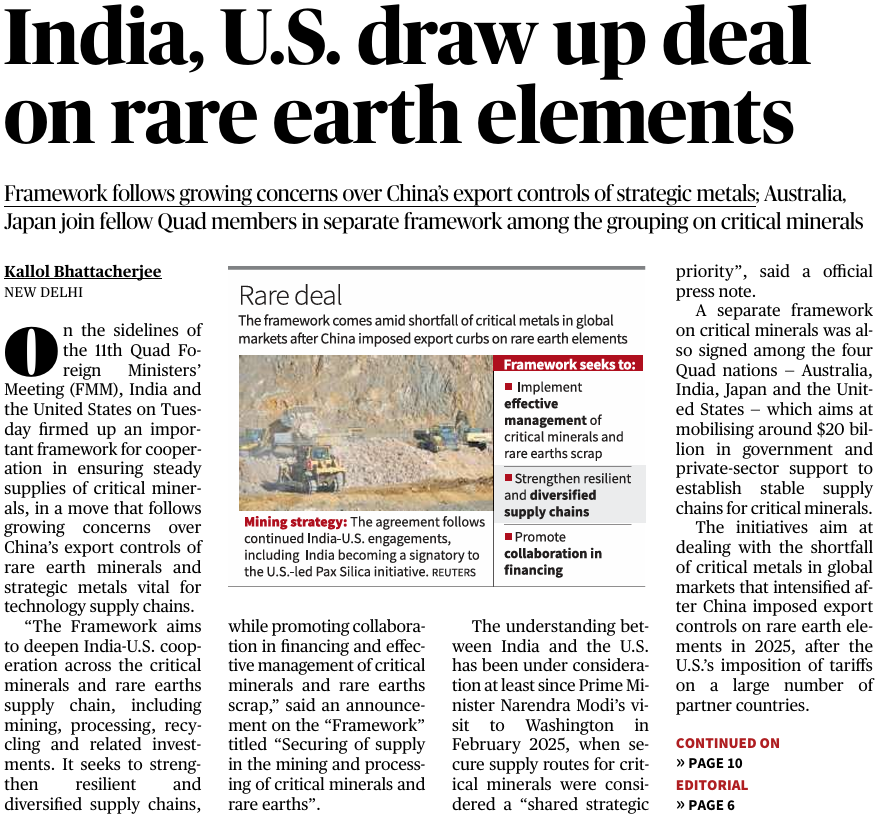
India and the United States have finalised a framework for cooperation on critical minerals and rare earth elements during the Quad Foreign Ministers’ Meeting. The agreement comes amid growing global concerns over China’s export controls on rare earth elements and strategic metals.
Prelims concepts
1. Rare Earth Elements (REEs) & Critical Minerals
Definition: A group of 17 chemically similar metallic elements (the 15 lanthanides plus scandium and yttrium). They are called "rare" not because they are scarce in the earth's crust, but because they are geochemically difficult to find in economically extractable concentrations.
Strategic Significance: They are indispensable inputs for new-age and clean-energy technologies, including:
Permanent magnets used in electric vehicles (EVs) and wind turbines.
Components for defense systems, smartphones, and aerospace hardware.
Semiconductor manufacturing and Artificial Intelligence (AI) infrastructure.
Global Market Scenario: China maintains a near-monopoly on processing and refining, controlling approximately 90% of global capacity. Recent weaponization of this dominance through strict export licensing regimes and curbs has forced major economies to pursue "friendshoring" strategies.
2. Institutional Frameworks & Initiatives
A. India-U.S. Bilateral Critical Minerals Framework
Core Objective: Deepen bilateral cooperation across the entire supply chain to ensure a steady supply of strategic metals, directly tackling supply-chain vulnerabilities.
Operational Scope: Spans four distinct areas: Mining, Processing, Recycling, and Investment (including the management of critical minerals and rare earths scrap).
Strategic Origin: Built upon foundations laid during high-level state visits, particularly under the umbrella of the India-U.S. TRUST (Transforming the Relationship Utilising Strategic Technology) initiative and the Strategic Mineral Recovery initiative.
B. The Pax Silica Initiative
What it is: A United States-led, multilateral technology coalition launched to secure resilient supply chains across the entire AI and semiconductor technological stack (from geology to software).
India's Standing: India formally became a signatory to the Pax Silica initiative on February 20, 2026.
Modus Operandi: It leverages a "coalition of capabilities" approach, matching public-private capital with resource-rich jurisdictions (like India and the Philippines) to build alternative, trusted tech ecosystems and bypass geopolitical bottlenecks.
C. The Quad Critical Minerals Initiative Framework
Context: Signed on the sidelines of the 11th Quad Foreign Ministers’ Meeting (FMM) held in New Delhi.
Financial Mobilization: Aims to mobilize around $20 billion through combined government and private-sector support.
Target Focus: Nurtures strategic projects that are located within Quad partner countries and operated by companies headquartered within Quad nations, systematically blocking supply chain vulnerabilities.
Circular Economy Element: Explicitly targets the recovery and recycling of strategic materials from e-waste and industrial scrap to reduce primary mining dependencies.
UPSC MCQ
Q. Consider the following statements regarding Rare Earth Elements (REEs):
1. Rare Earth Elements are critical inputs for electric vehicles, wind turbines, and defence technologies.
2. China has a dominant position in the global rare earth processing and supply chain.
3. India is completely dependent on imports for rare earth mineral reserves.
Which of the statements given above is/are correct?
A. 1 and 2 only
B. 2 and 3 only
C. 1 only
D. 1, 2 and 3
Answer: A. 1 and 2 only
Explanation
Statement 1 is correct: REEs are essential for clean energy technologies, electronics, and defence systems.
Statement 2 is correct: China dominates global rare earth processing and supply chains.
Statement 3 is incorrect: India possesses rare earth reserves, especially monazite sands, though processing capacity remains limited.
Quad lays out maritime measures amid Iran war
GS Paper II
India and its neighbourhood and bilateral relations
India’s interests in West Asia and Indo-Pacific
GS Paper III
Energy security
Maritime security
Strategic chokepoints and global trade
Context
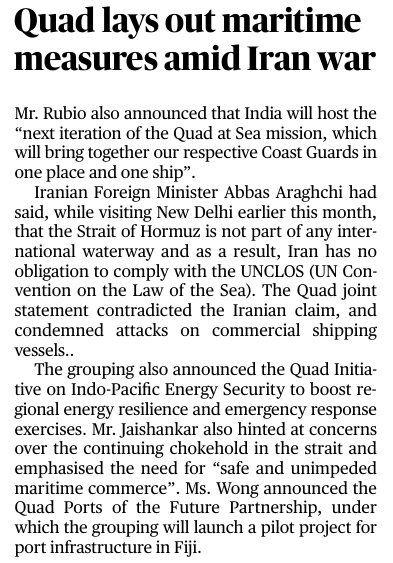
The Quad countries — India, the U.S., Japan, and Australia — announced new maritime and energy-security initiatives amid rising tensions linked to the Iran conflict and concerns over disruptions in the Strait of Hormuz.
Prelims concepts
1. Geographic Chokepoint: The Strait of Hormuz
Location: A strategically vital waterway connecting the Persian Gulf (to its west) with the Gulf of Oman and the Arabian Sea (to its southeast).
Geopolitical Significance: It is the world's most critical oil transit chokepoint. A significant portion of global petroleum liquids and liquefied natural gas (LNG) consumption passes through it daily, making its stability vital to global energy security.
Bordering Nations: It is jointly bounded by Iran to the north/northfeast and Oman (the Musandam exclave) and the United Arab Emirates (UAE) to the south.
2. United Nations Convention on the Law of the Sea (UNCLOS)
What it is: Adopted in 1982, UNCLOS is an international treaty that provides a comprehensive legal framework for all marine and maritime activities, often referred to as the "Constitution for the Oceans."
The Transit Passage Dispute: Under UNCLOS, straits used for international navigation enjoy the right of transit passage, meaning all ships (including commercial and military vessels) have the freedom of unimpeded navigation solely for continuous and expeditious transit.
The Conflict in the Text: The Iranian Foreign Minister claims that the Strait of Hormuz is not an international waterway and that Iran has no obligation to comply with UNCLOS. The Quad nations strongly contradict this, upholding the principle of "safe and unimpeded maritime commerce" through the strait.
3. Quad Maritime & Regional Infrastructure Initiatives
A. Quad at Sea Mission
Core Mandate: A joint maritime security exercise aimed at strengthening interoperability and regional maritime law enforcement.
Key Mechanism: It brings together the respective Coast Guards of the four Quad nations (India, US, Japan, Australia) to operate jointly "in one place and one ship."
Host Country: India is slated to host the next iteration of this mission.
B. Quad Ports of the Future Partnership
Objective: A strategic infrastructure initiative aimed at building sustainable, resilient, and highly integrated port networks across the Indo-Pacific region.
Pilot Project: The grouping will launch its initial pilot project for port infrastructure development in Fiji (a key island nation in the South Pacific).
C. Quad Initiative on Indo-Pacific Energy Security
Objective: A collaborative framework designed to boost regional energy resilience.
Scope: Focuses on mitigating supply-chain vulnerabilities, safeguarding critical energy corridors against chokepoints, and organizing emergency response exercises to handle sudden supply disruptions.




 Launch your Graphy