The Hindu Analysis 26th May 2026 for UPSC, APPSC & TSPSC Exams

The Hindu News Analysis – 26th May, 2026
1. Why is the Indian rupee falling? (GS-3)
2. Indian mobile market hit as global semiconductor industry faces ‘severe memflation’ (GS-3)
3. President confers Padma awards; Dharmendra, N. Rajam honoured
(GS-1)
4. ‘Greater public participation, talks with stakeholders vital’: SC on defining Aravali hills (GS-2,GS-3)
5. SC blames NTA for repeated NEET question paper leaks (GS-2)
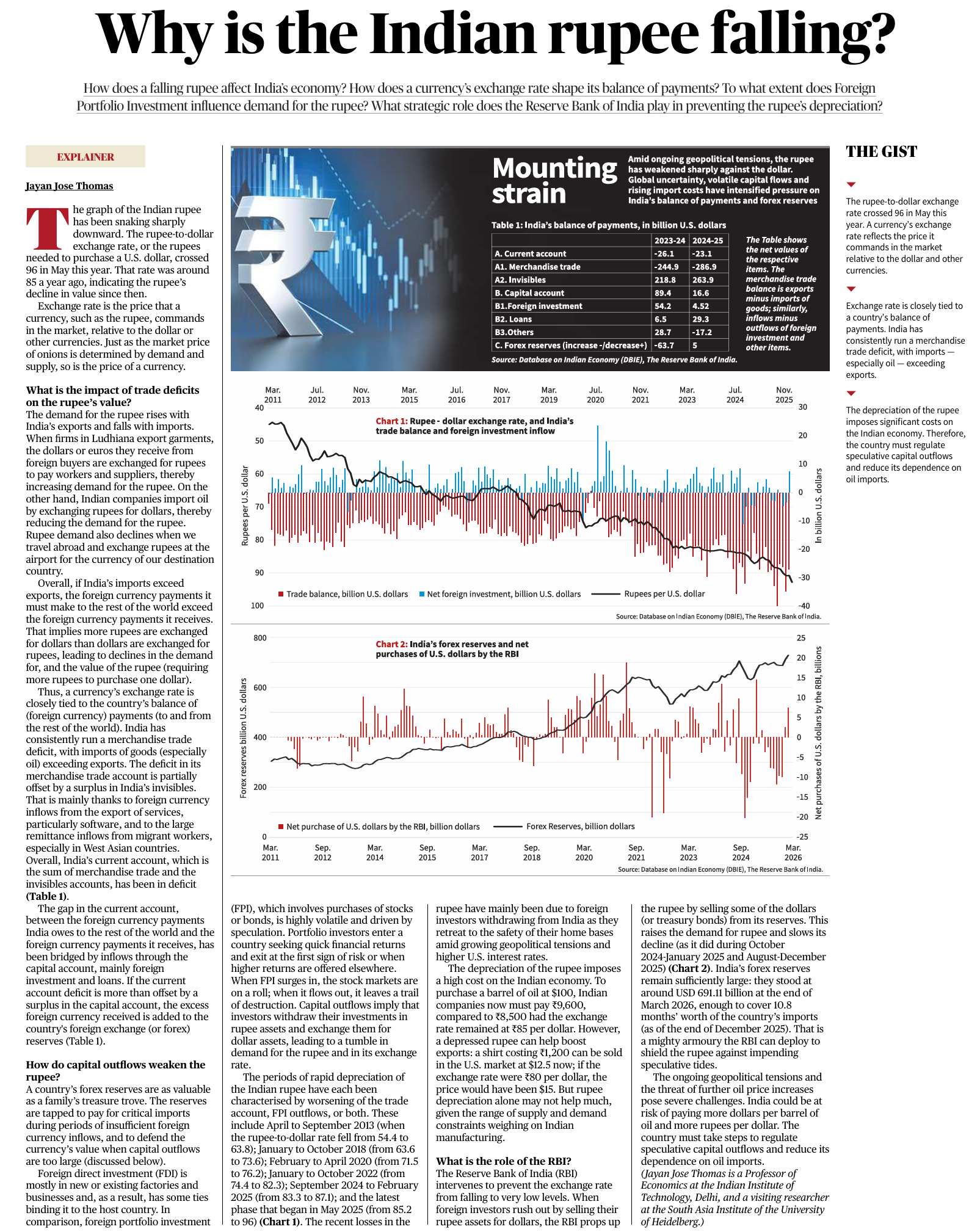 Why is the Indian rupee falling?
GS Paper III
Indian Economy and issues relating to planning, mobilization of resources, growth and development
Balance of Payments (BoP)
Foreign Exchange Reserves
Inflation and External Sector Stability
Context
The Indian rupee recently crossed ₹96 per U.S. dollar, reflecting sustained depreciation against the dollar. The article explains how trade deficits, foreign portfolio investment (FPI) outflows, geopolitical tensions, oil imports, and RBI interventions influence the rupee’s exchange rate.
Detailed Analysis
Historical Background
Exchange Rate System in India
India shifted from a fixed exchange rate system to a market-determined exchange rate after the 1991 economic reforms.
The rupee’s value is now largely determined by:
Demand and supply of foreign currency
Trade flows
Capital flows
RBI intervention
Persistent Trade Deficit
India traditionally imports more than it exports, especially:
Crude oil
Gold
Electronics
This creates continuous demand for dollars, weakening the rupee over time.
Why is the Rupee Falling?
1. Trade Deficit and Current Account Pressure
Imports exceed exports, creating higher demand for dollars.
Oil imports significantly increase dollar outflows.
More rupees are exchanged to buy dollars → rupee depreciates.
Impact:
Current Account Deficit (CAD) widens.
External vulnerability increases.
2. Foreign Portfolio Investment (FPI) Outflows
FPIs are highly volatile.
During global uncertainty, investors shift money to safer assets like U.S. treasury bonds.
Result:
Foreign investors sell Indian assets.
Demand for dollars rises.
Rupee weakens further.
3. Strong U.S. Dollar
Higher U.S. interest rates attract global capital to America.
Dollar appreciation automatically weakens emerging market currencies, including the rupee.
4. Geopolitical Tensions
Conflicts in West Asia and global instability raise crude oil prices.
Since India imports most of its oil, higher prices increase dollar demand.
5. Balance of Payments (BoP) Stress
India’s BoP depends on:
Current Account (trade + services + remittances)
Capital Account (FDI, FPI, loans)
When capital inflows weaken and trade deficits rise simultaneously, the rupee comes under pressure.
Significance of Exchange Rate Movements
Positive Effects of Depreciation
Export Competitiveness
Indian goods become cheaper globally.
Export sectors like textiles and IT services may benefit.
Boost to Remittances
Indians receiving dollars get more rupees in return.
Negative Effects
Imported Inflation
Fuel, electronics, fertilizers become costlier.
Inflationary pressure rises.
Higher Production Costs
Industries dependent on imported raw materials suffer.
External Debt Burden
Servicing dollar-denominated debt becomes expensive.
Pressure on Consumers
Foreign education, travel, and imports become costlier.
Role of the RBI
Forex Market Intervention
The RBI sells dollars from its forex reserves to stabilize the rupee.
Liquidity Management
Controls volatility through monetary tools.
Maintains investor confidence.
Forex Reserves as Buffer
India’s forex reserves act as protection against:
Sudden capital flight
Currency speculation
External shocks
Challenges
1. Heavy Dependence on Oil Imports
India imports nearly 85% of crude oil needs.
2. Volatile Global Capital Flows
FPIs react quickly to global uncertainty.
3. Limited Export Diversification
Manufacturing competitiveness remains weak.
4. Inflation Risks
Currency depreciation fuels imported inflation.
5. Global Economic Uncertainty
Wars, supply chain disruptions, and recession fears intensify currency instability.
Way Forward
1. Reduce Import Dependence
Promote renewable energy
Increase domestic manufacturing
Encourage import substitution
2. Strengthen Exports
Improve logistics and competitiveness
Expand high-value manufacturing exports
3. Attract Stable Capital
Encourage long-term FDI over volatile FPI flows.
4. Maintain Adequate Forex Reserves
Continue prudent reserve accumulation.
5. Deepen Structural Reforms
Improve ease of doing business
Enhance productivity and industrial capacity
Conclusion
The depreciation of the rupee reflects both domestic structural challenges and global economic pressures. While moderate depreciation can improve export competitiveness, persistent weakening raises inflation and external sector risks. A combination of stronger exports, reduced oil dependence, macroeconomic stability, and calibrated RBI intervention is essential for maintaining long-term currency stability.
UPSC Mains Question
Q. Why is the Indian rupee depreciating? Discuss the impact of rupee depreciation on the Indian economy and the role of the RBI in managing exchange rate volatility.

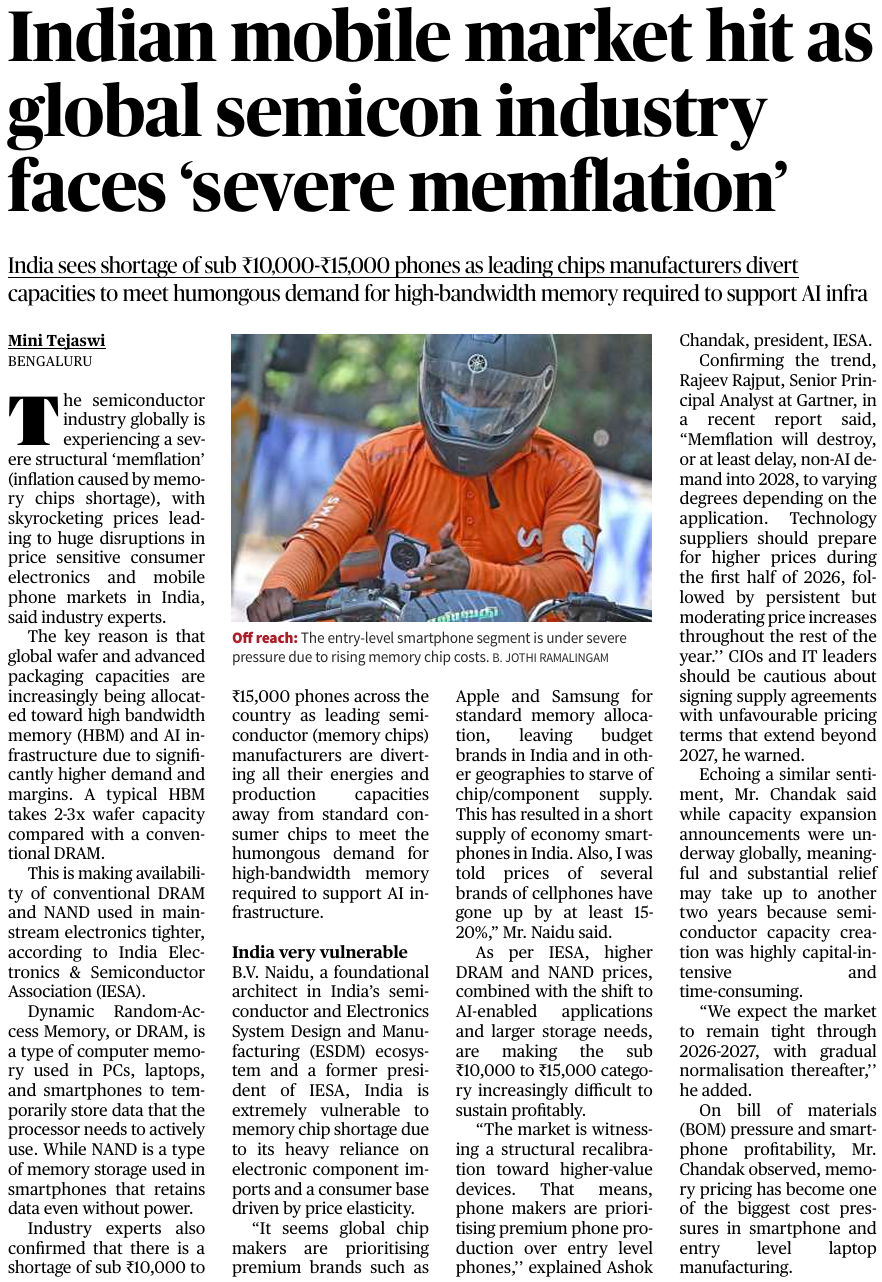
Indian mobile market hit as global semiconductor industry faces ‘severe memflation’
GS Paper III
Electronics and Semiconductor Industry
Science and Technology Developments
Industrial Policy and Manufacturing
Artificial Intelligence and Emerging Technologies
Context
The global semiconductor industry is witnessing “memflation” — inflation caused by shortages and rising prices of memory chips like DRAM and NAND. Rising demand for AI infrastructure and High-Bandwidth Memory (HBM) chips has diverted manufacturing capacity away from conventional chips, impacting India’s mobile phone and electronics market, especially budget smartphones.
What is Memflation?
“Memflation” refers to sharp price increases in memory chips due to supply shortages.
AI infrastructure requires massive amounts of:
DRAM
NAND
High-Bandwidth Memory (HBM)
HBM production consumes significantly higher wafer capacity compared to traditional DRAM.
Why is India Vulnerable?
1. Heavy Import Dependence
India relies heavily on imported semiconductor components.
2. Weak Domestic Chip Ecosystem
India lacks large-scale fabrication and advanced packaging capabilities.
3. Price-Sensitive Consumer Market
Entry-level smartphones dominate Indian demand.
Rising memory prices directly affect affordability.
Impact on India
Smartphone Market Disruptions
Shortage of ₹10,000–₹15,000 smartphones.
Manufacturers prioritizing premium devices over budget phones.
Rising Consumer Prices
Smartphone prices expected to increase by 15–20%.
Pressure on Electronics Industry
Increased Bill of Materials (BoM) costs.
Reduced profitability for manufacturers.
Digital Inclusion Concerns
Expensive smartphones may slow digital access for low-income users.
UPSC MCQ
Q. The term “memflation”, recently seen in the semiconductor industry, refers to:
A) Inflation caused by excessive production of semiconductor chips
B) Rising prices of memory chips due to shortages and high demand from AI infrastructure
C) Decline in smartphone demand caused by cheaper memory devices
D) Government subsidies provided for semiconductor manufacturing
Answer: B) Rising prices of memory chips due to shortages and high demand from AI infrastructure
Explanation:
“Memflation” refers to inflation in memory-chip prices, particularly DRAM, NAND, and High-Bandwidth Memory (HBM), driven by massive demand from AI infrastructure and constrained semiconductor production capacity.
President confers Padma awards; Dharmendra, N. Rajam honoured
GS Paper I
Indian Culture
Contributions of artists and musicians
Salient aspects of Art Forms, Literature and Architecture
Context
President Droupadi Murmu conferred the Padma Awards for 2026 at the Civil Investiture Ceremony held at Rashtrapati Bhavan. Eminent personalities from fields such as art, music, cinema, sports, social work, medicine, and public service were honoured with Padma Vibhushan, Padma Bhushan, and Padma Shri awards.
Prelims concepts
1. The Padma Awards: Core Framework
The Padma Awards are among the highest civilian honors in India, announced annually on the eve of Republic Day (January 26) and conferred by the President of India at Rashtrapati Bhavan.
Hierarchy of the Awards
The awards are given in three categories, listed here in descending order of superiority:
Padma Vibhushan: For exceptional and distinguished service.
Padma Bhushan: For distinguished service of a high order.
Padma Shri: For distinguished service in any field.
Key Constitutional & Statutory Aspects
Article 18(1): The Supreme Court of India (in Balaji Raghavan v. Union of India, 1996) upheld the validity of these awards but ruled that they do not amount to "titles" under Article 18 of the Constitution. Therefore, they cannot be used as prefixes or suffixes to the recipient's name.
Total Cap: The total number of awards given in a year (excluding posthumous awards and those given to NRIs/Foreigners/OCIs) should not exceed 120. (Note: The article mentions 131 approved awards for the year, which includes all categories and posthumous/foreign listings).
Posthumous Awards: These awards are generally not conferred posthumously, but the government can make exceptions in highly deserving cases (as seen with actor Dharmendra in the article).
2. Art, Culture, and Literature Concepts
The article highlights several awardees whose contributions are deeply tied to India’s cultural heritage:
Music and Performing Arts
Gayaki Ang (Violin): Pioneered by N. Rajam (Padma Vibhushan). It is a revolutionary technique in Hindustani classical music where the violin is played to perfectly emulate the nuances, inflections, and emotional depth of the human vocal tradition (Gayaki).
Avadhana (Shatavadhani R. Ganesh): Avadhana is a ancient literary performance popular in South India (mainly Telugu and Kannada). It tests a person's simultaneous multi-tracking capabilities in memory, literature, poetry, and grammar. A Shatavadhani is an expert who can handle 100 questioners/tasks (Prcchakas) simultaneously.
Silambam (K. Pajanivel): A weapon-based Indian martial art originating from Tamil Nadu. It traditionally utilizes a bamboo staff and finds mention in ancient Sangam literature.
Folk Traditions: The article mentions Mir Haji Kasam (folk musician) and Taga Ram Bheel (traditional folk music artist from the desert regions/Rajasthan context), highlighting the preservation of non-classical, indigenous oral and musical traditions.
Crafts and Heritage
Kantha Embroidery: An ancient embroidery craft originating from West Bengal and Bangladesh (though practiced widely, including artists like Tripti Mukherjee mentioned here). It traditionally involves reusing old sarees and dhotis, stitching them together using a simple running stitch to create beautiful motifs inspired by nature and daily life.
The Padma Awards Committee: The nominations for the awards are placed before a committee constituted by the Prime Minister every year. The committee is headed by the Cabinet Secretary.
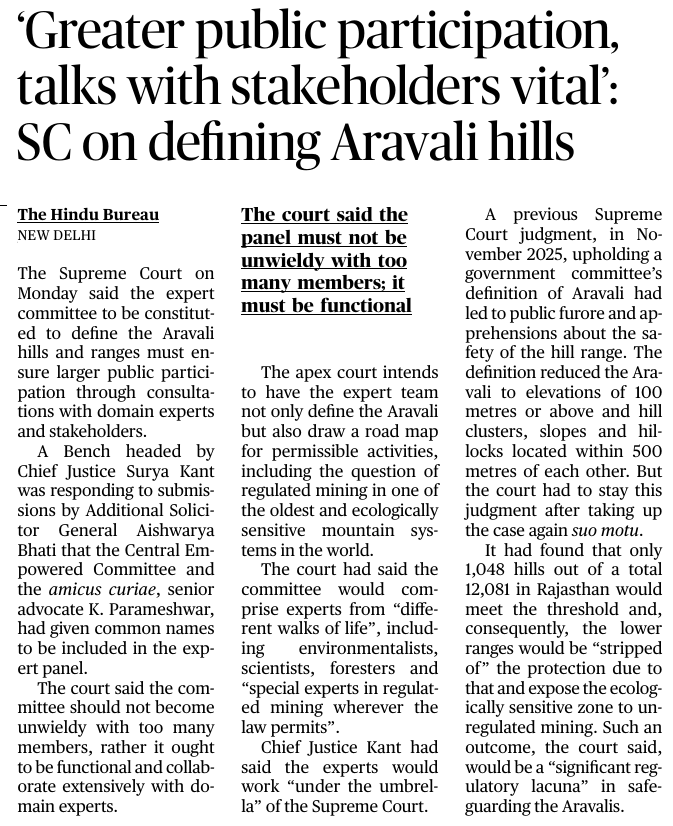 ‘Greater public participation, talks with stakeholders vital’: SC on defining Aravali hills
GS Paper III
Environmental Conservation
Biodiversity and Ecosystem Protection
Environmental Impact Assessment
GS Paper II
Role of Judiciary in Environmental Protection
Context
The Supreme Court emphasized the need for wider public participation and stakeholder consultation while defining the Aravali hills and ranges. The Court directed that the expert committee should be functional, multidisciplinary, and scientifically robust to safeguard the ecologically sensitive Aravali ecosystem.
Prelims concepts
1. Geography: The Aravali Mountain Range
The core of the article revolves around protecting the Aravali ecosystem. For Prelims, its physical and ecological characteristics are highly crucial.
Type of Mountain: The Aravalis are old fold mountains that have now been significantly eroded, classifying them as residual mountains. They form one of the oldest geological mountain systems in the world.
Geographical Extension: The range runs in a South-West to North-East direction. It spans across four states/union territories: Gujarat, Rajasthan, Haryana, and Delhi.
Highest Peak: Guru Shikhar (1,722 meters) located on Mount Abu in Rajasthan.
Ecological Significance: It acts as a natural barrier checking the eastward expansion of the Thar Desert.
It serves as a critical groundwater recharge zone for the water-scarce regions of northwestern India.
It is the source of origin for rivers like the Banas, Luni, Sakhi, and Sabarmati.
Ecological Importance
Acts as a natural barrier against desertification from the Thar Desert.
Supports biodiversity and groundwater recharge.
Helps regulate regional climate and air quality.
UPSC MCQ
Q. With reference to the Aravali Range, consider the following statements:
1. The Aravali Range acts as a natural barrier against the expansion of the Thar Desert.
2. The Aravali hills extend across Rajasthan, Haryana, Delhi, and Gujarat.
3. The Supreme Court recently emphasized wider stakeholder consultation in defining the Aravali hills.
Which of the statements given above is/are correct?
A) 1 and 2 only
B) 2 and 3 only
C) 1 and 3 only
D) 1, 2 and 3
Answer: D) 1, 2 and 3
Explanation:
Statement 1 is correct: Aravalis help check desertification from the Thar Desert.
Statement 2 is correct: The range extends through Rajasthan, Haryana, Delhi, and Gujarat.
Statement 3 is correct: The Supreme Court stressed public participation and stakeholder consultation while defining the Aravali ecosystem.
SC blames NTA for repeated NEET question paper leaks
GS Paper II
Education Sector Governance
Accountability and Transparency in Institutions
Role of Judiciary
Statutory and Regulatory Bodies
Context
The Supreme Court criticized the National Testing Agency (NTA) over repeated NEET-UG paper leak incidents and questioned why earlier reform recommendations were not effectively implemented. The Court sought responses from the Union Government and NTA on restructuring the examination body.
Prelims concepts
National Testing Agency (NTA)
What is it? The NTA is an independent, autonomous, and self-sustained premier testing organization established to conduct efficient, transparent, and international-standard tests to assess the competence of candidates for admission to premier higher education institutions.
Legal Status: It is registered as a Society under the Societies Registration Act, 1860. It is not a statutory body (it was not created by an Act of Parliament), which is why the petitions highlighted in the article seek to "fundamentally restructure" it or "make it answerable to Parliament."
Parent Ministry: It operates under the Ministry of Education, Government of India.
Central Bureau of Investigation (CBI)
The text notes that a CBI probe is currently underway regarding the paper leak.
Establishment: The CBI was set up in 1963 by a resolution of the Ministry of Home Affairs. It was recommended by the Santhanam Committee on Prevention of Corruption (1962–1964).
Statutory Power: The CBI is not a statutory body itself, but it derives its investigating powers from the Delhi Special Police Establishment (DSPE) Act, 1946.
Jurisdiction: To investigate cases in a state, the CBI requires the consent of the State Government concerned (either case-specific or general consent), unless ordered otherwise by the Supreme Court or High Courts.
2. Indian Polity & Judicial Concepts
Parliamentary Accountability vs. Autonomous Bodies
Executive Accountability: In India's parliamentary system, the executive and its attached offices/agencies are collectively responsible to the Legislature (Article 75 for the Union Council of Ministers).
Mechanisms of Control: Parliament exercises control over autonomous bodies and government departments through:
Parliamentary Questions: Question Hour (Starred, Unstarred, Short Notice questions).
Parliamentary Committees: Such as the Department-related Standing Committee on Education, Women, Children, Youth and Sports, which can scrutinize the functioning and structural lacunas of bodies like the NTA.
UPSC MCQ
Q. With reference to the National Testing Agency (NTA), consider the following statements:
1. The NTA was established to conduct standardized national-level entrance examinations in India.
2. NEET and CUET are conducted by the NTA.
3. The NTA is a constitutional body directly answerable to Parliament.
Which of the statements given above is/are correct?
A) 1 and 2 only
B) 2 and 3 only
C) 1 only
D) 1, 2 and 3
Answer: A) 1 and 2 only
Explanation:
Statement 1 is correct: NTA was created to conduct standardized entrance exams efficiently and transparently.
Statement 2 is correct: NEET and CUET are conducted by NTA.
Statement 3 is incorrect: NTA is an autonomous body under the Ministry of Education, not a constitutional body.




 Launch your Graphy