The Hindu Analysis 23rd May 2026 for UPSC, APPSC & TSPSC Exams
The Hindu News Analysis – 23rd May, 2026
1. Cyber warfare is outpacing global legal accountability (GS-2, GS-3)
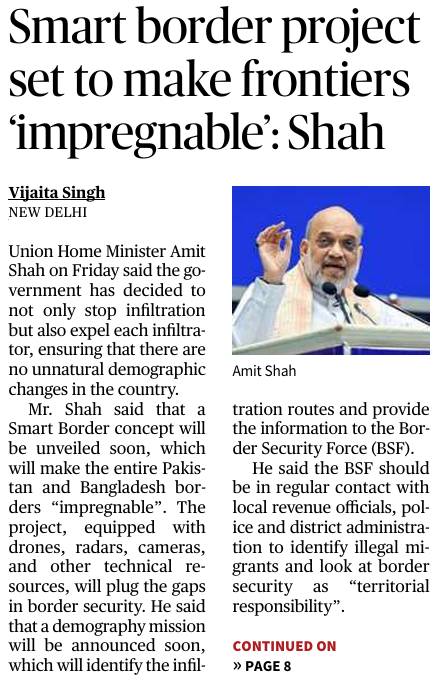
2. Smart border project set to make frontiers ‘impregnable’: Shah (GS-3)
3. EC announces Rajya Sabha polls for 24 seats on June 18 (GS-2)
4. Demand driving growth, but economic outlook somewhat clouded: RBI report (GS-3)
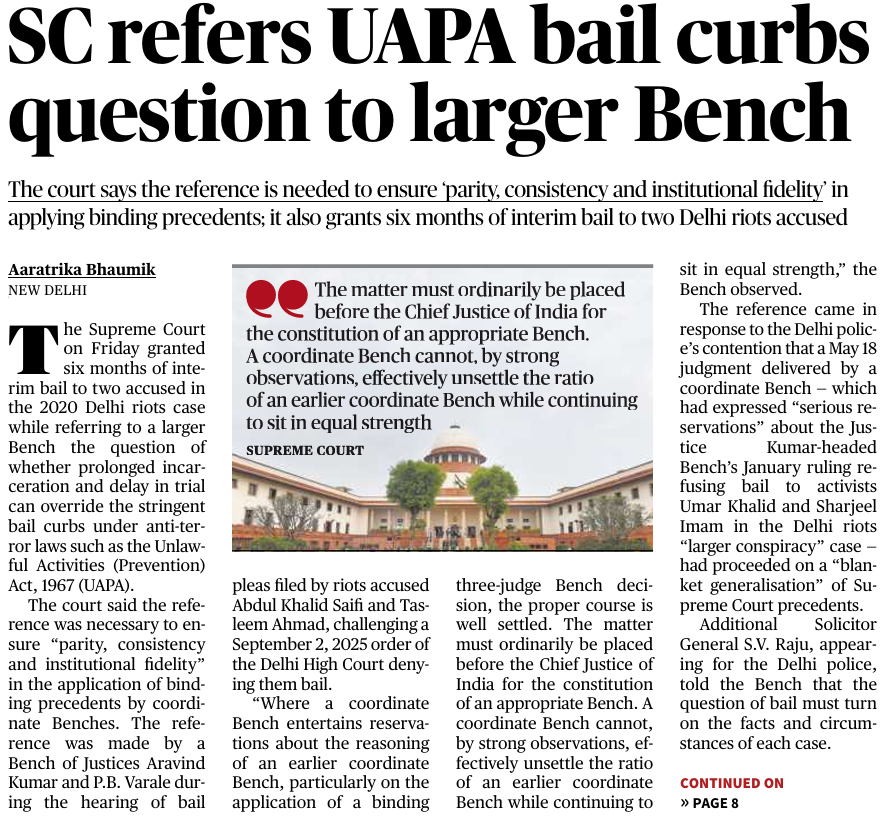
5. SC refers UAPA bail curbs question to larger Bench (GS-2)
Cyber warfare is outpacing global legal accountability
GS Paper II
International institutions and global governance
India and its bilateral/multilateral relations
International treaties and agreements
GS Paper III
Cyber Security
Internal Security challenges
Emerging technologies and security implications
Context
The article discusses how recent conflicts involving the United States, Israel, and Iran demonstrate the growing role of cyber warfare alongside conventional military operations. It highlights the widening gap between rapid technological advancements in cyber operations and the limited capacity of international law to ensure accountability, attribution, and legal enforcement.
Detailed Analysis
Challenges
1. Difficulty in Defining Threshold of Use of Force
International law, particularly Article 2(4) of the UN Charter, prohibits the use of force.
However, determining when a cyberattack becomes equivalent to an “armed attack” remains difficult.
Cyber operations often:
disrupt infrastructure,
target communication systems,
damage essential services without physical destruction.
Problem
Lack of universally accepted standards for:
severity,
intent,
consequences of cyberattacks.
2. Attribution Problem
One of the biggest legal hurdles is identifying the actual perpetrator.
Cyber operations:
are routed through multiple jurisdictions,
use proxy servers and anonymous networks,
involve non-state actors and hacker groups.
Consequences
Political suspicion may exist, but:
legally admissible evidence is hard to establish,
proving state responsibility becomes difficult.
This creates a gap between:
political certainty, and
judicial proof.
3. Absence of Effective Legal Forums
International courts face structural limitations.
International Court of Justice (ICJ)
Can hear disputes only with state consent.
Sensitive cyber disputes rarely reach the ICJ.
Domestic Courts
Foreign states are protected by sovereign immunity.
Cross-border jurisdiction issues complicate litigation.
Result
Very few cyber-related cases receive effective judicial scrutiny.
4. Evidentiary and Technical Complexity
Cyber incidents involve:
classified intelligence,
technical forensic evidence,
complex causal chains.
Courts struggle to establish:
who conducted the attack,
extent of damages,
causal relationship between attack and harm.
5. Strategic Reluctance of States
States often avoid litigation because:
court cases may escalate tensions,
sensitive intelligence may be exposed,
retaliation risks increase.
Hence, cyber incidents are usually handled through:
diplomacy,
sanctions,
covert retaliation,
rather than legal adjudication.
6. Inadequacy of Existing International Frameworks
Existing instruments like:
Budapest Convention on Cybercrime,
UN Convention against Cybercrime,
mainly focus on:
cybercrime,
law enforcement cooperation.
They inadequately address:
state-sponsored cyber warfare,
geopolitical cyber conflicts,
accountability during armed conflicts.
Significance
1. Cyber Warfare as a New Domain of Conflict
Cyber operations have become integral to modern warfare.
They can:
disable critical infrastructure,
disrupt financial systems,
manipulate information ecosystems,
weaken defence preparedness.
2. Blurring Line Between Peace and War
Cyberattacks occur:
below the threshold of conventional war,
continuously during peacetime.
This creates:
“grey-zone warfare”,
ambiguity in legal and military responses.
3. Threat to Critical Infrastructure
Sectors increasingly dependent on digital systems are vulnerable:
banking,
power grids,
healthcare,
transportation,
telecommunications.
Attacks can create nationwide disruptions without physical invasion.
4. Growing Relevance for India
India’s rapid digitalisation increases vulnerability.
Key Areas at Risk
Digital public infrastructure,
Financial systems,
Energy networks,
Defence communication systems.
India therefore has a strong stake in:
shaping international cyber norms,
strengthening domestic cyber resilience,
improving attribution and response mechanisms.
Way Forward
Develop Global Cyber Norms
Define cyber “use of force”
Clarify state responsibility
Establish proportional response norms
Strengthen Attribution
Improve cyber forensic cooperation
Enhance intelligence sharing
Create reliable verification systems
Create Specialized Legal Mechanisms
Cyber dispute tribunals
International cyber arbitration
Stronger UN-led cyber governance
Enhance India’s Cyber Preparedness
Strengthen CERT-In and cyber commands
Improve cyber infrastructure
Build skilled cyber workforce
Promote Multi-Stakeholder Cooperation
Involve governments, tech firms, academia, and civil society
Adopt Cyber Deterrence Strategies
Combine defensive security, diplomacy, legal tools, and countermeasures
Conclusion
Cyber warfare is advancing faster than global legal systems. Weak attribution, limited accountability, and unclear international norms have created a governance gap. Strengthening global cyber laws and domestic cyber resilience is essential, especially for digitally dependent countries like India.
UPSC Mains Question
“Cyber warfare is increasingly challenging the effectiveness of existing international legal frameworks.” Discuss the major challenges in ensuring accountability in cyberspace and suggest measures to strengthen global cyber governance. (250 words)
Smart border project set to make frontiers ‘impregnable’: Shah
GS Paper III
Internal Security
Border Management
Security Challenges and their Management
Context
Union Home Minister Amit Shah announced that the government is developing a “Smart Border” project to strengthen surveillance and prevent infiltration along the India-Pakistan and India-Bangladesh borders. The initiative will use advanced technologies such as drones, radars, cameras, and sensors to improve border security and identify infiltration routes.
Prelims concepts
Smart Border Concept / CIBMS
The text highlights a project equipped with drones, radars, cameras, and technical resources. In India's security framework, this falls under the Comprehensive Integrated Border Management System (CIBMS).
Definition: A robust, multi-layered security ecosystem that replaces traditional manual border patrolling with automated, technology-driven surveillance.
Components: Sensors: Thermal imagers, infrared and laser intruders alarms.
Surveillance: Aerostats and Unmanned Aerial Vehicles (UAVs)/Drones.
Communication: Ground penetrating radars and satellite feeds.
Objective: To create an "impregnable" line by plugging geographical gaps (riverine, mountainous, marshy terrains) where physical fencing is impossible.
Border Security Force (BSF)
The article explicitly mentions providing information and assigning responsibility to the BSF.
Nature: One of the seven Central Armed Police Forces (CAPFs) of India, functioning under the administrative control of the Ministry of Home Affairs (MHA).
Mandate: Raised in 1965, it is a specialized border-guarding force tasked with securing India's land borders during peacetime and preventing trans-border crimes.
Trans-Border Infiltration and Demographics
Infiltration: The unauthorized crossing of international borders by hostile actors, insurgents, or illegal migrants.
Demographic Overlap: The article highlights checking "unnatural demographic changes." In internal security dynamics, unchecked illegal migration along porous borders (particularly the eastern sector) alters the local socio-economic and political landscape of border states.
Inter-Agency Coordination: The article notes that the BSF must coordinate with local revenue officials, police, and district administration to view security as a "territorial responsibility". For Prelims, understand that effective border management relies on a synthesis of Union forces (BSF) and State-level machinery (Local Police and Revenue departments).
UPSC MCQ
Q. With reference to the proposed Smart Border Project in India, consider the following statements:
1. The project aims to strengthen surveillance along the India-Pakistan and India-Bangladesh borders using advanced technologies.
2. The project proposes the use of drones, radars, cameras, and sensors for border monitoring.
3. The Smart Border Project is being implemented exclusively by the Indian Army along maritime borders.
Which of the statements given above is/are correct?
A) 1 and 2 only
B) 2 and 3 only
C) 1 and 3 only
D) 1, 2 and 3
Answer: A) 1 and 2 only
Explanation:
Statements 1 and 2 are correct as the Smart Border Project focuses on technology-driven surveillance along the India-Pakistan and India-Bangladesh borders.
Statement 3 is incorrect because the project is primarily related to land border management involving agencies like the BSF, not exclusively the Indian Army or maritime borders.
EC announces Rajya Sabha polls for 24 seats on June 18
GS Paper II
Parliament and State Legislatures
Representation of People Act
Election Commission of India
Context
The Election Commission (EC) announced elections for 24 Rajya Sabha seats across 10 States following the retirement of incumbent members. The elections are scheduled for June 18. Bypolls were also announced for one Rajya Sabha seat each from Maharashtra and Tamil Nadu.
Prelims concepts
1. The Election Commission of India (ECI)
The article notes that the "EC announces Rajya Sabha polls."
Constitutional Status: A permanent, independent constitutional body established directly by the Constitution under Article 324.
Mandate: It superintends, directs, and controls the elections to:
Parliament (Lok Sabha and Rajya Sabha)
State Legislatures (Legislative Assemblies and Councils)
Office of the President of India
Office of the Vice-President of India
Note: Elections to local bodies (Panchayats and Municipalities) are conducted by respective State Election Commissions, NOT the ECI.
2. Rajya Sabha (The Upper House / Council of States)
The article discusses the upcoming polling for 24 vacant seats.
Constitutional Provisions: Dealt with under Article 80 of the Constitution.
Permanent House: Unlike the Lok Sabha, the Rajya Sabha is a permanent body and not subject to dissolution.
Tenure & Retirement: Members are elected for a 6-year term. As highlighted in the text ("incumbent Rajya Sabha members are retiring on different dates"), one-third of its members retire every second year.
Composition: Maximum strength is 250 (238 representatives of States/UTs + 12 nominated by the President from fields of Art, Literature, Science, and Social Service).
3. Election Mechanism for Rajya Sabha
Indirect Election: Citizens do not vote directly. Representatives of each State are elected by the elected members of the Legislative Assembly (MLAs) of that State.
System of Voting: Elected through the system of Proportional Representation by means of a Single Transferable Vote (STV).
Voting Method: It uses an Open Ballot System (to check corruption and cross-voting), meaning MLAs must show their marked ballot paper to the authorized agent of their party before dropping it into the ballot box.
4. Rajya Sabha Bypolls
The article mentions: "The EC also announced bypolls for one Rajya Sabha seat each from Maharashtra and Tamil Nadu."
What is a Bypoll? An election held to fill a vacancy that arises mid-term (before the completion of the 6-year tenure) due to resignation, death, or disqualification of a sitting member.
Reasons in the Article: * Maharashtra seat fell vacant due to the resignation of a member who was subsequently elected to the State Assembly.
Tamil Nadu seat fell vacant because the sitting MP became an MLA and resigned.
Key Law (Representation of the People Act, 1951): Section 151A mandates that a by-election to fill any vacancy must be held within six months from the date of the occurrence of the vacancy, provided the remainder of the term of the member is one year or more.
Tenure of a Bypoll Winner: The newly elected member serves only for the remainder of the term of the member who vacated the seat, not a fresh 6-year term.
5. Dual Membership Restrictions
The text highlights individuals resigning from the Rajya Sabha after being elected to State Assemblies.
Prohibition: A person cannot be a member of both Parliament and a State Legislature at the same time.
The Rule: According to the Representation of the People Act, 1951, if a sitting Member of Parliament (MP) is elected to a State Legislature, their seat in Parliament becomes vacant unless they resign from the State Legislature within a specified period (14 days under the Prohibition of Simultaneous Membership Rules).
UPSC MCQ
Q. With reference to the election and composition of the Rajya Sabha, consider the following statements:
1. The election of Rajya Sabha members is conducted through an open ballot system.
2. The Fourth Schedule of the Constitution deals with the allocation of Rajya Sabha seats to States and Union Territories.
3. A member elected to fill a casual vacancy in the Rajya Sabha serves a full six-year term.
Which of the statements given above are correct?
A) 1 and 2 only
B) 2 and 3 only
C) 1 and 3 only
D) 1, 2 and 3
Answer:
A) 1 and 2 only
Explanation:
Statement 1 is correct: Rajya Sabha elections use an open ballot system.
Statement 2 is correct: The Fourth Schedule allocates Rajya Sabha seats among States and Union Territories.
Statement 3 is incorrect: A member elected in a casual vacancy serves only the remainder of the predecessor’s term.
Demand driving growth, but economic outlook somewhat clouded: RBI report
GS Paper III
Indian Economy and issues relating to planning, mobilization of resources, growth and development
Inflation and monetary policy
Infrastructure: energy and transport
Effects of global events on the Indian economy
Context
The Reserve Bank of India (RBI), in its State of the Economy report (April 2026), stated that strong domestic demand continues to drive India’s economic growth. However, it warned that the near-term outlook is “somewhat clouded” due to global uncertainties such as the West Asia crisis, supply-side pressures, crude oil price volatility, and weakening external demand.
Prelims concepts
1. Macroeconomic Indicators & Concepts
Headline Inflation vs. Core Inflation
The text notes: "Although headline inflation remains firmly within the tolerance band..."
Headline Inflation: A measure of the total inflation within an economy, including commodities such as food and energy prices (e.g., crude oil, vegetables), which tend to be highly volatile. In India, it is measured by the Consumer Price Index (CPI) combined.
Core Inflation: Excludes the volatile food and fuel components from headline inflation to capture the underlying, long-term trend of the price level.
Purchasing Managers' Index (PMI)
The text mentions: "...while the Services PMI accelerated..."
What it is: An economic indicator derived from monthly surveys of private sector companies. It acts as a leading indicator of economic health, reflecting current and future business conditions.
The Scale: It is a headline index number ranging from 0 to 100.
Above 50 indicates an expansion in business activity compared to the previous month.
Below 50 indicates a contraction.
At 50 indicates no change.
Released by: In India, the surveys are compiled by S&P Global (e.g., S&P Global India Services/Manufacturing PMI).
2. Supply-Side Indicators
E-Way Bills
The article states: "...while e-way bills continued to hit double-digit growth..."
Definition: An Electronic Way Bill is a compliance mechanism wherein the person causing the movement of goods uploads the relevant information prior to the commencement of movement.
Threshold Limit: It is mandatory for inter-state movement of goods of consignment value exceeding ₹50,000 under the GST regime.
Economic Significance: High growth in e-way bills serves as a high-frequency proxy indicator reflecting robust internal trade and domestic economic activity.
Agricultural Seasons: Summer Crops (Zaid)
The text reports: "...sowing in the summer season has been 'progressing well'..."
Agricultural Seasons in India:
Kharif: Sown with the onset of the southwest monsoon (June-July) and harvested in autumn (e.g., Rice, Maize, Cotton).
Rabi: Sown in winter (October-December) and harvested in spring (e.g., Wheat, Mustard, Barley).
Summer/Zaid: A short season between the Rabi and Kharif crops (March to June). Crops grown require warm dry weather for major growth periods and longer day length for flowering.
Common Zaid Crops: Watermelon, muskmelon, cucumber, seasonal vegetables, and certain fodder crops.
SC refers UAPA bail curbs question to larger Bench
GS Paper II
Judiciary and judicial review
Fundamental Rights
Government policies and interventions
Issues relating to internal security and terrorism
Context
The Supreme Court referred to a larger Bench the question of whether prolonged incarceration and delay in trial can override the stringent bail restrictions under the Unlawful Activities (Prevention) Act (UAPA), 1967. The Court also granted six months’ interim bail to two Delhi riots accused.
Prelims concepts
1. Judicial Doctrines & Practices
Coordinate Benches & Judicial Precedent
The article highlights: "A coordinate Bench cannot, by strong observations, effectively unsettle the ratio of an earlier coordinate Bench while continuing to sit in equal strength."
Coordinate Bench: Refers to a bench of the exact same numerical strength of judges as a previous bench (e.g., a two-judge bench evaluating a precedent set by another two-judge bench).
Doctrine of Precedent (Stare Decisis): A foundational legal principle ensuring that lower courts and benches of equal strength follow previously established rulings to maintain legal certainty, consistency, and uniformity.
Master of the Roster
The text notes: “The matter must ordinarily be placed before the Chief Justice of India for the constitution of an appropriate Bench.”
The Rule: The Chief Justice of India (CJI) is the sole "Master of the Roster."
Authority: The CJI has the exclusive prerogative to constitute benches of the Supreme Court and allocate cases/legal references to those specific benches. No other judge or bench can independently assign a case or create a larger bench without the CJI’s administrative directive.
Statutory Provisions: The UAPA, 1967
Unlawful Activities (Prevention) Act (UAPA), 1967
The article centers on the "stringent bail curbs under anti-terror laws such as the UAPA."
Nature of the Act: It is India's primary anti-terror legislation, enacted to provide more effective prevention of certain unlawful activities of individuals and associations, and for dealing with terrorist activities.
Key Provisions & Amendments:
Jurisdiction: Applies to both Indian and foreign nationals. It holds validity even if the crime is committed on foreign soil outside India.
2019 Amendment: Empowered the Central Government to designate individuals as terrorists on specific grounds; previously, only organizations could be designated as unlawful or terrorist associations.
Investigating Agency: The National Investigation Agency (NIA) conducts investigations. An inspector-rank officer of the NIA is empowered to investigate cases under UAPA.





 Launch your Graphy