The Hindu Analysis 22nd May 2026 for UPSC, APPSC & TSPSC Exams
The Hindu News Analysis – 22nd May, 2026
1. How does the Gaganyaan’s life-support system operate? (GS-3)
2. RBI revived intervention strategy to arrest rupee fall, say bankers
(GS-3)
3. India skips vote on UN climate resolution (GS-2, GS-3)
4. Criminal justice system must adopt a more victim-centric approach: SC (GS-2)
5. Sedition trials can go on if accused is willing, says SC (GS-2)
How does the Gaganyaan’s life-support system operate?
GS Paper III
Space Technology
Human Spaceflight
Indigenous Technology Development
Context
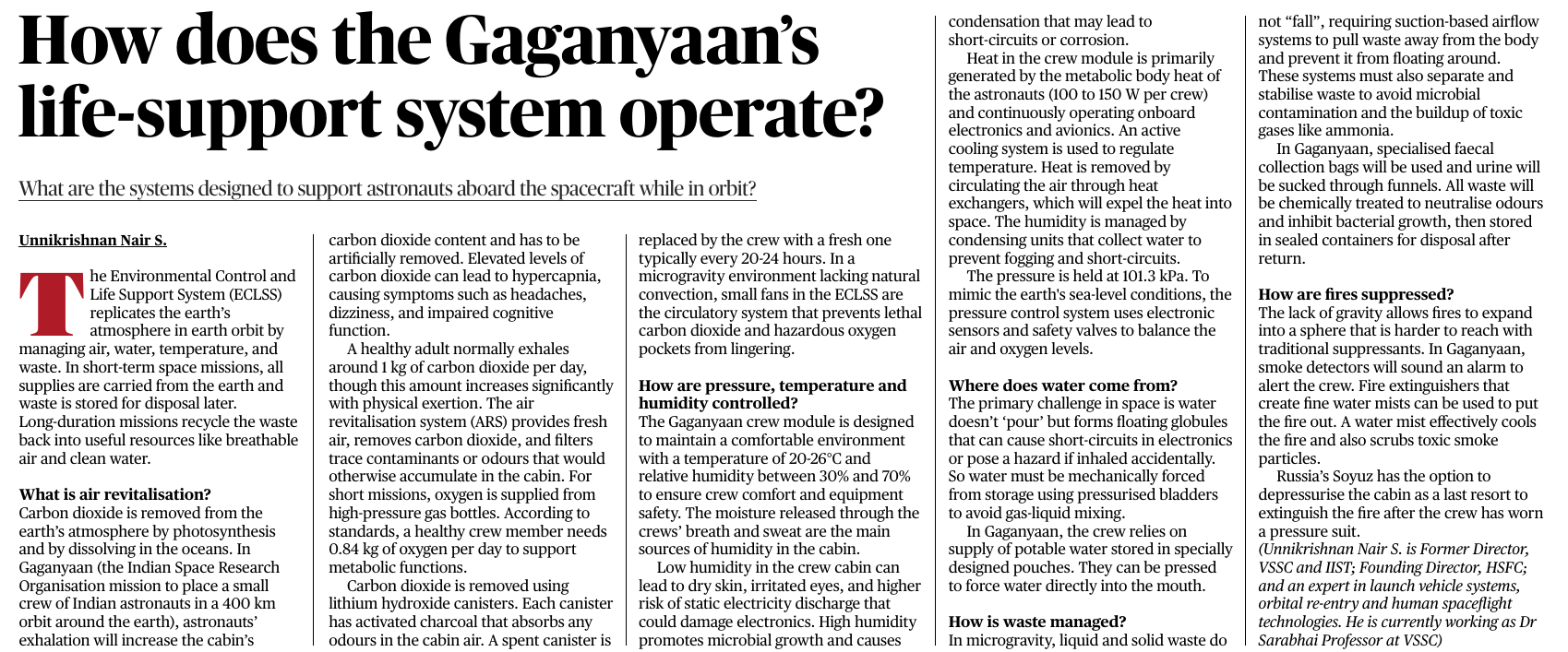
The article explains the functioning of the Environmental Control and Life Support System (ECLSS) in India’s Gaganyaan mission. The system recreates earth-like living conditions inside the spacecraft by regulating air, pressure, temperature, water, and waste management.
Detailed Analysis
1. ECLSS: Core of Human Spaceflight
The ECLSS is the most critical component of any crewed mission because it directly determines astronaut survival in space.
It performs:
Oxygen supply
Carbon dioxide removal
Temperature and humidity control
Water and waste management
Fire suppression
Without such systems, long-duration human spaceflight is impossible.
2. Technological Significance for India
Gaganyaan represents India’s transition from:
Satellite-launch capability → Human spaceflight capability
The development of indigenous life-support systems demonstrates:
Advanced aerospace engineering
Space medicine capability
Human-rated safety systems
It places India among a small group of nations capable of independent human space missions.
3. Microgravity Creates Unique Challenges
Most systems used on Earth cannot function normally in space because:
Fluids do not flow naturally
Heat transfer changes
Waste does not fall downward
Fire behaves differently
Hence, Gaganyaan requires:
Forced airflow systems
Suction-based waste disposal
Pressurised water systems
Special fire suppression technologies
This highlights the complexity of human space missions compared to robotic missions.
4. Importance of Air Revitalisation
The article emphasizes carbon dioxide management because CO₂ accumulation can quickly become fatal in enclosed spacecraft.
Key technologies include:
Lithium hydroxide canisters
Activated charcoal filters
Air circulation fans
This shows how maintaining atmospheric balance is a constant engineering challenge in space habitats.
5. Human Safety and Reliability
Unlike satellite missions, crewed missions require:
Extremely high reliability
Redundant safety systems
Real-time monitoring
Even small failures in pressure, temperature, or oxygen systems can endanger astronaut lives.
Thus, human spaceflight demands far stricter engineering standards.
6. Long-Term Strategic Importance
The technologies developed for Gaganyaan can support future:
Indian space stations
Lunar missions
Deep-space exploration
The mission also strengthens:
Scientific research
Strategic prestige
High-technology manufacturing ecosystem
Challenges
Ensuring zero-failure reliability
Managing limited onboard space and power
Recycling air and water efficiently
Protecting astronauts from prolonged microgravity effects
Way Forward
Develop closed-loop recycling systems
Improve autonomous monitoring and AI-based controls
Increase investment in space medicine
Expand international cooperation in human spaceflight technologies
Conclusion
The Gaganyaan life-support system reflects the technological sophistication required for human spaceflight. Beyond astronaut survival, it signifies India’s emergence as a major space power capable of undertaking complex and long-duration crewed missions.
UPSC Mains question
Q. Discuss the significance of the Environmental Control and Life Support System (ECLSS) in the Gaganyaan mission and the challenges of sustaining human life in space.
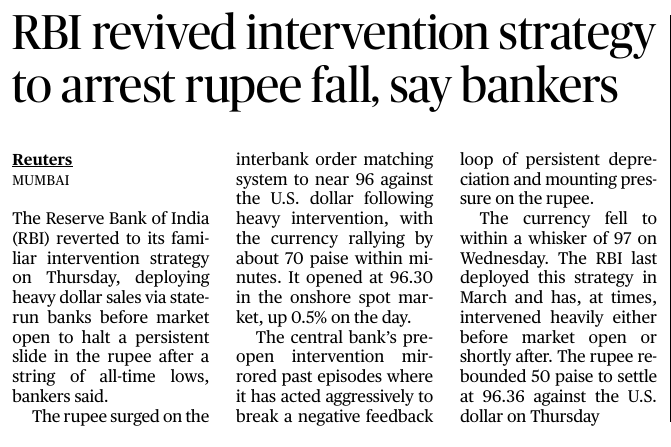
RBI revived intervention strategy to arrest rupee fall, say bankers
GS Paper III
Indian Economy & Banking
RBI and Monetary Policy
External Sector & Exchange Rate Management
Context
The Reserve Bank of India (RBI) intervened aggressively in the forex market through heavy dollar sales to prevent a sharp depreciation of the rupee, which had fallen to near-record lows against the U.S. dollar.
Prelims concepts
1. Foreign Exchange Market Intervention
Concept: The mechanism by which a country's central bank influences the exchange rate of its national currency.
Mechanism in the Article: The RBI deployed "heavy dollar sales via state-run banks."
How it works: When the local currency (Rupee) is depreciating rapidly due to high demand for foreign currency (USD), the RBI supplies dollars into the market by selling its own foreign exchange reserves. Increasing the supply of dollars stabilizes or appreciates the value of the Rupee.
Pre-open Intervention: Intervening right before the formal market trading hours commence to set a stable opening tone and curb speculative panic trading.
2. Currency Depreciation vs. Appreciation
Depreciation: A fall in the value of a currency in a floating or managed floating exchange rate system due to market forces (demand and supply). The article highlights the rupee falling "within a whisker of 97" per USD.
Appreciation/Rally: An increase in the value of the currency. Following RBI's intervention, the rupee "surged" and "rallied by about 70 paise", settling at 96.36.
3. Onshore Spot Market
Spot Market: A financial market where financial instruments or commodities are traded for immediate delivery (usually cash settlement within two business days, T+2), as opposed to futures or forwards markets.
Onshore Market: Foreign exchange trading that takes place within the geographical boundaries of the domestic country (India) and is governed by domestic regulations (RBI and FEMA guidelines).
4. Negative Feedback Loop (Currency Markets)
Concept: A self-reinforcing economic cycle where a decline in currency value triggers behaviors that cause it to fall even further.
RBI’s Role: Aggressive, timely intervention aims to "break" this psychological loop before it causes systemic macroeconomic instability.
5. Exchange Rate Management Policy of RBI
Managed Float System: India does not have a purely free-floating exchange rate, nor a fixed peg. It follows a managed float (or "dirty float").
Official Stance: The RBI maintains that it does not target a specific level or exchange rate value for the Rupee. It intervenes solely to contain excessive volatility and ensure orderly market conditions.
UPSC MCQ
Q. With reference to the Indian economy, which of the following actions are typically taken by the Reserve Bank of India (RBI) to arrest a sharp depreciation of the Indian Rupee?
1. Selling U.S. dollars in the domestic foreign exchange market
2. Increasing the policy Repo Rate to attract foreign capital inflows
3. Conducting buyback of government securities to inject liquidity into the banking system
Select the correct answer using the code given below:
A) 1 only
B) 1 and 2 only
C) 2 and 3 only
D) 1, 2 and 3
Answer: B) 1 and 2 only
Explanation
Statement 1: Correct. RBI sells U.S. dollars from forex reserves to increase dollar supply and stabilize the rupee.
Statement 2: Correct. Higher repo rates can attract foreign portfolio investments by offering better returns, supporting the rupee.
Statement 3: Incorrect. Injecting liquidity through government securities buyback increases rupee liquidity, which may further weaken the currency instead of supporting it.

India skips vote on UN climate resolution
GS Paper II
Important International Institutions
United Nations and Global Governance
International Relations
GS Paper III
Climate Change
Environmental Conservation
International Environmental Agreements
Context
India abstained from voting on a UN General Assembly resolution related to countries’ obligations on climate change, arguing that the resolution undermines the “sacrosanct architecture” of the UN Framework Convention on Climate Change (UNFCCC).
Prelims concepts
1. United Nations General Assembly (UNGA) & Voting Nature
Concept: The UNGA is the main policy-making organ of the UN, comprising all 193 member states.
Nature of Resolutions: As explicitly noted in the article ("adoption of the resolution by the General Assembly does not create binding commitments"), UNGA resolutions are generally non-binding in nature. They carry significant political and moral weight but lack the legally binding enforcement power found in UN Security Council (UNSC) resolutions passed under Chapter VII.
Voting Terms: Abstention: Choosing not to cast a vote "in favour" or "against" a resolution. India frequently uses strategic abstentions to balance its geopolitical interests while registering disagreement on specific clauses without blocking consensus completely.
2. United Nations Framework Convention on Climate Change (UNFCCC)
An international environmental treaty adopted in 1992 at the Rio Earth Summit to stabilize greenhouse gas concentrations. It is considered the foundation ("sacrosanct architecture") of global climate governance.
Core Principle (CBDR-RC): The cornerstone of the UNFCCC is Common But Differentiated Responsibilities and Respective Capabilities. It recognizes that while all nations must fight climate change, developed countries carry a historical responsibility to lead because they caused the bulk of emissions and possess more financial/technological resources.
India's Stance: India's abstention stems from protecting this framework. India opposes parallel climate resolutions outside the UNFCCC framework (like in the UNGA or UNSC) that might dilute CBDR-RC or shift the mitigation burden onto developing nations.
3. International Court of Justice (ICJ) & Advisory Opinions
The ICJ is the principal judicial organ of the United Nations, based in The Hague, Netherlands.
Jurisdiction Types: 1. Contentious Cases: Legal disputes submitted by member States (binding judgements). 2. Advisory Proceedings: Requests for legal opinions submitted by UN organs and specialized agencies.
Advisory Opinions: The article mentions an "advisory opinion of the International Court of Justice on States’ obligations on climate change."
Key Fact for Prelims: Unlike judgements in contentious cases, ICJ Advisory Opinions are non-binding under international law. However, they carry immense legal authority, clarify legal obligations, and help shape international customary law.
UPSC MCQ
Q. Consider the following statements regarding international bodies and legal mechanisms related to climate change:
1. Resolutions adopted by the United Nations General Assembly (UNGA) create legally binding obligations on all member states.
2. The International Court of Justice (ICJ) can issue advisory opinions on international law, which carry legal authority but are fundamentally non-binding.
3. India advocates that climate negotiations should remain within the core architecture of the United Nations Framework Convention on Climate Change (UNFCCC).
Which of the statements given above are correct?
A) 1 and 2 only
B) 2 and 3 only
C) 1 and 3 only
D) 1, 2 and 3
Answer: B) 2 and 3 only
Explanation:
Statement 1: Incorrect. UNGA resolutions are generally recommendatory and non-binding unless linked to specific UN Charter provisions.
Statement 2: Correct. ICJ advisory opinions clarify international legal principles and carry persuasive authority, but they are not legally binding.
Statement 3: Correct. India consistently supports climate negotiations within the UNFCCC framework, particularly emphasizing equity and the principle of Common But Differentiated Responsibilities and Respective Capabilities (CBDR-RC).
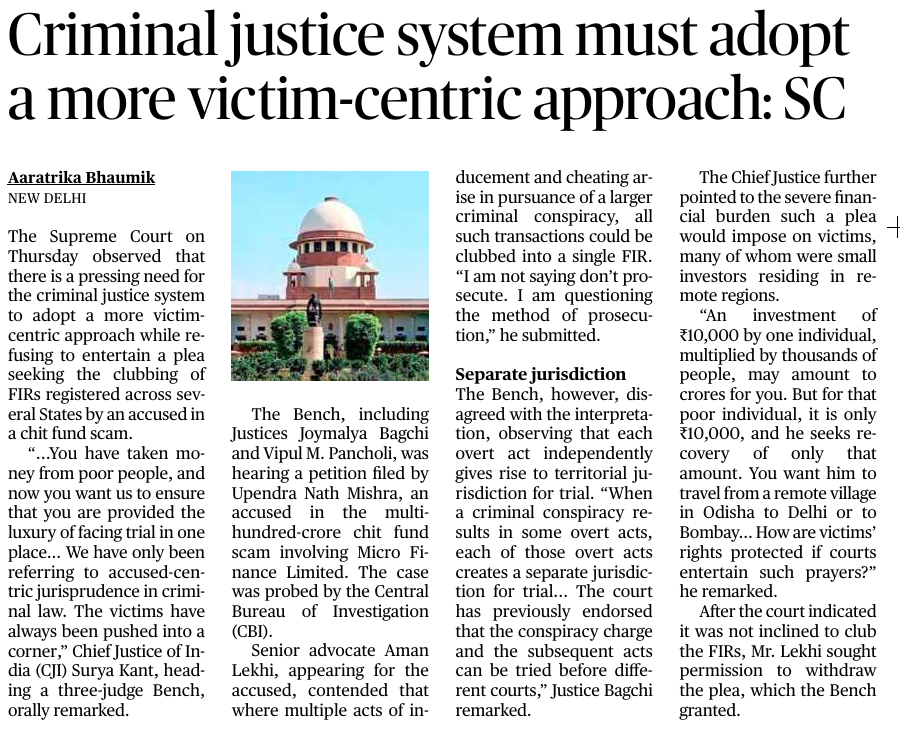
Criminal justice system must adopt a more victim-centric approach: SC
GS Paper II
Judiciary
Criminal Justice System
Victim Rights and Access to Justice
Context
The Supreme Court emphasized the need for a more victim-centric criminal justice system while refusing to club multiple FIRs related to a chit fund scam registered across different States.
Prelims concepts
1. Accused-Centric vs. Victim-Centric Jurisprudence
Accused-Centric Approach: Traditional criminal law heavily focuses on safeguarding the fundamental rights of the accused (e.g., protection against double jeopardy, right to a speedy trial, and minimizing undue harassment across multiple jurisdictions).
Victim-Centric Approach: An evolving legal paradigm strongly advocated by the Supreme Court in this article. It focuses on the rights, hardships, and financial burdens of the victims.
Key Focus: The Court highlighted that clubbing FIRs across multiple states for the convenience of the accused pushes vulnerable victims (e.g., small, rural investors) into a corner by forcing them to travel long distances to seek justice and recovery.
2. First Information Report (FIR) and Clubbing of FIRs
Concept of FIR: While the term "FIR" is not explicitly defined in the Code of Criminal Procedure (CrPC) / Bharatiya Nagarik Suraksha Sanhita (BNSS), it refers to the information recorded by a police officer regarding the commission of a cognizable offence.
Clubbing of FIRs: A legal remedy usually sought under Article 32 (Supreme Court) or Article 226 (High Courts) to merge multiple FIRs registered across different police stations or states for the same cause of action into a single investigation.
The SC Exception (Chit Fund/Conspiracy): The Court clarified that when a larger criminal conspiracy involves multiple "overt acts" (e.g., cheating separate individuals in different regions), each overt act independently gives rise to a separate territorial jurisdiction for trial. Thus, they cannot always be clubbed.
3. Judicial Administration & Territorial Jurisdiction
Territorial Jurisdiction: The geographical limit within which a court or law enforcement agency has the authority to try a case or investigate an offence.
Overt Act: An open, manifest act done in furtherance of a criminal conspiracy or design. As per the Bench, each distinct overt act creates its own separate legal jurisdiction, meaning the conspiracy and its subsequent individual crimes can be tried across different courts simultaneously.
4. Central Bureau of Investigation (CBI)
The premier investigating agency of India, mentioned in the text as the agency probing the Micro Finance Limited chit fund scam.
Key Facts for Prelims:
It is not a statutory body; it derives its investigative powers from the Delhi Special Police Establishment (DSPE) Act, 1946.
It functions under the Ministry of Personnel, Public Grievances and Pensions.
For investigating cases in various states, it generally requires either the General/Specific Consent of the respective State Government or an order from the High Court/Supreme Court.
UPSC MCQ
Q. With reference to the judicial administration and criminal justice system in India, consider the following statements:
1. The Central Bureau of Investigation (CBI) is a statutory body established under the Code of Criminal Procedure.
2. Under Indian jurisprudence, the Supreme Court is bound to club multiple First Information Reports (FIRs) filed across different States if they originate from a single overarching criminal conspiracy.
3. The Supreme Court can refuse to club FIRs to protect the territorial jurisdiction of trials and reduce the financial burden on individual victims.
Which of the statements given above is/are correct?
A) 1 and 2 only
B) 3 only
C) 1 and 3 only
D) 2 and 3 only
Answer: B) 3 only
Explanation
1: Incorrect — CBI derives powers from the DSPE Act, 1946, not the CrPC.
2: Incorrect — SC is not bound to club FIRs arising from a larger conspiracy.
3: Correct — SC can refuse clubbing to protect territorial jurisdiction and victim access to justice.
Sedition trials can go on if accused is willing, says SC
GS Paper II
Judiciary
Fundamental Rights
Criminal Laws and Governance
Context
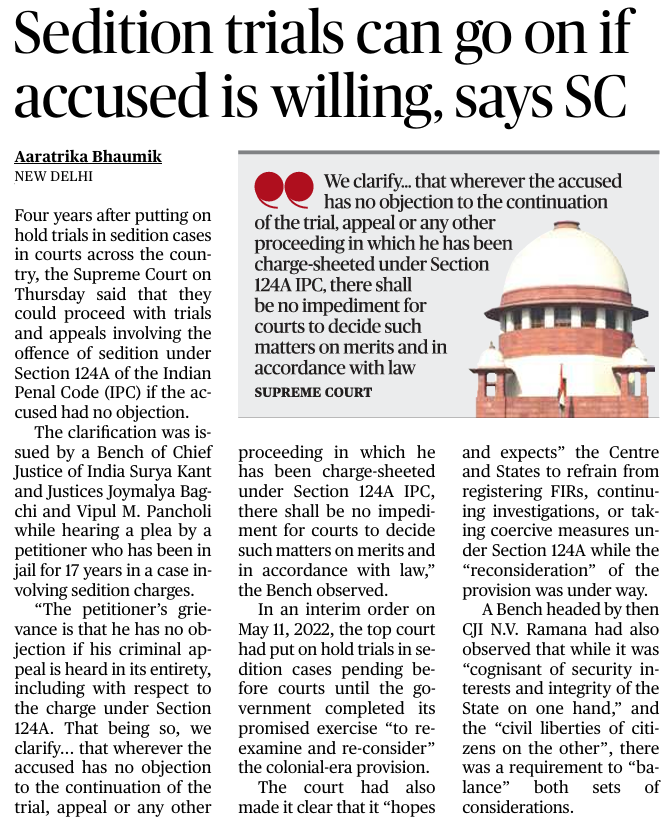
The Supreme Court clarified that sedition trials under Section 124A IPC may continue if the accused has no objection, despite the earlier interim stay on sedition proceedings.
Prelims concepts
1. Law of Sedition in India (Historical & Legal Framework)
Section 124A of the Indian Penal Code (IPC): Sedition is defined as any action (by words, signs, or visible representation) that brings or attempts to bring hatred, contempt, or excites disaffection towards the Government established by law in India.
Colonial-Era Legacy: It was not part of the original IPC drafted by Thomas Macaulay in 1860 but was introduced later in 1870 by James Stephen to curb nationalist dissent during British rule.
Legal Nature of the Offence: It is a cognizable (police can arrest without a warrant), non-bailable, and non-compoundable (cannot be settled privately out of court) offence.
Note on Transition: Under the newer Bharatiya Nyaya Sanhita (BNS), which replaces the IPC, the term "sedition" has been technically omitted, but the offence has been introduced under a new nomenclature targeting acts endangering the sovereignty, unity, and integrity of India.
2. Supreme Court's Interim Stay & Balances
The May 2022 Interim Order: In a historic ruling (led by then CJI N.V. Ramana), the Supreme Court effectively put Section 124A in abeyance (temporary suspension). It directed the Centre and States to refrain from registering fresh FIRs, continuing investigations, or taking coercive steps under this section while the Union government re-examines the law.
The New Clarification: The Supreme Court has now introduced an exception/nuance: Sedition trials, appeals, or legal proceedings can proceed if the accused has "no objection." The Rationale: If an accused has been languishing in jail for years (like the petitioner mentioned who was jailed for 17 years), keeping the trial frozen indefinitely strips them of their right to be heard, vindicated, or acquitted on merits.
3. Judicial Doctrine: Balancing National Security vs. Civil Liberties
Constitutional Conflict: The sedition law directly intersects with two competing values:
Article 19(1)(a): The fundamental right to Freedom of Speech and Expression.
Article 19(2): Reasonable restrictions on free speech, including public order, decency, and the sovereignty and integrity of India.
The Landmark Precedent (Kedarnath Singh v. State of Bihar, 1962): A 5-judge Constitution Bench upheld the validity of Section 124A but heavily restricted its application. The court ruled that criticism of the government cannot be labeled seditious unless it involves an incitement to violence or a tendency to create public disorder.
4. Types of Court Orders (Interim Orders)
Interim Order: A temporary order passed by a court during the pendency of a case, before the final judgment is delivered. It is used to preserve the status quo or prevent manifest injustice while the larger legal issue (like the constitutional validity of Section 124A) is being re-considered or debated.
UPSC MCQ
Q. With reference to the law of Sedition in India, consider the following statements:
1. It was an integral part of the original Indian Penal Code enacted in 1860.
2. According to the landmark Kedarnath judgment, regular criticism of government policies without incitement to violence does not amount to sedition.
3. The Supreme Court has completely struck down Section 124A of the IPC as unconstitutional, making all ongoing trials null and void.
Which of the statements given above is/are correct?
A) 1 and 2 only
B) 2 only
C) 2 and 3 only
D) 1, 2 and 3
Answer: B) 2 only
Explanation
1: Incorrect — Section 124A was inserted into the IPC in 1870, not in the original 1860 Code.
2: Correct — The Kedarnath Singh judgment limited sedition to acts involving incitement to violence or public disorder.
3: Incorrect — The Supreme Court has only kept the provision in abeyance for reconsideration; it has not struck it down.





 Launch your Graphy