The Hindu Analysis 21st May 2026 for UPSC, APPSC & TSPSC Exams
The Hindu News Analysis – 21st May, 2026
1. Preparing India for a credible digital Census (GS-2, GS-3)
2. India, Italy seal defence agreement, elevate ties (GS-2, GS-3)
3. 13-nation military exercise commences in Meghalaya (GS-2, GS-3)
4. Steel, cement help quicken April core sector growth to 1.7% (GS-3)
5. Rajnath holds wide-ranging defence talks in South Korea, pushes strategic cooperation (GS-2, GS-3)
Preparing India for a credible digital Census
GS Paper II
Governance
Population and associated issues
Welfare schemes and targeting
Federalism and representation
GS Paper III
Science and Technology in governance
Digital infrastructure
Data governance
Context
The article discusses the challenges and requirements for conducting India’s 2027 Census through a digital data-collection system. It highlights concerns regarding questionnaire design, caste enumeration, digital infrastructure, respondent fatigue, and the accuracy of self-enumeration.
Detailed Analysis
Why the 2027 Census is Important
The Census is crucial because it determines:
Population statistics
Welfare targeting
Delimitation of constituencies
Policy planning
Resource allocation
The 2027 Census assumes greater significance as:
Caste enumeration is being included after Independence.
Census figures may influence future Lok Sabha delimitation.
De Facto vs De Jure Census
India’s Traditional Method: De Facto Census
People are counted where they are physically present during enumeration.
This includes:
Temporary residents
Visitors staying during enumeration
Implications
Population figures may differ from voter populations.
Non-Resident Indians (NRIs) are generally excluded.
Issue of NRIs in Census
The article notes:
India has nearly 1.58 crore NRIs abroad.
States such as: Kerala; Gujarat; Punjab; Telangana; Tamil Nadu have significant migrant populations.
Excluding NRIs may affect:
Population counts
Future delimitation outcomes
The author suggests:
Pre-testing questions related to non-residents.
Digital Census: Opportunities
1. Faster Data Processing
Digital collection enables:
Real-time validation
Faster compilation
Improved consistency checks
2. Reduced Paperwork
Mobile-based enumeration reduces:
Manual entry errors
Time delays
3. Potential for Self-Enumeration
Citizens may self-report through:
Smartphones
Computers
Major Challenges
1. Enumerator Capacity
Many enumerators may:
Lack digital familiarity
Face difficulty handling devices
This may:
Increase data-entry errors
Affect confidentiality
2. Complex Questionnaire Design
Questions on:
Caste
Occupation
Disability
Employment
require careful wording and simplification.
Poorly designed questions may:
Confuse respondents
Reduce data reliability
3. Respondent Fatigue
Very lengthy online schedules can:
Reduce participation quality
Lead to incomplete or inaccurate responses
4. Risks in Self-Enumeration
Possible issues:
Fraudulent entries
Deliberate misinformation
Exclusion of migrant or absent household members
5. Omission Errors
Groups vulnerable to exclusion:
Domestic workers
Hostel students
Migrants
Temporary residents
This may distort:
Welfare targeting
Demographic accuracy
6. Confidentiality and Data Security
Digital systems raise concerns regarding:
Privacy
Data breaches
Misuse of personal information
Significance of a Credible Census
1. Evidence-Based Policymaking
Reliable data supports:
Welfare schemes
Urban planning
Employment policies
2. Democratic Representation
Population data affects:
Delimitation
Seat allocation
Political representation
3. Social Justice
Caste and demographic data influence:
Reservation debates
Inclusion policies
Targeted welfare
Way Forward
1. Extensive Field Testing
Pre-test questionnaires to ensure:
Clarity
Simplicity
Uniform understanding
2. Enumerator Training
Provide:
Digital literacy training
Ethical and privacy guidelines
3. Strengthen Verification Systems
Develop mechanisms to:
Detect duplicate/fraudulent entries
Reduce omission errors
4. Ensure Data Protection
Adopt strong:
Cybersecurity safeguards
Privacy protections
Data governance frameworks
Conclusion
India’s transition to a digital Census can improve efficiency, speed, and data quality, but only if supported by strong planning, technological safeguards, enumerator training, and carefully designed questionnaires. A credible Census is essential not only for governance and welfare delivery but also for preserving democratic representation and public trust in state institutions.
UPSC Mains Question
Discuss the opportunities and challenges associated with conducting a digital Census in India. How can a credible Census strengthen governance, welfare delivery, and democratic representation? (250 words)
India, Italy seal defence agreement, elevate ties
GS Paper II
India and Europe relations
Bilateral agreements
International cooperation
GS Paper III
Defence technology
Critical minerals
Maritime security
Energy security
Context
India and Italy signed multiple agreements to deepen bilateral cooperation, including a defence agreement, a Defence Industrial Road Map, cooperation in critical minerals, and collaboration in agriculture, technology, and Africa-focused development initiatives.
Key Areas of India–Italy Cooperation
1. Defence Cooperation
Defence Industrial Road Map signed
Focus on defence manufacturing, industrial collaboration, and technology partnerships
Supports Make in India and defence indigenisation
2. Critical Minerals
MoU on critical minerals cooperation
Important for EV batteries, semiconductors, and renewable energy technologies
3. Financial Enforcement
Cooperation between Italian Guardia di Finanza and India’s Directorate of Enforcement
Focus on financial crimes and illicit financial flows
4. Agriculture & Research
Collaboration in agricultural innovation and institutional research
5. Indo-Pacific & Maritime Cooperation
Support for free and open Indo-Pacific
Emphasis on freedom of navigation and UNCLOS
Concern over disruptions in the Strait of Hormuz
6. Africa Partnership
Joint projects in Africa in:
Digital Public Infrastructure (DPI)
Healthcare
AI
Renewable energy
Connectivity infrastructure
Reflects growing trilateral development cooperation and strategic outreach to Africa.
Food and Agriculture Organisation (FAO)
Nature: A specialized agency of the United Nations that leads international efforts to defeat hunger and improve nutrition and food security.
Headquarters: Rome, Italy (established in 1945).
Agricola Medal: A prestigious award conferred by the FAO to global leaders who have made outstanding contributions to the promotion of agriculture, food security, and international cooperation. (Note: The article mentions PM Modi being conferred this award for 2026).
UPSC MCQ
Q. Consider the following statements regarding recent India–Italy cooperation:
1. India and Italy signed a Defence Industrial Road Map to enhance defence manufacturing and technology cooperation.
2. India and Italy agreed to cooperate in Africa in areas such as Digital Public Infrastructure, healthcare, and renewable energy.
Which of the statements given above is/are correct?
a) 1 only
b) 2 only
c) Both 1 and 2
d) Neither 1 nor 2
Answer: c) Both 1 and 2
Explanation:
Statement 1 is correct: India and Italy signed a Defence Industrial Road Map focusing on defence manufacturing and technology collaboration.
Statement 2 is correct: Both countries agreed to jointly support projects in Africa in sectors like DPI, healthcare, AI, renewable energy, and connectivity infrastructure.
13-nation military exercise commences in Meghalaya
GS Paper II
India and its neighbourhood
Bilateral and regional groupings
GS Paper III
Internal security
Defence cooperation
Military exercises
Context
A 13-nation military exercise, PRAGATI 2026, commenced at Umroi Military Station in Meghalaya with participation from India and 12 friendly countries to strengthen professional military exchanges and defence cooperation.
Participating Countries
Apart from India, participating nations are: Bhutan; Cambodia; Indonesia; Laos; Malaysia; Maldives; Myanmar; Nepal; Philippines; Seychelles; Sri Lanka; Vietnam
Objectives of the Exercise
Enhance military-to-military cooperation
Promote professional exchange among armed forces
Improve interoperability and coordination
Strengthen regional security partnerships
Significance
1. Regional Defence Diplomacy
Strengthens India’s engagement with:
Southeast Asia
Indian Ocean Region (IOR)
Neighbouring countries
2. Act East Policy
Supports India’s strategic outreach toward ASEAN and Indo-Pacific partners.
3. Capacity Building
Facilitates: Joint training ; Tactical learning; Exchange of best practices
4. Strategic Presence in Northeast
Holding the exercise in Meghalaya highlights the strategic importance of Northeast India in regional connectivity and security.
Steel, cement help quicken April core sector growth to 1.7%
GS Paper III
Indian economy
Infrastructure
Industrial growth
Energy sector
Context
Growth in India’s eight core industries accelerated to 1.7% in April from 1.2% in March, mainly driven by improved performance in steel and cement sectors, indicating revival in construction and infrastructure activity.
Prelims concepts
1. Index of Eight Core Industries (ICI)
The primary macro-economic indicator discussed in the text is the Index of Eight Core Industries.
Definition: It is a production volume index that measures the collective and individual performance of production in selected eight core industries.
Significance: These eight industries are considered 'core' because they form the structural backbone of the economy and have a major impact on general industrial as well as overall economic activities.
Compiling and Releasing Authority: Compiled and released monthly by the Office of the Economic Adviser (OEA), Department for Promotion of Industry and Internal Trade (DPIIT) under the Ministry of Commerce and Industry.
Base Year: The current base year for calculation is 2011-12.
Relationship with IIP: The Eight Core Industries comprise 40.27% of the total weight of items included in the Index of Industrial Production (IIP).
Component Weights within the ICI
Rank
Core Industry
Weight (Percentage)
1
Refinery Products
28.04%
2
Electricity
19.85%
3
Steel
17.92%
4
Coal
10.33%
5
Crude Oil
8.98%
6
Natural Gas
6.88%
7
Cement
5.37%
8
Fertilizers
2.63%
Memory Trick (Highest to Lowest Weight in Core Industries)
Refinery → Electricity → Steel → Coal → Crude Oil → Natural Gas → Cement → Fertilizers
“REFined Electricity STEELs COAL, CRUDE Natural Cement Fertilizers”
UPSC MCQ
Q. Consider the following statements regarding India’s core industries:
1. Crude oil and natural gas are included in the Index of Eight Core Industries.
2. The Index of Eight Core Industries is released by the Ministry of Commerce and Industry.
Which of the statements given above is/are correct?
a) 1 only
b) 2 only
c) Both 1 and 2
d) Neither 1 nor 2
Answer:
c) Both 1 and 2
Explanation:
Statement 1 is correct: Crude oil and natural gas are part of the eight core industries.
Statement 2 is correct: The Index of Eight Core Industries is released by the Ministry of Commerce and Industry.
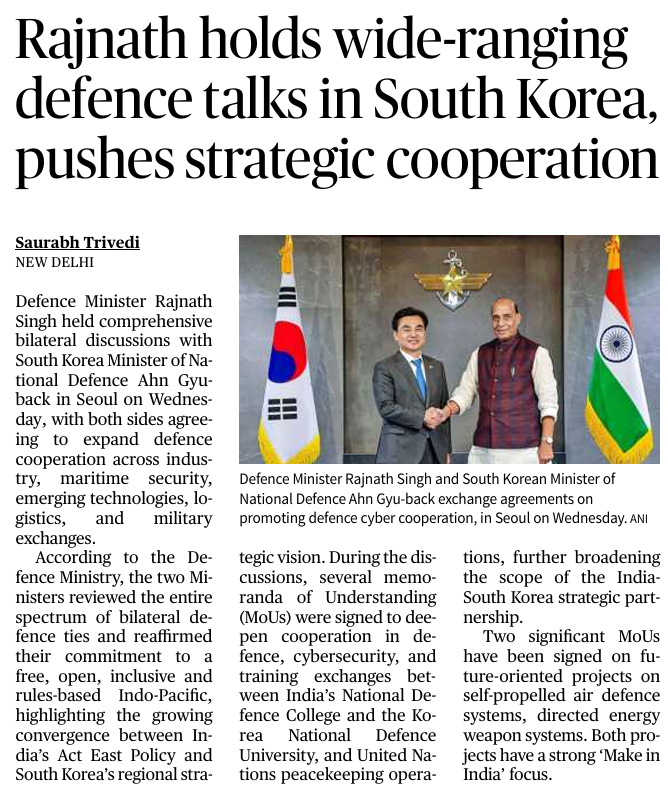
Rajnath holds wide-ranging defence talks in South Korea, pushes strategic cooperation
GS Paper II
India and East Asia relations
Bilateral agreements
Indo-Pacific cooperation
GS Paper III
Defence technology
Cybersecurity
Maritime security
Defence manufacturing
Context
Rajnath Singh held comprehensive defence talks with South Korea’s Defence Minister in Seoul to strengthen bilateral strategic cooperation in defence industry, cybersecurity, maritime security, logistics, and emerging technologies.
Key Areas of Cooperation
1. Defence Industry Cooperation
India and South Korea agreed to:
Expand defence industrial collaboration
Promote technology partnerships
Strengthen military exchanges
This aligns with India’s:
Make in India
Defence indigenisation initiatives
2. Maritime Security
Both sides reaffirmed commitment to:
Free, open, and inclusive Indo-Pacific
Rules-based maritime order
This reflects growing convergence in Indo-Pacific strategy.
3. Cybersecurity and Emerging Technologies
MoUs were signed for cooperation in:
Cyber defence
Training exchanges
Defence education
4. Future-Oriented Defence Projects
MoUs signed on:
Self-propelled air defence systems
Directed energy weapon systems
These represent cooperation in advanced defence technologies.
Institutional Cooperation
Partnerships were expanded between:
India’s National Defence College and
Korea National Defence University
UN peacekeeping training cooperation




 Launch your Graphy