The Hindu Analysis 1st June 2026 for UPSC, APPSC & TSPSC Exams
The Hindu News Analysis – 1st June, 2026
1. The apex court rings its own chain (GS-2)
2. Mann Ki Baat: PM praises athletes, changemakers (GS-2, GS-3, GS-4)
3. Human trafficking can’t be separated from broader migration flows, says SC (GS-2, GS-3)
4. Nepal PM sparks row, says his country has encroached upon Indian territory (GS-2)
5. Odisha govt. clears key road for Vedanta’s mining project (GS-3)
 The apex court rings its own chain
GS Paper II
Judiciary: Structure, Organisation and Functioning
Separation of Powers
Judicial Activism and Judicial Accountability
Issues relating to Governance and Rule of Law
Context
The article critiques the increasing use of suo motu cognisance by the Supreme Court, particularly in the context of the Twisha Sharma case. It argues that a jurisdiction originally intended for exceptional circumstances is increasingly being triggered by media reports, raising questions about judicial priorities, institutional capacity, and the allocation of judicial attention.
Detailed Analysis
Arguments Against Frequent Suo Motu Intervention
1. Media-Driven Judicial Action
Several recent suo motu cases have been initiated following extensive media coverage.
This creates a perception that judicial intervention is influenced by public visibility rather than objective institutional criteria.
2. Diversion of Scarce Judicial Resources
Courts already face a massive backlog of pending cases.
Time spent on monitoring investigations and conducting continuous hearings may reduce attention available for ordinary litigants.
3. Weakening Lower Judicial Institutions
Excessive intervention may signal lack of trust in trial courts, police investigations, and High Courts.
Instead of strengthening institutional capacity, it may encourage dependence on apex court oversight.
4. Lack of Clear Selection Criteria
No transparent framework exists for determining which cases deserve suo motu attention.
Similar cases may not receive equal treatment, raising concerns about consistency.
5. Risk of Judicial Overreach
Continuous supervision of investigations can blur the distinction between adjudication and administration.
It may affect the balance between the judiciary, executive agencies, and investigative bodies.
Arguments For Suo Motu Intervention
1. Protection of Fundamental Rights
Enables courts to act swiftly where victims are unable to approach the judiciary.
Helps protect vulnerable and marginalized groups.
2. Correcting Institutional Failures
Acts as a safeguard when police investigations appear compromised or ineffective.
Can ensure accountability in exceptional circumstances.
3. Public Confidence in Justice
Demonstrates judicial responsiveness to serious violations of rights.
Reinforces citizens' faith in constitutional institutions.
4. Constitutional Duty of the Supreme Court
As the guardian of fundamental rights, the Court has a responsibility to intervene when justice appears threatened.
5. Addressing Extraordinary Situations
Suo motu powers have proved useful during disasters, humanitarian crises, environmental emergencies, and major governance failures.
Way Forward
Establish Clear Guidelines
Define objective criteria for initiating suo motu proceedings.
Ensure transparency and consistency in case selection.
Prioritize Institutional Strengthening
Improve capacity of trial courts, forensic infrastructure, and investigative agencies.
Focus on systemic reforms rather than case-specific monitoring.
Judicial Restraint
Reserve suo motu jurisdiction for truly exceptional circumstances.
Avoid routine intervention in matters that can be handled by existing institutions.
Enhance Case Management
Reduce pendency through technological upgrades, judicial appointments, and procedural reforms.
Allocate judicial attention efficiently across all levels of the judiciary.
Strengthen Accountability Mechanisms
Periodic review of ongoing suo motu cases.
Ensure interventions produce measurable institutional improvements.
Conclusion
Suo motu jurisdiction remains an important constitutional tool for protecting justice and fundamental rights. However, its increasing use in response to media attention raises concerns about judicial priorities and resource allocation. The long-term solution lies not merely in apex court intervention but in strengthening the capacity and credibility of the entire judicial system so that justice is delivered effectively at every level.
UPSC Mains Question
Q. While suo motu jurisdiction enables courts to protect constitutional rights in exceptional circumstances, its frequent use may raise concerns regarding judicial overreach and institutional efficiency.” Critically examine. (250 words)
Nepal PM sparks row, says his country has encroached upon Indian territory
GS Paper II
India and its neighbourhood relations
Bilateral, regional and global groupings involving India
Effect of policies and politics of neighbouring countries on India’s interests
Context
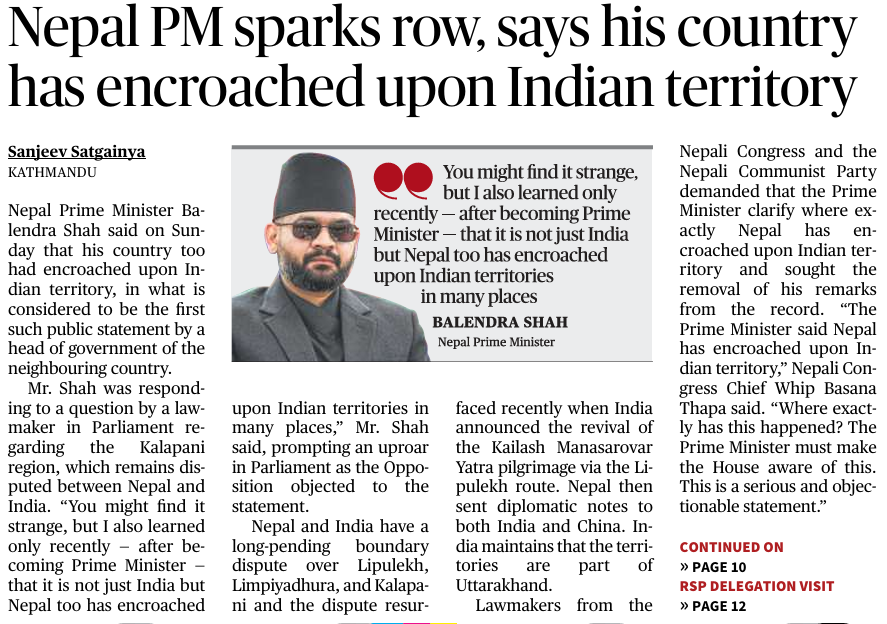
Nepal Prime Minister Balendra Shah stated in Nepal’s Parliament that Nepal had also encroached upon Indian territory in some places. The remarks triggered political controversy in Nepal and renewed attention on the long-standing India–Nepal boundary disputes, particularly concerning the Kalapani-Limpiyadhura-Lipulekh region.
India-Nepal Border Dispute Regions
The long-pending boundary dispute between India and Nepal primarily revolves around a contiguous tri-junction area.
Disputed Territories: Kalapani, Lipulekh, and Limpiyadhura.
Indian Stand: India maintains that these territories are an integral part of the Pithoragarh district in the state of Uttarakhand.
Historical Baseline: The border is historically governed by the Treaty of Sugauli (1816) signed between the British East India Company and the Kingdom of Nepal, which established the Mahakali River as Nepal's western boundary. The dispute arises from differing interpretations of the source of the river.
Lipulekh Pass & Kailash Manasarovar Yatra
The area holds immense strategic, geographical, and cultural significance for India.
Geographical Location: Lipulekh is a Himalayan pass situated at the tri-junction of India (Uttarakhand), Nepal, and China (Tibet).
Kailash Manasarovar Yatra: The pass is a primary, ancient route utilized for the annual pilgrimage to Mount Kailash and Lake Manasarovar in Tibet.
Strategic Road: India's infrastructure development and revival of the yatra route via this pass have historically drawn diplomatic objections from Nepal, which claims the pass lies within its territory.
UPSC MCQ
Q. Consider the following statements regarding the India–Nepal boundary dispute:
1. The dispute over Kalapani, Lipulekh, and Limpiyadhura arises from differing interpretations of the Treaty of Sugauli (1816).
2. Lipulekh Pass is located near the India–Nepal–China tri-junction and is strategically significant.
3. Nepal and India agree that the source of the Kali (Mahakali) River lies at Limpiyadhura.
Which of the statements given above are correct?
(a) 1 and 2 only
(b) 2 and 3 only
(c) 1 and 3 only
(d) 1, 2 and 3
Answer: (a) 1 and 2 only
Explanation:
Statement 1 is correct: The dispute is rooted in differing interpretations of the Treaty of Sugauli (1816) and the origin of the Kali River.
Statement 2 is correct: Lipulekh Pass is strategically important as it lies near the India–Nepal–China tri-junction and serves as a route for the Kailash Mansarovar Yatra.
Statement 3 is incorrect: Nepal considers Limpiyadhura to be the source of the Kali River, whereas India has a different interpretation. Therefore, there is no agreement between the two countries on this issue.
Mann Ki Baat: PM praises athletes, changemakers
GS Paper II
Government policies and interventions
Citizen participation in governance
Social capital and community initiatives
GS Paper III
Science and Technology – Promotion of scientific temper
Environment and biodiversity conservation
Sports development in India
GS Paper IV
Ethics in public life
Social responsibility and community service
Context
In the 134th episode of Mann Ki Baat, Prime Minister Narendra Modi highlighted achievements in sports, agriculture, environmental conservation, scientific awareness, and grassroots social initiatives. The address emphasized citizen-led development and community participation in nation-building.
Key Highlights Discussed by the PM
Chola-Era Copper Plates: Repatriated from the Netherlands; crucial historical sources providing insights into the maritime strength, governance, and international diplomacy of the Chola Empire.
Ganga River Dolphin: Highlighted active community and environmental conservation efforts to protect this endangered freshwater species.
Athletics Record: Praised sprinter Gurindervir Singh for clocking 10.09 seconds in the 100m sprint at Ranchi (becoming the first Indian to break the 10.10-second barrier), alongside sprinter Animesh Kujur.
Agricultural Exports: Appreciated mango farmers for successfully scaling up production to reach international global markets.
Heatwave Vigilance: Urged citizens and local administrative bodies to remain active and collectively minimize the impact of summer heatwaves.
Astronomy Initiatives: Commended the youth outreach work of organizations like Astro Kerala, Bangalore Astronomical Society, and the Big Bang Astronomy Club of Rajkot.
Grassroots Changemakers:
Girija Amma: Educator who raised nearly ₹40 lakh for soldiers by collecting just one rupee daily from students.
Saji Valasheril: Trained thousands of people, including children with disabilities, through grassroots swimming programmes in Kerala.
Human trafficking can’t be separated from broader migration flows, says SC
GS Paper II
Vulnerable sections of society
Issues relating to women and children
Welfare mechanisms and protection of vulnerable groups
GS Paper III
Human trafficking
Internal migration and associated challenges
Social justice and inclusive development
Context
The Supreme Court, while examining issues related to trafficking and sex work, observed that human trafficking cannot be viewed in isolation from broader migration patterns. The Court highlighted that migration is often a survival and livelihood strategy, but structural vulnerabilities can expose migrants—especially women and children—to exploitation and trafficking.
Prelims concepts
1. The Link Between Migration and Trafficking
Supreme Court Observation: The Supreme Court (Bench of Justices J.B. Pardiwala and R. Mahadevan) noted that for a large majority of India's population, migration acts as a core "survival and livelihood strategy".
Vulnerability: The structural inequalities and vulnerabilities that drive this migration often create conditions conducive to coercion and deception, making human trafficking inseparable from broader migration flows.
2. The Palermo Protocol
Framework: The UN Palermo Protocol establishes a universally recognized three-tiered framework to define and identify human trafficking: Act, Means, and Purpose.
Relevance: It forms the baseline for identifying whether an act constitutes trafficking by checking if explicit 'means' (like force or deception) were used for the 'purpose' of exploitation.
3. Bharatiya Nyaya Sanhita (BNS) - Section 143
Alignment with Palermo Protocol: Section 143 of the BNS mandates that the act of bringing a person into prostitution must involve specified 'means' (such as force, coercion, inducement, or deception) to legally constitute trafficking.
Significance: It legally differentiates between forced trafficking (where coercion is present) and situations where such 'means' are absent.
4. Immoral Traffic (Prevention) Act (ITPA) & Its Limitations
Conflation of Terms: The Court flagged that the legislative framework under ITPA conflates voluntary sex work with sex trafficking.
Absence of 'Means' Test: Unlike the BNS, the ITPA operates on a different logic where all prostitution involving third parties is treated as trafficking for commercial sexual exploitation, entirely regardless of whether force, coercion, or inducement was employed.
UPSC MCQ
Q. Consider the following statements regarding Human Trafficking in India:
1. Under Section 143 of the Bharatiya Nyaya Sanhita (BNS), trafficking requires the use of means such as force, coercion, deception, or inducement for exploitation.
2. The Supreme Court has observed that human trafficking can be completely separated from broader migration flows.
3. The Immoral Traffic (Prevention) Act (ITPA) has been criticized for conflating voluntary adult sex work with trafficking in certain situations.
Which of the statements given above are correct?
(a) 1 and 2 only
(b) 1 and 3 only
(c) 2 and 3 only
(d) 1, 2 and 3
Answer: (b) 1 and 3 only
Explanation:
Statement 1 is correct: Section 143 of the Bharatiya Nyaya Sanhita defines trafficking through a three-tier framework involving act, means (force, coercion, deception, etc.), and purpose (exploitation).
Statement 2 is incorrect: The Supreme Court specifically observed that human trafficking cannot be separated from broader migration flows, as vulnerabilities associated with migration often facilitate exploitation.
Statement 3 is correct: The Court noted that the ITPA tends to conflate voluntary adult sex work with trafficking, leading to concerns regarding the rights and protection of adult sex workers.
Odisha govt. clears key road for Vedanta’s mining project
GS Paper III
Mining sector and mineral resources
Forest Conservation
Inclusive Growth and Sustainable Development
Context
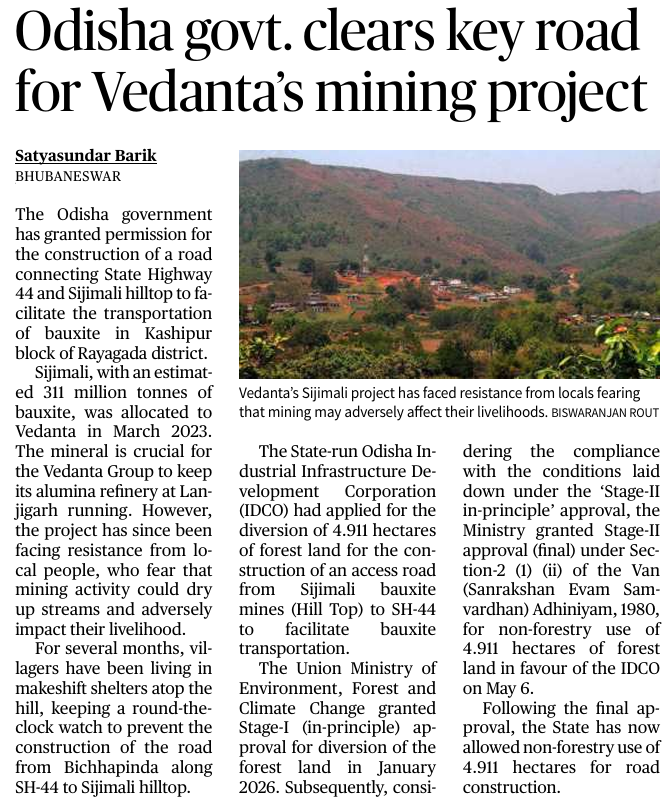
Odisha has approved a road to connect SH-44 with the Sijimali bauxite mine for Vedanta's project, after granting Stage-II forest clearance for diversion of 4.911 hectares of forest land. The project faces local opposition over environmental and livelihood concerns.
Prelims concepts
1. Sijimali Bauxite Reserve & Regional Geography
The article highlights a major mining project in the Eastern Ghats, a region ecologically and economically significant for its rich mineral deposits.
Location: The Sijimali hilltop is located in the Kashipur block of Rayagada district, Odisha.
Mineral: It is a major Bauxite reserve (estimated 311 million tonnes). Bauxite is the primary commercial ore used to produce alumina (at refineries like Lanjigarh) and subsequently aluminium.
Ecological Concerns: Local resistance is driven by apprehensions that open-cast hilltop mining will disrupt local hydrology, drying up perennial streams and impacting the livelihoods of indigenous communities.
2. Van (Sanrakshan Evam Samvardhan) Adhiniyam, 1980
The diversion of forest land to construct access roads for the mining project requires strict statutory clearance under this Act, which is the amended and renamed version of the Forest (Conservation) Act, 1980.
Core Mandate: Section-2 (1) (ii) of the Act strictly regulates the de-reservation of forests and restricts the use of forest land for non-forestry purposes (such as mining, road construction, or industrial projects).
Central Authority: While state agencies (like the Odisha Industrial Infrastructure Development Corporation - IDCO) apply for the diversion, the statutory power to grant this approval lies primarily with the Union Ministry of Environment, Forest and Climate Change (MoEFCC).
3. Two-Stage Forest Clearance Process
The statutory mechanism for diverting forest land for non-forest use operates through a sequential, two-tiered regulatory system to ensure environmental compliance.
Stage-I Approval: This is an 'in-principle' clearance granted by the MoEFCC. It stipulates a set of strict conditions (such as payment for Compensatory Afforestation and Net Present Value) that the user agency must fulfill.
Stage-II Approval: This is the final approval. It is granted only after the user agency and the State Government submit a comprehensive compliance report proving that all stipulations laid down during the Stage-I clearance have been satisfactorily executed.





 Launch your Graphy