There are no items in your cart
Add More
Add More
| Item Details | Price | ||
|---|---|---|---|



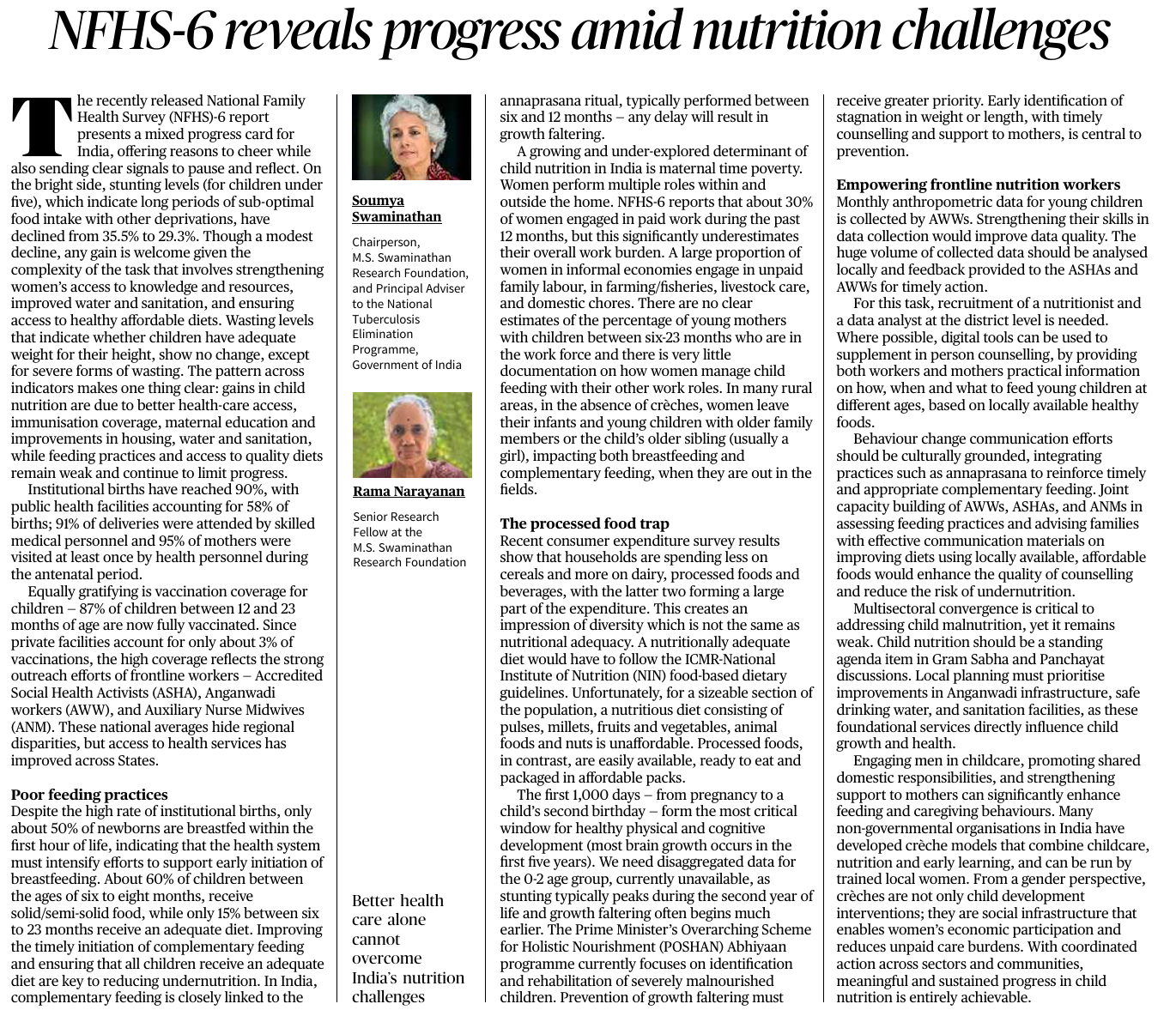 NFHS-6 reveals progress amid nutrition challenges
Context
The recently released National Family Health Survey (NFHS-6) presents a mixed picture of India's nutritional status. While indicators such as stunting among children under five have declined, challenges related to wasting, poor infant feeding practices, dietary inadequacy, and maternal constraints continue to hinder progress in achieving optimal child nutrition outcomes.
Detailed Analysis
Significance of the Findings
1. Improvement in Child Nutrition Indicators
Stunting declined from 35.5% to 29.3%, indicating better long-term nutritional outcomes.
Reflects gains from:
Improved healthcare access
Better sanitation and drinking water
Higher maternal education
Expanded immunisation coverage
2. Strengthening of Maternal and Child Healthcare
Institutional deliveries have reached nearly 90%.
High antenatal care coverage and skilled birth attendance.
Vaccination coverage among children aged 12–23 months stands at 87%.
3. Success of Frontline Health Workforce
Contributions of ASHAs, Anganwadi Workers (AWWs), and ANMs have significantly expanded healthcare outreach.
Improved access to maternal and child health services across states.
4. Evidence-Based Policymaking
NFHS provides crucial data for targeted interventions under programmes such as:
POSHAN Abhiyaan
Integrated Child Development Services (ICDS)
National Health Mission (NHM)
Challenges Highlighted by NFHS-6
1. Persistent Wasting and Growth Faltering
Wasting levels remain largely unchanged.
Indicates continued vulnerability to acute undernutrition and infections.
2. Poor Infant and Young Child Feeding Practices
Only about 50% of newborns are breastfed within the first hour.
Around 60% of children receive complementary food between 6–8 months.
Only 15% of children aged 6–23 months receive an adequate diet.
3. Maternal Time Poverty
Women shoulder unpaid domestic and caregiving work alongside income-generating activities.
Lack of childcare facilities affects breastfeeding and complementary feeding practices.
4. Growing Dependence on Processed Foods
Consumption patterns show rising expenditure on processed foods and beverages.
Nutritional diversity is often replaced by calorie-dense but nutrient-poor diets.
5. Affordability Constraints
Nutritious diets including pulses, fruits, vegetables, animal-source foods, and nuts remain inaccessible for many households.
6. Weak Data Utilisation
Large volumes of nutrition-related data are collected but often not analysed effectively at local levels for corrective action.
7. Regional and Social Disparities
National averages conceal significant interstate and intra-state variations in nutrition outcomes.
Way Forward
1. Focus on the First 1,000 Days
Prioritise nutrition from pregnancy to a child’s second birthday.
Early detection of growth faltering through regular monitoring.
2. Improve Infant and Young Child Feeding
Promote early initiation of breastfeeding.
Ensure timely introduction of complementary feeding.
Strengthen nutrition counselling for mothers.
3. Address Maternal Time Poverty
Expand community-based childcare and crèche facilities.
Encourage greater male participation in caregiving responsibilities.
4. Strengthen Frontline Nutrition Systems
Build capacities of AWWs, ASHAs, and ANMs.
Use digital tools for growth monitoring and counselling.
5. Promote Affordable Healthy Diets
Encourage consumption of locally available nutritious foods.
Integrate food-based dietary guidelines into awareness campaigns.
6. Enhance Convergence
Nutrition interventions should involve:
Health
Women and Child Development
Water and Sanitation
Education
Panchayati Raj Institutions
7. Localised Planning and Community Participation
Make child nutrition a standing agenda in Gram Sabha and Panchayat meetings.
Strengthen Anganwadi infrastructure and sanitation facilities.
UPSC Mains Question
Q. The findings of NFHS-6 indicate both progress and persistent gaps in India's fight against malnutrition. Critically examine.
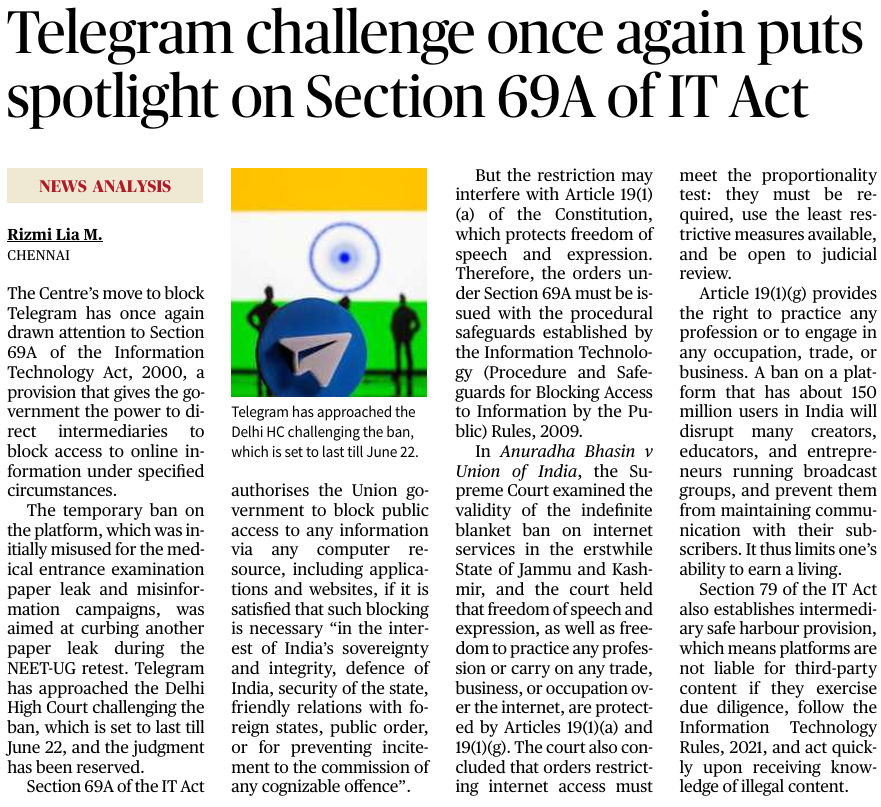
Context
Telegram has challenged the Centre's temporary ban before the Delhi High Court, bringing renewed attention to Section 69A of the Information Technology Act, 2000. The provision empowers the government to block online content or platforms on grounds such as national security, sovereignty, public order, and prevention of offences. The case raises important questions about balancing national security with constitutional freedoms and proportionality.
Prelims concepts
1. Information Technology (IT) Act, 2000
Section 69A (Power to Block Information): Empowers the Union Government to direct intermediaries to block public access to any online information.
Grounds for Blocking: The government can invoke this only under specific conditions:
Interest of India's sovereignty and integrity.
Defence of India.
Security of the State.
Friendly relations with foreign states.
Public order.
Preventing incitement to the commission of any cognizable offence.
Section 79 (Safe Harbour Provision): Protects intermediaries (social media platforms, messaging apps) from legal liability for third-party content posted on their platforms.
Conditions for Safe Harbour: Platforms must exercise "due diligence," follow the IT Rules, 2021, and act quickly to remove content upon receiving actual knowledge of its illegal nature.
2. Constitutional Provisions (Fundamental Rights)
Article 19(1)(a): Guarantees the freedom of speech and expression. Orders passed under Section 69A must not arbitrarily violate this right and must follow procedural safeguards.
Article 19(1)(g): Guarantees the right to practice any profession, or to carry on any occupation, trade, or business. The article notes that banning platforms with massive user bases disrupts the livelihood of creators, educators, and entrepreneurs, thereby engaging this article.
3. Landmark Supreme Court Judgment
Anuradha Bhasin v. Union of India:
Internet as a Right: The Supreme Court ruled that the freedom of speech and expression and the freedom to practice any profession over the internet enjoys constitutional protection under Articles 19(1)(a) and 19(1)(g).
Rule against Indefinite Bans: The court held that indefinite blanket bans on internet services are invalid.
The Proportionality Test: Any restriction on internet access must meet the proportionality test. This means the restriction must be strictly required, utilize the least restrictive measure available, and remain open to judicial review.
4. Relevant Subordinate Legislation (Rules)
Information Technology (Procedure and Safeguards for Blocking Access to Information by the Public) Rules, 2009: These rules provide the actual procedural safeguards and framework that the government must follow when issuing blocking orders under Section 69A.
Information Technology Rules, 2021: Intermediaries must adhere to these rules to maintain their "safe harbour" immunity under Section 79.
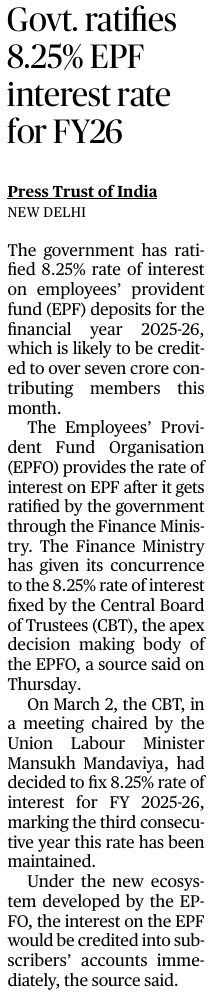
Context
The Central Government has ratified an 8.25% interest rate on Employees' Provident Fund (EPF) deposits for FY 2025–26, following the recommendation of the Central Board of Trustees (CBT) of the Employees' Provident Fund Organisation (EPFO). The interest is expected to be credited to the accounts of over seven crore subscribers.
Prelims concepts
1. Central Board of Trustees (CBT)
Role: It is the apex decision-making body of the Employees' Provident Fund Organisation (EPFO).
Function: One of its primary functions is to fix the rate of interest on employees' provident fund (EPF) deposits.
Leadership: The CBT is chaired by the Union Labour Minister.
2. Process of Fixing the EPF Interest Rate
Initial Recommendation: The interest rate is first decided and fixed by the Central Board of Trustees (CBT).
Mandatory Ratification: The rate fixed by the CBT is not automatically implemented. It requires mandatory concurrence and ratification by the government, specifically through the Ministry of Finance.
Implementation: Once ratified by the Finance Ministry, the EPFO provides the interest rate to its contributing members.
3. Employees' Provident Fund Organisation (EPFO)
Context: It is the organization responsible for managing the provident fund and developing the ecosystem for crediting interest into the accounts of over 7 crore contributing members.
New Ecosystem: The EPFO has developed a new system that enables the interest on the EPF to be credited into subscribers' accounts immediately upon ratification.
4. Current Facts (FY 2025-26)
The government has ratified an 8.25% rate of interest on EPF deposits for the financial year 2025-26.
This marks the third consecutive year that the 8.25% interest rate has been maintained.
UPSC MCQ
Q. Consider the following statements regarding the Employees’ Provident Fund (EPF):
1. The Employees’ Provident Fund Organisation (EPFO) declares the EPF interest rate, which becomes effective only after ratification by the Central Government.
2. The Central Board of Trustees (CBT) is the apex decision-making body of the EPFO.
3. EPF interest rates are determined and notified directly by the Reserve Bank of India (RBI).
Which of the statements given above is/are correct?
(a) 1 and 2 only
(b) 2 and 3 only
(c) 1 and 3 only
(d) 1, 2 and 3
Answer: (a) 1 and 2 only
Explanation
Statement 1: Correct. The EPFO declares the interest rate, but it becomes applicable after ratification/concurrence by the Central Government.
Statement 2: Correct. The Central Board of Trustees (CBT) is the apex decision-making body of EPFO.
Statement 3: Incorrect. The RBI does not determine EPF interest rates; they are recommended by the CBT and approved by the Government.
SC seeks response from Centre, BCI on advocates’ registry
GS Paper 2:
Judiciary, Governance, Regulatory Bodies
Issues relating to transparency and accountability in institutions
Context
The Supreme Court has sought responses from the Centre, the Bar Council of India (BCI), State Bar Councils, and the University Grants Commission (UGC) on a plea seeking the creation of an authoritative national database of enrolled advocates and a code of conduct governing lawyers' use of digital platforms. The petition was filed against concerns regarding lawyers possessing dubious degrees and issues relating to professional ethics on social media.
Prelims concepts
1. Proposed "Advocates' Registry" (National Database)
Rationale: The initiative aims to address a "structural crisis" in the legal profession's governance, specifically the growing concern over individuals practicing law with "dubious degrees".
Implementation: The Supreme Court noted that building such a comprehensive database would inherently require the active participation and coordination of law universities.
2. Bar Council of India (BCI) Rules & Solicitation
Code of Conduct for Digital Platforms: The plea also seeks the establishment of a specific code of conduct to govern how lawyers use digital and social media platforms.
Rule against Solicitation: The article highlights increasing instances of legal professionals using social media in ways that amount to "solicitation". Under the Advocates Act, 1961 and the BCI Rules, advertising or soliciting work by legal professionals is generally prohibited in India.
Mentorship: The Chief Justice remarked that while genuine members adhere to professional ethics, mentoring young legal professionals is key to remedying irresponsible behavior on digital platforms.
3. Key Regulatory Institutions Involved
The Supreme Court has issued notices to several key statutory bodies regarding this issue, highlighting the multi-institutional framework governing legal education and practice in India:
Bar Council of India (BCI): The apex statutory body that regulates legal practice and legal education in India.
State Bar Councils: Responsible for maintaining the state-level roll of advocates.
University Grants Commission (UGC): The statutory body responsible for the coordination, determination, and maintenance of standards of higher education, playing a vital role in verifying the authenticity of degrees awarded by universities.
UPSC MCQ
Q. Consider the following statements regarding the regulation of the legal profession in India:
1. The Bar Council of India is a statutory body established under the Advocates Act, 1961.
2. The Bar Council of India regulates legal education and professional conduct of advocates.
3. The University Grants Commission enrolls advocates and maintains the national roll of advocates.
Which of the statements given above is/are correct?
(a) 1 and 2 only
(b) 2 and 3 only
(c) 1 and 3 only
(d) 1, 2 and 3
Answer: (a) 1 and 2 only
Explanation:
Statements 1 and 2 are correct.
Statement 3 is incorrect. Enrollment and regulation of advocates are handled by State Bar Councils and the Bar Council of India, not the UGC.
Context
In his address to the Tamil Nadu Legislative Assembly under Article 176, Governor R.N. Ravi reiterated the State government's positions on the two-language policy, opposition to the three-language formula under NEP 2020, caste enumeration, financial devolution, NEET, and inter-State river disputes. The address also highlighted Tamil Nadu's demand for greater fiscal autonomy and continuation of welfare and industrial development initiatives.
Prelims concepts
1. Constitutional Provisions
Governor's Customary Address: The article references the Governor's customary address to the State Assembly.
Prelims Link: Article 176 of the Constitution mandates the Governor to address the state legislature at the commencement of the first session of each year and the first session after each general election. The address is prepared by the state cabinet and outlines the government's policies.
Language of High Courts: The state is pressing for the use of Tamil as the language of pleading at the Madras High Court and its Madurai Bench.
Prelims Link: Under Article 348(2) of the Constitution, the Governor of a State, with the previous consent of the President, can authorize the use of the state's official language in proceedings of the High Court. However, judgments, decrees, and orders must remain in English unless Parliament legislates otherwise.
Seat of the Supreme Court: The state is seeking the establishment of a Supreme Court Bench in Chennai.
Prelims Link: Article 130 of the Constitution states that the Supreme Court shall sit in Delhi or in such other place(s) as the Chief Justice of India may, with the prior approval of the President, from time to time, appoint.
2. Inter-State River Water Disputes
The article mentions the state's opposition to two major inter-state river projects:
Mullaperiyar Dam Dispute: The state opposes Kerala's move to build a new dam and intends to take steps to strengthen the existing dam and raise its water level.
Prelims Link: The Mullaperiyar Dam is a masonry gravity dam on the Periyar River. It is geographically located in Kerala but is operated and maintained by Tamil Nadu under a 999-year lease agreement.
Mekedatu Project: The state is taking legal measures to halt the proposed balancing reservoir project by Karnataka.
Prelims Link: Mekedatu is a deep gorge situated at the confluence of the Cauvery River and its tributary Arkavathi. Karnataka proposes a multi-purpose (drinking water and power generation) balancing reservoir here, which the lower riparian state (Tamil Nadu) opposes, fearing a reduction in its water share.
3. Centre-State Relations & Fiscal Federalism
Conditional Funding in Centrally Sponsored Schemes: The state views the Centre's withholding of ₹3,458 crore under the Samagra Shiksha Abhiyan as "unacceptable" because the funds were linked to the implementation of the three-language formula, while the state adheres to a two-language policy.
Prelims Link: Samagra Shiksha is an overarching Centrally Sponsored Scheme for the school education sector extending from pre-school to class 12. Tying scheme funds to policy implementation (like the National Education Policy 2020) often becomes a point of friction in Centre-State fiscal relations.
4. Demographics and Governance
Census vs. State Surveys: The Governor urged the Centre to swiftly complete caste enumeration as part of the national population census, following which the state would conduct a "Social Justice Survey".
Prelims Link: 'Census' is a Union Subject (Entry 69 of the Union List in the Seventh Schedule), governed by the Census Act, 1948. States cannot conduct a "Census" but are constitutionally permitted to conduct socio-economic "surveys" to identify backward classes for affirmative action.
Two-Language Policy vs Three-Language Formula
Aspect
Two-Language Policy (Tamil Nadu)
Three-Language Formula (NEP 2020 framework)
Languages Taught
Tamil + English
Three languages chosen by States/students (At least two must be native to India)
Objective
Preserve linguistic identity and reduce language burden
Promote multilingualism, cognitive development, and national integration
Historical Basis
Based on anti-Hindi agitations and State policy officially adopted in 1968
Originated from the 1961 Chief Ministers' Conference, adopted in 1968, and updated in NEP 2020
Tamil Nadu's Position
Strongly supports
Opposes mandatory implementation (views it as a backdoor imposition of Hindi)
Key Concern
Protection of federal autonomy and linguistic rights
Enhanced linguistic diversity and inter-state mobility
 Launch your Graphy