There are no items in your cart
Add More
Add More
| Item Details | Price | ||
|---|---|---|---|





Context:
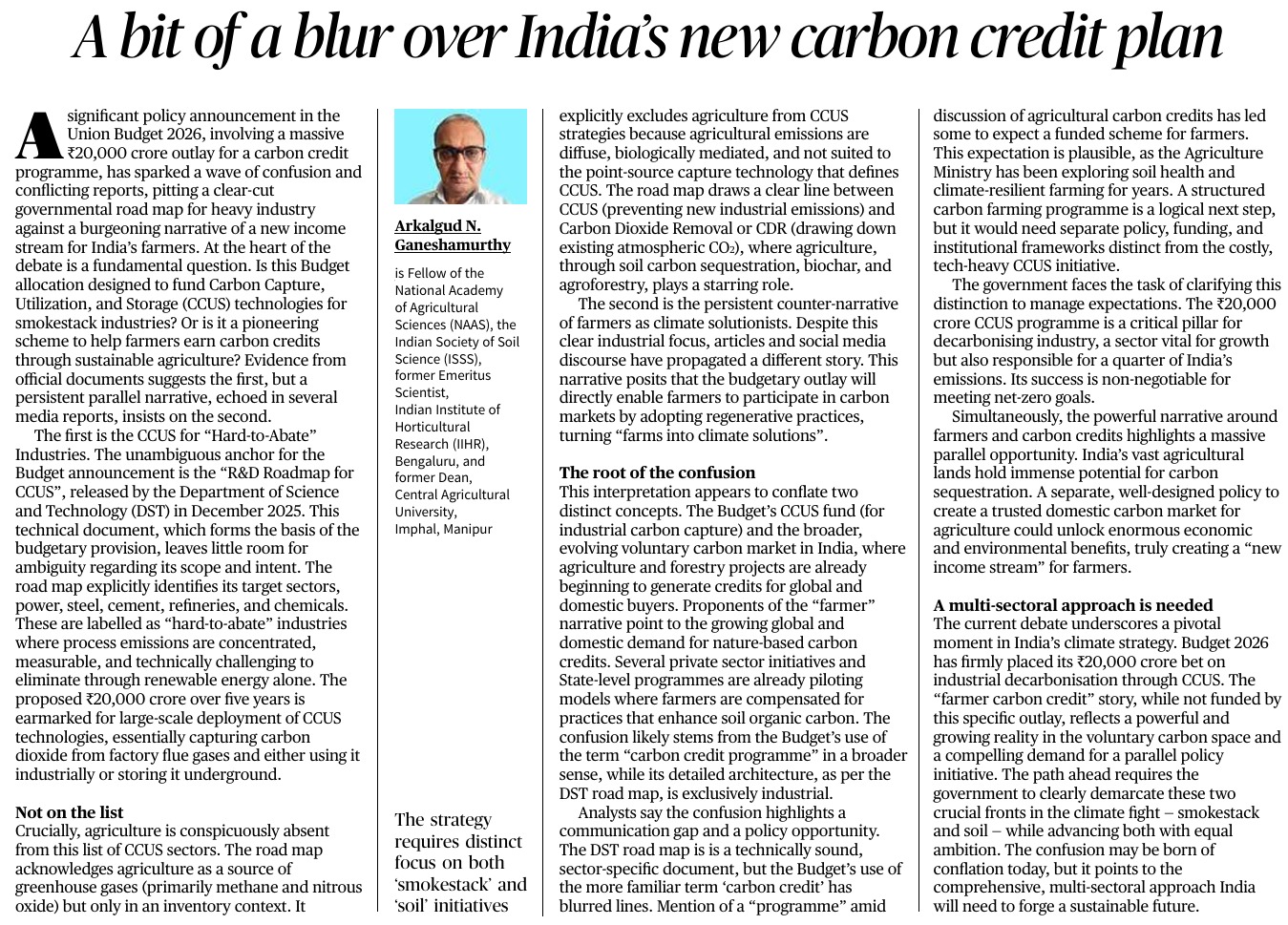
The Union Budget 2026 announced a ₹20,000 crore carbon credit programme anchored in Carbon Capture, Utilization and Storage (CCUS). While official documents clearly focus on industrial decarbonisation, a parallel narrative has emerged suggesting that farmers will directly benefit through carbon credits, creating confusion about the scheme’s intent and beneficiaries.
Detailed Analysis
1. Core Objective of the Budget Announcement
- The budget allocation is primarily meant for CCUS technologies.
- Target sectors:
- Power
- Steel
- Cement
- Refineries
- These are “hard-to-abate” sectors, where emissions are:
- Concentrated
- Technologically capturable
- The roadmap (DST’s R&D plan) clearly emphasizes:
- Capturing CO₂ from industrial sources
- Either utilizing it or storing it underground
👉 Inference: The scheme is fundamentally an industrial decarbonisation
initiative, not an agricultural income scheme.
2. Why Agriculture is Not Included in CCUS
- Agricultural emissions differ fundamentally:
- Methane (livestock)
- Nitrous oxide (fertilizers)
- These emissions are:
- Diffuse (spread out)
- Biologically mediated
- CCUS requires:
- Point-source emissions (e.g., smokestacks)
👉 Therefore:
- Agriculture is unsuitable for CCUS technologies.
- It is mentioned only in emissions inventory context, not as a
mitigation pathway under this scheme.
3. The Parallel Narrative: Farmers & Carbon Credits
- Media and public discourse have created a counter-narrative:
- Farmers as “climate solution providers”
- Income through carbon credits
- This narrative is based on:
- Global rise of voluntary carbon markets
- Practices like:
- Soil carbon sequestration
- Agroforestry
- Biochar
👉 Key Issue:
This narrative is not supported by the current budget allocation, yet it
is gaining traction.
4. The Root Cause of Confusion
The confusion arises due to conceptual conflation:
Aspect
Industrial CCUS
Agricultural Carbon Credits
Type
Emission reduction
Carbon removal (CDR)
Source
Point (factories)
Diffuse (soil, biomass)
Policy Status
Funded (₹20,000 crore)
Not formally structured
Market
Compliance/regulated
Voluntary market
- The Budget uses the broad term “carbon credit programme”, which:
- Includes both industrial and nature-based credits in general
discourse
- But in policy reality, refers only to industrial CCUS
👉 This terminological ambiguity is the central issue.
5. Policy and Communication Gap
- The DST roadmap is:
- Technical
- Sector-specific (industrial)
- But the Budget language is:
- Broad and politically communicative
- Result:
- Public misinterpretation
- Media amplification of incomplete understanding
👉 Insight:
This highlights a classic governance issue:
Mismatch between technical policy design and public communication.
6. Emerging Opportunity: Agricultural Carbon Markets
Even though not part of the current scheme, the article identifies a
future opportunity:
Potential Benefits:
- Additional farmer income
- Promotion of sustainable practices
- Improved soil health
- Climate mitigation through carbon sequestration
Existing Developments:
- Pilot projects by:
- Private sector
- State governments
- Growing demand for:
- Nature-based carbon credits (globally)
👉 However:
- Requires:
- Separate funding
- Policy architecture
- Verification systems
7. Strategic Importance for India
- India’s climate strategy must address two fronts:
(A) Industrial Emissions (Smokestack Approach)
- Through CCUS
- Essential for:
- Net-zero targets
- Energy-intensive sectors
(B) Nature-Based Solutions (Soil Approach)
- Through agriculture & forestry
- Essential for:
- Carbon removal
- Rural sustainability
👉 The article argues for a dual-track climate strategy.
8. Risks if Confusion Persists
- Policy Credibility Risk: Misaligned expectations can reduce trust.
- Farmer Disillusionment: If benefits don’t materialize.
- Inefficient Resource Allocation: Mixing two distinct policy domains.
- Delayed Climate Action: Lack of clarity may slow implementation.
Conclusion:
The article highlights that the confusion surrounding India’s carbon
credit plan is not merely semantic but structural. While the government
has made a decisive push toward industrial decarbonisation via CCUS, the
simultaneous rise of agricultural carbon credit narratives reflects an
untapped but separate policy domain. Moving forward, India must adopt a clear, multi-sectoral climate strategy, distinguishing between
“smokestack solutions” and “soil-based solutions”, ensuring both clarity
in communication and effectiveness in implementation.
UPSC Mains Question
A lack of conceptual clarity between industrial carbon capture and
agricultural carbon sequestration has led to policy confusion in India’s
carbon credit framework. Critically analyse. (250 words)
Source: The Hindu
Context:
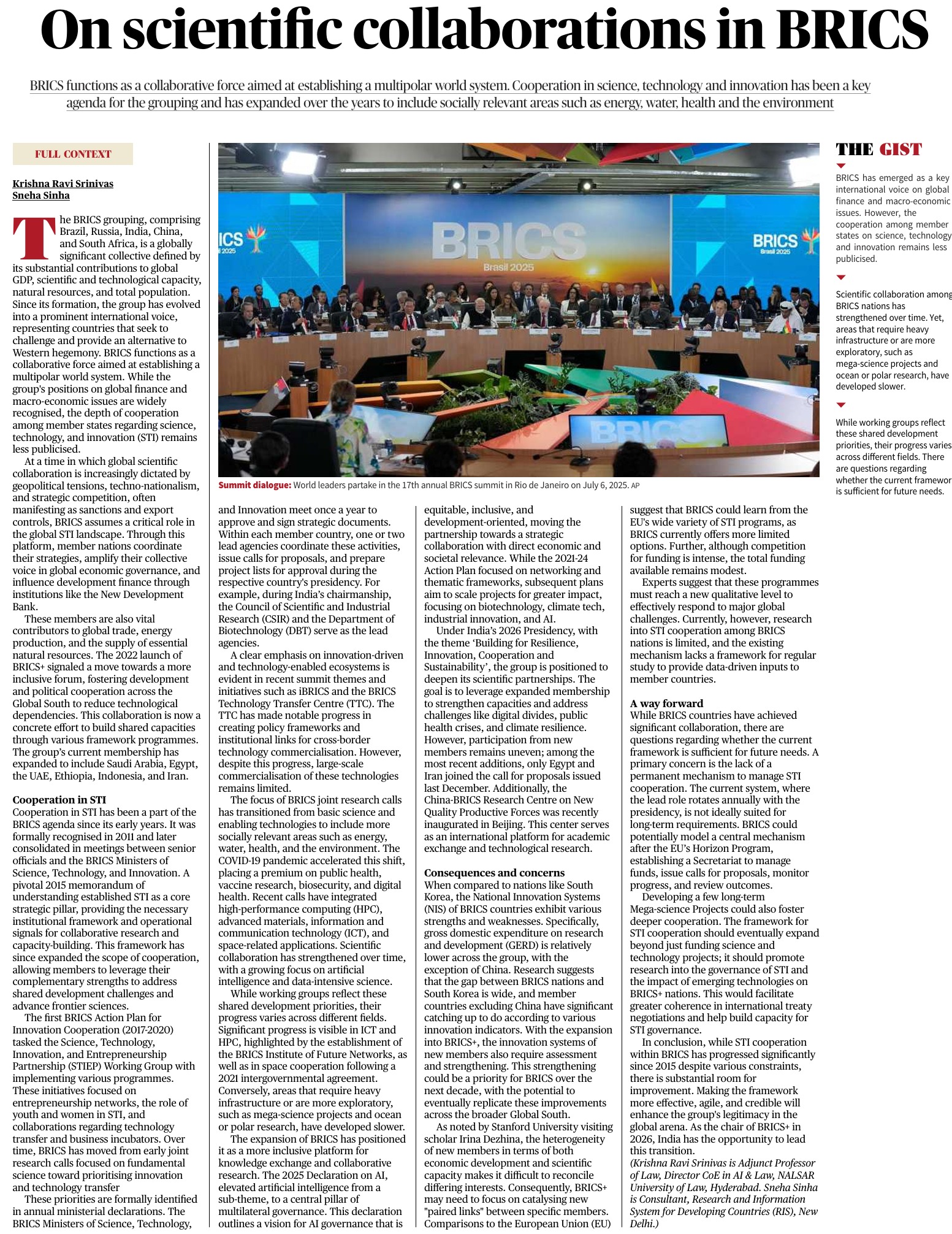
The article analyses the trajectory, achievements, and limitations of
Science, Technology, and Innovation (STI) cooperation within BRICS. It
highlights how BRICS aims to build a multipolar global order, but faces
structural and geopolitical constraints in translating scientific
collaboration into tangible outcomes.
Detailed Analysis
1. BRICS as a Strategic Scientific Bloc
- BRICS is not just an economic grouping but a collective scientific
and technological platform.
- It seeks to:
- Counterbalance Western dominance in global knowledge systems
- Promote South-South cooperation
- STI cooperation acts as a soft power tool to:
- Influence global governance
- Build technological autonomy
👉 Key Insight:
Scientific collaboration is central to BRICS’ ambition of shaping a
multipolar world order.
2. Evolution of STI Cooperation in BRICS
Initial Phase: Coordination
- Early years focused on:
- Dialogue among science ministries
- Identifying common priorities
Institutionalisation Phase (Post-2015)
- Formal STI framework established
- Mechanisms created:
- Annual ministerial meetings
- Coordinated research calls
Current Phase: Applied & Impact-Oriented Research
- Shift towards:
- Innovation-driven collaboration
- Societal problem-solving
👉 Focus areas:
- Energy
- Health
- Water
- Environment
- Digital technologies
👉 Trend:
From basic science → applied research → societal impact orientation
3. Key Achievements
A. Institutional Mechanisms
- BRICS STI framework has:
- Enabled joint research calls
- Created cross-border institutional linkages
B. Expansion of Research Areas
- Inclusion of advanced domains:
- Artificial Intelligence
- Biotechnology
- Digital health
- Climate science
C. Technology Commercialisation
- Efforts to:
- Translate research into marketable innovations
- Strengthens:
- Industry-academia linkages
D. Inclusive Development Approach
- Focus on:
- Developmental challenges of Global South
- Example:
- Affordable healthcare technologies
- Climate-resilient solutions
4. Structural Limitations in Collaboration
1. Absence of a Permanent Institutional Framework
- No dedicated BRICS STI Secretariat
- Coordination depends on:
- Rotating presidencies
- Leads to:
- Discontinuity
- Lack of long-term vision
2. Funding Constraints
- Compared to:
- EU (Horizon Programme)
- USA
- BRICS funding is:
- Fragmented
- Insufficient for large-scale projects
👉 Limits:
- Mega-science projects
- High-end research infrastructure
3. Uneven Capabilities Among Members
- Significant disparities:
- China → advanced R&D ecosystem
- Others → catching up
👉 Results in:
- Imbalanced contributions
- Dependency within the bloc
4. Limited Success in Mega-Science Projects
- Areas like:
- Space cooperation
- Ocean research
- Polar science
- Progress remains slow due to:
- High costs
- Coordination challenges
5. Weak Monitoring and Evaluation Systems
- Lack of:
- Data-driven assessment
- Regular performance review
👉 Consequence:
- Difficulty in measuring outcomes
- Inefficient policy adjustments
5. External and Internal Constraints
A. Geopolitical Tensions
- Rising:
- Tech-nationalism
- Strategic competition
- Internal issues:
- India-China tensions
- Differing national priorities
B. Global Scientific Fragmentation
- Increasing restrictions on:
- Technology transfer
- Research collaboration
👉 BRICS must operate in a fragmented global innovation ecosystem.
C. Expansion Challenges
- New members:
- Limited participation
- Weak integration
👉 Creates:
- Coordination complexity
- Institutional stress
6. Comparative Perspective
Aspect
BRICS
European Union
Institutional structure
Weak, rotational
Strong (Horizon Programme)
Funding
Limited
Large, centralized
Integration level
Moderate
High
Policy continuity
Low
High
👉 Inference:
BRICS lacks the institutional maturity seen in advanced blocs like the
EU.
7. Strategic Opportunities
1. South-South Innovation Ecosystem
- BRICS can lead:
- Alternative innovation networks
- Affordable technology solutions
2. Digital and AI Leadership
- Joint collaboration in:
- AI governance
- Digital public infrastructure
3. Climate and Sustainability Technologies
- Strong scope for:
- Green technologies
- Climate adaptation innovations
4. Paired Collaboration Model
- Bilateral partnerships within BRICS:
- e.g., India-Brazil, China-South Africa
- Can accelerate:
- Technology transfer
- Capacity building
8. Governance Deficit – Core Issue
The article’s central argument:
The main limitation is not lack of intent, but lack of institutional
depth and governance architecture.
- No permanent secretariat
- No long-term funding pipeline
- No monitoring system
👉 This leads to:
- Fragmented progress
- Limited global impact
9. Way Forward (Analytical Synthesis)
A. Institutional Strengthening
- Establish:
- Permanent BRICS STI Secretariat
- Long-term governance framework
B. Financial Scaling
- Create:
- Common research fund
- Support mega-science projects
C. Policy Integration
- Align STI with:
- Economic policy
- Industrial strategy
D. Enhance Collaboration Depth
- Move from:
- Networking → Co-development → Co-innovation
E. Monitoring & Accountability
- Develop:
- Data-driven evaluation systems
- Impact assessment frameworks
Conclusion:
Scientific collaboration in BRICS reflects both promise and paradox.
While it has evolved into a meaningful platform for South-South
technological cooperation, its impact remains constrained by
institutional weaknesses, funding limitations, and geopolitical
complexities. For BRICS to emerge as a credible alternative in global
scientific governance, it must transition from loose coordination to
structured integration, backed by strong institutions, sustained
funding, and strategic alignment.
UPSC Mains Question:
Examine how Science, Technology and Innovation (STI) cooperation within
BRICS can contribute to building a multipolar world order. What
challenges limit its effectiveness? (250 words)
Context:
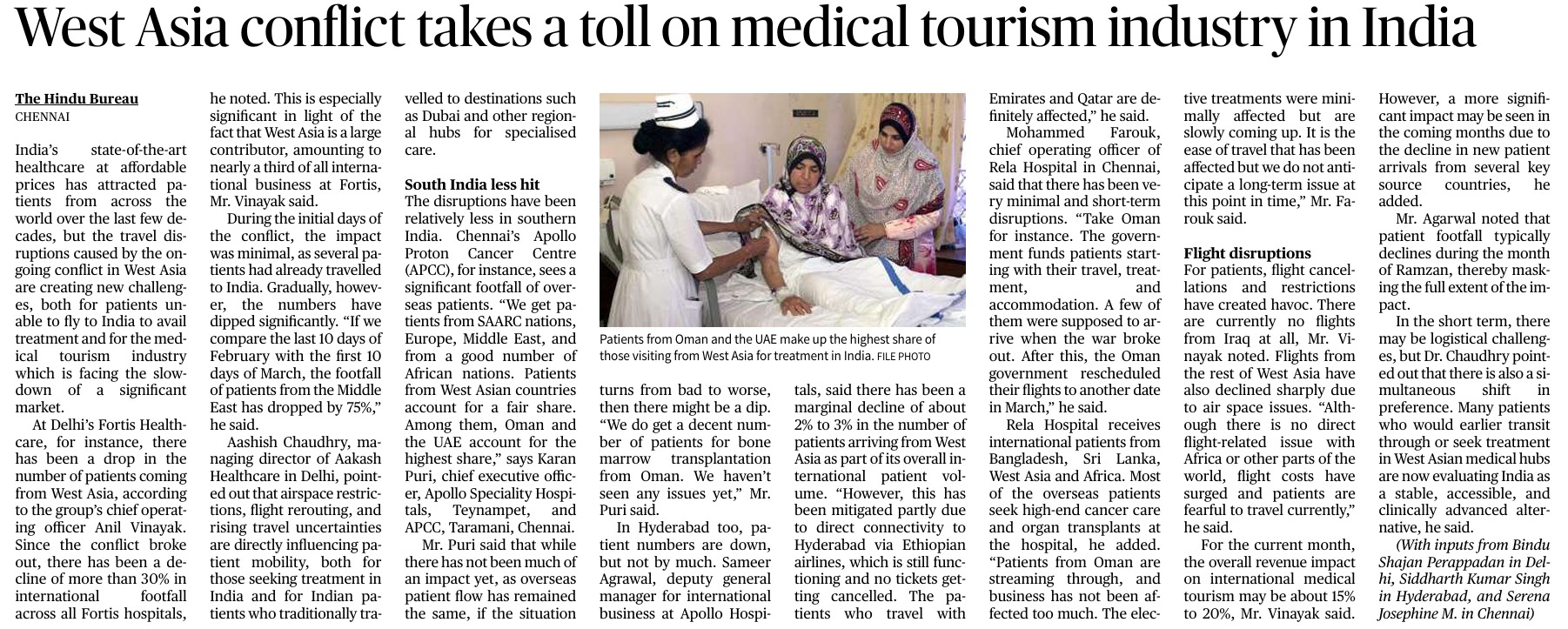
The ongoing conflict in West Asia has disrupted travel and mobility,
leading to a decline in medical tourism to India, particularly from
Middle Eastern countries. This has affected hospital revenues, patient
inflows, and overall healthcare service exports.
Importance of Medical Tourism in India
- India is a major global hub due to:
- Affordable healthcare
- Advanced medical infrastructure
- Skilled professionals
- Key source regions:
- West Asia (significant contributor)
- SAARC countries
- Africa
👉 West Asia alone contributes ~1/3rd of international patients in some
hospitals.
Invisible Exports (Services Exports)
- Medical tourism is part of invisible exports.
- Includes:
- IT services
- Tourism
- Banking & insurance
- Earns foreign exchange without exporting goods.
Organ Transplant Tourism
- A subset of medical tourism
- Strictly regulated in India under:
- Transplantation of Human Organs and Tissues Act (THOTA), 1994
UPSC Prelims MCQ:
Q. With reference to medical tourism in India, consider the following
statements:
1. It is classified under merchandise exports in the Balance of
Payments.
2. It contributes to foreign exchange earnings through the services
sector.
3. It is largely dependent on international patient mobility and
connectivity.
How many of the above statements are correct?
(a) Only one
(b) Only two
(c) All three
(d) None
Answer: (b) Only two
Explanation:
- Statement 1 is incorrect: Medical tourism is part of services
(invisible exports), not merchandise exports.
- Statement 2 is correct: It earns foreign exchange via services.
- Statement 3 is correct: Depends heavily on travel, visas, and
connectivity.
Context:
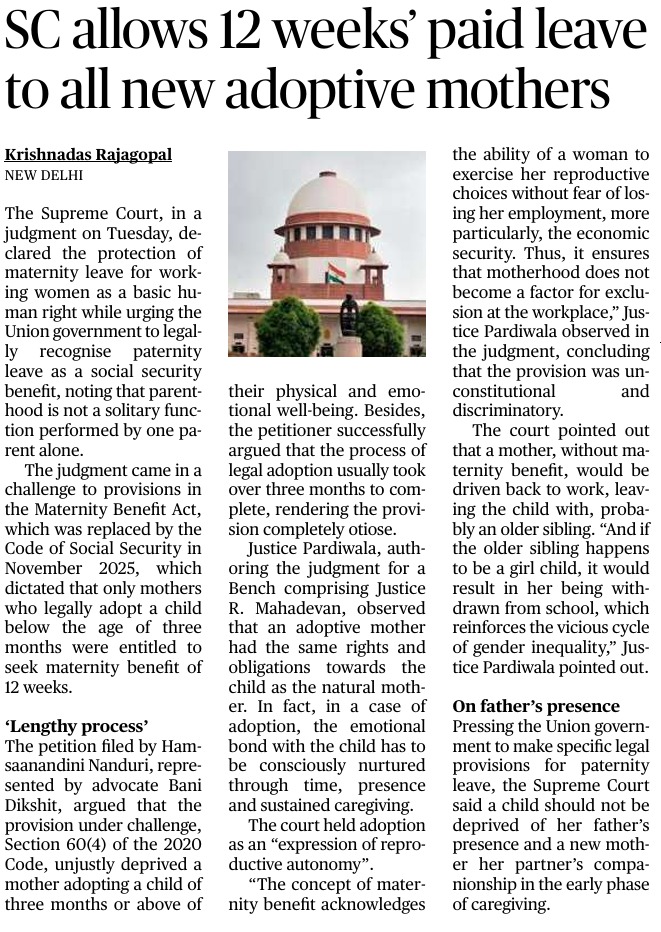
The Supreme Court ruled that all adoptive mothers are entitled to 12
weeks of paid maternity leave, irrespective of the age of the adopted
child. This came while examining provisions of the Maternity Benefit Act
(now under the Code on Social Security, 2020), which earlier restricted
benefits only to mothers adopting children below three months of age.
Key Highlights of the Judgment
- Recognised maternity leave as a basic human right for working women.
- Extended 12 weeks paid leave to all adoptive mothers, removing
earlier restrictions.
- Declared the earlier provision:
- Discriminatory
- Unconstitutional
👉 Court emphasised that:
- Adoptive mothers have the same rights and responsibilities as
biological mothers.
2. Legal and Constitutional Basis
A. Equality and Non-Discrimination
- Violation of:
- Article 14 (Equality before law)
- Article 15 (Non-discrimination)
- Earlier law created unreasonable classification:
- Based on age of adopted child
B. Right to Dignity and Reproductive Autonomy
- Linked to:
- Article 21 (Right to Life and Personal Liberty)
- Court termed adoption as:
- An expression of reproductive choice
C. Social Justice Perspective
- Recognised maternity leave as:
- Social security benefit
- Essential for childcare and maternal well-being
UPSC Prelims MCQ:
Q. Consider the following statements regarding maternity benefits in
India:
1. They are considered a form of social security.
2. They apply only to biological mothers.
3. They aim to ensure the well-being of both mother and child.
Which of the statements given above are correct?
(a) 1 and 3 only
(b) 1 and 2 only
(c) 2 and 3 only
(d) 1, 2 and 3
Answer: (a) 1 and 3 only
Explanation:
- Statement 1 is correct.
- Statement 2 is incorrect: Now includes adoptive mothers as well.
- Statement 3 is correct.
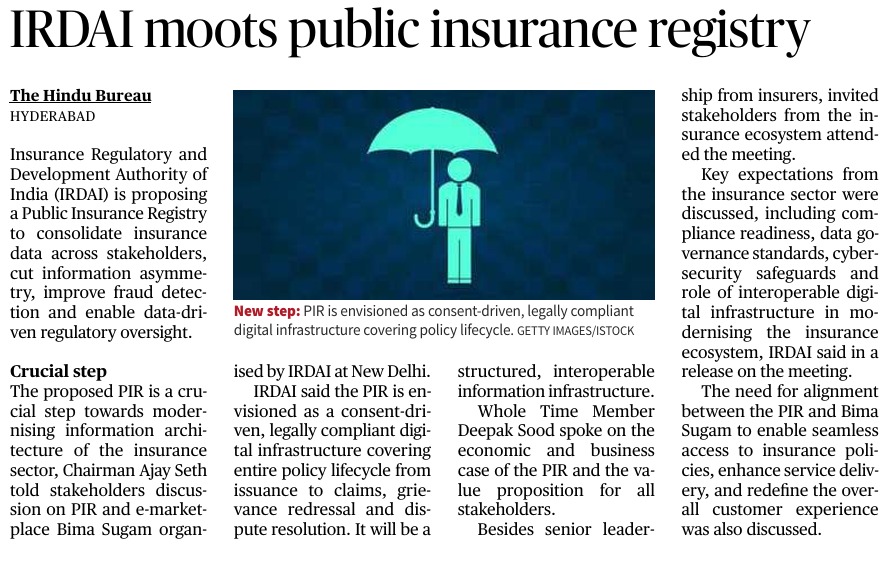
Context:
The Insurance Regulatory and Development Authority of India (IRDAI) has
proposed a Public Insurance Registry (PIR) to consolidate insurance data
across stakeholders. The initiative aims to improve transparency, reduce
fraud, and enable data-driven regulatory oversight through a
consent-based digital infrastructure.
What is Public Insurance Registry (PIR)?
- A centralised digital repository of insurance-related data
- Covers entire policy lifecycle:
- Policy issuance
- Claims
- Grievance redressal
- Dispute resolution
👉 Designed as:
- Consent-driven
- Legally compliant
- Interoperable digital infrastructure
2. Objectives of PIR
A. Reduce Information Asymmetry
- Currently:
- Fragmented data across insurers
- PIR will:
- Provide unified access to stakeholders
B. Improve Fraud Detection
- Helps identify:
- Duplicate claims
- Misrepresentation
- Strengthens:
- Risk assessment mechanisms
C. Enable Data-Driven Regulation
- IRDAI can:
- Monitor trends
- Ensure compliance
- Improves:
- Supervisory efficiency
D. Enhance Customer Experience
- Seamless access to:
- Policy details
- Claims status
- Reduces:
- Delays and disputes
Key Features
- Consent-based architecture → aligns with data privacy principles
- Interoperability → connects insurers, regulators, and platforms
- Lifecycle coverage → from issuance to settlement
- Integration with Bima Sugam platform (insurance marketplace)
Insurance Regulatory and Development Authority of India (IRDAI)
1. About IRDAI
- The Insurance Regulatory and Development Authority of India
(IRDAI) is a statutory regulatory body responsible for:
- Regulating
- Promoting
- Ensuring orderly growth of the insurance sector in India
- It supervises both:
- Life insurance
- Non-life (general) insurance
- Ensures:
- Consumer protection
- Fair market practices
- Financial stability
2. Establishment
- Established under: Insurance Regulatory and Development Authority
Act, 1999
- Became operational in: 2000
- Took over regulatory functions from:
- Earlier system dominated by government control (LIC, GIC era)
3. Objectives of IRDAI
- Protection of Policyholders’ Interests
- Ensuring fair treatment and grievance redressal
- Promotion of Competition
- Encouraging a healthy and competitive insurance market
- Financial Stability of Insurers
- Monitoring solvency and risk management
- Increase Insurance Penetration
- Expanding access to insurance, especially in rural areas
- Transparency and Fair Practices
- Regulating premium rates and preventing malpractices
- Granting licenses to insurance companies and intermediaries
- Regulating investment of funds by insurers
- Monitoring solvency margins
- Protecting policyholders through grievance mechanisms
- Promoting innovation (e.g., InsurTech, digital platforms like Bima
Sugam)
- Ensuring compliance with laws and regulations
UPSC Prelims MCQ:
Q. Which of the following is the primary objective of the Public
Insurance Registry?
(a) Increasing insurance premiums
(b) Reducing information asymmetry and improving fraud detection
(c) Replacing private insurance companies
(d) Promoting only life insurance products
Answer: (b)
 Launch your Graphy