The Hindu Analysis 18th June 2026 for UPSC, APPSC & TSPSC Exams
The Hindu News Analysis – 18th June, 2026
1. The RBI and its growing fiscal role (GS-2, GS-3)
2. India to meet 3% compressed biogas blending goal for FY27(GS-3)
3. ‘Parasites’: SC denies bail to man accused of cyberfraud, calls for sterner legislation (GS-2, GS-3)
4. Iran-U.S. framework deal outlines nuclear pledge, financial relief
(GS-2, GS-3)
5. India, U.K. announce July 15 as trade deal implementation date
(GS-2, GS-3)
The RBI and its growing fiscal role
GS Paper 3: Indian Economy, Monetary Policy, Fiscal Policy, Banking and Financial Institutions
GS Paper 2: Centre-State Relations, Fiscal Federalism
Context
The Reserve Bank of India (RBI) transferred a record ₹2.87 lakh crore surplus to the Union Government for FY26. The article argues that while such transfers strengthen government finances, they also indicate the RBI’s increasing fiscal significance, raising concerns regarding central bank independence, fiscal centralisation, and the exclusion of these transfers from fiscal devolution to States.
Detailed Analysis
Significance of RBI’s Growing Fiscal Role
1. Creates Fiscal Space for Government
Provides substantial non-tax revenue without increasing taxes or borrowing.
Helps contain fiscal deficits and finance public expenditure.
2. Supports Macroeconomic Stability
RBI’s reserve management, foreign exchange operations, and investment earnings strengthen sovereign finances.
Enhances confidence during periods of economic uncertainty.
3. Efficient Utilisation of Public Assets
Surplus generated from reserve management and foreign assets can be channelled toward developmental priorities.
4. Strengthens Government’s Fiscal Position
Reduces immediate borrowing requirements.
Can lower interest burden and improve fiscal sustainability.
Challenges and Concerns
1. Central Bank Independence
Excessive reliance on RBI profits may blur the distinction between monetary and fiscal authorities.
Risks creating pressure on the RBI to prioritise fiscal outcomes over monetary objectives.
2. Fiscal Centralisation
RBI surplus accrues entirely to the Union Government.
States do not automatically receive a share through Finance Commission devolution mechanisms.
3. Federal Imbalance
States face greater expenditure responsibilities and stricter borrowing constraints under Article 293.
Exclusion of RBI transfers from divisible resources widens fiscal asymmetry.
4. Accountability and Transparency Issues
Growing fiscal contribution of the RBI lacks a broader framework for discussing its implications on federal finances.
Raises questions about institutional accountability when monetary institutions indirectly support fiscal objectives.
5. Increasing Interdependence of Monetary and Fiscal Policies
Large surplus transfers may deepen the linkage between RBI operations and government finances.
Could complicate policy decisions during periods of inflation or financial stress.
Way Forward
1. Preserve RBI Autonomy
Ensure surplus transfers remain guided by the Economic Capital Framework (ECF) and not short-term fiscal needs.
2. Strengthen Transparency
Provide detailed disclosures on surplus generation, reserve management, and transfer mechanisms.
3. Revisit Fiscal Federalism Concerns
Examine whether extraordinary non-tax revenues should be considered while assessing Centre-State fiscal balance.
4. Maintain Institutional Distance
Clearly distinguish monetary policy objectives from fiscal requirements to protect policy credibility.
5. Develop a Long-Term Framework
Establish principles governing the treatment of large central bank surpluses within India’s fiscal architecture.
Conclusion
The RBI remains primarily a monetary authority, but its record surplus transfers demonstrate its growing fiscal significance. While these transfers provide valuable fiscal support to the Union Government, safeguarding central bank independence, ensuring transparency, and addressing concerns of fiscal federalism will be crucial to maintaining the balance between monetary stability and fiscal needs.
UPSC Mains Question
Q. The Reserve Bank of India is increasingly emerging as an important fiscal institution alongside its traditional monetary role. Discuss the implications of this trend for central bank independence and fiscal federalism in India
India to meet 3% compressed biogas blending goal for FY27
GS Paper 3: Energy Security, Renewable Energy, Biofuels, Sustainable Development
Context
The Union Government is on track to achieve the target of 3% blending of Compressed Biogas (CBG) with CNG and domestic PNG by FY27. The blending level has nearly doubled to around 2%, supported by the expansion of CBG production capacity and construction of new plants across the country.
Prelims Concepts:
1. Current Affairs & Factual Data
National Target: The Centre aims to achieve a 3% blending goal of Compressed Biogas (CBG) with CNG (transport) and PNG (domestic) by the financial year 2026-27 (FY27).
Current Status: India's CBG blending percentage has recently doubled and currently stands at approximately 2%.
Consumption Metrics: India consumes about 34-35 MMSCMD (million metric standard cubic metre per day) of natural gas combined for domestic Piped Natural Gas (PNG) and Compressed Natural Gas (CNG) for transport.
Strategic Need: Boosting domestic energy security and reducing dependence on imported fossil fuels in response to geopolitical vulnerabilities.
2. Compressed Biogas (CBG):
What is it? Biogas produced naturally through the anaerobic decomposition of waste/biomass sources (like agricultural residue, cattle dung, municipal solid waste). After purification (removing hydrogen sulphide, carbon dioxide, etc.) and compression, it is known as CBG.
Properties: It has pure methane content (typically over 90%) and calorific value similar to commercially available natural gas, making it a green renewable automotive fuel.
CNG vs. PNG:
CNG (Compressed Natural Gas): Natural gas compressed to a high pressure, used primarily as a cleaner alternative fuel for vehicles.
PNG (Piped Natural Gas): Natural gas supplied directly to households and industries through a pipeline network, primarily used for cooking and heating.
GOBARdhan Initiative / Portal:
The article explicitly mentions the Petroleum Ministry's Gobardhan portal, which tracks the construction of CBG/bio-CNG plants.
Note for Prelims: While the overarching GOBARdhan Scheme (Galvanizing Organic Bio-Agro Resources Dhan) is a key component of Swachh Bharat Mission (Gramin) under the Ministry of Jal Shakti, the Ministry of Petroleum and Natural Gas (MoPNG) plays a critical role in standardizing, promoting, and tracking the commercial production of CBG (often linked with the SATAT scheme).
SATAT Initiative (Sustainable Alternative Towards Affordable Transportation): it is the parent initiative under the Ministry of Petroleum and Natural Gas designed to set up CBG production plants and make CBG available in the market for use in automotive fuels.
UPSC MCQ
Q. Consider the following statements regarding Compressed Biogas (CBG):
1. Compressed Biogas is produced from biodegradable organic waste such as agricultural residue, cattle dung, and municipal waste.
2. The Government of India has mandated a target of 3% blending of Compressed Biogas with CNG and domestic PNG by FY27.
Which of the statements given above is/are correct?
(a) 1 only
(b) 2 only
(c) Both 1 and 2
(d) Neither 1 nor 2
Answer: (c) Both 1 and 2.
Explanation:
Statement 1 is correct: CBG is produced through anaerobic digestion of organic wastes such as agricultural residue, cattle dung, sewage sludge, and municipal solid waste.
Statement 2 is correct: Under the CBG Blending Obligation (CBO), the Government aims to achieve 3% blending of CBG with CNG and domestic PNG by FY27.
‘Parasites’: SC denies bail to man accused of cyberfraud, calls for sterner legislation
GS Paper 2: Judiciary, Criminal Justice System
GS Paper 3: Cyber Security, Internal Security
Context
The Supreme Court refused interim bail to an accused involved in multiple cyberfraud cases across different States and emphasized the need for stricter laws to tackle organized cybercrime. The Court observed that cyberfraudsters exploit jurisdictional gaps by committing offences in one State and moving to another to evade arrest.
Challenges Highlighted by the Supreme Court
1. Rise of Organized Cybercrime
Cybercriminal networks operate across multiple States and jurisdictions.
Victims are often spread across the country, complicating investigations.
2. Jurisdictional and Enforcement Issues
Offenders exploit federal boundaries to avoid detection and arrest.
Coordination among State police agencies remains a challenge.
3. Growing Financial and Social Impact
Large-scale financial losses to citizens.
Erosion of trust in digital transactions and online services.
4. Legal and Procedural Gaps
Existing laws may not adequately address sophisticated cybercrime networks.
Difficulty in tracking digital evidence and recovering stolen assets.
Prelims Concepts
Suo Motu Cognizance: The power of the court to initiate legal proceedings on its own motion, without the requirement of a formal petition from an aggrieved party.
Digital Arrest Scams: A form of organized cyberfraud where criminals impersonate law enforcement or judicial officers to extort money from victims. These scams typically utilize forged court orders to intimidate victims into transferring funds.
Iran-U.S. framework deal outlines nuclear pledge, financial relief
GS Paper 2: International Relations – West Asia, India and the World
GS Paper 3: Nuclear Security, International Institutions
Context
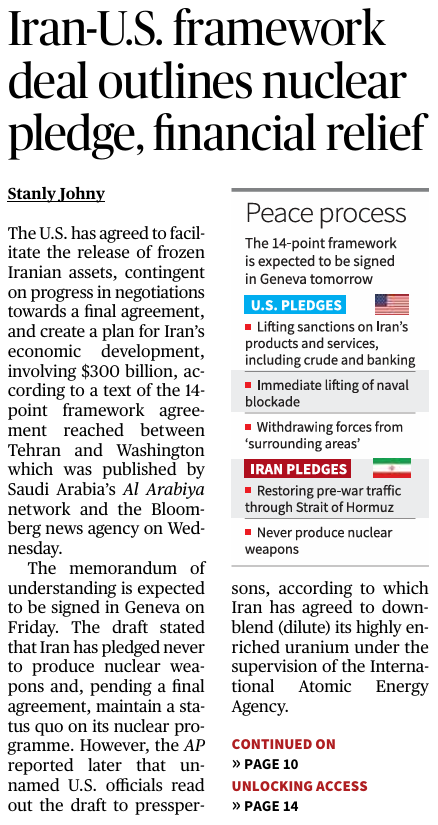
Iran and the United States have reached a 14-point framework agreement aimed at reviving nuclear negotiations. Under the proposed deal, Iran has pledged not to develop nuclear weapons and to dilute its highly enriched uranium under international supervision, while the U.S. has agreed to facilitate sanctions relief and the release of frozen Iranian assets.
Prelims Concepts:
1. Geographical Locations in News
Strait of Hormuz: A critical global maritime chokepoint. Under the proposed agreement, Iran pledged to restore "pre-war traffic" through this strait.
Static Concept for Map Pointing: It lies between the Persian Gulf and the Gulf of Oman, separating Iran from the Arabian Peninsula (specifically Oman and the UAE). It is one of the world's most important oil transit chokepoints.
Geneva (Switzerland): Mentioned as the diplomatic venue where the 14-point framework Memorandum of Understanding (MoU) is expected to be signed.
2. International Organizations
International Atomic Energy Agency (IAEA): The article states that the IAEA will supervise Iran's process of down-blending its enriched uranium.
Static Concept: The IAEA is the world's central intergovernmental forum for scientific and technical co-operation in the nuclear field. You should revise its headquarters (Vienna, Austria), its founding year (1957), and its reporting structure (reports to both the UN General Assembly and Security Council).
3. Science & Technology: Nuclear Concepts
Uranium Enrichment & Down-blending: The draft notes that Iran has agreed to "down-blend (dilute) its highly enriched uranium."
Static Concept: Natural uranium consists primarily of U-238, with a small fraction of U-235 (which is fissile). "Enrichment" increases the U-235 concentration for use in reactors or weapons. "Down-blending" is the reverse process—mixing highly enriched uranium (HEU) with natural or depleted uranium to reduce the U-235 concentration, thereby rendering it unusable for nuclear weapons but safe for civilian reactor fuel.
4. Current Affairs: Key Pledges of the 14-Point Framework
United States Pledges:
Lifting sanctions on Iran’s products and services, notably targeting the crude oil and banking sectors.
Immediate lifting of the naval blockade.
Withdrawing forces from "surrounding areas".
Facilitating the release of frozen Iranian assets and initiating a $300 billion economic development plan for Iran.
Iranian Pledges:
A binding pledge to never produce nuclear weapons.
Maintaining a status quo on its current nuclear programme until a final agreement is reached.
Restoring maritime traffic through the Strait of Hormuz.
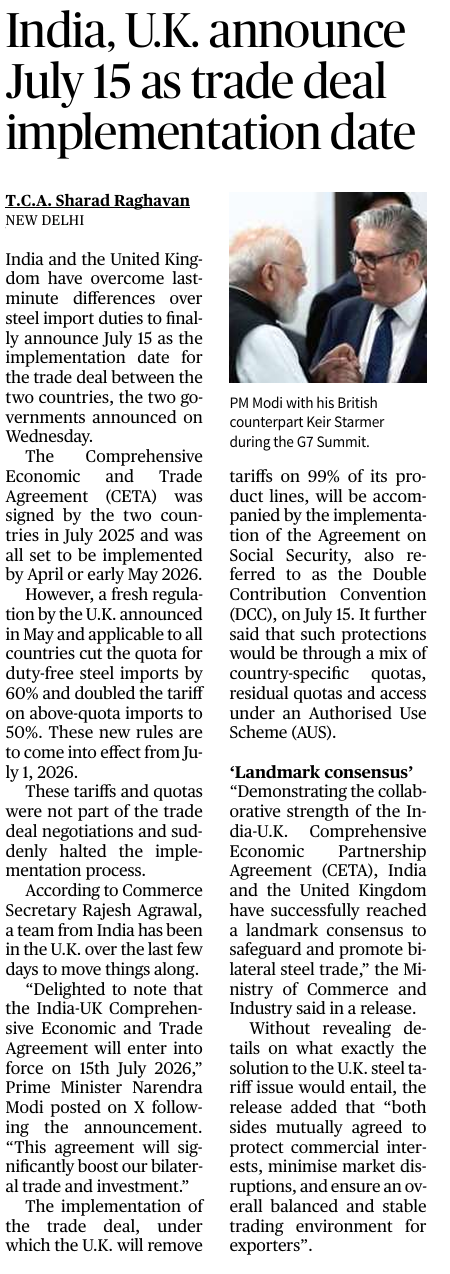
India, U.K. announce July 15 as trade deal implementation date
GS Paper 2: India and Bilateral Relations
GS Paper 3: International Trade, Economic Development
Context
India and the United Kingdom have announced July 15, 2026 as the implementation date for the Comprehensive Economic and Trade Agreement (CETA). The agreement was delayed due to changes in the U.K.'s steel import regulations but has now been finalized after bilateral consultations.
Prelims Concepts:
1. India-U.K. Trade Pact Terminology
Comprehensive Economic and Trade Agreement (CETA) / Comprehensive Economic Partnership Agreement: This is the bilateral free trade agreement negotiated and signed between India and the United Kingdom in July 2025, with a final implementation date set for July 15, 2026.
Tariff Elimination: Under this agreement, the U.K. is set to remove tariffs on 99% of its product lines, drastically reducing trade barriers for Indian exports.
2. Social Security and Taxation Concepts
Double Contribution Convention (DCC): The trade pact is accompanied by an Agreement on Social Security, known as the Double Contribution Convention.
Static Concept for Prelims: A Social Security Agreement (SSA) or DCC prevents double taxation/contribution for cross-border or detached workers. For example, it ensures that an Indian professional working temporarily in the U.K. does not have to contribute to the social security systems of both nations simultaneously, enhancing ease of doing business and mobility.
3. International Trade & Protectionist Instruments
Tariff-Rate Quotas (TRQs): Refers to the mechanism where a specific "quota" or volume of goods (like steel) is allowed to enter a country duty-free or at a lower tariff, while any imports above that quota face a significantly higher tariff (in this case, raised to 50%).
Country-Specific Quotas vs. Residual Quotas: Used by importing nations to regulate trade volume. Country-specific quotas allot fixed amounts to specific trading partners, while residual quotas are open to all other countries on a first-come, first-served basis.
Authorised Use Scheme (AUS): A customs procedure allowing goods to be imported at a reduced or zero rate of import duty based on their specific end-use or destination.
UPSC Prelims MCQ
Q. Consider the following statements regarding the India-U.K. Comprehensive Economic and Trade Agreement (CETA):
1. Under CETA, the United Kingdom will remove tariffs on 99% of Indian product lines.
2. The Double Contribution Convention (DCC) seeks to prevent workers from making social security contributions in both countries for the same period of employment.
Which of the statements given above is/are correct?
(a) 1 only
(b) 2 only
(c) Both 1 and 2
(d) Neither 1 nor 2
Answer: (c) Both 1 and 2
Explanation:
Statement 1 is correct: The U.K. will eliminate tariffs on 99% of Indian product lines under CETA.
Statement 2 is correct: The DCC avoids double social security contributions by eligible workers in both countries.




 Launch your Graphy