The Hindu Analysis 17th June 2026 for UPSC, APPSC & TSPSC Exams
The Hindu News Analysis – 17th June, 2026
1. Moving from war to deal in a deeply divided region (GS-2, GS-3)
2. India’s rainfall deficit at 35% as monsoon progress stalls
(GS-1, GS-3)
3. Govt. restricts Telegram app till NEET re-test (GS-2, GS-3)
4. Central banks to raise gold reserves over one year: WGC India
(GS-3)
5. World suffers from shortage of trust, PM tells G7 leaders (GS-2)
Moving from war to deal in a deeply divided region
GS Paper 2:
International Relations – India and West Asia
Bilateral, Regional and Global Groupings
GS Paper 3: Security Challenges and Geopolitics
Context
The article examines the implications of the emerging U.S.–Iran deal following a period of intense conflict in West Asia. It argues that military force alone cannot provide lasting solutions and that sustainable peace requires political settlements. The deal reflects changing regional dynamics, exposes divisions within the Gulf, and raises important strategic questions for India.
Detailed Analysis
1. Limits of Military Solutions
Recent conflicts in Ukraine, Gaza, Lebanon, Sudan, and Iran demonstrate that military victories rarely deliver durable peace.
Prolonged wars have caused immense civilian suffering while failing to resolve underlying political disputes.
The growing stalemate in major conflicts has pushed key actors toward negotiations.
Key Insight
Political settlements, rather than military campaigns, remain the only viable path to long-term stability.
2. Why the U.S.–Iran Deal Emerged
For the United States
A full-scale war with Iran became strategically costly and politically unsustainable.
Escalation threatened regional stability and global energy supplies.
For Iran
Economic sanctions and military setbacks created pressure for negotiations.
The deal offers sanctions relief, asset unfreezing, and reduced isolation.
Major Features of the Deal
Conditional opening of the Strait of Hormuz.
Reduction of hostilities across regional fronts.
Commitments related to Iran’s nuclear programme.
A framework for further negotiations.
3. Persistent Regional Insecurities
Despite the agreement:
Iran continues to possess significant strategic capabilities.
Non-state actors such as Hezbollah, Houthis, and Iraqi militias remain influential.
Israel remains skeptical of Iran’s intentions.
Trust deficits between regional actors persist.
Implication
The deal reduces immediate tensions but does not eliminate the structural causes of conflict.
4. Gulf Fault Lines Exposed
The conflict highlighted divisions among Gulf states.
Key Trends
Different Gulf countries adopted different approaches toward Iran.
Saudi Arabia and the UAE pursued varying regional policies.
Energy security concerns have intensified.
Concerns over potential disruptions in the Strait of Hormuz remain.
Significance
The perception of a unified Gulf strategic bloc has weakened, exposing long-standing rivalries and differing priorities.
5. Impact on Regional Power Balance
United States
Seeks to preserve influence through diplomacy and regional partnerships.
Continues efforts to integrate Israel into a broader regional framework.
Iran
Gains strategic breathing space and diplomatic legitimacy.
Retains considerable regional influence.
Israel
Faces uncertainty regarding the long-term implications of the deal.
Remains concerned about Iran's regional network.
China and Russia
Benefit from reduced U.S. strategic flexibility.
China is likely to expand its influence through economic engagement rather than direct security intervention.
6. Implications for India
Strategic Concerns
India depends heavily on West Asia for energy imports.
Stability in the Strait of Hormuz is vital for Indian trade.
Millions of Indians living in the Gulf contribute substantial remittances.
Foreign Policy Lessons
Avoid taking sides in regional rivalries.
Maintain balanced relations with Israel, Iran, Saudi Arabia, and the UAE.
Continue pursuing strategic autonomy and multi-alignment.
Opportunities
Stronger engagement with all regional actors.
Enhanced role in connectivity, trade, and maritime security initiatives.
Significance
Demonstrates the limits of military coercion in resolving geopolitical disputes.
Reinforces the importance of diplomacy and negotiations.
Reshapes power equations in West Asia.
Highlights the growing importance of regional security architecture.
Creates both opportunities and challenges for India’s strategic interests.
Challenges
Deep mistrust between Iran, Israel, and Gulf states.
Continued influence of non-state armed groups.
Fragility of ceasefires and agreements.
Competition among major powers (U.S., China, Russia).
Vulnerability of global energy routes and maritime trade.
Way Forward
Develop an inclusive regional security framework involving Iran and Gulf states.
Strengthen diplomatic engagement rather than relying on military solutions.
Promote confidence-building measures among regional rivals.
Ensure uninterrupted energy and maritime security.
For India, continue a balanced West Asia policy based on strategic autonomy and multi-alignment.
Encourage economic interdependence and regional cooperation to reduce conflict incentives.
Conclusion
The U.S.–Iran deal may reduce immediate tensions, but it does not resolve the deeper geopolitical rivalries dividing West Asia. Lasting peace will depend on creating an inclusive regional security architecture that accommodates the interests of all stakeholders. For India, a balanced and pragmatic approach remains essential to safeguard its energy, trade, and strategic interests in the region.
UPSC Mains Question:
Q. Military victories often fail to produce lasting peace unless accompanied by political settlements. In the context of recent developments in West Asia, examine the challenges to regional stability and discuss the implications for India's foreign policy.
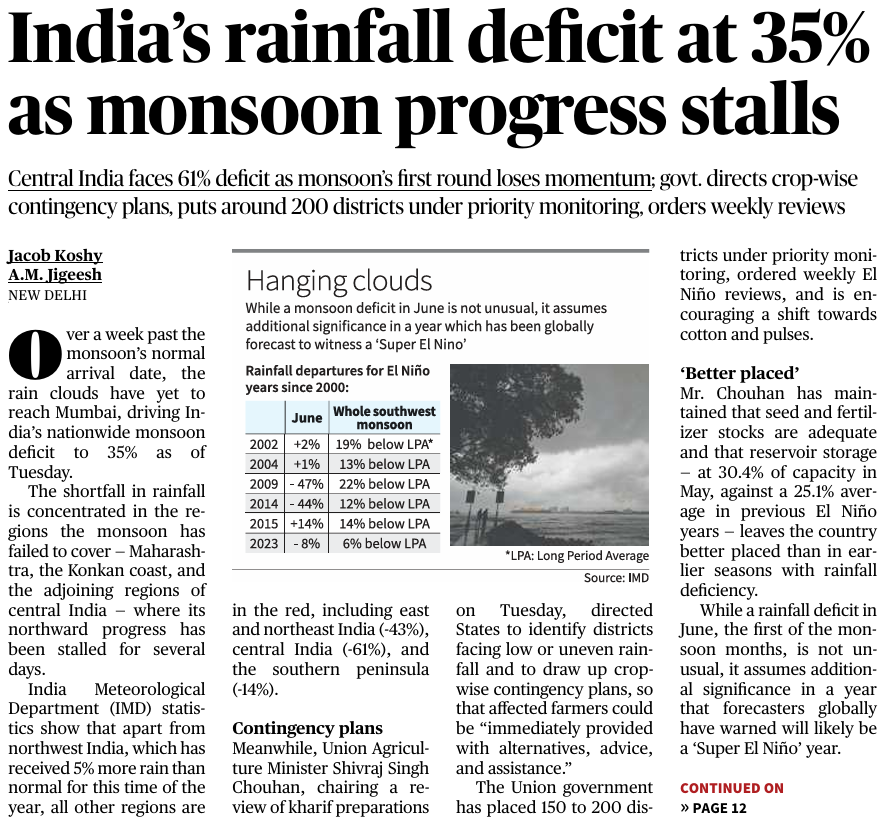 India’s rainfall deficit at 35% as monsoon progress stalls
GS Paper 1: Indian Geography – Monsoon and Climatic Conditions
GS Paper 3: Agriculture, Disaster Management, Food Security
Context
India recorded a 35% rainfall deficit as the southwest monsoon's advance stalled, with Central India facing a 61% deficit. The situation has gained significance due to forecasts of a possible Super El Niño, raising concerns about agricultural production, water availability, and economic stability.
Prelims Concepts
1. Southwest Monsoon
Mechanism and Progression: The article highlights the stalling of the monsoon's northward progression, particularly affecting Maharashtra, the Konkan coast, and Central India.
Regional Distribution: Note the varying rainfall distribution patterns (e.g., Northwest India receiving surplus rain while Central, East, Northeast, and Peninsular India face steep deficits).
2. El Niño and 'Super El Niño'
Concept: A climate pattern describing the unusual warming of surface waters in the eastern tropical Pacific Ocean.
Impact on India: Historically associated with weakened monsoon winds and rainfall deficits in India, as shown in the article's table (e.g., 2002, 2009, 2014, 2015, 2023).
Super El Niño: Refers to an exceptionally strong El Niño event, which forecasters warn could heavily impact the current year's rainfall.
3. Long Period Average (LPA)
Definition: Mentioned in the infographic footnote, LPA is the average rainfall received over a specified region for a long period (typically 50 years).
Application: The India Meteorological Department (IMD) uses the LPA as a benchmark to measure quantitative rainfall (e.g., normal, below normal, or deficient).
4. Kharif Crops and Season
Sowing Cycle: The article mentions "kharif preparations" which directly depend on the onset and progression of the Southwest monsoon (June-July).
Specific Crops: The government is encouraging a shift towards cotton and pulses as part of contingency plans for areas with delayed or uneven rainfall.
5. India Meteorological Department (IMD)
Role: The agency responsible for meteorological observations, weather forecasting, and seismology. They provided the statistics regarding the regional rainfall deficits mentioned in the text.
Nodal Ministry: It operates under the Ministry of Earth Sciences.
6. Reservoir Storage Capacity
Agricultural Impact: The article notes that adequate reservoir storage (at 30.4% capacity in May) helps mitigate immediate irrigation crises during a monsoon deficit.
Monitoring Agency: The Central Water Commission (CWC) typically monitors live storage capacity of major reservoirs in India (a good supplementary fact to remember).
UPSC MCQ:
Q. Consider the following statements regarding the Southwest Monsoon and El Niño:
1. El Niño conditions are generally associated with weaker southwest monsoon rainfall over India.
2. Central India recorded a higher rainfall deficit than the national average during the current monsoon season.
Which of the statements given above is/are correct?
(A) 1 only
(B) 2 only
(C) Both 1 and 2
(D) Neither 1 nor 2
Answer: (C) Both 1 and 2
Explanation:
Statement 1 is correct: El Niño is often associated with below-normal monsoon rainfall in India.
Statement 2 is correct: Central India recorded a rainfall deficit of about 61%, which is higher than the national rainfall deficit of 35%.
Govt. restricts Telegram app till NEET re-test
GS Paper 2: Governance, Education, Government Policies
GS Paper 3: Cyber Security, Internal Security, Digital Governance
Context
The Ministry of Electronics and Information Technology (MeitY) temporarily restricted Telegram services in India until the completion of the NEET re-test process. The decision was taken after reports that several Telegram groups were allegedly advertising fake test papers and facilitating examination-related fraud.
Prelims Concepts
1. Ministry of Electronics and Information Technology (MeitY)
Role in Digital Governance: MeitY is the nodal ministry responsible for IT policy, electronics, and the internet in India.
Blocking Powers: As highlighted in the article, MeitY is the authority that issues blocking orders to restrict messaging applications or websites operating in India.
2. National Testing Agency (NTA)
Nature of the Body: The NTA is an autonomous, self-sustained, and premier testing organization.
Establishment: It was established by the Ministry of Education (formerly MHRD) to conduct entrance examinations for admissions/fellowship in higher educational institutions.
Mandate: It conducts high-profile competitive exams in India, including the National Eligibility cum Entrance Test (NEET) mentioned in the text.
3. Statutory Backing for App/Website Blocking (IT Act, 2000)
Section 69A of the IT Act: The legal power enabling MeitY to restrict or block public access to any information online flows from Section 69A of the Information Technology Act, 2000.
Grounds for Blocking: The government can issue blocking directions in the interest of India's sovereignty and integrity, defense, security of the State, friendly relations with foreign states, or public order.
4. Digital Intermediary Liabilities and Features
Intermediary Status: Large messaging apps like Telegram function as 'intermediaries' under Indian law.
Backdating Scams & Features: The article notes a specific technical vulnerability—the manipulation of timestamping via 'edited' tags or channel creation. Telegram's founder highlights efforts to make the "edited" label more visible to prevent fraud and "backdating scams" (where old files are edited to look like recent leaks).
 Central banks to raise gold reserves over one year: WGC
GS Paper 3:
External Sector, Foreign Exchange Reserves
Banking and Financial Institutions
Context
According to the World Gold Council (WGC) Central Bank Gold Reserves Survey (CBGR), central banks worldwide intend to increase their gold holdings over the next year. The trend is driven by rising geopolitical uncertainties, economic volatility, and the desire to diversify reserve portfolios. The Reserve Bank of India (RBI) has also significantly increased its gold reserves in recent years.
Prelims Concepts:
1. World Gold Council (WGC)
Nature: The World Gold Council is an international trade association representing the global gold industry.
Membership: Its members primarily consist of leading global gold mining companies, rather than sovereign nations, central banks, or international financial institutions.
Headquarters: The organization is headquartered in London, United Kingdom.
Key Reports: The WGC publishes the Central Bank Gold Reserves (CBGR) survey, which tracks the accumulation of gold by central banks worldwide.
2. Composition of India's Foreign Exchange (Forex) Reserves
Components: India's foreign exchange reserves officially comprise Foreign Currency Assets (FCA), Gold, Special Drawing Rights (SDRs), and the Reserve Tranche Position (RTP) with the International Monetary Fund (IMF).
Major Component: Foreign Currency Assets constitute the largest and most dominant portion of India's forex reserves.
RBI's Gold Holdings: According to the provided article, the Reserve Bank of India (RBI) has aggressively expanded its gold reserves, noting an increase from 822.1 tonnes in FY24 to 880.52 tonnes in FY26.
Storage locations: The RBI stores its gold reserves domestically as well as in safe custody overseas, primarily with the Bank of England and the Bank for International Settlements (BIS).
3. Rationale for Central Banks Accumulating Gold
Safe-Haven Asset: Central banks maintain and increase gold reserves because the metal acts as a reliable hedge against inflation and currency fluctuations during times of geopolitical and economic uncertainty.
Diversification: Purchasing gold allows central banks like the RBI to diversify their foreign exchange portfolios and reduce their over-dependence on other fiat currencies. The article notes central banks have doubled their purchases over the past four years to an average of 1,000 tonnes.
4. Factors Influencing Domestic Gold Prices
Global Institutional Demand: As highlighted in the text, aggressive purchasing by global central banks creates a supply-demand dynamic that keeps the price of the "yellow metal" high.
Currency Depreciation: A major determinant of rising gold prices for Indian retail customers is the depreciation of the Indian Rupee against the U.S. Dollar. Because global gold prices are denominated in U.S. Dollars, a weaker Rupee makes importing gold more expensive.
UPSC MCQ
Q. Consider the following statements regarding gold as a reserve asset:
1. Gold is considered a safe-haven asset during periods of geopolitical and economic uncertainty.
2. Gold reserves help central banks diversify their reserve portfolios and reduce dependence on any single foreign currency.
Which of the statements given above is/are correct?
(A) 1 only
(B) 2 only
(C) Both 1 and 2
(D) Neither 1 nor 2
Answer: (C) Both 1 and 2
Explanation:
Statement 1 is correct: Gold is widely regarded as a safe-haven asset during crises and uncertainty.
Statement 2 is correct: Central banks use gold to diversify reserves and reduce concentration risks associated with reserve currencies.
World suffers from shortage of trust, PM tells G7 leaders
GS Paper 2: Important International Groupings and India's Foreign Policy
Context
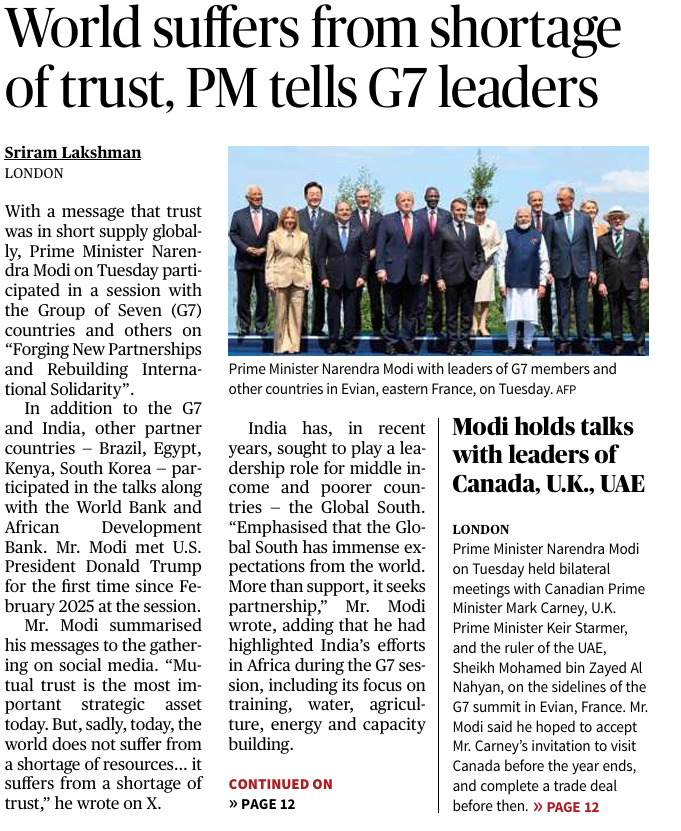
At the G7 Summit in France, Prime Minister Narendra Modi emphasized that the world today suffers not from a shortage of resources but from a shortage of trust. He highlighted the need for rebuilding international solidarity, strengthening partnerships, and addressing the aspirations of the Global South through cooperation in areas such as agriculture, water, energy, capacity building, and development.
Key Prelims Concepts
1. The Group of Seven (G7)
Nature: The G7 is an informal bloc of industrialized democracies.
Membership: The text implicitly refers to the G7 and India alongside other guest nations. The core G7 members are:
Canada; France; German; Italy; Japan; United Kingdom (U.K.); United States (U.S.)
Note: The European Union (EU) is also a non-enumerated member.
Current Context: The text describes the 52nd G7 Summit occurring in Evian, eastern France, on Tuesday, June 16, 2026. The summit is organized around the theme "Forging New Partnerships and Rebuilding International Solidarity."
2. Global South & India's Leadership Role
Concept: The "Global South" generally refers to countries in Asia, Africa, and Latin America characterized by lower to middle-income economies.
India's Stance: The Prime Minister emphasized that India has sought to play a leadership role for the Global South, aiming to voice the concerns and expectations of middle-income and poorer countries at international forums like the G7.

 Launch your Graphy