There are no items in your cart
Add More
Add More
| Item Details | Price | ||
|---|---|---|---|




Context
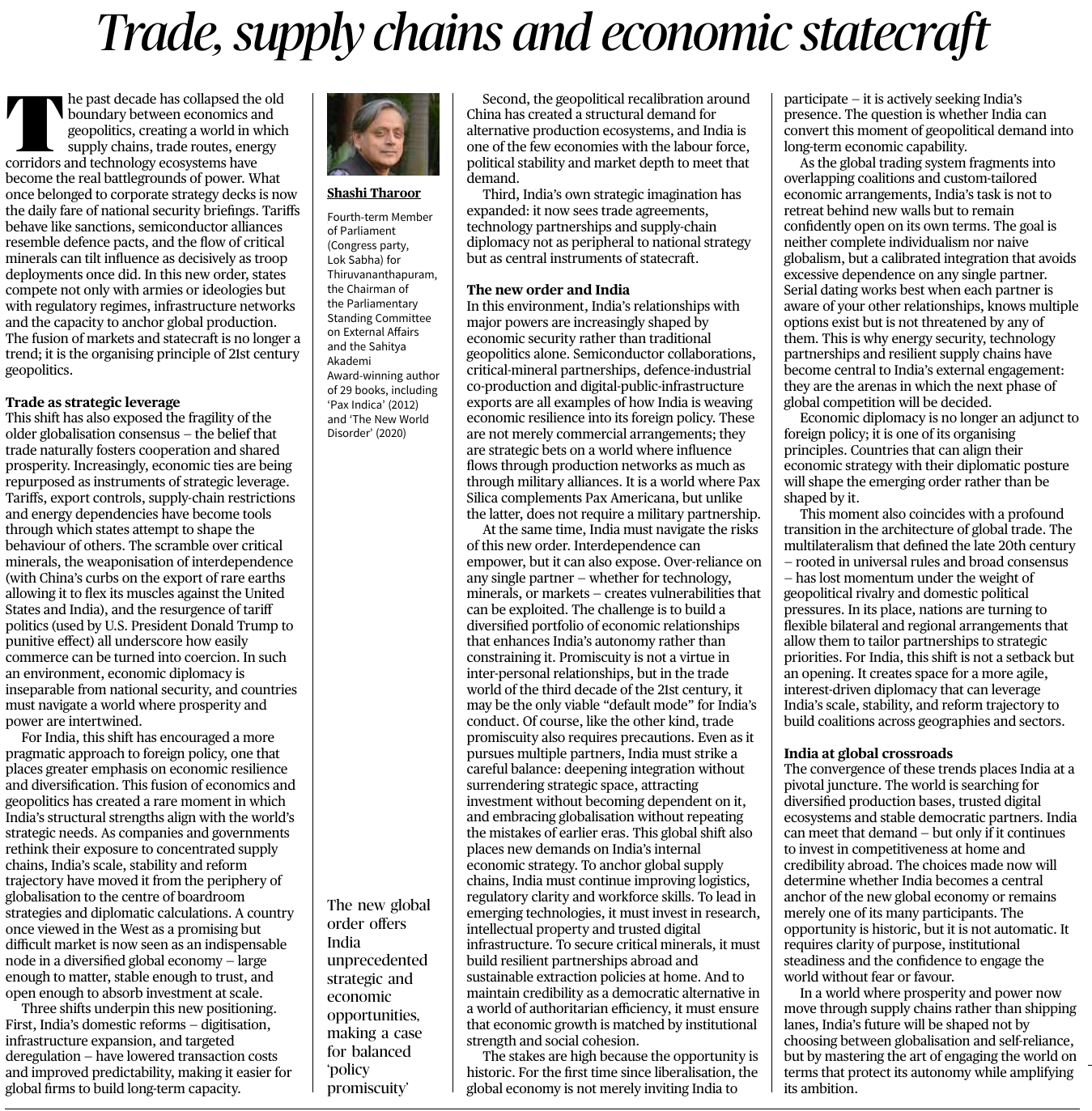
The article discusses the growing fusion of economics and geopolitics in the 21st century, where trade, supply chains, technology partnerships, energy corridors, and critical minerals have become instruments of strategic power. It analyses how countries increasingly use economic tools such as tariffs, export controls, and supply-chain restrictions for geopolitical objectives, and how India is positioning itself in this evolving global order through “economic statecraft”.
Detailed Analysis
Collapse of the Divide Between Economics and Geopolitics
The article argues that the traditional separation between economics and geopolitics has disappeared.
Earlier:
Trade was viewed mainly as a source of prosperity.
Globalisation focused on efficiency and interconnected production.
Now:
Supply chains are strategic assets.
Economic dependence can be weaponised.
Trade policies influence national security.
Examples include:
Tariffs used as coercive tools.
Semiconductor controls.
Restrictions on critical mineral exports.
Strategic competition between the U.S. and China.
Thus, economic networks now function as instruments of power projection.
Trade as Strategic Leverage
The article highlights how economic interdependence is increasingly being used strategically.
Major Features
1. Weaponisation of Trade
Countries are using:
Tariffs
Export controls
Investment restrictions
Technology bans
to influence geopolitical behaviour.
2. Supply Chain Politics
Global powers seek:
Trusted partners
Diversified sourcing
“Friend-shoring”
Reduced dependence on adversaries
3. Critical Minerals as Strategic Assets
Rare earths, lithium, semiconductors, and battery materials are becoming central to global power competition.
Why India Gains Strategic Importance
The article identifies three structural advantages for India.
1. Domestic Reforms
India has improved its attractiveness through:
Digitisation
Infrastructure expansion
Production-linked incentives (PLI) Regulatory simplification
These reduce transaction costs and improve manufacturing competitiveness.
2. China+1 Strategy
Global firms are diversifying away from overdependence on China due to:
Geopolitical tensions
Supply disruptions
Security concerns
India benefits because of:
Large labour force
Political stability
Large domestic market
Democratic institutions
3. Strategic Reorientation
India now views:
Technology partnerships
Trade agreements
Supply-chain diplomacy
as central tools of foreign policy rather than peripheral economic issues.
The New Global Order and India
The article explains that economic security is replacing purely military alliances as the basis of global partnerships.
Emerging Trends
Semiconductor Cooperation
Countries are creating trusted semiconductor ecosystems involving:
Manufacturing
Design
Technology sharing
Critical Mineral Partnerships
Access to lithium, cobalt, nickel, and rare earths is becoming strategically vital.
Digital Infrastructure Diplomacy
Countries compete over:
Digital payments
Telecom standards
Data governance
AI ecosystems
India seeks to integrate itself into these strategic production networks.
Challenges for India
Overdependence on one country for technology or minerals
Need for better logistics and skilled workforce
Balancing foreign investment with strategic autonomy
Significance
India can become:
A trusted manufacturing hub
A resilient supply-chain partner
A major player in economic diplomacy
Way Forward
1. Build Supply Chain Resilience
Diversify trade partners
Develop domestic manufacturing
Secure critical mineral access
2. Strengthen Economic Competitiveness
Focus on:
Infrastructure
Logistics
Ease of doing business
Skill development
Innovation ecosystem
3. Deepen Strategic Trade Partnerships
India should expand:
FTAs
Technology alliances
Semiconductor cooperation
Clean energy partnerships
4. Maintain Strategic Balance
India must:
Avoid bloc politics
Retain multi-alignment
Balance openness with self-reliance
Conclusion
The future global order will be shaped by economic networks and supply chains. India has a historic opportunity to convert geopolitical shifts into long-term economic and strategic gains through strong domestic reforms and smart economic diplomacy.
UPSC Mains Question
Q. In the emerging global order, trade and supply chains are increasingly becoming instruments of geopolitical power. Discuss the implications of this trend for India’s economic diplomacy and strategic autonomy. (250 words, 15 marks)
Context
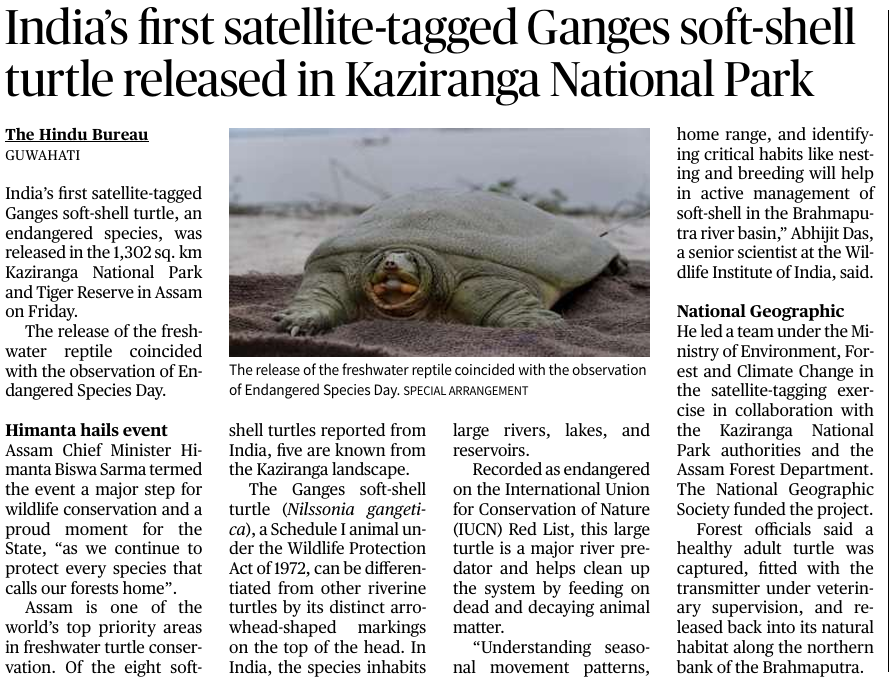
India’s first satellite-tagged Ganges soft-shell turtle was released in Kaziranga National Park. The initiative aims to study movement patterns, breeding behaviour, and habitat use of this endangered freshwater turtle species in the Brahmaputra river system.
Prelims concepts
1. Species in News: Ganges Soft-Shell Turtle
Scientific Name: Nilssonia gangetica
Physical Features: It is a large freshwater reptile and riverine turtle. It can be distinguished from other turtles by distinct arrowhead-shaped markings on the top of its head.
Habitat & Distribution: Inhabits large rivers, lakes, and reservoirs.
Found in India, particularly across the Brahmaputra river basin and the Ganges network.
Of the 8 soft-shell turtle species reported from India, 5 are found in the Kaziranga landscape (Assam).
Ecological Role: It is a major river predator and acts as an ecological scavenger, helping clean up the aquatic ecosystem by feeding on dead and decaying animal matter.
Conservation Status
IUCN Red List: Endangered
Wildlife Protection Act (WPA), 1972: Schedule I (affords the highest level of legal protection and penalties for offenses in India).
2. Protected Areas: Kaziranga National Park and Tiger Reserve
Location: Assam, India.
Geographic Feature mentioned: Located along the banks of the Brahmaputra River (the article specifically mentions the turtle's release along the northern bank).
Significance: Identified as one of the world's top priority areas for freshwater turtle conservation.
3. Wildlife Conservation Initiatives & Tech
Satellite-Tagging: The turtle was fitted with a transmitter to study:
Seasonal movement patterns.
Home range sizes.
Critical habitat behaviors like nesting and breeding.
Collaborating Institutions: Wildlife Institute of India (WII) (led by senior scientists under the Ministry of Environment, Forest and Climate Change).
Assam Forest Department & Kaziranga National Park authorities.
Funding Partner: The National Geographic Society.
4. Important Days & Events
Endangered Species Day: The release of this satellite-tagged turtle was strategically timed to coincide with the observation of this day to highlight wildlife conservation efforts.
UPSC MCQ:
Q. With reference to the Ganges Soft-shell Turtle (Nilssonia gangetica), consider the following statements:
It is a freshwater turtle species found in major river systems of northern India.
It is listed as “Critically Endangered” under the IUCN Red List.
It is protected under the Wildlife Protection Act, 1972.
Which of the statements given above is/are correct?
A) 1 and 3 only
B) 2 only
C) 1 and 2 only
D) 1, 2 and 3
Answer: A) 1 and 3 only
Explanation
Statement 1 is correct:
The Ganges soft-shell turtle is a freshwater turtle species inhabiting rivers, lakes, and reservoirs, especially in the Ganga and Brahmaputra river systems.
Statement 2 is incorrect:
It is listed as Endangered, not Critically Endangered, under the IUCN Red List.
Statement 3 is correct:
The species is protected under the Wildlife Protection Act, 1972.
Context
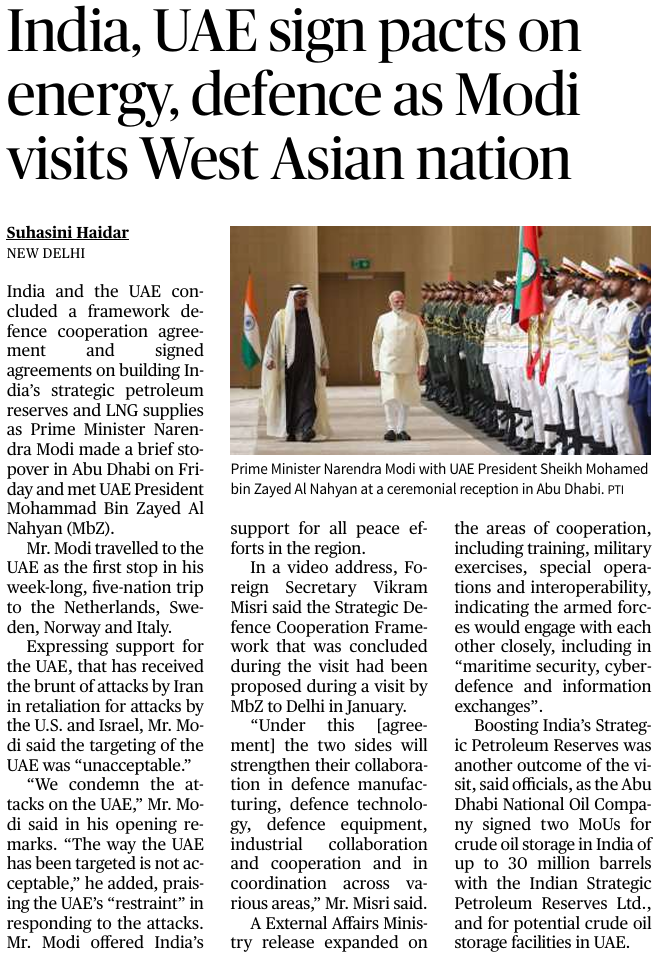
India and the United Arab Emirates signed agreements on:
Defence cooperation
Strategic petroleum reserves
LNG supplies
during Prime Minister Narendra Modi’s visit to Abu Dhabi.
Prelims concepts
1. International Relations & Bilateral Frameworks
India-UAE Strategic Partnership: The article highlights a deepening of bilateral ties between India and the United Arab Emirates (UAE) during the Prime Minister's stopover in Abu Dhabi to meet UAE President Sheikh Mohamed bin Zayed Al Nahyan (MbZ).
Geopolitical Stance: India explicitly expressed solidarity with the UAE regarding regional security threats, calling recent external attacks on the West Asian nation "unacceptable" and praising its "restraint."
2. Defence and Security Cooperation
Strategic Defence Cooperation Framework
A comprehensive framework agreement was concluded to enhance interoperability between the armed forces of both nations. Key focus areas include:
Joint Exercises & Training: Enhancing mutual capabilities through military exercises and specialized operations.
Technology & Manufacturing: Strengthening collaboration in defence manufacturing, technology sharing, and industrial equipment coordination.
New-Age Security Realms: Closer institutional ties in maritime security, cyber-defence, and information exchanges.
3. Economic & Energy Security
Strategic Petroleum Reserves (SPR)
Energy security forms a core pillar of the bilateral talks, focusing on expanding India's oil stockpiles to cushion against global supply chain disruptions.
Agreement Details: The Abu Dhabi National Oil Company (ADNOC) signed two Memorandums of Understanding (MoUs) with the Indian Strategic Petroleum Reserves Ltd. (ISPRL).
Storage Capacity: The pact involves storing up to 30 million barrels of crude oil within India's strategic reserves.
Reciprocal Storage: The framework also explores the potential creation of crude oil storage facilities for India within the UAE.
LNG Supplies: The agreements also cover securing steady Liquefied Natural Gas (LNG) supplies to boost India's clean energy transition.
Context
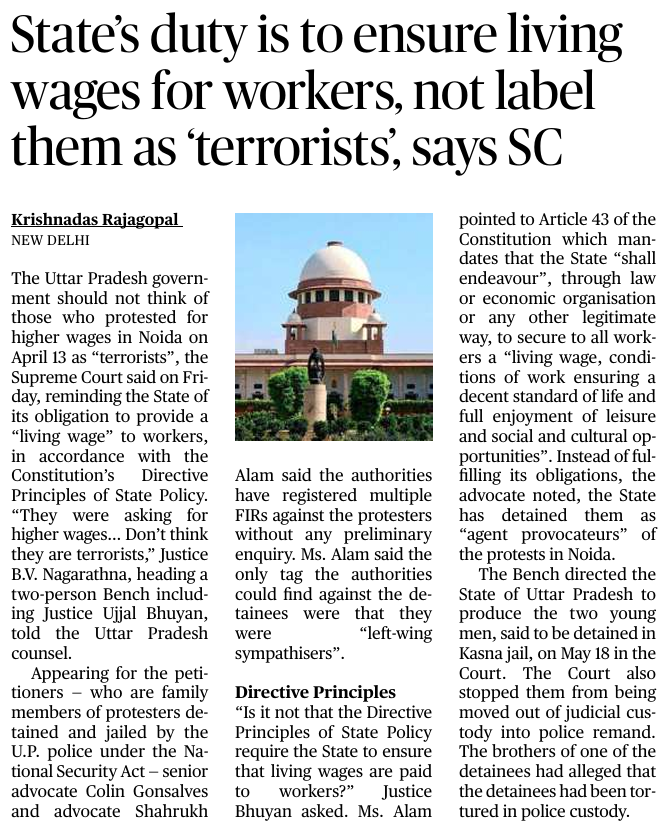
The Supreme Court of India criticised the Uttar Pradesh government for treating protesting workers as “terrorists” and emphasised the State’s constitutional obligation to ensure living wages under Article 43 of the Directive Principles of State Policy (DPSP).
Prelims concepts
1. Constitutional Provisions: Directive Principles of State Policy (DPSP)
The Supreme Court heavily relied on the Directive Principles of State Policy (Part IV of the Indian Constitution) to remind the State of its obligations.
Article 43 of the Constitution
Mandate: It explicitly states that the State “shall endeavour”, by suitable legislation or economic organization or in any other way, to secure to all workers a “living wage”.
Conditions of Work: It mandates ensuring conditions of work that guarantee a decent standard of life, full enjoyment of leisure, and social and cultural opportunities.
Classification: Article 43 is primarily categorized under Socialistic Principles of the DPSPs, aimed at establishing a welfare state and ensuring social and economic justice.
2. Important Legal & Constitutional Concepts
Living Wage vs. Minimum Wage
While the article explicitly mentions "living wage" (a constitutional goal under Article 43), Indian jurisprudence distinguishes between three levels of wages:
Minimum Wage: The bare minimum required for a worker to survive (food, shelter, clothing). It is a statutory right.
Fair Wage: A step above minimum wage, seeking to maintain employment levels while considering the capacity of the industry to pay.
Living Wage: The highest level of wage, which covers not just basic survival but also good health, education for children, social security, and a measure of comfort (as envisioned in Article 43).
National Security Act (NSA)
The article notes that the protesters were detained and jailed by the police under the National Security Act (NSA).
Prelims Core: The NSA is a preventive detention law. Under Article 22 of the Constitution, preventive detention allows the state to detain a person without a formal charge or trial to prevent them from committing future acts that could threaten national security or public order.
3. Judicial & Procedural Concepts
Judicial Custody vs. Police Remand
The Supreme Court bench explicitly stopped the detainees from being moved out of judicial custody into police remand.
Police Custody/Remand: The accused is locked up in a police station physical cell. The police have physical custody for interrogation purposes.
Judicial Custody: The accused is under the custody of the magistrate/court and is housed in a central or district jail, not a police station. Interrogation by police during judicial custody requires explicit permission from the magistrate.
Habeas Corpus Overtones
The Bench directed the State of Uttar Pradesh "to produce the two young men... in the Court".
This directive directly aligns with the core philosophy of a Writ of Habeas Corpus (under Article 32 or Article 226), which translates to "to have the body of" and is used to protect individual liberty against unlawful or arbitrary state detention.
UPSC MCQ
Q. Consider the following statements regarding the Directive Principles of State Policy (DPSP):
Article 43 directs the State to secure a living wage and decent standard of life for workers.
DPSPs are legally enforceable through courts.
DPSPs were inspired partly by the Constitution of Ireland.
Which of the statements given above are correct?
A) 1 and 3 only
B) 1 and 2 only
C) 2 and 3 only
D) 1, 2 and 3
Answer: A) 1 and 3 only
Explanation:
Statement 1 is correct:
Article 43 of the Constitution directs the State to secure living wages, decent working conditions, and a dignified standard of life for workers.
Statement 2 is incorrect:
Directive Principles are non-justiciable, meaning they are not enforceable by courts.
Statement 3 is correct:
The concept of DPSPs in the Indian Constitution was inspired by the Constitution of Ireland.
Context
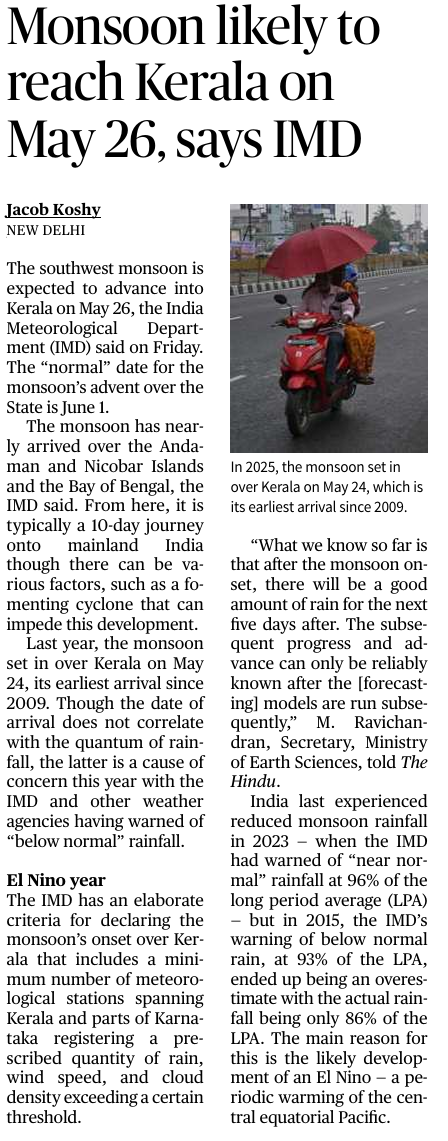
The India Meteorological Department (IMD) has forecast that the southwest monsoon is likely to reach Kerala around May 26, earlier than the normal onset date of June 1.
Prelims concepts
1. Indian Monsoon Dynamics: Onset and Progress
Southwest Monsoon: The article notes the anticipated early onset of the Southwest monsoon over the Indian mainland.
Timeline of Onset: Normal Date: The established normal date for the monsoon's advent over Kerala is June 1.
Progress Route: It typically arrives over the Andaman and Nicobar Islands and the Bay of Bengal first. From there, it usually takes a 10-day journey to make landfall on mainland India (Kerala).
Factors Impeding Progress: The progress of the monsoon from the islands to the mainland can be disrupted by external meteorological factors, such as a fomenting cyclone in the adjacent oceanic waters.
2. IMD Criteria for Monsoon Onset Over Kerala
The India Meteorological Department (IMD) uses an elaborate, objective mathematical criteria rather than subjective observation to officially declare the monsoon onset over Kerala. It depends on a combination of three parameters exceeding specific thresholds:
Rainfall: A minimum prescribed number of meteorological stations spanning Kerala and parts of Karnataka must register a specific quantity of rain over consecutive days.
Wind Speed: The depth and speed of westerly winds up to a certain atmospheric height must reach prescribed thresholds.
Cloud Density: The Outgoing Longwave Radiation (OLR) value—which indicates cloud density and depth—must exceed a specific threshold.
3. Global Climatic Phenomenon: El Niño
Definition: El Niño is a climate pattern characterized by the periodic warming of sea surface temperatures (SSTs) in the central and eastern equatorial Pacific Ocean.
Impact on Indian Monsoon: It is historically and highly correlated with reduced monsoon rainfall over India, often leading to "below normal" or drought-like conditions.
4. Statistical Concepts in Rainfall Forecasting
Long Period Average (LPA)
The IMD benchmarks its seasonal rainfall forecasts against the Long Period Average (LPA). It represents the average rainfall recorded over a region for a specific long-term period (usually 30 or 50 years).
Normal Rainfall: Quantified when the actual rainfall falls between 96% and 104% of the LPA.
Below Normal Rainfall: Quantified when the forecasted or actual rainfall falls below 96% of the LPA (e.g., the article mentions a 2015 forecast of 93% of LPA, which ultimately dropped to an actual deficit of 86% of LPA due to El Niño).
5. Institutional Framework
India Meteorological Department (IMD): The principal agency responsible for meteorological observations, weather forecasting, and seismology in India.
Parent Ministry: It functions directly under the Ministry of Earth Sciences (MoES).
UPSC MCQ
Q. Consider the following statements regarding the Southwest Monsoon in India:
The southwest monsoon normally reaches Kerala around June 1.
The onset date of the monsoon over Kerala directly determines the total monsoon rainfall over India.
El Niño conditions are generally associated with weaker monsoon rainfall in India.
Which of the statements given above is/are correct?
A) 1 and 3 only
B) 1 only
C) 2 and 3 only
D) 1, 2 and 3
Answer: A) 1 and 3 only
Explanation:
Statement 1 is correct:
The normal onset date of the southwest monsoon over Kerala is around June 1.
Statement 2 is incorrect:
The onset date does not directly determine the total seasonal rainfall, which depends on several atmospheric and oceanic factors.
Statement 3 is correct:
El Niño generally weakens the Indian southwest monsoon by altering atmospheric circulation patterns.
 Launch your Graphy