There are no items in your cart
Add More
Add More
| Item Details | Price | ||
|---|---|---|---|





Context
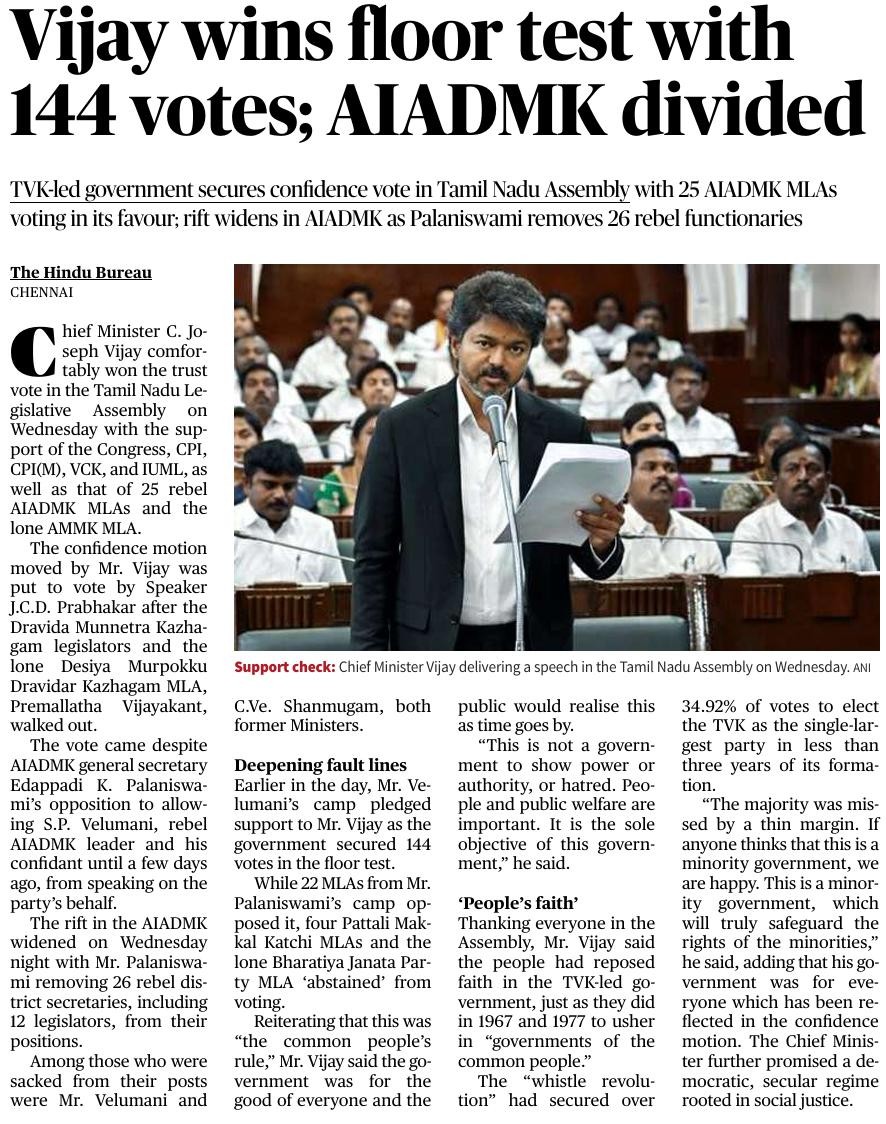
Tamil Nadu Chief Minister C. Joseph Vijay won the confidence motion in the Tamil Nadu Legislative Assembly with 144 votes. The TVK-led government secured support from alliance partners and a section of rebel AIADMK MLAs.
The development highlighted:
• Political instability within AIADMK
• Importance of floor tests in parliamentary democracy
• Coalition politics in State Assemblies
• Questions regarding party discipline and defections
Prelims concepts
1. Floor Test (Confidence Motion)
A floor test is a mechanism used to determine if the executive (the Council
of Ministers) still enjoys the confidence of the legislature.
• Definition: It is a vote held in the Legislative Assembly to prove that
the Chief Minister has the support of the majority of the members.
• Constitutional Basis: Under Article 164 of the Indian Constitution,
the Council of Ministers is collectively responsible to the Legislative
Assembly of the State.
• The Governor's Role: If the Governor has reasons to believe that the
Chief Minister has lost the majority, they can ask the CM to prove
their majority on the floor of the house.
• Types of Votes: It can be conducted via voice vote, division
(electronic voting or physical counting), or secret ballot (though
rare).
2. Role of the Speaker
The article mentions Speaker J.C.D. Prabhakar putting the motion to vote.
• Presiding Officer: The Speaker is the constitutional and statutory
head of the House.
• Conduct of Business: The Speaker decides the agenda and whether
a motion (like a confidence or no-confidence motion) is in order to be
put to vote.
• Casting Vote: Under Article 189, the Speaker does not vote in the
first instance but exercises a "casting vote" in the case of an equality
of votes (a tie).
3. Anti-Defection Law (10th Schedule)
The article highlights a rift where 25 AIADMK MLAs voted in favor of the
TVK-led government against their party line.
• Disqualification: Under the 52nd Amendment Act (1985), a
member of a House belonging to any political party becomes
disqualified if they vote or abstain from voting contrary to any
direction (whip) issued by their political party.
• The "Split" Exception: Previously, a split of one-third of members was
protected, but this was deleted by the 91st Amendment Act (2003).
Currently, only a merger involving two-thirds of the members is
protected from disqualification.
• Deciding Authority: The Speaker or the Chairman of the House has
the final power to decide on disqualification petitions.
UPSC MCQ
Q. With reference to the concept of a Floor Test in the Indian
parliamentary system, consider the following statements:
1. A floor test is conducted to determine whether the Council of
Ministers enjoys the confidence of the legislature.
2. The Governor can direct a floor test when doubts arise regarding the
majority of the government.
3. The Anti-Defection Law is contained in the Sixth Schedule of the
Constitution.
Which of the statements given above are correct?
A) 1 and 2 only
B) 2 and 3 only
C) 1 and 3 only
D) 1, 2 and 3
Answer: A) 1 and 2 only
Explanation:
Statement 1: Correct
A floor test is conducted in the legislature to verify whether the
government has majority support in the House.
Statement 2: Correct
The Governor may ask the Chief Minister to prove majority through a floor
test when political uncertainty or defections create doubts about the
government’s stability.
Statement 3: Incorrect
The Anti-Defection Law is contained in the Tenth Schedule of the
Constitution, added through the 52nd Constitutional Amendment Act,
1985, not the Sixth Schedule.
 What has the IMD announced ahead of this year’s monsoon?
Context
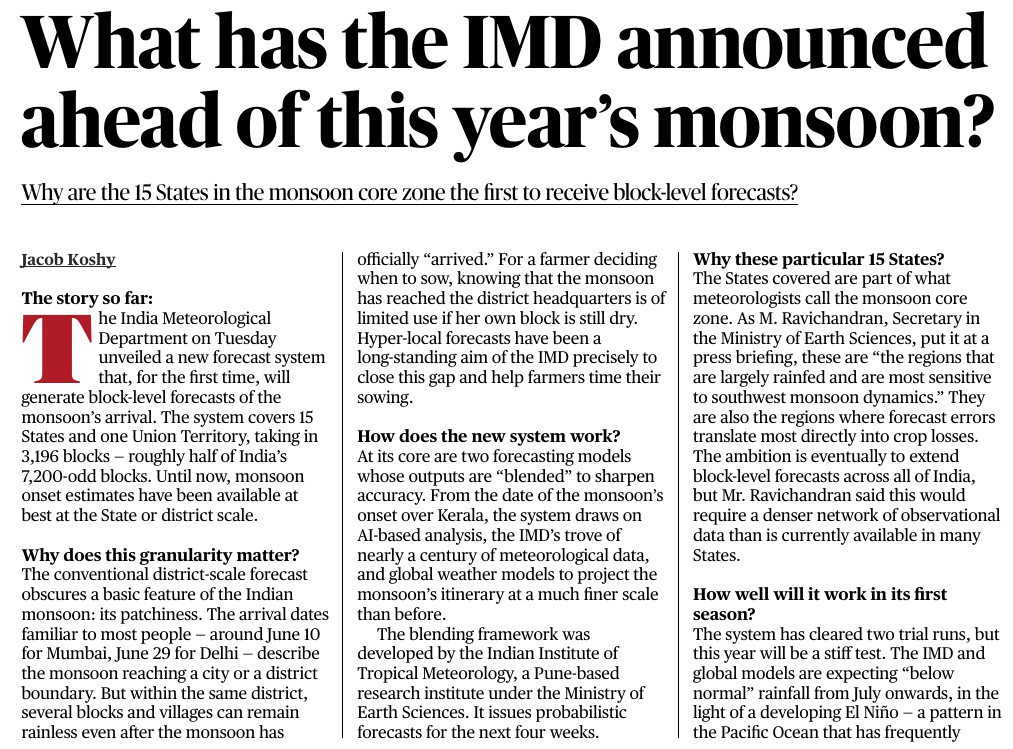
The India Meteorological Department (IMD) has introduced India’s first
block-level monsoon onset forecasting system covering:
• 15 States
• 1 Union Territory
• Around 3,196 blocks
The initiative focuses on the Monsoon Core Zone (MCZ), regions highly
dependent on southwest monsoon rainfall and vulnerable to rainfall
variability.
The system combines:
• AI-based analysis
• Historical weather data
• Global climate models
• Blended forecasting techniques
Understanding the Indian Monsoon
What is the Southwest Monsoon?
The Southwest Monsoon is a seasonal wind system bringing rainfall to
India from:
June to September
It contributes nearly:
70–75% of India’s annual rainfall
It is critical for:
Agriculture, Water security, Hydropower, Rural livelihoods & Food
security
Features of the Indian Monsoon
1. Seasonal Reversal of Winds
During summer:
Land heats faster than oceans.
Low pressure develops over northwestern India.
Moist winds from the Indian Ocean move towards India.
2. Uneven and Patchy Distribution
The monsoon is highly variable:
Spatially
Temporally
Even within the same district:
Some blocks may receive heavy rainfall
Others may remain dry
This is why district-level forecasts are often insufficient.
3. High Dependence of Agriculture
Around:
Half of India’s net sown area remains rain-fed.
Thus:
Monsoon variability directly impacts crop output and rural incomes.
What is New in the IMD System?
Earlier Forecasting System
Traditionally, forecasts were available at:
National scale
State scale
District scale
This created a gap because:
Farmers make decisions at village/block level.
For example:
Monsoon may officially “arrive” in a district,
but several blocks may still not receive adequate rainfall.
New Block-Level Forecasting
The new system provides:
Localised monsoon onset forecasts at block level.
Key Features
Forecasting at much finer spatial scale
Probabilistic forecasts for next four weeks
AI-assisted weather modelling
Blending of multiple forecast models
Role of AI and Data Analytics
The system combines:
Nearly a century of meteorological data
Real-time observations
Global climate models
Machine learning techniques
This improves:
Accuracy & Spatial precision
Why Were These 15 States Chosen?
The selected States are part of the Monsoon Core Zone (MCZ), which:
Receives major monsoon rainfall
Is highly vulnerable to rainfall variability
Depends heavily on rain-fed agriculture
These regions are crucial for India’s food grain production.
Significance
Helps farmers plan sowing and irrigation better
Reduces crop losses and agrarian distress
Improves disaster preparedness for floods and droughts
Supports climate resilience through hyper-local forecasting
Promotes AI-based and data-driven governance
Helps manage food inflation and agricultural productivity
Challenges
Lack of dense weather infrastructure
Increasing climate unpredictability
Poor last-mile communication to farmers
Initial concerns over forecast accuracy
Need for better coordination among agencies
Way Forward
Expand block-level forecasting nationwide
Strengthen radar and weather station networks
Improve farmer outreach through local advisories and mobile alerts
Integrate forecasts with crop insurance and agricultural planning
Conclusion
The IMD’s block-level forecasting initiative can improve agricultural
planning, disaster management, and climate resilience through precise and
localised monsoon predictions.
UPSC Mains Question
Q. Hyper-local weather forecasting can significantly strengthen India’s
agricultural resilience and disaster preparedness. Discuss in the context of the India Meteorological Department’s new block-level monsoon
forecasting initiative. (250 words)
Context
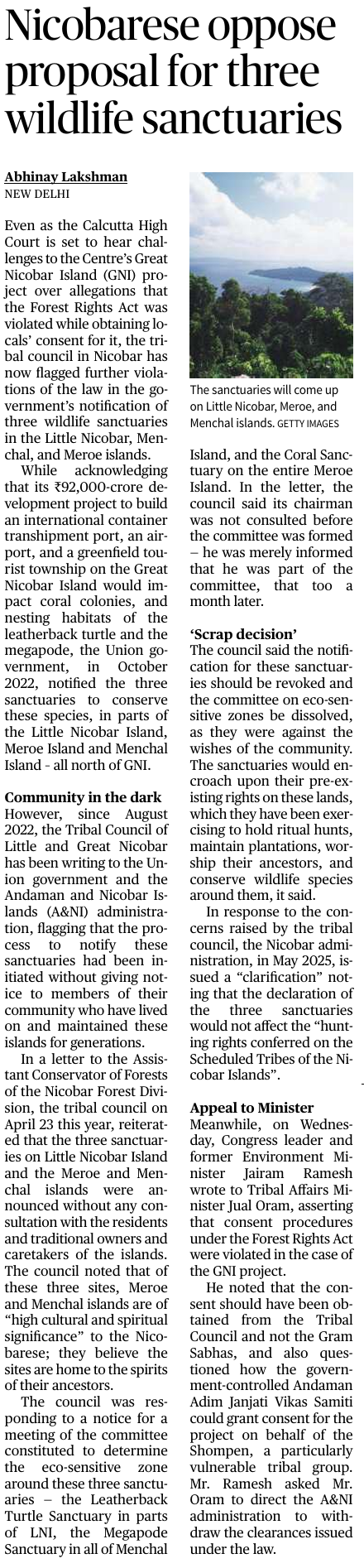
The Tribal Council of Little and Great Nicobar Islands has opposed the
Union Government’s proposal to declare:
Three wildlife sanctuaries
In Little Nicobar, Menchal, and Meroe Islands
The council alleged that:
Proper consultation with indigenous communities was not conducted
Legal procedures under tribal and forest rights protections were
violated
The issue is linked to the proposed:
Great Nicobar Island Project
Prelims concepts
1. Geography & Environment: Andaman and Nicobar Islands
The article discusses conservation efforts and development on specific
islands within the archipelago.
Key Locations:
Great Nicobar Island (GNI): The southernmost island of India, home to a
proposed ₹92,000-crore development project.
Little Nicobar, Meroe, and Menchal Islands: Locations identified for three
new wildlife sanctuaries north of GNI.
Target Species for Conservation:
Leatherback Turtle: Nesting habitats are a primary focus for the new
sanctuaries.
Megapode: A unique ground-nesting bird species whose habitat is under
conservation.
Coral Colonies: Sensitive ecosystems impacted by the transhipment port
and township projects.
Protected Areas:
Wildlife Sanctuaries: Regions notified to conserve specific flora or fauna
while allowing certain human activities.
Eco-Sensitive Zones (ESZ): Buffer areas around protected regions (like
sanctuaries) meant to regulate activities and minimize human-wildlife
conflict.
2. Governance & Legislation: Forest Rights Act (FRA)
The article highlights legal challenges regarding the consent of local
communities under the Scheduled Tribes and Other Traditional Forest
Dwellers (Recognition of Forest Rights) Act, 2006.
Gram Sabha vs. Tribal Council: A point of contention is whether consent
for development should come from individual Gram Sabhas or the
overarching Tribal Council.
Community Forest Rights: These include rights to hold ritual hunts,
maintain plantations, worship ancestors, and conserve wildlife in
traditional lands.
3. Social Justice: Tribal Communities
The report focuses on the rights and concerns of indigenous groups in the
Nicobar region.
Nicobarese Tribe: The primary group opposing the sanctuaries due to
impacts on their "high cultural and spiritual" sites, believed to be homes for
ancestral spirits.
Shompen Tribe: Categorized as a Particularly Vulnerable Tribal Group
(PVTG). Questions have been raised regarding who can legally grant
consent on their behalf for large-scale projects.
PVTGs: These are tribal communities characterized by declining
populations, low literacy, and pre-agricultural levels of technology,
requiring higher levels of protection.
4. Infrastructure: Great Nicobar Island (GNI) Project
A massive holistic development plan involving:
International Container Transhipment Port: Aimed at leveraging the
island's strategic location near global shipping lanes.
Greenfield Tourist Township: Part of the infrastructure push to increase
connectivity and economic activity.
Airport Development: Included in the ₹92,000-crore budget for regional
growth.
UPSC MCQ
Q. With reference to the Great Nicobar Island Project (GNIP), consider
the following statements:
1. The project includes the development of an international transshipment
port and airport infrastructure.
2. The proposed wildlife sanctuaries are located in ecologically sensitive
regions inhabited by indigenous tribal communities.
3. The Leatherback Turtle is one of the species likely to be affected by the
project.
Which of the statements given above are correct?
A) 1 and 2 only
B) 2 and 3 only
C) 1 and 3 only
D) 1, 2 and 3
Answer: D) 1, 2 and 3
Explanation
Statement 1: Correct
The Great Nicobar Island Project includes:
International transshipment port
Airport
Township and infrastructure development
Statement 2: Correct
The proposed sanctuaries are situated in ecologically fragile areas
inhabited by Nicobarese tribal communities.
Statement 3: Correct
The project area includes nesting habitats of the Leatherback Turtle,
raising environmental concerns.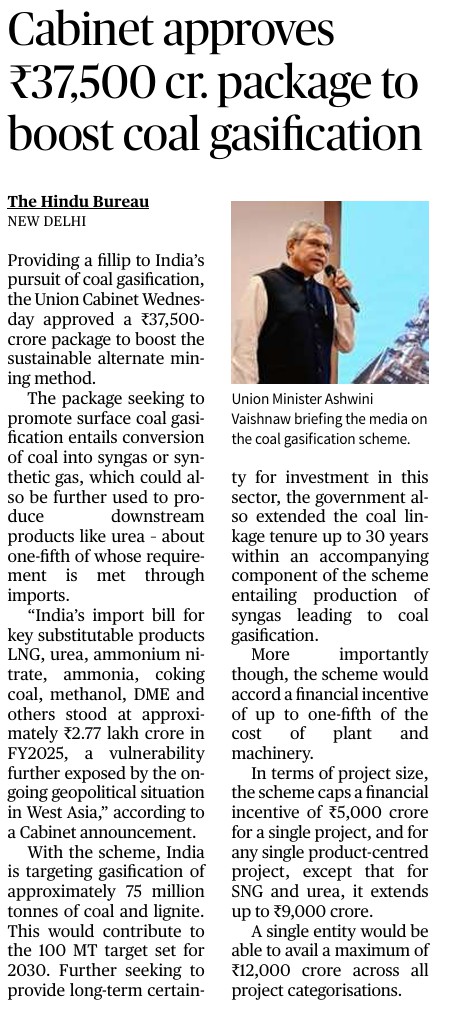
Context
The Union Cabinet has approved a ₹37,500 crore package to promote
coal gasification in India.
The scheme aims to:
Convert coal into syngas (synthetic gas)
Reduce import dependence on products like:
Urea ; LNG; Methanol; Ammonia
Support India’s target of gasifying 100 million tonnes of coal by 2030
Prelims concepts
1. Coal Gasification and Syngas
Process: Coal gasification is a process that uses heat, pressure, and steam
to convert coal into syngas (synthetic gas).
Composition of Syngas: Syngas is primarily a mixture of Hydrogen (H_2),
Carbon Monoxide (CO), and sometimes small amounts of Carbon Dioxide
(CO_2) and Methane (CH_4).
Significance: It is considered a cleaner coal technology compared to direct
burning because it allows for the removal of impurities like sulfur and
particulate matter before the gas is used for power or chemical
production.
2. Downstream Products and Import Substitution
The government aims to reduce the import bill (which stood at
approximately ₹2.77 lakh crore in FY2025) by using syngas to produce key
commodities.
Urea: About one-fifth of India's urea requirement is currently met through
imports; coal gasification can provide the feedstock to produce it
domestically.
Chemical Feedstocks: Syngas is used to produce Methanol, Ammonium
Nitrate, Ammonia, and DME (Dimethyl Ether).
Energy Security: Substituting imports of LNG (Liquefied Natural Gas) and
Coking Coal through domestic gasification helps mitigate vulnerabilities
caused by geopolitical situations.
UPSC MCQ
Q. With reference to Coal Gasification, consider the following
statements:
1. Coal gasification converts coal into synthetic gas (syngas).
2. Syngas can be used in the production of fertilisers, chemicals, and
synthetic fuels.
3. Coal gasification completely eliminates carbon emissions from coal
usage.
Which of the statements given above are correct?
A) 1 and 2 only
B) 2 and 3 only
C) 1 and 3 only
D) 1, 2 and 3
Answer: A) 1 and 2 only
Explanation:
Statement 1: Correct
Coal gasification is the process of converting coal into syngas (synthetic
gas) through partial oxidation at high temperatures.
Statement 2: Correct
Syngas is used for producing:
Fertilisers
Chemicals
Methanol
Synthetic fuels
Statement 3: Incorrect
Coal gasification does not completely eliminate carbon emissions.
Although it may be cleaner than direct coal burning, it still generates
greenhouse gas emissions unless combined with carbon capture
technologies.
 Launch your Graphy