The Hindu Analysis 13th May 2026 for UPSC, APPSC & TSPSC Exams
The Hindu News Analysis – 13th May, 2026
1. NEET-UG 2026 cancelled after question paper leak (GS-2)
2. How India is governing its water resources (GS-2, GS-3)
3. China’s Foreign Minister set to skip BRICS meet in Delhi (GS-2, GS-3)
4. Iran warns of enriching uranium to 90% purity (GS-2, GS-3)
5. Pricey food, dining out push retail inflation to a 13-month high of 3.5% (GS-3)
NEET-UG 2026 cancelled after question paper leak
GS Paper II
Issues relating to development and management of Social Sector/Services relating to Health and Education
Government policies and interventions for development in various sectors
Transparency and accountability in governance
Context
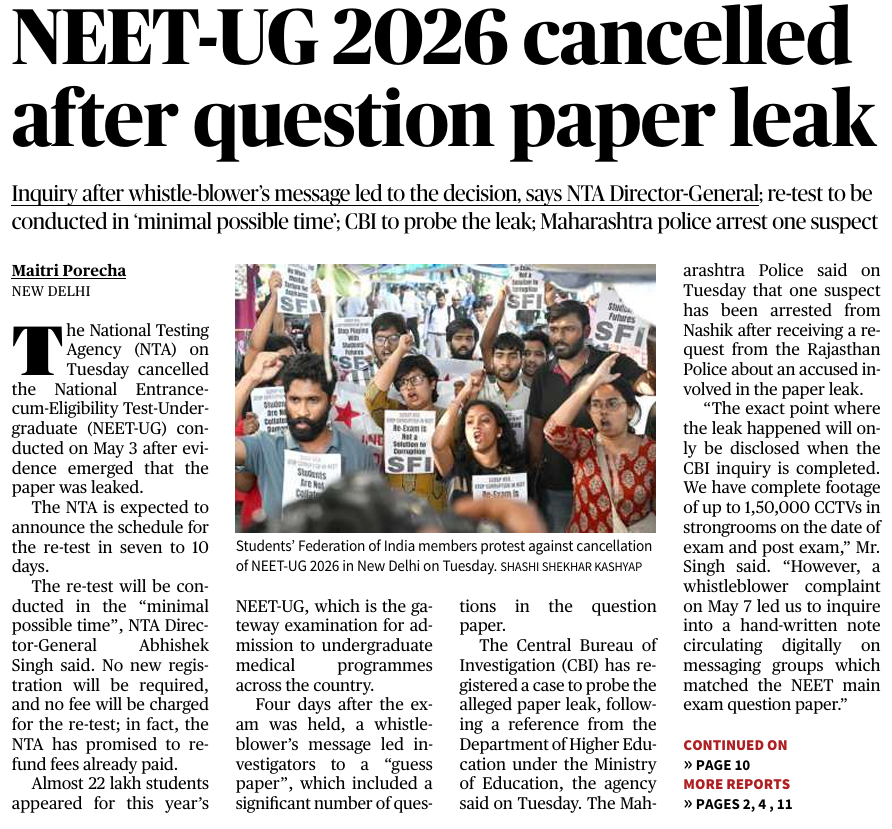
The National Testing Agency (NTA) cancelled the NEET-UG 2026 examination after evidence emerged that the question paper had been leaked before the exam. Around 22 lakh students appeared for the examination.
The Central Bureau of Investigation (CBI) has been asked to probe the matter, while a re-test is expected within a short time frame.
Key concepts
1. National Testing Agency (NTA)
The NTA is the primary body mentioned as responsible for conducting and managing the examination process.
Mandate: It is the nodal agency for conducting the National Entrance-cum-Eligibility Test-Undergraduate (NEET-UG) for medical admissions across India.
Administrative Actions: The NTA has the authority to cancel examinations upon evidence of malpractice (such as paper leaks) and schedule re-tests.
2. Central Bureau of Investigation (CBI)
The CBI has been brought in as the central investigative authority to probe the leak.
Jurisdiction: The agency registered the case following a reference from the Department of Higher Education under the Ministry of Education.
Role in Examination Integrity: The CBI’s inquiry focuses on identifying the "exact point" of the leak and investigating digital evidence, such as hand-written notes circulating on messaging groups.
3. Governance and Public Policy
Whistleblower Mechanism: The investigation was triggered by a whistleblower's message regarding a "guess paper" that matched the actual exam content.
Ministry Oversight: The Department of Higher Education (Ministry of Education) acts as the supervising administrative body for the NTA and initiates high-level probes.
 How India is governing its water resources
GS Paper II
Government policies and interventions for development in water sector
GS Paper III
Conservation of natural resources
Environmental pollution and degradation
Disaster and water resource management
Context
The article highlights that India’s water crisis is not merely due to scarcity of water, but due to weaknesses in governance, storage, regulation, and management systems. Despite receiving substantial rainfall annually, India faces severe water stress because only a limited portion is effectively captured, stored, and utilised.
The article discusses India’s evolving framework of water governance through schemes, institutional mechanisms, and sustainability-oriented reforms.
Detailed Analysis
Enduring Water Paradox in India
Abundance Amid Scarcity
India:
Receives nearly 4,000 billion cubic metres of rainfall annually
Supports around 18% of the world’s population
Possesses only about 4% of global freshwater resources
Yet a significant portion of water remains underutilised due to:
Poor storage infrastructure
Uneven rainfall distribution
Ecological limitations
Weak governance mechanisms
Declining Per Capita Water Availability
Per capita water availability has sharply fallen:
Post-independence: Above 5,000 cubic metres annually
Present: Around 1,400 cubic metres
This reflects:
Population growth
Urbanisation
Groundwater over-extraction
Climate stress
Groundwater Dependency
India is the world’s largest groundwater user.
Excessive extraction has:
Supported agricultural expansion
Increased irrigation access
Improved livelihoods
But also caused:
Falling water tables
Aquifer depletion
Ecological stress
Water Governance Structure in India
1. Multi-Level Governance Framework
India follows a federal water governance structure involving:
Union government
State governments
Local bodies
2. Key Institution
Ministry of Jal Shakti
Nodal ministry for:
Water resources
Drinking water
Sanitation
Central Water Commission (CWC)
Focuses on:
Surface water planning
Flood control
River basin development
Central Ground Water Board (CGWB)
Responsible for:
Groundwater assessment
Aquifer management
Scientific inputs for regulation
Challenges in Water Governance
Institutional Fragmentation – Multiple agencies lead to coordination issues.
State-Level Disparities – Uneven administrative and financial capacity affects implementation.
Poor Groundwater Regulation – Weak monitoring and subsidies encourage overuse.
Climate Stress – Erratic rainfall, floods, and droughts worsen water insecurity.
Urban Water Crisis – Rapid urbanisation causes scarcity and pollution.
Major Government Initiatives
1. Jal Jeevan Mission
Launched in 2019 to provide:
Functional tap water connections to rural households
Significance:
Improves public health
Enhances rural welfare
Reduces burden on women
Mission extended till 2028 for universal coverage.
2. Atal Bhujal Yojana
Focuses on:
Participatory groundwater management
Community-led aquifer monitoring
Water budgeting
Targets water-stressed regions.
3. Pradhan Mantri Krishi Sinchayee Yojana (PMKSY)
Promotes:
Micro-irrigation
“Per Drop More Crop”
Irrigation efficiency
Important because agriculture consumes most freshwater resources.
4. AMRUT Mission
Addresses urban water management through:
Water supply expansion
Sewage treatment
Wastewater reuse
5. Namami Gange Programme
Integrated river rejuvenation programme focusing on:
Pollution control
Sewage treatment
Ecological restoration
Towards a Circular Water Economy
Wastewater Reuse – Recycle treated water to reduce freshwater pressure.
Efficient Irrigation – Promote drip and sprinkler irrigation.
Technology Use – Smart metering, GIS, AI-based monitoring.
Participatory Governance – Involve communities and local bodies.
Significance of Effective Water Governance
Economic Growth – Essential for agriculture, industry, and energy.
Social Stability – Prevents migration, distress, and conflicts.
Environmental Sustainability – Protects ecosystems and improves resilience.
Way Forward
Integrated Water Management – Basin-level planning for surface and groundwater.
Cooperative Federalism – Better Centre–State coordination.
Regulatory Reforms – Strong groundwater laws and water auditing.
Water Conservation – Rainwater harvesting and restoration of traditional water bodies.
Behavioural Change – Promote efficient use and water literacy.
Conclusion
India’s water crisis is primarily a governance challenge requiring integrated, technology-driven, and participatory solutions for sustainable water security.
UPSC Mains Question
Q. India’s water crisis is as much a governance challenge as a hydrological one. Discuss in the context of India’s evolving water governance framework. (250 words
China’s Foreign Minister set to skip BRICS meet in Delhi
GS Paper II
India and its neighbourhood- relations
Bilateral, regional and global groupings involving India
Important international institutions and groupings
GS Paper III
Security challenges and their management
Global geopolitical developments and their impact on India
Context
China announced that Foreign Minister Wang Yi will skip the BRICS Foreign Ministers’ Meeting in New Delhi citing “scheduling reasons”. Instead, Chinese Ambassador Xu Feihong will represent China.
The meeting coincides with U.S. President Donald Trump’s visit to China, making it diplomatically significant. The development comes amid:
India-China tensions
Prelims concepts
Membership Evolution
Original Members: Brazil, Russia, India, China, and South Africa.
Expanded Membership (11-Nation Grouping): The bloc now includes Egypt, Ethiopia, Iran, Saudi Arabia, the United Arab Emirates (UAE), and Argentina (though participation varies by political administration).
Significance of BRICS for India
BRICS (Brazil, Russia, India, China, South Africa and new members) serves as:
A platform for multipolar global governance
An alternative voice to Western-dominated institutions
A mechanism for South-South cooperation
A forum for economic, developmental and strategic coordination
For India, BRICS helps:
Enhance strategic autonomy
Balance Western and Chinese influence
Strengthen Global South leadership
Promote reforms in institutions like IMF, World Bank and UNSC
Significance of the Meeting for India
1. India as BRICS Chair
India seeks to:
Shape BRICS agenda
Promote Global South priorities
Strengthen multilateral reforms
Enhance its diplomatic leadership
2. Opportunity for Strategic Balancing
India uses BRICS to:
Maintain engagement with China despite tensions
Deepen ties with Russia and Global South
Avoid overdependence on any bloc
This reflects India’s policy of multi-alignment.
3. Voice of the Global South
India aims to emphasise:
Development financing
Climate justice
Technology access
Food and energy security
UPSC MCQ
Q. With reference to BRICS, consider the following statements:
1. The New Development Bank (NDB) was established by BRICS countries.
2. BRICS functions as a military alliance similar to NATO.
Which of the statements given above is/are correct?
A. 1 only
B. 2 only
C. Both 1 and 2
D. Neither 1 nor 2
Answer:
A. 1 only
Explanation:
Statement 1 is correct: The New Development Bank (NDB) was created by BRICS nations to support infrastructure and sustainable development projects.
Statement 2 is incorrect: BRICS is not a military alliance; it is a grouping focused on economic, political and developmental cooperation.
Iran warns of enriching uranium to 90% purity
GS Paper II
International relations
Effect of policies and politics of developed and developing countries on India’s interests
Important international institutions
GS Paper III
Nuclear technology and security issues
Security challenges and their management
Context
Iran warned that it could enrich uranium up to 90% purity if attacked again, raising concerns over escalation of its nuclear programme and regional tensions in West Asia.
Prelims concepts
What is Uranium Enrichment?
Uranium enrichment is the process of increasing the concentration of the isotope Uranium-235 (U-235).
Enrichment Levels
3–5% → Civilian nuclear power reactors
20% → Research reactors
60% → Near weapons-grade
90%+ → Weapons-grade uranium
The enrichment process is mainly done using centrifuges.
Why is 90% Significant?
At 90% purity:
Uranium can potentially be used in nuclear weapons
It drastically reduces the “breakout time” needed to build a bomb
It raises global non-proliferation concerns
This could intensify:
Israel-Iran tensions
U.S.-Iran rivalry
Instability in West Asia
Concerns for Global Security
1. Nuclear Proliferation
Iran moving closer to weapons-grade enrichment may:
Trigger regional arms race
Encourage nuclear ambitions in West Asia
Weaken global non-proliferation norms
2. Weakening of JCPOA
The Joint Comprehensive Plan of Action (JCPOA) aimed to:
Limit Iran’s nuclear programme
Reduce enrichment levels
Allow international inspections
Iran’s recent stance indicates further erosion of the agreement.
3. Regional Instability
Potential consequences include:
Increased military confrontation
Israeli pre-emptive strikes
Higher geopolitical volatility in Gulf region
UPSC MCQ
Q. With reference to uranium enrichment, consider the following statements:
1. Uranium enriched up to 90% purity is considered weapons-grade.
2. Civilian nuclear reactors generally use uranium enriched below 5%.
Which of the statements given above are correct?
A. 1 only
B. 2 only
C. Both 1 and 2
D. Neither 1 nor 2
Answer:
C. Both 1 and 2
Explanation:
Statement 1 is correct: Uranium enriched to around 90% purity is considered weapons-grade.
Statement 2 is correct: Civilian nuclear reactors commonly use low-enriched uranium below 5%.
Pricey food, dining out push retail inflation to a 13-month high of 3.5%
GS Paper III
Indian Economy and issues relating to planning, mobilisation of resources, growth and development.
Effects of liberalisation on the economy.
Context
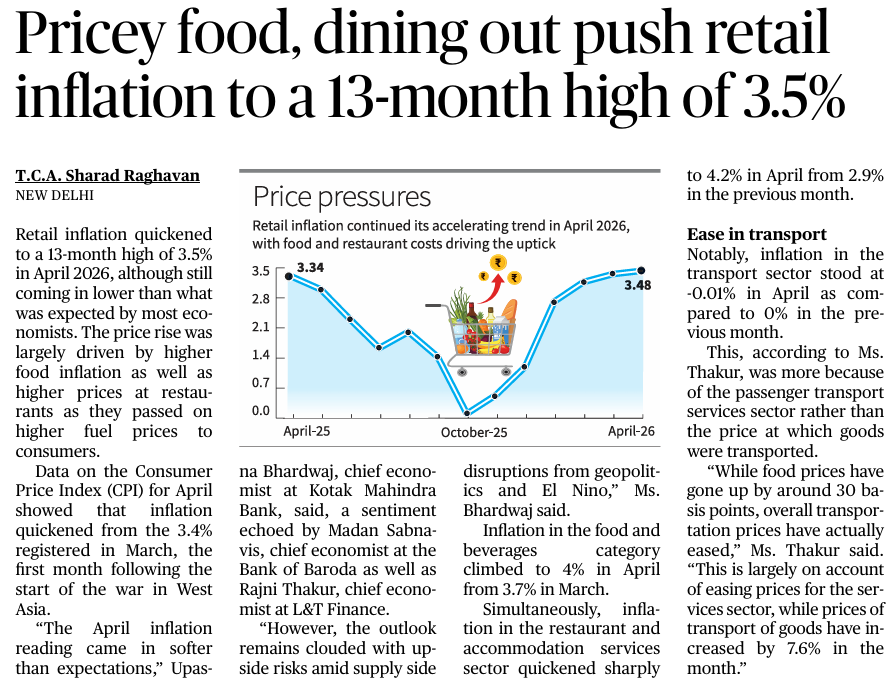
India’s retail inflation, measured by the Consumer Price Index (CPI), rose to a 13-month high of 3.5% in April 2026, mainly driven by rising food prices and higher restaurant and dining costs.
What is Retail Inflation?
Retail inflation refers to the increase in prices of goods and services consumed by households.
India measures it through:
Consumer Price Index (CPI)
Released by the National Statistical Office (NSO)
The Reserve Bank of India (RBI) uses CPI inflation for monetary policy decisions.
Major Drivers of Inflation
1. Food Inflation
Rising essential commodity prices
Supply disruptions and weather uncertainties
High food weightage in CPI amplified impact
2. Rising Restaurant & Dining Costs
Higher fuel, input and wage costs
Increased inflation in accommodation and food services
3. Global Geopolitical Factors
West Asia conflict
Supply-chain disruptions
Rise in global commodity prices
Implications
1. Impact on Consumers
Reduces purchasing power and real income
Affects poor and middle-class households the most
2. Monetary Policy Implications
Limits RBI’s scope for interest rate cuts
Influences monetary policy decisions
3. Impact on Economic Growth
Reduces consumer demand
Raises business costs and slows investment


 Launch your Graphy