The Hindu Analysis 11th May 2026 | Current Affairs for UPSC, APPSC & TSPSC
The Hindu News Analysis – 11th May, 2026
1. The Governor who forgot his job (GS-2)
2. CII says private sector capex grew by 67% in September 2025
(GS-3)
3. ‘Blend organic manure with fertilizers to cut costs’ (GS-3)
4. India-Trinidad pact to help diaspora trace ancestral roots: Jaishankar (GS-2)
5. ‘Maritime security is of primordial importance to Indian Ocean Region’ (GS-2, GS-3)
The Governor who forgot his job
GS Paper II
Functions and responsibilities of the Union and the States
Role of Governor in State polity
Parliament and State Legislatures — structure, functioning and conduct of business
Constitutional bodies and issues arising out of their functioning
Context
The article discusses the constitutional controversy arising after the 2026 Tamil Nadu Assembly elections, where the Governor delayed inviting the single largest party, TVK, to form the government and insisted on signed letters proving majority support before administering the oath.
The authors argue that such actions violate established parliamentary conventions and constitutional morality governing the office of the Governor.
Detailed Analysis
Electoral Verdict in Tamil Nadu
The election produced a fractured mandate:
TVK emerged as the single largest party with 108 seats in a House of 234.
DMK won 59 seats.
AIADMK secured 47 seats.
Instead of immediately inviting the leader of the single largest party to form the government, the Governor demanded written support from 118 MLAs before swearing in the Chief Minister-designate.
The article views this as a departure from accepted constitutional conventions.
What is the Constitutional Role of the Governor?
The Governor’s role after elections is limited and largely guided by convention.
Core Principle
The Governor must identify the person most likely to command the confidence of the House.
The Governor is:
Not a returning officer
Not an arithmetic verifier
Not expected to demand pre-oath proof of majority
The actual test of majority must occur on the floor of the Assembly.
Constitutional Conventions on Government Formation
The article highlights recommendations of various commissions:
Sarkaria Commission (1988)
Recommended order of preference:
Pre-poll alliance with majority
Single largest party with support
Post-poll coalition
Minority government with outside support
Venkatachaliah Commission (2002)
Reinforced the importance of constitutional morality and objective standards.
Punchhi Commission (2010)
Emphasised neutrality of Governors and avoidance of partisan conduct.
The article argues that these conventions were ignored selectively.
Selective Use of Gubernatorial Discretion
The authors compare past cases:
State/Year
Governor’s Action
Observation
Goa (2017)
BJP invited despite fewer seats
Preference to post-poll alliance
Manipur (2017)
BJP invited over Congress
Single largest party ignored
Karnataka (2018)
BJP given 15 days to prove majority
Extended time allegedly enabled defections
Tamil Nadu (2026)
Single largest party denied invitation initially
Majority proof demanded beforehand
The article argues that gubernatorial discretion has often been politically selective.
Minority Governments are Constitutionally Valid
A major argument of the article is that minority governments are legitimate within parliamentary democracy.
Examples cited:
Atal Bihari Vajpayee government (1996)
P.V. Narasimha Rao government
Deve Gowda and I.K. Gujral governments
Manmohan Singh’s first government (2004)
Constitutional Basis
Article 164 implies that:
The Council of Ministers remains in office as long as it enjoys confidence of the House.
Majority is tested on the floor, not in Raj Bhavan.
Thus, pre-swearing verification has no constitutional basis.
Problems with Pre-Swearing Majority Proof
The article strongly criticises the Governor’s demand for signed letters.
Concerns Raised
Encourages Horse-Trading
Long delays before floor tests may encourage:
Defections
Political bargaining
Coercion of MLAs
Weakens Parliamentary Democracy
The Assembly floor is the legitimate forum for testing majority.
Distorts Anti-Defection Principles
Artificial deadlines and political uncertainty undermine democratic stability.
Supreme Court’s Role
The article calls for clearer judicial guidelines.
Important Cases Mentioned
Established that majority must ordinarily be tested on the floor of the House.
Rameshwar Prasad Case
Discussed constitutional limits on gubernatorial discretion.
What Reforms Does the Article Suggest?
1. Governor Must Follow Established Order of Preference
Discretion should not become arbitrary.
2. Floor Test Should Be the Sole Test
The Governor should:
Swear in the claimant government
Allow Assembly proceedings
Conduct an early floor test if necessary
3. Minority Governments Should Not Be Delegitimised
They are a normal feature of parliamentary systems.
4. Opposition Should Move No-Confidence Motion
Instead of requiring pre-emptive proof of majority.
5. Reduce Scope for Political Manipulation
Short and transparent timelines for floor tests can curb instability.
Constitutional Principles Involved
Parliamentary Democracy
Executive legitimacy flows from confidence of the legislature.
Constitutional Morality
Constitutional offices must function impartially.
Federalism
Governors should not act as agents of the Union government.
Democratic Mandate
The people’s verdict should not be altered through procedural manipulation.
Significance of the Debate
The issue is important because it concerns:
Neutrality of constitutional offices ; Stability of elected governments
Protection of federalism
Prevention of misuse of gubernatorial discretion
Preservation of parliamentary conventions
Way Forward
Codify Conventions
Parliament or Supreme Court guidelines can reduce ambiguity.
Time-Bound Floor Tests
Floor tests should occur quickly to prevent political manipulation.
Ensure Political Neutrality of Governors
Appointments should prioritise constitutional integrity over political loyalty.
Judicial Clarification
The Supreme Court should evolve uniform principles governing hung assemblies.
Conclusion
The article argues that the Governor’s role is constitutional, not political. In a parliamentary democracy, legitimacy is determined on the floor of the House, not inside Raj Bhavan. Frequent deviations from established conventions risk weakening federalism, encouraging political opportunism, and undermining the democratic mandate expressed by voters.
UPSC Mains Question
Q. The discretionary powers of the Governor in government formation have increasingly become a source of constitutional and political controversy. Discuss in the context of parliamentary democracy and federalism in India.
CII says private sector capex grew by 67% in September 2025
GS Paper III
Indian Economy and issues relating to planning, mobilisation of resources, growth and development
Inclusive growth and issues arising from it
Investment models
Infrastructure and energy
MSMEs and industrial growth
Context
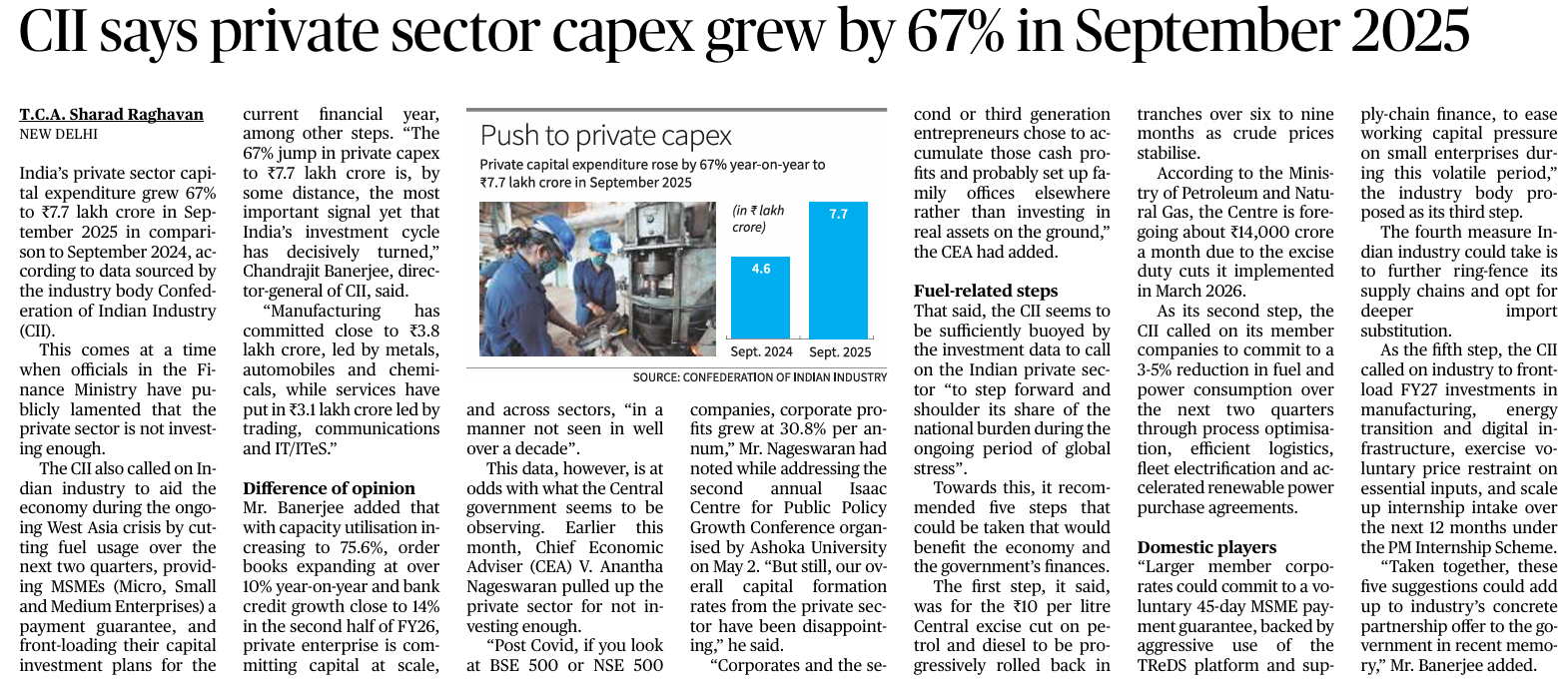
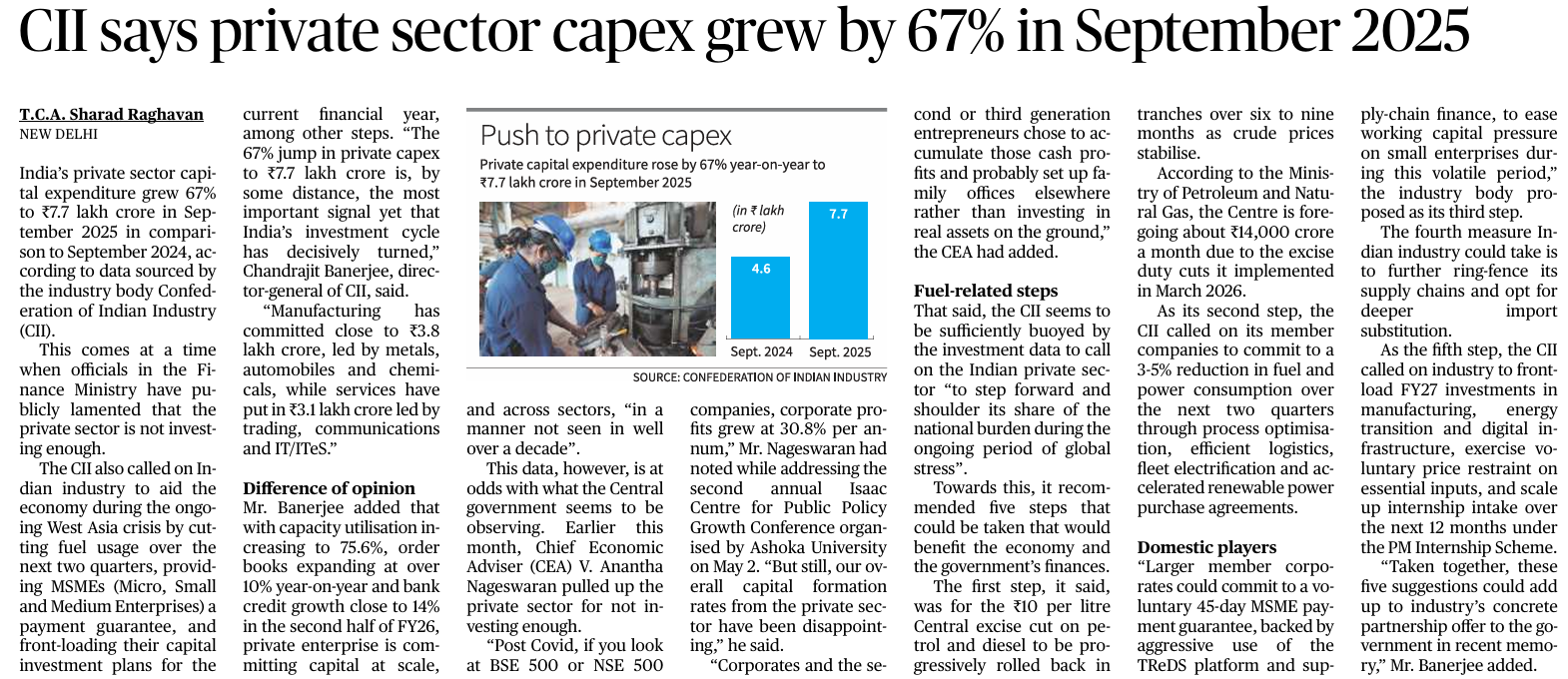
According to the Confederation of Indian Industry (CII), India’s private sector capital expenditure (capex) increased by 67% year-on-year to ₹7.7 lakh crore in September 2025.
The report suggests that India’s investment cycle may be reviving, especially in manufacturing and services sectors. At the same time, the CII proposed measures to support economic growth amid global uncertainties and fuel-price volatility.
Prelims concepts
1. Capital Expenditure (Capex)
Definition: Funds used by a company or government to acquire, upgrade, and maintain physical assets such as property, plants, buildings, technology, or equipment.
Significance: It is a "productive" expenditure because it creates assets and has a multiplier effect on the economy, leading to long-term growth and employment.
Article Context: Private sector capex in India reached ₹7.7 lakh crore in September 2025, marking a 67% increase year-on-year.
2. Capacity Utilisation
Definition: The extent to which an enterprise or a nation uses its installed productive capacity. It is the relationship between the actual output produced and the potential output that could be produced.
Relevance: Generally, when capacity utilisation crosses the 75-80% mark, it triggers fresh private investment (capex) because existing machines can no longer meet rising demand.
Article Context: The article notes utilisation has increased to 75.6%, signaling a "decisive turn" in the investment cycle.
3. TReDS (Trade Receivables Discounting System):
Concept: An institutional mechanism (an online platform) set up by the RBI to facilitate the discounting of trade receivables of MSMEs from corporate and other buyers.
Purpose: It helps MSMEs manage their working capital by ensuring they get paid early for their invoices, rather than waiting for 45–90 days.
Confederation of Indian Industry (CII)
The CII is a non-government, not-for-profit, industry-led and industry-managed organization. It acts as the "Voice of Indian Industry."
Key Facts
Established: 1895 (Started as the Engineering and Iron Trades Association).
Status: A non-governmental organization (NGO/Business Association). It is not a statutory or constitutional body.
Headquarters: New Delhi (The Mantosh Sondhi Centre).
Primary Functions & Roles
Policy Advocacy: Acts as a bridge between the Industry and the Government. It works closely with the government on policy issues, representing the viewpoint of the industry during the formation of the Union Budget and other economic reforms.
Nurturing Competitiveness: Enhances efficiency and business opportunities through specialized services and global linkages.
Societal Outreach: Engaging in CSR, skill development, and sustainable development initiatives.
UPSC MCQ
Q. With reference to private sector capital expenditure (capex) in India, consider the following statements:
Private sector capex mainly refers to long-term investment by firms in productive assets such as machinery, infrastructure and technology.
Higher private capex can generate a “crowding-in effect” by encouraging additional economic activity and investment.
Capacity utilisation below 50% generally indicates strong incentive for firms to undertake large-scale expansion investments.
How many of the above statements are correct?
A. Only one
B. Only two
C. All three
D. None
Answer: B. Only two
Explanation
Statement 1 — Correct: Capex refers to investment in long-term productive assets.
Statement 2 — Correct: Higher private investment can stimulate further investment and economic growth through the crowding-in effect.
Statement 3 — Incorrect: Low capacity utilisation usually discourages fresh investment; higher utilisation levels encourage expansion.
Blend organic manure with fertilizers to cut costs
GS Paper III
Agriculture
Cropping patterns and farm inputs
Issues related to subsidies
Sustainable agriculture
Conservation and environmental pollution
Context
The Indian Biogas Association (IBA) has recommended mandatory 10% blending of fermented organic manure (FOM) with chemical fertilizers by 2030.
According to the IBA, such blending could save nearly $2 billion annually in fertilizer imports while promoting soil sustainability and reducing dependence on chemical fertilizers.
Prelims concepts
1. Fermented Organic Manure (FOM)
Definition: A byproduct of the anaerobic digestion process (biogas production). When organic waste (like cattle dung or crop residue) is processed in a biogas plant, the solid/liquid residue left behind is nutrient-rich FOM.
Key Benefits: High organic carbon content, improves soil texture, and increases water-holding capacity.
Economic Impact: The article notes that 10% mandatory blending could save $2 billion in annual fertilizer imports.
2. Integrated Nutrient Management (INM)
Concept: The scientific approach of combining chemical fertilizers with organic manures (like FOM) and bio-fertilizers to maintain soil fertility and supply plant nutrients at an optimum level.
Objective: To reduce dependency on chemical fertilizers (like Urea, DAP), lower input costs for farmers, and prevent soil degradation.
3. Related Government Schemes
A. Nutrient Based Subsidy (NBS) Scheme
Ministry: Ministry of Chemicals and Fertilizers.
Mechanism: Fixed amount of subsidy is decided on an annual basis for each nutrient (Nitrogen, Phosphorus, Potash, and Sulphur) contained in the fertilizer.
Note: Urea is currently excluded from NBS; its price is statutorily controlled by the government.
B. Soil Health Card (SHC) Scheme
Launched: 2015.
Function: Provides farmers with information on the nutrient status of their soil (12 parameters) along with recommendations on the appropriate dosage of nutrients and soil amendments.
Goal: Promote "balanced use" of fertilizers.
C. Paramparagat Krishi Vikas Yojana (PKVY)
Nature: A sub-component of the National Mission of Sustainable Agriculture (NMSA).
Focus: Promotion of organic farming through a cluster-based approach and PGS (Participatory Guarantee System) certification.
Funding: Centrally Sponsored Scheme (60:40 ratio for states).
4. Institutional Body: Indian Biogas Association (IBA)
Type: An industrial association (not a statutory government body).
Role: Acts as a nationwide platform for operators, manufacturers, and planners of biogas plants to promote the bio-energy sector in India.
Comparison: Organic Manure vs. Chemical Fertilizer
Feature
Fermented Organic Manure (FOM)
Chemical Fertilizer (NPK)
Origin
Biological/Organic waste
Synthetic/Industrial
Soil Health
Improves structure & microbial activity
May lead to acidification/crusting over time
Nutrient Release
Slow and steady
Immediate and fast
Cost
Low (often byproduct)
High (heavily subsidized by govt)
UPSC MCQ
Q. With reference to integrated nutrient management in agriculture, consider the following statements:
Integrated nutrient management involves the combined use of organic and inorganic sources of plant nutrients.
Excessive dependence on chemical fertilizers can reduce soil microbial activity over time.
Organic manures generally improve the water-holding capacity of soil.
Which of the statements given above are correct?
A. 1 and 2 only
B. 2 and 3 only
C. 1 and 3 only
D. 1, 2 and 3
Answer: D. 1, 2 and 3
Explanation
Statement 1 — Correct: Integrated nutrient management promotes balanced use of organic and chemical nutrient sources.
Statement 2 — Correct: Excessive chemical fertilizer usage may negatively affect soil biodiversity and microbial health.
Statement 3 — Correct: Organic manures enhance soil structure and improve moisture retention.
India-Trinidad pact to help diaspora trace ancestral roots: Jaishankar
GS Paper II
India and its neighbourhood and bilateral relations
Indian diaspora
Cultural diplomacy and soft power
Context
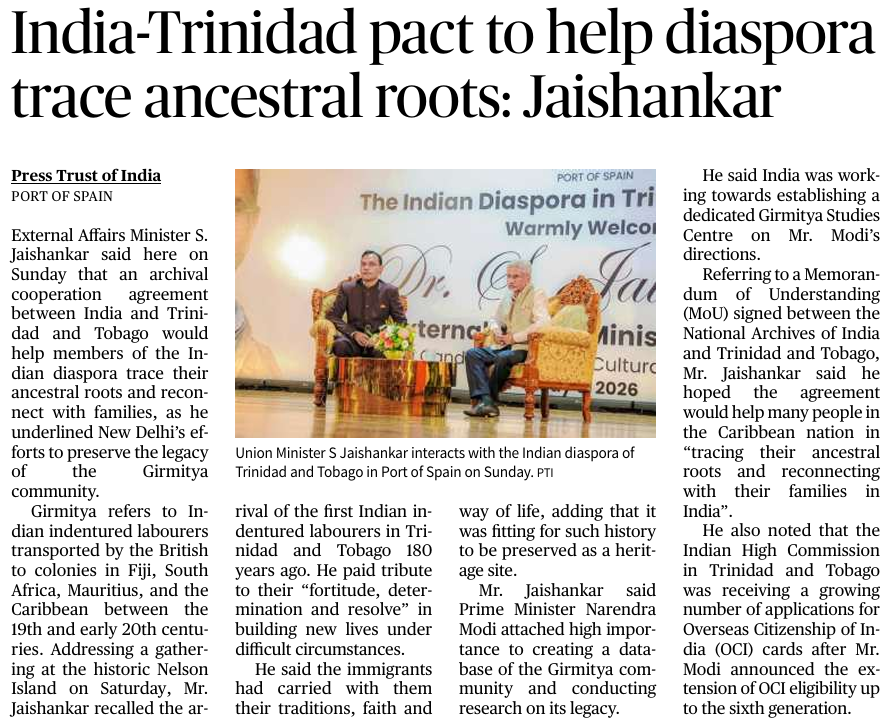
India and Trinidad & Tobago signed an archival cooperation agreement aimed at helping members of the Indian diaspora trace their ancestral roots and reconnect with families in India.
The initiative was highlighted by External Affairs Minister S. Jaishankar during his visit to Trinidad & Tobago and is linked to preserving the legacy of the Girmitiya community.
Prelims concepts
India-Trinidad and Tobago Relations
Archival Cooperation Agreement: A Memorandum of Understanding (MoU) signed between the National Archives of India and its counterpart in Trinidad and Tobago. Its primary goal is to digitize and share records to help the diaspora trace their lineage.
Cultural Diplomacy: The use of shared history and heritage (like the Girmitiya legacy) to strengthen bilateral ties and "soft power."
Overseas Citizenship of India (OCI)
Eligibility Extension: The article mentions that OCI eligibility has been extended up to the sixth generation.
Context: OCI is a form of permanent residency available to people of Indian origin and their spouses, allowing them to live and work in India indefinitely (with some restrictions like voting rights or holding constitutional posts).
The Girmitiya Community
Definition: Derived from the word "Agreement" (mispronounced as Girmit). It refers to the Indian indentured labourers transported by the British Empire to various colonies.
Major Destinations: Caribbean: Trinidad and Tobago, Guyana, Suriname.
Indian Ocean: Mauritius, Seychelles, Reunion.
Pacific: Fiji.
Africa: South Africa.
Nelson Island
Significance: Located in Trinidad and Tobago, it served as a disembarkation point and quarantine station for Indian indentured labourers arriving on the island. It is now treated as a heritage site.
National Archives of India (NAI)
Role: An attached office under the Ministry of Culture. It is the custodian of the non-current records of the Government of India and holds them for the use of administrators and scholars.
Legal Framework: It functions under the Public Records Act, 1993.
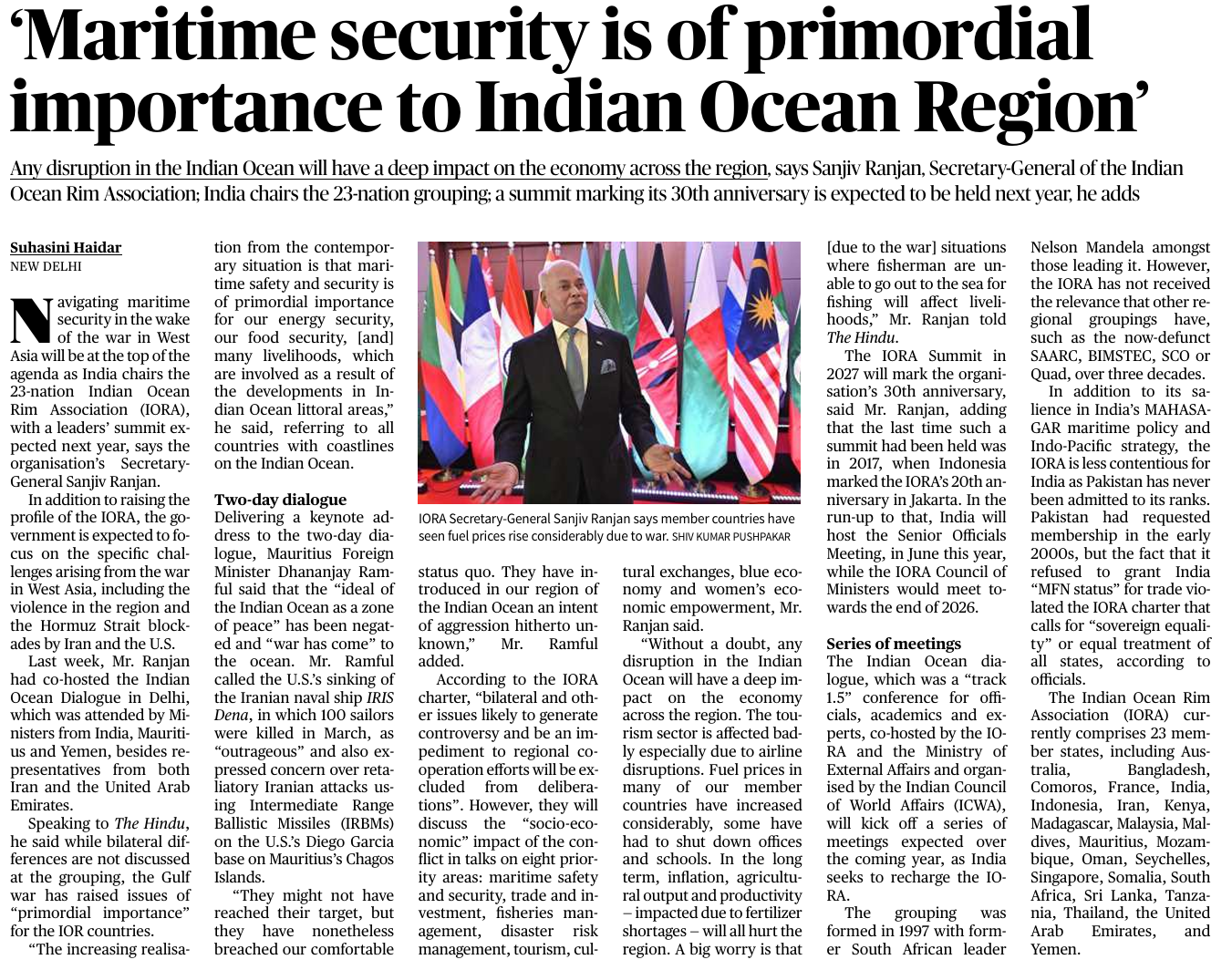
‘Maritime security is of primordial importance to Indian Ocean Region’
GS Paper II
India and its neighbourhood
Bilateral, regional and global groupings involving India
Effect of policies and politics of developed and developing countries on India’s interests
GS Paper III
Security challenges and their management
Maritime security
Context
The Secretary-General of the Indian Ocean Rim Association (IORA), Sanjiv Ranjan, highlighted the growing importance of maritime safety and security in the Indian Ocean Region (IOR).
The statement comes amid rising geopolitical tensions in West Asia, disruptions in maritime trade routes, and increasing concerns regarding regional security and economic stability.
Prelims concepts
1. Indian Ocean Rim Association (IORA)
Establishment: Formed in 1997 (formerly known as the Indian Ocean Rim Initiative).
Genesis: The idea was championed by Nelson Mandela; it is based on the principles of "Open Regionalism."
Membership: Currently comprises 23 Member States and 11 Dialogue Partners.
Note: Pakistan is not a member (the article notes their refusal to grant India MFN status as a hurdle).
Priority Areas: The article highlights 8 key areas:
Maritime Safety and Security
Trade and Investment Facilitation
Fisheries Management
Disaster Risk Management
Tourism and Cultural Exchanges
Academic, Science and Technology
Blue Economy
Women’s Economic Empowerment
2. Maritime Security & Strategic Geography
Hormuz Strait: Mentioned in the context of "blockades." It is a vital chokepoint between the Persian Gulf and the Gulf of Oman, essential for global oil supplies.
Chagos Islands: Located in the central Indian Ocean. The article mentions the Diego Garcia base (a major UK-US military facility) and recent tensions involving retaliatory strikes.
Zone of Peace: Refers to the historical concept (UN Resolution 2832) to keep the Indian Ocean free from great power rivalry and nuclear weapons.
3. Indian Foreign Policy Frameworks
MAHASAGAR: India’s high-level virtual interaction with maritime heads of Indian Ocean Region (IOR) nations. It stands for "Maritime Heads for Active Security And Growth for All in the Region."
SAGAR Vision: Security and Growth for All in the Region (India’s over-arching policy for the IOR).
4. Economic Impacts of Maritime Instability
Energy Security: Any disruption in IOR chokepoints directly leads to fuel price hikes and inflation.
Blue Economy: Sustainable use of ocean resources for economic growth. Disruption affects tourism and fisheries, which are lifelines for littoral states.
Global Supply Chains: Shortages in fertilizers and food security are linked to the safety of sea lanes of communication (SLOCs).





 Launch your Graphy