Daily Hindu Analysis 6th Feb 2026


| S.No | Topic |
|
| Daily Hindu Analysis (YouTube) |
| 1. | The fading of India’s environmental jurisprudence |
|
| 2. | More money for defence, now fix the process |
|
| 3. | India, GCC nations sign terms of reference for FTA |
|
| 4. | SC flags States’ preference for ‘ad-hoc’ DGP appointments |
|
| 5. | Procurement of minor forest produce dips 92% in 2024-25 |
|
| 6. | Anurag Thakur is free to participate in BCCI affairs: SC |
|
The fading of India’s environmental jurisprudenceGS 2: Polity and Governance – Judiciary, Constitutional values, Environmental governance
Context:
The article critically examines recent judicial and policy developments that, according to the authors, indicate a gradual dilution of India’s environmental jurisprudence. It argues that courts and regulatory institutions are increasingly prioritising development and infrastructure over ecological protection, weakening constitutional environmental safeguards.
Detailed Analysis:
Environmental Justice under Strain
The authors argue that environmental justice in India is being diluted in the name of development.
Constitutional promises related to environmental protection risk becoming symbolic rather than enforceable.
Ecological losses, once ignored, return with severe consequences such as floods, landslides, and biodiversity loss.
Dilution through Policy and Judicial Recall
In December 2025, policy changes diluted Environmental Impact Assessment requirements for non-coal mining.
The Supreme Court recalled its own progressive judgment in Vanashakti v Union of India (2025), which had banned retrospective environmental clearances.
This recall is cited as a key moment in weakening environmental safeguards.
From Mountains to Mangroves: A Pattern
The controversy over redefining the Aravalli ranges based on height reflects a shift in legal reasoning.
Judicial approval for destruction of mangroves, such as the clearing of about 34,000 trees for infrastructure, shows erosion of ecological science in decision-making.
Projects like the Char Dham highway in Uttarakhand highlight risks of landslides and river disturbances in fragile ecosystems.
Aravallis Case and Height-Based Definition
The Aravallis are ecologically crucial for groundwater recharge, soil stability, and climate regulation.
Earlier judgments, including M.C. Mehta v Union of India (2004), recognised this ecological role and imposed mining bans.
The 2025 judgment accepting a 100-metre height-based definition departed from the precautionary principle upheld in earlier cases like Vellore Citizens’ Welfare Forum v Union of India (1996).
This approach excludes large ecologically sensitive areas from legal protection.
Constitutional Implications
Article 21, which includes the right to a clean and healthy environment, is directly impacted.
Article 48A obligates the State to protect and improve the environment, while Article 51A(g) places duties on citizens.
Judicial interpretations that allow ecological exclusion weaken these constitutional mandates.
Discriminatory protection of landforms based on height is argued to violate the principle of non-arbitrariness under Article 14.
Judicial Leniency and Procedural Dilution
Courts have increasingly relied on post-facto clearances and mitigation assurances.
In Common Cause v Union of India (2017), the Supreme Court had earlier rejected post-facto legalisation of illegal mining.
Subsequent leniency marks a retreat from deterrence-based environmental enforcement.
Environmental compliance risks becoming a checklist rather than substantive protection.
Mangroves and Urban Ecology
Mangroves are critical for flood control, carbon sequestration, and coastal protection.
Judicial approvals for large-scale mangrove destruction undermine long-term ecological security.
Compensatory afforestation is criticised as inadequate because mature ecosystems take decades to develop.
Corporate Influence and Fairness
Environmental clearances for large corporations are often fast-tracked.
Objections are labelled obstructionist, and hearings are curtailed.
This undermines procedural fairness, transparency, and equality before law under Article 14.
Preferential treatment to economically powerful actors erodes public trust in environmental governance.
Erosion of Public Trust Doctrine
Earlier judgments like M.C. Mehta v Kamal Nath (1996) firmly established the public trust doctrine.
Recent judicial trends allowing ecological degradation dilute this doctrine.
Courts risk moving away from their role as custodians of environmental rights.
Suggestions of the Author:
Courts must reaffirm the precautionary principle and ecological science in decision-making.
Environmental Impact Assessment processes should be strengthened, not diluted.
Judicial scrutiny of large infrastructure projects must be substantive and not procedural.
Green Benches in all High Courts should be revitalised and empowered.
Development should not override constitutional environmental obligations.
UPSC Mains Question:
Critically examine how recent judicial trends reflect a shift in India’s environmental jurisprudence. Discuss the constitutional implications of prioritising development over ecological protection.
Source: The Hindu
More money for defence, now fix the processGS 3: Defence and Security – Defence budgeting, defence procurement, indigenisation
Context:
The article analyses the recent sharp increase in India’s defence budget and argues that while higher allocations are necessary, structural and procedural inefficiencies in defence planning, procurement, and research must be urgently reformed to translate spending into real military capability.
Detailed Analysis:
A Significant Budgetary Push
The defence budget has recorded its first double-digit growth in a decade.
Defence spending has reached about 2% of GDP, signalling strategic intent amid a volatile global order.
Capital expenditure has increased sharply, reversing years of neglect and indicating a clear focus on modernisation.
The Positives in the Allocation
Capital expenditure has grown by over 22%, outpacing revenue expenditure.
Indian Air Force received a substantial hike for aircraft and capability upgrades.
Indian Army allocations increased for heavy vehicles and weapon systems.
Indian Navy, despite a modest increase, benefits from earlier success in indigenisation and fund absorption.
Defence exports have risen significantly, reflecting growing domestic production capacity.
Hidden Constraints Despite Higher Spending
Depreciation of the rupee has increased the cost of imported capital equipment.
Pension expenditure continues to consume a sizeable share of the defence budget.
A portion of the “double-digit” increase is offset by inflation and currency effects.
Bureaucracy and Procurement Delays
Nearly 75% of capital acquisition is earmarked for domestic industry, including private players.
The L1 (lowest cost) procurement rule disadvantages innovation and technology-intensive firms.
Long delays plague major projects:
Project 75 submarines approved in 1997 with deliveries expected only in the mid-2030s.
Rafale aircraft, conceptualised in the 1990s, delivered only by 2019–20.
In FY2024–25, the Ministry of Defence returned ₹12,500 crore due to delayed procurement.
Need for Structural Financial Reform
Repeated calls for a Non-Lapsable Defence Modernisation Fund remain unimplemented.
Annual budgeting encourages under-spending rather than long-term capability planning.
Financial convenience is prioritised over operational readiness.
R&D: The Weakest Link
Defence R&D remains fragmented and scattered across institutions.
India’s overall R&D spending is about 0.66% of GDP, far below advanced economies.
Private sector participation in defence R&D is minimal.
Despite increased funding to DRDO, research outcomes rarely translate into deployable capabilities.
Countries like Japan and Australia allocate significantly higher shares to defence and innovation.
Defence as an Engine of Growth
Defence spending should not be seen through a “guns versus butter” lens.
Indigenisation has a strong employment multiplier effect, especially in shipbuilding and ancillary industries.
Defence manufacturing supports broader initiatives like border infrastructure and vibrant villages.
The budget should align with the vision of a $30 trillion economy under Viksit Bharat.
Suggestions of the Author:
Reform defence procurement rules to prioritise innovation over lowest cost.
Implement a Non-Lapsable Defence Modernisation Fund for long-term planning.
Integrate and unify defence R&D with stronger private sector participation.
Reduce bureaucratic delays through clearer timelines and accountability.
Treat defence expenditure as a growth-enabling investment, not merely a cost.
UPSC Mains Question:
Increased defence expenditure alone cannot ensure military preparedness. Examine the structural and procedural challenges in India’s defence procurement and R&D ecosystem and suggest reforms to address them.
Source: The Hindu
India, GCC nations sign terms of reference for FTA
GS 3: Indian Economy – External trade, Free Trade Agreements, International economic relations
Context :
India and the six-nation Gulf Cooperation Council have signed the Terms of Reference (ToR) to begin negotiations on a Free Trade Agreement, marking a formal step towards deeper economic integration.
Key Points:
Signing of Terms of Reference
ToR signed by India and the Gulf Cooperation Council (GCC).
It is the mandatory precursor to the start of formal FTA negotiations.
Signed by India’s chief negotiator and the GCC Secretariat representative.
GCC Countries Involved
Bahrain, Kuwait, Oman, Qatar, Saudi Arabia, and the UAE.
GCC collectively forms India’s largest merchandise trade partner group.
India’s trade with GCC exceeds that with the EU and the U.S.
Rationale for the FTA
Aim to create a robust trading arrangement.
Enable free flow of goods and services.
Provide policy predictability and stability to businesses.
Encourage greater investment flows between India and GCC nations.
Expected Economic Benefits
Expansion of India’s export markets, especially for labour-intensive sectors.
Opportunities for Indian workforce in GCC countries.
Access to investments already committed by GCC nations at different stages.
Support for diversification and growth of India’s energy sources.
Strategic and Long-term Significance
Strengthens India’s economic engagement with West Asia.
Enhances India’s role in global and regional supply chains.
Aligns with India’s broader FTA strategy to boost trade competitiveness.
Additional Points:
Negotiations are being led under the Ministry’s trade policy framework.
The FTA is expected to complement India’s existing agreements with the UAE.
Focus areas likely include goods, services, investments, and trade facilitation.
UPSC Prelims Practice Question:
Question:
With reference to the India–GCC Free Trade Agreement negotiations, consider the following statements:
1.Signing of the Terms of Reference is required before formal FTA negotiations begin.
2.The Gulf Cooperation Council consists of six member countries.
3.The GCC as a group is India’s largest merchandise trade partner.
Which of the statements given above are correct?
Options:
(a) 1 and 2 only
(b) 2 and 3 only
(c) 1 and 3 only
(d) 1, 2 and 3
Correct Answer: (d) 1, 2 and 3
Explanation:
The Terms of Reference initiate formal FTA talks, the GCC has six member countries, and collectively the GCC is India’s largest merchandise trade partner.
Source: The Hindu
SC flags States’ preference for ‘ad-hoc’ DGP appointments
GS 2: Polity and Governance – Police reforms, Judiciary, Federalism
Context :
The Supreme Court expressed concern that several States are bypassing the appointment of regular Directors General of Police by continuing with “Acting” DGPs, in violation of its 2006 judgment on police reforms.
Key Points:
Supreme Court’s Observation
States are deliberately delaying the process for appointing regular DGPs.
Preference is being given to “Acting” DGPs of choice, undermining judicial directions.
This practice violates the 2006 Prakash Singh judgment.
Prakash Singh Case (2006) Directions
DGPs must be appointed from a panel of three senior-most and meritorious officers prepared by UPSC.
DGPs should have a minimum fixed tenure of two years.
The objective was to insulate police leadership from political interference.
Procedural Lapses by States
States are not sending proposals to UPSC three months before retirement of the incumbent DGP.
Some States continue with Acting DGPs for years.
Example highlighted: Telangana, where no regular DGP has been appointed since 2017.
Role of UPSC
UPSC informed the Court that ground realities do not reflect compliance with the 2006 judgment.
The Court directed UPSC to write to States seeking timely proposals.
UPSC was granted liberty to approach the Supreme Court if States ignore communication.
Impact on Police Leadership
Meritorious and senior officers lose opportunities due to prolonged delays.
Acting appointments weaken institutional autonomy and continuity.
Accountability and professionalism in policing are adversely affected.
Court’s Warning
The Supreme Court warned that necessary consequences, including fixing accountability, may follow.
Emphasised that UPSC should not fall into the ploys of State governments.
Supreme Court of India’s role:
Reiterated its role as guardian of police reforms.
Emphasised strict compliance with earlier judgments.
Reinforced the need for rule-based governance in senior police appointments.
UPSC Prelims Practice Question:
Question:
With reference to the appointment of Directors General of Police (DGPs), consider the following statements:
1.The Prakash Singh judgment mandated a fixed minimum tenure for DGPs.
2.DGPs must be selected from a panel prepared by the Union Public Service Commission.
3.States are free to appoint Acting DGPs indefinitely if administrative necessity demands.
Which of the statements given above are correct?
Options:
(a) 1 and 2 only
(b) 2 and 3 only
(c) 1 and 3 only
(d) 1, 2 and 3
Correct Answer: (a) 1 and 2 only
Explanation:
The Prakash Singh judgment mandates a fixed tenure and UPSC-prepared panel for DGP appointments. Indefinite continuation of Acting DGPs violates Supreme Court directions.
Source: The Hindu
Procurement of minor forest produce dips 92% in 2024-25
GS 2: Social Justice – Tribal welfare, Forest rights, Government schemes
Context :
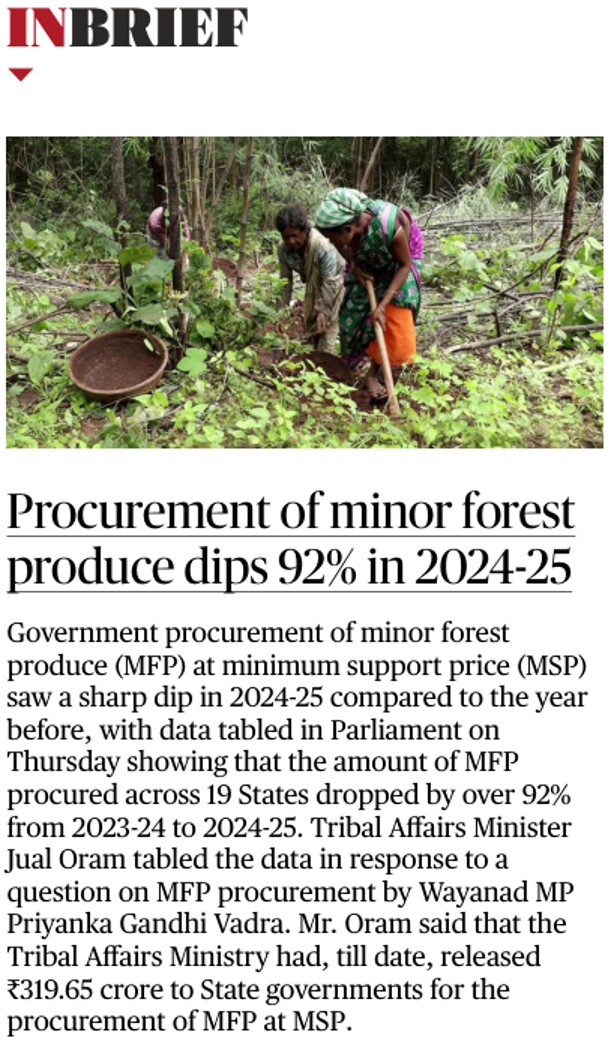
Government procurement of minor forest produce (MFP) at Minimum Support Price (MSP) witnessed a sharp decline in 2024-25, with Parliament informed that procurement across 19 States fell by over 92% compared to the previous year.
Key Points:
Extent of Decline in Procurement
MFP procurement dropped by over 92% from 2023-24 to 2024-25.
Data was tabled in Parliament by the Tribal Affairs Minister.
The figures reflect procurement carried out under the MSP for MFP mechanism.
Financial Support to States
The Union government released ₹319.65 crore to State governments.
Funds were meant to support procurement of MFP at MSP.
Despite financial releases, actual procurement remained very low.
Significance of MFP for Tribal Livelihoods
MFP forms a major source of income for Scheduled Tribes and forest-dependent communities.
Provides livelihood security during lean agricultural seasons.
Ensures food security and cash income in remote forest areas.
Policy Concern Highlighted
Sharp fall indicates implementation and operational gaps at State level.
Raises concerns about market access, price realisation, and institutional support.
Weak procurement undermines the objective of MSP-based income assurance for tribals.
Forest Rights Act, 2006
Defines minor forest produce as all non-timber forest products of plant origin.
Includes bamboo, brush wood, cane, tussar cocoons, honey, wax, lac, kendu leaves, medicinal plants, herbs, roots, and tubers.
Empowers forest-dwelling Scheduled Tribes and Other Traditional Forest Dwellers with ownership and disposal rights over MFP.
UPSC Prelims Practice Question:
Question:
With reference to Minor Forest Produce (MFP) in India, consider the following statements:
1.Minor forest produce includes all non-timber forest products of plant origin.
2.Ownership rights over minor forest produce are recognised under the Forest Rights Act, 2006.
3.Timber extracted from forests is classified as minor forest produce.
Which of the statements given above are correct?
Options:
(a) 1 and 2 only
(b) 2 and 3 only
(c) 1 and 3 only
(d) 1, 2 and 3
Correct Answer: (a) 1 and 2 only
Explanation:
Minor forest produce includes non-timber forest products of plant origin and ownership rights are recognised under the Forest Rights Act, 2006. Timber is explicitly excluded.
Source: The Hindu
Anurag Thakur is free to participate in BCCI affairs: SC
GS 2: Polity and Governance – Judiciary, Accountability of institutions, Sports governance
Context :
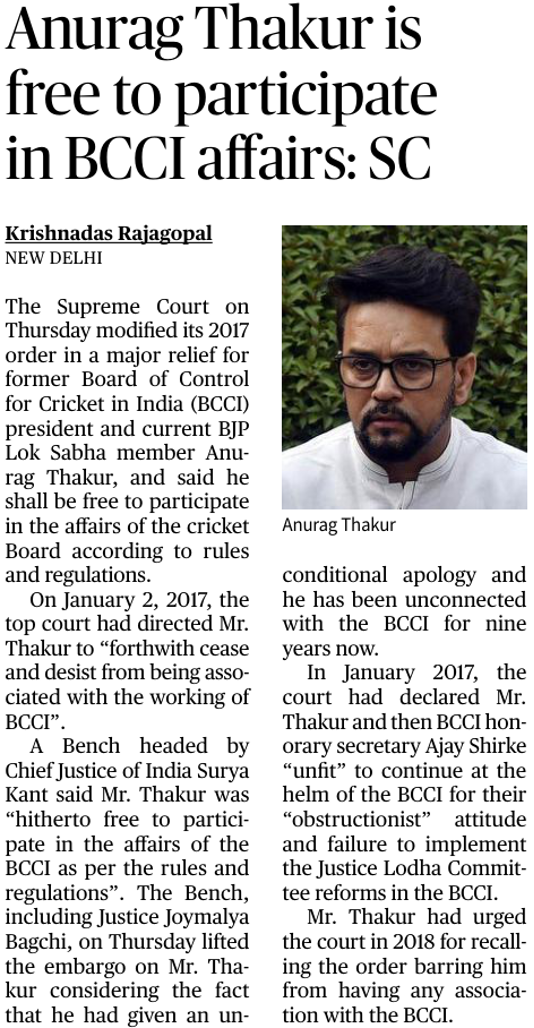
The Supreme Court modified its 2017 order and allowed former BCCI president and BJP MP Anurag Thakur to participate in the affairs of the BCCI as per its rules and regulations.
Key Points:
Supreme Court Decision
The Supreme Court modified its January 2, 2017 order.
It lifted the embargo that barred Anurag Thakur from associating with BCCI affairs.
The Court noted that he had remained unconnected with the BCCI for nine years.
Background of the 2017 Order
In 2017, the Supreme Court directed Anurag Thakur to cease and desist from BCCI activities.
The action followed allegations of obstruction and non-implementation of Justice Lodha Committee reforms.
Then BCCI honorary secretary Ajay Shirke was also removed.
Present Bench Observations
The Bench headed by the Chief Justice of India held that Thakur is now free to participate subject to BCCI rules and regulations.
The Court considered his conditional apology and the long passage of time.
The Bench lifted the restriction without disturbing the broader reform framework.
Legal and Institutional Significance
Reinforces the principle of proportionality in judicial restrictions.
Indicates that punitive restrictions are not meant to be permanent unless justified.
Reflects judicial willingness to revisit earlier orders based on changed circumstances.
Board of Control for Cricket in India (BCCI)
The national governing body for cricket in India.
Formed in December 1928 as a society.
Registered under the Tamil Nadu Societies Registration Act.
It is a consortium of State cricket associations.
State associations elect representatives who in turn elect BCCI office-bearers.
BCCI manages an annual revenue of around ₹2,000 crore.
Conclusion:
The Supreme Court’s decision marks a recalibration of its earlier stance, balancing institutional accountability with individual rights. While cricket governance reforms remain intact, the ruling underscores that judicial sanctions must not outlive their purpose.
UPSC Prelims Practice Question:
Question:
With reference to the Board of Control for Cricket in India (BCCI), consider the following statements:
1.BCCI is a statutory body established by an Act of Parliament.
2.It is registered as a society under the Tamil Nadu Societies Registration Act.
3.Its office-bearers are elected by representatives of State cricket associations.
Which of the statements given above are correct?
Options:
(a) 2 and 3 only
(b) 1 and 2 only
(c) 1 and 3 only
(d) 1, 2 and 3
Correct Answer: (a) 2 and 3 only
Explanation:
BCCI is not a statutory body; it is registered as a society under the Tamil Nadu Societies Registration Act, and its governance structure is based on elections by State cricket associations.
Source: The Hindu

 Launch your Graphy