Daily Hindu Analysis 3rd Feb 2026
| Index |
| Topic |
| |
| Daily Hindu Analysis (YouTube) |
| Wetlands as a national public good |
| |
| Why are tribals protesting in Maharashtra? |
| |
| Funding framework essential to ensure UPI remains a free service |
| |
| External team involved in PSLV probe; next launch date in June, says Minister |
| |
| A Budget less driven by elections, more by global headwinds |
| |
| U.S. tariff on India reduced to 18%, say Modi and Trump |
| |
| |
Wetlands as a national public good
GS 3: Environment | Conservation | Disaster Management
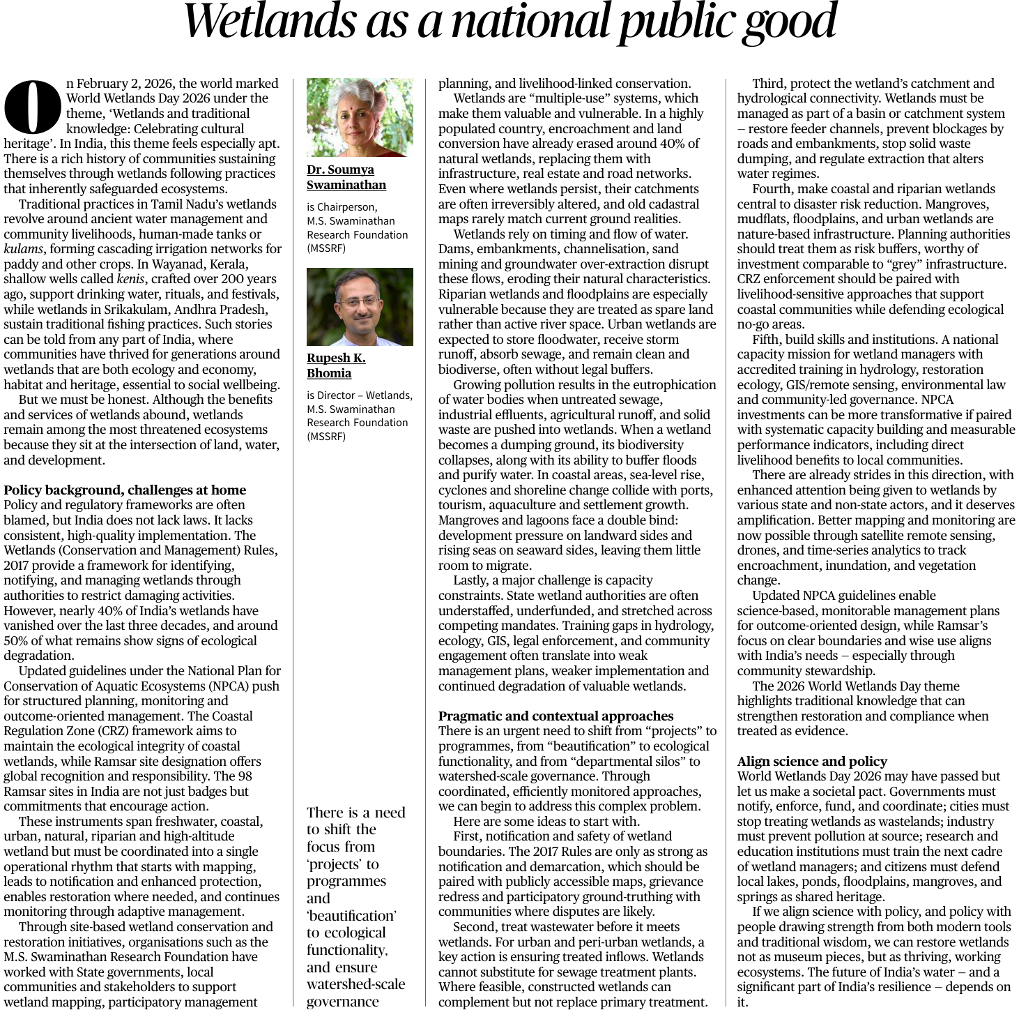
Context
The authors discuss wetlands as ecological, economic, and cultural systems that function as a national public good. Using examples from across India, the article highlights how traditional knowledge sustained wetlands, the current threats due to development and weak governance, and the urgent need for science-based, community-linked conservation.
Detailed Analysis
1. Wetlands and Traditional Knowledge
Wetlands in India have historically been conserved through community practices rooted in livelihood and culture.
These systems integrated ecology with economy, ensuring sustainability across generations.
2. Why Wetlands Are Under Severe Threat
Despite their benefits, wetlands are among the most threatened ecosystems due to their location at the intersection of land, water, and development.
Nearly 40% of India’s wetlands have vanished in the last three decades, and around 50% of the remaining are degraded.
Encroachment, land conversion, infrastructure projects, and altered hydrology have eroded both area and function.
3. Policy Framework: Strengths and Gaps
India has adequate laws such as the Wetlands (Conservation and Management) Rules, 2017, CRZ regulations, Ramsar framework, and NPCA guidelines.
The core challenge lies not in absence of law but in weak implementation, poor coordination, and lack of updated ground-level data.
Wetlands are often treated in silos—freshwater, coastal, urban—rather than as part of a connected hydrological system.
4. Ecological Degradation and Urban Pressure
Altered water flows due to dams, embankments, sand mining, and groundwater overuse disrupt wetland ecology.
Urban wetlands are treated as wastelands or dumping grounds, receiving untreated sewage and solid waste.
Pollution leads to eutrophication, biodiversity loss, and reduced flood-buffering capacity.
Coastal wetlands like mangroves and lagoons face dual pressure from inland development and sea-level rise.
5. Capacity and Governance Constraints
Wetland authorities at the State level are often understaffed, underfunded, and overstretched.
Gaps exist in hydrology, GIS, restoration ecology, legal enforcement, and community engagement.
This results in weak planning, delayed action, and continued degradation.
Suggestions by the Authors
1. Shift in Conservation Approach
Move from isolated “projects” to integrated programmes.
Replace cosmetic “beautification” with restoration of ecological functionality.
Adopt watershed- and basin-scale governance instead of fragmented management.
2. Strengthen Protection and Hydrological Integrity
Clearly notify and demarcate wetland boundaries with public access to maps.
Restore feeder channels, prevent blockages, regulate extraction, and stop waste dumping.
Treat wastewater before it enters wetlands; wetlands should not replace sewage treatment plants.
3. Disaster Risk Reduction through Wetlands
Recognise mangroves, floodplains, and urban wetlands as nature-based infrastructure.
Invest in them on par with grey infrastructure for flood and cyclone mitigation.
Combine CRZ enforcement with livelihood-sensitive conservation.
4. Build Skills and Institutions
Launch a national capacity mission for wetland managers.
Invest in training on hydrology, restoration, GIS, remote sensing, and environmental law.
Link NPCA funding to measurable outcomes and livelihood benefits.
5. Use Technology and Community Stewardship
Leverage satellite data, drones, and time-series analytics to monitor encroachment and change.
Align Ramsar principles with local stewardship and traditional knowledge, treating communities as partners.
UPSC Mains Question
“Wetlands are not wastelands but vital ecological infrastructure.” In the light of recent challenges and policy responses, examine the need for treating wetlands as a national public good in India.
Source: The Hindu
Why are tribals protesting in Maharashtra?
GS 2: Polity & Governance | Tribal Issues | Rights-based Legislation
Context
The article explains the recent large-scale protests by tribal communities in Maharashtra, particularly from Palghar and Nashik districts. It analyses the long-pending grievances related to land rights, weak implementation of the Forest Rights Act (FRA), 2006, and associated demands concerning livelihoods, irrigation, education, and self-governance.
Detailed Analysis
1. Background of the Protests
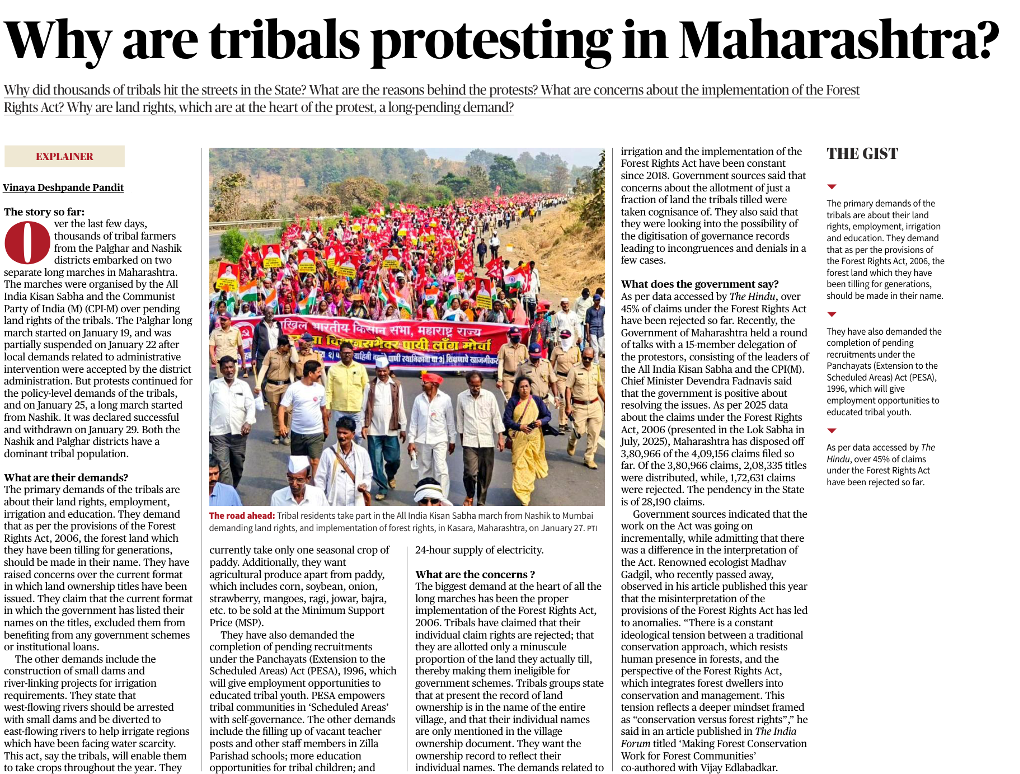
Thousands of tribal farmers undertook long marches from Palghar and Nashik towards Mumbai.
The marches were organised by the All India Kisan Sabha (AIKS) and supported by the CPI(M).
While some administrative demands were addressed temporarily, protests continued over policy-level failures, especially related to land rights.
2. Core Demands of the Tribal Communities
a) Land Rights under Forest Rights Act (FRA), 2006
Tribals demand ownership titles over forest land they have cultivated for generations.
They allege that titles granted are often for very small portions, far less than what they actually till.
In many cases, village-level or collective ownership is recorded instead of individual ownership, excluding individuals from welfare schemes and institutional credit.
b) High Rejection of FRA Claims
As per government data cited in the article, over 45% of FRA claims in Maharashtra have been rejected.
Though lakhs of claims were disposed of, a significant number were either denied or left pending, creating distrust among tribal communities.
3. Livelihood and Irrigation Concerns
Tribal farmers rely heavily on rain-fed agriculture, often managing only one crop annually.
They demand small dams, river-linking projects, and diversion of west-flowing rivers to address water scarcity.
They also seek inclusion of crops like ragi, jowar, soybean, onion, fruits, and vegetables under Minimum Support Price (MSP).
4. Governance and Administrative Gaps
a) Weak Implementation of FRA
Tribals allege arbitrary rejection of individual claims without proper verification.
Digitisation of land records, while intended to improve efficiency, has led to inconsistencies and exclusions.
b) Conservation vs Rights Debate
The article highlights an ideological tension between traditional conservation approaches that restrict human presence and the FRA framework, which integrates forest dwellers into conservation.
Misinterpretation of FRA provisions has resulted in administrative resistance and ecological anxieties.
5. Other Key Demands
Implementation of PESA Act, 1996, including pending recruitments under Panchayats (Extension to Scheduled Areas).
Filling vacancies in Zilla Parishad schools to improve access to education.
Improved electricity supply, healthcare, and employment opportunities for tribal youth.
Suggestions Highlighted in the Article
Correct interpretation and faithful implementation of FRA, especially individual and community forest rights.
Re-examination of rejected claims with transparency and community participation.
Better coordination between conservation goals and tribal rights, rather than treating them as conflicting objectives.
Strengthening local self-governance institutions under PESA to empower tribal communities.
UPSC Mains Question
“The implementation of the Forest Rights Act, 2006 has exposed the tension between conservation priorities and tribal rights.” Examine this statement in the context of recent tribal protests in Maharashtra.
Source: The Hindu
Funding framework essential to ensure UPI remains a free service
GS 3: Economy | Financial Inclusion | Digital Payments
Context
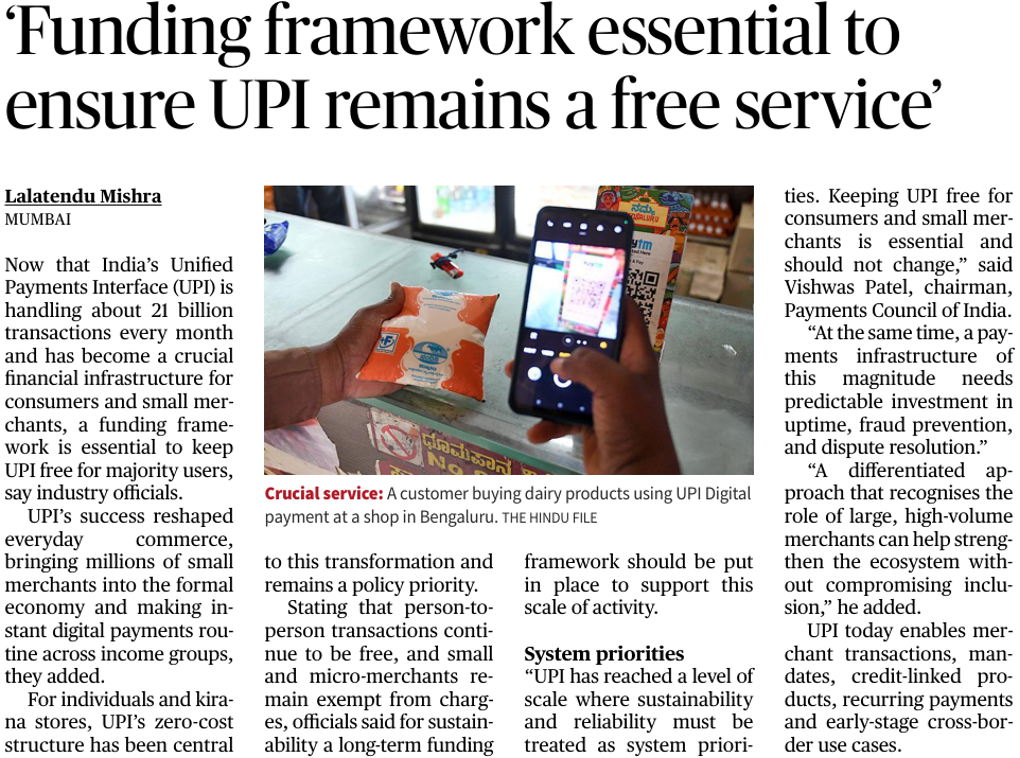
India’s Unified Payments Interface (UPI), now handling around 21 billion transactions per month, has become critical digital public infrastructure, prompting discussions on a sustainable funding framework to keep it free for users.
Key Points
UPI as Digital Public Infrastructure
UPI has transformed everyday commerce by integrating millions of small merchants into the formal economy.
Its zero-cost structure has driven mass adoption across income groups.
Need for a Funding Framework
Keeping UPI free for individuals and small merchants is considered essential for inclusion.
However, the scale of operations requires long-term predictable funding.
Cost Drivers in the UPI Ecosystem
High transaction volumes demand continuous investment in uptime, reliability, and scalability.
Significant resources are required for fraud prevention and dispute resolution.
Differentiated Charging Approach
Industry stakeholders suggest no charges for person-to-person transactions.
Small and micro-merchants should remain exempt from fees.
Large, high-volume merchants may be charged to help cross-subsidise the system.
System Priorities Going Forward
Sustainability and reliability must be treated as system-level priorities, not optional features.
A stable funding model will help UPI support credit-linked products, recurring payments, mandates, and cross-border use cases.
Payments Council of India’s stand:
Emphasised that keeping UPI free for consumers and small merchants should not be compromised.
Highlighted the need for predictable investment to maintain infrastructure of this magnitude.
Supported a differentiated framework that strengthens the ecosystem without hurting inclusion.
UPSC Prelims Practice Question
Consider the following statements regarding the Unified Payments Interface (UPI):
1.UPI is considered a form of digital public infrastructure supporting financial inclusion.
2.Current policy discussions favour charging all UPI users uniformly to ensure system sustainability.
Which of the statements given above is/are correct?
A. 1 only
B. 2 only
C. Both 1 and 2
D. Neither 1 nor 2
Answer: A
Explanation:
Statement 1 is correct as UPI functions as a key digital public infrastructure.
Statement 2 is incorrect because the discussion favours a differentiated charging approach, not uniform charges for all users.
Source: The Hindu
External team involved in PSLV probe; next launch date in June, says Minister
GS 3: Science & Technology | Space Technology
Context
ISRO is investigating consecutive mission failures of the Polar Satellite Launch Vehicle (PSLV) and has involved an external team to strengthen the probe, while targeting the next PSLV launch in June after corrective measures.
Key Points
Background of the Failures
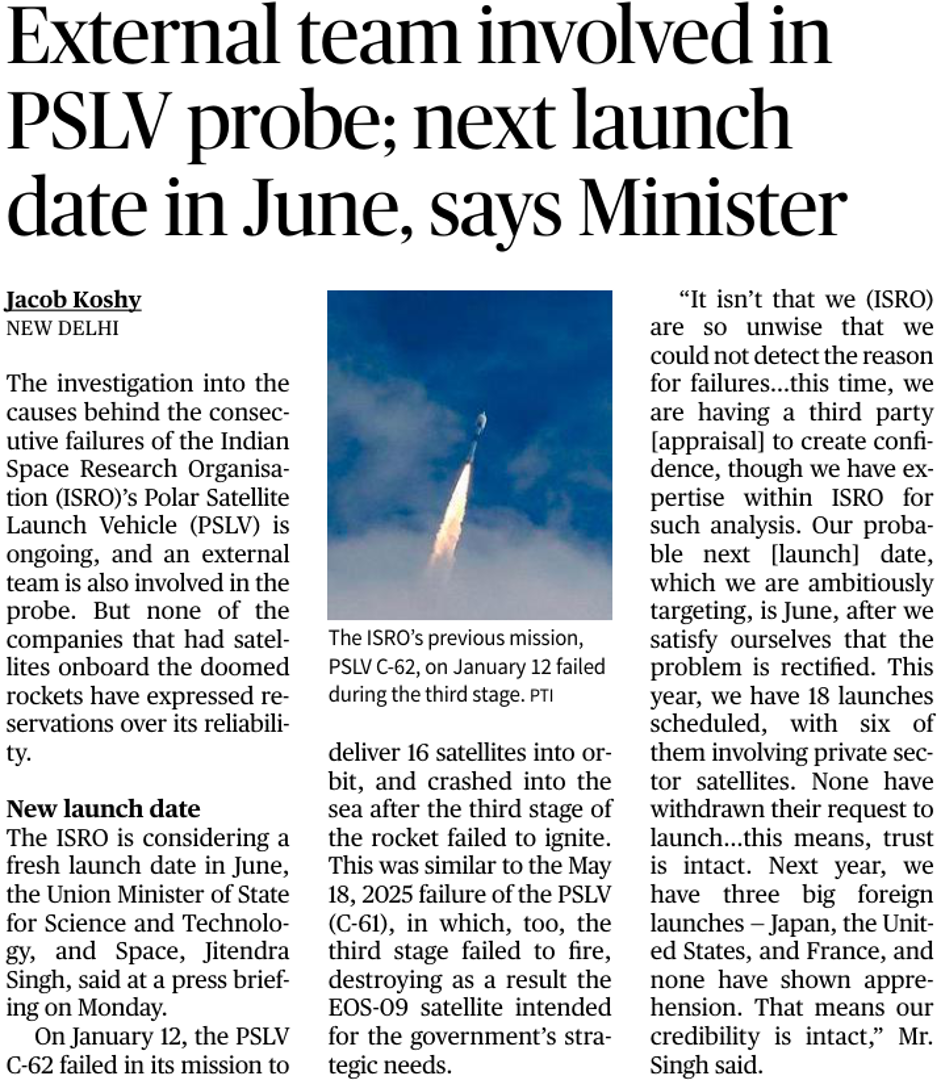
The PSLV-C62 mission (January 12) failed after the third stage did not ignite, causing the payload to fall into the sea.
This followed a similar failure in PSLV-C61 (May 18, 2025), where the third stage malfunction destroyed the EOS-09 satellite.
Investigation and External Appraisal
Indian Space Research Organisation (ISRO) has initiated a detailed internal probe.
An external third-party appraisal has been included to enhance credibility and confidence in identifying the root cause.
Rationale for External Involvement
The move is not due to lack of in-house expertise but to ensure independent validation of findings.
Aims to build confidence among domestic and international stakeholders.
Next Launch Timeline
The government is considering June as the next PSLV launch window.
Launch will proceed only after ISRO is fully satisfied that rectifications are complete.
Impact on Launch Schedule
ISRO has 18 launches planned this year, including six involving private satellites.
No private or foreign customer has withdrawn, indicating continued trust in ISRO’s launch services.
International Launch Confidence
Three major foreign launches next year involving Japan, the United States, and France remain on track.
The government stated that ISRO’s credibility remains intact
PSLV:
ISRO operates PSLV as a reliable workhorse for Earth observation and commercial launches.
Recent failures are being treated as systemic issues, with a focus on engineering corrections and quality assurance.
UPSC Prelims Practice Question
Consider the following statements regarding PSLV missions:
1.Recent PSLV mission failures were linked to malfunction in the third stage of the launch vehicle.
2.ISRO has postponed all future PSLV launches indefinitely due to loss of international confidence.
Which of the statements given above is/are correct?
A. 1 only
B. 2 only
C. Both 1 and 2
D. Neither 1 nor 2
Answer: A
Explanation:
Statement 1 is correct as both recent failures involved third-stage ignition issues.
Statement 2 is incorrect because launches are rescheduled, not indefinitely postponed, and international confidence remains intact.
Source: The Hindu
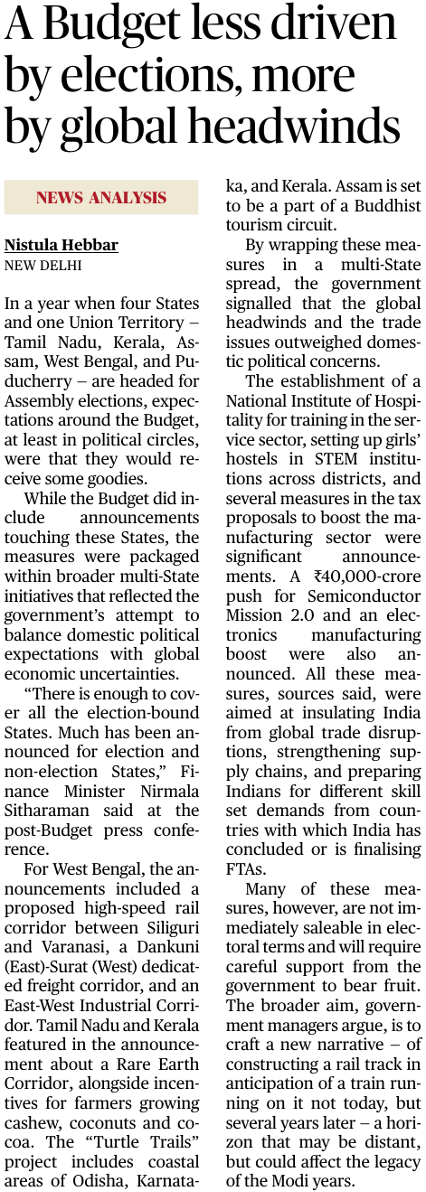
A Budget less driven by elections, more by global headwinds
GS 3: Economy | Government Budgeting | Globalisation
Context
The Union Budget drew attention for prioritising global economic uncertainties and trade disruptions over immediate electoral considerations, despite Assembly elections in several States.
Key Points
Elections vs Economic Strategy
Four States and one Union Territory are heading for elections, creating expectations of State-specific populist measures.
Instead, announcements were clubbed under multi-State initiatives, signalling restraint in election-driven spending.
Global Headwinds as the Dominant Driver
The Budget reflected concerns over global trade disruptions, supply chain risks, and geopolitical uncertainty.
Policy focus shifted towards long-term economic resilience rather than short-term political gains.
Infrastructure and Connectivity Push
Announcements included high-speed rail corridors, freight corridors, and industrial corridors spanning multiple States.
These projects aim to boost logistics efficiency and regional integration, not immediate electoral appeal.
Manufacturing and Strategic Sectors
A ₹40,000-crore push for Semiconductor Mission 2.0 and measures to boost electronics manufacturing were announced.
The objective is to reduce import dependence and strengthen India’s role in global value chains.
Human Capital and Services Sector
Establishment of a National Institute of Hospitality to support the services sector.
Expansion of girls’ hostels in STEM institutions to improve access and workforce participation.
Trade and Supply Chain Preparedness
Measures aimed at preparing India for diverse skill demands from countries with which India has concluded or is negotiating FTAs.
Emphasis on export competitiveness and supply chain insulation.
Political Messaging
Government indicated there was “enough for election and non-election States”, underscoring balanced allocation.
The broader aim is to build a long-term development narrative, even if electoral benefits are delayed.
UPSC Prelims Practice Question
Consider the following statements regarding the recent Union Budget:
1.The Budget prioritised insulation of the Indian economy from global supply chain disruptions.
2.Most announcements were narrowly targeted at election-bound States to maximise immediate electoral gains.
Which of the statements given above is/are correct?
A. 1 only
B. 2 only
C. Both 1 and 2
D. Neither 1 nor 2
Answer: A
Explanation:
Statement 1 is correct as the Budget focused on manufacturing, supply chains, and trade resilience.
Statement 2 is incorrect because measures were framed as multi-State and long-term initiatives, not election-specific giveaways.
Source: The Hindu
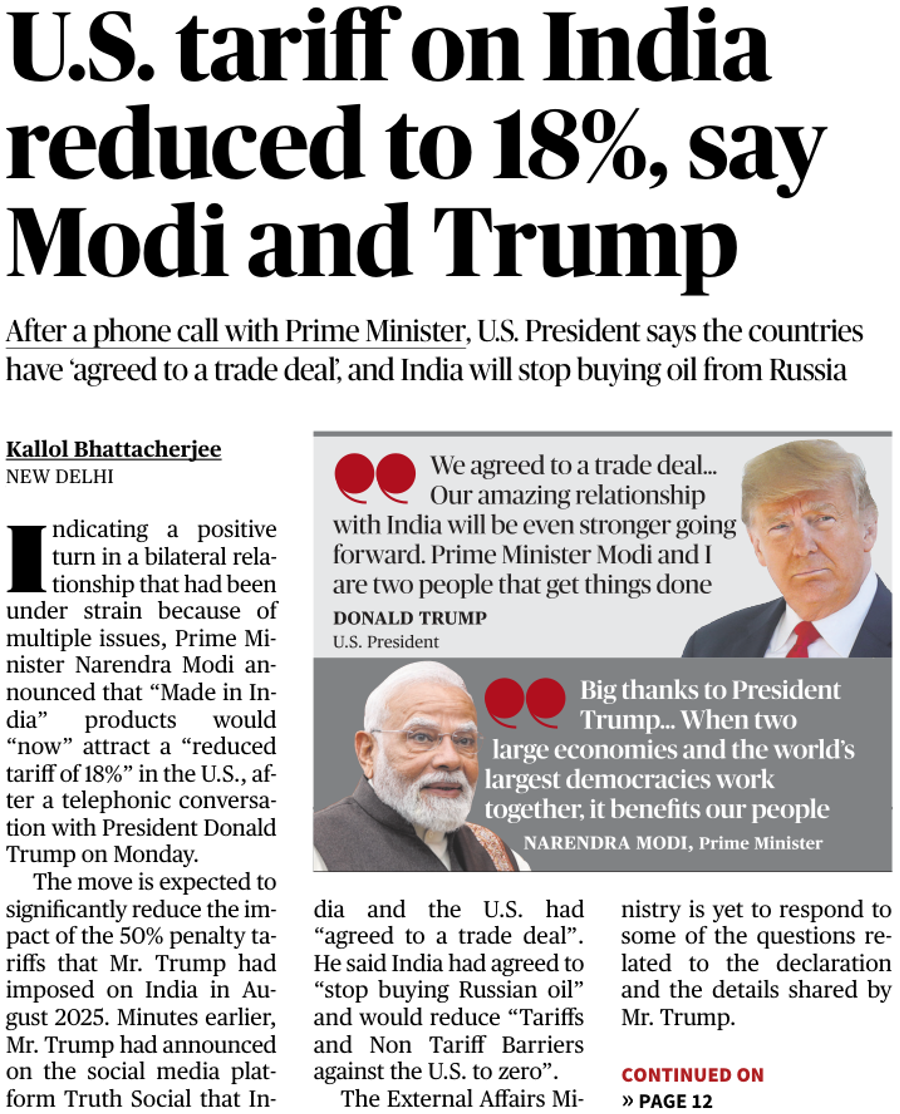
U.S. tariff on India reduced to 18%, say Modi and Trump
GS 2: International Relations | India–U.S. Relations | Trade Diplomacy
Context
India and the United States announced a reduction of U.S. tariffs on Indian goods to 18% following a phone call between Narendra Modi and Donald Trump, signalling a positive turn in bilateral trade ties.
Key Points
Tariff Reduction Decision
“Made in India” products will now face a reduced tariff of 18% in the U.S. market.
This marks a significant rollback from the 50% penalty tariffs imposed earlier.
Trade Deal Announcement
Both leaders stated that India and the U.S. have agreed to a trade deal.
The agreement aims to reduce tariffs and non-tariff barriers between the two countries.
Impact on Bilateral Relations
The move indicates easing of trade-related tensions that had strained ties.
Expected to boost Indian exports and improve market access in the U.S.
Economic and Strategic Significance
Strengthens cooperation between the world’s two largest democracies.
Supports India’s manufacturing and export-led growth strategy.
Unresolved Issues
Some operational details of the trade deal and official confirmation from ministries remain awaited.
Certain aspects of the declaration require policy and administrative follow-up.
UPSC Prelims Practice Question
Consider the following statements regarding recent India–U.S. trade developments:
1.The United States has agreed to reduce tariffs on Indian goods to 18%.
2.The announcement signals a complete removal of all non-tariff barriers between India and the U.S.
Which of the statements given above is/are correct?
A. 1 only
B. 2 only
C. Both 1 and 2
D. Neither 1 nor 2
Answer: A
Explanation:
Statement 1 is correct as both leaders announced a tariff reduction to 18%.
Statement 2 is incorrect because the agreement talks about reducing, not completely eliminating, non-tariff barriers.
Source: The Hindu



 Launch your Graphy