Daily Current Affairs7 May 2026 | The Hindu Analysis for UPSC & APPSC
The Hindu News Analysis – 7th May, 2026
1. When does a CM cease to hold office? (GS-2)
2. Vietnam major pillar of India’s Act East Policy, says Modi as defence, rare-earth ties renewed (GS-2, GS-3)
3. Overall crime rate drops 6%; cybercrime up by 17%: NCRB
(GS-2, GS-3)
4. India, Algeria hold first joint defence commission meet (GS-2, GS-3)
5. India to host first Big Cat Summit in June; 95 countries set to participate (GS-3)
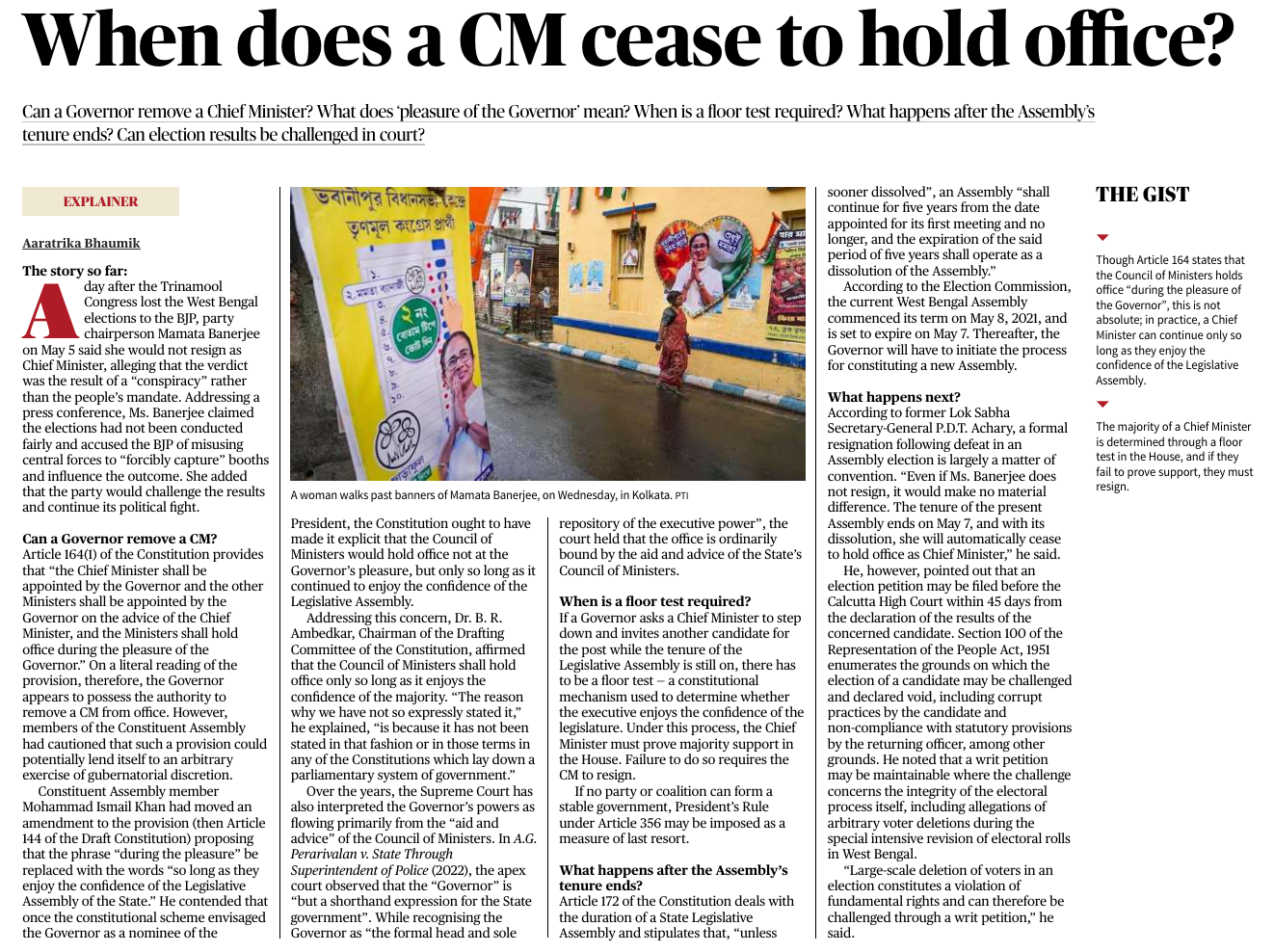
When does a CM cease to hold office?
GS Paper II
Functions and responsibilities of the Union and the States
Role of Governor in State polity
Separation of powers between various organs
Representation of People Act and electoral process
Context
The article discusses the constitutional position of a Chief Minister (CM) after the ruling party’s electoral defeat in West Bengal. It explains:
Whether a Governor can remove a CM,
Meaning of “pleasure of the Governor,”
Need for floor tests,
What happens after the Assembly’s tenure ends,
Legal remedies against disputed election results.
Detailed Analysis
Constitutional Provisions Related to CM’s Office
Provision
Details
Article 164
CM is appointed by the Governor; Ministers hold office during the pleasure of the Governor
Article 163
Governor acts on aid and advice of Council of Ministers
Article 172
State Assembly normally continues for 5 years
Article 356
President’s Rule in case of constitutional breakdown
Representation of the People Act, 1951
Provides grounds for challenging elections
Can a Governor Remove a Chief Minister?
Though Article 164 mentions that Ministers hold office “during the pleasure of the Governor,” this power is not absolute.
Constitutional Interpretation
The Constituent Assembly clarified that:
The CM remains in office only as long as they enjoy majority support in the Legislative Assembly.
The Governor cannot arbitrarily dismiss a CM.
Dr. B.R. Ambedkar’s View
Ambedkar stated that the phrase must be understood within the framework of parliamentary democracy, where the real test is legislative confidence.
Meaning of “Pleasure of the Governor”
In practice, the Governor:
Acts largely on the aid and advice of the Council of Ministers.
Functions as a constitutional head, not an independent political authority.
Supreme Court Position
Shamsher Singh v. State of Punjab (1974)
The Court held that:
Governors are constitutional heads.
Real executive power lies with the elected government.
Nabam Rebia Case (2016)
The Court restricted arbitrary gubernatorial interference in legislative matters.
In re: I.A.G. Perarivalan Case (2022)
The Court reiterated that Governors are generally bound by ministerial advice.
When is a Floor Test Required?
A floor test becomes necessary when:
The Governor doubts whether the CM still enjoys majority support.
There is political instability, defections, or coalition collapse.
Purpose
It determines majority support inside the Assembly, not outside.
Outcome
If the CM proves majority → Government continues.
If the CM fails → Must resign.
The Supreme Court has repeatedly emphasized that the Assembly floor is the only valid place to test majority.
What Happens After the Assembly’s Tenure Ends?
Under Article 172:
A State Assembly normally lasts five years.
After expiry/dissolution, the existing Council of Ministers effectively ceases.
Caretaker Government
Until a new government is formed:
The outgoing CM may function in a caretaker capacity.
Major policy decisions are generally avoided.
Can Election Results be Challenged?
Yes.
Under the Representation of the People Act, 1951, election results can be challenged through:
Election petitions in the High Court.
Grounds for Challenge
Corrupt practices,
Electoral malpractice,
Improper acceptance/rejection of nominations,
Non-compliance with election laws,
Serious irregularities affecting electoral integrity.
Significance
1. Protects Parliamentary Democracy
Ensures that the executive remains accountable to the legislature.
2. Limits Arbitrary Governor Powers
Prevents misuse of constitutional offices for political purposes.
3. Reinforces Federalism
Maintains balance between elected State governments and constitutional authorities.
4. Upholds Electoral Legitimacy
Provides legal mechanisms to challenge flawed elections.
Challenges
Political Misuse of Governor’s Office
Governors are often accused of partisan conduct during government formation crises.
Delays in Floor Tests
Unnecessary delays may encourage horse-trading and instability.
Ambiguity in Caretaker Conventions
The Constitution does not clearly define caretaker government powers.
Electoral Litigation Delays
Election petitions often take years, reducing practical effectiveness.
Way Forward
Codify Governor’s Discretion
Clear constitutional conventions should define gubernatorial powers.
Time-bound Floor Tests
The Supreme Court’s guidance on immediate floor tests should be institutionalized.
Strengthen Electoral Transparency
Improve electoral roll management and grievance redressal.
Fast-track Election Petitions
Special courts or timelines can ensure quicker resolution.
Conclusion
A Chief Minister’s continuation in office ultimately depends not on the Governor’s personal discretion but on the confidence of the Legislative Assembly. India’s constitutional framework seeks to preserve parliamentary democracy by ensuring that majority support, tested on the Assembly floor, remains the decisive factor in determining the legitimacy of a State government.
UPSC Mains Question
Q. Discuss the constitutional provisions governing the appointment, continuance, and removal of a Chief Minister in India.
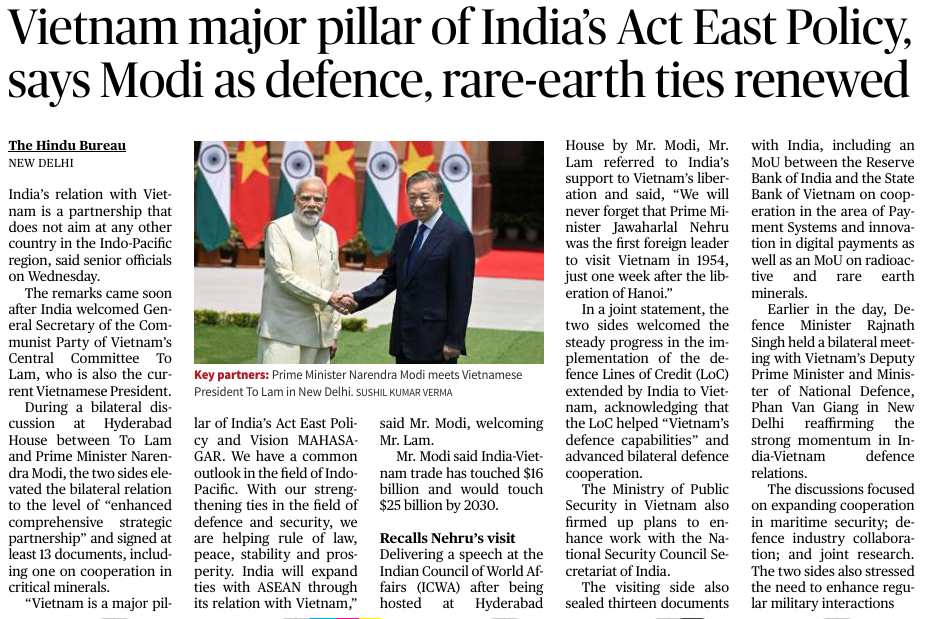 Vietnam major pillar of India’s Act East Policy, says Modi as defence, rare-earth ties renewed
GS Paper II
India and its neighbourhood relations
Bilateral, regional and global groupings involving India
India’s interests in the Indo-Pacific region
GS Paper III
Critical minerals and resource security
Defence cooperation and strategic security
Context
India and Vietnam elevated their ties through renewed cooperation in:
Defence and maritime security,
Rare-earth minerals,
Digital payments and innovation,
Indo-Pacific strategic coordination.
During the visit of Vietnamese leader To Lam, both countries reaffirmed their commitment to strengthening the Comprehensive Strategic Partnership under India’s Act East Policy and Vision MAHASAGAR.
Prelims concepts
1. India-Vietnam Bilateral Relations
Enhanced Comprehensive Strategic Partnership: The bilateral relationship has been elevated to this level, indicating a deep level of trust and cooperation across security, economy, and diplomacy.
Historical Ties: Reference to Jawaharlal Nehru’s 1954 visit to Vietnam (the first foreign leader to visit after the liberation of Hanoi), highlighting the long-standing nature of the relationship.
2. Geopolitical Frameworks
Act East Policy: Vietnam is cited as a "major pillar" of this policy, which focuses on extended neighborhood relations in the Asia-Pacific region.
Vision SAGAR: Security and Growth for All in the Region. This is India’s strategic vision for the Indian Ocean and Indo-Pacific region.
Indo-Pacific Region: The discussions emphasized a common outlook on the Indo-Pacific, focusing on the "rule of law, peace, stability, and prosperity."
3. Defense and Security Cooperation
Lines of Credit (LoC): India has extended LoCs to Vietnam specifically for defense capabilities.
Maritime Security: A key focus area given the strategic location of Vietnam in the South China Sea.
Defense Industry Collaboration: Moving beyond buyer-seller relationships to joint research and regular military interactions.
4. Regional & International Organizations
ASEAN (Association of Southeast Asian Nations): The article highlights that India views its relation with Vietnam as a gateway to expanding ties with the broader ASEAN bloc.
ICWA (Indian Council of World Affairs): Mentioned as the venue for the Vietnamese President's speech; it is a premier Indian think tank for foreign policy.
UPSC MCQ
Consider the following statements regarding India–Vietnam relations:
Vietnam is an important partner in India’s Act East Policy and Indo-Pacific strategy.
India and Vietnam have expanded cooperation in areas such as defence and rare-earth minerals.
Which of the statements given above is/are correct?
(a) 1 only
(b) 2 only
(c) Both 1 and 2
(d) Neither 1 nor 2
Answer: (c) Both 1 and 2
Explanation:Vietnam is a key partner in India’s Act East Policy and Indo-Pacific vision. Both countries are strengthening cooperation in defence, maritime security, and rare-earth minerals.
 Overall crime rate drops 6%; cybercrime up by 17%: NCRB
GS Paper II
Government policies and interventions
Issues relating to vulnerable sections
Governance and internal security challenges
GS Paper III
Cyber security
Internal security
Social issues and crime trends
Context
The National Crime Records Bureau (NCRB) report for 2024 shows:
Overall cognisable crimes declined by 6%,
Cybercrime cases increased by 17%,
Drug overdose deaths rose sharply,
Suicides among vulnerable occupational groups remained high.
The report highlights changing patterns of crime and emerging digital security challenges.
Prelims concepts
1. National Crime Records Bureau (NCRB)
Establishment: Set up in 1986 based on the recommendations of the National Police Commission (1977-81) and the MHA Task Force (1985).
Mandate: Headquartered in New Delhi under the Ministry of Home Affairs (MHA), it acts as a repository for crime and criminal data to assist investigators.
Key Publications:
Crime in India (Annual report).
Accidental Deaths & Suicides in India (ADSI).
Prison Statistics India.
2. Cybercrime Trends (2024)
Growth: Cybercrime cases rose by 17% (from 86,420 in 2023 to 1,01,928 in 2024).
Primary Motives:
Fraud: 72.6% (majority of cases).
Sexual Exploitation: 3.1%.
Extortion: 2.5%.
Significance: While overall crime dropped, the sharp rise in cybercrime highlights a shift in the security landscape toward the digital domain.
3. General Crime Statistics & Legal Framework
Overall Decline: Cognizable crimes dropped by 6% (58.86 lakh cases registered).
Legislative Transition: The article mentions cases being registered under both the Indian Penal Code (IPC) and the Bharatiya Nyaya Sanhita (BNS).
Prelims Note: BNS replaced the IPC as India’s primary criminal code. It introduced new categories like "Organized Crime" and "Terrorism" while removing "Sedition."
Offenses Against the State: 5,194 cases were registered.
84.6% of these were under the Prevention of Damage to Public Property Act.
12.5% were under the Unlawful Activities (Prevention) Act (UAPA).
4. Social Issues: Suicide & Drug Abuse
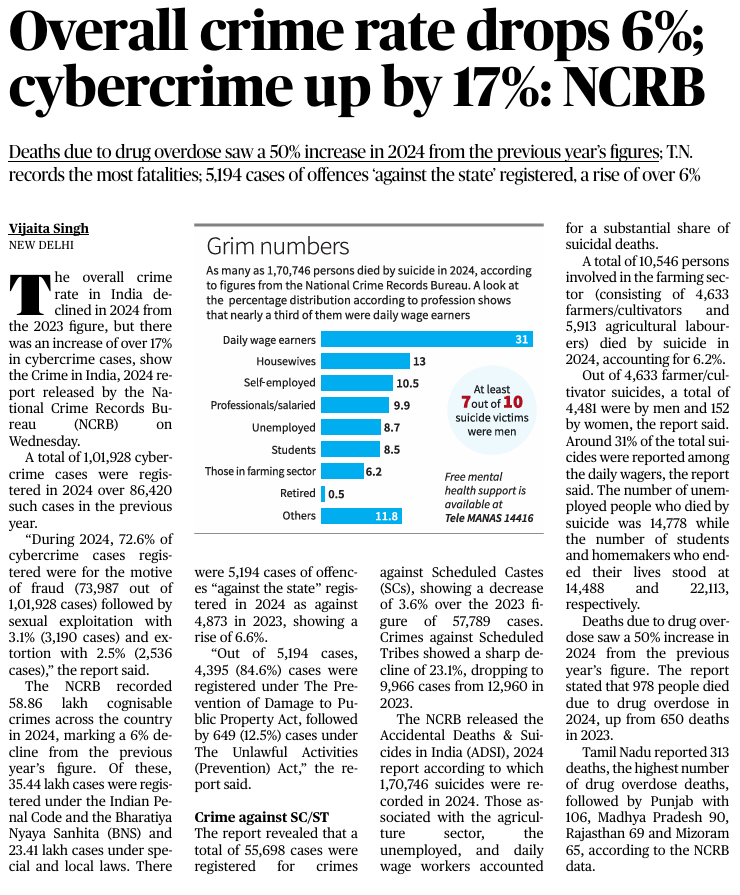
Suicide Distribution: Total suicides reached 1,70,746 in 2024.
Mental Health Support: The article notes Tele MANAS (14416) as a resource.
Drug Overdose: Saw a 50% increase nationwide compared to 2023. Tamil Nadu recorded the highest number of fatalities.
5. Vulnerable Sections
SC/ST Crimes: Crimes against Scheduled Castes (SCs) dropped by 3.6%.
Crimes against Scheduled Tribes (STs) showed a significant decline of 23.1%.
UPSC MCQ
Q. Consider the following statements regarding the National Crime Records Bureau (NCRB):
NCRB functions under the Ministry of Home Affairs.
NCRB publishes the annual report titled Crime in India.
Which of the statements given above is/are correct?
(a) 1 only
(b) 2 only
(c) Both 1 and 2
(d) Neither 1 nor 2
Answer: (c) Both 1 and 2
Explanation:
NCRB is an agency under the Ministry of Home Affairs and annually publishes the Crime in India report containing nationwide crime statistics.
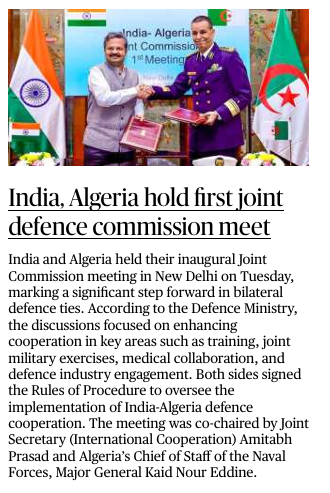
India, Algeria hold first joint defence commission meet
GS Paper II
Bilateral relations involving India
India and Africa relations
GS Paper III
Defence cooperation
Internal and external security challenges
Context
India and Algeria held their inaugural Joint Defence Commission meeting in New Delhi to strengthen bilateral defence ties.
Both countries also signed Rules of Procedure to institutionalize defence cooperation.
Prelims concepts
1. India-Algeria Bilateral Relations
Inaugural Joint Defence Commission (JDC): This was the first-ever meeting of the JDC, signaling a formalization of defense ties that were previously less structured.
Strategic Location: Algeria is the largest country in Africa by area and holds a strategic position on the Mediterranean coast, making it a key partner for India’s maritime and continental interests in Africa.
2. Key Areas of Cooperation
The JDC identified four primary pillars for future engagement:
Training: Capacity building for military personnel.
Joint Military Exercises: Establishing interoperability between the two armed forces.
Medical Collaboration: Sharing expertise in military medicine and healthcare infrastructure.
Defence Industry Engagement: Potential for exporting Indian defense hardware and joint production (aligning with Aatmanirbhar Bharat).
Geographic & Strategic Context for Prelims
Algeria's Neighbors: Tunisia, Libya, Niger, Mali, Mauritania, Western Sahara, and Morocco.
Strategic Waterway: The Mediterranean Sea.
Resource Connection: Algeria is a major exporter of oil and natural gas, which is vital for India’s energy security.
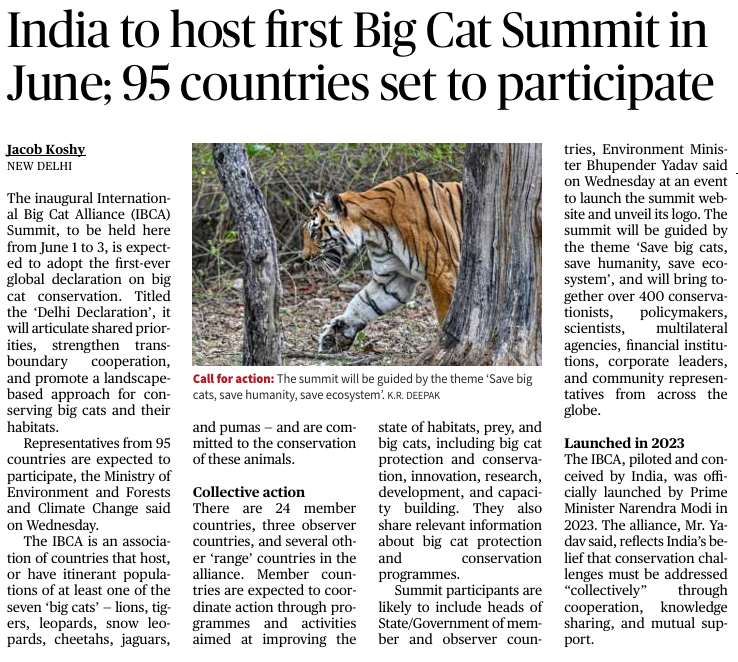
India to host first Big Cat Summit in June; 95 countries set to participate
GS Paper III
Conservation and environmental protection
Biodiversity and wildlife conservation
International environmental cooperation
Context
India will host the inaugural International Big Cat Alliance (IBCA) Summit with participation from 95 countries. The summit aims to strengthen global cooperation for the conservation of big cats and their habitats through the proposed “Delhi Declaration.”
Prelims concepts
1. International Big Cat Alliance (IBCA)
Origin: Conceived and piloted by India; officially launched by Prime Minister Narendra Modi on April 9, 2023, in Mysuru, Karnataka, to mark 50 years of Project Tiger.
Status: A treaty-based inter-governmental international organization.
Headquarters: New Delhi, India.
Focus: Conservation of seven big cats globally.
Funding: The Government of India has committed ₹150 crore as initial support for a five-year period (2023-24 to 2027-28).
2. The "Seven Big Cats"
The alliance focuses on seven specific species. It is important to note that while the genus Panthera includes the first five, the Cheetah and Puma are biologically distinct.
Tiger (Panthera tigris)
Lion (Panthera leo)
Leopard (Panthera pardus)
Snow Leopard (Panthera uncia)
Jaguar (Panthera onca)
Cheetah (Acinonyx jubatus) — Not a Panthera; fastest land animal.
Puma/Cougar (Puma concolor) — Not a Panthera; found in the Americas.
Prelims Fact: India is currently home to five of these seven big cats (Tiger, Lion, Leopard, Snow Leopard, and the recently reintroduced Cheetah). It lacks the Jaguar and Puma.
3. The inaugural IBCA Summit (June 2026)
Host: New Delhi, India.
Participants: Representatives from 95 "Range" countries (countries where these cats naturally reside) and other "non-range" partner countries.
Theme: "Save big cats, save humanity, save ecosystem."
The Delhi Declaration: The summit's primary outcome is the expected adoption of this declaration, which will create a unified global framework for:
Transboundary cooperation.
Landscape-based conservation approaches.
Sharing technical expertise and scientific research.
4. Governance Structure
Modelled similarly to the International Solar Alliance (ISA), the IBCA consists of:
The Assembly: The supreme decision-making body comprising all member countries.
The Standing Committee: To oversee the implementation of policies.
The Secretariat: Based in India to handle daily operations.
Comparative Analysis: Big Cats in India
Species
Conservation Status (IUCN)
Key Habitats in India
Tiger
Endangered
Corbett (UK), Kanha (MP), Bandipur (KA)
Asiatic Lion
Endangered
Gir National Park (Gujarat)
Snow Leopard
Vulnerable
Hemis (Ladakh), Spiti (HP)
Cheetah
Vulnerable
Kuno National Park (MP) - Reintroduced
Leopard
Vulnerable
Found pan-India across various landscapes
UPSC MCQ
Q. Consider the following statements regarding the International Big Cat Alliance (IBCA):
It aims to promote transboundary cooperation for big cat conservation.
It was launched under the aegis of the United Nations Environment Programme (UNEP).
Which of the statements given above is/are correct?
(a) 1 only
(b) 2 only
(c) Both 1 and 2
(d) Neither 1 nor 2
Answer: (a) 1 only
Explanation:IBCA promotes international cooperation and transboundary conservation of big cats. It was launched by India, not by UNEP.



 Launch your Graphy