Daily Current Affairs for UPSC Ist Dec 2025


| Index |
| S.No | Topic | Page No |
| Daily Hindu Analysis (YouTube) |
| 1. | AIDS and TB fight — Tamil Nadu shows the way again |
|
| 2. | India needs research pipelines |
|
| 3. | Centre appoints Vivek Chaturvedi as CBIC chief |
|
| 4. | Constitution evolving to ‘swadeshi’, says Presidential Reference Bench |
|
| 5. | CSIR-NAL unveils production version of Hansa-3 plane |
|
| 6. | Why has Goa been asked to set up a tiger reserve? |
|
| 7. | Crisil raises GDP growth forecast to 7% in FY26 |
|
| 8. | Rajasthan revokes controversial order after drawing flak |
|
| 9. | Centre’s citizenship scrutiny power is ‘limited’, EC says |
|
| |
| Daily Current Affairs (App) |
| 10. | National Mission for Mentoring |
|
| 11. | Indian Pharmacopoeia Commission |
|
| 12. | National Coral Reef Research Institute (NCRRI) |
|
| 13. | World Telecommunication Development Conference 2025 – Baku |
|
| 14. | Prerona Scheme – Assam |
|
| 15. | Asia Power Index 2025 |
|
AIDS and TB fight — Tamil Nadu shows the way again
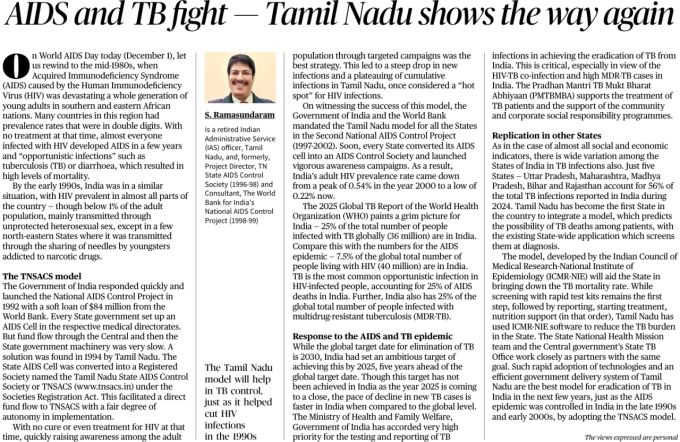
Context
The article, written by S. Ramasundaram, reflects on the success of Tamil Nadu's model in addressing the dual epidemics of HIV/AIDS and Tuberculosis (TB). The author underscores how the state’s innovative strategies in AIDS control have been replicated in the fight against TB, leading to significant improvements in public health outcomes. The article discusses the need for targeted health interventions, early diagnosis, and the importance of integrating community support to achieve effective TB elimination. Detailed Analysis 1. The Early Challenge: AIDS in India
- HIV/AIDS in the 1980s:
In the mid-1980s, HIV/AIDS spread rapidly in India, with high rates of infection among vulnerable groups. By the early 1990s, the country saw a rapid increase in HIV prevalence, primarily due to unprotected heterosexual contact and the sharing of needles by drug users.
- Impact on TB:
HIV infection often leads to opportunistic infections, with tuberculosis (TB) being the most common co-infection. The lack of effective treatment in the early years contributed to high mortality rates in affected populations.
2. Tamil Nadu’s Response to AIDS - The TNSACS Model:
Tamil Nadu implemented the Tamil Nadu State AIDS Control Society (TNSACS) model, which became a cornerstone for India’s HIV control efforts. The state’s model focused on targeted awareness campaigns, prevention programs, and community-based strategies.
- The approach targeted high-risk populations, such as intravenous drug users, and created a community-driven model for HIV prevention.
- India’s AIDS prevalence dropped significantly in Tamil Nadu due to these efforts, reducing the state’s HIV rate from 0.54% in 2000 to 0.22% today.
- National Adoption:
The success of Tamil Nadu’s model led to its adoption nationwide. The World Bank and Government of India recognized the model, scaling it to the Second National AIDS Control Project (1997-2002), which contributed to a national reduction in HIV prevalence.
3. Addressing the TB Epidemic in India - TB in India:
According to the World Health Organization (WHO), India accounts for 25% of global TB cases, and the nation’s TB burden remains the highest in the world. TB is the most common opportunistic infection in HIV-infected individuals and continues to be a major cause of morbidity and mortality.
- Tamil Nadu’s TB Control Strategy:
Tamil Nadu adapted its HIV-control strategies to combat TB. The state-wide screening for TB integrates TB diagnosis with existing healthcare systems, ensuring early detection and treatment.
- The Pradhan Mantri TB Mukt Bharat Abhiyaan (PMTBMBA) launched in 2022, focuses on providing nutritional, diagnostic, and vocational support for TB patients, and crowdsourcing nutrition through the Ni-Kshay Mitra initiative.
- Tamil Nadu became the first state to implement a comprehensive TB management program, including rapid TB detection, effective treatment regimens, and community involvement.
4. National Response to TB and HIV - Global and National TB Elimination Goals:
- The WHO's global target for TB elimination is 2030, but India aims to eliminate TB by 2025, five years ahead of the global deadline.
- India’s National Tuberculosis Elimination Program (NTEP) and National AIDS Control Program (NACP) are working in tandem to reduce new HIV infections and TB cases.
- India has also introduced improved drug-resistant TB treatments under NTEP, such as Bedaquiline, to increase the success rates of MDR-TB treatment.
5. Key Suggestions by the Author - Integrated Health Strategies:
Tamil Nadu's integrated health model that addresses both HIV and TB is essential for achieving nationwide health improvements. The author stresses the importance of early diagnosis, targeted interventions, and community support to eliminate TB deaths.
- National Rollout:
The author suggests that other states should adopt Tamil Nadu’s approach to combat TB and HIV, focusing on coordinated efforts between state health departments, NGOs, and community leaders.
- A key component should be the Ni-Kshay Mitra initiative, which engages citizens and corporates to provide nutrition and economic aid to TB patients.
About Tuberculosis (TB) : - Cause: TB is caused by Mycobacterium tuberculosis.
- Primary Affected Area: Primarily affects the lungs, but can also affect abdomen, glands, bones, and nervous system.
- Transmission: Spreads through airborne transmission when an infected person coughs or sneezes.
- Types of TB:
- Latent TB: The bacteria remain in the body in an inactive state, causing no symptoms. It is not contagious.
- Active TB: Contagious and causes symptoms such as coughing, weight loss, and night sweats.
- Global Impact: India has the largest TB burden in the world, accounting for a significant portion of global cases.
- National Goal: India aims to eliminate TB by 2025 as part of the National Tuberculosis Elimination Program (NTEP).
Government Initiatives in Tuberculosis (TB) 1. National Tuberculosis Elimination Programme (NTEP)
o Formerly RNTCP: The Revised National Tuberculosis Control Program (RNTCP) was renamed the National Tuberculosis Elimination Programme (NTEP) in 2020.
o Objective: Aims to eliminate TB by 2025, five years ahead of the global target of 2030.
o Strategic Pillars:
§ Detect – Early diagnosis using advanced tools like GeneXpert and Xpert MTB/RIF.
§ Treat – Ensure quality-assured treatment and monitor patient adherence.
§ Prevent – Implement measures for prevention, including vaccination, contact tracing, and treatment of latent TB. § Build – Strengthen the health system to improve detection, reporting, and treatment coverage.
2. Pradhan Mantri TB Mukt Bharat Abhiyaan (PMTBMBA)
o Launched in 2022: A key component of NTEP focused on providing nutritional, diagnostic, and vocational support to TB patients. o Crowd-sourcing Nutrition: The program has Ni-Kshay Mitra, a scheme that encourages individuals, NGOs, and corporates to support TB patients with nutritional aid and social support for six months.
3. Ni-Kshay Portal
o Tracking TB Cases: The Ni-Kshay Portal allows health workers to manage TB cases, track treatment progress, and report real-time data for India’s TB surveillance system.
o Real-Time Data: It helps to monitor treatment adherence and track patient outcomes across the country.
4. Drug-Resistant TB Treatment o Shorter, Safer Regimens: India has introduced the Bedaquiline regimen for drug-resistant TB (MDR-TB), which reduces the treatment duration and increases the success rate from 68% in 2020 to 75% in 2022.
o mBPaL Regimen: The mBPaL regimen (Bedaquiline, Pretomanid, Linezolid) offers an 80% success rate for MDR-TB, reducing the treatment duration to six months. About HIV :
- Cause: Human Immunodeficiency Virus (HIV) attacks the immune system, specifically the CD4 cells (a type of white blood cell).
- Disease Progression: If untreated, HIV leads to AIDS (Acquired Immunodeficiency Syndrome), severely weakening the immune system.
- Transmission: Primarily transmitted through:
- Unprotected sexual contact
- Sharing needles
- Mother to child during childbirth or breastfeeding.
- Prevalence in India: Over 2.4 million people living with HIV in India, the third-largest number in the world.
- National Goal: India is on track to meet the 95-95-95 target by 2025:
- 90% of people living with HIV are diagnosed.
- 90% of diagnosed people receive ART (Antiretroviral Therapy).
- 90% of those on ART achieve viral suppression.
- National AIDS Control Program (NACP): India’s ongoing initiative to reduce HIV transmission and provide free ART to infected individuals.
UPSC Mains Question: Discuss the role of Tamil Nadu’s integrated approach in combating both HIV/AIDS and Tuberculosis (TB). How can this model be adapted and implemented across other states in India to meet the national goal of TB elimination
India needs research pipelines
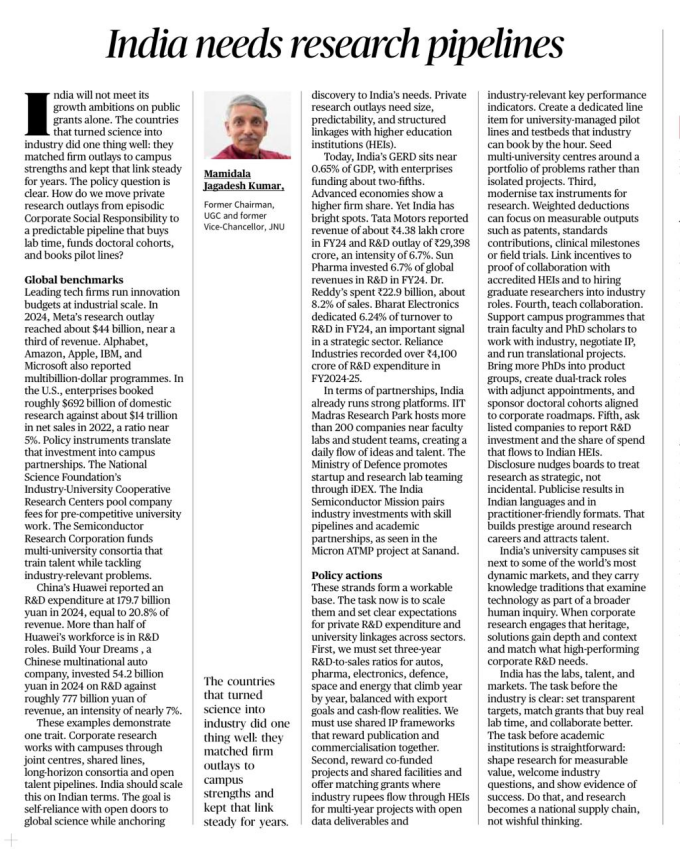
Context
The author discusses India's growing ambition in public grants for science and technology. He emphasizes the need for a structured research framework, moving beyond episodic corporate social responsibility (CSR) funding. The author argues that a consistent research pipeline, which includes doctoral programs, institutional collaborations, and long-term public sector funding, is essential for India to achieve its scientific and technological goals.
Detailed Analysis
1. India’s Current Research Framework
- Global Benchmarking: The author compares India’s research spending to leading global innovation hubs, such as the U.S. and China. It points out that companies in these countries often have multibillion-dollar research programs. For example, in 2024, Meta (formerly Facebook) is expected to spend about $44 billion on research, while companies like Amazon and IBM also heavily invest in R&D.
- India’s Gross Expenditure on Research and Development (GERD) stands at just 0.65% of GDP, with only about two-fifths of it being funded by enterprises. This highlights the need for higher investment to match the growing demand for research in various sectors.
2. Global Innovation Ecosystems and India’s Position - Advanced Economies: The article notes that advanced economies, particularly those with strong research infrastructure, such as the U.S., Germany, and Japan, have a higher R&D to GDP ratio. In comparison, India’s R&D output is significantly lower, limiting its global innovation standing.
- Pharmaceutical R&D: The article specifically references Pharma R&D, with examples of companies like Dr. Reddy’s Laboratories investing substantial amounts in R&D. For example, Dr. Reddy's spent $22.9 billion on R&D in FY24, while the Indian pharmaceutical sector is increasingly playing a pivotal role in global health innovation.
3. Research Collaboration Models - India’s growing research platforms are highlighted, such as Madras Research Park, which hosts over 200 companies collaborating with university labs, students, and faculty. This model has been successful in ensuring the flow of talent and investment into high-impact innovation projects.
- The author also highlights government initiatives like the India Semiconductor Mission, which encourages collaboration between academic institutions and private companies. These collaborations are essential for enhancing India’s technological capabilities and industrial growth.
4. Need for Structured Research Pipelines - India requires a long-term, predictable funding pipeline for research, much like the model seen in the U.S. and China. This includes corporate R&D funding, government investments, and academic-industry partnerships.
- The article stresses the importance of a multi-university research model, where research is organized into interdisciplinary areas that address larger, national problems rather than isolated research projects.
Suggestions by the Author 1. Creation of Research Pipelines: The author suggests establishing dedicated research programs that integrate universities, public labs, and industry sectors to foster long-term collaboration. This would help build institutional knowledge and provide a clear career pathway for researchers.
2. Policy Frameworks for R&D Investment: The government must create policy frameworks that encourage corporate R&D investment. This should be coupled with incentives for private players and industries to invest in high-risk, long-term research areas such as health, pharmaceuticals, and defense technology.
3. Enhancing Collaboration: Public and private sector collaborations should be encouraged, particularly in multidisciplinary areas like the Semiconductor Mission and artificial intelligence. This will help India maintain its competitive edge and foster innovation.
4. Financial Support for Research: The author calls for financial incentives for universities and academic institutions to collaborate with industry and establish R&D parks similar to Madras Research Park. These will help drive innovation and create industry-relevant solutions.
Conclusion India’s current model of research funding, although growing, is not yet structured to meet the demands of global competition in technology and innovation. The country needs to build long-term, sustainable research pipelines that bring together government, industry, and academic institutions.
UPSC Mains Question Discuss the challenges and opportunities in establishing structured research pipelines in India. How can the government and private sector collaborate to promote sustainable innovation in the country?
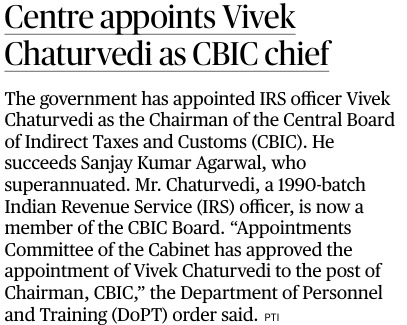
Centre appoints Vivek Chaturvedi as CBIC chief
Context
- The government has appointed Vivek Chaturvedi as the new Chairman of the Central Board of Indirect Taxes and Customs (CBIC), succeeding Sanjay Kumar Agarwal who superannuated.
- The appointment has been approved by the Appointments Committee of the Cabinet (ACC).
Key Points 1. Appointment details
- Post: Chairman, Central Board of Indirect Taxes and Customs (CBIC).
- Appointing authority: Appointments Committee of the Cabinet (ACC).
- Reason for vacancy: Superannuation of former Chairman Sanjay Kumar Agarwal.
2. Significance of the CBIC Chairperson - Heads India’s apex body for indirect tax administration, including:
- Customs
- Central Excise
- Central Goods and Services Tax (CGST)
- Integrated GST (IGST)
- Plays a key role in:
- Policy formulation for levy and collection of indirect taxes.
- Implementation of GST and customs laws across the country.
- Anti-smuggling and enforcement functions under customs and related laws.
3. Central Board of Indirect Taxes and Customs (CBIC) - Earlier name: Central Board of Excise and Customs (CBEC).
- Statutory basis: One of the Boards constituted under the Central Boards of Revenue Act, 1963.
- Location in government: Apex body under the Department of Revenue, Ministry of Finance for administering indirect taxes in India.
- Main functions:
- Formulation of policy concerning levy and collection of Customs, Central Excise, CGST and IGST.
- Prevention of smuggling and administration of matters related to Customs, Central Excise, CGST, IGST and certain narcotics within its purview.
- Acts as the administrative authority for subordinate organizations such as:
- Custom Houses
- Central Excise and Central GST Commissionerates
- Central Revenues Control Laboratory (CRCL)
- Composition: Headed by a Chairman with six Members in addition to the Chairman.
UPSC Prelims Practice Question Q. Consider the following statements regarding the Central Board of Indirect Taxes and Customs (CBIC): 1. CBIC is constituted under the Central Boards of Revenue Act, 1963. 2. It is the apex body for the administration of Customs, Central Excise, GST and IGST in India. 3. The CBIC is headed by a Chairman and has six Members in addition to the Chairman. Which of the statements given above is/are correct? A. 1 and 2 only
B. 2 and 3 only
C. 1 and 3 only
D. 1, 2 and 3
Answer: D
Constitution evolving to ‘swadeshi’, says Presidential Reference Bench
Context
Key Points 1. Meaning of ‘Swadeshi’ Constitution
- The Bench noted that the Constitution’s interpretation is continuously shedding colonial vestiges.
- The Supreme Court has evolved a vibrant, Indianised foundation, drawing from domestic needs and indigenous values.
2. Judicial shift away from foreign legal dependence - The Bench’s opinion did not rely on foreign case law, signalling confidence in Indian jurisprudence.
- Supports the idea of building a unique Indian legal system rooted in historical, cultural, and societal realities.
- Former CJI P.N. Bhagwati earlier said that India no longer needs the “crutches of a foreign legal order.”
3. Longstanding debate on ‘Indianisation’ of the legal system - Several CJIs, including N.V. Ramana and S.A. Bobde, have advocated Indianisation to make laws more accessible to the poor and culturally compatible.
- Chief Justice Ramana highlighted the need for courts to consider the practical realities of Indian society (e.g., litigants from rural areas).
4. Use of ancient Indian texts in constitutional reasoning - Courts, in some landmark judgments, have relied on ancient Indian literature:
- Examples include references from Manusmriti in privacy jurisprudence.
- Adultery decriminalisation and Sabarimala cases also referred to historical traditions and texts.
- Emphasis on tapping India’s own intellectual and legal heritage.
5. Broader implications - The shift aligns with the idea of decolonising the legal system, reducing overdependence on Western precedents.
- Encourages jurisprudence reflecting India’s social diversity, cultural ethos, and lived realities.
Additional Information Indian Constitution - Draws from multiple global sources, but its interpretation has gradually adapted to Indian conditions, making it contextually unique.
The Supreme Court’s evolution of doctrines like
basic structure, constitutional morality, and
transformative constitutionalism reflects this indigenous character.
CSIR-NAL unveils production version of Hansa-3 plane
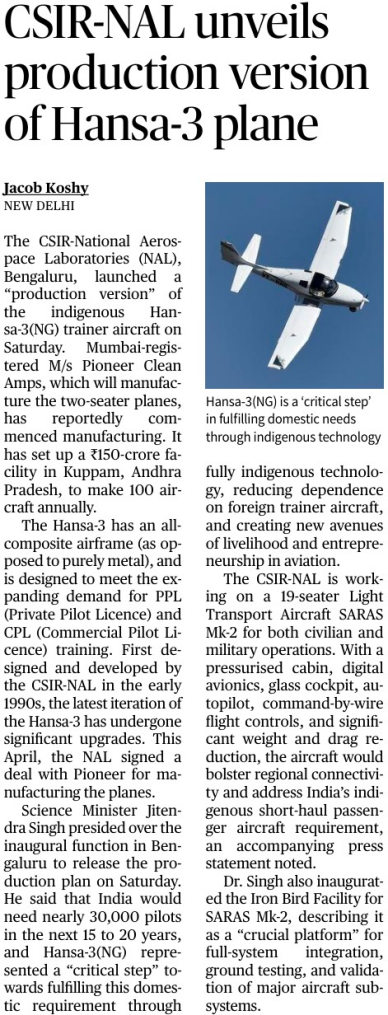
Context
- CSIR–National Aerospace Laboratories (NAL) has launched the production version of the indigenous Hansa-3(NG) trainer aircraft.
- Pioneer Clean Amps has begun manufacturing the aircraft at its new facility in Kuppam, Andhra Pradesh.
Key Points 1. Launch of Production Version
- CSIR-NAL unveiled the Hansa-3(NG) production model in Bengaluru.
- Manufacturing partner: Pioneer Clean Amps, Mumbai-registered company.
- Production facility: ₹150-crore unit in Kuppam, Andhra Pradesh, with capacity to produce 100 aircraft per year.
2. Features of Hansa-3(NG) - Fully indigenous two-seater trainer aircraft.
- Made with an all-composite airframe (lighter and more durable).
- Designed to meet rising demand for:
- PPL – Private Pilot Licence training
- CPL – Commercial Pilot Licence training
- Represents a critical step in reducing dependence on foreign trainer aircraft.
- Enables new avenues for livelihood and entrepreneurship in aviation.
3. Development Background - Hansa aircraft was first developed by CSIR-NAL in the early 1990s.
- The Hansa-3(NG) is a significantly upgraded version.
- In April, NAL signed a deal with Pioneer to manufacture the aircraft.
4. India’s Pilot Requirement - Science Minister Jitendra Singh stated India will need 30,000 pilots in the next 15–20 years.
- Hansa-3(NG) will help bridge the acute shortage of training aircraft in the country.
5. Other CSIR-NAL Projects - Working on SARAS Mk-2, a 19-seater Light Transport Aircraft for civilian and military use.
- Key features of SARAS Mk-2:
- Pressurised cabin
- Digital avionics and glass cockpit
- Autopilot
- Fly-by-wire controls
- Reduced weight and drag
- Expected to improve regional connectivity and meet India’s indigenous short-haul passenger aircraft need.
- Iron Bird Facility for SARAS Mk-2 inaugurated for full-system integration and testing.
Additional Information CSIR–National Aerospace Laboratories (NAL) - Premier civil aviation R&D institution under Council of Scientific and Industrial Research (CSIR).
- Focus: aerospace technologies, indigenous aircraft development, advanced materials, avionics, and systems integration.
- Key contributions include Hansa, SARAS, and aerospace composites.
UPSC Prelims Practice Question Q. With reference to the Hansa-3(NG) aircraft, consider the following
statements:
1. It is an entirely indigenous trainer aircraft developed by CSIR-NAL.
2. It uses an all-composite airframe.
3. It is designed exclusively for military pilot training.
Which of the statements given above is/are correct?
A. 1 and 2 only
B. 2 and 3 only
C. 1 and 3 only
D. 1, 2 and 3
Answer: A
Why has Goa been asked to set up a tiger reserve?
Context
- The Central Empowered Committee (CEC) of the Supreme Court has recommended a phased establishment of a tiger reserve in Goa.
- The move follows directions of the Bombay High Court and long-standing concerns over tiger protection in the State.
Key Points 1. What prompted the CEC’s involvement?
- In July 2023, the Bombay High Court ordered Goa to notify five protected areas as a tiger reserve, including:
- Mhadei Wildlife Sanctuary
- Bhagwan Mahavir Wildlife Sanctuary
- Bhagwan Mahavir National Park
- Netravali Wildlife Sanctuary
- Cotigao Wildlife Sanctuary
- The Court also asked the State to prepare a Tiger Conservation Plan and examine the rights of Scheduled Tribes and forest dwellers.
- The order followed a petition highlighting the poisoning deaths of a tigress and her cubs in 2020 in the Mhadei Sanctuary.
- In 2016, the National Tiger Conservation Authority (NTCA) had already recommended declaring these areas as a tiger reserve.
2. How did the Goa government respond? - Goa filed a Special Leave Petition in the Supreme Court opposing the tiger reserve.
- Initially claimed:
- Only 1,724 households in 33 villages would be affected (~5,000–6,000 people).
- No resident tiger population in Goa; only “transient” tigers.
- Later submissions contradicted this, as earlier State reports indicated resident tigers, not just visitors.
- CEC noted that Goa’s forests form a contiguous tiger landscape with Karnataka and Maharashtra.
3. What did the CEC recommend? - Suggested a phased declaration to minimise displacement and disturbance:
- Core area: Protected areas directly contiguous with the Kali Tiger Reserve (Karnataka), which already hosts a permanent tiger population.
- Buffer area: Surrounding wildlife sanctuaries with lower human habitation.
- Core zone to include:
- Netravali WLS (50 households)
- Cotigao WLS (41 households)
- Total core area: ~296 sq. km
- Buffer zone to include minimally inhabited parts of:
- Kali Tiger Reserve adjoining areas
- Northern Bhagwan Mahavir WLS
- Bhagwan Mahavir National Park
- Purpose: Improve landscape-level ecological connectivity.
4. Why does it matter? - Declaring a tiger reserve increases:
- Funding from the Centre
- Protection measures
- Conservation priority
- Tiger reserves have core and buffer zones:
- Core: Inviolate areas for tiger conservation; human presence restricted.
- Buffer: Integration of conservation with local livelihoods; habitation allowed but regulated.
- Key challenge: Relocation of households, often leading to local resistance.
Additional Information Tiger Reserves in India - Declared under Wildlife Protection Act, 1972, Section 38V.
- Managed under Project Tiger, launched in 1973.
- India currently has over 50 tiger reserves, forming part of the world’s largest tiger conservation network.
Crisil raises GDP growth forecast to 7% in FY26
Context
- Rating agency Crisil has revised India’s GDP growth forecast for FY26 upward from 6.5% to 7%, driven by stronger-than-expected growth in the first half of the financial year.
Key Points 1. Reason for Upward Revision
- India recorded 8% growth in the first half of FY26, exceeding expectations.
- Real GDP growth in Q2 was 8.2%, driven primarily by private consumption.
2. Impact of Easing Inflation - Although real growth was high, nominal GDP growth was relatively modest at 8.7%, due to lower inflation.
- Lower inflation has reduced the difference between real and nominal GDP growth rates.
3. Key Driver of Growth - Crisil notes that private consumption—especially urban consumption—has been the main contributor to real GDP performance.
4. Broader Economic Implications - Higher GDP growth forecast indicates:
- Continued economic resilience
- Strong domestic demand
- Improved macroeconomic stability due to easing prices
- However, monitoring rural demand and global economic trends remains important.
Rajasthan revokes controversial order after drawing flak Context - The Rajasthan government revoked an order directing all schools in the state to observe December 6 as Shaurya Diwas (Victory Day), marking the demolition of the Babri Masjid in 1992.
- The order faced strong opposition from Muslim groups and the Opposition parties, leading to its recall.
Key Points 1. Details of the Controversial Order - Released via an official WhatsApp group, the order instructed all schools to commemorate December 6 as Shaurya Diwas.
- Schools were directed to organize cultural programs aimed at promoting patriotism.
- Proposed activities included:
- Essay competitions on Indian cultural pride, the Ram Mandir movement, and youth’s role in nation-building.
- Painting contests focused on Ayodhya Ram Mandir and Indian warriors.
- Exhibitions on the Ram temple and Indian traditions.
2. Reasons for Recall - The order was met with backlash from various sections of society, particularly Muslim groups and Opposition parties.
- The government cited “unavoidable circumstances” as the reason for withdrawing the directive.
- Director of the Board of Secondary Education, Sitaram Jat, clarified that no official directions were issued to the schools.
3. Reactions to the Order - Opposition parties accused the government of trying to politicize education and undermine secularism.
- The directive’s association with the Babri Masjid demolition led to tensions, especially in the context of religious sensitivity in the state.
4. Clarification from the Government - The government retracted the order after it stirred significant controversy.
- It stated that the order would not be enforced in schools, dispelling rumors circulating via the WhatsApp group.
Additional Information Shaurya Diwas and Babri Masjid - December 6 marks the day when the Babri Masjid in Ayodhya was demolished by a large group of Hindu activists, sparking widespread communal tensions.
- The demolition led to significant political and social implications across the country, particularly impacting Hindu-Muslim relations.
Centre’s citizenship scrutiny power is ‘limited’, EC says
Context
- The Election Commission (EC) of India has clarified its authority over citizenship scrutiny for electoral purposes, asserting that its powers are limited to assessing citizenship for voter registration in the electoral rolls, rather than determining the status of citizenship itself.
- The EC dismissed claims from the Opposition regarding exclusive Union government powers in citizenship scrutiny.
Key Points 1. Opposition's Claim and EC’s Response
- Opposition's Argument: The Opposition parties argued that only the Union government had the authority to scrutinize citizenship, particularly in the case of voluntary acquisition of foreign citizenship.
- EC’s Response: The Election Commission asserted that its authority to assess citizenship is limited to reviewing electoral rolls under the Representation of the People Act (ROPA), 1950, and that it does not extend to determining the status of citizenship itself.
- The EC emphasized that the Central government’s authority over citizenship is restricted to determining when and how an Indian citizen acquires foreign citizenship, as per Section 9 of the Citizenship Act, 1955.
2. Citizenship Scrutiny and the SIR (Special Intensive Revision) - SIR Exercise: The EC clarified that the Special Intensive Revision (SIR) is not a National Register of Citizens (NRC) exercise but a voter registration process to ensure the purity of electoral rolls.
- It rejected claims that the SIR was being misused for citizenship screening. The SIR exercise was meant to ensure that only Indian citizens are included in the electoral rolls, and that proof of citizenship was only sought for the purpose of voter registration under Article 326 of the Constitution.
3. The EC’s Constitutional Authority - Article 324: The EC asserted its power to oversee elections and maintain electoral rolls, which includes the authority to scrutinize the citizenship of voters, directly drawn from Article 324 of the Constitution.
- The Representation of the People Act (ROPA), 1950 lays down that voters must be Indian citizens and ordinarily resident in a constituency. It also stipulates that non-citizens cannot be included in the electoral rolls.
4. Implementation of the SIR Process - The SIR process was a voluntary and cooperative exercise, where citizens were required to sign their pre-filled forms.
- The commission rejected allegations that the process shifted the burden of verification onto citizens, saying that officials were responsible for verifying the eligibility of voters.
Additional Information Citizenship and the Election Commission - Citizenship Scrutiny: The EC’s power to assess citizenship is confined to ensuring the integrity of voter registration and electoral processes, as mandated under Article 324 and ROPA.
- The National Register of Citizens (NRC) and National Population Register (NPR) are separate exercises, which involve different legal frameworks and authorities.
UPSC Prelims Practice Question Q. Consider the following statements regarding the Election Commission's power to scrutinize citizenship:
1. The Election Commission has the authority to determine the status of citizenship in India.
2. The Special Intensive Revision (SIR) exercise is a part of the process to ensure the purity of the electoral rolls.
3. The SIR exercise was aimed at creating a National Register of Citizens (NRC).
Which of the statements given above is/are correct?
A. 2 only
B. 1 and 2 only
C. 2 and 3 only
D. 1, 2 and 3
Answer: A Explanation:
- Statement 1 is incorrect: The Election Commission does not have the authority to determine the status of citizenship.
- Statement 2 is correct: The SIR exercise is aimed at ensuring purity of electoral rolls.
- Statement 3 is incorrect: The SIR is not a NRC process but related to voter registration.
National Mission for Mentoring
Syllabus: GS Paper 2 – Education, Governance & Teacher Development Context
- The UGC has recently asked all Higher Educational Institutions to nominate experienced faculty as mentors under the National Mission for Mentoring (NMM).
- This initiative operationalises NEP 2020’s focus on strengthening teacher development through structured mentoring.
Key Points - Nodal Ministry: Department of School Education & Literacy, Ministry of Education.
- Policy Alignment: Based on NEP 2020, emphasising continuous professional development of teachers.
- Objective: Creates a platform where Mentors guide Mentee teachers by sharing knowledge, skills and classroom expertise.
- Launch: Started on 29 July 2022 as a pilot in 30 Central Schools (15 KVs, 10 JNVs, 5 CBSE schools).
- Aim: Builds a supportive mentoring ecosystem to enhance teacher effectiveness and promote overall professional growth.
- Design Agency: NCTE is responsible for developing and designing the mission’s modalities.
- NMM – The Blue Book: NCTE has released a detailed framework and implementation roadmap for the mission.
- Stakeholders:
- Mentor – expert guiding teachers
- Mentee – teacher receiving mentorship
- Nodal officers/administration – coordinating the process
- Pilot Implementation: Engaged 60 mentors, including Padma Awardees, for mentoring in selected central schools.
- Capacity Building: Workshops and seminars are organised to train Master Mentors, who further train other mentors.
- Incentives: Participation is voluntary, but the mission offers certificates, performance credits and recognition to encourage engagement.
- Implementation Support: A digital platform is provided for conducting mentoring sessions across locations.
Source: The Hindu
Indian Pharmacopoeia Commission
Syllabus: GS Paper 2 –
Health, Regulatory Bodies & Drug Standards Context - The Indian Pharmacopoeia Commission (IPC) has signed three MoUs with the Nagaland Medical Council, Nagaland State Drugs Control Administration (NSDCA) and the Nagaland State Pharmacy Council.
- The collaboration aims to strengthen drug quality standards and promote safe, effective medicines in the state.
Key Points - Status: IPC is an autonomous institution under the Ministry of Health & Family Welfare.
- Mandate: Established to set standards for drugs across India to ensure safety, quality and efficacy.
- Core Function: Regularly updates drug standards, especially for medicines used in treating prevalent diseases.
- Official Publications: Issues the Indian Pharmacopoeia (IP), which contains new and updated monographs to improve medicine quality.
- Generic Promotion: Publishes the National Formulary of India to encourage the rational use of generic medicines.
- Standards Prescribed: Sets norms for identity, purity and strength of drugs essential for human and animal health.
- Reference Substances: Provides IP Reference Substances (IPRS), used as a standard “fingerprint” to verify identity and purity of drugs as per IP.
- Pharmacopoeia Meaning: It is an official compendium of drug quality standards for medicines imported, manufactured, stocked or distributed in India.
Source: PIB
National Coral Reef Research Institute (NCRRI)
Syllabus: GS Paper 3 –
Environment, Biodiversity & Climate Change Context - India will soon inaugurate the National Coral Reef Research Institute (NCRRI) in the Andaman & Nicobar Islands to strengthen marine conservation.
- The institute aims to expand scientific understanding of coral ecosystems and improve national capacity for climate resilience.
Key Points - Location & Cost: Being set up at Chidiyatapu, South Andaman with an estimated cost of ₹120 crore.
- Nodal Role: Will function as the national hub for coral reef research, monitoring and ecosystem management.
- Supervising Ministry: Operated under the Ministry of Environment, Forest and Climate Change (MoEFCC).
- Research Focus: Provides advanced facilities for marine biodiversity studies, reef restoration, and climate impact assessment.
- Climate Resilience: Coral reefs act as natural wave barriers, reducing coastal storm impacts; strengthening reefs is vital in the context of sea-level rise and warming oceans.
- Public Engagement: The Zoological Survey of India (ZSI) will use QR codes in the Sri Vijay Puram museum for easy digital access to species information.
- Biodiversity Significance: Andaman & Nicobar Islands are one of India’s four biodiversity hotspots, home to diverse indigenous and migratory species.
- Citizen Involvement: Public participation in biodiversity documentation, including naming newly discovered species, is being actively encouraged.
Source: The Hindu
World Telecommunication Development Conference 2025 – Baku
Syllabus: GS Paper 2 – International Relations, ICT & Global Governance Context
- The World Telecommunication Development Conference (WTDC) 2025 concluded in Baku with strong global participation.
- The conference, held every four years, finalised the international strategic roadmap for global telecom development.
Key Points - Scale of Participation: Over 2,300 delegates, including ministers, policymakers and industry leaders, attended the conference.
- India’s Representation: India participated at a high level, led by the Union Minister of State for Communications and Rural Development.
- Leadership Roles: India served as Conference Vice-Chair and took lead roles in coordination, innovation and study group activities.
- Global Engagement: India held multiple bilateral meetings and ministerial dialogues, reinforcing digital partnerships worldwide.
- Focus on Connectivity: India highlighted its vision of universal connectivity and sustainable digital transformation.
- Resolution 85: India pushed to extend smart sustainable city frameworks to rural areas, promoting inclusive digital growth.
- Resolutions 89 & 90: Strengthened innovation ecosystems, support for local innovators, and development of emerging technologies.
- Digital Inclusion: India backed global actions to expand meaningful connectivity, capacity-building and public–private collaboration.
Source: The Hindu
Prerona Scheme – Assam
Syllabus: GS Paper 2 – Education, Social Welfare & Government Schemes
Context
- Assam has launched a monthly financial support initiative for Class 10 students to help them prepare for board examinations with reduced financial stress.
- The scheme aims to improve academic focus and ensure essential study needs during the pre-exam period.
Key Points - Benefit Amount: Provides ₹300 per month to every Class 10 student in Assam until the completion of board exams.
- Purpose: Helps students buy study materials and maintain minimum nutrition during preparation.
- Universal Coverage: Applies to all students appearing for the High School Leaving Certificate (HSLC) exam under the state board.
- CBSE Inclusion: Also covers Assam residents studying in CBSE-affiliated Adarsha Vidyalayas in Class 10.
- No Income Criteria: Assistance is universal, ensuring equal financial support for all eligible learners.
- Reducing Inequality: Aims to support students from low-income households, reducing educational disparities.
- Reducing Dropouts: Expected outcomes include lower dropout rates, better exam performance, and higher enrolment in government/provincialised schools.
- Learning Continuity: Designed to ensure uninterrupted learning by easing financial burdens during a demanding academic phase.
Source: The Hindu
Asia Power Index 2025
Syllabus: GS Paper 2 – International Relations & Global Indices Context
- India has ranked third in the Asia Power Index 2025, behind the United States and China.
- The Lowy Institute report highlights India’s rising regional influence driven by stronger economic performance, military capability and diplomatic outreach.
Key Points - Publishing Body: Released by Lowy Institute, Australia.
- Coverage: The 7th edition evaluates 27 countries/territories using 131 indicators across eight key areas.
- Key Areas Assessed: Military Capability, Economic Capability, Defence Networks, Diplomatic Influence, Cultural Influence, Resilience and Future Resources.
- India’s Rank: India placed 3rd, marking its highest position so far in the Index.
- Score: Secured 40/100, a 2% improvement from previous years.
- Category Upgrade: India is classified asa “major power” for the first time.
- Factors Behind Rise: Strong post-pandemic economic recovery, expanding geopolitical relevance, improved connectivity, leverage, and technology capacity.
- Global Comparison:
- US: Ranks 1st with a score of 81.7.
- China: Ranks 2nd with 73.7, continuing to narrow the gap with the US.
- Regional Comparison: India stays far ahead of peers in South and Southeast Asia, though the gap with China remains significant.
- Other Shifts: Russia shows renewed momentum due to closer ties with China and North Korea; Japan, Australia and ASEAN nations show mixed changes.
Source: The Hindu

 Launch your Graphy